Published online November 20, 2013 (http://www.sciencepublishinggroup.com/j/ijber) doi: 10.11648/j.ijber.20130206.14
Impact of micro finance: perceptions of direct
stakeholders of self help groups
Sanjay Kanti Das
1, *, Amalesh Bhowal
21Head, Department of Commerce, Lumding College, Lumding, Nagaon, Assam-782447, India 2Dept. of Commerce, Assam University, Diphu Campus, Assam-782462, India
Email address:
[email protected](S. K. Das), [email protected](A. Bhowal)
To cite this article:
Sanjay Kanti Das, Amalesh Bhowal. Impact of Micro Finance: Perceptions of Direct Stakeholders of Self Help Groups. International Journal of Business and Economics Research. Vol. 2, No. 6, 2013, pp. 142-157. doi: 10.11648/j.ijber.20130206.14
Abstract:
Self Help Group is a unique innovation of credit delivery technique and has produced positive impacts on two vital areas of national development, alleviation of poverty and women’s empowerment. Sixty five variables relating to impact of SHGs on members are identified from survey of literature and relevant perception of direct stakeholders whether the aspects like impact on members of SHG and its involvement in larger social issues should be peripheral or core components of quality indicators of SHG is perceived in this study. The study is conducted by using multi-stage random sampling method to collect primary data from the selected Development Blocks of Nagaon districts of Assam (India). It is observed that there was no significant effect of stakeholders on overall score on impact on members of SHG as Peripheral or Core issue. It is observed that different stakeholders believed that the impact on members of SHG and its involvement in larger social issues should be ‘somewhat core component’ as the mean value lies in between the scale range of 1 & 0 which represents the range of ‘somewhat core component’. It is further observed that Financial Institutions are less concerned about the social issues while Donor’s are more concerned about the social issues.Keywords:
Assam, Core Component, Direct Stakeholders, Peripheral Components, Psychometrics, Impact on Members,Self Help Group
1. Introduction
The Millennium Development Goal (MDG) emphasises three strategic objectives of strengthening the capacity of the rural poor and their organisations, improving equitable access to productive natural resources and technology and increasing access to financial services and markets in order to achieve poverty reduction [59; 79]. Institution building is now recognised as vital for poverty reduction across the world [72]. To enhance international development, the United Nations Organisation (UNO) announced the MDGs which aimed to eradicate poverty by 2015. Governments,
donors and NGOs around the world responded
enthusiastically with plans and promised to work together towards the realisation of these goals. In the recognition of micro finance, the UNO celebrated the year 2005 as a year of micro credit, as a result this financing instrument is perceived worldwide as a very effective mean against hunger and poverty, mainly in developing countries [84].
The microcredit programme through Self Help Group (hence forth SHG) is a unique innovation of credit delivery
Micro Credit Summit [86] also reported micro finance and its relevant programmes is the most sensational anti-poverty tool for the poorest, especially for women. It has been quite well recognised that micro finance smoothens consumption, reduces the vulnerability of the poor and leads to increase in their income. By giving the world’s poor a hand up, micro finance can help to break the vicious cycle of poverty in as little as a single generation [77].
Micro finance programme like SBLP, SGSY or MFI linkage have a positive impact on both economic and social empowerment on the women members along with reduction in poverty. The relevance of SHGs as powerful instruments of social, political and economic empowerment of women has also been unanimously accepted by researchers [10, 60, 130]. A lot of researchers have also
showed their negative experiences on micro finance [116].
Thus, from literature reviews of empirical research on the impact of micro finance on the poor found controversial (and inconclusive) findings.
• A lot of literature on impact of micro finance and
SHGs on members are reviewed and these can be broadly classified as under [78].
• A lot of studies experienced beneficial
socio-economic impact of micro finance and SHGs on members, such as income stability and growth, reduced income inequality, reduced vulnerability, employment, nutrition and health improvements, school attendance, strengthened social networks, and women’s empowerment [4, 15, 16, 19, 50, 51, 70, 127, 138, 140].
• A lot of studies expressed mixed impact of micro
finance and SHGs on members. For example, benefits for the poor but not for the poorest [33, 52, 91, 93, 134, 142]; or helping the poor to better manage the money they have [120] but not directly or sufficiently increasing income, empowering women, etc. [81, 56, 113]; or supporting large labour-intensive industries for job creation [67, 75].
• A lot of studies reported negative impact of micro
finance and SHGs on members, such as the exploitation of women, unchanged poverty levels, increased income inequality, increased workloads, high interest rates and loan repayment, creating dependencies, and creating barriers to sustainable local economic and social development [2, 18, 24, 32, 47, 64, 119].
Further, despite the apparent success and popularity of micro finance, no clear evidence yet exists that micro finance programme have positive impacts [12, 13]. Four major reviews as cited in Stewart et al., 2010 [133] examining impacts of micro finance [42, 48, 104, 105, 128] concluded that while anecdotes and other inspiring stories [137] purported to show that micro finance can make a real difference in the lives of those served, rigorous quantitative evidence on the nature, magnitude and balance of micro finance impact is still scarce and inconclusive [12, 13]. Overall, it is widely acknowledged that no well-known
study robustly shows any strong impacts of micro finance [12]. A series of studies have been raised serious doubts about the effectiveness of micro finance programmes among the most vulnerable sections of the society [8, 30, 54, 61, 62, 88, 131]. These studies have pointed that inflexibly and non-negotiable repayment systems are found to be too hard for the poorest sections which many at times compel them to sell their assets to meet the deadlines of their contribution and repayment [131]. The stringency of repayment rules has a series of negative implications for the poor members. A number of studies have pointed out that micro finance members are quite often completed to depend on informal credit sources and money lenders for the timely repayment of loans [6, 114]. The impact of peer pressure and possibility of negative social sanction on the defaulted members and the resultant straining of relationships have been amply demonstrated by the scholars [89, 90, 139]. In the latter half of 2010 the micro finance industry made news for negative reasons. By October of that year regulation of the micro finance industry through the Micro Finance Institutions Ordinance, 2010 in Andhra Pradesh, India elicited much debate. The concerns of this ordinance were high interest rates of between 27% and 30% charged by MFIs, the practice of multiple lending, splitting self help groups to form joint liability groups, and coercive collection tactics that were blamed for the suicides by borrowers [69, 117].
Thus, Micro-finance has created considerable thrust and expectations among the academics, policy makers of the Government, NGO leaders, donors, investors and other development practitioners in all over the world. In essence, micro-finance has produced positive impacts on three vital areas of national development - alleviation of poverty, social development and women’s empowerment. A lot of research persuaded to access the impacts of SHGs on members on different sphere like economic, social, and other aspects. One modest effort has been initiated by Sa-Dhan, 2003 [122] in preparing and publishing a discussion paper on ‘Quality Parameters of SHGs’, wherein a lot of issues sets out in the quality assessment of SHGs. Moreover, the paper also set out some unresolved key issues for further discussion and research. Thus, the present study is limited to one of the unresolved issues of quality assessment of SHGs as raised by Sa-Dhan.
2. Impact of Self Help Group on
Members in India: A Review
It is fairly clear from the literature as reported above that the state of impact assessment in micro finance, more specifically community organisations such as SHGs is still undeveloped in general and very nascent stage in India. A lot of micro level studies were conducted so far in India on impact of SHGs on members. However, all these studies are confined to one or more of the followings facts.
in many studies that primary benefits of participation in SHG is the opportunity to save regularly, access formal savings institutions and participate in the management of these savings [22, 43, 83, 97, 99, 112, 125, 141].
Access to credit: A corollary of participation in SHGs is an improvement in a woman’s access to credit. The financial mobility due to participation in the SHG has led to an improvement in the quality of life, according to some of the successful groups. Overall, many families were able to address their basic needs better than before which is also reported in many studies [22, 99, 125, 141].
Employment: The implementation of SHG has
generated self-employment opportunities by
establishing own income generating units. The programme helped many participants in improving their economic conditions [20, 22, 124].
Decision-making within the household: It is also reported in many studies that the impact of the SHG programme increased involvement in household decision-making. Researcher observed that there is a change in the attitude of male members of the
families, especially in children education,
schoolings decisions, sanitation etc. [65, 71, 80, 96, 99, 109, 111, 125, 130].
Participation in local government: Involvement in SHG has resulted further involvement in the democratic set up either in the SHG leadership or in participation in local bodies. These impacts of SHGs are also refereed in many studies [1, 38,106]. Communication level of members: Micro finance movement is having a good impact on members, in their ability to express their feelings and has made people more confident to express themselves [31, 80, 99, 125, 109].
Self confidence among members: The group formation brought out the hidden talent and leadership qualities among the members. Therefore, it can be concluded that after joining the SHG the members have improved their status in family, skill and feel confident in establishing economic units. They now feel confident in consultation with government, non-government and bank officials these things. Members generally, got lesser opportunity to interact with bankers, Government officials, NGOs and others in the Pre-SHG period. Involvement confidence to interact with the officials. Such interaction helped them to articulate their problems and improved their self-confidence [5, 25, 31, 80, 107, 118].
Change in family violence: Involvement with SHG has reduced domestic violence which was also reported in research studies [21].
Status of access to amenities: Since SHG
programme has economic as well social
implications. It can be seen that there has been an
increase in standard of living in terms of their status of access to amenities factors. It is reported that after joining the SHG the members have improved in getting access to amenities like medical, sanitation, education, market, water supply, transport [31, 96, 132].
Community participation: SHG members undertook a lot of community activities. They participated in several social & community development initiatives and other social welfare programmes. Involvement in such programmes resulted interaction with experts has resulted in building congenial relationships and has ensured fewer conflicts. It has also had the multiplier effect of spreading the SHG movement. Awareness of health related issues, personal hygiene, communicable diseases; effects
of malnutrition, environmental issues, and
sanitation have also increased as a result of training programmes and their participation in the related projects. They also organises a lot of community development events which are also observed by many researcher [28, 31, 96, 111].
Increased nutritional status: Researcher also observed positive impacts on nutritional intake of the family members of SHGs [36, 41, 87].
Disseminating social awareness: Members of SHGs spread social awareness among people of their locality and villages. They make people aware of their social rights & responsibilities. Involvement in SHGs by the women have positive influence on achieving lower child mortality, improved maternal
health, better nutrition, housing & health [96].
SHGs and environmental management: Research and policy has tended to focus on the relationship between poverty and environmental degradation in terms of pointing out that the poor are both victims
and agents of environmental degradation.
Involvement of SHG members in development programmes through SHGs can effectively increase awareness of society to ward environmental sustainability.
Improving the efficiency of credit system: The SHG helps the vulnerable sections of the society to meet their credit requirements that cannot be possible through formal banking system. Further, by providing large scale micro credit, it reduces the costs of credit delivery and improves the efficiency of credit system.
Providing channels to financial inclusion: Financial inclusion aims at providing easy credit at affordable costs to the vulnerable sections of the society. SHGs are an important tool in financial inclusion. Moreover, through SHGs funds are provided mostly to socially and economically backward people like BPL, SC, ST and rural women etc.
Promoting savings & banking habits: A large number of poor, rural populations do not have access to banks. SHGs motivate these people to save by explaining to members the benefits derived from such savings. These savings are pooled together and the funds so created are deposited in the banks.
Improving living conditions: One of the main aim of SHGs is reduction of poverty in rural in rural areas. The provision of micro credit leads to self employment in the rural areas and help reduction in poverty. This improves the living conditions of the
people. Moreover, membership in SHGs enabling
poor households to achieve better school attendance and lower dropout rates of their kids.
Developing individual skills of group members: The rural people are not very educated or skilled. While working as members of SHGs, they develop various skills and acquire knowledge on various subjects like record keeping, credibility, effective problem solving, team work, leadership etc. Reducing influences of unorganised sectors: SHGs provide bank supported credit to its members. This reduces the influences of the unorganized sector of money market who charge exorbitant rate of interest, on the credit provided to the people.
3. Operationalising the Concepts
Impact assessment is a management mechanism aimed at measuring the effects of projects on the intended beneficiaries. The rationale is to ascertain whether the resources invested produce the expected level of output and benefits as well as contribute to the mission of the organisation that makes the investments. An almost infinite array of variables can be identified to assess impacts on different units. To be of use these must be able to be defined with precision and must be measurable. Conventionally, economic indicators have dominated
micro-finance impact assessments with assessors
particularly keen to measure changes in income despite the enormous problems. Other popular variables have been levels and patterns of expenditure, consumption and assets.
As the ‘social’ sphere of impact is the focal point of this research, it is pertinent to have a very clear understanding of how the term is perceived in development research and academic circles and how it will be connoted in this study.
Neubert, 2000 [101] describes it as ‘concerning the order of
human society’, by referring to it as a concept that pertains
to the relationship between individuals, between
individuals and groups, and between groups within a society. Variables of social impact refers to measurable changes to the human population, communities and social relationships resulting from development initiatives instigated by third sector organisations- NGOs or MFIs. Broadly speaking, these variables pertain predominantly to indicators proposed by various institutions in an attempt to
set forth a standardised and measurable set of indices that determine human well-being in a society. The social indicators that became popular in the early 1980s (e.g. educational status, access to health services, nutritional levels, anthropometric measures and contraceptive use etc.) have recently been extended into the socio-political arena in an attempt to assess whether micro finance can promote empowerment [47, 49, 82, 126]. Social impact by means of micro financing activities and its evaluation can be best understood by means of a standard model. But there are no well acceptable model so far developed to access social impact [45]. The Annual Human Development Report [55] published by the United Nations Development Programme (UNDP) makes use of a number of such indicators that attempt to portray, amongst other aspects, the social well-being of people around the world [55] viz, the Human Development Index (HDI), Gender-related Development Index (GDI), the Gender Empowerment Measure (GEM), the Quality-of-Life Index (QLI), the Economist Intelligence Unit (EIU) etc. In 2003, the foundation Argidus, the CERISE (2000) and several European researchers had developed the initiative Social Performance Indicators [63]. It is conceived like an instrument of analysis, which can stimulate the internal reflection on the MFI or between its managers and their stakeholders as for the social objectives and the realisations and perspectives of the institution. The Consultative Group to Assist the Poor (CGAP) rates the social performance of MFIs, from the main five dimensions of the Millennium Development Goals: i) Proportion of clients below the line of the poverty; ii) Improvement of the savings of the clients; iii) Improvement of the presence in the school of the children and reduction of the illiteracy; iv) Improvement on the access to the services of health; and v) Progress in terms of women empowerment. Further, the
Inter-organisational Committee on Guidelines and
Principles for Social Assessment, 1994 [46] presents an all-encompassing description of Social Impact Assessment [58] and suggests that cultural impacts also constitute an important element while assessing social impacts.
Further, here in this research study the words ‘core components’ refers as the heart or inner part of social impact facilitated by the SHG members. It is considered as the central part of issues of social impact that often enjoys by SHGs. On the other hand, ‘Peripheral Component' means on the outer part of something. Its meaning, so far as technology/ issues are concerned, is the same. Since the study access the perceptions of the direct stakeholders of SHGs regarding the issue whether impact on members of SHGs and its involvement in large social issues is Peripheral components of quality indicators or not, hence all social impact issues that may impact the SHG members are incorporated in the research study.
programme. Reviews of literature were also made to find out suitable indicators on the impact of SHG on both social and economic sphere that were used by different researcher and also to be considered for the present study [11, 14, 16, 17, 23, 27, 35, 37, 39, 53, 66, 68, 73, 80, 94, 94, 100, 109, 110, 107, 123]. Several researchers have reported that SHGS contribute in other areas of economic development
and growth such as poverty eradication, social
transformation and empowerment [9, 14, 29, 102, 135]. From the survey of literature cited above, sixty five statements on impacts- indicators relating to social issues are identified and included to study the perceptions of different stakeholders on SHG whether the aspects like impact on members of SHG and its involvement in larger social issues should be peripheral or core components of quality indicators of SHG (Figure 1).
4. Objective of the Study
The present study is pursued keeping in view the
following main objectives
a) To examine the opinion of the direct stakeholders
(viz. Promoters, Donors, Financial Institutions and the Group members) whether the aspects like impact on members of SHG and its involvement in larger social issues should be peripheral or core components of quality indicators of SHG.
b) To forward conclusion based on the findings of the
study.
5. Research Hypotheses
Given the survey of literature and objectives, the study is pursued to test the following statistical hypothesis:
Ho: There is no significant association in the opinion of the direct stakeholders (viz. Promoters, Donors, Financial Institutions and the Group members) of SHGs regarding the issue whether impact on members of SHGs and its involvement in large social issues be peripheral or core components of quality indicators.
Impact on Members of SHG
Ec
on
om
ic
(E
C)
Pa
rt
ic
ip
at
or
y
(P
A
)
Em po w er m en t (E M ) Sk ill D ev el op m en t (S D ) A cc es s to So ci al S er vi ce s (A S ) So ci a l ( SO ) Ps yc ho lo gi ca l (P S) Co m m un it y D ev el op m en t (C D )9 5 17 4 3 7 7 9
Ca pa ci ty B ui ld in g( CB ) 4 IMPC 12 IMPC 14 IMPC 15 IMPC 24 IMPC 25 IMPC 26 IMPC 27 IMPC 48 IMPC 63 IMPC 22 IMPC 39 IMPC 40 IMPC 55 IMPC 49
IMPC 2 IMPC 38 IMPC 11 IMPC 44 IMPC 3 IMPC 45 IMPC 23 IMPC 50 IMPC 28 IMPC 52 IMPC 31 IMPC 60 IMPC 32 IMPC 64 IMPC 33 IMPC 65 IMPC 34 IMPC 13 IMPC 17 IMPC 20 IMPC 30 IMPC 7 IMPC 57 IMPC 29 IMPC 4 IMPC 5 IMPC 6 IMPC 56 IMPC 53 IMPC 46 IMPC 54 IMPC 1 IMPC 8 IMPC 9 IMPC 10 IMPC 35 IMPC 36 IMPC 51 IMPC 37 IMPC 47 IMPC 61 IMPC 62 IMPC 16 IMPC 18 IMPC 59 IMPC 19 IMPC 21 IMPC 41 IMPC 42 IMPC 43 IMPC 58
Figure 1. Subscales for assessing Impact of SHG on Members- Core Issue vs. Peripheral Issues Source: Designed based on Survey of Literature
6. Methodology and Sample Design
The research design and methodology devised in this paper is being presented which has been designed keeping in mind the focused objectives and with the aim of acquiring accurate and authentic data. The methodology of research is descriptive in nature and empirical method is also applied to assess perceptions of direct stakeholders on the issue of SHGs as financial intermediaries. As the study adopted a descriptive study design; this design was crucial in capturing the socio-economic characteristic of the study groups such as demographics data, economic status, social benefits, and entrepreneurial activities. As explained by
Promoters including banks, NGOs, NGO-MFI, Farmers Club and Government Departments are also selected randomly who are directly associated with the sampled SHGs. In selecting the sample size earlier studies of researchers are duly considered [103]. Primary data was collected from the 100 sample respondents using pre-tested
questionnaire. Key information about SHGs and
stakeholders are collected from the office of the DRDA, Nagaon, Assam and SHGs which are existed above two years and involved in income generating actives are cover within the purview of study. The study was conducted during 2012. Secondary data was collected from report and journals. The important variables were formulated and the relevant data collected from the field were coded and analysed using SPSS (Statistical Package for Social Sciences) software. Perceptions of direct stakeholders whether SHG is a financial model were expressed based on 5 Point Scale where SA= Strongly Agree (2), A = Agree (1), NAND = Neither agree nor disagree (0), DA = Disagree (-1), and SDA = Strongly disagree (-2). Further, the data collected was analysed using the measure of descriptive statistics like mean, variance, standard deviation, maximum, minimum etc. Further, Cronbach alpha, Normality Test i.e. Kolmogorov- Smirnov Test, and ANOVA were applied in analysing and interpreting the data.
6.1. Profile of the Study Area
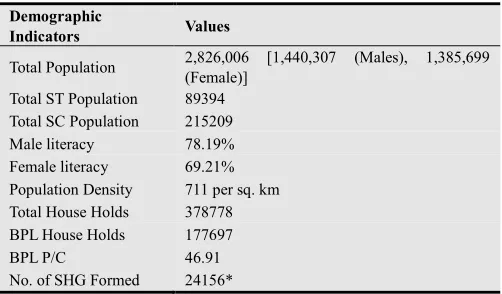
The Central Assam District of Nagaon (spelled by the British as Nowgong) is one of the largest districts of Assam. It sprawls across almost four thousand square kilometers of fertile alluvial plains and thickly forested hills. Nagaon extends from 250-45' to 260-45' North Latitude and 920-33'-6" East Longitude. The district is bounded by Sonitpur district and the river Brahmaputra in the north, West Karbi Anglong and North Cachar Hills in the south and East Karbi Anglong and Golaghat district in the east. The mighty river Brahmaputra flows along the northern periphery of the district. Other major tributaries meandering through the district such as Kolong, Kopili drain into the Brahmaputra. Lying at a distance of 123 kilometers by road from Guwahati, Nagaon town constitutes a vital corridor linking the Upper Assam districts of Golaghat, Jorhat, Sivasagar, Dibrugarh, Tinsukia and the North Assam districts of Sonitpur and North Lakhimpur. Nagaon has covered total area of 3,993 sq. km. The demographic profiles of the study district are briefed in Table 1.
The SHG linkage approach operating in the districts of Nagaon is to some extent similar with the state structure. While we undertook pilot survey at preliminary stage in order to examine whether all models exist in practice, we found NGO as MFIs and NGO as financial intermediary did not exist separately. Therefore, Model II A and Model II B have been clubbed together into a single category termed as Model II (NGO as Financial Intermediary). Further, three MFI and fifty four Farmer Clubs are also promoted SHGs in the district. Besides, there are five Cooperative
SHGs in the district of Nagaon (Micro Finance Status Report, NABARD 2010-11, and SLBC Report, March 2010).
Table 1. Demographic Profile of Nagaon District of Assam, India
Demographic
Indicators Values
Total Population 2,826,006 [1,440,307 (Males), 1,385,699
(Female)]
Total ST Population 89394
Total SC Population 215209
Male literacy 78.19%
Female literacy 69.21%
Population Density 711 per sq. km
Total House Holds 378778
BPL House Holds 177697
BPL P/C 46.91
No. of SHG Formed 24156*
*Upto March 2011
Source: Census Report 2011 and Microfinance Status Report, NABARD 2010-11
Further, the overall progress of SHGs under SHG-Bank linkage and MFI-Bank linkage in the study district are shown in the below Table 2.
To get rid from poverty and to increase in income are the main motivating factors to join SHGs & the process that lead to the formation of a SHG is at the desire of promoter to achieve the target-oriented approach of SHG promotion. In Nagaon district, SHGs are formed and organised under directly or the other umbrella programmes of the Government, NGOs, banks and sometimes, even by the people themselves.
6.2. Profile of the Respondents
agencies, including bilateral donors, foundations, multilateral development banks, and socially oriented private investors. While NABARD and RMK etc. remains a major donor to NGOs and SHG institutions in India and have been receiving a fraction of required funds for their development. In the study district, NABARD, State Government under SGSY and NGO-MFIs are the major donors of SHGs. In this study respondents belonging to Donor includes some officials of NGO-MFI such as ASOMI, Prochesta-MFI, RGVN-MFI, Dristi Foundation, RuTAG-NE, Srimanta Sankardeb Sangstha; Officials of
District Veterinary & Animal Husbandry, NABARD, NERCRMP, SIRD, Agriculture Departments etc. SHPIs include banks, NGOs, NGO-MFIs and state governments. Here in the state of Assam and even in the study district SHPIs acts both promoter and financier. However for the sake of convenience of study, we have collected perceived opinions of different stakeholders on different scale of capacity, i.e. bank is considered financier, promoter and donor. In this study respondents belonging form Financial Institutions includes Officials of nationalised commercial banks including SBI, RRBs i.e. AGVB etc.
Table 2. Progress of SHGs in Nagaon, Assam (As on 31st March 2011)
Promoter No. of SHG Formed No. of SHG taken up Economic activity No. of Women SHGs Formed
Total* Total Total
SGSY 20590 5592 12630
Asomi-MFI 24 15 22
Prochesta- MFI 64 35 37
RGVN- MFI 87 56 64
NGO-MFI
SK Human Welfare Assoc. 50 27 44
Gharoa** 50 28 38
Jana Chetana Samity Asom 62 24 48
Zeal Thrill Friend-ship
Group** 50 10 40
Gramya US 31 11 26
Bank *** 165 56 132
Farmer Club / SHG
as Cooperative society 258 123 168
Others including Govt. Depts. 2725 121 87
Total 24156 6098 13336
*Total since 1st April, 1999;**Promoted with Banks , ***Reported from SLBC Report, March 2010.
Source: Microfinance Status Report, NABARD 2010-11, and SLBC Report, March 2010
Table 3. Distribution of the Sample Respondents
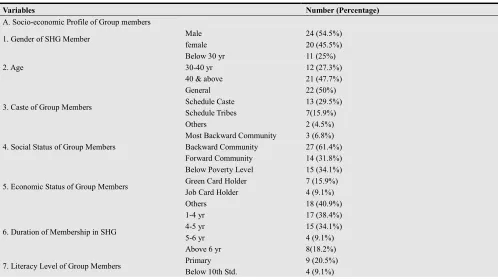
Variables Number (Percentage)
A. Socio-economic Profile of Group members
1. Gender of SHG Member Male 24 (54.5%)
female 20 (45.5%)
2. Age
Below 30 yr 11 (25%)
30-40 yr 12 (27.3%)
40 & above 21 (47.7%)
3. Caste of Group Members
General 22 (50%)
Schedule Caste 13 (29.5%)
Schedule Tribes 7(15.9%)
Others 2 (4.5%)
4. Social Status of Group Members
Most Backward Community 3 (6.8%)
Backward Community 27 (61.4%)
Forward Community 14 (31.8%)
5. Economic Status of Group Members
Below Poverty Level 15 (34.1%)
Green Card Holder 7 (15.9%)
Job Card Holder 4 (9.1%)
Others 18 (40.9%)
6. Duration of Membership in SHG
1-4 yr 17 (38.4%)
4-5 yr 15 (34.1%)
5-6 yr 4 (9.1%)
Above 6 yr 8(18.2%)
7. Literacy Level of Group Members Primary 9 (20.5%)
Variables Number (Percentage)
10th Std. 11 (25%)
Above 10th Std. 20 (45.5%)
8. Annual Income of Group Members Upto Rs. 50 Thousand 25 (56.8%)
Rs. 50- Rs. 1 lakhs 19 (43.2%)
B. Profile of Other Stakeholder
9. Nationality of Other Stakeholders Indian 34(100%)
10. Nature of Promoting Organisation
Govt. Depts. 7 (20.6%)
Other Govt. Agencies 19 (55.9%)
NGO- Universal 1 (2.9%)
NGO- Nation hood 3 (8.8%)
NGO-Region hood 2 (5.9%)
NGO- Statehood 2 (5.9%)
11. Place of Location of Stakeholders
Assam Promoter= 18(52.9%); Donor= 6(60%); FI= 4 (33.3%);
Total= 28(50%) Outside Assam but
within NER Promoter= 2(5.9%); Donor= 2(20%); Total= 4(7.14%)
Outside NER Promoter= 14(41.2%); Donor= 2(20%); FI= 8 (66.7%);
Total= 24(42.86%)
12. Nature of Programme/ Project of Stakeholders SGSY
Promoter= 19(55.9%); Donor= 3(30%); FI= 12 (100%); Total =34 (60.71%)
Others Promoter= 15(44.1%); Donor= 7(70%); Total=22(39.29%)
13. Nature of Promotion by Stakeholders
Financial Promoter= 18(52.9%); Donor= 1(10%); FI= 11 (91.7%);
Total =30 (53.57%)
Both Promoter= 16(47.1%); Donor= 9(90%); FI= 1 (8.3%); Total
= 26(46.43%)
14. Recovery Percentage of SHG Promoted by Different Stakeholders
Below 25% Nil
25-50% Donor= 6(60%); Total= 6(27.27%)
50-75% FIs= 10(83.3%); Donor=4(40%); Total= 14(63.64%)
Above 75% FIs= 2 (16.7%); Total=2 (9.09%)
15. Impact Assessment by Stakeholders No
Promoter= 27(79.4%); Donor= 5(50%); FI= 12 (100%); Total = 39(69.64%)
Yes Promoter= 7(20.6%); Donor= 5(50%); Total = 12(21.43%)
16. Quality Assessment Conducted by Stakeholders
No Promoter= 23(67.6%); Donor= 6(60%); FI= 9 (75%); Total
= 38(67.86%)
Yes Promoter= 11(32.4%); Donor= 4(40%); FI= 3 (25%); Total
= 18(32.14%)
17. Performance Assessment Conducted by
Stakeholders
No Promoter= 15(44.1%); Donor= 4(40%); FI= 5 (41.7%);
Total = 24(42.85%)
Yes Promoter= 19(55.9%); Donor= 6(60%); FI= 7 (58.3%);
Total = 32(57.14%)
18. Nature of Donor Organisation
Govt. Dept 5 (50%)
Trust 3 (30%)
NGO 2 (20%)
19. Nature of Financial Institution Public Sector FI 9 (75%)
RRBs 3 (25%)
Source: Compiled from questionnaire
7. Analysis and Discussion
7.1. Reliability Test
To understand the reliability of the field data, Cronbach’s alpha test was conducted which reveals that Cronbach’s Alpha is 0.832 which is considered good and further denotes that there are the presences of internal consistency [34, 44, 103].
7.2. Validity
The instrument used in this study was developed by the researchers after an extensive review of literature in the
revising the survey questions (e.g., add, substituted or delete), and overall utility of the instrument. Based on their feedback, some items were dropped and others reworded
where necessary. At this stage, the 100 items relating to impact on members of SHG and its involvement in larger social issues were reduced to 65.
Table 4. Descriptive on Perception of Stakeholders of SHG on Impact- Peripheral or Core Component of Quality Indicators of SHG
Overall Score on (IMPC) N Mean Std. Deviation Std. Error 95% Confidence Interval for Mean Minimum Maximum Lower Bound Upper Bound
Promoter 34 21.7941 12.20477 2.09310 17.5357 26.0526 -2.00 46.00
Donor 10 33.2000 16.24671 5.13766 21.5778 44.8222 8.00 67.00
Financial Institutions 12 17.5000 12.50818 3.61080 9.5527 25.4473 -2.00 39.00
Group Members 44 23.0682 14.52087 2.18910 18.6534 27.4829 -14.00 60.00
Total 100 22.9800 14.04609 1.40461 20.1930 25.7670 -14.00 67.00
Source: Compiled from the Questionnaire
Positive Value of Mean Core
Negative Value of Mean Peripheral
IMPC-3 IMPC-4 IMPC-18 IMPC-19 IMPC-25 IMPC-29 IMPC-32 IMPC-39 IMPC-40
IMPC-44 IMPC-45 IMPC-54 IMPC-58 IMPC-59 IMPC-60 IMPC-61 IMPC-62 IMPC-1
IMPC-2 IMPC-5 IMPC-6 IMPC-7 IMPC-8 IMPC-9 IMPC-10 IMPC-11 IMPC-12
IMPC-13 IMPC-14 IMPC-15 IMPC-16 IMPC-17 IMPC-20 IMPC-21 IMPC-22 IPMC-23 IMPC-24
IMPC-26 IMPC-27 IMPC-28 IMPC-30 IMPC-31 IMPC-33 IMPC-34 IMPC-35 IMPC-36 IMPC-37
IMPC-38 IMPC-41 IMPC-42 IMPC-46 IMPC-47 IMPC-48 IMPC-49 IMPC-50 IMPC-51
IMPC-52 Value of
Mean = Zero [Rest Elements] IMPC-65
IMPC-43 IMPC-53
IMPC-55 IMPC-56 IMPC-57 IMPC-63 IMPC-64
Figure 2. Item wise Descriptive on Statements on Impact on member of SHG & Involvement in Social Issues
Table 5. One-Sample Kolmogorov-Smirnov Test on Perception of
Stakeholders of SHG on IMPC
Overall Score on IMPC Values
N 100
Normal Parametersa,b Mean 22.980
Std. Deviation 14.046
Most Extreme Differences
Absolute .075
Positive .074
Negative -.075
Kolmogorov-Smirnov Z .751
Asymp. Sig. (2-tailed) .625
a. Test distribution is Normal. b. Calculated from data.
Source: Compiled from the Questionnaire
7.3. Descriptive Statistics
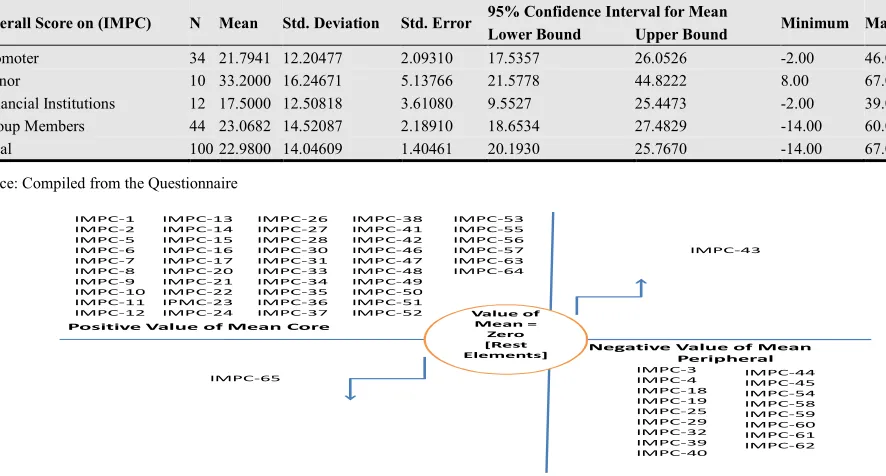
Further, the descriptive scale statistics on the perception of different stakeholders on whether the aspects like impact on members of SHG and its involvement in larger social issues should be peripheral or core components of quality indicators of SHG denotes the mean value 22.98, variance 197.293 and Standard Deviation is 14.046 (Table 4).
7.4. Normality Test
Here two tests for normality are run viz. Kolmogorov-Smirnov test and Shapiro-Wilk. In our case, since we have only 65 elements, the Shapiro- Wilk test is used and the p-value revealed as 0.312. We can accept the null hypothesis and conclude that the data are comes from a normal distribution. Similarly, individual item wise tests of
Normality under two different Test viz. Kolmogorov-Smirnov test and Shapiro-Wilk is also conducted and found that p-value is 0.000. Hence, we reject the null hypothesis and conclude that the data are not comes from a normal distribution. Therefore, to get a clear picture about the issue on normality we resorted to K-S Z Test. It is observed since the p-value is 0.625 for Overall Score of variables on Impact- Peripheral or Core, there is no reason to doubt the distribution is normal, so we can safely proceed with the ‘ANOVA’ test. (Table 5).
7.5. ANOVA Analysis
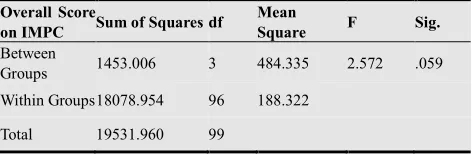
From Table 6 the ANOVA output, (ANOVA) is the key
table because it shows whether the overall F ratio for the
ANOVA is significant. In case of Overall Score on Impact-
Peripheral or Core, F ratio (2.572) is significant (p = 0 .059)
at the .05 alpha level. It is observed that F (3, 96) = 2.572,
p≥ .05. We conclude that at least one of the group means is
not significantly different from the others (or that at least two of the group means are not significantly different from each other). In brief, there was no significant effect of Stakeholders on overall score on Impact on members of SHG as Peripheral or Core issue remembered at the p≥ .05 level for the three conditions [F(3,96) = 2.572, p = 0 .059].
equal from the Descriptive Statistics as shown in Figure 2. The overall score on the opinion of different stakeholders on whether the aspects like impact on members of SHG and its involvement in larger social issues should be peripheral or core components of quality indicators of SHG is interpreted with the help of Mean of Total Score on IMPC i.e. 22.98. From this mean value, it is observed that different stakeholders believed that the impact on members of SHG and its involvement in larger social issues should be ‘somewhat core component’ as the mean value (22.98) lies in between the scale range of 1 & 0 which represents the zone of “somewhat core component”.
From the descriptive statistics on overall score on statements on impact on member of SHG & involvement in social issues, it is observed that the mean score is almost equal or higher than the mean of overall score i.e. in case of Promoter (21.794), Donor (33.20) and Group member (23.068). It is further observed that the mean on impact on member of SHG & involvement in social issues in case of Donor (33.20) is too higher than the mean of overall score (22.98) and the mean on impact on member of SHG & involvement in social issues in case of Financial Institutions (17.50) is too lower than the mean of overall score (22.98). This implies that Financial Institutions are less concerned with the statements on impact on members in social sphere while Donor’s are more concerned with the impact on member’s social issues.
Table 6. ANOVA on perception of stakeholders of SHG on IMPC
Overall Score
on IMPC Sum of Squares df
Mean
Square F Sig.
Between
Groups 1453.006 3 484.335 2.572 .059
Within Groups 18078.954 96 188.322
Total 19531.960 99
Source: Compiled from the Questionnaire
Further, from the descriptive analysis on perceived opinion by the different stakeholders on individual statement on impact on member of SHG & involvement in social, it is observed that out of 65 elements, only on 46 elements where different stakeholders perceived their opinion that these statements relating to impact on members on social perspectives are seems to be a core component while assessing the quality parameters of SHGs. Similarly, out of 65 elements, only on 17 statements they showed their negative perceptions i.e. considered to be peripheral components and on 2 statements they showed their normative approach i.e. neither core nor peripheral component while assessing the quality parameters of SHGs (Figure 2).
8. Conclusion
Microfinance institutions target the poor, with the aim of socially and economically empowering them. Donors make
the funds available, while the MFIs facilitate their distribution and recovery. The donors, MFI staff and national and regional governments need and want to know how well the program is performing. Program evaluation by means of impact assessment studies provides the requisite information that provides vital feedback to make critical future decisions. Social impact assessment, in contrast to economic assessment, is still in its infancy. As research expands, the discipline will develop and more refined models will facilitate understanding of this multifarious area. To access the perceptions of different stakeholder’s viz. Promoters, Donors, Financial institutions and Group members of SHG whether the aspects like impact on members of SHG and its involvement in larger social issues should be peripheral or core components of quality indicators of SHG, Sixty Five (65) statements related to impact on SHG and involvement in social issues are collected and corresponding opinion are quantified with the five point scale as defined in the research methodology. From the median value on the overall score on the opinion of different stakeholders on whether the aspects like impact on members of SHG and its involvement in larger social issues should be peripheral or core components of quality indicators of SHG it is observed that different stakeholders believed that the impact on members of SHG and its involvement in larger social issues should be ‘Somewhat core component’ as the mean value (22.98) lies in between the scale range of 1 & 0 which represents the zone of “somewhat core component” under given methodology. Further, it is observed that there was no significant effect of Stakeholders on overall score on Impact on members of SHG as Peripheral or Core issue. Finally, this implies that Financial Institutions are less concerned with the statements on impact on members in social sphere while Donor’s are more concerned with the impact on member’s social issues.
References
[1] Abdulla, V. K. (2000), “Tribal custom that helps Rural Development”, Social Welfare, 47 (5), pp. 20-22.
[2] Adams, D. & Von Pischke, J. D. (1992), “Micro-enterprise credit programs”, World Development, 20(10), pp. 1463– 1470.
[3] Affrane, S. (1998), “Impact Evaluation of Soweto Microenterprise Development Project (SOMED)”, Mid-term review report prepared for Australian Agency for International Development (AusAID) and SEED Foundation,
South Africa. [Online]. Available:
http://msmitwiki.byu.edu/esrreview/articles/article55.pdf. [Accessed February 15, 2010].
[4] Afrane, Sam (2002), “Impact Assessment of Microfinance Interventions in Ghana and South Africa: A Synthesis of Major Impacts and Lessons”, Journal of Microfinance / ESR
Review, 4(1), pp. 37-58. [Online].
[5] Agricultural Finance Corporation (2005), “Report on Impact Evaluation of Swashakti, MWCD”, Agricultural Finance Corporation Ltd, New Delhi.
[6] Ahmed, H. (1999), “Operating formate of micro finance scene: negative shocks and poverty”, Savings and Development, L (23), pp. 57-66.
[7] Alreck, P. L., & Settle, R. B. (1995), The survey research handbook (2nd ed.). Boston, MA: Irwin McGraw-Hill. [8] Amin, Sajeda, Ashok S. Rai, and Giorgio, Topa (2003),
“Does micro credit reach the poor and vulnerable? Evidence from Northern Bangladesh”, Journal of Development Economics, 54 (I), pp. 59-82.
[9] Anand, J. S. (2002), “Self-help groups in empowering women: Case study of selected SHGs and NHGs”, Discussion Paper 38. Kerala research programme on local level development, Centre for Development Studies, Thiruvananthapuram.
[10] Antia, N. H. and Kadekodi, G. K. (2002), “Dynamics of Rural Development: Lessons from Ralegaon Siddhi”, A Joint Study by the Foundation for Research in Community Health, Pune and Centre for Multi-disciplinary Development Research, Dharwad, pp. 53-56.
[11] APMAS (2009), “Quality and Sustainability of SHGs in
Assam”. [Online]. Available:
http://www.apmas.org/pdf%5CAssam%20SHG%20study% 20report-%20final%2003 0909. pdf. [Accessed October 15, 2013].
[12] Armendariz de Aghion B. & Morduch, J. (2005), The economics of microfinance, MIT Press, Cambridge. [13] Armendariz de Aghion B. & Morduch, J. (2010), The
economics of microfinance, (2nd ed.), MIT Press, Cambridge.
[14] Aruna, M. & Jyothirmayi, R. (2011), “The role of microfinance in women empowerment: A study on bank linkage Program in Hyderabad, Andhra Pradesh”, Indian Journal of Commerce and Management Studies, 2(4), pp. 77-95.
[15] Barnes, C. & Keogh, E. (1999), “An assessment of the impact of Zambuko’s micro-enterprise program in Zimbabwe: Baseline findings”, Management Systems International, Washington DC.
[16] Barnes, Carolyn (1996), “Assets and the Impact of Microenterprise Finance Programmes”, Management Systems International, Washington DC.
[17] Baruah, Prasenjit Bujar (2009), “Self Help Group and Asset Creation: A Case Study of Deharkuchi Gaon Panchayat of Nalbari District, Assam”, The microFINANCE Review, January-June, 1 (1), pp. 183-197.
[18] Bateman, M. & Chang, H. (2009), “The microfinance
illusion”. [Online]. Available:
http://www.econ.cam.ac.uk/faculty/chang/pubs/Microfinanc e.pdf. [Accessed February 15, 2010].
[19] Beck, T, Demirguc-Kunt, A. & Levine, R. (2004), “Finance, inequality and poverty: Cross-country evidence”, World Bank Policy Research Working Paper 3338, World Bank, Washington DC.
[20] Bera, Sudhin Kumar (2011), “A Study of SHG-Micro finance Initiative in Purbo Midnapore District of West Bengal”, Economic Affairs, 56(2), pp. 107-116.
[21] Bokil, Milind (2005), “Ending domestic violence: self help groups can help”, Development Support Team 32, Pune. [Online]. Available: http://nipccd.nic.in/reports/rawe.pdf . [Accessed on 6/09/2012]
[22] Borbora, S. and Mahanta, R. (2008), “Micro finance through Self Help Groups and its Impact: A Case of Rashtriya Grameen Vikas Nidhi-Credit and Saving Programme in Assam”, Indian Journal of Agriculture Economic, July- September, 56(3), pp. 449-454.
[23] Brau, J. C. & Woller, G. M. (2004), “Microfinance: A comprehensive review of the existing literature”, Journal of Entrepreneurial Finance and Business Ventures, 9(1), pp. 1– 26.
[24] Buckley, G. (1997), “Microfinance in Africa: Is it either the problem or the solution”? World Development, 25, pp. 1081–1093.
[25] Burra Neera, Ranadive, J. (2005), “Micro Credit, Poverty and Empowerment”, in Deshmukh, Joy and Murthy, Rajani K. (Ed.), Micro Credit, Poverty and Empowerment (pp. 34-56), Sage Publication Pvt. Ltd, New Delhi.
[26] CERISE Report (2000), CERISE Report. [Online]. Available: http://www.uneca.org [Accessed on 21/02/2010]. [27] Chakrabarti, Rajsh (2004), “The India Microfinance
Experience – Accomplishments and Challenges”, in Bibek Debroy and Amir Ullah Khan (Eds.), Integrating the Rural Poor into Markets (pp. 32-67), Academic Foundation, New Delhi.
[28] Chandra, Subhash W. (1999), “Sustainable micro credit model for poverty alleviation and empowerment”, Financing Agriculture Special Millennium Issue, 31 (3), pp. 84-111. [29] Chavan, P. & Birajdar, B. (2009), “Micro finance and
financial inclusion of women: An evaluation, Reserve Bank of India Occasional Papers, 30(2), pp. 109-129.
[30] Chavan, P. and Ramakumar, R. (2002), “Micro credit and rural poverty”, Economic & Political Weekly, 37 (10), pp. 955-965
[31] Choudhury, Sanghamitra (2008), “Women Self Help Groups in Empowering Women in a Conflict Situation: in Nalbari (Assam)”, Dialogue, 9 (3). [Online]. Available: http://www.asthabharati.org/Dia_Jan08/choud.htm.
[Accessed on 22/01/2012]
[32] Copestake, J. (2002), “Inequality and the polarising impact of microcredit: Evidence from Zambia’s copper belt”, Journal of International Development, 14(6), pp. 743–755. [33] Copestake, J., Bhalotra, S. & Johnson, S. (2001), “Assessing
the impact of micro-credit: a Zambian case study”, Journal of Development Studies, 37(4), pp. 81–100.
[34] Cronbach, L. J. (1951), “Coefficient alpha and the internal structure of tests”, Psychometrika, 16(3), pp. 297–334 [35] De, S. and D. Sarker (2010), “Impact of Micro-credit
[36] Deininger, Klaus & Liu, Yanyan (2009), “Longer-Term Economic Impacts of Self Help Groups in India”, World Bank Policy Research Working Paper 4886, The World Bank Development Research Group Sustainable Rural and Urban Development Team. [Online]. Available: doi: 10.1596/1813-9450-4886. [Accessed on 6/09/2010] [37] Dhanya, M. B and P. Sivakumar (2010), “Microfinance,
Women Empowerment and Banking Habit: Perspective on Kerala”, The Microfinance Review, II (1), pp. 97-109. [38] EDA Rural Systems (2006), “Quality Issues of Self Help
Groups in Rajasthan”, Centre for Microfinance, Hyderabad. [Online]. Available: http:// www.edarural.com. [Accessed on 6/02/2010]
[39] EDA Rural Systems and APMAS (2006), “The Light and Shades of SHGs in India”, CRS, USAID, CARE and GTZ/NABARD, CARE India.
[40] Gaddis, S. E. (1998), “How to design online surveys”? Training and Development Journal, 52(6), pp. 67-71. [41] Gaiha, R. and Mani Arul, N. (2007), “Micro finance, Self
Help Groups and Empowerment in Maharashtra”, Working Paper 2007/15, Australia South Asia Research Centre, Australian National University, Canberra. [Online]. Available:
http://www.crawford.anu.edu.au/acde/asarc/pdf/papers/2007 /WP2007_15. [Accessed on 6/09/2012]
[42] Gaile, G. L. & Foster, J. (1996), “Review of methodological approaches to the study of the impact of microenterprise credit programmes”, Report submitted to USAID assessing the impact of microenterprise Services (AIMS), June. Cited in Duvendack, Maren (2010). Smoke and Mirrors: Evidence of Microfinance Impact from an Evaluation of SEWA Bank in India. [Online]. Available: http://mpra.ub.uni-muenchen.de/id/eprint/24511. [Accessed on 2/12/2012]. [43] Gaonkar, Rekha R. (2001), “Working and Impact of Self
Help Groups in Goa”, Indian Journal of Agricultural Economics, 56(3), pp. 471-476.
[44] George, D., & Mallery, P. (2003), SPSS for Windows step by step: A simple guide and reference. 11.0 update (4th ed.), Allyn & Bacon, Boston, pp. 231.
[45] Ghalib, Asad Kamran (2009), “Measuring the impact of microfinance intervention: A Conceptual framework of social impact assessment”, Impact Assessment Research (IARC), University of Manchester, IARC Working Papers Series, No. 24/2009. [Online]. Available: http://www.sed.manchester.ac.uk/research/iarc/publications/ working_papers/. [Accessed February 15, 2013].
[46] Glasson, J. (2000), “Socio-economic impacts: overview and economic impacts” in Morris, P. and Therivel, R. (2000) (Ed.), Methods of Environmental Impact Assessment, Spon Press, London and New York.
[47] Goetz, A. M. & SenGupta, R. (1996), “Who takes the credit? Gender, power and control over loan use in rural credit programmes in Bangladesh”, World Development, 24(1), pp. 45–63.
[48] Goldberg, N. (2005), “Measuring the impact of micro finance: Taking stock of what we know”, Grameen Foundation USA Publication Series, December. [Online]. Available:
http://www.givewell.org/.../Independent%20research%20on
%20microfinance. [Accessed on 2/12/2012].
[49] Hashemi, S. M., Schuler, S. R. and Riley, A. P. (1996), “Rural Credit Programmes and Women’s Empowerment in Bangladesh”, World Development, 24(4), pp. 635-654. [50] Hietalahti, J. & Linden, M. (2006), “Socio-economic
impacts of microfinance and repayment performance: A case study of the Small Enterprise Foundation, South Africa”, Progress in Development Studies, 6(3), pp. 201–210. [51] Hossain, F. & Knight. T. (2008), “Financing the poor: can
micro-credit make a difference? Empirical observations from Bangladesh”, BWPI Working Paper 38. Brooks World Poverty Institute, Manchester.
[52] Hulme, D. & Mosley, P. (Ed.). (1996), Finance against the poor (Vol. 1 and 2). Routledge, London.
[53] Hulme, D. (2000), “Impact assessment methodologies for microfinance: theory, experience and better practice”, World Development, 28(1), pp. 79–88.
[54] Hulme, D. (2003), “Is micro finance good for the poor people? A note on the dark side of micro finance”, in Malcom Harper (Ed.), Micro Finance: evolution, Achievements and Challenges. ITDH Publications, London. [55] Human Development Report (2006), “Human Development
Report”, published by the United Nations Development Programme (UNDP). [Online]. Available: http://www.undp.org, [Accessed on 21/02/2009].
[56] Husain, Z., Mukherjee, D. & Dutta, M. (2010), “Self Help Groups and Empowerment of Women: Self Selection or actual benefits”? Munich Personal RePEc Archive No. 20765. [Online]. Available: http://www.mpra.ub.uni-muenchen.de/20765/1/MPRA_paper_20765.pdf. . [Accessed February 15, 2013].
[57] Hussain, A. M. (1998), “Poverty Alleviation and Empowerment: The Second Impact Assessment Study of BRAC’s”, Rural Development Programme. BRAC, Dhaka. [58] IARC (2009), “Impact Assessment Research”, University of
Manchester, IARC Working Papers Series, No. 24/2009.
[Online]. Available:
http://www.sed.manchester.ac.uk/research/iarc/publications/ working_papers/. [Accessed February 15, 2013].
[59] IFAD (2003), “Transforming Rural Institutions in order to Reach the Millennium Development Goals”, International Fund for Agricultural Development (IFAD). [Online]. Available: http://www.ifad.org/gbdocs/gc/26/e/rural.pdf . [Accessed February 15, 2013].
[60] Jahan, R., Kelkar, G. and Nathan, D. (2004), “Redefining Women’s Samman: Micro credit and Gender Relations in Rural Bangladesh”, Economic and Political Weekly, 39(32), pp. 3627-3640.
[61] Jain, P. and Moore, Mick (2002), “What makes micro credit programmes effective? Fashionable fallacies and workable realities”, IDS Working Paper No.177, Institute of Development Studies, Sussex. [Online]. Available: http://www.ids.ac.uk/publications. [Accessed February 15, 2013].
pp. 253–279. [Online]. Available: www.elsevier.com/locate/econbase. [Accessed on 2/12/2012].
[63] Jose Augusto Tomo Pisco (2001). Social Evaluation of the Micro Finance Institutions in Mozambique. [Online]. Available: http://www.uneca.org [Accessed on 21/02/2010]. [64] Kabeer, N. (1998), “Money can’t buy me love? Re-evaluating gender, credit and empowerment in rural Bangladesh”, IDS Discussion Paper No. 363, Institute of Development Studies, University of Sussex, Brighton. [65] Kabeer, N. (2001), “Conflicts over credit: re-evaluating the
empowerment potential of loans to women in rural Bangladesh”, World Development, 29(1), pp. 63-84. [66] Kabeer, N. (2003), “Assessing the ‘wider’ social impacts of
microfinance services: concepts, methods, findings”, IDS Bulletin, 34(4), pp. 106–114.
[67] Karnani, A. (2007), “Microfinance misses its mark”, Stanford Social Innovation Review. [Online]. Available: http://nbis.org/nbisresources/sustainable_development_equit y/microfinance_misses_its_mark_kamani.pdf. [Accessed February 15, 2013].
[68] Kashyap, S. K. and S. S. Kashyap (2010), “Impact of Bank-SHG Linkage Programme in Empowering Rural Women in Nalbari District of Assam: A Case Study”, The Microfinance Review, II (1), pp. 68-82.
[69] Kazmin, A. (2010), Micro finance: small loan, big snag. Financial Times, 1st December, 15. [Online]. Available: http://www.ft.com. [Accessed on 23/02/2012].
[70] Khandker, S. (2001, February), “Does micro-finance really benefit the poor? Evidence from Bangladesh”, paper Presented at Asia and Pacific Forum on Poverty: Reforming Policies and Institutions for Poverty Reduction on 5th to 9th at Washington DC.
[71] Kumar, A. (2009), “Self Help Groups, Women's Health and Empowerment: Global Thinking and Contextual Issues”, Jharkhand Journal of Development and Management Studies, 4(3), pp. 2061-2079.
[72] Kumar, D. Suresh (2009), “Participation in Self-help Group Activities and its Impacts: Evidence from South India”, The Bangladesh Development Studies, September XXXII (3), pp. 1-18. [Online]. Available: http://www.bids-bd.org/bds/32-3/BDS_ 32_3%20Suresh%20Kumar.pdf. [Accessed February 15, 2013].
[73] Kumar, S. (2010), “Performance and Impact of Self-Help Groups in Punjab – Past Experience and the Roadmap Ahead”, The Microfinance Review, II (1), pp. 19-35. [74] Leedy, P. D., & Armrod, J. E. (2001), Practical research (7th
ed.). Upper Saddle River, Prentice-Hall, NJ.
[75] Lipton, M. (1996), “Successes in anti-poverty. Geneva: International Institute of Labour Studies”. [Online]. Available:
http://www.ilo.int/wcmsp5/groups/public/@ed_emp/.../wcm s_123434.pdf. [Accessed February 15, 2013].
[76] Long, L. (1998), Surveys from start to finish. Alexandria, American Society for Training and Development, VA. [77] Maheswaranathan, S. & Kennedy, F. B. (2010), “Impact of
Micro-Credit Programmes on Eliminating Economic Hardship of Women”, ICBI, University of Kelaniya, Sri
Lanka. [Online]. Available:
http://www.kln.ac.lk/uokr/ICBI2010/7.pdf. [Accessed June 15, 2012]
[78] Makina, D. & Malobola, L. M. (2004), “Impact assessment of microfinance programmes, including lessons from Khula Enterprise Finance”, Development Southern Africa, 21(5), pp. 799–814.
[79] Maluccio, A. John and Flores, Rafael (2005), “Impact Evaluation of a Conditional Cash Transfer Program: The Nicaraguan Red de Proteccion Social”, Research Report No.141, International Food Policy Research Institute, Washington, D.C. [Online]. Available: http://www.ifpri.org/sites/default/files/publications/fcndp18 4.pdf. [Accessed June 15, 2010].
[80] Manimekalai, M. and Rajeswari, G. (2001), “Nature and Performance of Informal Self Help Groups - A Case from Tamilnadu”, Indian Journal of Agricultural Economics, 56(3), pp. 453-454.
[81] Mayoux, L. (1999), “Questioning virtuous spirals: microfinance and women’s empowerment in Africa”, Journal of International Development, 11, pp. 957–984. [82] Mayoux, Linda (1997), “Impact Assessment and Women’s
Empowerment in Micro-Finance Programmes: Issues for a Participatory Action and Learning Approach. (mimeo). Washington DC: Consultative Group to Assist the Poorest (CGAP).
[83] Meetei, K. I. (2011, January), “The impact of MF accessibility through group initiative to Rural Women in Manipur–A case study”, paper presented in Seminar BIRD in collaboration with IIBM on Micro finance in North East, on 28th and 29th at Guwahati. [Online]. Available: http://www.docstoc.com/docs/125091327/Seminar-on-?Microfinance-in-North-East?-organized-by-BIRD-in. [Accessed on 6/01/2012]
[84] Mia, Md. B. (2005), “ICT in Microfinance: A Bangladesh Perspective”, in Stuart Mathison (Ed.), Electronic Banking with the Poor Increasing the Outreach and Sustainability of Microfinance through ICT Innovation (pp. 1-10), The Foundation for Development Cooperation, Bangaladesh.
[Online]. Available:
http://www.intercooperation.ch/finance/download/sk-wks/2005IctAndMicrofinance.pdf. [Accessed June 15, 2010].
[85] Micro Finance Institutions Ordinance (2010), Micro Finance Institutions Ordinance. [Online]. Available:
http://indiamicrofinance.com/download-andhra-microfinance-ordinance-9. [Accessed on 23/02/2012]. [86] Micro-Credit Summit (1997), “The Micro-Credit Summit:
Declaration and Plan for Action”, Grameen Foundation, Washington, DC.
[87] Mohindra, K. S. et al. (2008), “Can Micro credit Help Improve the Health of Poor Women? Some Findings from a Cross- Sectional Study in Kerala, India”, International Journal of Equity in Health, 7, 2. [Online]. Available: http://www.equityhealthj.com/content/7/1/2 . [Accessed on 26/04/2010]
America”, ADB Institute Research Paper No.63, ADB, Manila.
[89] Montgomery, R. (1996), “Disciplining or protecting the poor? Avoiding the social costs of peer pressure in micro-credit schemes”, Journal of International Development, 8(2), pp. 289-305.
[90] Montgomery, R. Davies, R, Saxena, N C and Ashley, S (1996), “Credit for the poor in Bangladesh: the BRAC Rural Development Programme”, in David Hulme and Mosley (Eds.), Finance against Poverty. Routledge, London.
[91] Morduch, J. (1998), “Does microfinance really help the poor? Evidence from flagship programs in Bangladesh”, World Bank, Washington DC. [Online]. Available: http://www.worldbank.org/wbp/impact/practice/annex1_2.p df. [Accessed June 15, 2010].
[92] Morduch, J. (2000), “The Microfinance Schism”, World Development, 28(4), pp. 617- 629.
[93] Mosley, P. & Hulme, D. (1998), “Microenterprise finance: is there a conflict between growth and poverty alleviation”? World Development, 26, pp. 783–790.
[94] Moyle, T., M. Dollar, and Biswas, S. N. (2006), “Personal and Economic empowerment in Rural Indian women: A Self-help Group Approach”, International Journal of Rural Management, 2(2), pp. 245-266.
[95] Mugenda, Olive M. (2003), “Research Methods: Quantitative & Qualitative Approaches”, African Centre for Technology Studies Press, Nairobi, pp. 256.
[96] Mukerjee, Tuhin (2006), “Impact assessment study of SGSY programme on empowerment of women at Babpur village”, Vidyasagar School of Social Work, Kolkata, pp. 83. [97] MYRADA (2002), “Impact of Self Help Groups (Group
Processes) on the Social/ Empowerment Status of Women Members in Southern India”, Microcredit Innovations Department, National Bank for Agriculture and Rural Development, Mumbai. [Online]. Available: http://www.nabard.org/pdf/publications/sudy_reports/myrad a.pdf. [Accessed on 7/05/2012]
[98] Nair, Ajai (2005), “Sustainability of Microfinance Self Help Groups in India: Would Federating Help”? World Bank Research Working Paper, 3516, February. [Online]. Available:
http://elibrary.worldbank.org/doi/book/10.1596/1813-9450-3516[Accessed March 1, 2010].
[99] Nath Sarmah, Gunindra & Das, Diganta Kumar (2012), “Micro Finance, Self Help Groups (SHGS) & the Socio-economic Development of Rural People (A Case Study with Special Reference to the Lakhimpur District of Assam)”, Asian Journal of Research in Business Economics and Management, 2(4), pp. 145-149.
[100]NCAER (2008), “Impact and Sustainability of SHG-Bank Linkage Programme”, National Council of Applied Economic Research New Delhi. [Online]. Available: http://.www.apmas.org/pdf%5CGTZ_NCAER.pdf .
[Accessed June 15, 2010].
[101]Neubert, S. (2000), “Social Impact Analysis of Poverty Alleviation Programmes and Projects - A Contribution to the Debate on the Methodology of Evaluation in Development Cooperation”, Frank Cass Publishers in association with the
German Development Institute, Berlin. [Online]. Available: http://www.worldbank.org/
socialanalysissourcebook/SAEvolutionMay2902.pdf. [Accessed February 15, 2010].
[102]Nidheesh, K. B. (2009), “Study on the changing process of Kerala women through Kudumbasree, Kerala”, International NGO Journal, 4(8), pp. 352-361.
[103]Nunnally, J. C. and Bernstein, I. H. (1994), Psychometric Theory (3rd ed.).: New York, McGraw-Hill
[104]Odell, K. (2010), “Measuring the impact of micro finance: Taking another look”, Grameen Foundation USA Publication Series, May. [Online]. Available: http://business.dom.edu/sites/default/files/documents/Measu ring-the-Impact.pdf. [Accessed on 2/12/2012].
[105]Orso, C. E. (2011), “Microcredit and poverty. An overview of the principal statistical methods used to measure the programme net impacts”, POLIS Working Paper No. 180,
February. [Online]. Available:
http://polis.unipmn.it/pubbl/RePEc/uca/ucapdv/orso180.pdf. [Accessed on 2/12/2012].
[106]Parida, P. C. & Sinha, Anushree (2010), “Performance and Sustainability of Self Help Groups in India: A Gender Perspective”, Asian Development Review, 27 (1), pp. 80–
103. [Online]. Available:
http://econpapers.repec.org/article/risadbadr/2713.htm. [Accessed on 7/05/2012]
[107]Premchander, S. & Vanguri, P. (2007), “Micro Finance & Women’s Empowerment: Programme & Policy Review”, CARE, New Delhi. Also cited in Singh, Awadhesh Kumar (2007), “Functioning & Performance of Swashakti and Swayamsiddha Projects in India”, Planning Commission, Government of India, New Delhi.
[108]Premchander, Smita and Prameela, V. (2007), “Empowering Women through Microfinance: A Policy and Programme Review”, Care India, Delhi. [Online]. Available: http://www.careindia.org/ManagePublications. [Accessed on 22/02/2009]
[109]Puhazhendhi, V. and Satyasai, K. J. S. (2000), “Micro Finance for Rural People: An impact evaluation’, Microcredit Innovations Department, National Bank for Agriculture and Rural Development, Mumbai.
[110]Puhazhendi, V. and K. C. Badatya (2002, November), “SHG-Bank Linkage Programme for Rural Poor- An Impact Assessment”, paper presented at seminar on SBLP at New Delhi on 25th and 26th. Mumbai: NABARD.
[111]Purushotham, P. (2004), “Marketing Support to the SHGs”, Kurukshetra, 52 (4), pp. 23-28.
[112]Raghavendra, T. S. (2001), “Performance Evaluation of Self Help Groups: A Case Study of Three Groups in Shimoga District”, Indian Journal of Agricultural Economics, 56(3), pp. 466-467.
[113]Rahman, A. (1998), “A micro-credit initiative for equitable and sustainable development: Who pays”? World Development, 26(1), pp. 67–82.