ENVIRONMENTAL/ECONOMIC ANALYSIS AND RECYCLING OF
WASTES FROM AIR LIQUID NIGERIA LTD.
AGUNWAMBA, J.C. and NKPAH, L.S. Dept. of Civil Engineering,
University of Nigeria, Nsukka.
ABSTRACT
Environmental and economic analysis was performed on the wastes from Air Liquid Nigeria Ltd. The company's waste water, spent oil, noise and air pollutants were examined. Results show no serious adverse impact on the ambient air quality. There was serious noise pollution problem around the factory hall and generator areas. Results of the waste-water analysis revealed that the company is not responsible for the pollution of Oginigba River as the parameters analyzed were well below FEPA standards. Spent oil analysis showed that about 97.5% of what the company disposes off as waste constitutes potentially utilizable products such as gasoline (12.3%), kerosene (20.2%) and gas oil (64.8%) were obtained by recycling the spent lubricants by the process of table distillation. These were of comparable quality with the corresponding standard products in the market. However, the recycled products had a little more impurities, but the levels of purity can be improved by better recycling. A detailed cost - Benefit analysis carried out between disposal and recycling revealed that the latter is a viable option.
INTRODUCTION
One of the most visible results of development is the enormous growth of industries. Today the world manufactures seven times as many goods and produce three times the amount of minerals than it did in the 1970s [1]. The developing countries' share of the world's manufacturing output remained virtually stagnant at around 12.7% during the period 1980-1985, but increased slightly to about 14% in 1990 [3]. This large increase in manufactured products is associated with a large amount of wastes which are not properly managed. Improper management and disposal of industrial waste could have deleterious effects on living organisms. For instance, a total of over 17 million kg/ pollutant load of BOD were discharged into Nigerian coastal environment without any form of treatment [3]. Industrial establishments dump their effluents and solid wastes into public sewers, drains and
surface waters without treatment.
Virtually all the acqueous pollutants from the industries in Port Harcourt and its adjacent areas are discharged into streams and Creeks, which drains into the Bonny river system. The pollutants deplete oxygen in receiving streams and contribute to eutrophication. While the first destroys the aquatic living organisms the second problem renders the water unfit for commercial, recreational and transportation purposes. On account of the potentials of industrials to contribute to environmental degradation, t becomes necessary to study industries in this regard. The objectives of this study are as follows: (a) Broadly appraise the activities of the Air Liquid Nigeria Ltd. and their extent of environmental pollution;
(b) Consider the viability of pollution control through recycling.
The Air Liquid Nigeria Ltd. is situated at Trans Amadi Industrial Layout in Port Harcourt. It is a multinational company with headquarters in Paris - France. It specialises in the production of 38 tons natural gases such as Oxygen, Nitrogen, Hydrogen, Carbon dioxide Nitrogen dioxide, and Acetylene. The company also undertakes the buying, reprocessing and distribution of refrigerant gases (Freons). The production process is essentially fractional distillation of air. The plant is in an Air Separation Plant (ASP) consisting of extractor, air filter, compressor, heat exchanger, refrigerating unit, purification tank, expansion turbine and medium pressure column.
MATERIALS AND METHODS
Ecological data on air Liquid Nigeria Ltd. premises were acquired through interviews, actual sample collection and analysis. The level of impact based on the immediate environment was estimated by comparing the current field data with the DPR and FEPA standards.
Air Quality Determination
The air quality parameters include Suspended Particulate Matter (SPM),
Carbon Monoxide (CO), and Nitrogen Dioxide (N02). The SPM was determined
by the Hi-volume sampler, CO by a portable CO Monitor, and
N02 by the wet method [9].
Noise level determination
In Air Liquid Nigeria Ltd., the major sources of noise are the factory hall and generator house. Noise levels were therefore determined in the premises and within the immediate neighbourhood at ten (10) different locations within the factory hall and generator house as reference points. The instrument used was the portable sound level monitor. The locations were labelled L1 L2, L3, L4, L5, L6, L7, L8, L9 and L10.
Wastewater Analysis
Wastewater are produced from the cooling of the plants, miscellaneous cleaning, bathing and washing. These wastewater are discharged via a public drain along RIVOC road into Oginigba river which is a tributary of Bonny River. A sampling point was marked which was about 1 meter away from the effluents Outfall into the drain. Samples of the wastewater were collected for analysis once a day over a twenty-day period. Parameters analyzed were Biochemical Oxygen Demand (BOD), Chemical Oxygen Demand (COD), Total Suspended Solids (TSS), Temperature, pH, and turbidity. The samples were collected in a 2 litre plastic container, properly labelled and taken to the laboratory for analysis. The analysis was conducted at Eleme Petrochemical Company Limited (EPCL) Product Programming and Quality Contract (PPQC) laboratory. Analytical methods used were those specified in Standard Methods for the analysis of water and wastewater [10].
Waste Characterization
and the sources are summarized in Table 1. Some of the spent oil were collected in a 2-litre plastic container and taken to NNPC laboratory for analysis. The aim was to check out for the toxic and hazardous constituents of the oil so that its effect on the affected environment can be grasped easily with or without any form of physical inspection of the site. Before
collection of the samples all quality control precautions were observed.
Wastewater Analysis
The parameters analyzed conformed with the approved FEPA standard. The variations of the BOD, COD, TSS,
Table 1: Nature of waste generated from Air Liquid Nigeria Limited
S/No. Type of Waste Source(s) Remarks
1. Solid waste (Soda Ash) Acetylene production Occasionally wooden materials, papers, etc.
2. Liquid waste Plant cooling process
Sometimes from miscellaneous washing cleaning/bathing wastewater.
3. Gaseous effluent
From plants exhausts (chimney) minor leakage (very rare)from utility, e.g. generator.
Generator used
intermittently, leakage insignificant to affect local air quality.
4. Spent oil From planat and generator servicing.
Advised to store in drums and properly disposed or recycled.
RESULTS AND DISCUSSIONS Air Quality
There was an observable plume from the plants and generator chimneys from where particulate are believed to be discharged into the atmosphere. But the discharge was minimal enough to adversely affect the ambient air quality (Table 2).
Table 2: Ambient Air Quality Data Around Air Liquid Premises and Neighbourhood (July 200)
Location SPM CO CO 1 2 3 4 5 6 7 8 125.0 102.5 158.2 166.3 145.5 172.0 164.8 111.2 4.4 6.8 3.5 4.5 5.0 5.5 3.4 5.3 29.4 16.8 8.2 19.5 10.0 18.8 9.6 8.6
Location SPM CO CO 9 10 MEAN S.D FEPA Standard 100.5 101.2 134.7 27.2 600.0 5.6 3.6 4.8 1.1 11.2 8.0 7.8 13.7 1.9 75-113 Parameter concentration in g/ m3
*Locations outside Air Liquid Premises.
concentrations in the two samples. Heavy metals is so much of serious concern that even at micro concentrations, they may have some deleterious effects. In the analysis only copper (Cu), Manganese (Mn) and Calcium (Ca) were detected but their concentrations were well below WHO limits.
Noise
The measurements of noise level in the premises are as shown in the table below. Table 3: noise level measurement in air liquid Nigeria Ltd.
S/NO Location Noise Level (db) L1 L2 L3 L4 L5 L6 L7 L8 L9 L10
In front of administrative Block
Inside Warehouse (plants and Gen. on) In front of clinic (plants and Gen. on) Inside the clinic (Door shut)
Outside Sup. Office complex
(plants and Gen. on) Factory Hall (inside) (plants and Gen. on) Factory Hall 10m away (plants and Gen. On) Gen. House (inside)Gen on
Gen. house 10m away gen on
Factory hall (inside) Plants and Gen. off
65 75 72 50 78 105 78 98 70 55
The measurement of noise level shows that the factory hall and generator house are the two main sources of noise (105 db and 98 db respectively) and the noise level decreases with increasing distance away from these sources. Occupational health data collected for the months of March, April and May 2000 revealed the following: In March 2000, out of 32 registered patients treated in the staff clinic, 19 of them were factory workers,
and out of the 19, 13 cases were severe headache and one hearing problem. In April, out of 46 cases, 21 were factory workers. Out of the 21, 16 were severe headache. In May, out of the 23 cases, 14 were headache. It is worth mentioning here that the factory workers constitute just about 1/5 of the total work force.
The severe headaches amongst factory workers may be attributed to the ringing sensations in the ear, which affects the brain, and this is caused by exposure to excessive noise. This is grossly unhealthy and should be checked. Noise is a pollutant that is undesirable to everyone. The wearing of defenders is mandatory for the workers exposed to an 8-hour excess of 85db like those in the factory and generator areas. The exposure to industrial and other forms of noise can induce hearing loss and other pathological changes in the affected population. Hence, it is recommended that daily noise exposure for workers should not exceed 90db daily for an 8-hour working period, 92db daily for a 6-hour working period, 95db daily for a 4-hour working period and 97db daily for a 3-hour working period [I]. Off duty noise dose up to 70db are considered to have no influence on hearing loss from exposure at work as the additional noise energy received is negligible compared to the 85dbyermitted at work.
Liquid Nigeria Ltd. noise was a serious environmental problem especially in and around the factory hall and generator house.
Table 4: Noise Exposure Limits for Nigeria. Duration Per Day (House) Permissible Exposure Limits (db) 8 6 4 3 2 1.5 1 0.5
0.25 or less
90 92 95 97 100 102 105 110 115 Source: FEPA [11]
Waste Recycling
The major solid and liquid wastes are hydrated lime (Soda Asha) and spent lubricants respectively. Hydrated lime is a by-product of Acetylene gas production. These wastes (hydrated lime and spent lubricants) can be recycled or reprocessed into some useful products such as
1, Hydrated Lime (Soda Ash)
Hydrated lime can be converted into dehydrated lime, a very useful product to farmers. The conversion or recycling process is achieved by heating in an oven. The dehydrated lime can be used in restoring acidic soils, thus improving the agricultural productivity of soils. Besides, it can be used as a viable alternative to drilling mud.
2. Spent Lubricants
Recycling of spent lubricants is achieved by the process of table distillation. This is followed by the traditional techniques of repeated filtration using decolourising charcoal and re-distillation of the filtrate. The recycling process can produce the following very useful products/ fractions.
Table 5: Products from Table Distillation of Air Liquid Spent Lubricants,
Temp. range
Constituent Fraction
Percentage
00-1500C
1500C-2500C
2500C-3500C
Total Potentially Utilizable Product Residue (for incineration) Or asphalt Product Total Gasoline Fraction Kerosene Fraction Gas oil Fraction 12.3 20.2 64.8 97.3 2.7 100.0
Obviously, if spent lubricants are properly treated and recycled, it could serve as a viable source of raw materials, which will in turn help in the control of environmental pollution, provide job opportunities and conserve energy. The recycled product could be used as gasoline, kerosine and gas oil.
Spent Oil Analysis
The result obtained from the analysis of Air Liquid Nigeria Limited Spent lubricants showed that about 97.3% of the spent oils usually disposed off as wastes by the company constitutes potentially utilizable products. These products useful as they are, are disposed off into the environment without any form of treatment. Generally, the consequences of oil pollution in the ecosystem includes soil infertility, destruction of soil living forms, damage to structures and ecological systems, lead poisoning and general interference with legitimate uses of the environment.
greases have increased tremendously. For instance, the consumption increased from 64,992 metric tons in 1974 to 198,294 metric tons in 1980, that is, an increase of 1 %. This figure has increased by more than 500% presently Wit the present mode of indiscriminate disposal of spent lubricants coupled with a parallel increase in the national consumption level, there is a corresponding increase in environmental pollution. Investigations revealed that the quantity or percentage of gasoline, kerosene and gas oil fractions vary from one oil sample to another. However, overall recovery of the potentially utilizable products remained appreciably
constant at about 97.5%.
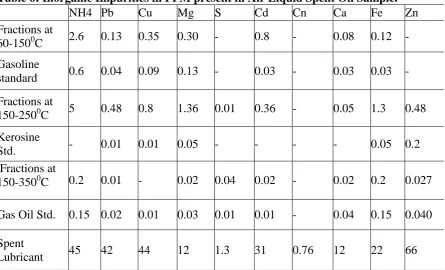
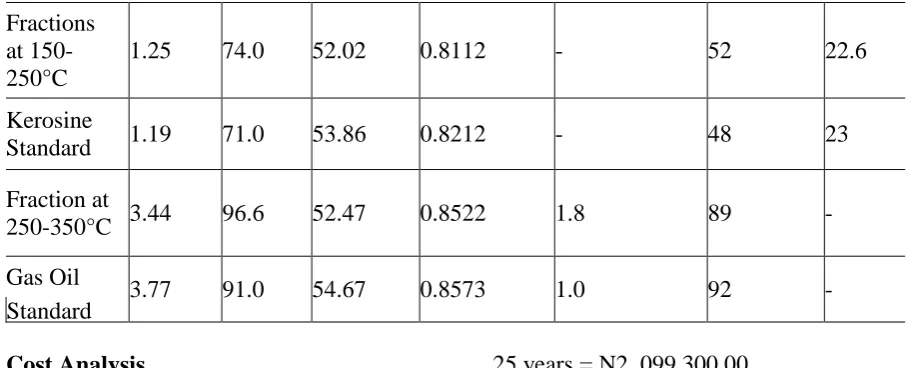
A purity check was carried out on the different fractions. Result of the analysis of each fraction was matched against products of similar grade in the Nigerian market as standards. The results of the analysis of the fractions and standards are provided in Tables 6 and 7. Table 6 is the result of inorganic impurities while Table 7 represents
the physic-chemical properties of the fractions from the spent oils compared with the standards
Table 6: Inorganic Impurities in PPM present in Air Liquid Spent Oil Sample.
NH4 Pb Cu Mg S Cd Cn Ca Fe Zn Fractions at
60-1500C 2.6 0.13 0.35 0.30 - 0.8 - 0.08 0.12 -
Gasoline
standard 0.6 0.04 0.09 0.13 - 0.03 - 0.03 0.03 -
Fractions at
150-2500C 5 0.48 0.8 1.36 0.01 0.36 - 0.05 1.3 0.48
Kerosine
Std. - 0.01 0.01 0.05 - - - - 0.05 0.2 Fractions at
150-3500C 0.2 0.01 - 0.02 0.04 0.02 - 0.02 0.2 0.027
Gas Oil Std. 0.15 0.02 0.01 0.03 0.01 0.01 - 0.04 0.15 0.040
Spent
Lubricant 45 42 44 12 1.3 31 0.76 12 22 66
Table 7: Physico-Chemical Properties of the Spent Oil Fractions Against Standards.
Sample
Viscosity at 50co
Catane Rating
Diesel Index
S.G at 60of
% Carabon Residue
Flash Point
Smoke Point
Spent Oil 41.5 - - 0.9002 3.1 - -
Fraction at 60- 150°C
0.70 61.20 43.95 0.7816 - - -
Gasoline
Fractions at 150- 250°C
1.25 74.0 52.02 0.8112 - 52 22.6
Kerosine
Standard 1.19 71.0 53.86 0.8212 - 48 23
Fraction at
250-350°C 3.44 96.6 52.47 0.8522 1.8 89 -
Gas Oil
3.77 91.0 54.67 0.8573 1.0 92 -
Standard
Cost Analysis
Table 8 shows the recycling cost of the spent oils. The analysis was based on the prevailing price of the plant at the Air Liquid Nigeria Ltd. Diesel Index (D.I)
range for a normal fuel is 30-60. This is based on the fuel's chemical composition without any additives.
Total = N83, 972.00
Total revenue from recycled products for
25 years = N2, 099,300.00
2)Salvage Value of the Recycling Plant
The percentage depreciation is assumed to be 30%. Applying this 30% depreciation value, the salvage value of the plant after
25 years is ₦22,548.01 to be 30%. Applying this 30% depreciation value, the salvage value of the plant after 25
Table 8: Cost Analysis for the Recycling of Air Liquid Nigeria Ltd. Spent Oils.
S/No Type of Cost Operation Cost of Naira
1. Installation at recycling planta ₦100,000,000.00
2.
Labour cost (a minimum of a operators i.e 2-man
per shift for a 4-shift system and one supervisor at an average of N120,000 00 per annum per staff for 25 years).
N 27,000.000.00
3. Operating cost (cost of regents, utility, property,
tax, maintenance cost, etc.) N 20 ,000 ,000.00
4. Miscellaneous N 250,000.00
5. Total N 147,250,000.00
a
Life span = 25 years.
BENEFITS OF RECYCLING
1) Revenue Accruable from Recycling
The plants consume a maximum of 210 litres (10 drums) of lubricating oil per annum and the generator a maximum of 840 litres (4 drums) per annum totaling 2940 litres. The oil does not carbonise easily which accounts for the small quantity of oil consumed by the plants annually.
Approximately, 2800 litres of spent oil is to be recycled. The 140 litres difference represents expected losses.
The final product is expected to be in the ratio of 12.3% gasoline (344.41);
20.2% kerosine (565.6 litres); 64.8% gas oil (1814.4 litres) and 2.7% residue. 344.4 litres of gasoline at N 100 per litre
=N 34,440.00
565.6litres of Kerosine at ₦17 per litre = N 9,615.20
1814.4litres of gas oil at N 22 per litres = N 39,916.80
years is N22,548.01
Total accruable revenue from recycling = N 2,099,300 + ₦22, 548.01
N 2,121,848.01 Net of recycling
3) socio-Economic benefits
From the foregoing analysis, recycling is capable of providing employment opportunities for not less than nine persons
COST ANALYSIS FOR DISPOSAL
i. The polluted plot of land is rendered useless and its value is to be quantified in monetary terms. Cost of a plot of land in Port Harcourt presently is about Six Hundred Thousand Naira (N 600,000.00). Investigations carried out revealed that land appreciates by 20% annually in the city. Therefore, the cost of the polluted plot of land measuring about 60m x 100m using a 20% annual appreciation value is P(l + R)n-1 (where P = N 600,000.00, n = 25 years and R = 20%) = N 47,698,494.00.
ii. There is no economic tree on the affected land presently but adjoining lands are pineapple orchards. Therefore there is every likelihood that the plot would have been used for the same purpose. The land is large enough to accommodate over 5000 heads of pineapple. It should be noted that pineapple suckers take about 5 to 6 months to mature if well catered for. It implies therefore, that about 5000 pineapple fruits would have been harvested from the land twice a year for about 28 years i.e. 25 years of pollution + 3 years recovery period. An average pineapple fruit costs about N 300 in Port Harcourt going by market survey conducted during the study. Therefore, estimated cost of damage is N5,
000 x 28 x 2 x 300 = N 84 million.
(iii) Field studies conducted revealed that pineapples orchard on adjoining lands to the polluted plot are not doing well at all, may be due to pollution caused by the escape (seepage) of oil from the disposal site through underground aquifers to these lands. Investigations revealed that the pineapples on these land (approximately 10,000 heads) taken as much as 1.5 years (18 months) to mature. And even when they mature, the fruits are so small that they can only sell for between ₦40 and ₦60.00 (i.e an average of ₦50.00). This is an enormous financial loss to the owner(s). The estimated financial loss is ₦300x28x2x10,000 – ₦50 x 10,000 x,28/1.5 = ₦168,000,000 – N 18,666,666.67 = ₦149,333,333,.00.
(iv) The company stands the risk of being sued for trespass or nuisance by the landlords in which case it can lose over 50, 000,000.00 like in the case of Umudje Vs SPDC -11SC 156 (1975).
(v) The oil is capable of seeping through underground aquifers to pollute ground water resources. It costs money to treat such water to make t fit for human consumption. This further increases the cost of disposal. Depicted on Table 9 is the cost analysis for disposal without environmental considerations while Table 10 is the analysis with environmental considerations.
Table 9: cost analysis for disposal without environmental considerations.
S/No Type of cost operation Cost in naira (N)
1
2 3
Transportation (hiring of pay loaders, tippers, etc. twice a year for 25 years)
Cost of land (disposal site) by the year 2027 Damage to economic trees
Total
Table 10: cost analysis for disposal with Environmental considerations.
S/No Type of cost operation Cost in naira (N)
1 2 3 4 5
Transportation (hiring of pay loaders, tippers, etc Cost of land (disposal site) by the year 2027 Damage to economic trees
Cost of environmental damage
Estimated damage to ground water resources + Secondary consequences Total 3,500.000.00 47,698,494.00 233,333,333.00 50,000,000.00 70,000,00.00 N 417,531,827.00
Analysis of the Alternatives
From the foregoing, it can be concluded that recycling is more beneficial to the company than disposal. However, it takes a longer period (about 12 years) for the company to begin to realize the benefits of recycling when disposal is carried out without environmental considerations while, it takes only nine years for disposal cost to outweigh recycling cost when environmental factors are incorporated into the disposal process Table 11. Therefore, recycling is more desirable from economic, social and environmental points of view. Besides, recycling will save the company a lot of foreign exchange as the recovered products can be re-used.
CONCLUSIONS
The following conclusions were made from the study:
1. The mean ambient particulate concentration was 27.2 g/ m3 (1 hr.) as against a FEPA allowable maximum value of 600.00 g/ m3 (1 hr.). Therefore, the operation of Air Liquid Nigeria ltd. does not adversely affect the immediate air quality.
2. The BOD and COD of the wastewater samples were appreciably low. There were however, some slight changes in turbidity resulting in a corresponding increase in total suspended solids (TSS) on some days. This may be attributed to frequent precipitations observed
Table 11: Financial Analysis of the Proposals.
15. 146,074,392 266,950,370.28 184,020,370.20
Note: Revenue realizable from recycling based on the company's present production level is N 83, 972.00.within the period of study. However, all the parameters analyzed were well below the approved FEPA standards. Therefore, Air Liquid Nigeria Ltd. is not responsible for the pollution of Oginigba River. However, its contribution together with those of other companies can contribute to pollution,
3. Noise level above 92db was observed around the factory hall and generator house. This noise level is quite above FEPA approved tolerable noise exposure limits for a 8-hour working period. There was therefore a serious noise pollution problem around these areas resulting into some serious occupational health problems amongst factory workers. This high noise level was however, localised around these areas as it was found to decrease with increasing distance away. As a mitigative measure, the wearing of protective devices (e.g. ear muffs) around the high noise zones should not only be enforced but made mandatory and such high noise area sign - posted.
4. The company contributes immensely to the pollution of the environment by the disposal of lubricants without any form of treatment. For instance, the spent oil contains heavy metals with concentrations far exceeding the permissible FEPA and WHO standards. A lot of revenue is lost by the company through careless disposal of about 97.3% utilizable products from their spent oils. Even the supposed 2.7% residue left as waste could be converted into bitumen or asphalt for road construction. 5. A dehydrated lime can be formed from the
hydrated lime and be used as fertilizer supplement.
6. A detailed cost-benefit analysis conducted revealed that recycling is a
better option for the company because
apart from its environmental considerations; it is financially and economically viable.
REFERENCES
1. WCED. Our Common Future. Oxford University Press, Oxford, 1987.
2. Mkpah, L.S.
Environmental/Economic Analysis and Recycling of Wastes from Air Liquid Nigeria Ltd. M.sc. Thesis, Department of Civil Engineering, University of Nigeria, Nsukka, Nigeria, 2002,81pp.
3. UNEP. Industry and
Environmental, The Next Decade. Special Issue No.3, 1982.
4. Tee, S. et. al. Industrial Pollution and Waste Disposal in Trans Amadi Industrial Area and the Eleme-Onne Areas. In: Okpokwasili, G.S.C. and Umezi, N. (eds.) Pollution Control Engineering and Management, Riverside Publishers, Port Harcourt, 1991.
5. Obuasi, P.A. "Environmental Impact of Petroleum Refinery". A paper presented at the Seminar on Petroleum Industry and the Nigerian Environment, Organized by NPC, 1987.
Bros. (Nig. Pub.) Ltd, Ibadan, 1988.
7. Kakulu, S.E. and Osibanjo, O. "Trace Metal Pollution Studies in the Niger Delta Area." J.Chem. Soc. Nigeria Vol. 13, 1988, pp. 9-15.
8. Kakulu, S.E. and Osibanjo, O. "Pollution Studies of Nigerian Waters: Trace Metal Levels of Surface Waters in the Niger Delta Area, Int. f. Environ. Studies, Vol. 41, 1992, pp.287-292.
9. WHO, "Management and Control of the Environment", Geneva, 1989.
10. APHA, Standard Method for Examination of Water and Wastewater, APHA, A WWA and WFCF, Washington, D.C., 1995.