LABORATORY STUDY OF THE EFFECT OF
TEMPERATURE CHANGES ON MIXING AND
PERFORMANCE OF PONDS
C.N. Mamaand J.C. Agunwamba
Department of Civil Engineering, Faculty of Engineering, University of Nigeria, Nsukka, Nigeria
Abstract
This work is an investigation of the effect of temperature changes on the mixing and performance of ponds. The parameters tested for were: biochemical oxygen demand, dissolved oxygen, coliform, suspended solid, temperature and pH. Three metallic tanks were fed simultaneously by a plastic container under gravity. This was achieved by systems of hoses and pipelines with one plastic container sup-plying sewage to another. Each tank measured 2 × 0.5 × 0.4m while each plastic container measured 300litres. Aerobic conditions prevailed in both the plastic con-tainers and the metallic tanks. There was a lighting system over each tank. Two tanks contained heating coils at the bottoms, thermostatically controlled. One tank was the control (without heating coils). Each tank also had control taps at both inlet and outlet. There was a sampling device for collecting sewage at every 0.1m depth of each tank. The results showed that mixing causes general fluctuations in dissolved oxygen, suspended solid, biochemical oxygen demand and coliform with respect to depth, as the temperature varies.
Keywords: biochemical oxygen demand, dissolved oxygen, suspended solid, coliform, pH.
1. Introduction
Waste stabilization ponds (WSP), often re-ferred to as oxidation ponds or lagoons, are holding basins used for secondary wastewater (sewage effluents) treatment where decompo-sition of organic matter is processed biologi-cally. The activity in the WSP is a complex symbiosis of bacteria and algae, which stabi-lizes the waste and reduces pathogens. The result of this biological process is to convert the organic content of the effluent to more
sta-ble and less offensive forms. WSP are used to treat a variety of wastewater, from domestic wastewater to complex industrial water, and they function under a wide range of weather conditions, i.e. tropical to arctic. They can be used alone or in combination with treatment processes [1].
inlet to the outlet) a well-treated effluent is discharged. Many characteristics make WSP substantially different from other wastewater treatment. They include design, construction and operation simplicity, cost effectiveness, low maintenance requirements, low energy re-quirements, easily adaptive for upgrading and high efficiency [1].
The most appropriate wastewater treat-ment is that which will produce an efflu-ent meeting the recommended microbiological and chemical quality guidelines both at low cost and with minimal operational and main-tenance requirements [2]. Adopting as low a level of treatment as possible is especially de-sirable in developing countries, not only from the point of view of cost but also in acknowl-edgement of the difficulty of operating com-plex systems reliably. In many locations it will be better to design the reuse systems to accept a low-grade of effluent rather than to rely on advanced treatment processes producing a re-claimed effluent which continuously meets a stringent quality standard.
Waste stabilization ponds (WSP) are now regarded as the method of first choice for the treatment of wastewater in many parts of the world. In Europe, for example, WSP are widely used for small rural communities (approximatedly up to 2000 population but larger systems exist in Mediterranean France and also in Spain and Portugal) [3, 4]. In the United States one third of all wastewa-ter treatment plants are WSP, usually serv-ing populations up to 5000 [5]. However in warmer climates (the Middle East, Africa, Asia and Latin America) ponds are commonly used for large populations (up to around 1 mil-lion). In developing countries and especially in the tropical and equatorial regions sewage treatment by WSPs has been considered an ideal way of using natural processes to im-prove sewage effluents.
The mixing of the pond contents is an im-portant mechanism, which helps to convey oxygen produced at the pond surface to the lower layers. Wind and heat are the two fac-tors of major importance, which influence the degree of mixing that occurs within a pond. Mixing contributes oxygen in its own way by the process of reaeration. It also helps to reduce thermal stratification, which aids in dispersing bacteria and algae throughout the pond thus producing an effluent of a more con-sistent quality.
The application of mixing is one of the first major advances in anaerobic treatment. Mixing is an important factor in pH control and maintenance of even environmental condi-tions. It distributes buffering agents through-out the reactor volume and prevents localized build-up of high concentrations of interme-diate metabolic products, which may inhibit methanogenic activity. On the contrary, inad-equate mixing propitiates the development of adverse microenvironments [1].
at about 5, the autotrophic- nitrifying bac-teria practically cease functioning. At 2, even the chemo-heterotrophic bacteria acting on carbonaceous material become essentially dormant.
As temperature rises, the rate of reac-tion also increases. In order to have a reasonable methane production rate, the temperature should be maintained above 20. Methane production rates are dou-bled for each 10temperature increase in the mesophilic range [6]. Increasing the temper-ature results in a more rapid bacteria kill. The temperature dependence of the biologi-cal reaction-rate constants is very important in assessing the overall efficiency of a biologi-cal treatment process. Temperature not only influences the metabolic activities of the mi-crobial population but also has a profound ef-fect on such factors as gas-transfer rates and the settling characteristics of the biological solids. The temperature at which the BOD of a wastewater sample is determined is usu-ally 20.
Hence, this work focused on investigating the effect of variation of some pond param-eters like DO, SS, Coliform, pH, BOD with depth. It investigated the effect of temper-ature on pond mixing and stratification. It also investigated the extent of stratification and mixing in ponds with respect to BOD, DO, SS, pH, temperature and coliform.
2. Experimental Procedure
2.1. Collection of Sample
Influent sewage to the facultative ponds was collected from the University of Nigeria, Nsukka wastewater treatment plant.
2.2. Laboratory Set-Up
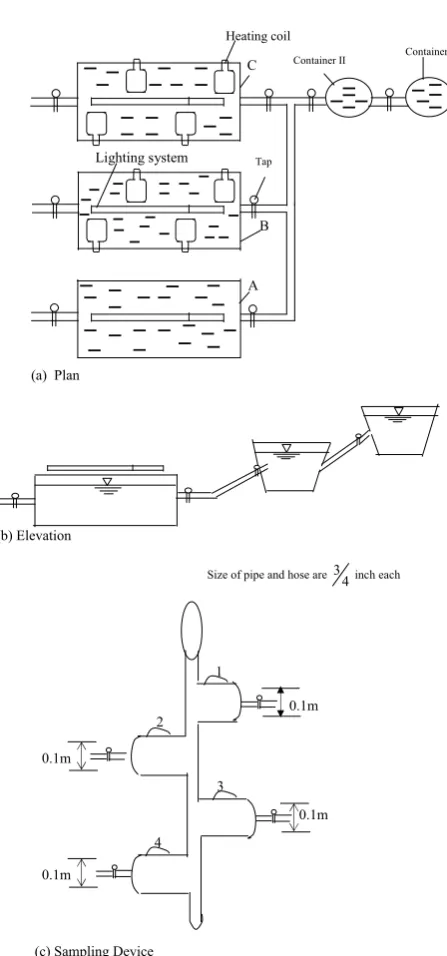
Figure 1 shows the laboratory set-up of three metallic tanks A, B, C (containing
sewage) fed simultaneously by plastic con-tainer II under gravity. This was achieved by systems of hoses and pipelines. Plastic con-tainer I supplied sewage to plastic concon-tainer II under gravity too. Each tank measured 2 x 0.5 x 0.4m while the capacity of each plas-tic container was 300litres. Aerobic conditions prevailed in both the plastic containers and the metallic tanks.
There was a lighting system over each tank. Tanks B and C contained heating coils at the bottoms; thermostatically controlled. Tank A was the control (without heating coils). Each tank also had control taps at both inlet and outlet.
Plastic container I was constantly being supplied with sewage because the flow dition throughout the entire set-up was con-tinuous. There was also a sampling device for collecting sewage at every 0.1m depth of each tank. It was numbered 1, 2, 3, and 4 to denote sewage samples collected from the surface to the bottom in that order. All sam-ples were preserved in such a way as to avoid any significant change in quality between the times of sampling and actual testing. Amer-ican standard methods were used throughout the analysis.
2.3. Sampling Technique
Table 1: Arithmetic average and standard deviationon of pond parameters*
T() pH (pH Units) DO (mg/l) SS (mg/l) COLIFORM (x104/ 100ml) BOD (mg/l)
B1 34±2.000 8.0±0 1.644±0.551 455.714±2.000 5.333±2.122 135.667±2.223 B2 34±2.000 6.4±0 1.526±0.538 21.429±2.006 9.667±2.222 101.333±1.004 B3 34±2.000 6.8±0 1.796±0.592 20±2.000 11±2.000 117.667±2.000 B4 34±2.000 7.5±0 1.554±0.634 17.143±2.000 15.333±2.221 85.667±1.740 C1 40±2.000 8.0±0 1.627±0.536 514.286±2.002 4.667±1.700 163±1,811 C2 40±2.000 7.5±0 1.793±0.528 29.714±2.000 4.333±1.886 131.667±1.222 C3 40±2.000 6.8±0 1.749±0.390 26.857±2.221 15.333±1.712 89.333±1.921 C4 40±2.000 6.4±0 1.583±0.449 23.857±2.000 8.667±1.500 103±2.411 *Average values of 7 sets of observations in T, pH, DO, SS, Coliform and BOD were based on 3 sets of observations
Table 2: Parameters and statistical properties*
STATISTICAL PROPERTIES Parameter Mean (mg/l) Standard deviation (mg/l) DO Pond A 2.122 0.569
B 1.630 0.590 C 1.688 0.487 SS Pond A 82.321 221.313
B 128.571 343.238 C 148.679 486.409 BOD Pond A 146.917 94.070
B 110.083 68.551 C 121.750 81.003
Coliform Pond A 20 x 104/ 100ml 40.694 x 10⁴/ 100ml B 10.33 x 10⁴/ 100ml 11.198 x 10⁴/ 100ml C 8.25 x 10⁴/ 100ml 10.361 x 10⁴/ 100ml *Notes same as in table 1
3. Analysis and Results
3.1. Characteristics of sewage control with respect to depth
The variation of pH, dissolved oxygen, bio-chemical oxygen demand, suspended solid, co-liform with depth are shown in figures 2 to 7. An average temperature of 27occurred in tank A (sewage control without heaters). Dissolved oxygen increased towards the sur-face. Dissolved oxygen was observed at all depths. Maximum and minimum values of dissolved oxygen (for tank A) were 2.499mg/l and 1.79mg/l respectively.
The pH showed marked variation with depth. Photosynthesis controls the pH value. As one approaches the surface, CO2 from
res-piration is no longer enough to satisfy the demand required by larger algae concentra-tion. Assimilation of the CO2 by algae causes
the disequilibrium of the carbonate balance. Therefore, the pH of the whole water in-creases. Maximum and minimum pH were 8.0 and 6.4 respectively.
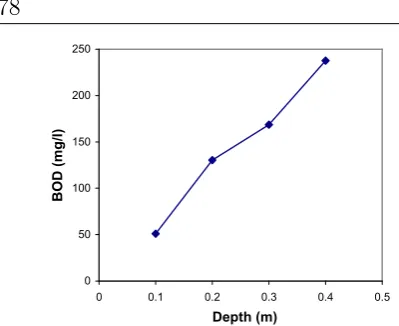
The vertical distribution of BOD was char-acterized by marked gradients of concentra-tion. Maximum (237.667 mg/l) and mini-mum (51 mg/l) occurred at the bottom and surface respectively. The occurrence of in-creased BOD towards the bottom was due to the anaerobic redissolution and digestion of the matter previously sedimented. The maxi-mum BOD reduction at the surface was asso-ciated with maximum DO, pH and tempera-ture.
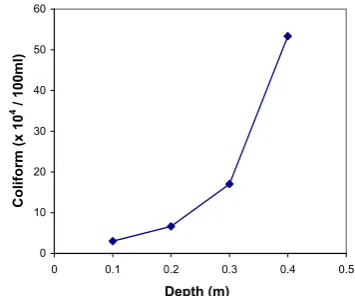
Coliform bacteria were higher at the bottom than on the surface. Due to higher photosyn-thetic activity at the surface, more bicarbon-ates available were utilized in the metabolic activity of algae, causing a reduction of bac-teria. Coliform concentration ranged from less than 3 x 10⁴ to 53.333 x 10⁴ per 100 ml.
!
"# $
& $
'(
'(
! %
'(
'(
Figure 1: Laboratory Set-Up.
takes place in ponds as shallow as 0.2 m [7].
3.2. Effect of changes in temperature on parameters with respect to depth
The variations of pH, SS, DO, BOD, Col-iform with depth are shown in tables 1 and 2. For tank B, as the temperature varied in the different test days, the pH values for 0.1, 0.2, 0.3, and 0.4m depths were 8, 6.4, 6.8 and 7.5 respectively while for tank C, it was 8, 7.5, 6.8, and 6.4 respectively. This was because mixing affects photosynthetic activity. Pho-tosynthesis controls the pH value.
In the dissolved oxygen test, as the tem-perature increased in the different test days, the DO levels fluctuated among the four depths. This was possibly because mixing has taken place and conveyed oxygen produced at the pond surface to the lower layers. In the suspended solid test, as the temperature changed, there was fluctuation in the trend because mixing helps to reduce thermal strat-ification of solids.
In the coliform test, fluctuation of coliform bacteria among the depths resulted possibly because mixing aids in dispersing bacteria and algae. In the BOD test, fluctuation of BOD values among the four depths resulted possi-bly due to the distribution of the digested, previously sedimented matter necessitated by mixing.
%& $ $ $ $ $
Figure 2: Relationship between average tempera-ture and depth for tank A.
! " # $ $ $ $ $
Figure 3: Relationship between pH and depth for tank A.
pond C (1.688 mg/l) and then pond B (1.63mg/l). The mean suspended solid was highest in pond C (148.679mg/l), followed by pond B (128.571mg/l) and then pond A (83.321mg/l). The mean BOD was high-est in pond A (146.917mg/l), followed by pond C (121.750mg/l) and then pond B (110.083mg/l). The mean faecal coliform was highest in pond A (20 x 104/ 100ml), followed
by pond B (10.333 x 10⁴/ 100ml) and then pond C (8.25 x 10⁴/ 100ml).
3.4. Implication on the efficiency of waste stabilization pond
The general trend showed marked reduction in suspended solid, coliform, dissolved oxygen,
$ $ $ $ $ $
Figure 4: Relationship between DO and depth for tank A. '' $ $ $ $ $
Figure 5: Relationship between SS and depth for tank A. *& $ $ $ $ $
$ $ $ $ $
Figure 7: Relationship between BOD and depth for tank A.
biochemical oxygen demand as the tempera-ture increased. This implied a high hydraulic efficiency. It also implied that the operating and environmental conditions were good.
4. Conclusions and Recommendations
From the results of investigations into the effect of temperature changes on pond mixing and performance, the following conclusions were drawn: Temperature changes affected mixing which invariably had significant effect on pond performance. The variability of pH value with respect to depth fell within the al-kaline range, confirming that sewage is strictly alkaline in nature. The control (that is, tank A) at an average temperature of 27showed increase in biochemical oxygen demand, col-iform, and suspended solid with depth. Dis-solved oxygen was highest at the surface for tank A (sewage control, without heaters).
Tanks B and C showed general fluctuations in dissolved oxygen, biochemical oxygen de-mand, suspended solid, coliform and pH with changes in temperature. This was attributed to mixing caused by the heating coils be-ing positioned at the bottom of the tanks. The shallow nature of the tanks depth could equally have caused it.
Since temperature has effects on several other parameters other than reaction con-stant, it is important to reflect this effect in future pond modeling in order to ensure more accurate results.
References
1. Hamzeh R. and Victor M.P.Design and Per-formance of Waste Stabilization Ponds Sta-bilizationponds.sdsu.edu/
2. Arar A. (1988) Background to Treat-ment and Use of Sewage Effluent. Ch.2,
Treatment and Use of Sewage Effluent
for Irrigation, M.B. Pescod and A. Arar
(eds).Butterworths, Sevenoaks, Kent. 3. Boutin, P., Vachon, A. and Racault, Y.
(1987). Waste Stabilization Ponds in France: an overall view. Water Science and Technology, 19 (12), pp.25-31.
4. Bucksteeg, K. (1987). German Experiences with Sewage Treatment Ponds. Water Sci-ence and Technology, 19 (12), pp.17-23. 5. EPA (1983). Design Manual: Municipal
Wastewater Stabilization Ponds. Report No. EPA-625/1-83-015. Cincinnati: Environ-mental Protection
6. Droste, R. L. (1997). Theory and Practice
of Water and Wastewater Treatment. John
Wiley and Sons. New York, USA.