THE EFFECTS OF INTERCRITICAL HEAT
TREATMENTS ON THE MECHANICAL
PROPERTIES OF 0.14WT%C 0.56WT%Mn
-0.13WT%Si STRUCTURAL STEEL
P.O. Offora, C.C. Daniel, B.A. Okorie
Department of Metallurgical And Materials Engineering, University Of Nigeria, Nsukka, Nigeria.
aEmail: [email protected].
Abstract
Effect of intercritical heat treatment on 0.14wt%C 0.56wt%Mn 0.13wt%Si struc-tural steel has been investigated. Specimens for single quenching and those for double quenching were prepared for intercritical heat treatment. The heat treat-ment of the experitreat-mental steel was based on intercritical annealing in the ferrite + austenite temperature range of the Fe - C phase diagram at temperatures 745◦C, 755◦C, 765◦C, 775◦C, 785◦C, 795◦C and 805◦C for 1 hour at each temperature in a laboratory muffle heat treatment furnace followed by quenching in plain water to room temperature. Specimens for single quenching were subjected to the above heat treatment route once while those for double quenching were subjected to the heat treatment route twice. Afterwards the specimens that were subjected to sin-gle quenching and those that were subjected to double quenching were separately tempered in a laboratory muffle heat treatment furnace at a temperature of 200◦C for 1hour and cooled to room temperature in still air. The results revealed that single quenching eliminated the yield strength, increased the tensile strength and hardness properties but decreased the ductility and notch impact toughness prop-erties of the experimental steel. Moreover, the results also revealed that double quenching eliminated the yield strength, and produced a greater increase in tensile strength and hardness properties than single quenching but a greater decrease in the ductility and notch impact toughness properties than single quenching of the experimental steel. Tempering increased the yield strength, ductility and notch im-pact toughness properties of the quenched steels but decreased their tensile strength and hardness properties. The established heat treatment conditions can be useful for manufacturing steels of high strength and hardness and good ductile and notch impact toughness properties.
Keywords: intercritical heat treatment, single and double quenching, mechanical properties
Symbol notation σt tensile strength
σy yield strength
δ ductility
H hardness
BHN Brinnel hardnes number
an notch impact toughness
dq double quenched sample
sqt single quenched and tempered sample
dqt double quenched and tempered sample
1. Introduction
The automotive industry aims at the pro-duction of vehicles with low weight, fulfill-ing high requirement concernfulfill-ing the safety improvement, the reduced fuel consumption and the limitation of the emission of harm-ful exhaust gases. In order to meet these de-mands, the optimization of well known ma-terials and searching for new mama-terials with a high ratio of strength to density and suit-ability for metal forming operations are still carried out. The requirements of the automo-tive industry are often met by micro alloyed structural steels [1 - 4]. In the modern auto-motive hot-rolled plates of micro alloyed steels are often used. Besides micro alloyed steel plates, cold - rolled sheets of BH - type (back hardening) and IF - type (interstitial free) structure are used [1, 5 - 8]. A special group of interest are steels of multiphase structure. They exhibit a superior strength-ductility bal-ance compared to conventional steels. These are sheets of the ferriticmartensitic (DP -dual phase) [1, 9, 10], ferritic-bainitic struc-ture with the retained austenite showing trip (transformation induced plasticity) effect [1, 11, 13] and complex multiphase cp-type struc-ture (CP - complex phase). The interest in re-spect of the stability for metal forming opera-tions is also connected with high - manganese steels of austenitic structure. To strengthen these steels the mechanical twinning during the technological deforming is used (TWIP ef-fect – Twinning induced plasticity) [1, 14, 15,]. Selection of a steel grade for a particular strength level should take into account the expected loads in forming. In this way the individual advantages can be optimally ex-ploited and the steel can also be used for dif-ficult drawn parts. The good work harden-ing properties, expressed by a relatively high n - value, make dual phase steels particularly
Table 1: Chemical composition of the steel used (wt %) with its critical temperature (calculated).
C Mn Si Ni S AC1(◦C) AC3(◦C)
0.14 0.52 0.13 0.04 0.001 725 831
Table 2: The mechanical properties of the experimen-tal steel in its original state.
σy σt δ H an
N/mm2 N/mm2 % BHN J/cm2
236.73 416.65 32.14 161 68.24
suitable for severe stretch forming. Due to their balanced ferrite and martensite contents they offer a particularly attractive combina-tion of high strength, low yielding-to-tensile ratio, good cold formability, and weldability [16].
2. Objectivies of the Study
The objectives of this work are to investi-gate the effects of intercritical annealing tem-peratures, single quenching, double quenching and low temperature tempering on the me-chanical properties of 0.14wt%C - 0.56wt%Mn - 0.13wt%Si structural steel.
3. Materials and Methods 3.1. Materials
The investigations were made using the specimens made from the experimental hot rolled 16mm (5/8inch) steel rod. The chemi-cal composition and the critichemi-cal temperatures of the experimental steel are given in Table 1. The mechanical properties of the experimen-tal steel in its original as hot - rolled state are given in Table 2.
3.2. Methods
In order to design suitable heat treatment conditions, the knowledge of critical temper-atures Ac1 and Ac3 for the austenite phase is
needed. They were calculated using Andrews’ equations [1, 17 - 20]. The calculated tem-peratures of the investigated steel are AC1 =
Intercritical Heat Treatments and Mech. Props. of Structural Steel
The specimens used for the present work were machined from the investigated steel. Specimens for single quenching and those for double quenching were prepared for intercriti-cal heat treatment. The heat treatment of the experimental steel was based on intercritical annealing in the ferrite + austenite tempera-ture range of the Fe-C phase diagram at tem-peratures 745◦C, 755◦C, 765◦C, 775◦C, 785◦C, 795◦C and 805◦C for 1 hour at each temper-ature in a laboratory muffle heat treatment furnace and quenched in plain water to room temperature. Specimens for single quenching were subjected to the above heat treatment route once while those for double quenching were subjected to the heat treatment route twice. Afterwards the specimens that were subjected to single quenching and those that were subjected to double quenching were sep-arately tempered in a laboratory muffle heat treatment furnace at a temperature of 200◦C for 1hr and cooled to room temperature in still air. The quenched specimens were tem-pered to improve their ductility and notch im-pact toughness. After the heat treatment of the specimens, tensile tests were carried out at room temperature using 10 ton universal test-ing machine. Brinell hardness testtest-ing method was used to determine hardness while Charpy impact testing machine was used for the de-termination of the notch impact toughness.
4. Results and Discussions
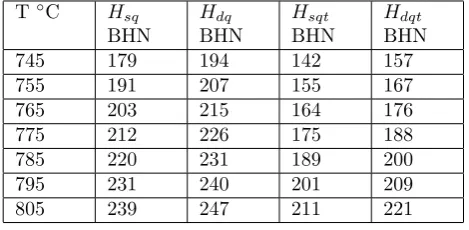
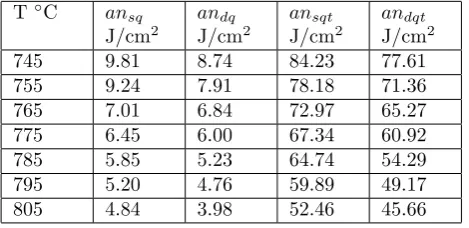
The results of the measurements made are tabulated in Tables 2 - 6.
A critical examination of Tables 2 - 6 re-veals that single quenching eliminated the yield strength increased the tensile strength and hardness properties but decreased the ductility and notch impact toughness prop-erties of the experimental steel. Moreover, the tables also revealed that double quench-ing eliminated the yield strength, and pro-duced a greater increase in tensile strength and hardness properties than single quench-ing but a greater decrease in the ductility and
notch impact toughness properties than single quenching of the experimental steel. The me-chanical properties of dual-phase steels arise from structural features, that is the fine dis-persion of hard martensite particles in a duc-tile ferrite matrix and all the related phenom-ena that accompany the “coexistence” [21]. The contributions of hardening mechanisms in martensitic structure according to [17, 22] in-clude the solid solution substitution element hardening, the precipitation hardening, the primary austenitic grain size hardening and the martensite morphology hardening. The dominant hardening effect of martensite in dual phase steels is the carbon concentration in martensite. It is relatively difficult to for-mulate regression equations for the contribu-tions of the individual hardening mechanisms in martensite, as it is possible for polygonal ferrite, since it is impossible to separate indi-vidual hardening mechanisms [22].
Table 3: Strength properties of the heat treated steel specimens.. T◦C σysq
N/mm2 σydq
N/mm2 σysqt
N/mm2
σydqt
N/mm2 σtsq
N/mm2 σtdq
N/mm2 σtsqt
N/mm2 σtdqt
N/mm2
745 - - 210.98 217.71 494.69 505.28 466.38 473.17
-755 - - 230.13 234.86 515.74 522.44 486.16 498.64
-765 - - 265.81 273.54 543.51 553.71 500.12 524.35
-775 - - 285.66 294.66 568.41 599.83 545.8 562.84
-785 - - 310.46 316.52 650.17 658.36 611.33 617.19
-795 - - 340.27 350.49 672.94 696.45 636.48 660.21
-805 - - 357.63 453.97 713.19 737.97 676.32 704.73
-in the structure is -increas-ing), with decrease of ductility and notch impact toughness [17, 24]. The higher the annealing temperature selected in the intercritical temperature zone, the more austenite forms and transforms to martensite, but the less carbon content in this martensite [23]. The increase in hard-ness, with the increase in intercritical an-nealing temperature has been attributed to the increase in volume fraction of martensite (austenite before quenching) which is a strong load-bearing phase in ferrite-martensite dual phase steels. Increasing the volume fraction of martensite decreases the interface of the fer-rite and martensite and therefore, the number of suitable places for nucleation and propaga-tion of cracks decreases [23].
The excellent ductility reported for most of the dual phase steels is the combined result of many factors. Among them are the volume fraction and the carbon content of martensite, topological parameters such as the martensite grain distribution in the ferrite matrix, the al-loy content of ferrite, the dislocation density in ferrite, the presence of carbides and/or re-tained austenite [22].
Tempering may be applied as part of the process in some continuous annealing lines, af-ter waaf-ter-quenching in inaf-tercritical treatment, to regulate the properties of the dual phase steel. After tempering at low temperatures, the yield strength increases. Discontinuous yielding returns only to the steels contain-ing only low volumes of martensite. When tempering at high temperatures, the yield strength decreases but discontinuous yielding
Table 4: Ductility properties of heat treated steel specimens.
T◦C σsq % σdq % σsqt % σdqt%
745 10.31 7.18 14.74 12.01
755 9.48 6.12 13.91 11.86
765 7.99 5.85 13.24 10.29
775 7.54 5.48 12.17 9.77
785 6.52 4.72 10.89 8.51
795 5.84 3.76 9.72 7.64
805 4.02 2.72 8.21 6.12
Table 5: Hardness properties of heat treated steel specimens.
T◦C Hsq
BHN
Hdq
BHN
Hsqt
BHN
Hdqt
BHN
745 179 194 142 157
755 191 207 155 167
765 203 215 164 176
775 212 226 175 188
785 220 231 189 200
795 231 240 201 209
805 239 247 211 221
appears in all steels. The tensile strength de-creases while post uniform and uniform elon-gations increase due to change in hardness of martensite [22].
5. Conclusions
Intercritical Heat Treatments and Mech. Props. of Structural Steel
Table 6: Notch impact properties of heat treated steel specimens.
T◦C ansq
J/cm2
andq
J/cm2
ansqt
J/cm2
andqt
J/cm2
745 9.81 8.74 84.23 77.61
755 9.24 7.91 78.18 71.36
765 7.01 6.84 72.97 65.27
775 6.45 6.00 67.34 60.92
785 5.85 5.23 64.74 54.29
795 5.20 4.76 59.89 49.17
805 4.84 3.98 52.46 45.66
to a decrease in tensile strength and hard-ness and an increase in ductility and notch impact toughness of the as hot rolled steel. Tempered steels presented the better com-promise between strength, hardness, ductility and notch impact toughness. Single quench-ing eliminated the yield strength, increased the tensile strength and hardness properties but decreased the ductility and notch im-pact toughness properties of the experimental steel. Double quenching eliminated the yield strength, and produced a greater increase in tensile strength and hardness properties than single quenching but a greater decrease in the ductility and notch impact toughness proper-ties than single quenching of the experimental steel. Tempering increased the yield strength, ductility and notch impact toughness prop-erties of the quenched steels but decreased their tensile strength and hardness proper-ties. The established heat treatment condi-tions can be useful for manufacturing steels of high strength and hardness and good ductile and notch impact toughness properties.
References
1. Adamczyk, J. and Grajcar, A., Effect of Heat Treatment Conditions on the Struc-ture and Mechanical Properties of DP-type steel, Journal of Achievement in Materials and Manufacturing Engineering, vol.17, is-sue 1-2, 2006, pp.305-308.
2. Adamczyk, J; Engineering of Metallic Ma-terials Widawnictwo Politeckniki Slaskiej, Gliwice 2004.
3. DeArdo, A. J., Modern Thermo mechani-cal Processing of the International Confer-ence Micro Alloyed Steel, Proceedings of the International Conference Microalloying ’95 Pittsburgh, 1995,15 33.
4. Gladman, T., The Physical Metallurgy of Micro Alloyed Steels, University. Press Cambridge, 1997.
5. Bleck, W., Cold-Rolled High-Strength Sheet for Auto Applications,Journal of Materials 48, 1996.
6. Alderdice, R. and Campbell, E. A., Pro-cess Plant Implication of ULSAB and High Strength Auto Body Steels,Iron Making 25, 1998, pp. 435-445.
7. Bleck, W., Deng, Z. and Papamantellous, K., A Comparative Study of the Forming-Limit Diagram Models for Sheets steels, Journal of Materials Processing Technology 83, 1998 pp.223-230.
8. Takechi, H., Application of if Based Sheet in Japan, Proceeding of the International Conference on the Processing, Microstruc-ture and Properties, of IF Steels Pittsburgh 2000, pp.1-12.
9. Mondal, D. K. And Ray R. K., Micro Struc-tural Changes and Kinetics Recrystalliza-tion in a few Dual Phase steels, Steel Re-search 60, 1989, pp.33-40.
10. Lis, A. K. and Grajcar, B., Modelling of the DP and TRIP micro structure in the CMnAlsic automobile steel. Proceeding of the 11th International Scientific confer-ence (CAMS 2005), Gliwice-Zakopane,2005 pp.585-591.
11. Adamczyk, J. and Grajcar, A; structure and mechanical properties of DP-type and trip-type sheets, Journal of Processing Technol-ogy 162 163, 2005 pp.23-27.
13. Zrnik, J; Lukas, P., Novy, Z. and Jencus, p, In Situ investigation of transformation ki-netics in Si-Mn TRIP Steel, proceedings of the 12th Scientific international conference (AMME 2003) Gliwice Zakopone, 2003, pp. 1083-1086.
14. Vercamme, S, Blanpain, B., De Cooman, B.c. and Woolants, P., An austenitic Fe-30Mn-3Al-3Si TWIP-steels, Acta Materilia 52, 2004, pp.2005-2012.
15. Allain, S., chateau, J.P. and Bouaziz, O., Constitutive model of high manganese con-tent austenitic steel, Steels Research 73, 2002, pp. 299-302.
16. Thyssenkrupp Steels Europe, Updated pro-duction information dual-phrase steels, 2009, pp.1-15.
17. Offor, P. O., The Effect of Diverse Heat Treatments on the Mechanical Properties of Structural Steels, M.Eng. Thesis, ESUT, Enugu, 1993.
18. Htun, M. S., Kyaw, S. T. and Lwin, T; Ef-fect of heat treatment on microstructures and mechanical of spring steelJour. of met, mat and min. Vol. 18 No. 2, 2008. pp. 191-197.
19. Andrews, K. W., Emperical Formular for the calculation of some transformation temper-atures,J. iron steels Institute 1965, 203:721-727.
20. Steven, W. and Haynes, A.G., the Tempera-ture of formation of Martensite and Bainite in Low Alloyed steels,J. iron steels institute, 1956 183:349.
21. Prodromos T., Mechanical properties of dual-phase steels, Doktor Ingenieurs (Dr. Ing.) genehmigten Dissertation, Technis-chen Universitat Munchem, Munich, 2006, pp. 14-15.
22. DuponM., Parilak L., Kollarova M.and Sinaiova I., Dual Phase Ferrite-Martensitic Steel Micro-Alloyed with V-Nb,Metallurgija 4 (2007) 1, 15-2004 pp. 247-255.
23. Abouei, V., Saghafian, H., Kheirandish, Sh. and Ranjbar, Kh., A Study on the Wear Be-haviour or Dual Phase Steels,J. Mater. Sci. Technol., Vol.23 No.1, 2007, pp. 107-110.