REPORTING TRILOGY – RESEARCH ON SUSTAINABILITY REPORTING IN AUSTRALIA: PART 3
Foreword 4
Global Context 4
Australian Context 4
Human Capital Management and Sustainability 5
Research Methodology 6
Research Results 7
Overall 7
Criteria Group Results:
Strategy and Governance 9
Management and Performance 10
Culture 11
Recommendations 13
Conclusion 14
Acknowledgments 15
Appendix 1 16
About the Authors and Criteria
Appendix 2 17
Annotated Bibliography
Appendix 3 20
Global Reporting Initiative G3 Guidelines and Indicators Relevant to Human Capital Management
Appendix 4 21
Top 50 ASX Companies Sustainability Reporting Practises
Appendix 5 22
Glossary of Terms
Appendix 6 23
This report is the third of a trilogy of research projects carried out by the Association of Chartered Certified Accountants (ACCA) Australia/NZ, in collaboration with Net Balance Foundation Limited. This research series investigated three key areas of sustainability reporting by analysing the level and quality of disclosures by large Australian corporations. The first two reports documented disclosures on: Stakeholder Engagement (March 2007); and Climate Change (May 2007)2. This report records disclosures on Human Capital Management.
A Human Capital Management (HCM) way of thinking is fundamentally different from Human Resource Management thinking, requiring different skills and approaches to management of the workforce. HCM is a topic which is becoming increasingly important for Australian companies to demonstrate how the effective and fair management of an organisation’s employees can affect overall business strategy and performance. It requires a strategic approach to managing organisations’ human capital assets, and in doing so developing business mechanisms that ensure:
• employee turnover is kept to an acceptable level to ensure organisational knowledge and learning is retained;
• the workforce is developed to the maximum capacity, driving productivity;
• employee engagement (satisfaction) is at the highest level; and
• employees are incentivised to perform to as high a standard as possible.
Leading organisations are considering how HCM practices contribute to increased sales and productivity and intangibles such as reputation and straight business (financial) performance. Many have decided to communicate their findings to
stakeholders via sustainability reports, annual reports and corporate websites as well as internally to employees.
This report examines the level and quality of HCM disclosures from the 50 largest publicly listed Australian companies’ (ASX top-50) efforts and identifies HCM disclosure trends among the top-50 ASX, outlining the strengths and weaknesses of companies’ approaches and makes recommendations for future reporting.
Global Context
As issues relating to risk drive an increased demand for disclosure in global markets, strengthening the quality of these disclosures, including intangibles, will help stakeholders such as investors, customers, suppliers, partners and employees, make more informed decisions. Improvements will also enable governments and organisations to better understand those contributions made to the economy based on intellectual skills.3
Poor HCM continues to be cited as one of the most significant risks facing global corporations. Research by the Economist Intelligence Unit, based on surveys of 218 executives around the world, found that confidence amongst risk managers is weakest in less traditional areas such as human capital and climate change.4The survey also revealed that at the same time external drivers to strengthen risk management include demands from investors for greater disclosure and accountability.5
A survey of chief executives by McKinsey Quarterly found CEOs identified talent constraints, poor public governance and climate change as the issues most critical for their companies to address.6
Another study published by the Chartered Institute of Personnel and Development (CIPD) found that although investors value any information that enhances understanding of how the business works and makes money, the current style and level of human capital management disclosures does not currently assist investors to make better informed judgements about long-term economic performance.7
A second report from the CIPD states, “while many organisations have had a great deal of success in developing their HCM data, few have reached a point where they can provide the kind of forward looking performance data that would be useful in guiding the business strategy and information for external stakeholders, including the investment community”.8
Research findings from these kinds of reports indicates that HCM reporting is considered important by the investment community (as well as other stakeholders), but that currently the standard and style of disclosures needs to be improved for it to be of real use to decision-making.
Australian Context
This report comes at a critical time for Human Capital
Management (HCM) in Australia. With the country experiencing the highest levels of employment in over 20 years, employers are facing great challenges in attracting and retaining the talent they need for business to succeed. The Australian Bureau of Statistics published the following information, “Since 1995, Australia’s estimated resident population aged 45 years and over has increased by 30%. In contrast, the number of children (aged 0 to 14 years) has increased 2.3%, and the number of people aged 15 to 44 years has increased 4.8%.”9
This gradual ageing of Australia’s population, combined with Baby Boomer retirement and one million Australians living overseas, has inevitably caused a shortage of labour supply in the marketplace, thus forcing employers to engage in a ‘war for talent’ in order to overcome the skills shortage.10
Despite high levels of employment and greater choice for potential employees, according to The Human Rights and Equal Opportunities Commission (HREOC), many Australian workers are not satisfied with their work, do not feel secure in their roles, and are not coping with managing the competing interests of paid work with responsibilities outside their job. HREOC’s report entitled It’s About Time: Women, men, work and Family,11 published in March 2007, found that Australia is the only OECD country to combine a culture of long working hours with contract labour.
Meanwhile, Generation Y employees are simply refusing to play by the rules of the work culture developed by their Generation X and Baby Boomer colleagues.These employees are increasingly making value-based assessments about who they work for. They also expect their employers to provide flexibility and fun in the workplace..12
These shifts in employees’ expectations have taken place in a rapidly changing industrial relations (IR) landscape. Australians remain divided on IR issues, with ‘Work Choices’ being one of the issues hotly debated in the 2007 Federal Election. Employee concerns about the impact of Work Choices are out of step with the expectations they have of employers and how they value work. Despite evidence of superior business results for workplaces where high levels of trust exist between employers and employees,13mistrust was a central theme in the Work Choices debate with a number of voters (employees) lacking trust in the intent of the legislation.
Speaking at Ethical Investor’s Sustainable Human Capital Management Conference in March 2007, John Rawlinson, CEO Talent2International, shared this insight: “When I started my job as a recruiter 20 years ago, I used to spend all my time listening to candidates sell themselves as the best candidate for the job. I now spend all my time selling the client to the candidate.”
In this context Human Capital Management has come of age. The leaders among Australia’s largest employers are taking a strategic approach to managing, recruiting, developing and retaining their talent. Australia’s top companies’ CEOs covet a place on lists such as Hewitt’s Best Employers, recognising that such an accolade will increase brand profile, raise the level of pride existing employees have in their organisation and attract talented job applicants their way.
As employees look to HCM disclosures for assurance about the type of workplace a potential employer provides; investors have begun factoring HCM disclosures into their decision making. A good example of this is Macquarie Equities’ decision in 2006 to favour ANZ Bank stocks over National Australia Bank (NAB); a significant influence in this decision was ANZ’s high ‘people score’. ANZ’s team was found to be highly-motivated, which was considered to be an asset. John McFarlane, former CEO of ANZ, indicated the value in this, highlighting that “soft or ‘intangible’ assets … hold the key to a company’s long-term performance.”14
The challenge is how Macquarie and other stakeholders translate ‘human capital’ and less tangible assets into quantifiable numbers or relevant data for reporting.
Human Capital Management and Sustainability
The Bruntland definition of sustainable development is that which “meets the needs of the present without compromising the ability of future generations to meet their own needs.”15In this context, Human Capital Management practices fall into two distinct ‘sustainability’ spheres. First, the sustainability of how an organisation’s people strategy, governance, systems, practises, processes and organisational culture contribute towards making a company a great workplace. The second relates to the ways in which people are engaged in both the development and
implementation of an organisation’s sustainability practices.
As such, Human Capital Management practitioners’ expertise relates to the following areas of sustainability:
• The treatment of talent within an organisation (e.g. non-discrimination, benefits, equity, employee health and wellbeing).
• Improvement of employees’ conduct in how they deliver against organisational objectives (e.g. ethics, culture, values and business goals).
• Employees’ engagement with stakeholders outside the organisation, (e.g. employee volunteering, payroll giving, liaison with customers and shareholders).
• Organisational approaches to second generation (contractors) and third generation (suppliers) employees, on matters relating to engagement, performance, health and safety, human rights and labour relations.
In ACCA and Net Balance Foundation’s first two research reports in this trilogy, Disclosures on Stakeholder Engagementand Disclosures on Climate Change, findings showed ASX top-50 companies are increasingly reporting on their sustainability performance (but there is progress to be made in the standard of most organisations’ disclosures). In line with global best practise trends,16the reports also indicated that companies recognised as ‘sustainability leaders’ are increasingly reporting on how their approach to managing sustainability has become an integral part of their core business strategy. Additionally, organisations are more frequently engaging stakeholders, including investors, civil society organisations such as environmental groups and NGO’s, shareholders and employees, to contribute to the way in which corporate strategy is developed.
Our assessment of the HCM practises of the top-50 ASX companies has also revealed this trend. The findings of our research show organisations are increasingly disclosing their approach to managing people as an integral part of their core business strategy. Moreover, many organisations’ employees are being engaged in how core business strategy is being developed.
While it is encouraging that companies are increasingly engaging their workforce in core strategy decision-making and disclosures are indicating they are incorporating HCM into business risk strategy considerations, organisations are still facing significant challenges in areas relating to:
• attraction, retention and development of a talented workforce;
• creating work-life balance for employees;
• reducing high levels of absenteeism with a link to work-related stress;
• eliminating inequality in pay for men and women;
• sharing private equity and reducing the discontent it can bring between labour and owners;
• developing measurable human capital indicators to report on HCM performance; and
• ensuring organisational culture strategy compliments, rather than competes with, organisational sustainability strategy.
This report summarises the findings of research carried out by an independent analyst on the largest 50 Australian companies (by market capitalisation) as recognised by the Australian Securities Exchange (ASX) Top 50 index as at 31st July 2007.
The 50 Australian companies are listed in Table 2 below. The research on company disclosures was conducted between 31st July and 14th September 2007. Assessment of research findings
was based on a series of criteria developed by Net Balance Foundation Limited, ACCA and an independent expert in the field. The criteria were divided into the following three groups with their respective indicators shown in the table below. Appendix 2 and 3 refers to research studies and Global Reporting Initiative (GRI) indicators used to guide the
development of criteria outlined in Table 1 and write this report. A glossary of terms is also provided in Appendix 5.
[image:6.595.28.542.222.534.2]Research methodology
Table 1 – Subject areas covered by HCM criteria used in the analysis
Strategy & Governance (30%)
Strategic Intent Clear demonstration of commitment in the organisation’s core operating strategy or business line to actively addressing human capital issues.
Materiality To what extent an organisation has attempted to define and prioritise which HCM issues are significant to achieving agreed performance and objectives.
Governance The structure and accountabilities in place for management and decision making on human capital issues. This will include company policies, codes of ethics and membership of any external bodies.
Engagement How the organisation captures inputs from chosen stakeholders, what informs their decision-making on human capital issues and how they demonstrate responsiveness to feedback they receive.
Assurance Whether an organisation adheres to any internationally recognised frameworks or standards that seek to provide structure and verification of management of sustainability and human capital issues
Management & Performance (50%)
Management The organisation’s approach to managing HCM issues. This incorporates demonstrating: • management accountability
• methods for developing and communicating organisational policies and systems
• informing stakeholders on how they measure performance, and clarifying channels for communicating and responding around these issues.
HCM impact areas might include anywhere the failure to act on human capital related risks would have a noticeable impact on the outcome for the business. For example – retention, diversity, OH&S, recognition and reward.
Performance The data produced by the processes an organisation has in place to measure performance against material human capital issues with a view to achieving clear, established targets.
Culture (20%)
Values Evidence of organisational commitment to material HCM issues being incorporated into the key values that run through every level. For example demonstrated management or employee behaviours – ‘walking the talk’. External Recognition Commendation in external benchmarking exercises or achieving issue specific recognition awards
TOTAL (100%)
Information used in the analysis was sourced from hard copy sustainability reports,17environmental reports, web-based reports and social and environmental information included in annual reports and associated accounts. Many organisations still did not include HCM as a sustainability issue but more frequently included it as a general business issue. Information contained
on websites and annual reports was also included even when it was not found in sustainability reports. A summary of top ASX companies’ sustainability reporting practices is given in Appendix 4. A total of 50 reports were analysed of which 15 per cent were verified by a secondary researcher.
Table 2 – The ASX Top 50 Companies used in the analysis
1 Alinta Limited 2 Alumnia Limited 3 AMP Limited 4 ANZ Banking Group 5 ASX Limited 6 AXA Asia Pacific 7 Babcock & Brown Ltd 8 BHP Billiton Ltd 9 Bluescope Steel Ltd 10 Brambles Ltd 11 Coca-Cola Amatil 12 Coles Group Ltd 13 Commonwealth Bank
14 CSL Limited 15 Fairfax Media Ltd 16 Fortescue Metals Group 17 Foster’s Group
18 Goodman Group 19 GPT Group
20 Insurance Australia Group 21 Leighton Holdings 22 Lend Lease Corporation 23 Macquarie Airports 24 Macquarie Bank Ltd 25 Macquarie Infrastructure 26 National Australia Bank
27 Newcrest Mining 28 News Corporation 29 Orica Limited 30 Origin Energy 31 Publishing &
Broadcasting Ltd 32 Qantas Airways 33 QBE Insurance Group 34 Rinker Group Ltd 35 Rio Tinto Ltd 36 Santos Ltd 37 St George Bank 38 Stockland
This report summarises the findings of research carried out by an independent analyst on the largest 50 Australian companies (by market capitalisation) as recognised by the Australian Securities Exchange (ASX) Top 50 index as at 31st July 2007.
The 50 Australian companies are listed in Table 2 below. The research on company disclosures was conducted between 31st July and 14th September 2007. Assessment of research findings was based on a series of criteria developed by Net Balance Foundation Limited, ACCA and an independent expert in the field. The criteria were divided into the following three different groups with their respective indicators shown in the table below. Appendix 2 and 3 refers to research studies and GRI indicators used to create the criteria outlined in Table 1 and write this report. A glossary of terms is also provided in Appendix 5.
Overall
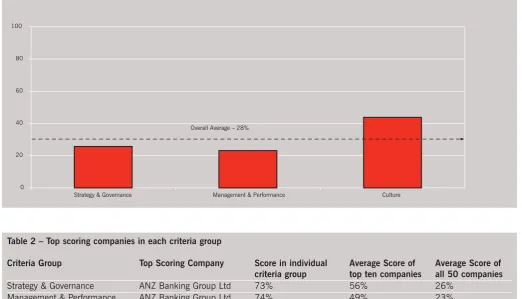
As in the previous studies on Stakeholder Engagement and Climate Change, there is a large variation in performance of the companies included in this study. The overall scores against all criteria (a total of 100) ranged from 75% scored by one company (ANZ Banking Corporation Limited), to under 10% scored by ten companies, to 0% scored by three companies. The average score of all 50 companies was just 28% illustrating that there is significant progress to be made on HCM disclosures for the majority of the companies included in the research (see Figure 1 below). The same was true of the individual criteria groups – scores ranged from 100% right down to 0% (see Table 2 for the top scoring companies in each criteria group).
Research results
0 20 40 60 80
Strategy & Governance Management & Performance Culture 100
Overall Average – 28%
[image:7.595.49.572.294.593.2]Figure 1 – Overall average percentage of the ASX 50 companies in each of the criteria groups
Table 2 – Top scoring companies in each criteria group
Criteria Group Top Scoring Company Score in individual Average Score of Average Score of
criteria group top ten companies all 50 companies
Strategy & Governance ANZ Banking Group Ltd 73% 56% 26%
Management & Performance ANZ Banking Group Ltd 74% 49% 23%
Culture Coles Group Limited 100% 70% 44%
The top ten companies’ overall performance (based on score out of 100) ranged from 75% (ANZ Banking Limited) to 41% (Newcrest Mining) with only three companies scoring 60% and over (see Figure 2). This is lower than the scores of the top ten companies which featured in our previous research on
sustainability reporting in Australia into ‘Disclosures on Climate Change’,18where scores ranged from 82% to 43%. This indicates that companies are finding Human Capital
0 10 20 30 40 50 60 70 80 90 100
ANZ Banking Grp Ltd
Westpac Banking Corp
Bluescope Steel Ltd
National Aust. Bank
Foster's Group
Insurance Australia
BHP Billiton
Limited
Transurban
Group stapled
Santos Ltd Newcrest Mining
Figure 2 – Top Ten Performing Australian companies in the ASX 50
0 10
Food & Beve
rage
Banki
ng & Fi nance
Teleco
mmun
icatio
ns
Dive
rsified I
ndust
rial
Mini
ng & Reso
urces
Industr ials*
Healthca
re* Gam
ing
Energy Retail
Buildi
ng & Co nstru
ction *
Prope
rty Invest
ment
Infrast ructur
e
Tran sport*
Manu factur
ing* Media Logistics* 20 30 40 50 60 70 80 90 100 Sco r e ( % )
* only one company in this sector
Figure 3 – Average overall score for each sector
These top ten scoring companies were from a variety of different industry sectors including Mining and Resources, Banking and Finance, Insurance, Building and Construction and Energy (see
[image:8.595.38.546.119.328.2] [image:8.595.30.545.434.639.2]ANZ Banking Grp Ltd
Westpac Banking Corp
Bluescope Steel Ltd
National Aust. Bank
Foster's Group
Insurance Australia
BHP Billiton
Limited
Transurban
Group stapled
Santos Ltd Newcrest Mining 0 10 20 30 40 50 60 70 80 90 100 Sco r e ( % )
Figure 4 – Performance of top ten ASX companies in Strategy and Governance criteria group Criteria Group Results
Strategy and Governance
Performance by the ASX 50 companies against the strategy and governance criteria varied, with scores ranging from 73% to 0%.
Ten companies out of the 50 scored 10% and seven companies scored 50% and over – all of which were included in the overall top ten (see Figure 4).The average score across all companies in the strategy and governance criteria group analysis was just 26%.
Performance against individual indicators also varied in the strategy and governance criteria. For the less challenging reporting areas, for example, disclosing information on the number of employees, most companies (42 in this case) fulfilled the criteria. However, for criteria such as disclosing information on programs for employee input in decision-making or
remuneration schemes linked to non-financial performance, the number of companies disclosing was much less (13 and 11 companies respectively). Twenty two companies did not systematically identify the human capital issues that are considered important for the business.
Most companies now refer to their employee codes of ethics/ conduct and board accountabilities in reporting, and integrating ethical and transparency frameworks into business strategy is more widely practised. This is a powerful way of signalling to stakeholders and the market that companies are seriously practising sustainability. Furthermore, providing values and behaviour training to employees is an effective way to ensure they are ‘living’ organisational values on an ongoing basis. By linking this to performance reviews and employee recognition schemes, organisations can further embed their HCM and sustainability practises.
Best Practice Case Study
ANZ Bank Limited – score 73%
ANZ provides a detailed overview of its Human Capital Strategy, recognising its importance and how it feeds into the overall business strategy and objectives. The ANZ report also outlines how employee engagement and input into its development was a key feature, when six years ago a new strategy was
developed which had equal emphasis on financial performance and people/culture. This whole process started with an extensive employee dialogue procedure, as shown:
“A strategy was developed to match our focus on financial performance with an equal emphasis on people and culture. Cultural transformation had to come from the inside because organisations don’t transform – people do. We started by engaging staff in the development of a vision for ANZ. The result was the desire to be ‘The Bank with the Human Face’ –
an aspiration that resonated strongly with our employees, customers and the community. We also developed a set of five values which remain unchanged today.”
ANZ also clearly identify the key Human Capital Management issues material to the business as including occupational health and safety, workplace relations, whistleblower and anti-discrimination policies. Human Capital Management issues are managed in the People Committee and Governance Committee, both of which include representation from senior executives.
The resulting ‘Breakout’ program explains the organisation’s culture and values and how they are relevant to employees in their daily actions. It has since reached over 30,000
Management and Performance
Continuing the trend found in the strategy and governance group results, the scores against management and performance criteria varied from 74% (ANZ Banking Group Ltd) to 0%. There were only four companies out of the 50 who scored 0%; most
companies did go some way in explaining their performance in Human Capital Management impact areas or KPIs. Companies most frequently included disclosures on areas such as diversity, equal opportunities, training and development.
Top ten performance in the Management and Performance criteria group saw an average score of 49%, with three companies (ANZ Banking, Westpac Banking and Bluescope Steel) scoring over 50%. This was less than for the Strategy and Governance criteria group, in which seven top ten companies scored over 50%.
The most common HCM performance areas reported on were training and development (34) and employee health and safety (33), both of which are important areas for any business. With a skills shortage in Australia and Generation Y employees continuing to identify training and development as a material issue,21these areas can significantly affect employee performance and morale and are particularly important for companies to report on. However, there were many areas which few, and in some cases no, companies included in their reporting.
In the modern business environment it is an accepted truth that a diverse workforce is a more productive, effective and profitable asset; it should be an organisational imperative to ensure a robust approach to managing diversity in the company.22 Despite this, few or no companies described programs to manage the age diversity of the workforce and few reported on numbers of employees with a disability or absenteeism rates for employees. Even high scoring companies did not report on a comprehensive set of indicators that would monitor all the key Human Capital Management issues, irrespective of their size or industry sector. Management of indigenous employment was only covered by 17 out of the 50 companies, with 11 companies disclosing the actual number of indigenous people employed.
ANZ Banking Grp Ltd
Westpac Banking Corp
Bluescope Steel Ltd
National Aust. Bank
Foster's Group
Insurance Australia
BHP Billiton
Limited
Transurban
Group stapled
Santos Ltd Newcrest Mining 0
10 20 30 40 50 60 70 80 90 100
Sc
o
r
e (
%
)
Figure 5 – Performance of top ten ASX companies in Management and Performance criteria group
Best Practice Case Study
Westpac Banking Corporation – score 69%
Westpac refers to several policies relating to Human Capital Management in its report and makes these available on the website. These include: work life balance, training, learning and development, remuneration, discrimination, freedom of
association, job sharing, redundancy and whistle blowing. The fact that Westpac has policies referring to potentially sensitive areas such as redundancy shows that the company is trying to
Culture
The results of the Culture criteria were unique because the top ten performing companies overall were not the top performing companies for this criteria. For this reason two graphs have been included: one depicting the performance of the top ten in the Culture criteria and one depicting the top ten of the Culture criteria.
Values or mission statements are the most popular way for organisations to articulate the ‘ethos’ or culture that underpin the company and how it operates, with 34 of the 50 companies stating these in their reporting. Of the top ten ASX companies,
three scored 80% and five 70% (see Figure 6). The performance in this criteria group is significantly stronger than that of Strategy and Governance and Performance Management, with an average of 70% compared to 56% and 49% of the top ten.
However, far fewer companies – just seven – tried to articulate how the implementation of the values was supported through, for example, communication to employees, and specific activities relating to the values. Thirteen companies disclosed practises that recognised employee behaviour modelling organisational mission and values.
ANZ Banking
Grp Ltd BaWestpacnking Corp BlSteel Ltduescope AuNatiost. Banalnk FosteGroup r's IAnusurstraalia nce BHP BillitoLimitedn TraGnrsourupban stapled
Santos Ltd Newcrest Mining 0
10 20 30 40 50 60 70 80 90 100
Sc
o
r
e (
%
)
Figure 6 – Performance of top ten ASX companies (overall) in Culture criteria group
0 10 20 30 40 50 60 70 80 90 100
Coles Group Limited
Insurance Australia
BHP Billiton
Limited
ANZ Banking Grp Ltd
ST George Bank
ASX Limited
Suncor p-Metway.
Tabcorp Holdings Ltd
CSL Limited
Wesfarmers Limited
Sc
o
r
e (
%
)
Best Practice Case Study
Coles Group Limited – score 100%
Although Coles Group were not part of the overall top ten, they were the only company out of the 50 to score the maximum in terms of their disclosures on organisational culture and values.
Coles Group’s website includes information on the values and mission of the company, and opens the section with the following statement:
“Our values and behaviours framework has been developed to help make Coles Group Limited a better place to work, a better place to shop and a better place to invest. We are striving on a journey to achieve different ways of thinking and diversity. Coles Group Limited is looking for team members who share our passion for excellence, embrace change and are committed to continuous improvement.”
This is followed by a ‘values and behaviours’ statement.
They also provide information on how the implementation of these values has been supported throughout the organisation, including communication to employees and training as shown by the statement below:
The following key recommendations are made to improve future Human Capital Management reporting for Australian companies:
1 Reports should clearly outline the HMC (or related) strategy in place throughout the organisation and how this fits into the overall business strategy and objectives.
2 Organisations should link sustainability strategy, performance management and organisational culture as part of their approach to developing a sustainability leadership position. Companies that are rated highly in this study (e.g. ANZ) have proven track records in successfully recruiting and retaining talent. They also have a well recognised reputation as being sustainability leaders.
3 The importance of employees and HCM to the future performance of the business should be acknowledged and explained.
4 A HCM strategy should be developed in consultation with employees, and this process, along with the results and subsequent inputs into the strategy development, should be explained in reporting.
5 As well as an overall strategy, individual policies in HCM impact areas – diversity, equal opportunities etc. – should be described and preferably made available on the company’s website.
6 Governance structures and processes in place to manage HCM performance should be included in reporting, including board level accountability, non-financial board or senior level committees (either a generic sustainability one or one specifically dealing with employees and HCM), senior management responsibility and any links of remuneration to performance in HCM impact areas.
7 Targets should be developed and reported. They are core to managing performance and to demonstrating an organisation’s level of commitment to managing HCM risks and opportunities. Targets can (and should) be both qualitative and quantitative, as appropriate to impact areas, and time-specific. Measurement of performance with no indication of priority forces stakeholders to rely on their own judgements as to what is the most important value driver. Mechanisms organisations use to measure, review and benchmark their HCM strategy and approach to material issues should also be disclosed.
8 Reports should include commentary on the materiality process used to identify HCM issues. The companies should therefore report these issues including:
• the management systems and programs in place to monitor and improve performance;
• the performance itself (for example, diversity of staff, turnover, health and safety); and
• commentary on any observed trends.23 9 As well as direct HCM performance information,
organisations should also try to explain its significance to the business’ financial performance and in more intangible areas such as reputation.
10 Companies should disclose information on the overall values and mission statement, which underpins the way in which the organisation operates and determines the ‘ethos’. This should be backed up by evidence showing that this is taken seriously within the organisation and efforts are made to ensure its implementation by educating and training employees.
Other steps organisations can take to progress their HCM reporting processes include the following:24
• Appointing someone at an executive level who is accountable for Human Capital.
• Developing the organisation’s Human Capital capability to compliment the above accountabilities.
• Improving the integration of HCM measures and metrics into the overall performance management and reporting of the organisation. For example, including performance against HCM targets in remuneration and bonus schemes as well as straight financial business performance.
This report shows many organisations can significantly improve their disclosures on Human Capital Management issues to the extent that they are of the same standard as the reporting of other more tangible assets.
A better understanding of why and how an organisation’s reporting adds significant value to business strategy and performance is the first step to helping companies realise the very tangible benefits of raising standards of disclosures. Measuring and reporting on HCM performance against concrete objectives sends signals to stakeholders (employees, shareholders, consumers and partners) about human capital asset management as a critical way of achieving sustainability and displaying corporate responsibility. It also communicates more effectively a clear positive message to employees: that they are valued, that their contribution is important to the success of the business and that their contribution helps to achieve organisational goals.
The following specific conclusions can also be drawn from this study:
• Reporting organisations need to be producing more integrated accounts of how HCM strategy feeds into the overall business performance, how they are managing their employees to their highest potential and the potential benefits of effective management.
• As for the two previous research reports on Stakeholder Engagement and Climate Change, although there were some high quality disclosures on HCM from a few companies, there is significant scope for improvement. This is
demonstrated by an average overall score of just 28% across all 50 companies.
• Areas of (relative) strengths identified in the disclosure analysis included reporting on the organisational scope (e.g. number of employees, geographic locations), disclosing information on the company’s value and mission,
acknowledging the importance of HCM for the business and explaining the people strategy.
• Areas of reporting that were particularly weak include explaining the materiality identification process behind issues selection for reporting, disclosing information on senior management accountability for HCM performance and explaining the mechanisms in place to incorporate employee feedback into decision making processes for HCM.
• Although many of the companies selected for this study seem to acknowledge HCM as an important issue to report upon, there are few that are covering all the material issues. There is also minimal concrete explanation in the reports describing in details how monitoring and improving performance in this area can bring real business benefits in terms of employee morale, reputation, productivity and financial performance.
ACCA Australia, in partnership with Net Balance Foundation, developed the criteria for this research and carried out the analysis of the ASX 50 companies. Several representatives from both organisations contributed to the write up of the research and this resulting report. The criteria was peer reviewed by an expert in HCM from La Trobe University. Appendix 1 gives more information on ACCA and Net Balance Foundation.
Richard Francis, ACCA Australia/NZ Vicky McAllister, ACCA UK
Terence Jeyaretnam, Net Balance Foundation Samantha Huddle, Net Balance Foundation Orana Sandri, Net Balance Foundation Rebecca Allonby, Net Balance Foundation Professor Carol Adams, La Trobe University
About the Authors and Criteria
About The Association of Chartered Certified Accountants
The Association of Chartered Certified Accountants (ACCA) has, for many years, been considered a leader in sustainability related issues, including reporting, assurance, research and corporate governance. The Sustainability Reporting Awards (formally Environmental Reporting Awards) was set up initially in the United kingdom over 15 years ago, designed to highlight and reward best practice approaches to reporting, increase awareness of key accountability and transparency issues and encourage the uptake of reporting. Since then, a number of national ACCA offices have set up their own awards schemes, including in Australia/New Zealand in 2003.
About Net Balance Foundation Limited
Net Balance Foundation Limited (www.netbalancefoundation.org) is a not-for-profit think-tank specifically set up to work with small-to-medium enterprises, research groups, industry groups, professional associations and other not-for-profit groups in the pursuit of sustainable business. The Foundation also undertakes research and consultancy projects on a not-for-profit basis, with the caveat that the research would be made publicly available for the public good. At Net Balance Foundation we believe that the fundamental purpose of business is to grow shareholder value by providing goods and services that reflect market and community needs at affordable prices, and reflecting actual value that incorporates environmental and social costs and benefits. We believe that this approach will contribute to stakeholder value creation in business, thereby reducing reputational risk and preserving the license to operate. More importantly, externalising such costs, we also believe, will only contribute to losing competitive advantage over the longer term. Net Balance Foundation draws its resources from Net Balance Management Group (www.netbalancemanagement.com), a sustainability advisory and assurance firm.
Annotated Bibliography
Examples of research studies that have been undertaken on HCM and reporting.
Bellamy. E, Bransgrove. G, Francis. R, Jeyaretnam. T, McAllister.V, Reporting Trilogy – Research on Sustainability
Reporting in Australia Part 2(May 2007) ‘Disclosures on
Climate Change’, ACCA/ Net Balance Foundation, http://www.netbalancefoundation.org/latest_research.html
This report is the second of three in a series of research projects carried out by ACCA Australia/NZ, in collaboration with Net Balance Foundation Limited, investigating trends in certain selected areas of sustainability reporting and disclosures in Australia. The three topics are: stakeholder engagement (which was published in March 2007), climate change and human capital management.
The aim of this trilogy of research projects is to delve deeper into these 3 key areas of sustainability reporting by analysing the level and quality of disclosures by large Australian corporates. Climate change (the theme of this particular report) is rarely out of the news, and if not addressed, is widely considered to be the single biggest threat to society and the environment. Recent publications such as the reports by the Intergovernmental Panel on Climate Change, UK’s Stern Review as well as international treaties and initiatives such as the Kyoto Protocol, Asia Pacific Partnership on Clean Development and Climate and the EU Emissions Trading Scheme all serve to find a solution to this growing global problem. As the products and services of large organisations contribute significantly to climate change, they are expected (and in some cases required by law) to mitigate their impacts by reducing their greenhouse gas emissions and introducing more energy efficient practices and products. This report examines the level and quality of disclosures on these climate change efforts from the 50 largest publicly listed Australian corporates. It summarises the findings of the research, identifying any trends, outlining strengths and weaknesses and making recommendations for the future.
Bielak, Debbie, Bonini, Sheila M.J, and Oppenheim, Jeremy M., McKinsey Quarterly – Strategy(October 2007) ‘CEOs and Social Issues’
The survey of 391 CEO’s from 230 global organisations found business leaders are now more inclined to incorporate society’s expectations into their core strategies, but face many challenges when they do. They are responding to increased pressure from employees and consumers and see opportunities to gain competitive advantage arising from addressing global problems. The most critical issues for their companies to address at present are listed as talent constraints, poor public governance and climate change. Along with competing priorities, the complexity of implementing strategy across business functions was identified as a key barrier to CEOs better implementing an integral and strategic company-wide approach to environmental, social and governance issues.
Forstater Maya, Zadek, Simon, Evan, Deborah, Knight, Alan, Sillanpaa, Maria Tuppen, Chris and Warris, Anne Marie, (2006) The Materiality Report; Aligning Strategy, Performance and Reporting, AccountAbility, London
This report was produced by AccountAbility, a London based not-for-profit organisation which works with business to develop and promote new accounting tools and systems that include social and environmental impacts. This report was produced in association with BT Group and Lloyds Register Quality Assurance (LRQA) and proposes a Materiality Framework, based on case studies of nine major organisation’s approaches and experiences, to focus sustainability reports on strategic issues.
The report discusses the challenges for materiality reporting on social and environmental issues, which include the need to shift from a short-term focus to a long-term view of risks and opportunities; to move beyond compliance and identify issues that could drive business strategy and performance; account for environmental and social factors within financial reporting to highlight the strategic case for sustainable development; and change the scope of what is considered material.
The case studies detailing approaches and experiences of organisations found that legal or financial guidance thresholds are not sufficient to account for potentially material social and environmental issues. The case study organisations had devised their own formal or informal frameworks, building from existing mechanisms such as GRI guidelines. The research found that these frameworks should remain flexible to ensure that competencies are not overlooked. Based on these case studies the Materiality Framework includes a clear definition of
materiality, design principles to guide methodology, questions to guide design, planning and preparation and an outline of core processes used by leading companies.
Francis. R, Jeyaretnam. T, McAllister. V, Richard Francis, White. M, Reporting Trilogy – Research on Sustainability
Reporting in Australia Part 1(March, 2007) ‘Disclosures on
Stakeholder Engagement’, ACCA / Net Balance Foundation. http://www.netbalancefoundation.org/latest_research.html
This report is the first of three in a series of research projects carried out by ACCA Australia/NZ, in collaboration with Net Balance Foundation Limited, investigating trends in certain selected areas of sustainability reporting and disclosures in Australia. The three topics are: stakeholder engagement, climate change and human capital management.
The aim of this trilogy of research projects is to delve deeper into 3 key areas of sustainability reporting by analysing the level and quality of disclosures by large Australian corporates. Stakeholder engagement (the theme of this particular report) has for a long time been recognised as extremely important for corporations, helping to manage (social and environmental) risks, improve reputation, identify new business opportunities by gauging customer/consumer needs and concerns, boost employee morale and input into business strategy and policy. This report
summarises the findings of the research, identifying any trends, outlining strengths and weaknesses and making
recommendations for the future.
McCrindle, M and Hooper,D Generation Y, Attracting, Engaging and Leading a New Generation at Work, Drake International White Paper Vol. 3, No. 1 2006.
This report is based on a survey conducted by Drake International of 3000 Australians and focus group studies of Generation Ys to help businesses understand how to approach generation diversity within their organisations. McCrindle and Hooper outline the four biggest shifts in the workforce which include an aging population, transitioning generations and the call for employers to meet the needs of a multi-generational workplace, increasing employment options in an employee’s market and a redefined work life of the new multi-career generation. In order to effectively manage Gen Ys, McCrindle and Hooper argue that employers should advertise in the right places using language that appeals to the younger generation, select employees based on additional selection activities to determine suitable applicants and understand what young people want in a workplace. In order to retain Gen Ys, McCrindle and Hooper recommend that businesses provide continual training and promotion opportunities, flexible working conditions, a variety of work roles, responsibility, rewards and recognition.
Saunders, Elaine, (2006) The Importance of Employee Satisfaction, Ethical Investor; Corporate Sustainability News and Views, Issue 60, October, pp14-16
Saunders highlights how employee satisfaction is increasingly being linked to company productivity and profitability. Saunders links employee satisfaction to engagement and discusses three levels of employee engagement that include engaged, not engaged, and actively disengaged. According to Gallup research, Australia currently ranks lowest for employee engagement compared with the US, Europe and Asia, costing the economy 31.5 billion per annum. The article focuses on three companies, Blackmores, Corporate Express and Warehouse Group who are all actively engaging with their employees to foster engagement and recognising that employees are the most important part of the organisation.
Walsh, Maria, (2006) Flexible Work Practices – Race On, Ethical Investor; Corporate Sustainability News and Views, Issue 60, October, pp6-9
In highlighting changing workforce trends, Walsh argues that employers are now under more pressure to provide flexible work options for employees. Explanations offered include fewer people entering the work force than leaving it, the changing needs of Baby Boomers’ and Generation Y placing increasing significance on life outside of work. The article draws on a number of experiences from companies, a consultant and recruitment agencies to describe how workplaces and job designs are changing to meet the new needs of employees.
Walsh, Michael, (2006) Fund Managers Wake to Human Capital, Ethical Investor; Corporate Sustainability News and Views, Issue 60, October, pp10-12
Walsh describes how sustainable investment analysts/fund managers are increasingly going beyond profit forecasts and considering human capital, including OHS practices that reflect a company’s culture to evaluate investment opportunities and to determine a company’s corporate governance standard. The article highlights a number of new evaluation methods by funds managers such as Portfolio Partners, Sustainability Fund, and Sustainable Asset Manager (SAM). These companies are considering aspects such as staff turnover rates and staff satisfaction, remuneration, performance appraisal, workplace education, skill mapping and non-financial benefits.
Walsh, Michael, (2006) Plugging in to Workers Life Cycle, Ethical Investor; Corporate Sustainability News and Views, Issue 60, October, pp13
The article reviews a speech by Bill Shorten, National Secretary of the Australian Workers’ Union (AWU) at an Ethical Investment Association (EIA) conference. Shorten discusses the importance of adjusting the workplace to employees ‘life-cycle’ and the importance of a focus on continual learning and training in the workplace to ensure companies meet the needs of a changing workforce.
Task Force on Human Capital Management, (2003) Accounting for People: Report of the Task Force on Human Capital
Management, State for Trade and Industry, UK
The Human Rights and Equal Opportunity Commission (2007) It’s About Time: Women, Men, Work and Family – Final Paper, Sex and Age Discrimination Unit, Sydney
The Human Rights and Equal Opportunity Commission (HREOC) is an independent national human rights association in Australia. This report builds on a 2005 paper by the HREOC titled Striking the Balance and is based on research involving 44 consultations and focus groups, 181 submissions from organisations and community groups and is informed by the advice and review of three advisory panels (academic, employment and community). The report outlines challenges surrounding the work/life or family/career balance for both sexes making recommendations for legislation change, workplace and government policy and programs to provide more choice for employees with a view to achieving work/life balance. It calls on action from employers, communities, government, families and individuals to ensure that the central challenges found in the report will be addressed.
Challenges identified in the report include recognition of the connection between workplaces and the broader community, flexibility in conditions of work, legal rights to paid maternity leave, flexible work conditions, structural changes for gender equality and changes to make workplaces more family friendly. The report recommends that the Government create new legislation titled Family Responsibilities and Carers’ Rights Act that defines discrimination directly in relation to family responsibilities and that can compensate for the limitations currently found in existing legislation such as the Sex Discrimination Act 1984 and in existing human rights obligations. The report also recommends that the Australian Bureau of Statistics and the Department of Employment and Workplace Relations conduct surveys and report on the
experiences and trends of issues relating to work/life balance and discrimination.
The Economist Intelligence Unit (2007) Best practice in risk management: A function comes of age, The Economist Intelligence Unit, ACE, IBM and KPMG
Strategy And Analysis
1.1 Statement from the most senior decision maker of the organisation 1.2 Description of key impacts, risks, and opportunities
4.10 Processes for evaluating the highest governance body’s own performance
4.13 Memberships in associations (such as industry associations) and/or national/international advocacy organisations 4.14 List of stakeholder groups engaged by the organisation
4.15 Basis for identification and selection of stakeholders with whom to engage
Economic
EC5 Range of ratios of standard entry level wage compared to local minimum wage at significant locations of operation EC6 Policy, practices, and proportion of spending on locally-based suppliers at significant locations of operation EC7 Procedures for local hiring and proportion of senior management hired from the local community
Social
LA1 Total workforce by employment type, employment contract, and region LA2 Total number and rate of employee turnover by age group, gender, and region
LA3 Benefits provided to full-time employees that are not provided to temporary or part-time employees, by major operations LA4 Percentage of employees covered by collective bargaining agreements
LA5 Minimum notice period(s) regarding operational changes, including whether it is specified in collective agreements LA6 Percentage of total workforce represented in formal joint management–worker health and safety committees LA7 Rates of injury, occupational diseases, lost days, absenteeism, and number of work related fatalities by region
LA8 Education, training, counselling, prevention, and risk-control programs in place to assist workforce members, their families, or community members regarding serious diseases
LA9 Health and safety topics covered in formal agreements with trade unions LA10 Average hours of training per year per employee by employee category
LA11 Programs for skills management and lifelong learning that support the continued employability of employees and assist them in managing career endings
LA12 Percentage of employees receiving regular performance and career development reviews
LA13 Composition of governance bodies and breakdown of employees per category according to gender, age group, minority group membership, and other indicators of diversity
LA14 Ratio of basic salary of men to women by employee category
Human Rights
HR1 Percentage and total number of significant investment agreements that include human rights clauses or that have undergone human rights screening
HR2 Percentage of significant suppliers and contractors that have undergone screening on human rights and actions taken HR3 Total hours of employee training on policies and procedures concerning aspects of human rights that are relevant to
operations, including the percentage of employees trained HR4 Total number of incidents of discrimination and actions taken
HR5 Operations identified in which the right to exercise freedom of association and collective bargaining may be at significant risk, and actions taken to support these rights
HR6 Operations identified as having significant risk for incidents of child labour, and measures taken to contribute to the elimination of child labour
HR7 Operations identified as having significant risk for incidents of forced or compulsory labour, and measures taken to contribute to the elimination of forced or compulsory labour
HR8 Percentage of security personnel trained in the organisation’s policies or procedures concerning aspects of human rights that are relevant to operations
HR9 Total number of incidents of violations involving rights of indigenous people and actions taken Global Reporting Initiative G3 Guidelines and Indicators
Top 50 ASX Companies Sustainability Reporting Practises
Companies in bold are rated in the top-ten of this report.
Appendix 4
Top ASX-50 Companies Publishing Reference to Global Reporting AA1000 Assurance Standard
an Annual Sustainability Report Initiative Guidelines
AGL Energy Limited No No
Amcor Limited No No
ANZ Banking Group Ltd Yes Yes
BHP Billiton Limited Yes Yes
Bluescope Steel Limited No No
Coles Group Limited No No
Foster’s Group Limited Yes No
Insurance Australia Group Limited Yes No
Lend Lease Corporation Limited Yes No
National Australia Bank Limited Yes Yes
Newcrest Mining Limited Yes No
Orica Limited No No
Origin Energy Limited No No
Rio Tinto Limited Yes No
Santos Limited No No
Stockland Yes No
Telstra Corporation Limited. Yes No
Transurban Group Yes Yes
Wesfarmers Limited Yes Yes
Westpac Banking Corporation Yes Yes
Woodside Petroleum Limited Yes No
Glossary of terms
ACCAAssociation of Chartered Certified Accountants Australia and New Zealand
CIPDChartered Institute of Personnel and Development. The CIPD is a UK professional body for those involved in the management and development of people. It is the largest professional membership organisation in the UK with over 130,000 individual members.
CSRCorporate Social Responsibility. The commitment of business to contribute to sustainable economic development, working with employees, their families, the local community and society at large to improve their quality of life. (Source: World Business Council for Sustainable Development www.wbcsd.org)
CDPThe Carbon Disclosure Project (CDP) is an independent not-for-profit organisation aiming to create a lasting relationship between shareholders and corporations regarding the implications for shareholder value and commercial operations presented by climate change. Its goal is to facilitate a dialogue, supported by quality information, from which a rational response to climate change will emerge. The CDP website is the largest repository of corporate greenhouse gas emissions data in the world http://www.cdproject. net./index
HCMHuman Capital Management is an approach to people management that treats it as a high-level strategic issues and seeks systematically to analyse, measure and evaluate how people policies and practices create value (Accounting for People Task Force, 2003). Unlike HRM, it is about assessing the impact of people management practices and the contribution of people to the bottom-line. (‘Human Capital Evaluation: Getting Started’ CIPD Human Capital Panel report Spring 2006 – 1)
HREOCThe Human Rights and Equal Opportunities Commission is an independent statutory organisation established in 1986 to foster greater understanding and protection of human rights in Australia and to address the human rights concerns of a broad range of individuals and groups. Their responsibilities include education and public awareness, discrimination and human rights complaints, human rights compliance, policy and legislative development.
Knowledge EconomyContributions made to the economy based on intellectual skills.
MaterialityFor the purpose of sustainability reporting, material information (materiality) is information which enables
stakeholders and management to make sound judgments and take action which influences the organisation’s performance.’1 AccountAbility’s AA1000 Assurance Standard 5-part materiality test guided the development of the material criteria for this report. The 5-part test calls on businesses to identify issues that are relevant to:
1. Direct short-term financial performance
2. The company’s ability to deliver on its strategy and policies
3. Best practice norms exhibited by peers 4. Stakeholder behaviour and concerns
5. Societal norms, particularly where linked to possible future regulation.
Further information regarding materiality may be found in AccountAbility’s The Materiality Report; Aligning Strategy, Performance and Reporting, www.accountability21.net. A synopsis of the report is included in the annotated bibliography on page 17.
SustainabilityThe Brundtland definition of sustainable
development originates from the Brundtland Commission, led by the former Norwegian Prime Minister Gro Harlem Brundtland United Nations in 1987. It defines sustainability as meeting the needs of the present generation without compromising the ability of future generations to meet their needs.
Sustainability ReportingOrganisations are increasingly disclosing their approach to sustainability issues via annual sustainability reports. These reports are also known as ‘corporate
responsibility’, ‘corporate social responsibility’ and ‘corporate citizenship’ reports. Organisations can also disclosure their approach to sustainability via an integrated set of annual accounts, combining the annual financial report with disclosures on sustainability (economic, social and environmental) issues.
Work ChoicesThe Workplace Relations Act 1996, as amended by the Workplace Relations Amendment Act 2005, or
WorkChoices, came into effect in March 2006 The laws introduced different ratifications to workplace relations; such as, a national system for industrial relations – as opposed to regional and state systems; the Fair Pay Commission, and secret ballots for industrial action. (www.wikipedia.com).
Notes
1 Evans. D, et. al. The Materiality Report: Aligning Strategy, Performance and Reporting, AccountAbility, November 2006 2 Synopsises of Part 1: Disclosures on Stakeholder
Engagement(March, 2007) and Part 2: Disclosures on Climate Change(May 2007) may be found in Appendix 2 -Annotated Bibliography in pp.23 – p.24.
3 www.wordwebonline.com
4 “Best Practice in Risk Management: A Function Comes of Age”, Economist Intelligence Unit, February 2007, p.2.
5 Ibid, p.6.
6 ‘CEO’s on Strategy and Social Issues’, Strategy, McKinsey Quarterly, October 2007.
7 ‘Research Insight: Investor’s views of human capital’, CIPD, June 2007.
8 ‘Report: Developing Performance Measures’, CIPD, June 2007.
9 www.abs.gov.au
10 Department of Foreign Affairs and Trade (DFAT), www.dfat.gov.au
11 ‘It’s About Time – Women, Men, Work and Family’, Final Paper, Human Rights and Equal Opportunity Commission 2007. http://www.hreoc.gov.au/sex_discrimination/its_about_time/for eword.html
12 According to a the results of focus groups conducted by Drake International and reported in their 2006 White Paper Generation Y, Attracting, Engaging and Leading a New Generation at Work, Generation Y employees look to have multiple needs met at work, including fun (p6). A synopsis of the report may be found in Appendix 2 – Annotated Bibliography, page 18.
Great Place to Work®Institute’s studies of Best Companies in 30 countries throughout the world have also found ‘fun’ to be an essential ingredient in creating Best Workplaces. For further information see Great Place to Work®Australia, http://www.greatplacetowork.com.au/great/employees.php
13 Great Place to Work Institute®Australia, www.greatplacetowork.com.au/great/results.php 14 Plakalo, Tamara ‘Untangling Intangibles,’ Managing
Information Studies Magazine, Wednesday, February 01, 2006
15 The Bruntland definition of sustainable development originates from the Bruntland Commission, led by the former Norwegian Prime Minister Gro Harlem Brundtland United Nations. 1987. ‘Report of the World Commission on
Environment and Development.’ General Assembly Resolution 42/187, 11 December 1987. Retrieved: 2007-04-12 16 See AccountAbility Rating, www.accountability21.net
17 Organisations are increasingly disclosing their approach to sustainability issues via annual sustainability reports. These reports are also known as ‘corporate responsibility’, ‘corporate social responsibility’ and ‘corporate citizenship’ reports. Organisations can also disclosure their approach to sustainability via an integrated set of annual accounts,
combining the annual financial report with disclosures on sustainability (economic, social and environmental) issues.
18 Bellamy. E, Bransgrove. G, Francis. R, Jeyaretnam. T, McAllister.V, Reporting Trilogy – Research on Sustainability Reporting in Australia Part 2(May 2007) ‘Disclosures on Climate Change’, ACCA/ Net Balance Foundation,
http://www.netbalancefoundation.org/latest_research.html. A synopsises of may be found in Appendix 2 – Annotated Bibliography, page 17.
19 Material issues are those that could make a major difference to an organisation’s performance. AccountAbility defines sustainability materiality as “Material information enables stakeholders and management to make sound judgments and take action which influences the organisation’s performance.” AccountAbility’s AA1000 Assurance Standard 5-part
materiality test guided the development of the material criteria for this report. The 5-part test calls on businesses to identify issues that are relevant to:
1. Direct short-term financial performance
2. The company’s ability to deliver on its strategy and policies
3. Best practice norms exhibited by peers 4. Stakeholder behaviour and concerns
5. Societal norms, particularly where linked to possible future regulation.
Further information regarding materiality for sustainability reporting may be found in AccountAbility’s The Materiality Report; Aligning Strategy, Performance and Reporting, www.accountability21.net. A synopsis of the report is included Appendix 2 – Annotated Bibliography page 17.
20 For more information on the Carbon Disclosure Project see glossary or http://www.cdproject. net./index
21 McCrindle. M, Hooper. D Generation Y, Attracting, Engaging and Leading a New Generation at Work, Drake International White Paper Vol. 3, No. 1 2006.
22 Diversity@Work
-http://www.diversityatwork.net/EN/en_building.htm 23 Evans. D, et. al. The Materiality Report: Aligning Strategy,
Performance and Reporting, AccountAbility, November 2006 24 Naomi Stanford – Human Capital Management – Institute of
Management Consultancy article
http://www.imc.co.uk/news/professional_consultancy_article. php?item_id=504&issue=14
25 The Global Reporting Initiative’s (GRI) vision is that reporting on economic, environmental, and social performance by all organisations is as routine and comparable as financial reporting. The Sustainability Reporting Framework – of which the Sustainability Reporting Guidelines are the cornerstone – provides guidance for organisations to use as the basis for disclosure about their sustainability performance, and also provides stakeholders a universally-applicable, comparable framework in which to understand disclosed information. The GRI’s G3 guidelines were released in 2006. For further information see http://www.globalreporting.org/Home
A study by the Association of Chartered Certified Accountants Published January 2008
ACCA Australia and New Zealand
Suite 707 109 Pitt Street Sydney NSW 2000
tel: +61 2 9233 1242 fax: +61 2 9233 1245 [email protected] www.accaglobal.com