DENSITY BASED TRAFFIC CONTROL SYSTEM
1
Bhagyashri Sadashiv Patil,
1Sayali Dilip Sakhare,
1Anuja Sadhuram
2Kadam,
Mr.Megharaj Patil
1
Student of Diploma computer,
2Professor
Rajarshi Shahu College of Engineering, Pune , India
Abstract- The project is aimed at designing a density based traffic signal system where the timing of signal will change automatically on sensing the traffic density at any junction. Traffic
congestion is a major problem in most cities across the world and therefore it is time to make
an automated system with decision making mechanism. Present day traffic signaling system
is fixed time based which is not effective if one lane has more traffic than others.
To fulfill this problem we have designed a concept of intelligent traffic control system.
Sometimes higher traffic density at one side of the junction demands longer green time as
compared to standard allotted time We, therefore propose a mechanism in which the time
period of green light and red light is assigned on the basis of the density of the traffic present
at that time. This is achieved by using Infrared sensors. Once the density is calculated, the
glowing time of green light is assigned by the help of the microcontroller (AT89s52). The
sensors which are present on sides of the road will detect the presence of the vehicles and
sends the information to the microcontroller where it will decide how long a the signal lights
will remain green.
Keywords— Traffic signals, Infrared Sensor, Microcontroller (AT89s52).
1. INTRODUCTION
In today’s day to day life traffic congestion becomes a serious issue. Due to this people
waste their most of work time in traffic. Large number of vehicles, the poor infrastructure and
the illogical distribution of the signaling system are main reasons for this congestion. It also
increases pollution level as engines remain on in most cases, a huge volume of natural
resources in forms of petrol and diesel is consumed without any effective outcome.
Therefore, in order to overcome these problems or at least reduction in them , newer
schemes need to be implemented by bringing in sensor based automation technique in this
field of traffic signaling system.
Journal homepage: www.mjret.in
2. LITERATURE SURVEY
Density Based Traffic Control
a) Authors: Er. Faruk Bin Poyen, Amit Kumar Bhakta, B.Durga Manohar, Imran Ali,
ArghyaSantra, AwanishPratap Rao Dept. of Applied Electronics & Instrumentation
Engineering, University Institute of Technology, Burdwan University, West Bengal, India.
Description : The project is aimed at designing a density based dynamic traffic signal
system where the timing of signal will change automatically on sensing the traffic density at
any junction. Traffic congestion is a severe problem in most cities across the world and
therefore it is time to shift more manual mode or fixed timer mode to an automated system
with decision making capabilities. Present day traffic signaling system is fixed time based
which may render inefficient if one lane is operational than the others. To optimize this
problem we have made a framework for an intelligent traffic control system. Sometimes
higher traffic density at one side of the junction demands longer green time as compared to
standard allotted time We, therefore propose here a mechanism in which the time period of
green light and red light is assigned on the basis of the density of the traffic present at that
time. This is achieved by using PIR(proximity Infrared sensors). Once the density is
calculated, the glowing time of green light is assigned by the help of the microcontroller
(Arduino). The sensors which are present on sides of the road will detect the presence of the
vehicles and sends the information to the microcontroller where it will decide how long a
flank will be open or when to change over the signal lights. In subsequent sections, we have
elaborated the procedure of this framework.
b) Authors: Sakshi Pandey, Mittal Jethva, Sailee Jangam, Yashika Panwa, Department of
Computer Engineering,Thakur Polytechnic, Mumbai, India
Description: The project is designed to manage the traffic signal or traffic light by estimating
the density or number of vehicle on the road or lane. Traffic light or signal will automatically
change by calculating the density. Nowadays traffic is the major issue in most of the cities so
by applying this system we can control the traffic. The main objective of this project is to
control the traffic lights or signal based on the density of the vehicles in particular lane.
In this system, IR sensors are used to evaluate the density of the vehicles which are fixed
within a fixed space. All the sensors are incorporated with the microcontroller which in turn
controls. The working or when to turn on/off the traffic signal or the signal light according to
density detected by the sensors. If the traffic density is sky-scraping on particular side more
the green signal is set to the side on main concern basis, where the sensors detect high
density. The side with next priority level follows the first main concern level. By using this
system traffic can be cleared without any worry and time delays even though there is no
traffic on the other side can be avoided.
3. SYSTEM ARCHITECTURE
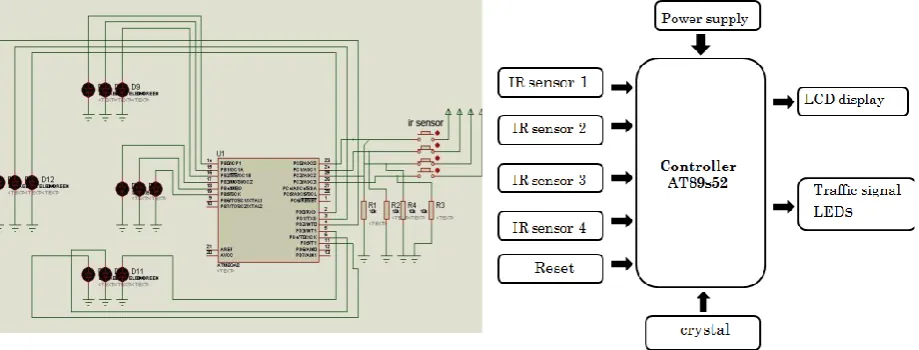
The below fig.1 and fig 2 shows architecture and block diagram of system. All the traffic
signal related signals are interfaced with port 1 and port3 of microcontroller. IRsensors
signals are interfaced with port0 and all LCD signal are interfaced with microcontroller.
Fig 1. .architecture diagram Fig 2.block diagram
4. RESULT & ANALYSIS
The result includes successful operation of the system. The system contains IR transmitter
and IR receiver (Photodiode) to measure the traffic density which are mounted on particular
side of road. The IR starts sensing whenever the vehicle passes through the sensors. For
normal flow the time allotted is of 5sec. If IR1 senses the traffic the time allocated will be
10sec (medium density) and if IR2 senses the traffic the time allotted will be 15sec (high
density). Based on density of traffic microcontroller takes the decision and updates the traffic
lights delay.
Case 2: In this case the density occurs at road 1 i.e. medium density so the time for green light of road 1 will be increase to 10sec.
Case 3: In this case the density occur at road 2 if the traffic crosses the first IR then the traffic density is medium and time allotted for green signal is 10sec and if the traffic crosses the second IR then the traffic density is high and time allotted for green signal is 15sec.
Case 5: In this case the density occur at road 4 if the traffic crosses the first IR then the traffic density is medium and time allotted for green signal is 10sec and if the traffic crosses the second IR then the traffic density is high and time allotted for green signal is 15sec.
5. CONCLUSION
There is urgent need of efficient traffic management system in our country as India meets
400 road accident every day .In this system we have worked on traffic congestion problem
where the traffic density is high. We have successfully implemented this application on small
scale with a proper outcome. We are looking further to implement this in our real life
scenario.We hope that our system will help to reduce the traffic and will bring a revolutionary
change in traffic management system.
6. FUTURE SCOPE
Real time traffic information update on traffic department web server.
Automatic tracking of defaulters.
7. ACKNOWLEDGMENT
We express our sincere thanks to our Project Guide Prof. Mr. Meghraj Patil for his
encouragement and support throughout our Project especially for the useful suggestions
given during the course of Project and supported throughout for the success of this work.
We would like to thank Prof. Mr. V.P Badhe (Head of Computer Engineering Department) for
his unwavering support during the entire course of this project work. We also thank all the
staff members for their help in making our project to work successfully.
REFERENCES
[1]. K.Vidhya, "International Journal of Innovative Research in Science, Engineering and Technology,"
Density Based Traffic Signal System , vol. Volume 3, no. Issue 3, 2014
[2]. Er. Faruk Bin Poyen, Amit Kumar Bhakta, B.Durga Manohar, Imran Ali, ArghyaSantra, AwanishPratap Rao
International Journal of Advanced Engineering, Management and Science (IJAEMS) [Vol-2, Issue-8, Aug-