Influence of resistant starch on microstructure and physical
properties of breaded fish fillets
Moradi Y¹.; Bakar J.*²; Che Man Y². and Syed Muhamed S.K.²
Received: March 2013 Accepted: July2013
Abstract
The influence of two types of resistant starches (RS2 and RS4) substituted at 10 and 20% in the batter formulation on the water retention capacity of the batter and on the texture, color, fat content and microstructure of the pre-fried and oven cooked breaded black pomfret fillets (Parastromateus niger) were studied. A significant (p<.05) increase of water retention capacity (3-7%) was found in all batters with RS as compared to the control, which was reflected in the moisture content of the breaded fillets. The addition of the resistant starches significantly (p<.05) decreased the fat content of the breaded fillets. Instrumental texture analysis showed that the presence of the RS in the batter also resulted in a significant increase in hardness and fracturability of the products. The L* and b* values of breading materials were increased in the samples containing 20% of RS.
Keywords: Resistant starch, breaded fish, batter formulation, texture
1-Iranian Fisheries Research Organization, P.O.Box: 13185-116, Tehran, Iran
2-Faculty of Food Science and Technology, Universiti Putra Malaysia (UPM) 43400, Serdang, Selangor,
Malaysia
*Corresponding author: [email protected]
Introduction
Battered and breaded foods are usually shallow or deep fried. This produces a unique flavor and texture associated with these types of products. However, the oil content in these products is becoming a consumers concern due to the health implication. Hence, a batter and breading system that could reduce the oil-uptake and at the same time safeguarding all the desirable properties of the product. Replacing the final cooking methods to other than frying for the reduction of the fat content has been recommended (Fiszman and Salvador, 2003). Oven cooking can be the best method of final cooking for the pre-fried battered and breaded sea foods since it produced minimal change in the amount of n-3 fatty acids during cooking (Türkkan et al., 2008) and reheating (Garcı´a-Arias et al., 2003). However, this method is not able to produce a highly acceptable product in terms of crispness, color, and flavor (Kulp and Loewe, 1990). Therefore, there is a need to focus on developing formulations of batter mixes that could possibly overcome this weakness.
The use of resistant starches (RS) in batter preparation for fried products is new. Resistant starch (RS) has been defined as the sum of starch and starch degradation products not absorbed in the small intestine of the healthy individuals and is considered as a dietary fiber (Asp and Björck, 1992). Resistant starches have been classified into four types; physically inaccessible starch (RS1), granular starch (RS2), retrograded starch (RS3) and chemically modified starch (RS4) (Xuejue et al., 2006). Its unique characteristics such as
bland flavor, white in color, fine particle size and high gelatinization temperature allow the formation of low-bulk high-fiber products with improved texture, appearance and mouth feel of the products (Tharanathan and Mahadevamma, 2003; Nugent, 2005) which is application attractive. The addition of resistant starch type 3 (Noveluse 330) and type 2 (Hi-maize 260) at 10 and 20% in the batter formulation for increasing the crispness and reduction the fat uptake in battered squid rings during deep-fat frying has been recommended (Sanz et al., 2007; Sanz et al., 2008). However, effects of incorporation of resistant starch on the quality of the pre-fried and final cooked food by oven have not been reported. The objective of this study was to investigation the effects of HI-Maize 1043 (RS2) and Fibersym 70 (RS4) on the quality attributes of the pre-fried and final oven cooked of breaded black pomfret (Parastromateus niger) fillets.
Materials and methods
Whole fresh black pomfret (P. niger) weighting approximately 350 ± 6 g and 22 ± 3 cm in length were purchased from the local sale market in Malaysia. The fish was manually filleted and each fillet was cut into two halves. The fillets were then washed under running tap water and dripped dry for 10 min a plastic colander. Six fillets were randomly packed in a polyethylene bag and stored at -20°C which was used within 2 weeks.
Palm olein was used as the pre-frying medium (Seri Murni, Thinkglobal Food Processing, Malaysia) was purchased from the local supplier.
Battering materials consisted of wheat flour, corn flour and salt those were purchased from the local market. Wheat flour (carbohydrate 74, protein 9 and fat 1g/100g) produced by FFM Berhad Company (Malaysia), corn flour (carbohydrate 86.3, protein 2 and fat 0.2 g /100g) manufactured by Fantes Marketing Sdn.Bhd, bread crumbs was produced by Schweiz Zutaten Sdn.Bhd (Malaysia). Resistant starch, RS2 (HI-MAIZE ® 1043) with 60% dietary fiber and 14% moisture content was obtained from the National Starch Innovation, Malaysia and RS4 (Fibersym™ 70) wheat base starch, with 70% dietary fiber and 10% moisture content was produced by GMP ingredient (United States) was purchased from Gulf Chemical Malaysia, Sdn Bhd, Selangor, Shah Alam.
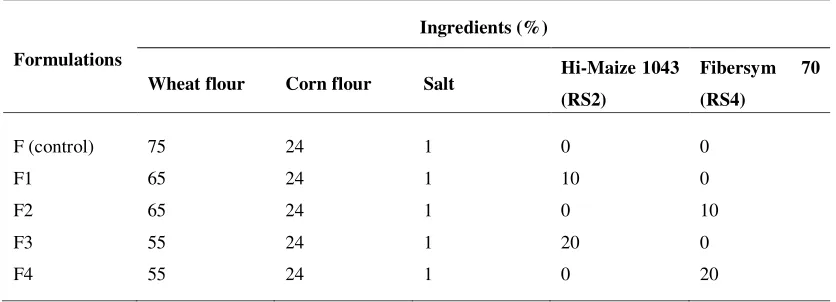
Five different batter formulations were prepared by replacing 10 and 20% of wheat flour in the batter with 10 and 20 % of the resistant starch as shown in Table 1. The percentage of the replacements was decided based on our experience in getting a simulate batter thickness. A batter formulation without
RS was designated as the control. The formulations were labeled as F (control), F1 (10% RS2), F2 (10% RS4), F3 (20% RS2) and F4 (20% RS4).
All ingredients of each batter formulation (Table 1) were mixed with the ratio of 1.0:1.4 (w/w) dry materials and cold tap water with a kitchen blender (National, MX-897 GM) thoroughly for 3 min. frozen fish fillets were thawed overnight in the cold room (4 °C). The surfaces of the thawed fillets were dabbed with paper towel before they were dipped into the batter. Excess batter was dripped off for 30s. Battered fillets were then breaded with bread crumbs.
Breaded fillets were pre-fried in a 3 L capacity deep-fryer (PHILUX, Model Df30AIT) at 180 ± 2°C for 30 s. The frying oil used for each batter formulation once. The pre-fried fillets were cooled, packed in polyethylene bags and blast freezer at -38 ºC for 1.5 h. The frozen fillets then were stored at -20 ºC for one week.
Table 1: The composition of different batter formulations
Formulations
Ingredients (%)
Wheat flour Corn flour Salt Hi-Maize 1043 (RS2)
Fibersym 70 (RS4)
F (control) F1 F2 F3 F4
75 65 65 55 55
24 24 24 24 24
1 1 1 1 1
0 10 0 20 0
0 0 10 0 20
The final cooking was carried out at 180ºC for 7 min in a combination oven (Combi-CPC61, Model RATONAL) set at dry mode.
Water retention capacity of the samples were determined according to the procedure of (Sanz et al., 2007). Thirty gram of batter were carefully weighed and placed in 50 ml centrifuge tubes and centrifuged at 17,300, g for 10 min at 15 ºC in a refrigerated high speed centrifuge (KUBOTA-7800, Japan). After centrifugation, the supernatant was carefully removed and weighed using a digital balance. Water retention capacity is expressed as 100 % minus the percentage of water released. Four measurements were made for each sample.
Total fat content was determined according to the (AOAC, 1990) soxhlet procedure. All data were carried out in triplicates.
Moisture content was determined by the AOAC (1990) oven method at 105 ºC. All measurements were made in triplicate.
The TPA of the samples was evaluated after 10 min cooling at room temperature. Texture profile analysis (TPA) of the final cooked breaded fillets was evaluated using
Texture Analyzer TA-XT2 (Stable Micro Systems, Surrey, England) according to the manual provided by the manufacture. A load cell of 30 kg and a cylindrical plunger P/0.5 (12.5 mm diameter) was used. The plunger was pressed into the fillets at a constant speed of 1 mm s-¹ until it reached 80 % of sample height (Anna et al., 2003). Six breaded fillets with 11 ± 0.5 cm length and about 4 cm wide were used for each treatment. Two measurements were performed in the middle (about 3 cm apart) on the surface of each fillet and mean values were used in the data analysis.
Color of the samples was measured using Minolta Chroma Meter (CR-300 Minolta Japan). The color readings were expressed by CIE (L* a* b*) system (Rafael et al., 2004). L*, a* and b* indicate the whiteness/darkness, redness/greenness and blueness/yellowness, respectively. The maximum value for L* is 100, which would be white. The minimum for L* would be zero, which would be black. The a* and b* axes have no specific numerical limits. Positive a* is red and negative of a* is green. Positive of b* is yellow and negative of
b* is blue. The color of the samples was evaluated after 10 min cooling at room temperature. Six breaded fillets were used for each treatment and the L*, a* and b* values were measured directly at three different positions on both sides of the fillets.
To identify the effects of resistant starches on the microstructure of the breaded fillets, SEM of the cross-sections of the breaded crust of the final cooked samples was carried out. The method for sample preparation was based on Loreca et al. (2003) with a slight modification. Sample of about 10 mm³ was taken from the middle of the breaded fillets. They were fixed in 4 % glutraldehyde (pH, 7.2) at 4 ºC for 24 h. They were then washed 3 times with 0.1 M sodium cacodylate buffer for 20 min for each washing. The samples were then post-fixed with 1% osmium tetraoxide at 4 ºC for 2 h. This was followed by another washing with 0.1 m sodium cacodylate buffer. Washing was repeated 3 times and each washing was for 20 min. After which, samples were dehydrated in a series of acetone
dilutions of increasing concentration (35, 50, 75, 95, and 100%), and then subjected to the critical point drying in the critical point dryer (Bal-Tec CPD 030, Netherland) for 1.5 h. The dried samples were then coated with gold by sputter coater (Bal-Tec SCD 005, Netherland). The prepared samples were then observed under the scanning electron microscope (LED 1455 VPSEM equipped with OXFORD LNCA ENERGY 300 EDX, UK) for observed of visual surface differences. Two fillets of each batter formulation were used for the SEM.
Statistical software Minitab ® Release 14, Copyright 2003-2005 (Minitab Inc, Pennsylvania) was used to analyze the data for one way analysis of variance ANOVA).
Results
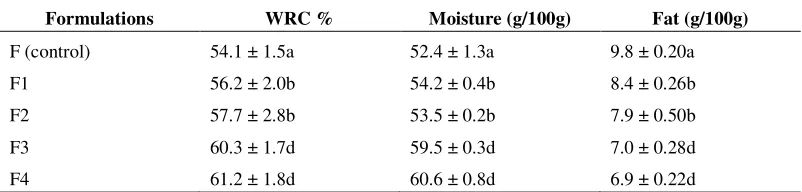
The addition of both RS2 and RS4 in the batter formulations resulted in the increase in the WRC (Table 2) of the batter. The higher increase was obtained when 20% RS (F3 and F4) was incorporated in the batter formulation as compared that with 10% (F1and F2).
Table 2: The WRC of the batter, fat, and moisture contents of the cooked breaded fillets
Formulations WRC % Moisture (g/100g) Fat (g/100g)
F (control) F1 F2 F3 F4
54.1 ± 1.5a 56.2 ± 2.0b 57.7 ± 2.8b 60.3 ± 1.7d 61.2 ± 1.8d
52.4 ± 1.3a 54.2 ± 0.4b 53.5 ± 0.2b 59.5 ± 0.3d 60.6 ± 0.8d
9.8 ± 0.20a 8.4 ± 0.26b 7.9 ± 0.50b 7.0 ± 0.28d 6.9 ± 0.22d
Values are mean ± sd of four replicates for WRC and three replicates for fat and moisture content Values bearing different letters in same column are significantly (p<.05) different
Moisture content of the samples significantly (p<.05) increased while fat
content decreased with increasing concentrations of either RS2 or RS4 in the
batter formulation (Table 2). The increase of moisture content ranged from 1.0 to 8.0 g/100g in the samples as compared to the control (F). The amount of fat content decreased approximately 2g /100g i.e 2% in the incorporation 10 % (F1 and F2) and 3g/100g (3%) in the 20 % RS (F3 and F4).
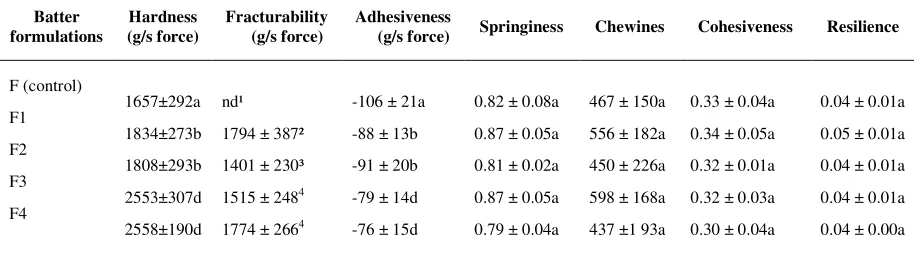
Texture profiles analyses (TPA) of different samples are shown in Table 3. Incorporation of the RS significantly (p<.05) increased the hardness, fracturability and adhesiveness of the samples. However, they did not significantly change the other parameters of the TPA. The hardness values of the cooked samples increased with increasing percentage of RS in the batter formulation. The increase was between 10 to 15% for 10% of RS (F1 and F2) incorporation and between 50 to 60% for 20% of RS (F3 and F4) substitutions. Fracturability were detected in all samples except for the control (F). Significant (p<.05) decrease of the
adhesiveness was also observed in all the RS samples as compared to the control.
Effects of RS concentration on the color properties of samples are showed in Table 4. No significant (p<.05) difference was found in a* values between among all the samples. L* and b* values increased significantly (p<.05) in the samples including 20 % of RS (F3 and F4) as compared to the control (F). However, they did not significantly (p<.05) change by substitution of the 10% RS (F1 and F2).
The micrographs of the cross-section of the breaded crust of all samples are shown in Figure 2. Layers of protein (P) with different shapes and sizes of starch granules (S) could be recognized in all of the micrographs. Voids (v) or cavities could be observed in the control (F) samples which could not be recognized in the other samples (F1-F4). Therefore batters with RS gave a more compact structure. The compactness of the crust was reflected in the hardness values of the samples with RS in the batter (Table 3).
Table 3: Effect of RS on the texture profile of the cooked breaded fillets
Batter formulations Hardness (g/s force) Fracturability (g/s force) Adhesiveness
(g/s force) Springiness Chewines Cohesiveness Resilience
F (control) F1 F2 F3 F4 1657±292a 1834±273b 1808±293b 2553±307d 2558±190d nd¹ 1794 ± 387² 1401 ± 230³ 1515 ± 2484 1774 ± 2664
-106 ± 21a -88 ± 13b -91 ± 20b -79 ± 14d -76 ± 15d
0.82 ± 0.08a 0.87 ± 0.05a 0.81 ± 0.02a 0.87 ± 0.05a 0.79 ± 0.04a
467 ± 150a 556 ± 182a 450 ± 226a 598 ± 168a 437 ±1 93a
0.33 ± 0.04a 0.34 ± 0.05a 0.32 ± 0.01a 0.32 ± 0.03a 0.30 ± 0.04a
0.04 ± 0.01a 0.05 ± 0.01a 0.04 ± 0.01a 0.04 ± 0.01a 0.04 ± 0.00a
Values are means ± sd of 12 replicates
Values bearing different letters in same column are significantly (p<.05) different 1: Not detected, 2: Five TPA detected, 3: Seven TPA detected, 4: Twelve TPA detected
Table 4: Effect of RS on the color of the cooked breaded fillets
Batter formulations L* a* b*
F (control) F1 F2 F3 F4
57.1 ± 2.9a 59.4 ± 3.4a 57.6 ± 2.7a 61.8 ± 3.7d 61.4 ± 4.0d
14.3 ± 2.1a 14.0 ± 3.4a 14.1 ± 2.1a 15.6 ± 1.9a 14.0 ± 2.0a
57.6 ± 2.7a 56.2 ± 2.0a 57.2 ± 3.0a 59.8 ± 3.6d 60.5 ± 1.6d
Values are mean ± sd of 36 replicates
Values bearing different letters in same rows are significantly (p<.05) different
W
R
C
(
%
)
60 58
56 54
52 62
61
60
59
58
57
56
55
54
53
10 9
8 7
Moisture content (g/100g) Fat content (g/100g)
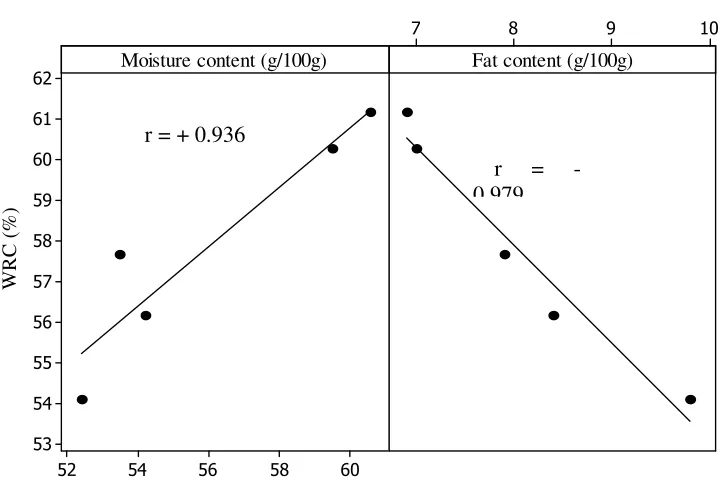
Figure 1: Correlation between the WRC of batter with fat and moisture content of cooked samples
r = + 0.936
r =
-0.979
S
P
P
Figure 2: SEM micrographs of cross-section of the crust of all the samples (Magnification X1000)
S: Starch granular, P: protein, V: void space
F: Control, F1: 10% RS2, F2: 10% RS4, F3: 20% RS2, F4: 20% RS4
Discussion
As indicated (Table 2) incorporation both RS2 and RS4 resulted in an increase the WRC.
An increase of about 4% of WRC was found by Sanze et al. (2007) when they replaced the
20 % wheat flour with 20 % RS3 (retrograded starch with 33% fiber content) in the squid ring batter formulation. Within the same percentage of incorporation, there was no significant
(p<.05) different in the WRC of the two RS studied.
Results from fat and moisture content of the samples indicated that moisture content of the samples significantly (p<.05) increased while fat content decreased with increasing concentrations of either RS2 or RS4 in the batter formulation (Table 2). A same result was observed by (Sanz et al., 2007). They reported that the incorporation of 10 and 20% the RS3 (Novelose 330) in the batter formulation of squid rings was resulted in a significantly (p<.05) decrease of the fat content and increase in the moisture content in the batter crust during deep-fat frying. This could be related to the increase of the WRC with RS (Table 2). A positive linear correlation between the WRC of the batter and moisture content (r = 0.94), and negative correlation between the WRC and fat content (r = -0.98) of the cooked samples were established (Fig. 1). The increase in WRC will diminish water loss during frying and therefore reduce the interchange with oil (Gamble et al.,1987). The incorporation of RS2 and RS4 did not exhibit influence on the different of the moisture and fat content of the samples.
Texture profile analyses (TPA) of different samples (Table 3) indicated that incorporation of the RS significantly (p<.05) increased the hardness, fracturability and adhesiveness of the samples. However, they did not significantly change the other parameters of the TPA. This decrease in the 20% RS samples (F3 and F4) was significantly lower than that in 10%RS (F1 and F2). Sanz et
al. (2008) reported that replacement of 20% of wheat flour of the batter with RS3 (Novelus 330) or RS2 (Hi-maize 260) significantly increased the hardness and the number of peaks of the batter crust of fried squid rings which produced crispier product.
SEM of the cross-section of the breaded crust of the all samples (Fig. 2) indicated that significant difference in the protein layers, shape and size of the starch granules. Some of voids could be observed in the sample with no RS in the batter formulation; however the voids could not be recognized in the other samples. Therefore batters with RS had more compact structure. The compactness of the crust was reflected in the hardness values of the samples with RS in the batter (Table 3).
Using both Hi-Maize 1043 (RS2) and Fibersym 70 (RS4) in the batter formulations resulted in a significant increase in the WRC of the batter which was reflected in the moisture content of the cooked fillets. A significant decrease of the fat content of the breaded fillets was also observed (P<0.05). Incorporation of both of the RS in the batter formula resulted in a significant increase of the hardness and fracturability which produced crisper breaded fillets. Color was not affected by the incorporation of RS.
References
Anna, M. B. R., Christelle, R. and Johanna, L., 2003. Liquid holding capacity, texture, and fatty acid profile of smoked fillets of salmon fed diets containing fish oil or soybean oil.
Food Research International, 36, 231-239.
AOAC., 1990. Official Methods of Analysis of the Association of Official Analytical Chemists, 15th ed. method: 954, 16; 952,45.
Asp, N. G. and Björck, I., 1992. Resistant starch.
Trends in Food Science and Technology, 3(5), 111-114.
Fiszman, S. M. and Salvador, A., 2003 Recent developments in coating batters. Trends in Food Science and Technology, 14, 339-407.
Gamble, M. H., Rice, P. and Selman, J. D., 1987,. Distribution and morphology of oil
deposits in some deep fried products. Journal of Food Science and Technology, 52, 1742.
Arias, M. T., Pontes, E. A., Garcı´a-Linares, M. C., Garcı´a- Ferna´ndez, M. C., Sa´nchez-Muniz, F. J. and Garcı´a-Arias, M. T., 2003. Cooking-freezing-reheating (CFR) of
sardine (Sardina pilchardus) fillets. Effect of different cooking and reheating procedures on the proximate and fatty acid compositions.
Journal of Food Chemistry, 83, 349-356.
Kulp, K. and Loewe, R., 1990. Batters and Breadings in Food Processing.
American Association of Cereal
Chemists, Inc, 14, 24,123-131.
Loreca, E., Isabel, H., Isabel, P. M., Amparo, Q., Virginia, L., Susana M. F., et al., 2003. Effect of batter formulation on lipid uptake during frying and lipid fraction of frozen battered squid. European Food
Research and Technology, 216, 297-302.
Nugent, A., 2005., Health properties of resistant starch. Br Nutrition Foundation. Nutrition Bullten, 30, 27-54.
Rafael, G., Tyri, V., Kolbrun, S. and Helgi, T., 2004. Effects of rearing temperature and strain on sensory characteristics, texture, color and fat of Arctic charr ( Salvelinus alpinus). Journal of Food quality and preference, 15, 177-185.
Sanz, T., Salvador, A. and Fiszman, S. M., 2004. Innovative method for preparing a frozen, battered food without a pre-frying step. Journal of Food Hydrocolloids, 18, 227-231.
Sanz, T., Salvador, A. and Fiszman, S. M., 2007. Resistant starch (RS) in battered fried products: Functionality and high-fiber benefit. Journal of Food Hydrocolloids, 4,453-549
Sanz, T., Salvador, A. and Fiszman, S. M., 2008.
Performance of three different types of resistant starch in fried battered food. European Food Research and Technology, 227, 21-27.
Tharanathan, R. N. and Mahadevamma, S., 2003. Grain legumes-a boon to human nutrition.
Trends of Food Science Technology, 14, 507-518.
Türkkan, A. U., Cakli, S. and Kilinc, B., 2008. Effects of cooking methods on the proximate
composition and fatty acid composition of seabass (Dicentrarchus labrax). Food and Bioproducts Processing, 3,163-166.
Xueju, X., Qiang, L. and Steve, W. C., 2006. Studies on the granular structures of resistant starches (type 4) from normal, high amylose and waxy corn starch citrates. Food Research International, 39, 332-341.