STUDY ON THE CONSUMPTION PATTERN OF JUNK FOOD AMONG UNIVERSITY STUDENTS
Sivapriya T*1, Saraswathy S2
*1Department of Home science Prof Dhanapalan college of Arts and Science. Kelambakkam Chennai
*Correspondence Author: [email protected]
Keywords:
Junk food, Diet, Awareness and knowledge.Abstract
Background: The term junk food refers to fast foods which are easy to make and quick to consume. They are zero in nutritional value and often high in fat, salt, sugar, and calories.
Objective: The aim of the present study was to evaluate the preference, prevalence and pattern of junk food consumption among university students.
Methods: In the current descriptive cross-sectional study, 100 university girls aged 18- 22 years old were enrolled by convenience sampling method. Data were collected on Demographic profile, Dietary intake, awareness and knowledge about junk foods by using 3 day 24-hour dietary recall, a food frequency questionnaire and a checklist.
Results: Consumption of Junk food was found among cent percent study population. Nutrition education programmer was significant at 5 % level. Educational campaigns on healthy lifestyles among young people are advocated.
Introduction
Background
Adolescence is an important growth and development period which has implications for future nutrition status and food consumption habits. [1]
Junk foods generally provide large amounts of energy from fats and sugars and too little in the way of complex carbohydrates, phytochemicals, and dietary fiber. The widespread satisfaction with junk food, in general, is due to their convenience, taste and flavor, and reasonable prices, not their nutritional quality. An occasional meal at a fast-food outlet doesn’t hurt, but a steady diet of junk food provides, for the average person, excessive energy and sodium and too little vitamin A, iron, phytochemicals, and dietary fiber, leading to a nutritionally unbalanced pattern of eating. [2]
Consumption of junk food is becoming more popular in developing countries. When the young enters university life, they take more control of their lifestyle, in particular food choices and practices, [3] especially if they are away from home. The food consumption patterns and associated nutritional risks specific to university students is a key concern. [4]
• To formulate, impart and find the impact of nutrition education
Materials and methods
By means of convenience sampling technique, a premiere college affiliated to the University of Madras was approached to collect data. A sample of 100 girls from the college was selected for the present study. Prior permission was obtained from the principal of the college clarifying the purpose of the study. After permission was obtained, the researcher spoke to the students and oriented them about the purpose and significance of the research. Consent forms were then distributed to the participants and those who were willing to participate in the study were asked to give their written consent and the same was obtained. Collection of data was carried out by perceiving the views and ideas from the girls through filling up of interview schedule, food frequency questionnaire and checklist. Demographic profile, dietary pattern, was elicited using an interview schedule. A food frequency questionnaire (FFQ) was filled by the researcher to study about the food consumption pattern of the participants. Similarly three day 24 hour recall was done to calculate the nutritive value of diet consumed by the subjects before and after nutrition education. Nutrition education was given to the participants after scrutinizing their knowledge and awareness about junk foods using a checklist. Impact of nutrition education was checked by means of the same check list after a week time. The data’s collected were coded and analyzed using the SPSS (Statistical Package for Social Sciences) version 11. Descriptive statistics like mean and standard deviation were obtained for age, body mass index. Students’’ test was done to find the difference before and after nutrition education.
Result and Discussion
% n
Age
17
11%
18
30%
19
31%
20
27%
22
1%
Educational status
Under graduates
99
99%
Post graduates
1
1%
Type of family
Nuclear family
82
82%
Joint family
18
18%
BMI
Below 18.5
33%
18.5-24.9
51%
25.0-29.9
14%
Above 30.0
2%
• Multiple responses
Though it is commonly agreed that breakfast is the most vital meal of the day, there has been a gradual increase in the proportion of adolescents who reported that they regularly skipped breakfast [10].
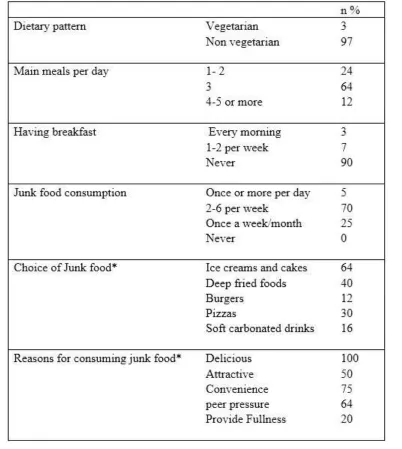
Breakfast consumption patterns showed that about 90 % of the participants do not consume daily. The most common reasons given for breakfast skipping were dieting, lack of time and not being hungry in the morning. The less common reason given by they were paternal absence and not liking the food prepared.
Scrutiny on pattern of junk food consumption among the participants revealed that 100% of the participants consume junk foods. Among them 70 % consumed 2-6 times a week while 5 % consumed junk foods daily. The junk foods commonly consumed were deep fried foods, carbonated drinks, ice-creams, burgers, and pizzas which were very high in refined carbohydrate and fat. The reasons for the preference of junk food over home-made meals were taste and flavor, attractiveness, convenient, to enjoy time with their friends and feeling of fullness.
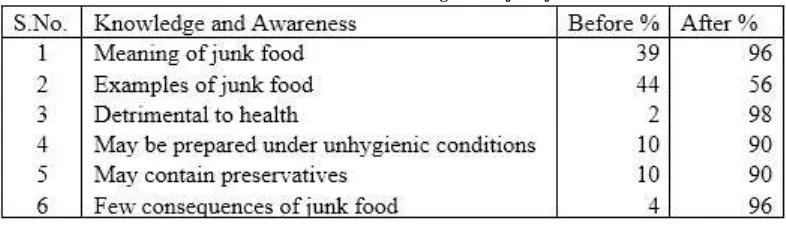
A pre tested check list was exercised before and after nutrition education to obtain data regarding the knowledge and awareness of junk foods. During the pre-nutrition education session subjects were not able to express the meaning of junk foods. They were hesitant and doubtful. Models of junk foods, healthy pyramid, Power point presentation, Charts were exhibited and enlightened about the basic five food groups, significance of taking breakfast and aftermaths of junk food consumption.
Table 3: Awareness and knowledge about junk foods
Knowledge and awareness about junk food among the participants were meagre (39 %).
Examples of junk food listed included Indian sweets, Egg rolls, Pooris, Samosas, Cutlets, Doughnuts, Ice creams, Fruit juices, Cakes, Biscuits and Carbonated drinks. Participants (90 %) were ignorant that junk foods when prepared under unhealthy conditions and environment could predispose an individual to develop many types of life threatening infections.
diabetes, cardiovascular disease, cancer etc. Since they contain excess carbohydrate, fat, and salt they may lead to the early onset of these diseases.
After nutrition education the study subjects were able to answer the checklist promptly and with ease. They were extremely satisfied with the new knowledge they were exposed. The results when compared with pre-test were significant at 5 % level.
Table 4: Comparison of the mean score of the nutrition education programme
Dietary intake of the participants
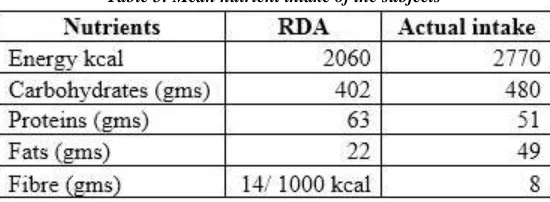
The dietary intake of the 100 participants was studied by three day 24 hour recall method (two weekdays and one weekend day), to account for any difference in dietary intake between weekdays and weekends. The average daily intake of energy, carbohydrate, protein, fat, dietary fiber was estimated.
Regarding the dietary pattern, 97 % of the participants were non-vegetarians while 3 % were vegetarians. Food frequency questionnaire was used to elucidate the frequency of consumption pattern of five food groups. The frequency of consumption of whole grain cereals like rice, wheat, ragi and milk in the form of beverages were regular. Pulses and legumes were consumed 2- 3 times in a week. Non vegetarian items were consumed 3 -5 times in a week. Vegetables and fruits consumption were found to be very poor. They were consumed 1-2 times in a week.
The nutrient intake of the subjects showed that the calorie, carbohydrate and fat intake of the subjects were high when compared to RDA. On contrary the protein intake was lower than recommended.
Table 5: Mean nutrient intake of the subjects
of adolescents have eating habits that deviate from healthy eating habits and are at greater threat of consuming diets that are not only lacking in terms of their nutritional needs but also are incompatible with their long term health. Every day addition of junk food and the omission of a variety of healthy foods by a huge percentage of adolescents may contribute to the growing problem of obesity among adolescents and the psychosocial and other health-related consequences associated with this condition such as insulin resistance.
Conclusion
Consumption of fast food is fetching more popularity among adolescents in developing countries. Junk foods are accountable for obesity epidemics among the younger cohorts. The prevalence of fast food consumption among university students was 99 %. The important factors for the preference of fast food include good taste, variety, convenience, and peer pressure. It is also heart-breaking to find that 97 % of these adolescents skip breakfast due to lack of time, lack of interest, lack of parental care and dieting. Eating breakfast can improve concentration, better performance, achievement scores and may also help students maintain a healthy weight. Special nutrition education programs, dietary guidelines and effective awareness campaigns could be instituted in institutions of higher learning to tackle the unhealthy lifestyle of university students and improve their health while highlighting the harmful effects of excessive consumption of junk food.
References
1. Lytle LA. Nutritional issues for adolescents. J Am Diet Assoc. 2002; 102 Suppl 3:S8-12.
2. John Anderson, PhD, Martin Root, PhD, An Introduction to Foods, Nutrients, and Human Health Human nutrition, ISBN:
9781449698744 Jones & Bartlett Learning 5 Wall Street, Burlington, MA 01803 PP 1-26,
3. Colic Baric I, Satalic Z, Lukesic Z. Nutritive value of meals, dietary habits and nutritive status in Croatian university students according to gender. Int J Food Sci Nutr 2003; 54:473-84.
4. Brevard PB, Ricketts CD. Residence of college students affects dietary intake, physical activity, and serum lipid levels. J Am Diet Assoc 1996;96:35-8.
5. WHO/FAO EC. Diet, Nutrition and the Prevention of Chronic Diseases. Geneva: World Health Organization; 2003.
6. Viner RM, Barker M. Young people's health: the need for action. BMJ. 2005; 330:901-3.
7. El Ansari W, Stock C, Mikolajczyk RT. Rela-tionships between food consumption and living arrangements among university
students in four European countries - a cross-sectional study. Nutr J 2012;11:28.
8. Franklin J, Denyer G, Steinbeck KS, Caterson ID, Hill AJ. Obesity and risk of low self-esteem: a statewide survey of Australian children. Pediatrics. 2006;118:2481-7.
9. Dwyer J, Evans M, Stone E, Feldman H, Lytle L, Hoelscher D, Johnson C, Zive M, Yang M 2001, Adolescents’ eating patterns
influence their nutrient intakes, Journal of the American Dietetic Association,101(7), 798-802.
10. Siega-Riz AM, Popkin BM, Carson T (1998) Trends in breakfast consumption for children in the United State from 1965 to