130
PRE-TRIAL SETTLEMENT OF DISPUTES WITH CUSTOMS IN
LITHUANIA: DEVELOPMENT OF LEGAL REGULATIONS, IT‘S
PROBLEMS AND PROSPECTS
Gediminas Valantiejus
Mykolas Romeris University, Lithuania
Abstract
Purpose – the aim of this article is to analyse and examine development of Lithuanian legislation governing the pre-trial settlement of the disputes with customs authorities (prior to accession to the European Union, and after it); discuss the practical problems related to regulation of the pre-trial litigation procedures and provide suggestions for the improvement of legal framework in order to ensure transparent and cost-effective resolution of disputes with customs.
Design/methodology/approach – analysis of relevant issues is based both on theoretical (analysis and synthesis, historical, systematic, comparative) and empirical methods (analysis of documents, generalization of professional practice (analysis of courts practice and practice of other dispute settlement bodies (institutions) in Lithuania), statistical analysis of data concerning use of pre-trial and trial disputes resolution procedures in Lithuania). The article consists of an introduction and three chapters.
Findings – procedures for the pre-trial settlement of disputes with customs in Lithuania are quite complex, diverse and are governed by different laws (legal documents), including the European Union law. The main legal documents are not compatible with each other and they do not provide a detail list of mandatory pre-trial dispute settlement procedures.
Research limitations/implications – article analyzes legal regulations of pre-trial disputes with customs since restoration of Lithuanian independence to the present days, with particular emphasis on developments relating to entry of Lithuanian Republic to the European Union, as well as formation of the case law on the application of these legal regulations.
Practical implications – article presents proposals for the improvement of current legislation – Regulations on Investigation of Complaints in the Custom of Lithuanian Republic approved by order No. 1B-540 of the Director General of the Customs Department under the Lithuanian Ministry of Finance on 19th of May, 2004.
Originality/Value – article presents practical problems of the pre-trial settlement of customs disputes (linking these problems with relevant case law), which are not widely discussed in the Lithuanian legal doctrine and specific academic legal literature.
131
Introduction
Customs of the Republic of Lithuania can be defined as the entirety of customs offices (authorities) responsible for the enforcement of customs legislation. It has a particular responsibility for the economic security of the state border, as well as the safety of the public life of the country and the formation of the budget. The customs authorities are assigned to ensure compliance with international trade laws and other legal acts, to collect import duties and taxes, apply the customs supervisory measures in the most effective way (Povilauskienė, 2006). The customs authorities also have a very important role in the European Union customs policy based on free movement of goods, people, services and capital.
The main acts of law regulating the activities the customs – European Community Customs Code, other European Community customs legislation, Law on Customs of the Republic of Lithuania, Law on Tax Administration of the Republic of Lithuania – establish the obligations of individuals (taxpayers) to perform certain customs procedures in accordance with the laws and the European Community customs legislation procedures to calculate, pay and declare taxes and duties administered by the customs authorities. However, in practice there are many cases when the person concerned (the taxpayer) and the institution in charge of the supervision of his (her) fulfillment of obligations – customs office – do not agree on the compliance with the duties, their distribution and calculation and taxes to be paid. In order to avoid such situations, and, if they happen, in order to solve the dispute, European Community laws as well as national laws provide appropriate measures, establish the right of appeal to the people concerned against the customs authorities and officials decisions and actions (Medelienė, 2012).
132
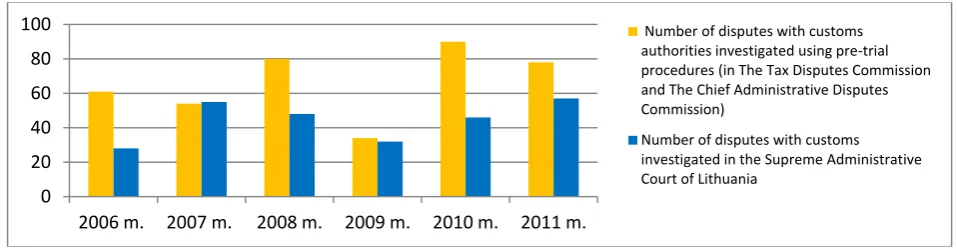
Figure 1. The number of the disputes with customs solved using judicial and pre-trial procedures in Lithuania.
Figure 1 shows that the number of the disputes with customs solved using pre-trial procedures is usually larger than number of disputes, investigated using trial (judicial procedures) (having compared number of disputes investigated in the Tax Disputes Commission and The Chief Administrative Disputes Commission and Supreme Administrative Court of Lithuania as the final judicial appeal instance for resolution of disputes with customs (INFOLEX.PRAKTIKA. Teismų apžvalgos, konsultacijos, nutarimai, sprendimai, nutartys [interactive]. [accessed 2013-03-09]. <http://www.infolex.lt/praktika/>). These tendencies show that there is a clear need for rational legal pre-trial dispute resolution procedures. Similar attitudes also prevail in the scientific literature, for example Andruškevičius (2008) emphasizes that the use of pre-trial procedures against the customs authorities are welcome, as it helps to regulate the increasing judicial workload. It is necessary to mention that since the year 2007 until 2011 number of all administrative disputes settled in the Supreme Administrative Court of Lithuania has grown from 1313 cases till 2571 cases (Lietuvos vyriausiojo administracinio teismo 2011 metų veiklos apžvalga, 2012) and, as shown in Figure 1, number of judicial disputes with customs has almost doubled.
The legal regulation of the pre-trial disputes against the customs authorities in Lithuania and its development
Implementation of person‘s (both natural and legal person, e.g. corporate entity) rights and their need for protection in customs sphere, require the state to determine the institutional control mechanism to each customs office. The control procedures as well as the ways of settlement of administrative disputes must be established. In the scientific literature (Pranevičienė, 2003) it is mentioned that the control of the administrative subjects can be implemented by disputing the legal acts and actions of the administrative subjects not only direct to the court of law but also using pre-trial procedures (by applying departmental or administrative chain of command to another public administration institutions) or by submitting a complaint to other specialized
0 20 40 60 80 100
2006 m. 2007 m. 2008 m. 2009 m. 2010 m. 2011 m.
Number of disputes with customs authorities investigated using pre-trial procedures (in The Tax Disputes Commission and The Chief Administrative Disputes Commission)
133
administrative dispute settlement institutions (quasi courts or pre-trial administrative litigation committees (tribunals, commissions).
Analysis of the legislation relating to the customs in the Republic of Lithuania confirms that the model of pre-trial settlement of disputes with customs historically exist for quite a long period of time. The provisions which made pre-trial disputes with the customs obligatory came into force on 1 July 1996 in the Regulations on Investigation of Complaints in the Customs of Lithuanian Republic1. The Lithuanian Customs Code,
which came into force in the Republic of Lithuania on 1 January 1998, set the legal framework for a modern customs system organization, which with annexes was in force until Lithuania’s accession into the European Community on 1 May 2004. In Lithuanian Customs Code2, the provisions of Title IX “Appeal” provided a procedure of appeal against
all decisions adopted by the customs (not distinguishing them into different types or categories).
According to the Lithuanian Customs Code, Article 228 complaints regarding the customs decisions had to be submitted to the customs office, which adopted (or failed to adopt) a decision in connection with the Customs Code, as well as other customs laws and other legislation attributed to the competence of the local customs office or Customs Department under the Ministry of Finance of the Republic of Lithuania, if the disputed decision was adopted exactly by this institution. As the primary version of the Lithuanian Customs Code, Article 229 established, the relevant regional customs decision adopted after the investigating the individual‘s complaint, could have been appealed to the Customs Department or to the court. This legal regulation shows that the primary Lithuanian Customs Code established a relatively simple (double)-stage dispute settlement system under which any appeal against the decision of the customs authorities may be reviewed under administrative (departmental) procedures [1] in the institution that made the decision, and then in the event of unsatisfactory decision at his (her) option (at the discretion) the person could apply to the court [2]. However, since June 1, 2002 when changes of the Lithuanian Customs Code Title IX3 came into force, the
order regarding the obligation of pre-trial procedures was tightened, and it was provided that complaints relating to the decisions (or failure to make them) made by the territorial customs can be submitted only to the Customs Department.
Fundamental changes in the pre-trial dispute settlement system with the customs took place after Lithuania’s accession to the European Union on May 1, 2004. The European Union customs legislation started to be applied in the Republic of Lithuania direct (first of all, the European Community Customs Code), which inter alia provide and establish the fundamental legal safeguards regarding the control of the customs
1 Regulations on Investigation of Complaints in the Custom of Lithuanian Republic. Official Gazette. 1996,
No. 56- 1328.
2 Customs Code of the Republic of Lithuania. Official Gazette. 1996, No. 52-1239.
3 Customs Code of the Republic of Lithuania (redaction No. IX-624 of 4 December 2001). Official Gazette.
134
authorities and the right of appeal against the decisions made by the customs authorities. The Community Customs Code (Article 243 paragraph 2) left the right for each country to determine whether the person concerned, who initiated the dispute against the Customs’ decisions relating to the application of customs legislation (or failure) must first lodge a complaint to the customs office, or he has the right to appeal to another judicial or equivalent dispute investigation institution1. Similar attitudes prevail in the European
Court of Justice (Case C-1/99, Kofisa Italy Srl v. Ministère des finances, Servizio della Riscossione Tributi [2001] ECR I-00207)
Analyzing the implementation of the European Community Customs Code into the Lithuanian national legal system after May 1, 2004, we can see that, in accordance with national legislation – the Law on Customs2 and Regulations on Investigation of
Complaints in the Customs of Lithuanian Republicapproved by Order No. 1B-540 of the General Director of the Customs Department under the Lithuanian Ministry of Finance (May 19, 2004)3 – complaints concerning the territorial customs authorities and special
customs authorities decisions related to the application of customs legislation4, and
failure to make such decisions are submitted to investigate to the Customs Department under the pre-trial procedure. Complaints regarding the Customs Department’s decisions and failure to make them are presented to a special pre-trial administrative disputes investigation institution – The Chief Administrative Disputes Commission or a court. Thus, in Lithuania the chosen and applied model for settlement of disputes with customs can be characterized in such way that before resorting to court or other administrative dispute resolution institution, it is necessary to take advantage of pre-trial litigation. First the complaint must be submitted to the customs office which is assigned to perform such litigation functions. It should be observed that, in regulating the appeal against the customs authorities’ decisions related to the application of customs legislation after Lithuania's accession to the European Union, earlier provisions on compulsory pre-trial review of a decision under administrative (departmental) procedures in the office, which made the decisions, were repealed.
On the other hand, from May 1, 2004 the Republic of Lithuania introduced additional separation of disputes with the customs as non-tax and tax disputes with customs were distinguished (Medelienė, 2011). According to the version of Law on Tax
1 Customs Code of the Republic of Lithuania. Official Gazette. 1996, No. 52-1239.
2 Customs Law of the Republic of Lithuania. Official Gazette. 2004, No. 73-2517.
3 Regulations on Investigation of Complaints in the Custom of Lithuanian Republic. Official Gazette. 2004,
No. 84- 3060.
4 Customs legislation (customs law) - European Community customs legislation, legislative provisions of the
Lithuanian
international treaties, provisions of Lithuanian legislature, which make the customs responsible for enforcing them,
legislature of the customs that is under its authority and International treaties and agreements with the customs other
135
Administration May 1, 20041, which is applicable when the customs authorities
administrate its assigned duties related to taxes (as far as it does not collide with the European Community customs legislation), tax disputes with customs authorities may arise from decisions taken by the customs authorities, when taxes are re-calculated and a taxpayer has to pay taxes. Disputes may also arise regarding the decision to refuse to refund (offset) the tax overpayment (difference). A special mandatory pre-trial tax litigation procedure with the customs is established. According to this procedure decisions made by the local tax authorities (regional customs) must be appealed in the mandatory form to the Customs Department, and the latter authority's decisions – by choice to the specific tax litigation authority – Commission on Tax Disputes under the Government of the Republic of Lithuania – or the court. For this reason, it is often stated that the current national law has two different pre-trial customs appeal procedures – non-tax (administrative) disputes with the customs and tax disputes.
Current problems of legal regulation regarding the disputes with the customs in Lithuania
Since, as mentioned above, the pre-trial dispute litigation with customs system in Lithuania is quite complicated, in each case it is especially important to identify correctly the order and how a dispute should be dealt with between a person who has received decision (or an action) made by the customs or customs official and thus influencing his rights or legitimate interests. This rather theoretical problem also have a great practical importance, since the person’s abilities to use means of legal defence in the most effective and shortest way depend on the establishment of particular litigation procedures, especially fair procedures of appeal. Examining provisions of the national law it is possible to distinguish certain problematic areas and aspects connected with the practical application of these provisions.
First of all, it must be emphasized that the Regulations on Investigation of Complaints in the Customs of Lithuanian Republic provide not only the mandatory pre-trial procedures of investigating complaints relating to the application of customs legislation, but also mandatory procedures regarding complaints due to the decisions made by the customs officials. According to the Regulations on Investigation of Complaints in the Customs of Lithuanian Republic Section 6.1 such complaints first of all must be investigated in the departmental (administrative) office, which employs particular customs official and only then the complaint may be submitted to other dispute settlement institutions2. However, the Article 243 of the European Community Customs
Code, and the Article 88 of the Law on Customs3 provide only a mandatory dispute
1 Law on Tax Administration of the Republic of Lithuania. Official Gazette. 2004, No. 63-2243.
2 Regulations on Investigation of Complaints in the Custom of Lithuanian Republic. Official Gazette. 2004,
No. 84- 3060.
136
settlement procedure regarding the decisions made the customs institutions (authorities) (see also B. J. M. Terra, P. J. Wattel, 2008). It is debatable whether such Regulations on Investigation of Complaints in the Customs of Lithuanian Republic comply with the national laws and (or) European Union law and therefore must be revoked, since according to the practice of the European Court of Justice (Case C-213/89, R. v. Secretary of State for Transport, ex parte Factortame Ltd [1990] ECR I-2433) any provision of a national legal system which might impair the effectiveness of European Union law constitutes the right to require from Member State or national court to set aside such national legislative provisions.
Secondly, attention should be paid to the fact that the European Court of Justice in Case C-213/99, José Teodoro de Andrade v. Director Alfândega da de Leixões [2000] ECR I-11083 has pointed out that the Community Customs Code, Article 243 gives the person concerned the right of appeal not only against written decisions made by the customs office or an official, but also against actions, i.e. when a decision is not adopted, there are no official records or reports about them. This opinion is also supported in the scientific literature (Europos Sąjungos teisė. Seminarai, 2006). However, the Law on Customs and Regulations on Investigation of Complaints in the Customs of Lithuanian Republic use the concept “the decision made by the customs office” or “the decision made by the customs official” when non-tax disputes with customs are defined. Thus, the national law does not regulate how the person concerned could appeal against the actions made by the customs offices (or customs officials) regarding the application of customs laws. It must be observed that in practice these actions are sometimes not registered officially with a written document. So the right of appeal against the actions made by the customs offices (especially in case when they have an unwritten form) can be deducted only directly from the rules established in European Union Law (Community Customs Code). In this case it is necessary to mention, that according to the practice of European Court of Justice (Case 26/62, N. V. Algemene Transport – en Expedite Onderneming van Gend en Loos v. Nederlandse Administratie der Belastingen [1963] ECR-1) any citizen of European Union has a right to rely on European Union law in any case which is settled in national court. Accordingly, the national court is obliged to defend and implement the right of a person to appeal against the actions made by the customs offices even if this right is not clearly defined in national law (legislation) at the present moment.
137
the application of customs legislation (customs law). However it is obvious that mandatory pre-trial procedure is not applied to certain disputes concerning some categories of decisions of customs or customs officials’ and other legal acts that are under the competence of customs. For example this procedure is also not applied when there is a failure to make decisions (inactivity) as well as in other cases when legal acts imperatively establish separate, special procedures for settlement of disputes with customs. Some of these exceptions are directly defined in the Regulations on Investigation of Complaints in the Customs of Lithuanian Republic, Section 1 (for example disputes on disciplinary matters of Customs officials; disputes, regarding the proceedings of the customs officials and their decisions adopted under the provisions of Criminal Code and Code of Criminal Procedure and so on)1.
Investigation practice regarding disputes with customs confirms that in addition to these mandatory listed categories of disputes, other administrative disputes may also arise, for example from the tax legal relations regulated by the Law on Tax Administration. It sets a specific legal basis for customs activity (see Law on Customs, Article 5)2. This law gives the right of appeal against any tax authority (official’s) activity
or inactivity (Law on Tax Administration, Section 144)3. The law provides that the
disputes regarding the tax authorities’ actions or decisions that are not considered to be connected with taxes, are investigated according to the Administrative Proceedings Law of the Republic of Lithuania4, i.e. without mandatory pre-trial dispute resolution
procedures and the person can file a complaint directly to the court. Such disputes could be disputes regarding certain tax duties recovery measures, established in the Law on Tax Administration of the Republic of Lithuania (Law on Tax Administration Article 106)5. Investigating these disputes the pre-trial procedure is not applied (The
Commission on Tax Disputes under the Government of the Republic of Lithuania, 24 October 2006 decision in the case AB “L1” v. Customs Department under the Ministry of Finance (case No. S-355 (7-347/2006); The Supreme Administrative Court of Lithuania, 13 June 2008 ruling of the board of judges in the administrative case individual enterprise of R. V. v. Vilnius Territorial Customs Office (case No. A261-939/2008).
Fourth, the major issue in practice remains Article 4 of the Regulations on Investigation of Complaints in the Customs of Lithuanian Republic, which establish complaints regarding the unfoundedly paid import and export duties and taxes (i.e. essentially complaints regarding unfoundedly paid or recovered customs duties as well as tax refund)6. These complaints can be investigated to such an extent that they are not
1 Regulations on Investigation of Complaints in the Custom of Lithuanian Republic. Official Gazette. 2004,
No. 84- 3060
2 Law on Tax Administration of the Republic of Lithuania. Official Gazette. 2004, No. 63-2243.
3 Law on Tax Administration of the Republic of Lithuania. Official Gazette. 2004, No. 63-2243.
4 Administrative Proceedings Law of the Republic of Lithuania. Official Gazette. 2000, No. 85-2566.
5 Law on Tax Administration of the Republic of Lithuania. Official Gazette. 2004, No. 63-2243.
6 Regulations on Investigation of Complaints in the Custom of Lithuanian Republic. Official Gazette. 2004,
138
covered by the Law on Tax Administration and other tax calculation and recovery regulating laws. However, as already mentioned, according to the Law on Tax Administration (Article 2, Paragraph 20), the customs as a tax administrator’s decision to refuse a refund (offset) overpayment (the difference) may be the subject of the tax dispute. Therefore it can be concluded that the legal norm set in the Regulations on Investigation of Complaints in the Customs of Lithuanian Republic, Paragraph 4 is not clearly formulated from the legal point of view, and the existing legal regulation hinders appropriate qualification of a certain arising dispute, determination of its legal nature and the right of appeal. Attention must be paid to the fact that according to the formulated practice regarding to disputes with customs authorities (The Supreme Administrative Court of Lithuania, 13 June 2008 ruling of the board of judges in the administrative case UAB “Energetikos tiekimo bazė” v. Customs Department under the Ministry of Finance (case No. A525-932/2008); 13 August 2006 ruling of the board of
judges in the administrative case UAB “Damava” v. Customs Department under the Ministry of Finance (case No. A5-883/2006), the disputes regarding the refunding
(offsetting) the overpaid taxes should be assigned to the category of tax disputes and to they must be investigated in accordance with the procedures of customs disputes.
Perspectives of improvement of legal regulation of pre-trial dispute settlement with customs in Lithuania
Identified problems, regarding the disputes with the customs in Lithuania, imply the need to improve the existing legal regulations. In the author's point of view, it is necessary to adjust the Regulations on Investigation of Complaints in the Customs of Lithuanian Republic (Paragraphs 5.1, 6.1, 8, and other provisions, which are set in the other articles of this legal document), which establish that the person concerned has the right of appeal against the decision made by the official of Customs Department, regional customs or special customs authorities, connected with the application of European Community customs legislation (customs law), Law on Customs of the Republic of Lithuania as well as the application of other legal acts attributed to the competence of the customs. It is suggested to abolish the reference to the decision made by the customs official as the object of the dispute with the customs or imperatively define the concepts of the decisions made by the customs officials and/or customs authorities/institutions). It is also appropriate to abolish the provision regarding the compulsory departmental appeal to the same institutions against decisions (or failure to make decisions) adopted by the officials of the Customs Department, the regional customs or special customs authorities (Regulations on Investigation of Complaints in the Customs of Lithuanian Republic, Paragraph 6.1) In order to achieve a clearer and more effective legal regulation it should be established in Regulations on Investigation of Complaints in the Customs of Lithuanian Republic that each person has the right of appeal not only against a decision (or a failure to make a decision), which is applied to him (her) directly and individually,
139
but also against legally binding actions (or activities) made by customs authorities (or officials) relating to the application of customs laws.
In addition it is necessary to supplement the Paragraph 3 of the Regulations on Investigation of Complaints in the Customs of Lithuanian Republic, with a provision that the provisions of Regulations on Investigation of Complaints in the Customs of Lithuanian Republic are not applied for investigation of administrative disputes that are not connected with application of the customs legislation (customs law) and which are investigated under the procedures set in the Law on the Administrative Proceedings. Also a debatable issue is a possibility to abolish Paragraph 4 of the Regulations on Investigation of Complaints in the Customs of Lithuanian Republic, which provides that the complaints regarding the overpayment or recovery of import or export duties and taxes are dealt according to this legal act to an extent not regulated by the Law on Tax Administration and other taxation laws, because such complaints are now generally dealt with according to the tax dispute proceeding rules.
Conclusions
Analysis of the legislation relating to the customs in the Republic of Lithuania confirms that the model of pre-trial settlement of disputes with customs historically exist for quite a long period of time. In recent years there is a clear tendency that various subjects are quite active in using their right to initiate disputes with customs using the pre-trial procedure.
It is necessary to mention that after Lithuania’s accession to the European Union procedures for the pre-trial settlement of disputes with customs in Lithuania became quite complex, diverse and are governed by different laws, including the European Union law. From May 1, 2004 the legislature of the Republic of Lithuania introduced separation of disputes with the customs into two main categories: non-tax and tax disputes. Both of these disputes resolution procedures have special pre-trial litigation rules.
However Lithuanian legislation do not provide a detail list of mandatory pre-trial dispute settlement procedures, since practice shows that other administrative disputes with customs may also arise which are solved without mandatory pre-trial dispute resolution procedures. So there is a need for the improvement of current legislation and its provisions since some of them may not even comply with the law of European Union.
References
Council Regulation No 2913/92/EEC of 12 October 1992 establishing the Community Customs Code. [1992] OJ L 302.
Administrative Proceedings Law of the Republic of Lithuania. Official Gazette. 2000, No. 85-2566. Customs law of the Republic of Lithuania. Official Gazette. 2004, No. 73-2517.
Customs Code of the Republic of Lithuania. Official Gazette. 1996, No. 52-1239.
Customs Code of the Republic of Lithuania (redaction No. IX-624 of 4 December 2001). Official
Gazette. 2001. No. 108-3901
140
Regulations on Investigation of Complaints in the Custom of Lithuanian Republic. Official Gazette. 1996, No. 56-1328.
Regulations on Investigation of Complaints in the Custom of Lithuanian Republic. Official Gazette.
1996, No. 56-1328.
Andruškevičius A. 2008. Administracinė teisė: bendrieji teorijos klausimai, valdymo aktų institutas, ginčo santykių jurisprudenciniai aspektai. Vilnius: Registrų centras.
Europos Sąjungos teisė. Seminarai. 2006. Vilnius: Teisinės informacijos centras. Medelienė A. Sudavičius B. 2011. Mokesčių teisė. Vilnius: Registrų centras.
Povilauskienė D. 2006. Teisė ir muitinės veikla. Vilnius: Mykolo Romerio universiteto Leidybos
centras.
Pranevičienė B. 2003. Kvaziteismai administracijos kontrolės sistemoje: monografija. Vilnius:
Lietuvos teisės universiteto Leidybos centras.
Terra B. J. M. Wattel P. J. 2008. European Tax Law. Alphen aan den Rijn: Kluwer Law
International.
Medelienė A. 2008. Ginčai su muitine: lyginamieji aspektai. Teisė., 69(2008): 37–51.
Medelienė A. 2012. Disputes with customs in Lithuania. Issues of Business and Law., 4(2012): 35–47. INFOLEX.PRAKTIKA. Teismų apžvalgos, konsultacijos, nutarimai, sprendimai, nutartys
[interactive]. [accessed 2013-03-09]. <http://www.infolex.lt/praktika/>) .
Lietuvos Respublikos muitinė>Apie mus>Leidiniai [interactive]. [accesed 2013-03-09]. <http://www.cust.lt/ web/guest/700>.
Lietuvos vyriausiojo administracinio teismo 2011 metų veiklos apžvalga. 2012. Vilnius: Lietuvos vyriausiasis administracinis teismas.
Mokestinių ginčų komisija prie Lietuvos Respublikos Vyriausybės >> Veikla >> Planavimo dokumentai
>>Veiklos ataskaitos [interactive]. [accesed 2013-03-09]. <http://www.mgk.lt/veiklos-ataskaitos>.
Case 26/62, N. V. Algemene Transport – en Expedite Onderneming van Gend en Loos v. Nederlandse Administratie der Belastingen [1963] ECR-1.
Case C-213/89, R. v. Secretary of State for Transport, ex parte Factortame Ltd [1990] ECR I-2433. Case C-213/89, R. v. Secretary of State for Transport, ex parte Factortame Ltd [1990] ECR I-2433. Case C-1/99, Kofisa Italia Srl v. Ministero delle Finanze, Servizio della Riscossione dei Tributi [2001] ECR I-00207.
Case C-213/99, José Teodoro de Andrade v. Director Alfândega da de Leixões [2000] ECR I-11083. The Supreme Administrative Court of Lithuania, 13 June 2008 ruling of the board of judges in the
administrative case individual enterprise of R. V. v. Vilnius Territorial Customs Office (case No. A
261-939/2008).
The Supreme Administrative Court of Lithuania, 13 June 2008 ruling of the board of judges in the
administrative case UAB “Energetikos tiekimo bazė” v. Customs Department under the Ministry of
Finance (case No. A525-932/2008).
The Supreme Administrative Court of Lithuania, 13 August 2006 ruling of the board of judges in the
administrative case UAB “Damava” v. Customs Department under the Ministry of Finance (case No. A5
-883/2006.