[Monteiro* 4(4): April, 2017] ISSN 2349-4506
Impact Factor: 2.785
G
lobal
J
ournal of
E
ngineering
S
cience and
R
esearch
M
anagement
ANALYSIS OF SOIL EFFECTIVE SHEAR STRENGTH PARAMETERS
CONSIDERING DIFFERENT SPECIMEN DIAMETERS IN TRIAXIAL TESTS
Fernando Feitosa Monteiro*, Yago Machado Pereira de Matos, Mariana Campos Fontenelle,
Beatriz Rodrigues Soares, Icaro Rodrigues Marques
*
Department of Civil and Environmental Engineering, University of Brasilia, Brazil
Department of Hydraulic and Environmental Engineering, Federal University of Ceará, Brazil
Department of Technological Sciences, University of Fortaleza, Brazil
Department of Technological Sciences, University of Fortaleza, Brazil
Department of Technological Sciences, University of Fortaleza, Brazil
DOI: 10.5281/zenodo.496160
KEYWORDS
: Triaxial Tests, Specimen Diameter, Effective Shear Strength Parameters.
ABSTRACT
The aim of this paper is to analyze effective shear strength parameters measured with triaxial tests on remolded sand soils specimens with 50mm e 38mm diameters. A laboratory testing campaign of twenty-one consolidated undrained (CU) tests were carried out on remolded specimens. Those triaxial tests were performed applying confining pressures of 100, 200, and 300 kPa. The results indicated that the angle of internal friciton of the 50mm e 38mm specimens presented the value of 33º and 29º.While the results for the cohesion intercept presented values of 18,25 and 68,12 kPa. Analyzing the results that were obtained on this study, it is possible to indicate that the variation of the specimen diameter can influence on effective shear strength parameters. The results show that the specimen diameter influence on effective shear strength parameters for triaxial tests on different diameters specimens is small regarding the internal friction angle. On the other hand, soil cohesion presented a significant variation.
INTRODUCTION
Conventional triaxial test involves subjecting a cylindrical soil sample to radial stresses (confining pressure) and controlled increases in axial stresses or axial displacements. In this type of test, the shear strength parameters of soils are obtained, which are crucial and useful for design work to produce safe and economic geotechnical structure design. The shear strength of soil is the maximum resistance to shear expressed as a stress. Soil shear strength derived from two main components: internal friction angle and cohesion [1]. Movement of wedge soil behind a retaining wall or sliding in an earth embankment are some of the forms of shear failure [2]. An improper estimation can constitute a serious damage to both property and life. Cohesion is a component of the shear strength, which is independent of the normal stresses applied, the origin of this phenomenon is due to the grouting between the particles, chemical attraction between clay particles, residual stresses from the original rock and ionic attraction [3].
The triaxial compression test is one of the most used tests when it comes to the evaluation of the shear strength of the soil, and obtaining its parameters. The test offers a range of possibilities in its conduction, as the option to control the load applied to the sample or the deformation suffered by it. The principle of triaxial compression test is versatile, and procedures may be related to various practical problems such as the investigation of slope stability and the design of retaining walls and foundations optimization [4]. The test can simulate real situations of the field by providing better understanding of the behavior of soils and their properties. On the test, the cylindrical specimen is sealed by a rubber membrane, and confined in a cell with water, which can be subjected to pressure. An axial load is thrown on top of the sample via a piston, which controls deviator stress. The connections allow the cell to drain both water and air in the soil voids, or the measurement of pore pressure on condition of undrained test [5].
MATERIALS AND METHODS
[Monteiro* 4(4): April, 2017] ISSN 2349-4506
Impact Factor: 2.785
G
lobal
J
ournal of
E
ngineering
S
cience and
R
esearch
M
anagement
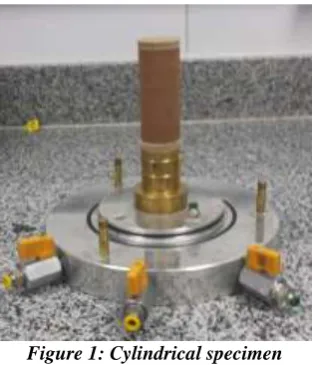
Federal Institute of Ceará. Soil index properties tests such as moisture content, specific gravity, particle size distribution, plastic limit, and liquid limit were carried out according to the Brazilian Standard [6]. The triaxial tests were performed on remolded soil specimens. The remolded specimens for the triaxial tests were prepared using static compaction at a specified moisture content and density. The soil samples were compacted in a cylindrical mold with moisture content of 10,5% and 19,17 kN/m³ density as shown in Figure 1.Figure 1: Cylindrical specimen
The CU triaxial tests were performed under three different cell pressures of about 100, 200, and 300 kPa using specimens of 50mm e 38mm diameter. The specimens in the CU triaxial test were sheared with a strain rate of 0.083 mm/min.
RESULTS AND DISCUSSION
The soil subjected to the tests was classified as a SM-SC (silty sand), according to the Unified Soil Classification System. Table 1 shows the basic properties of the studied soil.
Table 1: Basic properties of studied residual soil
Moisture Content
(%)
Specific Gravity
Particle Size Distribution Atteberg Limits
Soil Classification
(USCS) Clay
(%) Silt (%)
Sand
(%) Gravel(%)
Plastic limit
(%)
Liquid Limit (%)
10,5 2,48 14 3 83 0 0 0 SM-SC
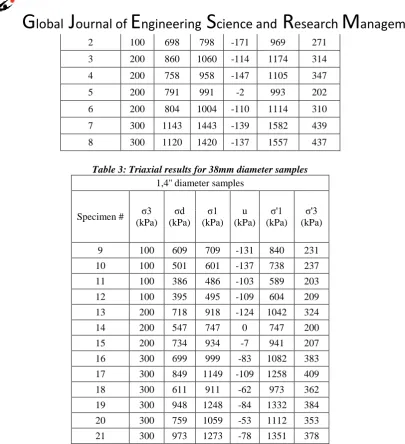
Many tests were performed to obtain consistent results. Because of the relative complexity of the test, some samples were lost, others, presented inconsistent values. For the selection of compatible values, it was held a careful analysis of the various results. Table 2 and Table 3 present results of the performed triaxial tests with 50mm e 38mm diameter samples.
[Monteiro* 4(4): April, 2017] ISSN 2349-4506
Impact Factor: 2.785
G
lobal
J
ournal of
E
ngineering
S
cience and
R
esearch
M
anagement
2 100 698 798 -171 969 271
3 200 860 1060 -114 1174 314
4 200 758 958 -147 1105 347
5 200 791 991 -2 993 202
6 200 804 1004 -110 1114 310
7 300 1143 1443 -139 1582 439
8 300 1120 1420 -137 1557 437
Table 3: Triaxial results for 38mm diameter samples
1,4'' diameter samples
Specimen # σ3 (kPa)
σd (kPa)
σ1 (kPa)
u (kPa)
σ'1 (kPa)
σ'3 (kPa)
9 100 609 709 -131 840 231
10 100 501 601 -137 738 237
11 100 386 486 -103 589 203
12 100 395 495 -109 604 209
13 200 718 918 -124 1042 324
14 200 547 747 0 747 200
15 200 734 934 -7 941 207
16 300 699 999 -83 1082 383
17 300 849 1149 -109 1258 409
18 300 611 911 -62 973 362
19 300 948 1248 -84 1332 384
20 300 759 1059 -53 1112 353
21 300 973 1273 -78 1351 378
[Monteiro* 4(4): April, 2017] ISSN 2349-4506
Impact Factor: 2.785
G
lobal
J
ournal of
E
ngineering
S
cience and
R
esearch
M
anagement
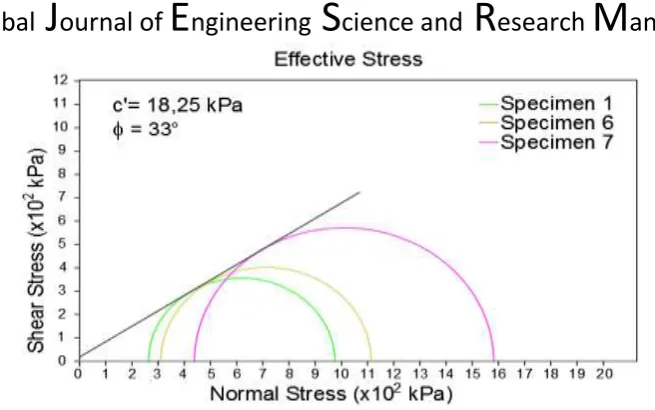
Figure 2: Mohr-Coulomb failure envelope for the 50mm diameter samples
Figure 3: Mohr-Coulomb failure envelope for the 38mm diameter samples
[Monteiro* 4(4): April, 2017] ISSN 2349-4506
Impact Factor: 2.785
G
lobal
J
ournal of
E
ngineering
S
cience and
R
esearch
M
anagement
Table 4. 50mm and 38mm diameter samples comparison
Specimen Diameter
(mm)
c' (kPa) (º)
50 18,25 68,12
38 33 29
CONCLUSION
The results show that the specimen diameter influence on effective shear strength parameters for triaxial tests on different diameters specimens is small regarding the internal friction angle. On the other hand, soil cohesion presented a significant variation. The results of the triaxial tests showed that 50mm diameter samples presented a cohesion intercept of 18, 25 kPa and the internal friction angle of 33º. Meanwhile, the 38mm diameter samples presented a 68,12 soil cohesion and a 29º internal friction angle. The internal friction angle exposed a 12,12% difference between the different diameter specimens. The specimens cohesion showed a 73,20% divergence, which is a considerable variance. The usage of 38mm diameter specimens is not recommended due to its fragility when testing silty sand soils, which can be easily damaged during the rubber sheath handling, in that way, possibly occasioning inconsistent results.
ACKNOWLEDGEMENTS
The authors thanks CNPq and FUNCAP for the financial support
REFERENCES
1. Rohaya Alias, Anuar Kasa, Mohd Raihan Taha: “Effective Shear Strength Parameters for Remolded Granite Residual Soil in Direct Shear and Triaxial Tests” Electronic Journal of Geotechnical Engineering, 2014 (19.R):4559-4569. Available at ejge.com
2. Sushama Kiran, Bindhu Lal: “Modelling of Soil Shear Strength Using Neural Network Approach” Electronic Journal of Geotechnical Engineering, 2016 (21.10): 3751-3771. Available at ejge.com 3. Fernando Feitosa Monteiro, Leila Maria Coelho de Carvalho, Alfran Sampaio Moura, Marcos Fábio
Porto de Aguiar, Icaro Rodrigues Marques: “Specimen Diameter Influence on Effective Shear Strength Parameters in Triaxial Tests” Electronic Journal of Geotechnical Engineering, 2016 (21.7): 4049-4060. Available at ejge.com
4. HEAD, K.H. Manual of soil laboratory testing. Chichester: John Wiley & Sons Ltd, v.2, 1994
5. BISHOP, A. W., HENKEL, D. J. The measurement of soil properties in the triaxial test, 2.ed, Londres, UK: Edward Arnold Ltd., 227 p., 1962.
6. Associação Brasileira de Normas Técnicas. (2016). Amostras de solo - Preparação para ensaios de compactação e ensaios de caracterização: NBR 6457. Rio de Janeiro, Brasil.