The Learning Network Program:
An online collaborative methodology
Mariana Clini
Project Manager Instituto Crescer [email protected]
Abstract
The Learning Network Program is an initiative and an online collaborative methodology which can be applied to all age ranges, with students from the beginner level up to university students. It is an interschool project promoted by the Brazilian NGO Instituto Crescer since 2010, and it is been promoting interaction between schools from different parts of the world. Teachers, together with their students, work on a topic proposed by Instituto Crescer, relative to the environment, historical memory, citizenship or culture of the region where the school is located. The whole process is documented in a virtual community, such as Facebook, by the teachers themselves, who also have the objective of sharing the work of the other schools with their students. At one point of the project, students have a video conference call to exchange impressions and experiences about the work they did. Students not only become familiar with other cultures, but also begin to gain deeper knowledge about their own reality.
Science Volume 3, 2020, Pages 72–80
1. Collaborative Learning
A group of students in a learning process inside a classroom is a promising situation to develop collaborating attitudes among them. After all, students are in a collective, full development situation, and they have to be prepared with good values to confront the society beyond the school walls. However, why do we have to fuel collaboration between them? In addition to making them more proactive in a more equalitarian society, is there any evidence that collaboration is beneficial to the learning process of students?
According to Gokhale (1995) [1], collaborative learning is an “instruction method in which students at various performance levels work together in small groups toward a common goal. The students are responsible for one another's learning as well as their own. Thus, the success of one student helps other students to be successful” [1]. Thus, we can say that collaboration involves a feeling of solidarity, which could be related to a true dialogue between students. Paulo Freire (2005) [2]. stated that a “true dialogue cannot exist unless the dialoguers engage in critical thinking—thinking which discerns an indivisible solidarity between the world and the people and admits of no dichotomy between them.”.
However, traditional education, most of the times, favors an individual way of working or, when students are asked to work in groups, competition is stimulated among them. The evaluation system, based on individual grades, incites competition and does not recognize the individual learning process of students. The best students are considered to be the ones that have higher qualifications. But students are naturally in a group already, hence why not stimulate collaboration?
Collaborative learning is an opportunity to encourage other competencies in students, beyond teaching traditional content from curricula. Johnson and Johnson (1986) [3], as a conclusion of their empirical observation of students in basic schools, claimed that if teachers want their students to learn more and feel self-confident and motivated, they should stimulate collective interactions among them, instead of individual or competitive. Moreover, Gokhale (1995) [1] also stated that students who participate in activities that stimulate collaborative learning develop more critical thinking than students that work individually. Then, if collaborative learning could provide students not only with social and emotional benefits, but also with bigger opportunities of learning and development of their critical thinking, there is no doubt that this is a strategy that has to be explored by educators.
interaction may occur”. So, how can we create an environment for students to have real collaborative learning?
Opportunities have to be created for this collaboration to arise. Thus, educational projects with this goal should be implemented while respecting four principles, according to Inside the Collaborative Classroom: The Core Principles (2015) [5]: social and academic curricula have to be interdependent and integrated; fostering caring relationships and building inclusive and safe environments are foundational practices for both the student and adult learning community; classroom learning experiences should be built by having students construct knowledge and engage in action; finally, honoring and building on students’ intrinsic motivation leads to engagement and achievement.
Putting all these principles into practice is not a simple task for an educator, but fortunately, there are many methodologies and educational approaches that foster collaboration, and there is no doubt that technology could be an ally to achieve this goal.
2. Technology and Collaboration
When we think about collaborative projects, most of the times we imagine students sitting in a circle, talking and sharing experiences. But we can also think about this dynamic in a virtual environment, which means using digital technologies and the Internet to enhance collaborative learning.
A virtual environment has a potential for constructing knowledge collaboratively and horizontally, because of the relativity of time, space and geographic boundaries. This characteristic allows for a new, non-linear, more democratic and participative language.
Because it is more democratic and inclusive, online collaborative learning could also potentialize the manifestation of cultural diversity. Nonetheless, similarly, having a group of people together does not mean that they will work collaboratively; it does not mean that different people, together, will feel empathy and accept one another. Likewise, it has to be an environment that stimulates collaboration and encourages this cultural diversity. In other words, it is not enough create spaces inside schools to study the local culture or another culture through technology.
3. The role of teachers
Teachers, therefore, has three responsibilities in this process of online collaboration: the first one is to create a warm environment for diversity arises; the second one is to allow the interaction between students to be really collaborative; the third one is to allow this experience to be an effective learning moment.
Just having good infrastructure inside schools and carrying out online collaborative projects, results could not happen if teachers are not aware of their pedagogical possibilities. Thus, the implementation of active methodologies supported by new technologies will not achieve good results if teachers do not set clear learning objectives. About the role of the teacher in these processes, Allan (2015) [7] underscored that a “teacher has to ask the right questions, awaken students’ curiosity and invite them to build knowledge together. That means being receptive to learning from students, particularly when the theme is technology, something that youth knows deeply”1.
Teachers should know that are many other benefits when students have the opportunity to participate in online collaborative projects; in addition to learning the traditional curricula, they could learn some important abilities and competencies, such as: technology literacy, team work, reading and interpretation of texts and expression in different languages. With the support of new tools, a new dynamic is established in the school environment; students may feel curious and ask questions, and teachers have to be able to mediate moments of reflection and to systematize knowledge to achieve moments of significant learning.
Consequently, within a technological and collaborative context, a good plan and a consistent methodology are required to achieve a more sophisticated level of knowledge which really fosters a good collaborative process, promotes other cultures and, at the same time, preserves cultural differences.
4. The Learning Network Program
The Learning Network Program is an initiative of Instituto Crescer para a Cidadania, a Brazilian NGO that has been working with education and community development since 2000. Instituto Crescer uses and develops bold education methodologies, always aiming at the development of communities and society.
Instituto Crescer has previous experience in projects all over the Brazilian territory, and also in other countries such as Argentina, Mozambique and Paraguay. One of the international projects is The Learning Network Program, which has been promoting
more enthusiastic and effective learning to young students since 2010, through online collaborative projects that favor cultural diversity and make use of technologies. The main target audience is composed of teachers of different elementary schools in many parts of the world. They are put together in a private group in a social media platform (e.g., Facebook), and they have to work with their students on a specific theme, from eight to twelve weeks. During the project, they have to share their workflow in the private group with the students from the others schools, which could be in another part of the world. The Learning Network Program has an eight-step process developed by Instituto Crescer through its empirical experience and knowledge of education.
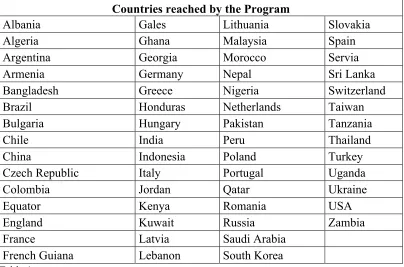
Currently, the ninth edition of the program is being held. In the first editions, teachers and their students had to work in the English language, and exchanges took place with countries such as Brazil, England, India and Kenya. After some good results in the first editions, Instituto Crescer implemented the program in Portuguese for schools in Brazil, and subsequently in Spanish in Latin American countries and Spain. When all editions are taken into account, the program has already been implemented in schools in more than 50 countries in four continents, as shown in Table 1.
Countries reached by the Program
Albania Gales Lithuania Slovakia
Algeria Ghana Malaysia Spain
Argentina Georgia Morocco Servia
Armenia Germany Nepal Sri Lanka
Bangladesh Greece Nigeria Switzerland
Brazil Honduras Netherlands Taiwan
Bulgaria Hungary Pakistan Tanzania
Chile India Peru Thailand
China Indonesia Poland Turkey
Czech Republic Italy Portugal Uganda
Colombia Jordan Qatar Ukraine
Equator Kenya Romania USA
England Kuwait Russia Zambia
France Latvia Saudi Arabia
French Guiana Lebanon South Korea
In each edition, 120 teachers, on average, joined the program. This means that more than 2,000 students reached indirectly per edition. After the eight edition, 960 teachers and more than 19,000 students had the opportunity to share their research project with another school.
5. The Methodology
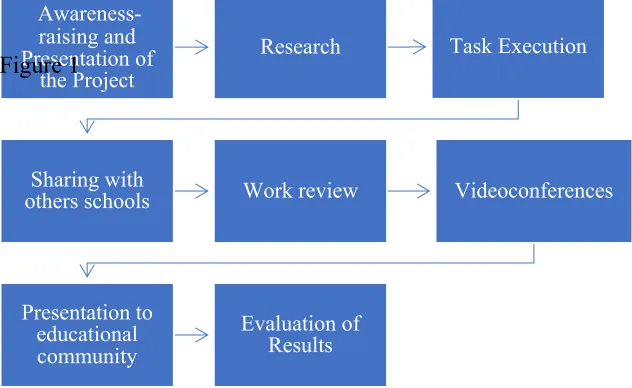
The methodology of the program has been consolidated as a result of the experience of implementing it. This process has eight steps that could be adapted to any theme and any age range, as shown in Figure 1. These steps take eight to twelve weeks to be implemented.
According to Figure 1, teachers first organize students into small groups and explain the project and the subject that they will work on. Importantly, teachers play the roles of mediations in order to support the students in their research, which could be simple or more complex, depending of the students’ grade. Through mediation of Instituto Crescer’s staff, teachers contact one another in a private virtual community, e.g., Facebook or another online platform. After that, students make a product/task resulting from the research that has to be shared with other schools in the social network. Teachers share their students’ research findings. Then, they select some research made by students from another school and show it to their own students. After this first stage, schools interact in videoconferences sessions to discuss the results of their research. Teachers share their final thoughts in the virtual community and analyze whether the outcomes were achieved.
To implement this project, the following resources are necessary: a private group in a social media platform, a mediator and a week-by-week project plan. For a school to participate, it will need a computer, internet connection at least once a week, a webcam
Awareness-raising and Presentation of
the Project
Research Task Execution
Sharing with
others schools Work review Videoconferences
Presentation to educational community
and a microphone for the videoconference sessions. Thus, it is a low-cost project and it has a good potential to scale.
6. Main activities
Every edition of the project has a theme in which students must work on. Themes are all related to the environment, citizenship or culture of the region where the school is located. Instituto Crescer developed an agenda for the activities of each theme, namely:
- “Me and my world”: children do research on the school’s neighborhood, its history and the culture of the residents.
- “Story tellers”: children do research on legends and folklore of the region. - “Little chefs”: the students have to research about typical dishes, and their
ingredients, and then they have to prepare a recipe of the other school.
- “Great Personalities”: students do research on the personalities that are important for their community.
- “Child's play”: children do research on the traditional games that their parents and grandparents used to play.
- “Hit Parade”: children present some traditional music of their region, and after that they create a parody of the music of other school.
- “Cyberbullying”: students do a research of the perception of the school community about cyberbullying, them they present a project proposal to tackle the issue.
- “My way to school”: students do a study of how people of the school community go to school. Them, they develop a campaign of how to go to school in a safer way.
7. Strategic and specific goals
The main objective of the Program is to deliver effective learning to children in elementary schools. To achieve this purpose, the program has four specific goals: 1- Motivate teachers in their work.
When teachers are in contact with one another and work together, they feel more motivated, as they can share experience and knowledge.
2- Make teachers use an innovative strategy to teach the traditional content of the curricula.
If students see the same content at school, they may find it boring, but in a new format and strategy, they are more likely to have effective learning. In the case of the program, the strategy is cultural exchange and use of technologies.
The empirical observation conducted showed that when a person studies their own culture and environment, their history and their customs, he/she starts to appreciate it more. And the result is clearer when this student has to present it to another group, or in this case, to another school.
4- Make children get to know different cultures.
Thanks to the use of technology, children have access to the work of other schools, in other places. By knowing the work of different students, they can see the difference from other cultures, but they also discover the similarities to a child at the same age.
8. Expected results and impact
Participation in the program is voluntary, and any teacher can join it without any selection process. What they all have to do is fill in a form to confirm their participation. For this reason, adhesion is normally high (an average of 120 teachers in each edition).
In all editions of the project, Instituto Crescer expects each registered school to have participated in the whole process, which means producing a final work with elements of their own culture and of another culture. As a minimum result, the expectation is that, at least 50% of the teachers registered in the project should complete the whole process. Those teachers receive a certificate for their participation.
Videoconferencing is not mandatory for participation, because sometimes Internet connection in schools is not good enough. However, the impact on students is much stronger when they see other children live on camera. It is hoped that at least 25% of the initial number of participants can experience a videoconference session.
By the end of the edition of the program, the online group remains active, with all the works available. The maximum expectation is that teachers will stay in permanent contact and make an effort to make other cultural exchanges in the future.
9. Supporters and samples of works
During almost nine years, the project had some occasional supporters, like Scholas Ocurrentes, from Argentina, with the recognition of Pope Francis; Omnis Institute from England; the British Council; and the Federation Internationale de L´automobile (FIA).
These are some samples of works made during nine years of project: Hits Parade 2011:
students of India:http://www.youtube.com/watch?v=oKbaGDmvQp8
Great Personalities 2012:
Story tellers 2016:
students from Spain:
http://prezi.com/qwmxvhx6oz-g/?utm_campaign=share&utm_medium=copy&rc=ex0share
students from Honduras:
https://www.youtube.com/watch?feature=youtu.be&v=p64_6pGItzk&app=desktop students from Chile:
https://www.youtube.com/watch?v=YRvY9L4bxOo
Sample of a videoconference with children from Paraguay in 2015: https://www.youtube.com/watch?v=YhGF4O3o2ow
References
[1] Gokhale Anuradha, “Collaborative Learning Enhances Critical Thinking”, JTE, Volume 7, Number 1, Fall 1995.
[2] Freire Paulo, Pedagogy of the Oppressed, Continuum, New York, 2005, p 92.
[3] Johnson Roger and Johnson David. “Cooperative Learning in the Science Classroom”. Science and Children, Oct 1986, p31-32.
[4] Dillenbourg Pierre. What do you mean by collaborative learning?. P. Dillenbourg. Collaborative-learning: Cognitive and Computational Approaches., Oxford: Elsevier, 1999, p.1-19.
[5] Inside the Collaborative Classroom: The Core Principles. Center for the Collaborative Classroom, 2015.
[6] Bauman, Zygmunt. Retrotopia. Paidós Ibérica, Barcelona, 2017, p. 86.
[7] Allan, Luciana. Escola.com: como as novas tecnologias estão transformando a educação na prática. Figurati, São Paulo, 2015, p.146.