Patient Experience Journal
Patient Experience Journal
Volume 1
Issue 1 Inaugural Issue
Article 6
2014
“Working the system”: The experience of being a primary care
“Working the system”: The experience of being a primary care
patient
patient
Michelle LA Nelson PhD
Bridgepoint Collaboratory for Research and Innovation, Bridgepoint Health; Adjunct Professor; Daphne Cockwell School of Nursing, Ryerson University, [email protected]
Mark G. Torchia PhD
University Teaching Services, University of Manitoba, [email protected]
Jennifer B. Mactavish PhD
Faculty of Graduate Studies, Ryerson University, [email protected]
Ruby E. Grymonpre PharmD
Faculty of Pharmacy, University of Manitoba, [email protected]
Follow this and additional works at: https://pxjournal.org/journal
Part of the Health and Medical Administration Commons, Health Policy Commons, Health Services Administration Commons, and the Health Services Research Commons
Recommended Citation
Recommended Citation
Nelson, Michelle LA PhD; Torchia, Mark G. PhD; Mactavish, Jennifer B. PhD; and Grymonpre, Ruby E. PharmD (2014) "“Working the system”: The experience of being a primary care patient," Patient Experience Journal: Vol. 1 : Iss. 1 , Article 6.
DOI: 10.35680/2372-0247.1005
Available at: https://pxjournal.org/journal/vol1/iss1/6
Patient- and Family-Centeredness – Research
“Working the system”: The experience
Michelle LA Nelson, PhD,
Bridgepoint Collaboratory
Daphne Cockwell School of Nursing, Ryerson University
Mark G Torchia, PhD,
University Teaching Services,
Jennifer B Mactavish, PhD,
Faculty of Graduate Studies,
Ruby E Grymonpre, PharmD.,
Faculty of Pharmacy,
Abstract
Health care providers and system administrators are in the midst of a paradigm shift; moving from paternalism toward an egalitarian approach. For patient centred care to occur, health care providers must prioritize patient needs; provide information regarding treatments while taking patient preferences and expectations into account. While there is literature regarding patient centredness, there is less infor
patient and the influence on behaviour. Using phenomenological research methods and the theory of planned behaviour as a theoretical framework, this study addressed the questions, a) what
patient, and b) what influence do beliefs, attitudes, and experience have on people’s behaviour as a patient? Nineteen individuals participated. Seven shared elements of being a primary health care patient were
the development of a composite vignette. The patient experience was a socially oriented, governed and reinforced cyclical process. Patients described themselves as actively engaged in their health care
what they needed, when they needed it. Patients changed their beliefs, attitudes and behaviour as a result of experiences with their physicians, and their perceived success or failure in acquiring the best health care possible. Being a patient was not a single, observable behaviour, but rather a set of contextually dependent strategies patients’ directed at the specific goal of getting the best healthcare possible. The theory of planned behaviour was unsuitable for understanding patients’ beliefs, attitudes and behaviour.
Keywords
Patient-centred care, primary health care, qualitative research, personal narrative, physician patient relationship, interpersonal interactions
Background and Study Purpose
Health care providers and health system administrators are in the midst of a paradigm shift that is transforming traditional physician/ health care provider driven approaches (paternalistic or hierarchical) to more egalitarian models that place individuals at the centre of practice. The former creates passivity in patients and dependence on health care providers, which in turn decreases confidence and ability to cope with health concerns1, 2 while the latter involves patients in the planning and delivery of health care services at both the individual and systemic level. This new approach can be attributed in part to the rise in health promotion and changes in health care delivery processes
active patient concept is part of a dialectic that has waxed and waned for two centuries, with broader societal interests in autonomy, self-direction, and personal responsibility”.5
Patient experience is an aspect of patient centeredness; one of six health care quality aims proposed by the Institute of
Research
he experience of being a primary care patient
Bridgepoint Collaboratory for Research and Innovation, Bridgepoint Health; Adjunct Professor;
Daphne Cockwell School of Nursing, Ryerson University
University Teaching Services,
University of Manitoba
Faculty of Graduate Studies,
Ryerson University
Faculty of Pharmacy,
University of Manitoba
Health care providers and system administrators are in the midst of a paradigm shift; moving from paternalism toward entred care to occur, health care providers must prioritize patient needs; provide information regarding treatments while taking patient preferences and expectations into account. While there is literature regarding patient centredness, there is less information from the patient perspective about the experience of being a patient and the influence on behaviour. Using phenomenological research methods and the theory of planned behaviour as a theoretical framework, this study addressed the questions, a) what is the essence of being a primary health care patient, and b) what influence do beliefs, attitudes, and experience have on people’s behaviour as a patient? Nineteen individuals participated. Seven shared elements of being a primary health care patient were identified and contributed to the development of a composite vignette. The patient experience was a socially oriented, governed and reinforced cyclical process. Patients described themselves as actively engaged in their health care – “working the system”
what they needed, when they needed it. Patients changed their beliefs, attitudes and behaviour as a result of experiences with their physicians, and their perceived success or failure in acquiring the best health care possible. Being a patient was ot a single, observable behaviour, but rather a set of contextually dependent strategies patients’ directed at the specific goal of getting the best healthcare possible. The theory of planned behaviour was unsuitable for understanding patients’
centred care, primary health care, qualitative research, personal narrative, physician patient relationship,
Health care providers and health system administrators are in the midst of a paradigm shift that is transforming
physician/ health care provider driven approaches (paternalistic or hierarchical) to more egalitarian models that place individuals at the centre of practice. The former creates passivity in patients and dependence on health care providers, which in turn
ecreases confidence and ability to cope with health while the latter involves patients in the planning and delivery of health care services at both the individual and systemic level. This new approach can be attributed in part to the rise in health promotion and changes in health care delivery processes3, 4 however “the
ncept is part of a dialectic that has waxed and waned for two centuries, with broader societal
direction, and personal
an aspect of patient centeredness; one of six health care quality aims proposed by the Institute of
Medicine6 to promote better understanding of patient experiences during their interactions with health care providers and the health care system. A good patient experience is positively related to other aspects of care quality. Understanding and assessing patient experience, therefore, is essential for practitioners and policy makers concerned with enhanced quality of care for all patients. The expectations of the public and patients for health care services and providers have been seen as problematic by clinicians and policy makers but “understanding how expectations are formed and how they affect health attitudes, behaviours and outcome assessment is crucial”. As societal expectations and demands for eff
responsive health care services continue to escalate, there is a corresponding demand for better understanding of the expectations of users.
There is substantial literature on patient centredness yet relatively little that reflects the beliefs,
needs from the person/patient perspective. Van Dulmen stated that “the meanings and effects of patient
centredness may perhaps only be assessable by inquiring
of being a primary care patient
for Research and Innovation, Bridgepoint Health; Adjunct Professor;
Health care providers and system administrators are in the midst of a paradigm shift; moving from paternalism toward entred care to occur, health care providers must prioritize patient needs; provide information regarding treatments while taking patient preferences and expectations into account. While there is literature
mation from the patient perspective about the experience of being a patient and the influence on behaviour. Using phenomenological research methods and the theory of planned behaviour
is the essence of being a primary health care patient, and b) what influence do beliefs, attitudes, and experience have on people’s behaviour as a patient? Nineteen
identified and contributed to the development of a composite vignette. The patient experience was a socially oriented, governed and reinforced
“working the system” to get what they needed, when they needed it. Patients changed their beliefs, attitudes and behaviour as a result of experiences with their physicians, and their perceived success or failure in acquiring the best health care possible. Being a patient was
ot a single, observable behaviour, but rather a set of contextually dependent strategies patients’ directed at the specific goal of getting the best healthcare possible. The theory of planned behaviour was unsuitable for understanding patients’
centred care, primary health care, qualitative research, personal narrative, physician patient relationship,
to promote better understanding of patient experiences during their interactions with health care providers and the health care system. A good patient experience is positively related to other aspects of care
y. Understanding and assessing patient experience, therefore, is essential for practitioners and policy makers concerned with enhanced quality of care for all patients.
public and patients for health care been seen as problematic by clinicians and policy makers but “understanding how expectations are formed and how they affect health attitudes, behaviours and outcome assessment is crucial”.7 As societal expectations and demands for effective and responsive health care services continue to escalate, there is a corresponding demand for better understanding of the
There is substantial literature on patient centredness yet relatively little that reflects the beliefs, expectations and needs from the person/patient perspective. Van Dulmen8 stated that “the meanings and effects of patient
Working the system, Nelson et al.
38 Patient Experience Journal, Volume 1, Issue 1 - April 2014
about each patient’s individual needs, expectations and preferred level of activation and decision participation prior to entering a medical treatment and, subsequently, by evaluating visit and health outcomes in relation to these a priori assessed measures”. Little et al.9 also emphasized that the patient is the best source of information. Despite these calls, most of the available literature draws on clinician/administrator perspectives and does not account for patients’ experiences and needs. When patient expectations are factored into research, the scope is generally limited to views on topics such as physician prescribing habits and engaging patients in decision making.10-12
The presented study explored how beliefs, attitudes and experiences influence people’s behaviour in primary health care (PHC) settings. Principle among the questions was ‘what is the essence of being a primary health care patient’? ‘What influence does experience, beliefs and attitudes have on being a patient’?
Methods
LeVasseur13 noted that “traditional science has not been concerned with the lived experiences of individuals because these are largely unmeasurable and difficult to appreciate through sensory observation. However, clinicians must contend with and respond to their patients’ lived experience of health and illness”. The need to understand the lived experience extends to health researchers and policy makers as well. The presented research was concerned with people’s
lived experiences in health care, so selecting an appropriate research approach and methods was essential. This work used an interpretive phenomenological approach, based on the belief that the truth can be discovered in peoples’ lived experiences. Additionally, patient’ experiences, explored from their own perspectives is a relatively unstudied topic and phenomenology is well suited to holistic questions or to phenomena that are not well understood.
The Theory of Planned Behaviour14 (TPB) served as a guiding framework for the study which allowed for an exploration of beliefs and attitudes specific to the behaviour of being a patient. The TPB was not tested within this study. The exploration of patients’ beliefs using the TPB as a guiding framework allowed for an exploration of patient beliefs and
attitudes specific to the behaviour of being a patient. This exploration of patient experience related to the TPB was conducted as an additional analytical activity. This analysis was conducted to identify each element and examine the behavioural beliefs about the consequences of being patient, whether those behaviours were positively evaluated or not, what significant others and the broader community felt about being a patient, as well as the perceptions about ability to engage in the given behaviour.
Participants & Recruitment
Upon receiving approval from the university research ethics board, a purposeful sampling strategy was
implemented to ensure participants had experience with or knowledge of the phenomenon of interest. Paper
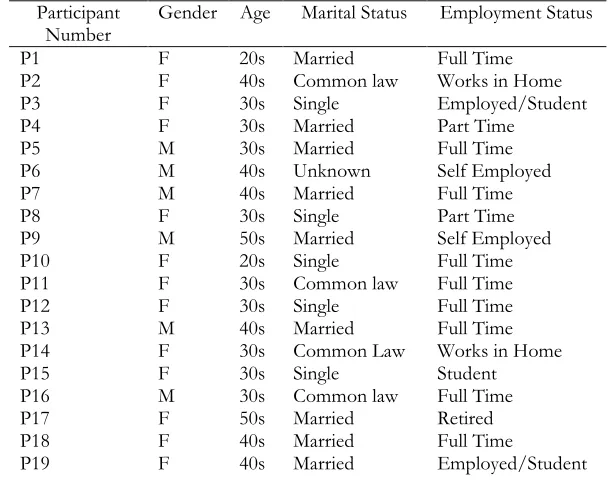
advertisements were posted in public locations. An electronic snowball recruitment strategy using email networks and social media was implemented to recruit a wide range of individuals. The use of social networking sites allowed for widespread dissemination of the study recruitment materials in order to identify participants who were information rich examples for the study. To maximize variation in the data, participant demographic characteristics were not limited. Inclusion criteria required participants to be over the age of 18, a resident of Manitoba, and able to communicate in English. Nineteen individuals participated in this study. Participants were predominantly Caucasian (89%), married/common law (68%), female (68%) and employed either full or part time (79%). Further detail regarding the participants can be found in Table 1.
Table 1. Participant Characteristics
Participant Number
Gender Age Marital Status Employment Status
P1 F 20s Married Full Time
P2 F 40s Common law Works in Home
P3 F 30s Single Employed/Student
P4 F 30s Married Part Time
P5 M 30s Married Full Time
P6 M 40s Unknown Self Employed
P7 M 40s Married Full Time
P8 F 30s Single Part Time
P9 M 50s Married Self Employed
P10 F 20s Single Full Time
P11 F 30s Common law Full Time
P12 F 30s Single Full Time
P13 M 40s Married Full Time
P14 F 30s Common Law Works in Home
P15 F 30s Single Student
P16 M 30s Common law Full Time
P17 F 50s Married Retired
P18 F 40s Married Full Time
Experts agree that researchers should interview between 5 and 25 individuals who have experienced the
phenomenon15,16, but interviews should be conduct theoretical saturation occurs – in other words, until no new information, or only minor variations emerge the purpose of this study “theoretical saturation” was considered met when new information added only minor variations in the themes and did not change the essence of the shared experience.
Data Collection & Analysis
The study interview guide was developed and pilot tested using a modified cognitive interview approach
focused on the processes individuals used to answer the interview questions rather than the responses themselves. Although cognitive interviewing is usually undertaken to assess and reduce measurement errors with survey instruments the approach was very helpful in assessing if the participants were able to understand
the researcher intended them, what meanings they attribute the question and how they formed their
responses. As a result of the pilot testing, several questions were reworded for clarity and the interview guides were reorganized to create better conversational flow.
After obtaining informed consent, participants were asked about their general beliefs and attitudes about health care as well as their experiences with health care services and providers. Overarching questions included “What experience have you had with health care?” “How would you describe or characterize your participation with health care?” “Have you, or do you currently see a physician?” “Could you describe a typical visit to your physician?” “Are your actions at medical appointments consistent or different with how you planned to behave?”
Data analysis was an iterative interpretive process. An initial assessment of all data collected provided an overall sense of the meaning and a scope of the information collected, including an initial impression of
the overall depth, credibility and potential usefulness of the information. This process assisted in determining if saturation had been met or if additional interviews were needed. From each interview transcript and field notes, a list of mutually exclusive substantive statements were derived, which were then grouped into larger thematic units (the common elements of the experience). These themes were then examined for relationships to the other themes, and organized accordingly. A description of what the participants’ experienced (textural description) and how it was experience (structural description) was generated from the verbatim quotations.
Experts agree that researchers should interview between 5 and 25 individuals who have experienced the
, but interviews should be conducted until in other words, until no new information, or only minor variations emerge.15 For
tudy “theoretical saturation” was considered met when new information added only minor variations in the themes and did not change the essence of
The study interview guide was developed and pilot tested using a modified cognitive interview approach17 which focused on the processes individuals used to answer the
ew questions rather than the responses themselves. Although cognitive interviewing is usually undertaken to assess and reduce measurement errors with survey instruments the approach was very helpful in assessing if the participants were able to understand the questions as
what meanings they attribute the question and how they formed their
responses. As a result of the pilot testing, several questions were reworded for clarity and the interview guides were
better conversational flow.
fter obtaining informed consent, participants were asked about their general beliefs and attitudes about health care as well as their experiences with health care services and providers. Overarching questions included “What experience have you had with health care?” “How would you describe or characterize your participation with health care?” “Have you, or do you currently see a physician?” “Could you describe a typical visit to your physician?”
l appointments consistent or different with how you planned to behave?”
Data analysis was an iterative interpretive process. An initial assessment of all data collected provided an overall sense of the meaning and a scope of the information collected, including an initial impression of
ial usefulness of the information. This process
been met or if additional interviews were needed. From each interview transcript and
ich
ption) and how it was experience (structural description)
These textural and structural descriptions formed the basis for a composite description of the phenomenon.
resulting composite vignette was compris
statements and verbatim participant quotes, reflecting the shared elements of the experience of all participants. composite description is however, more than retelling the experience; it is an interpretation by the researcher. researcher must select information that they consider representative of the experience. This selection of information by the researcher allows the inclusion of information that is useful and specific to the question being studied, while limiting the amount
and/or distracting information. Todres composite first person narrative pre
way that the reader can relate to them in a personal way This composite description is considered the apex of a phenomenological study and presents, using a first person perspective, the collective “essence” of the ex
serving as the primary representation of the study results.
Results
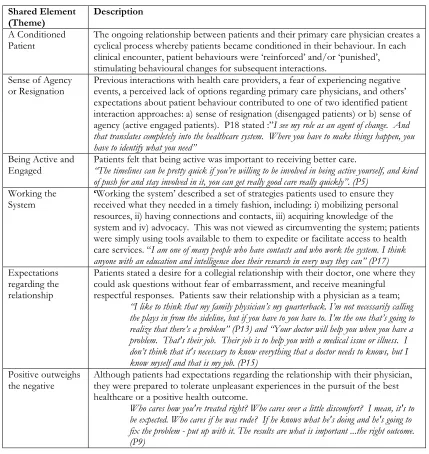
This study was originally designed to capture the perspectives of members of the general public regarding health care services. Through participant responses, attention and emphasis on primary health care (PHC) emerged and the study results subsequently re participants’ common beliefs, attitudes and resultant behaviours in regards to being a primary health care patient. Seven common elements (themes) were identified as composing the cyclical process of being a PHC patients; i) conditioned patients, ii)disengaged patients or iii) sense of agency, iv) active and engaged patients, v) working the system, vi) expectations of the relationship and vii) positive outweigh the negatives. Refer to Figure 1 for a visual of the shared elements (themes)
description of each theme with representative quotations.
Figure 1. Shared elements (Themes)
These textural and structural descriptions formed the basis for a composite description of the phenomenon. The resulting composite vignette was comprised of substantive statements and verbatim participant quotes, reflecting the shared elements of the experience of all participants. The composite description is however, more than retelling the experience; it is an interpretation by the researcher. The researcher must select information that they consider representative of the experience. This selection of information by the researcher allows the inclusion of information that is useful and specific to the question being studied, while limiting the amount of extraneous
Todres18 notes that the composite first person narrative presents the findings in a way that the reader can relate to them in a personal way.19 This composite description is considered the apex of a phenomenological study and presents, using a first person perspective, the collective “essence” of the experience, serving as the primary representation of the study results.
This study was originally designed to capture the perspectives of members of the general public regarding health care services. Through participant responses, attention and emphasis on primary health care (PHC) emerged and the study results subsequently reflected participants’ common beliefs, attitudes and resultant behaviours in regards to being a primary health care patient. Seven common elements (themes) were identified as composing the cyclical process of being a PHC patients;
i)disengaged patients or iii) sense of agency, iv) active and engaged patients, v) working the system, vi) expectations of the relationship and vii)
Working the system, Nelson et al.
40 Patient Experience Journal, Volume 1, Issue 1 - April 2014
Significant statements and emergent themes served as the basis for the textural and structural description of the patient experience, presenting what and how the phenomenon was experienced.
The Primary Health Care Patient Experience: A Composite Vignette
Health care isn’t something that I really spend a lot of time thinking about, and I don’t talk about it with my friends or family beyond ‘I had to go to the doctor, or how long I may have waited in the waiting room. We don’t talk about the big picture of health care. I think Canadians are really lucky – I wouldn’t want a system where you have to pay out of pocket. I am not saying that what we have in Canada is perfect, but I am pretty grateful that I don’t have to worry
about whether I can do to the doctor or not. But I also think that everyone has a responsibility to take care of themselves and not be a burden on the rest of the country. I know I try to take care of myself, trying to avoid having to engage with the health care system as much as I can.
Over my lifetime, I think I have learned “how” to be a patient. When I was 22 I didn’t really know anything about the system or how it worked. I followed the example set by my family about what was appropriate use of health care. But as I got more experience with the system my behaviour changed. I am definitely more actively engaged in trying to get the best possible care and avoid any possible negative experiences. I don’t really trust the system – I know errors are made and I don’t want to be the one that slips through the
Table 2. Descriptions of the Shared Elements of the Patient Experience and Representative Quotations
Shared Element (Theme)
Description
A Conditioned Patient
The ongoing relationship between patients and their primary care physician creates a cyclical process whereby patients became conditioned in their behaviour. In each clinical encounter, patient behaviours were ‘reinforced’ and/or ‘punished’, stimulating behavioural changes for subsequent interactions.
Sense of Agency or Resignation
Previous interactions with health care providers, a fear of experiencing negative events, a perceived lack of options regarding primary care physicians, and others’ expectations about patient behaviour contributed to one of two identified patient interaction approaches: a) sense of resignation (disengaged patients) or b) sense of agency (active engaged patients). P18 stated :”I see my role as an agent of change. And that translates completely into the healthcare system. Where you have to make things happen, you have to identify what you need”
Being Active and Engaged
Patients felt that being active was important to receiving better care.
“The timelines can be pretty quick if you’re willing to be involved in being active yourself, and kind of push for and stay involved in it, you can get really good care really quickly”. (P5)
Working the System
‘Working the system’ described a set of strategies patients used to ensure they received what they needed in a timely fashion, including: i) mobilizing personal resources, ii) having connections and contacts, iii) acquiring knowledge of the system and iv) advocacy. This was not viewed as circumventing the system; patients were simply using tools available to them to expedite or facilitate access to health care services. “I am one of many people who have contacts and who work the system. I think anyone with an education and intelligence does their research in every way they can” (P17)
Expectations regarding the relationship
Patients stated a desire for a collegial relationship with their doctor, one where they could ask questions without fear of embarrassment, and receive meaningful respectful responses. Patients saw their relationship with a physician as a team;
“I like to think that my family physician’s my quarterback. I’m not necessarily calling the plays in from the sideline, but if you have to you have to. I’m the one that’s going to realize that there’s a problem” (P13) and “Your doctor will help you when you have a problem. That's their job. Their job is to help you with a medical issue or illness. I don’t think that it's necessary to know everything that a doctor needs to knows, but I know myself and that is my job. (P15)
Positive outweighs the negative
Although patients had expectations regarding the relationship with their physician, they were prepared to tolerate unpleasant experiences in the pursuit of the best healthcare or a positive health outcome.
cracks. If you don’t care about your health, who will? I have had a bit of experience with the system and I know that there is good, there is bad and there is downright ugly. Everything I do is to avoid the ugly and get the good… I have definitely gotten good at working the system – using my personal resources and contacts to make sure I am getting what I need. I don’t really think this is circumventing the system or getting things that aren’t available to everyone. I know that almost everyone is trying to negotiate and navigate the system to get the best possible care and avoid the bad. I am not so naïve to think that everyone can do what I am doing – not everyone has the abilities or resources I have: I know that my knowledge, education and even money can help - I can’t imagine how frustrating it is for people who don’t have those things.
Before I go to my doctors’ appointments, I get prepared. Part of this is getting psyched up for the appointment itself and the other is making sure I have my list of topics to discuss ready. The worst part is the waiting room. Once I am in the exam room, my appointments are usually pretty quick. I sometimes feel a little rushed but I have learned to be resistant, I almost feel like I am trying to slip just one more question in before the doctor heads out the door.
I have a pretty good rapport with my physician, professional but not chummy. I don’t want to be their friend. The relationship is definitely is a work in progress. I chose him to be my doctor because I thought he was someone I could work with. At the beginning, I don’t think he was as respectful as he is now. I think that is partly because of my approach, I’ve learned that if I am a little bit pushy (maybe assertive is a better word…), he pays more attention to me, but the other thing I think that has changed our relationship is him recognizing that I am not a difficult patient. I come in with knowledge about my body, my health concerns and I am not there to waste his time. I think he respects that. He is the quarterback of my health care team but that isn’t to say that I am sitting on the sidelines watching – we are working together to make sure I am as healthy as can be. I have to trust his expertise.
I switched doctors to this one because I wasn’t feeling comfortable with the care I was getting from the last one, but I really don’t know what I am going to do if this doesn’t work out either. Everyone knows how hard it is to find a new family doctor. I also know I was lucky that I was able to get in with a new doctor – although I should thank my friend who got me in… I know lots of people who don’t have a doctor and rely on walk in clinics for all their care.
People talk about health care like it is a business, and maybe it should be run more like a business, but the idea of patients as customers is a bit tricky. I mean, sure, if people thought about themselves as consumers maybe they wouldn’t be so tolerant of the bad, maybe they would speak up more and demand better service. But on the other hand, it isn’t like any other business. If you have a bad experience with a physician it isn’t like a bad restaurant – you can’t just stop going. Your doctor is your doctor. We are caught in a situation with little choice. And you see that, when people are resigned to sit in the waiting room for 2 hours – like the doctor is doing them a favour by seeing them 2 hours after their appointment.
I definitely don’t trust the system entirely which is why I work the system, using my contacts to double check things and get second opinions. I think it just makes sense; if I don’t try to care about my health – who is? And everyone else is working the system – it is what smart, educated people do. I also appreciate that my doctor is using her connections as well to my advantage. I don’t know why, but I don’t seem to have to wait as long as other people report waiting for tests and procedures.
Sometimes the appointments are more positive than others, but to be totally honest, the outcome is what is really important. I am okay with a less than positive experience as long as the outcome in positive. Overall though I am usually fairly satisfied with the interaction and usually leave feeling like I got what I went for. Like I said, there is good, bad and ugly – so really it is my responsibility to work hard to get the good.
Discussion
The main findings of this study reflected the experiences of nineteen primary health patients and the influence of these experiences on their behaviour. Patients described themselves as actively engaged in their health care – “working the system” to get what they needed, when they needed it. Patients changed their beliefs, attitudes and behaviour as a result of experiences with health care providers, and their perceived success or failure in acquiring the best health care possible.
The patients involved in this study were focused on accessing and receiving the best health care possible. This was reflected in their approach to accessing health care services, an experience they described as socially oriented, structured and reinforced through their interactions with physicians and other health care providers. Although patients described themselves as actively engaged, they did not approach each interaction with health care with a set of predetermined behavioural beliefs about being a patient. It is important to note that for study participants, being a patient was not a single, observable behaviour, but rather a set of contextually dependent strategies they directed at a particular goal. Over the course of their relationship with clinicians, patients developed strategies to assist in achieving their goals and subsequently viewed the successful strategies more positively.
Much of the research focused on the experiences of PHC patient has examined a specific treatment, clinical situation or aspect of the therapeutic relationship and this study provides insight in patients’ perspectives on the system and their general approach to ‘being a patient’. It has been suggested that future work in the area of patient
Working the system, Nelson et al.
42 Patient Experience Journal, Volume 1, Issue 1 - April 2014
developed and reinforced in relation to contextually developed goals, and how behavioural beliefs are developed or adopted in relation to the goal. Future work building upon this study’s approach, exploring how these behavioural strategies and beliefs specifically relate to characteristics such as age and gender, or factors such as degree of contact with the health professional would be of interest.
This study clearly identifies that ‘being a patient’ is not a single behaviour that can be observed and tested and planned for, rather it is a complex socially constructed experience that cannot be distilled into a single framework of beliefs, attitudes and intentions. This is a valuable finding for policy makers, health care administrators and clinicians, as it may provide insight into consultation behaviours, understanding patient assessed outcomes including patient satisfaction, as well as informing formats for shared decision making, self care and self management.
Author Declarations
This study received ethical approval from the University of Manitoba Health Research Ethics Board. The authors assert that all procedures contributing to this work comply with the ethical standards set out in the Tri-Council Policy Statement regarding the Ethical Conduct for Research Involving Humans.
Financial Support
This study was supported by the following fellowships and awards:
•
CIHR Strategic Research Fellowship: TUTOR:PHC Research Fellowship•
William Eamer Scholarship - Faculty of Pharmacy Graduate Studentship•
Duff Robin Fellowship /Graduate Student FellowshipReferences
1. Auerbach SM. Do Patients Want Control over their Own Health Care? A Review of Measures, Findings, and Research Issues. Journal of Health Psychology. March 1, 2001 2001;6(2):191-203.
2. Coulter A, Dunn N. After Bristol: putting patients at the centreCommentary: Patient centred care: timely, but is it practical? Bmj. 2002-03-16 00:00:00 2002;324(7338):648-651.
3. Feeley N, Gottlieb L. Collaborative-partnership: A delicate balance. Toronto: CV Mosby. 2004.
4. Sullivan T, ed Collaboration: A health care imperative. New York: McGraw-Hill; 1998.
5. Roberts KJ. Patient empowerment in the United States: a critical commentary. Health Expectations.
1999;2(2):82-92.
6. America IoMCoQoHCi. Crossing the quality chasm: A new health system for the 21st century: National Academies Press; 2001.
7. Coulter A. Examining health expectations. Health Expectations. 2006;9(1):1-2.
8. van Dulmen S. Patient-centredness. Patient Education and Counseling. 2003;51(3):195-196.
9. Little P, Everitt H, Williamson I, et al. Preferences of patients for patient centred approach to consultation in primary care: observational study. Bmj.
2001;322(7284):468.
10. Britten N, Ukoumunne OC, Boulton MG. Patients' attitudes to medicines and expectations for
prescriptions. Health Expectations. 2002;5(3):256-269. 11. Gleason ME, Harper FW, Eggly S, Ruckdeschel JC, Albrecht TL. The influence of patient expectations regarding cure on treatment decisions. Patient Education and Counseling. 2009;75(2):263-269.
12. Goldzweig G, Meirowitz A, Hubert A, et al. Meeting expectations of patients with cancer: Relationship between patient satisfaction, depression, and coping.
Journal of Clinical Oncology. 2010;28(9):1560-1565. 13. LeVasseur JJ. The problem of bracketing in
phenomenology. Qualitative health research.
2003;13(3):408-420.
14. Ajzen I. From intentions to actions: A theory of planned behavior: Springer; 1985.
15. Morse JM. Designing funded qualitative research. 1994.
16. Polkinghorne DE. Phenomenological research methods. Existential-phenomenological perspectives in psychology: Springer; 1989:41-60.
17. Willis GB. Cognitive interviewing: A “how to” guide. Paper presented at: Meeting of the American Statistical Association1999.
18. Todres L. Embodied enquiry: Phenomenological touchstones for research, psychotherapy, and spirituality: Palgrave Macmillan; 2007.
19. Wertz MS, Nosek M, McNiesh S, Marlow E. The composite first person narrative: Texture, structure, and meaning in writing phenomenological