Flavored E-cigarette Use and
Progression of Vaping in Adolescents
Adam M. Leventhal, PhD,a,bNicholas I. Goldenson, PhD,aJunhan Cho, PhD,aMatthew G. Kirkpatrick, PhD,aRob S. McConnell, PhD,aMatthew D. Stone, BA,cRaina D. Pang, PhD,aJanet Audrain-McGovern, PhD,d Jessica L. Barrington-Trimis, PhDa
abstract
OBJECTIVES:Electronic cigarettes (e-cigarettes) are available in nontraditionalflavors (eg, fruit
and candy) that are banned in combustible cigarettes in the United States. Whether adolescent use of e-cigarettes in nontraditionalflavors prospectively predicts continuation of vaping and progression to more frequent vaping is unknown.
METHODS:High school students in Los Angeles, California, completed 5 semiannual surveys
(2014–2017 [10th grade to 12th grade]). Among past-6-month e-cigarette users at survey waves 1 to 4 (N = 478), e-cigaretteflavor (orflavors) used was coded into 2 mutually exclusive categories at each wave (use of$1 nontraditional flavors [fruit, candy, sweet or dessert, buttery, blends or combinations, and other] versus exclusive use of tobacco, menthol or mint, orflavorless). Flavor used during waves 1 to 4 was modeled as a time-varying, time-lagged regressor of vaping status and frequency outcomes 6 months later at waves 2 to 5.
RESULTS:Across waves 1 to 4, there were 739 (93.8%) observations of nontraditional-flavor
use and 49 (6.2%) observations of exclusive use of tobacco, mint or menthol, orflavorless e-cigarettes. Use of e-cigarettes in nontraditionalflavors (versus only tobacco, mint or menthol, orflavorless) was positively associated with vaping continuation (64.3% vs 42.9%; adjusted odds ratio = 3.76 [95% confidence interval 1.20 to 10.31]) and past-30-day number of puffs per nicotine vaping episode (mean: 3.1 [SD 5.5] vs 1.5 [SD 3.8]; adjusted rate ratio = 2.41 [95% confidence interval 1.08 to 5.92]) 6 months later. Flavor used was not associated with the subsequent number of past-30-day vaping days or episodes per day.
CONCLUSIONS:Adolescents who vaped e-cigarettes in nontraditionalflavors, compared with
those who exclusively vaped tobacco-flavored, mint- or menthol-flavored, orflavorless e-cigarettes, were more likely to continue vaping and take more puffs per vaping occasion 6 months later.
WHAT’S KNOWN ON THIS SUBJECT:Electronic cigarettes (e-cigarettes)
in nontraditionalflavors (eg, fruit and candy) are commonly used at e-cigarette use initiation by youth. Whether exposure to e-cigarettes in nontraditionalflavors after youth start vaping prospectively predicts persistence and progression of vaping is unknown.
WHAT THIS STUDY ADDS:This study provides thefirst prospective
longitudinal evidence indicating that among youth who vape e-cigarettes, use of e-cigarettes in nontraditionalflavors is positively associated with subsequent persistence of vaping and puffs per vaping episode.
To cite:Leventhal AM, Goldenson NI, Cho J, et al. Flavored E-cigarette Use and Progression of Vaping in Adolescents. Pediatrics. 2019;144(5):e20190789
bDepartments of Psychology andaPreventive Medicine, Keck School of Medicine, University of Southern California,
Los Angeles, California;cDepartment of Family Medicine and Public Health, School of Medicine, University of
California, San Diego, La Jolla, California; anddDepartment of Psychiatry, Perelman School of Medicine, University
of Pennsylvania, Philadelphia, Pennsylvania
The US Food and Drug
Administration (FDA) prohibits the sale of combustible cigarettes in
flavors other than menthol or tobacco.1,2These policies do not
currently extend to electronic cigarettes (e-cigarettes), which are available inflavors not traditionally found in combustible cigarettes.3
E-cigarettes in nontraditionalflavors (eg, fruit and candy) are commonly used at e-cigarette use initiation by youth.4–8Prospective longitudinal evidence of whether exposure to e-cigarettes in nontraditionalflavors after youth start vaping predicts future continuation of e-cigarette use and progression to more frequent vaping patterns is lacking. Greater frequency and chronicity of vaping may be dose-dependently associated with increased risk of addiction, behavioral conditions resulting from nicotine neuroexposure, combustible tobacco use, and other adverse health effects.9,10Flavors may compound these risks; exposure to e-cigarettes in nontraditional (versus traditional)
flavors is associated with increased combustible cigarette smoking susceptibility,11abuse liability,9,10and toxic emissions caused by
aerosolization offlavoring compounds.9
The FDA was considering a policy to limit sales of e-cigarettes in
nontraditionalflavors to only specialty stores that sell tobacco products.12,13In September 2019, the FDA announced that it intends to
finalize a compliance policy that would prioritize the agency’s enforcement of the premarket authorization requirements for non-tobacco-flavored e-cigarettes, which would clear the market offlavored e-cigarette products until
manufacturers obtained premarket authorization for their products or until a new policy is issued.14 Ordinances prohibiting sales of e-cigarettes in nontraditionalflavors within city or town boundaries have been introduced in several
locations15and could be adopted elsewhere. Prospective data on the relation of adolescent use offlavored e-cigarettes with subsequent vaping patterns could help policy makers forecast whether future regulations that prevent youth exposure to
flavored e-cigarettes would improve pediatric population health. This prospective cohort study tested whether adolescents who used e-cigarettes in nontraditionalflavors, compared with those who only used traditional-flavored (tobacco and menthol or mint) orflavorless e-cigarettes, were more likely to continue vaping and progress to more frequent vaping patterns 6
months later.
METHODS
Participants and Study Design
Students from 10 Los Angeles County, California, high schools enrolled in a longitudinal cohort study of behavioral health beginning in fall 2013 (their ninth-grade year).16Of 4100 eligible students, 3396 (82.8%) provided assent and parental consent and enrolled in the cohort. Paper-and-pencil surveys were administered on-site at participating high schools every 6 months through 12th grade in spring 2017.
Flavored e-cigarette use wasfirst assessed during the spring
2015 10th-grade assessment wave, the initial time point in the current study (wave 1; total surveyed = 3251 [96.0% of cohort enrollees]). Data from the fall 2015 11th-grade (wave 2;N= 3232 [95.6%]), spring 2016 11th-grade (wave 3;N= 3078 [91.0%]), fall 2016 12th-grade (wave 4;N= 3168 [93.8%]), and spring 2017 12th-grade (wave 5;N= 3140 [93.1%]) assessments were also included in this study. The analytic sample (N = 478 [14.1% of cohort enrollees]; Supplemental Fig 1) included students with$1 exposure wave–outcome wave pairings that met the following criteria: (1) across
waves 1 to 4, students reported vaping e-cigarettes with or without nicotine in the past 6 months and at that same wave indicated which e-cigaretteflavor they used
(designated as exposure waves), and (2) vaping outcome data were available at the wave immediately after the exposure wave (waves 2–5; outcome waves). Individual students could contribute multiple
exposure–outcome wave pairings to the analysis.
The University of Southern California Institutional Review Board approved this study. Written or verbal parental consent was obtained. All students assented to participation.
Measures
Flavored E-cigarette Use
At waves 1 to 4, participants were provided with a checklist of 9 differentflavors identified in previous work17,18preceded by the headings “Vaping”or“Vaping in the Past 30 Days”and the instructional stem, “Whichflavors did you usually use in your e-cigarette (select all that apply)?”Responses were coded to generate the study’s exposure variable that had 2 mutually exclusive categories: (1) use of
tobacco-flavored, menthol- or mint-flavored, orflavorless products only
(unexposed to nontraditionalflavors) and (2) use of$1 nontraditional
flavors, which included fruit, candy, sweet or dessert, buttery, blends or combinations, or otherflavors (exposed to nontraditionalflavors; either with or without concomitant use of tobacco, menthol or mint, or
flavorless products).17,18
Vaping Outcomes
past-30-day number of days vaped nicotine (range: 0–30), number of nicotine vaping episodes (range: 0–20), and puffs per nicotine vaping episode (range: 0–20) per vaping day, as in previous work (see the Supplemental Information for detailed item descriptions, data coding, and preliminary psychometric data suggesting convergent validity across frequency measures).20
Covariates
On the basis of the literature,20–28 we identified a priori covariates considered to be conceptually peripheral to the putative risk pathway, which could increase exposure toflavored e-cigarettes as well as alter vaping patterns and could therefore confound associations.
Time-Invariant Covariates
Demographics, including age (years; continuous variable), sex, and parental education ($1 parent obtained a college degree [yes or no]), were assessed with self-report questionnaires. Forced choice of 1 of 8 race and/or ethnicity categories (American Indian and/or Alaskan native, Asian American, Black and/or African American, Hispanic and/or Latino, Native Hawaiian and/or Pacific Islander, white, multiethnic and/or multiracial, or other) was recoded into a 4-level variable (Hispanic, white, Asian American, and other race and/or ethnicity).21,22 Because chronicity of vaping and device type may be associated with vaping patterns and e-cigarette
flavors used,26,27additional covariates included age of vaping onset25(years; continuous variable) and e-cigarette device type26,27 (forced choice: cigalike [appearance similar to combustible cigarette, nonrefillable, low power], midsize tank [appearance similar to a large pen, refillable, rechargeable, moderate to high power], or advanced personal vaporizer or modified electronic cigarette or
“Mod” [similar in size to
a smartphone, high power, modifiable, refillable]; assessed only at wave 2). Sensation seeking, assessed with the 12-item subscale of the urgency, perseverance, premeditation, and sensation seeking (UPPS) Impulsive Behavior Scale28(eg,“I generally seek new and exciting experiences and sensations”; Cronbach’sa= 0.93)29at wave 1, was included because it could influence the pursuit offlavors and vaping pattern.30
Time-Varying Covariates
All nicotine vaping frequency variables at each exposure wave were included as time-varying covariates to adjust for a propensity toward frequent vaping patterns that may precede use offlavors and subsequent vaping outcomes. To address confounding of vaping patterns andflavor choice with exposure to nicotine, other tobacco products, and social elements, we also included exposure wave self-report measures of past-month e-cigarette nicotine concentration typically used (0, 1–5, 6–17, or$18 mg/mL; recoded continuously [range: 0–3]),20 number of smoking days (range: 0–30) and cigarettes smoked per smoking day (range: 0–20), past-6-month noncigarette tobacco product use (hookah, cigars, or smokeless tobacco [yes or no]) and peer vaping ([0 vs$1 friends who vaped in the past 30 days]).24
Statistical Analysis
Random-effect repeated-measures regression can increase statistical power in cases with low frequency exposures that are spread across multiple time points.31We used logistic random-effect repeated-measures regression models in which e-cigaretteflavor used (any
nontraditional versus only tobacco, menthol or mint, orflavorless) at the exposure waves (waves 1–4) was modeled as a time-varying and time-lagged regressor. Dependent variables were either any
past-6-month vaping (yes or no; modeled with binary logit link distributions) or 1 of the past-30-day nicotine vaping frequency count variables (number of vaping days, episodes per day, and puffs per episode; negative binomial distributions) at the immediately subsequent outcome wave (waves 2–5).
Models werefit with and without adjustment for all time-invariant and time-varying covariates described above and included exposure wave time point (continuous variable: 1–4) random effects. Flavor–by– exposure-wave time point interactions were also tested. Analyses were conducted in Mplus version 7.32Because students could contribute multiple observations to the analysis (by providing$2 exposure–outcome wave pairings) and because of clustering of data within schools, 2-level random effects (time nested within students) and school-level random effects were included. Missing data were managed with full information maximum likelihood estimation. Regression coefficients were exponentiated to obtain odds ratios (ORs) or rate ratios (RRs) with 95% confidence intervals (CIs). Significance was set to 0.05 (2 tailed). Forflavor regressor estimates, Benjamini-Hochberg multiple testing corrections were applied to control the study-wide false-discovery rate at 0.05.33For exploratory purposes, vaping outcome descriptive statistics for exclusive use of tobacco, menthol or mint, orflavorless products were compared with exposure to each of the 6 individual nontraditional
flavors. Additional sensitivity analyses are summarized below and detailed in the Supplemental Information.
RESULTS
Sample
sensation-seeking scores, and differed in racial and/or ethnic distribution (Supplemental Table 4).
Descriptive Analyses
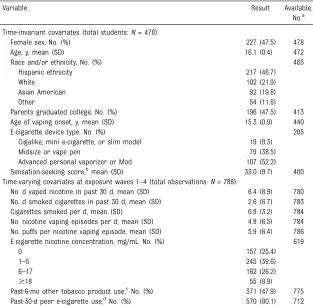
The analytic sample (N= 478; wave 1 mean age = 16.1 [SD 0.4]) was demographically heterogeneous (47.5% girls; 46.7% Hispanic; 47.5% had$1 parent with a college degree). The mean age of vaping initiation was 15.3 (SD = 0.9) years. Most students reported using advanced personal vaporizers or Mods (52.2%; Table 1).
Pooled across waves 1 to 4, there were 739 (93.8%) total exposure wave observations involving the use of e-cigarettes in nontraditional
flavors constituted by 454 unique students. There were 49 (6.22%) exposure wave observations
involving exclusive use of traditional
flavors (tobacco and mint or menthol) orflavorless products constituted by 47 unique students. Of these 47 students, 23 also reported using a nontraditionalflavor on$1 other exposure wave.
Illustrated in the left column of Table 2, fruit (total observations = 561 [71.2%]) and candy (N= 299 [37.9%]) were the most common nontraditionalflavors used pooled across exposure waves. Supplemental Table 5 reports wave-by-wave frequencies of nontraditional-flavor use and exclusive traditional-flavor or
flavorless use. Supplemental Table 6 reports detailed frequencies of the use of each e-cigaretteflavor in the overall sample and shows that the use of menthol or mint (18.3%) was more
common thanflavorless (6.3%) and tobacco-flavored (3.0%) products.
Association of Flavored E-cigarette Use With Subsequent Vaping Outcomes
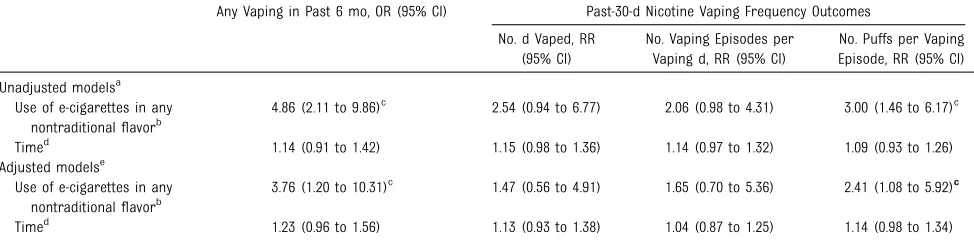
Table 2 reports descriptive results of study outcomes. Table 3 reports regression modeling results. With or without adjusting for the 15 covariates listed in Table 1, use of e-cigarettes in nontraditionalflavors (versus exclusive use of tobacco, menthol or mint, orflavorless products) at waves 1 to 4 was associated with greater odds of continuing versus discontinuing vaping during the 6 months after exposure in waves 2 to 5 (64.3% vs 42.9%; adjusted OR = 3.76 [95% CI 1.20 to 10.31]). Use of e-cigarettes in nontraditionalflavors (versus exclusive use of tobacco-flavored, mint- or menthol-flavored, or
flavorless products) was also associated with a greater number of puffs per nicotine vaping episode 6 months later (mean: 3.1 [SD 5.5] vs 1.5 [SD 3.8]; adjusted RR = 2.41 [95% CI 1.08 to 5.92]). Use of nontraditionalflavors (versus exclusively tobacco, mint or menthol, orflavorless products) was not significantly associated with the number of past-30-day nicotine vaping days (mean: 4.6 [SD 8.8] vs 2.9 [SD 7.3]) or episodes per day (mean: 3.5 [SD 6.3] vs 2.5 [SD 5.9]).
Flavor-by-time interactions were not significant in all models (P..15), suggestingflavor–vaping outcome associations did not differ by study wave. Estimates of association for covariates in the adjusted model are reported in Supplemental Table 7 and show that peer vaping, use of an advanced personal vaporizer (versus a cigalike), vaping a higher nicotine concentration, cigarette smoking, use of other tobacco products, and exposure wave vaping frequency were positively associated with some vaping outcomes 6 months later.
TABLE 1Descriptive Statistics for Study Covariates
Variable Result Available,
No.a Time-invariant covariates (total students:N= 478)
Female sex, No. (%) 227 (47.5) 478
Age, y, mean (SD) 16.1 (0.4) 472
Race and/or ethnicity, No. (%) 465
Hispanic ethnicity 217 (46.7)
White 102 (21.9)
Asian American 92 (19.8)
Other 54 (11.6)
Parents graduated college, No. (%) 196 (47.5) 413 Age of vaping onset, y, mean (SD) 15.3 (0.9) 440 E-cigarette device type, No. (%) 205
Cigalike, mini e-cigarette, or slim model 19 (9.3)
Midsize or vape pen 79 (38.5)
Advanced personal vaporizer or Mod 107 (52.2) Sensation-seeking score,bmean (SD) 33.0 (9.7) 400 Time-varying covariates at exposure waves 1–4 (total observations:N= 788)
No. d vaped nicotine in past 30 d, mean (SD) 6.4 (8.9) 780 No. d smoked cigarettes in past 30 d, mean (SD) 2.6 (6.7) 783 Cigarettes smoked per d, mean (SD) 0.9 (3.2) 784 No. nicotine vaping episodes per d, mean (SD) 4.9 (6.5) 784 No. puffs per nicotine vaping episode, mean (SD) 5.9 (6.4) 786 E-cigarette nicotine concentration, mg/mL, No. (%) 619
0 157 (25.4)
1–5 245 (39.6)
6–17 162 (26.2)
$18 55 (8.9)
Past-6-mo other tobacco product use,cNo. (%) 371 (47.9) 775 Past-30-d peer e-cigarette use,dNo. (%) 570 (80.1) 712
aThe number of students or observations with (nonmissing) data available for the respective variable and denominators for percentages reported for categorical variables.
Exploratory Analyses of Use of Individual Nontraditional Flavors
Relative to exclusive use of tobacco, menthol or mint, orflavorless products, the prevalence of vaping continuation was higher 6 months after use of each of the 6 individual nontraditionalflavors (ie, fruit, candy, blends, sweets or desserts, other, or buttery; Table 2). The mean number of puffs per nicotine vaping episode was higher 6 months after use of 4 of the 6 individual nontraditionalflavors than after exclusive use of tobacco, menthol or mint, orflavorless products. The number of past-30-day nicotine vaping days or episodes per vaping day did not uniformly differ byflavor used at exposure waves (Table 2).
Sensitivity Analyses
Sensitivity analyses found that the 3 vaping frequency items were moderately to strongly correlated with one another, providing preliminary evidence of their convergent validity (Supplemental Information, Supplemental Table 8). Sensitivity analyses suggested that the likelihood of unmeasured confounding was low and results were unchanged on the basis of past-30-day vaping at exposure (Supplemental Information). Analysis of alternative exposure variables suggested (1) possible graded (dose-responselike) associations between vaping a greater number of different nontraditionalflavors and
subsequent vaping patterns across most outcomes and (2) no differences in vaping outcomes between youth who used only nontraditionalflavors and those who used both traditional and nontraditionalflavors during concurrent or sequential waves (Supplemental Information, Supplemental Tables 9–12). To determine if graded associations were observed with traditionallyflavored orflavorless products, models including the total number of traditionallyflavored orflavorless
products used as regressors were tested and found no significant associations with any outcome (Supplemental Information, Supplemental Table 10).
DISCUSSION
This study provides new prospective evidence that adolescent use of e-cigarettes in nontraditionalflavors may be associated with greater odds of continuing vaping and progression to more frequent vaping patterns. Previous research on this topic has predominately implicated
nontraditionalflavors in e-cigarette use initiation.4–8Existing youth studies linking e-cigaretteflavor used with vaping persistence and
progression have primarily been retrospective and
cross-sectional,4–8,34leaving the temporal ordering of the association unclear. The present investigation addresses this gap by using a rigorous, prospective, longitudinal, 5-wave, time-varying, and time-lagged study design; comprehensiveflavored e-cigarette use assessment; and sensitivity analyses that support the robustness and specificity of the
identified associations. An additional study strength is the detailed vaping frequency outcome assessment, which permitted the identification of an association offlavored e-cigarette use with taking more puffs per vaping episode, which is notable given that frequent and consecutive puffing patterns can cause some e-cigarette devices to overheat and emit aerosol with greater toxicant
concentrations.35
Common factors that increase exposure toflavored e-cigarettes and alter vaping trajectories could confound the observed associations. After adjusting for 15 potential confounders, estimates of association were reduced by 20% to 23% but remained statistically significant, suggesting that these factors only partially explained the results. Further increasing the plausibility of the associations was supplementary evidence of graded
(dose-responselike) associations between exposure to more nontraditionally
flavored e-cigarette products and subsequent vaping patterns, which has been previously reported in cross-sectional research.34It is
unlikely that these graded associations reflect a nonspecific inclination toward using a greater diversity of e-cigarette products regardless offlavor. Sensitivity analyses found that the number of traditionallyflavored orflavorless e-cigarette products used was not associated with vaping outcomes and observed no differences in vaping outcomes between youth using both nontraditional and traditionalflavors versus those using nontraditional
flavors only.
A conservative operationalization of nontraditional-flavor exposure was applied in this study, resulting in a modest prevalence of unexposed cases of e-cigarette use (ie, exclusive use of tobacco-flavored, menthol- or mint-flavored, orflavorless
e-cigarettes;n= 49 [6.2%]). Youth who use traditionallyflavored or
flavorless e-cigarettes may represent a unique subgroup of the population that is inherently different from those who use nontraditional
flavors, which may directly influence vaping behaviors and is not captured by covariate adjustment. However, the study’s
TABLE 3Association of Flavored E-cigarette Use With Vaping Outcomes 6 Months Later
Any Vaping in Past 6 mo, OR (95% CI) Past-30-d Nicotine Vaping Frequency Outcomes
No. d Vaped, RR (95% CI)
No. Vaping Episodes per Vaping d, RR (95% CI)
No. Puffs per Vaping Episode, RR (95% CI)
Unadjusted modelsa
Use of e-cigarettes in any nontraditionalflavorb
4.86 (2.11 to 9.86)c 2.54 (0.94 to 6.77) 2.06 (0.98 to 4.31) 3.00 (1.46 to 6.17)c
Timed 1.14 (0.91 to 1.42) 1.15 (0.98 to 1.36) 1.14 (0.97 to 1.32) 1.09 (0.93 to 1.26) Adjusted modelse
Use of e-cigarettes in any nontraditionalflavorb
3.76 (1.20 to 10.31)c 1.47 (0.56 to 4.91) 1.65 (0.70 to 5.36) 2.41 (1.08 to 5.92)c
Timed 1.23 (0.96 to 1.56) 1.13 (0.93 to 1.38) 1.04 (0.87 to 1.25) 1.14 (0.98 to 1.34) Estimates are of association of time-varying, time-lagged regressors at waves 1 to 4 and time-invariant covariates with vaping outcomes 6 mo postexposure assessment at waves 2 to 5 from logistic repeated-measures random-effect regression models including school random effects (total observations: range 768–788; totals for each outcome are presented in Supplemental Fig 1). Flavor-by-time interaction terms were tested in separate models and were not significant in all models (P..15).
aUnadjusted models include use of e-cigarettes in nontraditionalflavors and time as sole regressors.
bTime-varying variable assessed at each exposure wave at waves 1 to 4 involving use of$1 nontraditionalflavor (fruit, candy, blends, sweets or desserts, other, or buttery [N= 739]) versus use offlavorless, tobacco-flavored, or mint- or menthol-flavored e-cigarettes only (N= 49).
cStatistically significant after Benjamini-Hochberg corrections for multiple testing to control the false-discovery rate at 0.05 for all estimates of e-cigaretteflavor used (on the basis of 2-tailed correctedPvalue).
dTime is the continuous variable (scored: wave 1, 0; wave 2, 1; wave 3, 2; wave 4, 3).
time-varying design mitigates this concern. Approximately half of students who vaped only
traditionallyflavored orflavorless e-cigarettes during 1 survey wave used nontraditionalflavors at another wave during the study and are represented in both exposure categories. Although unmeasured confounding is still possible, the likelihood that unmeasured confounders entirely explain associations was deemed to be low in supplemental analyses reported in the Supplemental Information.
It is possible that the sensory and pharmacologic effects of exposure to
flavored e-cigarettes increases the persistence and frequency of vaping in youth. The adolescent brain is particularly sensitive to the
pleasurable effects of palatable sweet tastes.36Laboratory experiments in young adults indicate that exposure to e-cigarettes in nontraditional
flavors that produce sensory perceptions of sweetness (versus menthol and tobaccoflavors) generate greater product appeal and willingness to use again.37A National Academies of Sciences, Engineering, and Medicine9consensus report concluded that that there was moderate evidence that product characteristics, such as nicotine and
flavors, may increase the addiction potential of e-cigarettes.
Nontraditionallyflavored e-cigarette solutions could increase addiction potential because they can contain compounds that decrease product pH, which may increase the
bioavailability of nicotine absorbed by the user at equivalent e-cigarette aerosol exposure doses.38
This study had limitations. First, exposure data in this study were collected in 2015 and 2016, before the emergence of pod-Mod e-cigarette
products with high nicotine concentrations that are currently popular among youth.39Replication with more recent data would be useful to explore the generalizability of this study’s results to the current milieu, in which youth use of pod-Mod e-cigarettes is ubiquitous. Second, tobacco, menthol or mint, and
flavorless categories were collapsed, which is consistent with previous work22and past FDA regulatory proposals12,13but precluded analyses separating them from each other. Third, some students indicated past-30-day e-cigarette flavor use but did not report past-30-day vaping at certain exposure waves, raising the possibility of inconsistent reporting, although sensitivity analyses comparing these students to the remainder of the sample revealed no differences inflavor–outcome associations. Fourth, although previous work and supplementary analyses provide preliminary
evidence of validity for the number of vaping episodes and puffs per episode measures (Supplemental Information),20these measures have not yet been extensively validated and may be subject to respondent recall error. Finally, covariate-adjusted association estimates may underestimate risk because certain covariates (eg, other tobacco product use, e-cigarette device, and nicotine concentration) could potentially be mediators along a putative causal pathway.
CONCLUSIONS
Although this study’s observational design does not support causal inferences, the results highlight the possibility that regulations that reduce youth exposure toflavored e-cigarettes may aid in preventing young people who try e-cigarettes from becoming frequent and
persistent users. Such regulations could also encourage existing adolescents who useflavored e-cigarettes to discontinue vaping. Over the past several years there had been no federal restrictions on the sale offlavored e-cigarettes in the United States. The FDA recently announced plans to enforce premarket authorization requirements for non-tobacco
flavored products, and because no
flavored products had gone through FDA premarket review, would result in removingflavored e-cigarette products from the market.14However, the timeline, parameters, and extent of enforcement of this policy remain unclear, and there are no product standards that would prohibit
flavored e-cigarette products from returning to the market pending successful premarket authorization. Some have proposed that the FDA use its authority to set a product standard prohibiting e-cigarettes in
nontraditionalflavors to be sold anywhere in the United States.40 Given the health risks associated with frequent and persistent youth use of e-cigarettes, particularly
flavored products,5,6any regulatory policy that effectively limits youth exposure toflavored e-cigarettes is likely to improve pediatric population health.
ABBREVIATIONS
CI: confidence interval
e-cigarette: electronic cigarette FDA: Food and Drug
Administration
Mod: modified electronic cigarette OR: odds ratio
RR: rate ratio
Drs Kirkpatrick, McConnell, Pang, and Audrain-McGovern and Mr Stone made contributions to the conception and design of the study and critically reviewed the manuscript for important intellectual content; and all authors approved thefinal manuscript as submitted and agree to be accountable for all aspects of the work.
DOI:https://doi.org/10.1542/peds.2019-0789 Accepted for publication Aug 1, 2019
Address correspondence to Adam M. Leventhal, PhD, Department of Preventive Medicine, University of Southern California Keck School of Medicine, 2001 N Soto St, 3rd Floor 302-C, Los Angeles, CA 90032. E-mail: [email protected]
PEDIATRICS (ISSN Numbers: Print, 0031-4005; Online, 1098-4275).
Copyright © 2019 by the American Academy of Pediatrics
FINANCIAL DISCLOSURE:The authors have indicated they have nofinancial relationships relevant to this article to disclose.
FUNDING:Supported in part by a Tobacco Centers of Regulatory Science award (U54CA180908) from the National Cancer Institute and Food and Drug Administration, the National Institute on Drug Abuse (grants K23048160, F31DA043303, K01DA040043, and K01DA04295), and the Tobacco-Related Disease Research Program (grant 27-IR-0034). The content is solely the responsibility of the authors and does not necessarily represent the official views of the National Cancer Institute, National Institute on Drug Abuse, or Food and Drug Administration. Funded by the National Institutes of Health (NIH).
POTENTIAL CONFLICT OF INTEREST:Dr Goldenson left the University of Southern California on February 10, 2019, and started as an employee of Juul Laboratories as of March 4, 2019. He met criteria for authorship before leaving the University of Southern California, and he had no role in revising the article after leaving the University of Southern California and joining Juul Laboratories; the other authors have indicated they have no potential conflicts of interest to disclose.
COMPANION PAPER:A companion to this article can be found online at www.pediatrics.org/cgi/doi/10.1542/peds.2019-1119.
REFERENCES
1. Carvajal R, Clissold D, Shapiro J. Family smoking prevention and tobacco control act: an overview.Food Drug Law J. 2009;64:717
2. Gostin LO. FDA regulation of tobacco: politics, law, and the public’s health. JAMA. 2009;302(13):1459–1460
3. Zhu S-H, Sun JY, Bonnevie E, et al. Four hundred and sixty brands of
e-cigarettes and counting: implications for product regulation.Tob Control. 2014;23(suppl 3):iii3–iii9
4. Ambrose BK, Day HR, Rostron B, et al. Flavored tobacco product use among us youth aged 12-17 years, 2013-2014.JAMA. 2015;314(17): 1871–1873
5. Villanti AC, Johnson AL, Ambrose BK, et al. Flavored tobacco product use in youth and adults:findings from thefirst wave of the PATH study (2013-2014).Am J Prev Med. 2017;53(2):139–151
6. Corey CG, Ambrose BK, Apelberg BJ, King BA. Flavored tobacco product use among middle and high school students–United States, 2014.MMWR Morb Mortal Wkly Rep. 2015;64(38): 1066–1070
7. Schneller LM, Bansal-Travers M, Goniewicz ML, McIntosh S, Ossip D, O’Connor RJ. Use offlavored electronic cigarette refill liquids among adults and youth in the US-Results from Wave
2 of the Population Assessment of Tobacco and Health study (2014-2015). PLoS One. 2018;13(8):e0202744
8. Harrell MB, Weaver SR, Loukas A, et al. Flavored e-cigarette use: characterizing youth, young adult, and adult users. Prev Med Rep. 2016;5:33–40
9. National Academies of Sciences, Engineering, and Medicine.Public Health Consequences of e-Cigarettes. Washington, DC: National Academies Press (US); 2018
10. Office of the Surgeon General. E-Cigarette Use Among Youth and Young Adults: A Report of the Surgeon General. Washington, DC: US Department of Health and Human Services; 2016
11. Chen JC, Das B, Mead EL, Borzekowski DLG. Flavored e-cigarette use and cigarette smoking susceptibility among youth.Tob Regul Sci. 2017;3(1): 68–80
12. US Food and Drug Administration. Statement from FDA Commissioner Scott Gottlieb, M.D., on proposed new steps to protect youth by preventing access toflavored tobacco products and banning menthol in cigarettes. 2018. Available at: https://www.fda.gov/ NewsEvents/Newsroom/
PressAnnouncements/ucm625884.htm. Accessed November 17, 2018
13. Roehr B. FDA announces crackdown on e-cigarettes in bid to reduce teenage vaping.BMJ. 2018;363:k4908
14. FDA. News Release: Trump
administration combating epidemic of youth e-cigarette use with plan to clear market of unauthorized,
non-tobacco-flavored e-cigarette products. Available at: https://www.fda.gov/news-events/ press-announcements/trump- administration-combating-epidemic- youth-e-cigarette-use-plan-clear-market-unauthorized-non?utm_source= Eloqua&utm_medium=email&utm_ term=stratcomms&utm_content= pressrelease&utm_campaign=CTP% 20News%26Connect%26SoS%3A% 20HHS%20Youth%20E-Cig%20Use% 20Response%20-%2091119. Accessed September 16, 2019
15. Chen J, Green K, Chen J, Hoke K, Borzekowski D. Restricting the sale of
flavored e-cigarettes in the US: an examination of local regulations.Tob Regul Sci. 2018;4(4):32–40
16. Leventhal AM, Strong DR, Kirkpatrick MG, et al. Association of electronic cigarette use with initiation of combustible tobacco product smoking in early adolescence.JAMA. 2015; 314(7):700–707
cigarette liquidflavors.Nicotine Tob Res. 2017;19(11):1381–1385
18. Krüsemann EJZ, Boesveldt S, de Graaf K, Talhout R. An e-liquidflavor wheel: a shared vocabulary based on systematically reviewing e-liquidflavor classifications in literature [published online ahead of print May 18, 2018]. Nicotine Tob Res. doi:10.1093/ntr/nty101
19. Miech R, Patrick ME, O’Malley PM, Johnston LD. What are kids vaping? Results from a national survey of US adolescents.Tob Control. 2017;26(4): 386–391
20. Goldenson NI, Leventhal AM, Stone MD, McConnell RS, Barrington-Trimis JL. Associations of electronic cigarette nicotine concentration with subsequent cigarette smoking and vaping levels in adolescents.JAMA Pediatr. 2017; 171(12):1192–1199
21. Patrick ME, Miech RA, Carlier C, O’Malley PM, Johnston LD, Schulenberg JE. Self-reported reasons for vaping among 8th, 10th, and 12th graders in the US: nationally-representative results.Drug Alcohol Depend. 2016;165: 275–278
22. Chen JC, Green KM, Arria AM, Borzekowski DLG. Prospective predictors offlavored e-cigarette use: a one-year longitudinal study of young adults in the U.S.Drug Alcohol Depend. 2018;191:279–285
23. Kong G, Kuguru KE, Krishnan-Sarin S. Gender differences in U.S. adolescent e-cigarette use.Curr Addict Rep. 2017; 4(4):422–430
24. Barrington-Trimis JL, Berhane K, Unger JB, et al. Psychosocial factors associated with adolescent electronic cigarette and cigarette use.Pediatrics. 2015;136(2):308–317
25. Morean ME, Krishnan-Sarin S, S O’Malley S. Assessing nicotine dependence in adolescent e-cigarette users: the 4-item Patient-Reported Outcomes Measurement Information System (PROMIS) nicotine dependence item bank for electronic cigarettes. Drug Alcohol Depend. 2018;188: 60–63
26. Yingst JM, Veldheer S, Hrabovsky S, Nichols TT, Wilson SJ, Foulds J. Factors associated with electronic cigarette users’device preferences and transition fromfirst generation to advanced generation devices.Nicotine Tob Res. 2015;17(10):1242–1246
27. Krishnan-Sarin S, Jackson A, Morean M, et al. E-cigarette devices used by high-school youth.Drug Alcohol Depend. 2019;194:395–400
28. Whiteside SP, Lynam DR. Thefive factor model and impulsivity: using
a structural model of personality to understand impulsivity.Pers Individ Dif. 2001;30(4):669–689
29. Whiteside SP, Lynam DR, Miller JD, Reynolds SK. Validation of the UPPS impulsive behaviour scale: a four‐factor model of impulsivity.Eur J Pers. 2005; 19(7):559–574
30. Case KR, Harrell MB, Pérez A, et al. The relationships between sensation seeking and a spectrum of e-cigarette use behaviors: cross-sectional and longitudinal analyses specific to Texas adolescents.Addict Behav. 2017;73: 151–157
31. Guo Y, Logan HL, Glueck DH, Muller KE. Selecting a sample size for studies with repeated measures.BMC Med Res Methodol. 2013;13:100
32. Muthén LK, Muthén BO.Mplus, Statistical Analysis With Latent
Variables Version. Los Angeles, CA: University of California; 2007:3
33. Benjamini Y, Hochberg Y. Controlling the false discovery rate: a practical and powerful approach to multiple testing. J R Stat Soc Series B Stat Methodol. 1995;57(1):289–300
34. Morean ME, Butler ER, Bold KW, et al. Preferring more e-cigaretteflavors is associated with e-cigarette use frequency among adolescents but not adults [published correction appears in PLoS One. 2018;13(9):e0204349].PLoS One. 2018;13(1):e0189015
35. Beauval N, Verrièle M, Garat A, et al. Influence of puffing conditions on the carbonyl composition of e-cigarette aerosols.Int J Hyg Environ Health. 2019; 222(1):136–146
36. Hoffman AC, Salgado RV, Dresler C, Faller RW, Bartlett C. Flavour preferences in youth versus adults: a review.Tob Control. 2016;25(suppl 2): ii32–ii39
37. Goldenson NI, Kirkpatrick MG, Barrington-Trimis JL, et al. Effects of sweetflavorings and nicotine on the appeal and sensory properties of e-cigarettes among young adult vapers: application of a novel methodology. Drug Alcohol Depend. 2016;168:176–180
38. St Helen G, Dempsey DA, Havel CM, Jacob P III, Benowitz NL. Impact of e-liquidflavors on nicotine intake and pharmacology of e-cigarettes.Drug Alcohol Depend. 2017;178:391–398
39. Barrington-Trimis JL, Leventhal AM. Adolescents’use of“pod mod” e-cigarettes - urgent concerns.N Engl J Med. 2018;379(12):1099–1102
DOI: 10.1542/peds.2019-0789 originally published online October 28, 2019;
2019;144;
Pediatrics
Jessica L. Barrington-Trimis
Rob S. McConnell, Matthew D. Stone, Raina D. Pang, Janet Audrain-McGovern and
Adam M. Leventhal, Nicholas I. Goldenson, Junhan Cho, Matthew G. Kirkpatrick,
Flavored E-cigarette Use and Progression of Vaping in Adolescents
Services
Updated Information &
http://pediatrics.aappublications.org/content/144/5/e20190789
including high resolution figures, can be found at:
References
http://pediatrics.aappublications.org/content/144/5/e20190789#BIBL
This article cites 34 articles, 5 of which you can access for free at:
Subspecialty Collections
_sub
http://www.aappublications.org/cgi/collection/preventative_medicine Preventive Medicine
http://www.aappublications.org/cgi/collection/smoking_sub Smoking
http://www.aappublications.org/cgi/collection/substance_abuse_sub Substance Use
following collection(s):
This article, along with others on similar topics, appears in the
Permissions & Licensing
http://www.aappublications.org/site/misc/Permissions.xhtml
in its entirety can be found online at:
Information about reproducing this article in parts (figures, tables) or
Reprints
http://www.aappublications.org/site/misc/reprints.xhtml
DOI: 10.1542/peds.2019-0789 originally published online October 28, 2019;
2019;144;
Pediatrics
Jessica L. Barrington-Trimis
Rob S. McConnell, Matthew D. Stone, Raina D. Pang, Janet Audrain-McGovern and
Adam M. Leventhal, Nicholas I. Goldenson, Junhan Cho, Matthew G. Kirkpatrick,
Flavored E-cigarette Use and Progression of Vaping in Adolescents
http://pediatrics.aappublications.org/content/144/5/e20190789
located on the World Wide Web at:
The online version of this article, along with updated information and services, is
http://pediatrics.aappublications.org/content/suppl/2019/10/24/peds.2019-0789.DCSupplemental
Data Supplement at:
by the American Academy of Pediatrics. All rights reserved. Print ISSN: 1073-0397.