Creative Components Iowa State University Capstones, Theses and Dissertations
Fall 2018
Abnormal Request Routing to Netflix Servers
Abnormal Request Routing to Netflix Servers
He Jin
Iowa State University, [email protected]
Follow this and additional works at: https://lib.dr.iastate.edu/creativecomponents
Part of the OS and Networks Commons
Recommended Citation Recommended Citation
Jin, He, "Abnormal Request Routing to Netflix Servers" (2018). Creative Components. 69. https://lib.dr.iastate.edu/creativecomponents/69
Abnormal Request Routing to Netflix Servers
Abstract
1. Introduction
Video from Netflix streaming service consumes a significant 15% of all internet
bandwidth globally, the most of any single application, which is according to the
Global Internet Phenomena Report from Sandvine, a vendor of
bandwidth-management systems [1]. In America, it grabs even bigger percentage, accounting for
19.1% of total downstream traffic. Thus, it deserves detailed study about how requests
users sent to Netflix servers are routed as routing efficiency affect performance of
video delivery. In this report, we study whether there exist some abnormally routed
requests which waste internet bandwidth resources. There are some papers about how
to infer and find Netflix’s streaming servers’ locations [2] and some about prototypes
for selecting a server to provide distributed services [3], but we are the first to do a
measurement worldwide to test which part of the areas which has Netflix services but
have a poor performance on routing to Netflix’s servers.
In this report, at first, we will find all Netflix Streaming servers’ routing prefixes
through Hurricane Electronic BGP toolkit, provided by a global Internet service
provider. The routing prefix is written as the first address of a network, followed by a
slash character (/), and ending with the bit-length of the prefix. For example,
198.51.100.0/24 is a prefix where first 24 bits represent network id and remaining 8
at IXPs in major cities around the world. And in each continent, with the help of Vela
platform [4], a platform which is a project of Center for Applied Internet Data
Analysis (CAIDA) [5] and provides lots of hosts in each continent, we get some hosts
sent ping requests to observe the round-trip time (RTT) it returns. Then we do a
traceroute command from hosts to those servers which has bad performance on RTT
to analyze them and see which hop get a problem and categorize these abnormal
routings. Through observation, there are two kinds of abnormal routing. One of them
is inter-domain abnormal routing, which refers to those packets going from one
autonomous system(AS) to another autonomous system that peers at a remote location
which causes detour routing. An AS is a collection of routers and networks under a
single administrative control. And the other abnormal routing is intra-domain
abnormal routing, which is a detour routing on the same network. Internet routing
protocols do not consider geography in routing like host A is geo-close to server B,
but requests from A are routed to remote location router C first, and then back to
server B on the same AS. Section 2 describes how we collect Netflix data and Section
3 explains how we analyze these data for five continents and last section makes a
summary about Netflix routing situations in five continents. Lots of routing paths to
Netflix servers has inter-domain, or intra-domain or both abnormal routing problems.
Thus, when users send requests for Netflix videos, it should assign the responding
2.
Methodology
Hurricane Electric [6] is a global Internet service provider(ISP) offering IPv4 and
IPv6 services, which also provides a Border Gateway Protocol (BGP) toolkit that
allows us to search Netflix screaming servers’ routing prefixes as shown in Figure 1
below. There are only 2 Netflix streaming services autonomous systems
number(ASN). In the figure 1, AS40027 marked by red line is one of Netflix’s ASNs
for their Open Connect program that partners with Internet Service Providers (ISPs)
to deliver their content more efficiently. The fact is that AS40027 is always directly
connected to the end users’ ISP network. Request routing path is always short and
correct. Thus, here we do not consider this ASN for our research and we focus on
AS2906 which announces prefixes for servers deployed at IXPs instead of servers
embedded within ISP. IXP [7] is the physical infrastructure through which Internet
service providers (ISPs) and content delivery networks (CDNs) exchange Internet
traffic between their networks.
is the prefix of the Internet Protocol version 4 network starting at the given address,
having 24 bits allocated for the network prefix, and the remaining 8 bits reserved for
host addressing. And Figure 2 below is what Netflix routing prefixes within AS 2906
look like. Based on the number of hosts in an area, the remaining bits are different for
different prefix. If Server location has more hosts, it will be assigned prefix like
23.246.0.0/18, or /24 will be enough for those places that have small number of hosts.
In this research, we only focus on the prefix with ‘/24’ because they represent server
cluster at a specific location. Again, as we mentioned above, ‘/24’ represents the first
24 bits standing for network id, and the remaining 8 bit (256 hosts) standing for hosts
id.
Figure 2. Netflix streaming servers’ prefixes
To collect the data, three methods are needed to use in this case. They are nslookup,
ping, and traceroute.
name or IP address mapping or for any other specific DNS record. In our research,
Nslookup is useful for finding our prefix location. For example, we want to know the
prefix 23.246.2.0/24 location and corresponding valid responding servers’ IPs from
23.246.2.0 to 23.246.2.255. We can just iterate from 0 to 255 and do ping and
nslookup for these IP addresses as shown in Figure 3 (left). If we get a reply without
timeout for a specific IP addresses, it means that IP address is one of valid servers to
respond clients’ requests. Then we get a list of servers’ valid responding IP addresses
for each prefix as shown in Figure 3 (right). And in Figure 3 (left), name’s value is
ipv4_1.cxl0.c201.dfw001.ix.nflxvideo.net where dfw(Dallas–Fort Worth) in substring
dfw001 is IATA airport code, which represents the prefix’s exact location in which
city’s exchange point (IXP). Thus, through this way, we could get all Netflix’s
servers’ locations deployment info.
Figure 3 result for nslookup (left), valid IP addresses for prefix 23.246.2.0/24(right)
Then we use ping to measure RTT for each IP addresses of prefix from Ames, Iowa.
To get statistical result, I compute median value of RTT for each valid IP addresses in
a prefix and count the valid server IP addresses for each prefix. In the end, we get
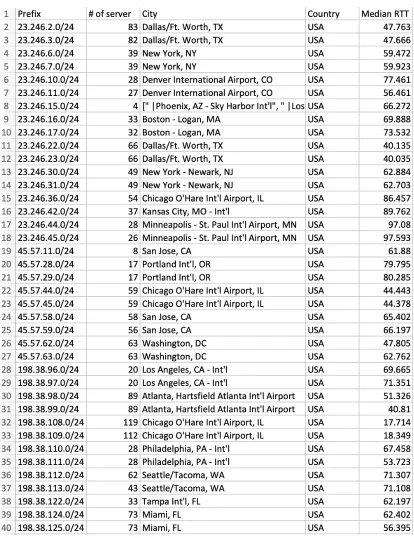
Figure 4. statistical result for South America Netflix routing prefixes
[image:9.595.92.506.276.697.2]Figure 6. statistical result for American Netflix routing prefixes
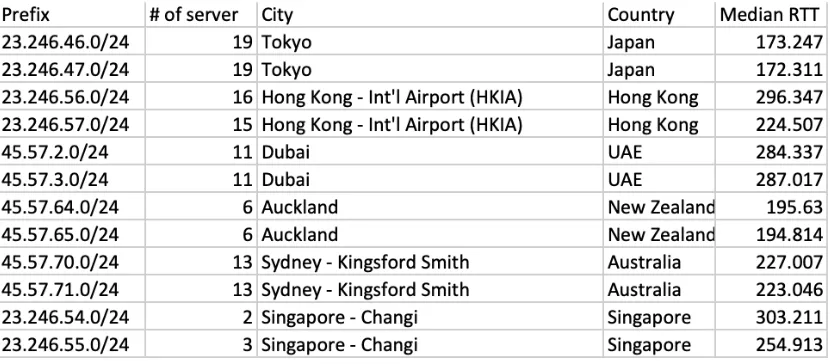
Figure 8. statistical result for Asian Netflix routing prefixes
Through above figures, we can find that RRT is proportionate to distance for five
continents like RRT to U.S. is under 100 milliseconds, RTT to Europe is between 100
and 200 milliseconds, RRT to South America is above 200 milliseconds and South
Africa has largest RTT that is above 300 milliseconds. But within U.S., RTT is not
proportionate to distance like RTT from our host in Ames to Kansas City is around 90
milliseconds, but RTT to Dallas is just around 40 milliseconds. Also, RTTs to different
prefix but prefixes are at same location vary differently. For instance, RTT to Chicago,
some requests to 198.38.108.0/24 may take under 20 milliseconds, but the other to
23.246.36.0/24 may take above 80 milliseconds at the same period.
3.
Analyze and find abnormal requests routing
We do ping and traceroute measurements in five continents to detect abnormal
requests routing. At first, we target on residential type of hosts to send requests to
their continental servers. Even though some countries may have their own Netflix
other country, or these countries’ requests to their own Netflix Servers may have
worse performance than to the other servers within the continent. Also, when native
servers have a huge workload, users’ requests may need to be routed to other
neighboring countries’ servers for services but cross-country routing performance
may be bad. That is what we want to find to check whether there indeed exist
abnormal routing that waste internet bandwidth and result in long delay. Thus, next
step is how we analyzed information and what abnormal request routings we found.
3.1 North America
In North American, the main area in which we do measurements is United States. As
Netflix headquarter is in U.S., there are lots of streaming servers in U.S. To dig out all
kinds of abnormal routings, we need to do it in systematic way. And in terms of
location, we choose the Netflix streaming servers in places all over the United States
to make sure we cover all situations. There are cities in middle area like Minneapolis,
Chicago, Kansas City and Dallas, cities in eastern area like Atlanta, Washington D.C.,
New York, and Miami, and cities in western area like San Jose, Seattle, Denver and
Portland. And I choose 3 cities including Las Vegas, Ames and Nashville as vantage
points where they do not have Netflix servers to check how request packets are routed
from such 3 places to above states that have Netflix streaming servers I mentioned.
Also, we do tests from hosts to the native servers, servers in the same state as the
From systematic measurement results, we can conclude that there exist two big
categories of abnormal routings. They are inter-domain abnormal routing and
intra-domain abnormal routing. Examples below will show cases of two kinds of abnormal
routings in United States.
The first representative example of intra-domain and inter-domain abnormal routing is
from Las Vegas to Kansas City’s streaming servers shown in Figure 9. As we test
requests routing from Las Vegas to Chicago’s servers, all requests are routed well like
some of them are directly routed to Chicago or the others are routed to Colorado and
then to Chicago. But requests from Las Vegas to Kansas City are routed abnormally,
although Kansas City is not far from Chicago and comparing to Chicago it is closer to
Las Vegas. The routing path is Las Vegas -> Los Angeles (AS 3356 level 3) -> Los
Angeles (AS 2906 Netflix network) -> Dallas (AS 2906) -> Denver (AS 2906) ->
Kansas City (AS 2906). We could see that Las Vegas is closer to servers in Los
Angeles. If users there in Las Vegas want to watch Netflix, packets routed to Los
Angeles seems reasonable. But packets from Las Vegas to Kansas City should not be
routed to Los Angeles first, which is in opposite direction of destination. And above
situation is common. Similarly, Packets from Las Vegas to Denver, to Dallas and
packets from Nashville to Kansas City, Denver, Portland and packets from Ames to
Kansas City, Minnesota, and New York have the same situation that requests may go
opposite direction first and then back to destination. And path within 2906 network is
Figure 9. packets from Las Vegas to Kansas City
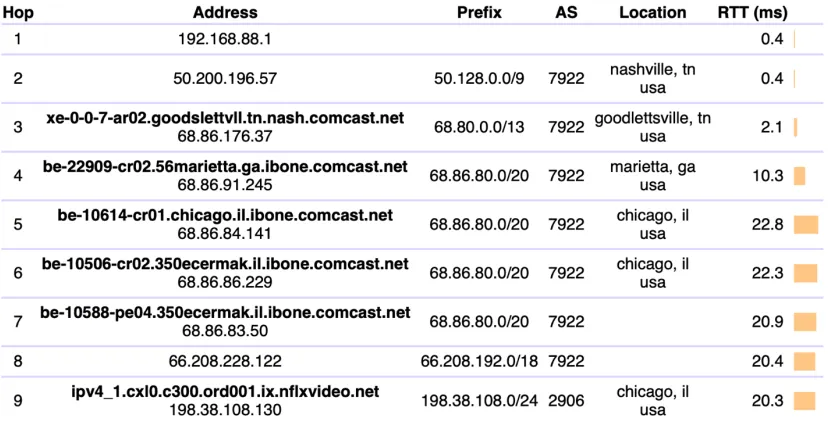
Another example of intra-domain routing is packets from Nashville to Chicago’s
streaming servers shown in Figure 10. As Nashville is in the middle of Atlanta and
Chicago, packets should be supposed to be directly routed to Chicago. However, it
goes to Atlanta first, and then turn to Chicago’s servers. Unlike the previous example
where abnormal intra-domain routing happens in Netflix network AS 2906, in this
case, abnormal intra-domain routing happens in other network (i.e. AS 7922), that is
Figure 10. packets from Nashville to Chicago
Also, we test routing from hosts to native servers including CA, Washington, Illinois,
Texas, Tennessee, Washington D.C., and New York to check whether local request
routing within a state is good or not. In most case, they are routed well and average
RTT is under 15 milliseconds, which is much faster than cross-state request which is
usually between 40 and 80 milliseconds. But we find an exception is that vantage
point in Chicago sent packets to prefixes 45.57.45.0/24 and 198.38.108.0/24 servers
in Chicago will detour to another state as shown in figure 11 below. It first goes to
Michigan and then turn back to Chicago, which from AS number, we could tell that it
Figure 11. packets from Chicago to local servers
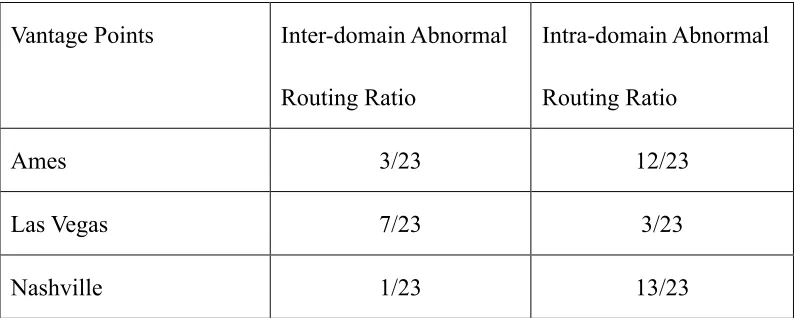
Table 1 below is the summary of routing cases of American Netflix streaming
requests. From 3 vantage points, hosts sent traceroute command to 23 servers in 11
cities in different states to check routing path. Each destination city may have 2 or
more groups of servers (prefixes) for supporting users’ requests. The abnormal routing
ratio is defined as Ratio = abnormal routing / (abnormal routing + normal routing) in that
kind of abnormal routing type. From table results, we could see that there are many
instances of abnormal routing in America. For example, a user in Ames, send
traceroute probes to 23 prefixes in total to 11 cities. Among them, there are 3
Vantage Points Inter-domain Abnormal
Routing Ratio
Intra-domain Abnormal
Routing Ratio
Ames 3/23 12/23
Las Vegas 7/23 3/23
[image:17.595.108.505.71.230.2]Nashville 1/23 13/23
Table 1. Abnormal routing ratio of 3 vantage points
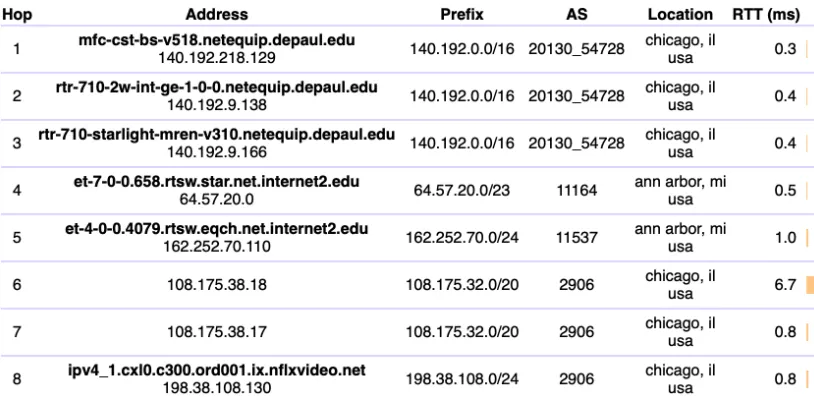
Also, for performance of local routing, we did tests that we got hosts in places which
have Netflix servers sent requests to their native servers, and results show that except
Chicago as shown in Figure 12 below, all other are routed well. Obviously, requests
[image:17.595.92.498.449.655.2]are routed to other state.
Figure 12. packets from Chicago to native servers
3.2 South America
In South America, Brazil, Argentina and Chile has Netflix Streaming servers. For
measurements in South America, there are 4 vantage points that are separately located
in Brazil, Argentina, Chile, and Paraguay on Vela platform that we could utilize. To
get a systematic result through measurements, we need to cover all the situations. For
that, from vantage points in different places, besides getting hosts sent requests to
their native Netflix streaming servers, we also let host send cross-country requests to
check the performance of routing for Netflix streaming request in South America.
There are two kinds of abnormal routings in South America, one example of abnormal
routing is that requests sent from Buenos Aires, Argentina to a server in Chile shown
in Figure 13, packets will be directed to U.S. first, which is inter-domain abnormal
routing and then under AS 6453, routing path is FL -> VA -> NY which is
intra-domain abnormal routing. Another example of inter-intra-domain abnormal routing is that
requests sent from Buenos Aires, Argentina to Brazil shown in Figure 14. Packets
Figure 13. requests from Buenos Aires, Argentina to Chile Netflix Server
Systematically, we get hosts in Argentina, Brazil, and Chile sent requests to the other
two countries to check cross-country requests routing performance and get results
shown in tables below. Brazil has 9 groups of Netflix streaming servers (prefixes), but
Chile has only 1 group of servers and Argentina has 2 group of servers. In our
measurement, we find that Argentina servers does not respond the requests. Thus, in
the table, we marked “No response”. Tables Below show the situations of routing
performance on cross-country requests in South America.
Destination Country Inter-domain Abnormal Routing Ratio Intra-domain Abnormal Routing Ratio Normal Routing Ratio
Chile 1/1 1/1 0/1
[image:20.595.88.506.321.402.2]Brazil 5/9 0/9 3/9
Table 2. Requests sent from VP in Argentina
Destination Country Inter-domain Abnormal Routing Ratio Intra-domain Abnormal Routing Ratio Normal Routing Ratio
Chile 1/1 0/1 0/1
[image:20.595.86.511.466.545.2]Argentina No response No response No response
Table 3. Requests sent from VP in Brazil
Destination Country Inter-domain Abnormal Routing Ratio Intra-domain Abnormal Routing Ratio Normal Routing Ratio
Argentina No response No response No response
Brazil 2/9 0/9 7/9
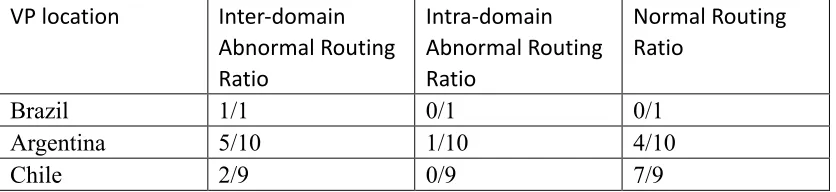
[image:20.595.88.507.606.687.2]Through measurements, we know that local request routing works well where RTT
usually takes under 20 milliseconds. Table 5 below is the summary of cross-country
routing. Brazil has lots of servers, and packets from Brazil will not be routed normally
to Chile, which can be accepted. There are more than half servers to which Argentina
users’ requests cannot be normally routed. But Chile users seem have good contact
with Brazil servers.
VP location Inter-domain Abnormal Routing Ratio Intra-domain Abnormal Routing Ratio Normal Routing Ratio
Brazil 1/1 0/1 0/1
Argentina 5/10 1/10 4/10
[image:21.595.90.508.291.387.2]Chile 2/9 0/9 7/9
Table 5. Hosts in these countries sent requests to the other two countries
3.3 Aisa
In Asia, Netflix company set up lots of servers in countries including Japan, Hong
Kong (China), Singapore, United Arab Emirates, and Australia. We want them to send
request to each other and compare with requests sent to native servers and we found
that in Asia, all cross-country request have inter-domain abnormal routing which costs
lots of time.
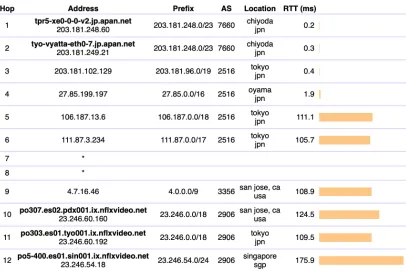
We start with Japan. From results that getting host in Japan sent requests to the other
Asian countries, we find that packets will not go to the destination directly. Packets
that, like to Dubai, Australia or New Zealand, then packets will be directed to Europe
[image:22.595.95.501.262.536.2]and finally to the Destination. Besides above routing, the weirdest thing shown in
Figure 15 is that packets from Japan to Singapore, after reaching U.S., packets will be
back to Japan ASN 2906 (Netflix network) and then are directed to the Singapore,
which seems so clear that routing algorithm should be improved.
Figure 15. Request from Japan to Singapore
Also, we tested all other countries like Hong Kong, Singapore, UAE, and Australia
separately. We find that cross-country request within Asian countries will be always
directed to U.S. which is inter-domain abnormal routing and then some of requests to
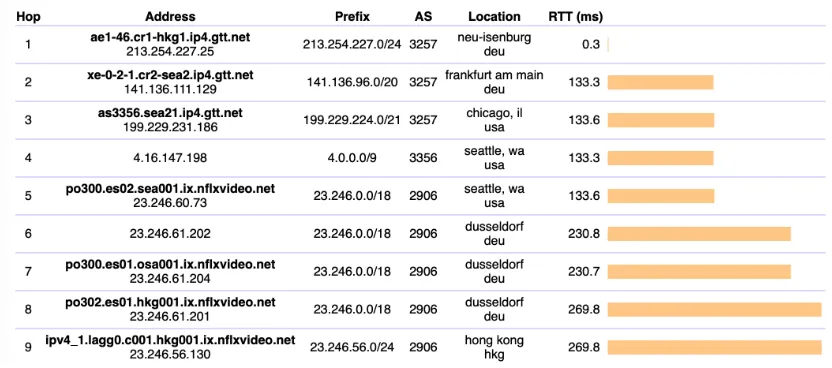
Also, for performance of local routing, we did tests that we got hosts in countries
which have Netflix servers sent requests to their native servers, and results show that
except Hong Kong as shown in Figure 16 below, requests first went to U.S., then went
to Japan(OSA) and finally reached Hong Kong, and all other local routings are routed
normally with around 20 milliseconds.
[image:23.595.91.507.262.446.2]
Figure 16. packets from Hong Kong to native servers
3.4 Europe
As setup in United States, Netflix company deploys lots of streaming servers in
Western Europe and Nordic countries including Sweden, Spain, Italy, UK, Ireland,
Germany, Switzerland, Belgium, Poland, Finland, Luxembourg, Netherlands and
France. Almost all western European countries have their own streaming servers.
Since these countries are close to each other, it makes sense to route requests to
neighboring countries when Netflix servers in a country got high workload or failed.
neighbors within Europe will be directed to U.S. like cases in South American and
Asia, and the number of abnormal cases for inter-domain routing and intra-domain
routing.
Figure 17 below illustrate routing between neighboring countries, the green thin
arrow represents at least there exists one streaming server prefix in this country to
which packets from source hosts can be routed normally. Red thick arrows represent
that the path from source to destination must go through United States where request
routing is obviously abnormal. The fact is that routing situation in Europe is not
optimistic. As we know, Netflix usually sets two or more prefixes of streaming servers
for a country and usually only one of the servers’ prefix can be reached normally from
Figure 17. Netflix request routing situations for Each country to its neighbors
Next, we will go into details about routing situations and connection between
countries. In Europe, there are still two abnormal kinds of cross-country routing,
inter-domain routing and intra-domain routing.
The representative example of inter-domain abnormal routing is that packets go from
Switzerland to France as shown in Figure 18. As we know, each country may have 2
or more group of servers, thus, we do the traceroute measurements to all these servers.
3356 router in Washington, DC, then to an AS 2906 Network in New York, then back
to London and finally reach France in 2906’s network.
Figure 18. packets from Switzerland to France
Another representative example of intra-domain abnormal routing is that packets go
from France to Switzerland. The routing path is Paris -> New York (AS
2906)->London (AS 2906)-> France (AS 2906) -> Germany (AS 2906) ->
Switzerland (AS 2906). From Paris to New York, this part is inter-domain abnormal
routing.
back to destination through AS 2906 network which may also has intra-domain
abnormal routing problem. Tables 6 through 12 show the exact numbers of abnormal
routing cases for each country’s requests to its neighbors.
Destination Inter-domain Abnormal Routing Ratio (abnormal/total) Intra-domain Abnormal Routing Ratio (abnormal/total) Normal Routing Ratio
Spain 1/2 0/2 1/2
Italy 2/2 0/2 0/2
Belgium 0/2 0/2 2/2
Switzerland 2/2 2/2 0/2
Germany 2/4 2/4 0/4
United Kingdom 1/1 0/1 0/1
Table 6. France requests to neighboring countries
Destination Inter-domain abnormal routing ratio Intra-domain Abnormal Routing Ratio Normal Routing Ratio
France 1/2 0/2 1/2
Netherland 0/2 0/2 2/2
Germany 3/4 0/4 1/4
United Kingdom 1/1 0/1 0/1
Table 7. Belgium requests to neighboring countries
Destination Inter-domain Abnormal Routing Ratio Intra-domain Abnormal Routing Ratio Normal Routing Ratio
Belgium 0/2 0/2 2/2
Germany 2/4 2/4 0/4
[image:27.595.85.507.205.662.2]United Kingdom 1/1 0/1 0/1
Germany (2 hosts in Germany and 2 prefixes in neighboring countries, then 2*2 = 4) Destination Inter-domain
Abnormal Routing Ratio Intra-domain Abnormal Routing Ratio Normal Routing Ratio
Netherland 0/4 0/4 4/4
Belgium 0/4 0/4 4/4
France 4/4 0/4 0/4
[image:28.595.85.511.102.648.2]Switzerland 0/4 4/4 0/4
Table 9. Germany requests to neighboring countries
Destination Inter-domain Abnormal Routing Ratio Intra-domain Abnormal Routing Ratio Normal Routing Ratio
Netherland 0/2 0/2 2/2
Belgium 0/2 0/2 2/2
France 1/2 0/2 1/2
[image:28.595.91.507.265.375.2]Ireland 2/2 0/2 0/2
Table 10. United Kingdom requests to neighboring countries
Destination Inter-domain Abnormal Routing Ratio
Intra-domain Abnormal Routing Ratio
Normal Routing Ratio
Switzerland 0/2 0/2 2/2
France 1/2 0/2 1/2
Table 11. Italy requests to neighboring countries
Destination Inter-domain Abnormal Routing Ratio Intra-domain Abnormal Routing Ratio Normal Routing Ratio
France 2/2 0/2 0/2
Germany 4/4 0/4 0/4
[image:28.595.91.507.382.617.2]Italy 2/2 0/2 0/2
Table 12. Switzerland requests to neighboring countries
Among Nordic countries including Countries including Sweden, Norway, Finland and
situation is great in Nordic countries but not good in western European countries.
Table 13 below is the summary of abnormal cases for routing from each country to its
neighbors in western European countries. From table 13, we could see that the most
common abnormal routing for cross-country requests is inter-domain abnormal
routing where packets are routed to United States AS 2906 network first and then to
the destination. And more than half of cross-country request routings have bad
performance.
Source Country Inter-domain Abnormal Routing Ratio Intra-domain Abnormal Routing Ratio Normal Routing Ratio
Germany 4/16 4/16 8/16
France 8/13 4/13 3/13
Spain 2/2 0/2 0/2
United Kingdom 3/8 0/8 5/8
Belgium 5/9 0/9 4/9
Italy 1/4 0/4 3/4
Netherland 3/7 2/7 2/7
Switzerland 8/8 0/8 0/8
Total 28/67 10/67 25/67
Table 13. Abnormal routing from each country to its neighbors
Also, for performance of local routing, we did tests that we got hosts in countries
which have Netflix servers sent requests to their native servers, and results show that
except Spain as shown in Figure 19 below and Germany, all others are routed
normally. Requests first went to U.S., then went to London and Paris, and finally
[image:29.595.87.505.319.516.2]Figure 19. packets from Spain to its native servers
3.5 Africa
In Africa, although it has Netflix services, Netflix set up small number of servers only
in Johannesburg. Vela platform have 11 hosts in Africa including Western Africa cities
like Accra in Ghana, Banjul in Gambia, Dakar, Ikeja Lagos State in Nigeria,
Ouagadougou in Burkina Faso, Eastern Africa cities like Dar es Salaam in Tanzania,
Kigali in Rwanda, Southern Africa cities like Lusaka in Zambia, and cities in South
Africa like Pretoria, Johannesburg, and Durban. Thus, we separately get hosts in such
11 cities sent requests to servers in Johannesburg to see routing performance in
At First, we do measurements in south Africa to see local request routing
performance. First, we let the host in Johannesburg send requests to servers in
Johannesburg. As expected, results turn out that routing is well as Figure 20 shows.
[image:31.595.93.502.319.683.2]Then we do similar tests from Durban, and Pretoria to servers in Johannesburg as
Figure 21 and 22 shows. As Pretoria is very close to Johannesburg, it can explain why
it routes as well as Johannesburg itself. Also, routing performance for Durban
requests is not bad either.
Figure 20. Johannesburg host to native server
[image:31.595.92.506.324.476.2] [image:31.595.96.503.513.676.2]Figure 22. Pretoria host to Johannesburg server
And for other areas which do not have Netflix servers like eastern Africa cities
including Dar es Salaam, and Kigali, the packets from such two places can be normally
[image:32.595.89.504.402.747.2]Figure 24. packets from Kigali to Johannesburg
For cities in western Africa including Accra, Banjul, Dakar, Ikeja Lagos State, and
Ouagadougou, not all of them can be routed normally to Johannesburg. Cities including
Ouagadougou, Dakar and Banjul will be routed to United States first and then back to
Johannesburg, which is due to inter-domain abnormal routing. Figure 25 below is one
representative path of abnormal routings.
[image:33.595.90.507.538.740.2]In table 14 below, we could see that local routing in South Africa works well and
countries close to South Africa in our measurements could be routed normally to
Netflix Streaming servers in Johannesburg. But hosts in western countries may not be
routed normally to Johannesburg. If Netflix have users there, they should consider
setting more servers up in western part of Africa.
Source Area Source City Inter-domain Abnormal Routing Ratio Intra-domain Abnormal Routing Ratio Normal Routing Ratio South Africa
Johannesburg 0/2 0/2 2/2
Durban 0/2 0/2 2/2
Pretoria 0/2 0/2 2/2
Eastern Africa
Dar es Salaam 0/2 0/2 2/2
Kigali in Rwanda 0/2 0/2 2/2
Western Africa
Accra in Ghana 0/2 0/2 2/2
Dakar 2/2 0/2 0/2
Ikeja Lagos State 0/2 0/2 2/2
[image:34.595.89.508.256.462.2]Ouagadougou 2/2 0/2 0/2
Table 14. Summary of abnormal routing cases in Africa
4.
Conclusion
In five continents, there exist two kinds of abnormal routing. One of them is
inter-domain abnormal routing. The reason for such abnormal routing is that the AS path
determined by BGP in a pair of ASes that peer at a location that cause detour routing.
And the other abnormal routing is intra-domain abnormal routing. It has two
situations. The one of them is abnormal routing under Netflix network AS 2906, the
The proportion of such two kinds of abnormal routings may vary in terms of different
continents. We find that local request routings usually have great performance except
Chicago in America, Spain in Europe, and Hong Kong in Asia. For North America,
intra-domain abnormal routing takes up much percentage in abnormal routing. In
Asia, cross-country Netflix streaming requests are not routed well, which are
inter-domain abnormal requests going through US or EU. Cross-country routing in Europe
is better than Asia, but there is still huge space needed to improve that normal routing
ratio is only 25/67. And western Africa may need some Netflix servers set up there.
Based on systematic measurements, we prove that abnormal routing is common
because routing protocols do not consider geography in choosing paths. Thus, Netflix
should not assign users to servers based on geolocation. Instead, it should be based on
the information of packets delay. Also, there is a need to improve routing protocols by
Reference
[1]Netflix Eats Up 15% of All Internet Downstream Traffic Worldwide (Study)
https://variety.com/2018/digital/news/netflix-15-percent-internet-bandwidth-worldwide-study-1202963207/
[2]Open Connect Everywhere: A Glimpse at the Internet Ecosystem through the Lens
of the Netflix CDN https://arxiv.org/abs/1606.05519
[3]Arrangement for selecting a server to provide distributed services from among
multiple servers based on a location of a client device,
https://patents.google.com/patent/US7747720B2/en
[4]Vela: On-Demand Topology Measurement Service
https://www.caida.org/projects/ark/vela/
[5]Center for Applied Internet Data Analysis http://www.caida.org/home/
[6] Hurricane Electric BGP toolkit https://bgp.he.net
[7]Internet exchange point https://en.wikipedia.org/wiki/Internet_exchange_point
[8] Classless Inter-Domain Routing
https://en.wikipedia.org/wiki/Classless_Inter-Domain_Routing