AUT J. Model. Simul., 49(2)(2017)173-180 DOI: 10.22060/miscj.2017.11583.4946
A Hybrid Modeling for Continuous Casting Scheduling Problem
M. H. Fazel Zarandi*, F. Kashani Azad, A. H. Karimi KashaniDept. of Industrial Engineering, Amirkabir University of Technology, Tehran, Iran
ABSTRACT: This paper deals with a multi-agent-based interval type-2 fuzzy (IT2F) expert system for scheduling steel continuous casting. Continuous caster scheduling is a complex and extensive process that needs expert staff. In this study, a distributed multi-agent-based structure is proposed as a solution. The agents used herein can cooperate with each other via various communication protocols. To facilitate such communication, an appropriate negotiation protocol (i.e., contract net protocol) is proposed. The due dates specified by expert staff are represented by IT2F membership functions (MFs). As a part of the objective functions, a simple procedure is proposed to calculate the total earliness and tardiness penalty when the due date’s MFs are IT2F. The proposed hybrid multi-agent-based system combines the multi-agent systems with type-2 fuzzy concepts which conforms to the real-world continuous casting problem.
Review History:
Received: 26 April 2016 Revised: 30 October 2016 Accepted: 14 January 2017 Available Online: 27 February 2017
Keywords:
Steel production
Continuous caster scheduling Agent-based system Negotiation Fuzzy system
1- Introduction
Continuous caster scheduling involves grouping slabs into heats and sequencing heats to maximize capacity utilization, minimize operating costs, and achieve delivery due dates. Moreover, slabs scheduled in the same heat must have a compatible width and grade constraints [1].
The existing continuous caster scheduling techniques can be classified into operational research and artificial intelligence-based techniques. Meta-heuristics have also been used for continuous caster scheduling [1]. For instance, Lally et al. [13] developed a solution based on mixed-integer linear programming for continuous caster scheduling. This model did not consider the complex constraints associated with continuous casters. Tang et al. [14] proposed a mathematical linear programming model and solved the continuous caster scheduling problem using standard linear programming software packages. Chang et al. [15] proposed an integer-programming model and solved the problem using a heuristic method. A few other works compared the performance of different scheduling techniques. For example, Dorn [11] compared the performance of tabu search, genetic algorithms, and simulated annealing for continuous caster scheduling and showed that tabu search outperforms the other methods. There are many papers on hybrid approaches for scheduling the steel casting. For instance, Dorn and Slany [10] combined expert systems with fuzzy logic for continuous caster scheduling. In most steel companies, the scheduling techniques used are manual and based on the experiences of experts who have worked there for years. Information about linguistic uncertainty, which is usually gained from experts, can be incorporated into a type-2 framework [18].
Type-2 fuzzy sets are used to convey the uncertainties in MFs of type-1 sets [6].
Most studies dealing with continuous caster scheduling are in the centralized static scheduling domain, which may not respond effectively to the needs of real-world problems because steel production is an extremely complex problem in a dynamic environment [1]. Multi-agent-based scheduling can dynamically and flexibly schedule manufacturing processes by means of cooperation and coordination abilities [19]. Hence, exploiting multi-agent systems can be helpful as such systems follow an intelligent distributed approach, which suits applications that are complex, changeable, and modular [4]. Multi-agent systems are made up of autonomous agents that collaborate dynamically to satisfy both local and global objectives [2]. Such agents yield a flexible and dynamic scheduling process rather than a mathematically optimal schedule [1].
Moreover, continuous caster scheduling is considered as a type of Constrained Bin Packing Problem, which is strongly NP-hard. In such a case, tabu search is usually a good technique to find suitable solutions with the low CPU time, which is one of the most important objectives in terms of responding to the need of real-time schedule generation in steel production [1]. Therefore, we propose a hybrid system comprising the fuzzy multi-agent concept and tabu search to simply represent the distribution and integration that exist in such problems. At first, we propose a modified mathematical model for continuous caster scheduling. In this model, to overcome the vagueness in due dates, which occurs in real-world problems, the type-2 fuzzy approach is proposed. In addition, a simple procedure is proposed to calculate the objective function, i.e., delivery penalty, where the due dates are presented by IT2F MFs. Then, with regard to the problem complexity, for using the capability of distributed systems,
a suitable architecture of a multi-agent system is proposed and a suitable communication protocol which is essential for cooperation and coordination of agents is suggested.
The remaining parts of this paper are organized as follows. The concepts of multi-agent systems and type-2 fuzzy systems are presented in sections 2 and 3, respectively. Section 4 illustrates a modified model based on the IT2F concept. In section 5, a distributed multi-agent-based structure for the scheduling of steel casting is proposed. This section describes the proposed multi-agent architecture, scheduling strategy, and negotiation protocol. The experimental results are presented in section 6. The conclusions of this study are presented in section 7. 2- Multi-agent systems
Multi-agent systems are an emerging sub-field of artificial intelligence concerned with societies of agents interacting to solve a common problem. They represent a new way of analyzing, designing, and implementing complex software systems [1]. Multi-agent systems are used for the positions that are complex, changeable, and modular. They have autonomy, integration, reactivity and flexibility capabilities. They can remove existing agents, dynamically integrate new agents, or upgrade agents independently [4].
An agent is an abstract or physical entity that can act in its environment. This entity has a partial representation of its environment and can communicate with other agents. The knowledge, perception, and interaction with other agents determine an agent’s behavior [4].
The term multi-agent system (MAS) has various definitions. Oliveira et al. [17] define MAS as a collection of possibly heterogeneous computational entities, having the ability to interact with other agents and problem-solving capabilities in order to achieve a global goal.
In order for a MAS to be able to solve a problem coherently, the agents must cooperate, coordinate, and communicate among themselves. Agents need to interact with other agents to achieve their objectives because, individually, they lack the capability or enough resources to solve the problem, or because there are interdependencies among agents that is resulting from being in a common environment [1].
3- Type-2 fuzzy system
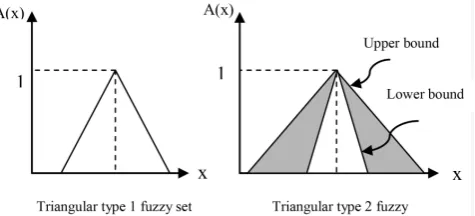
The MFs of type-1 fuzzy sets, which are crisp sets, are not sufficient for many kinds of uncertainties that necessarily appear in linguistic descriptions of numerical quantities or in subjectively expressed amounts [16]. The difference between type-1 and type-2 fuzzy sets is associated with the nature of the underlying MFs. The MFs of type-1 fuzzy sets are crisp and not able to directly model uncertainties. Type-2 fuzzy sets are able to model uncertainties because their MFs themselves are fuzzy [7]. In comparison with type-1 fuzzy sets, the MFs of type-2 fuzzy sets are not crisp and within lower and upper bounds. A comparison of type-1 and type-2 fuzzy sets is shown in Fig.1.
In situations where data uncertainty is too high, the use of type-2 fuzzy sets is more suitable than the use of type-1 fuzzy sets [8]. There are at least four sources of uncertainties in fuzzy set MFs: (1) The meaning of the words used in the rules can be uncertain (words have different meanings to different people). (2) Consequents may have a histogram of values associated with them, especially when knowledge is extracted
from a group of experts who may not agree unanimously. (3) Measurements that activate a type-1 fuzzy logic system may be noisy and, therefore, uncertain. (4) The data used to tune the parameters of a type-1 fuzzy logic system may be noisy as well [7].
If at least one of the consequent or antecedent sets is type-2, then the fuzzy logic system (FLS) is type-2. In forming the rules, the nature of the MF is not important. Therefore, the rule structure remains the same. In type-1 case, the rules are of the following forms:
IF x1 isr A1 and…xp isr Ap,THEN y isr Y
where we have p inputs (x1,…,xp) and 1 output (y). A1,…,Ap are type-1 fuzzy sets.
Like type-1 case, in type-2 case, we can assume that the rule is of the form
IF x1 isr Ã1 and…xp isr Ãp,THEN y isr Ŷ
where Ã1,…,Ãp are type-2 fuzzy sets [5].
Type-2 fuzzy sets are represented with primary and secondary MFs. When the secondary MFs are interval sets (i.e., all secondary memberships are equal to zero or one), we are dealing with an IT2F set [9].
In real-world continuous caster scheduling, the due dates usually are set by manufacturing experts. As mentioned before, information about linguistic uncertainty, which is usually gained from experts, can be merged in type-2 framework [6]. Hence, to overcome the vagueness in due dates, we propose one for using IT2F approach.
4- Proposed Model
In this work, we modify the mathematical model proposed in [1] because our problem is closely related to that model. The model comprises slabs of varying grade, width, and weight. The aim is to schedule these slabs in a minimum number of heats, m, with identical capacity, while minimizing the earliness and tardiness delivery penalties. The problem is subject to ensuring that the total weight of all slabs assigned to a heat does not exceed the maximum capacity and no heat contains slabs with incompatible width and grade. In our work, this problem, which incorporates type-2 fuzzy due dates, is formulated as a type-2 fuzzy problem which is useful for overcoming the vagueness in due dates in real-world problems.
4- 1- Variables, parameters and objective function in initial model
In the initial model, the objective function and variables are defined as follows [1]:
Fig. 1. Comparison of triangular type-1 and type-2 fuzzy sets
m m n
j ij ij j 1 j 1 i 1
min H ETP
= = =
+ δ
where:
while
ETPij that presents the earliness or tardiness delivery penalty to produce slabi in heatj is defined by (4),
where h is the index of the heat where slabi should ideally be produced according to the hot strip mill agent’s schedule; c is considered as the index of the heat where slabi is produced according to the continuous casting agent’s schedule.
Definitions:
Fmax: Maximum weight of the molten steel in a heat. Fsi: Weight of slabi.
: Minimum and maximum widths of slabi. : Minimum and maximum carbon contents of slabi.
:Minimum and maximum aluminum contents of slabi.
4- 2- Variables, parameters and objective function of modified model
The original and modified models differ in the following ways: • Based on the real problem condition, we replace the maximum and minimum silicon contents of slabi, instead of aluminium content, which is mentioned in the initial model:
: Minimum and maximum silicium contents of slabi.
• To calculate the objective function quantitatively, we define the following new variable:
Pj: Total cost of producing heatj with full capacity.
• We presume that the continuous casting scheduling problem is independent of the hot strip mill scheduling problem. Moreover, based on real-world conditions, the due dates gained from manufacturing experts, are represented using IT2F MFs. Thus, we define the earliness and tardiness penalties as follows:
ETP`ij is the earliness or tardiness delivery penalty for producing slabi in heatj, which was defined in (5). c and represent the completion time and type-2 fuzzy due date, respectively. The method of generating type-2 fuzzy sets and the procedure for calculating ETP`ij are described below. 4- 2- 1- Generating type-2 fuzzy sets
In this work, we gained the due dates directly from domain experts. Different experts have different opinions which are not necessarily the same as each other. To generate type-2 fuzzy sets from type-1 fuzzy sets proposed by individual domain experts, we employ the method reported in [12]. As shown in Fig. 2, each expert provides type-1 fuzzy sets that represent each linguistic label from the domain expert’s point of view and generates type-2 fuzzy sets.
4- 2- 2- Proposed procedure for calculating
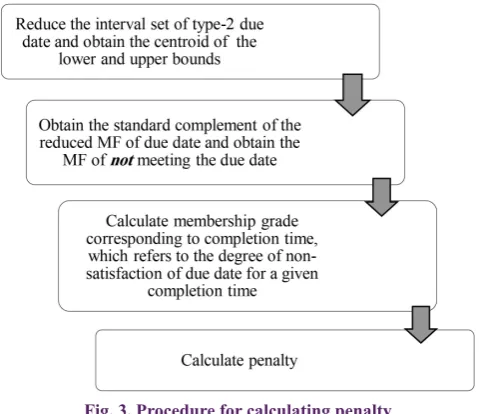
The procedure for calculating ETP`ij comprises four steps, as shown in Fig. 3.
In the sequel, the procedure is described step by step.
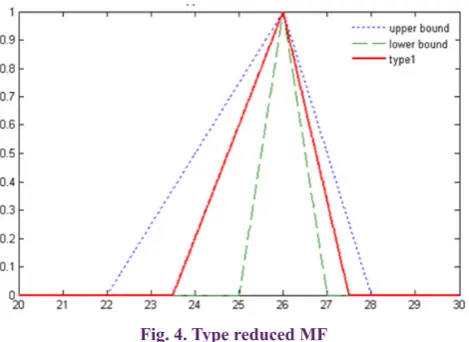
• Type reduction: An interval set is reduced using the average of upper and lower bounds [9]. We calculate m(x) according to (6).
An example of this step is shown in Fig. 4.
• Define the standard complement of type-1 MF: we calculate the standard complement of the MF according to (7). Fig. 2. Generation of T2FS from various triangular T1FSs that
represent experts’ individual opinions
Fig. 3. Procedure for calculating penalty
(5)
(6)
(7) (2)
(3)
(4)
i j
ij 1 if slab is assigned to heat
0 otherwise
δ =
{
}
{
}
i 1,...,n , j 1,...,m
∈
∈
{
}
j
n
1 if i 1 ij o , j 1,...,m
H
0 otherwise
∑ δ > ∈
=
=
(
)
ij
h c
if
c h
ETP
0
if
c h
2 c h
if
c h
−
<
=
=
−
>
(
i i)
min max
s s
W ,W
(
i i)
min max
s s
C ,C
(
i i)
min max
s s
Al ,Al
(
i i)
min max
s s
Si ,Si
( )
ij
d c if c d
ETP 0 if c d
c d if c d
− <
′ = =
− >
d
l u
(x) (x) (x) 2
m = m + m
(x) 1
(x)
The pictorial presentation of this operation is given in Fig. 5.
• Calculate : represents the degree of non-satisfaction of the due date. The schema of this definition is shown in Fig. 6.
• Calculate the penalty of assigning each slab to a heat: For instance, if slabi is assigned to heatj, we calculate the penalty of this assignment according to (8), where d represents the point of the highest degree of satisfaction of the MF.
4- 3- Modified mathematical model
In the modified model, as mentioned before, the variables are defined as follows:
while
where c and represent completion time and the type-2 fuzzy due date, respectively.
The parameters are defined as follows:
Fmax: Maximum weight of the molten steel in a heat. Fsi: Weight of slabi.
: Minimum and maximum widths of slabi. : Minimum and maximum carbon contents of slabi.
: Minimum and maximum silicium contents of slabi.
Pj: Total cost of producing heatj with a full capacity. The modified mathematical model is defined below:
subject to: Fig. 4. Type reduced MF
Fig. 5. Complement of type reduced MF
Fig. 6. Degree of non-satisfaction
(c)
m
m
(c)
ij
ETP
′ = − ×m
c d
(c)
(8)(9)
(10)
(11)
(12)
(13)
(14)
(15)
(16)
i j
ij 1 if slab is assigned to heat
0 otherwise
δ =
{
}
{
}
i 1,...,n , j 1,...,m
∈
∈
{
}
j
1 1 0, 1,...,
H 0
∑ > ∈
=
=
n j m
if i ij
otherwise δ
( )
ij
d c if c d
ETP 0 if c d
c d if c d
− <
′ = =
− >
d
(
i i)
min max
s s
W ,W
(
i i)
min max s s
C ,C
(
i i)
min max s s
Si ,Si
m m n
j j ij ij
j 1 j 1 i 1
min (H P ) ETP
= = =
′
× + δ
∑
∑∑
{
}
i
n
max s ij i 1
, j 1,...,m
=
F δ ≤ F ∈
∑
{
}
m ij j 1
1, i 1,...,n
=
δ = ∈
∑
max min max min
0
0
1
−
<
−
<
+
≤
i k k i
s s s s
ij kj
if
W
W
or
W
W
then
δ
δ
max min
0
max min0
1
−
<
−
<
+
≤
k k i
i s s s
s
ij kj
if C
C
or
C
C
4- 4- Solution method
Within the defined model, the continuous caster scheduling problem is considered as a type of Constrained Bin Packing Problem, which is a strongly NP-hard problem. Hence, our problem is a strongly NP-hard optimization problem as well [1]. For instance, if 50 slabs are required to be produced by a continuous caster, 50! sequences should be checked in the corresponding mathematical model. Therefore, the use of a suitable heuristic method is inevitable.
In this paper, we propose the tabu search technique. The reasons for doing so are presented below:
• The tabu search method usually obtains good solutions with low CPU time [1]. Finding a solution quickly is one of the most important objectives of the continuous casting scheduling problem because the steel industry deals with multi-stage processes, and any change in one step may have a bearing on other steps. Therefore, one must respond to the need of rapid, real-time schedule generation. • The results of a few studies show that tabu search finds suitable solutions to the continuous caster scheduling problem quickly [11].
As mentioned before, multi-agent systems yield a flexible, dynamic scheduling process rather than a mathematically optimal schedule. Hence, we propose a multi-agent structure and an appropriate negotiation protocol.
5- Distributed Multi-Agent-Based Structure
As mentioned previously, multi-agent systems follow an intelligent, distributed approach, which is used for situations that are changeable, complex, and modular. These features exist in continuous casting scheduling. The agents of a multi-agent system are characterized by flexibility, autonomy, reactivity, integration, and scalability. They can dynamically integrate with new agents, remove existing agents, and upgrade agents independently [4]. When using the multi-agent system, the problem of scheduling of steel casting is populated by a number of autonomous, heterogeneous intelligent agents. These agents can cooperate and coordinate via suitable communication protocols [18]; hence, we define multi-agent architecture and communication protocols, which are two important aspects of the multi-agent concept. 5- 1- Proposed multi-agent architecture
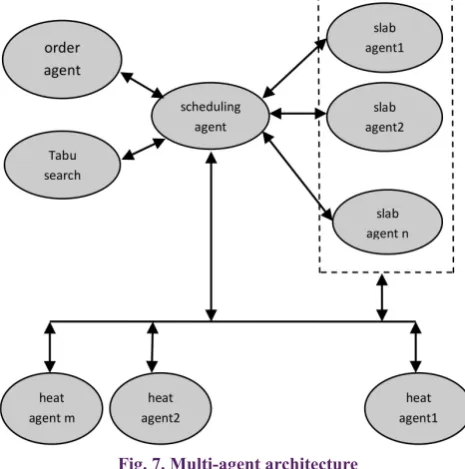
In this paper, we propose a multi-agent architectural framework based on [18] as shown in Fig. 7. At first, we describe the specific knowledge of the agents; then, we propose a scheduling strategy.
5- 1- 1- Description of agents’ specific knowledge
In this subsection, we describe the agents in the proposed architecture. Order agent is responsible for receiving external orders. Scheduling agent is the main manager of scheduling and connects all other agents to each other. This agent also produces an initial solution for tabu search agent. Tabu search agent encapsulates the tabu search algorithm and is responsible for improving the solution until the stopping conditions are met. Slab agents sort slabs in the increasing order of their due dates and introduce them to the heat agents.
Heat agents monitor different possible heats to assign slabs to and provide information to scheduling agent for making decisions.
5- 1- 2- Proposed scheduling strategy
The proposed scheduling strategy is according to the below procedure:
Step1: Transfer external order of slabs to order agent. Step2: Transfer order to scheduling agent.
Step3: Transfer order to slab agent and sort slabs based on earliest due date.
Step4: Introduce slab in turn to heat agent.
Step5: Send bids from heat agent to scheduling agent. Step6: Check possibility of assigning a slab to heats.
Step7: If a suitable heat is found, assign the slab, else, create a new heat agent.
Step8: Check if all slabs are assigned to heats.
Step9: If all slabs are assigned to heats, create an initial solution and send it to tabu search agent; else, go to step 4. Step10: Improve solution by performing an iteration in the neighborhood of the previous solution.
Step11: Check stopping conditions.
Step12: If stopping conditions are met, send the final solution to scheduling agent; else, go to step 10.
5- 2- Proposed negotiation protocol
Based on the distributed task allocation, a slab agent individually finds the suitable heat agents that can accept a given slab without any degree of centralization. The contract net protocol is a classical technique for distributed task allocation. It is the most common procedure for distributed task allocation in agent-based systems. The contract net protocol is a high-level protocol for achieving efficient cooperation based on negotiation. It is known as a market-like protocol. The basic metaphor used in the contract net protocol is contracting [1]. The negotiation protocol contains three steps [3]. It begins after the scheduling agent initiates a session by sending a request message to the slab agent to allocate a set of slabs to heats. The steps of the negotiation protocol are described below.
(17) max min
0
max min0
1
−
<
−
<
+
≤
i k k i
s s s s
ij kj
if
Si
Si
or
Si
Si
then
δ
δ
5- 2- 1- Task announcement
When a slab agent receives an order of several slabs at once, the announcement priority is dependent on the slabs’ due dates. In this work, we propose earliest due date (EDD) heuristic method, in which the slab with the earliest due date is accorded the highest priority. Upon receiving a request message from the scheduling agent to allocate a set of slabs, the slab agent tries to assign slabs based on their priority. In doing so, the slab agent negotiates slabs assignment with the heat agents. The slab agent issues an announcement message (slab-announcement) to the heat agents to allocate slabs according to the customer order. The slab-announcement message must specify the following information:
5- 2- 2- Bidding
After bidders receive the announcement, they determine the preferred slabs. Two sets of rules guide the choice. One set determines slab priority, that is, bidding for a slab of highest priority. The other is based on bidder regulations [3] such as incompatibility and capacity constraints. A bid represents an offer to accept the slab specified in the slab-announcement. The heat-bid message must specify the following information:
5- 2- 3- Contracting
Finally, the scheduling agent chooses one of the bids and sends “acceptance acknowledgment” to the chosen bidder. The contracts messages must specify the following essential information:
6- Experimental Results
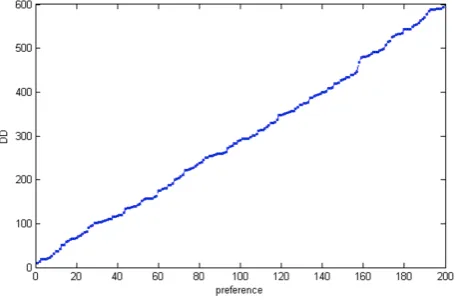
In order to determine the effect of using type-2 fuzzy concept, we considered the specifications of 200 slabs. The specifications of each slab are the grade, weight, width, and type-2 fuzzy MF of the due date. Based on the proposed scheduling procedure, in transferring orders to the slab agent, the scheduling agent sorts them in an ascending order of due date. This step is shown in Fig. 8. In the next step, the slabs are assigned to the minimum number of heats with
considering the constraints of the maximum capacity of heats and the incompatibility of slab’s width and grade. The initial solution is shown in Table 1. In this table, “slab no.” represents the preference of the slab to be produced earlier. As can be inferred from the table, for example in spite of the fact that slab 2 is preferred to slab 3, it is shifted to the next heat because of incompatibility constraints. After assigning the slabs to the heats based on the completion time of the slabs, we calculate the penalty of assigning the slabs to the heats. As mentioned before, the total penalty is directly related to the objective function of the model. Hence, to examine the effect of using the fuzzy sets instead of the crisp sets, we compare the total penalty of assigning slabs to the heats when using type-2 fuzzy due dates with that when using crisp due dates. To this end, we gained three data series, each of which contains the specifications of 200 slabs. Then, we calculated and compared the total penalty under two strategies, i.e. using type-2 fuzzy due date and using crisp due date.
The results are shown in Table 2.
As can be seen in this table, when we assume a fuzzy due date, the total penalty of assigning the slabs to the heats is lower than that under other condition. This proves fuzzy concept’s superiority over the crisp concept.
7- Conclusion
This paper deals with a type-2 fuzzy multi-agent-based approach for the scheduling of continuous caster. At first, the continuous caster scheduling problem is presented as a mathematical model. Regarding the problem condition, a suitable solution (i.e., tabu search) is suggested. To overcome the vagueness in due dates, which happens in real-world problems, the use of the type-2 fuzzy concept is proposed. With respect to the problem complexity, for using the capability of distributed systems, a suitable architectural framework is proposed for a multi-agent system. In addition, a suitable communication protocol is suggested, which is essential for coordination and cooperation of agents. In this work, for the first time, we proposed a hybrid multi-agent-based system for the scheduling of continuous caster; the proposed system combines multi-agent, tabu search, and type-2 fuzzy concepts, which conforms with the real world problem. Sender: Slab agent
Receiver: Heat agents Message Type: task announcement Message Task: allocate slab
Deadline: time by which the heat agent must respond with a bid Content: Slab specifications and its due date
Sender: Heat agent Receiver: Scheduling agent Message Type: bid
Message Task: allocate slab
Deadline: time by which the heat agent must respond with a bid
Content: heat specifications, such as unfilled capacity.
Sender: Scheduling agent Receiver: Heat agent Message Type: contract Message Task: allocate slab
REFERENCES
[1] D. Ouelhadj, A multi-agent system for the integrated dynamic scheduling of steel production, University of Nottingham, 2003.
[2] P.I. Cowling, D. Ouelhadj, S. Petrovic, Dynamic scheduling of steel casting and milling using multi-agents, Production Planning & Control, 15(2) (2004) 178-188.
[3] Y. Li, J.-Q. Zheng, S.-L. Yang, Multi-agent-based fuzzy scheduling for shop floor, The International Journal of Advanced Manufacturing Technology, 49(5) (2010) 689-695.
[4] M.F. Zarandi, P. Ahmadpour, Fuzzy agent-based expert system for steel making process, Expert systems with applications, 36(5) (2009) 9539-9547.
[5] O. Castillo, P. Melin, J. Kacprzyk, W. Pedrycz, Type-2 fuzzy logic: theory and applications, in: Granular Computing, 2007. GRC 2007. IEEE International Conference on, IEEE, 2007, pp. 145-145.
[6] N.N. Karnik, J.M. Mendel, Operations on type-2 fuzzy
sets, Fuzzy sets and systems, 122(2) (2001) 327-348.
[7] J.M. Mendel, R.B. John, Type-2 fuzzy sets made simple, IEEE Transactions on fuzzy systems, 10(2) (2002) 117-127.
[8] M.F. Zarandi, R. Gamasaee, Type-2 fuzzy hybrid expert system for prediction of tardiness in scheduling of steel continuous casting process, Soft Computing, 16(8) (2012) 1287-1302.
[9] Q. Liang, J.M. Mendel, Interval type-2 fuzzy logic systems: theory and design, IEEE Transactions on Fuzzy systems, 8(5) (2000) 535-550.
[10] J. Dorn, W. Slany, A flow shop with compatibility
constraints in a steelmaking plant, na, 1994.
[11] J. Dorn, Iterative improvement methods for knowledge-based scheduling, AI communications, 8(1) (1995) 20-34.
[12] F. Liu, J.M. Mendel, An interval approach to fuzzistics for interval type-2 fuzzy sets, in: Fuzzy Systems Conference, 2007. FUZZ-IEEE 2007. IEEE International, IEEE, 2007, pp. 1-6.
[13] B. Lally, L. Biegler, H. Henein, A model for sequencing a continuous casting operation to minimize costs, Mathematical Modelling of Materials Processing Operations, (1987) 1157-1172.
[14] L. Tang, J. Liu, A. Rong, Z. Yang, A mathematical
programming model for scheduling steelmaking-continuous casting production, European Journal of Operational Research, 120(2) (2000) 423-435.
[15] S.Y. Chang, M.-R. Chang, Y. Hong, A lot grouping
algorithm for a continuous slab caster in an integrated steel mill, Production planning & control, 11(4) (2000) 363-368.
Tab 2. Comparison of total penalty of assigning the slabs to the heats under two conditions
Tab 1. Initial solution Heat
No. Slab No.
1 1 3 5 8 11 14 16 20 25 29 30
2 2 4 9 12 15 17 21 23 24 26 27 34 39 40 44 48
3 6 10 13 18 22 31 32 35 37
4 7 19 33 36 42 45 50 59 66 68 70 79 87 89 90 91
5 28 38 41 43 46 47 49 52 55 56
6 51 57 58 64 67 76 80 81 84 85 95 96 102 103 105 108
7 53 54 63 69 72 73 75 86 92
8 60 61 62 65 71 74 77 78 82
9 83 88 97 99 109 113 116 117 123
10 93 98 100 106 124 125 127 128 129
11 94 101 104 107 112 115 118 120 122 131 146 151 160 166 170 172 12 110 111 114 119 121 130 133 137 141 148 152 154 156 157 158 163 13 126 135 136 138 139 140 143 144 150 155
14 132 134 142 145 147 149 153 162 164 15 159 165 167 168 173 174 178 179 182 16 161 175 176 185 187 191 196 197 199 17 169 171 181 183 188 190 192
18 177 180 189 194
19 184 186 193 195 198 200
Series No. Total penalty
Crisp due date Fuzzy due date
1 4148 4102
2 2805 2699
[16] A. Celikyilmaz, I.B. Turksen, Modeling uncertainty with fuzzy logic, Studies in fuzziness and soft computing, 240 (2009) 149-215.
[17] E. Oliveira, K. Fischer, O. Stepankova, Multi-agent systems: which research for which applications, Robotics and Autonomous Systems, 27(1-2) (1999) 91-106.
[18] M.F. Zarandi, F.K. Azad, A type 2 fuzzy multi agent based system for scheduling of steel production, in: IFSA World Congress and NAFIPS Annual Meeting (IFSA/NAFIPS), 2013 Joint, IEEE, 2013, pp. 992-996.
[19] Q.-l. Guo, M. Zhang, Multiagent-based scheduling
optimization for Intelligent Manufacturing System, The International Journal of Advanced Manufacturing Technology, 44(5) (2009) 595-605.
Please cite this article using:
M. H. Fazel Zarandi, F. Kashani Azad, A. H. Karimi Kashani, A Hybrid Modeling for Continuous Casting Scheduling Problem, AUT J. Model. Simul., 49(2)(2017)173-180.