journal homepage: http://jac.ut.ac.ir
Deciding Graph non-Hamiltonicity via a Closure
Algorithm
E.R. Swart
∗1, Stephen J. Gismondi
†2, N.R. Swart
‡3, C.E. Bell
§4and A.
Lee
¶51
Kelowna, British Columbia, Canada
2,5University of Guelph, Canada
3University of British Columbia Okanagan, Canada1 4Guelph, Ontario, Canada
ABSTRACT ARTICLE INFO
We present a matching and LP based heuristic algorithm that decides graph non-Hamiltonicity. Each of the n! Hamilton cycles in a complete directed graph on n+ 1 vertices corresponds with each of the n! n-permutation matrices P, such that pu,i = 1 if and only if the ith
arc in a cycle enters vertex u, starting and ending at vertex n+ 1. A graph instance (G) is initially coded as exclusion setE, whose members are pairs of components of P, {pu,i, pv,i+1}, i= 1, n−1, for each arc (u, v) not in
Article history:
Received January 26, 2016 Received in revised form Au-gust 23, 2016
Accepted October, 6, 2016 Available online November, 28, 2016
Keyword: Hamilton cycle, decision problem.
AMS subject Classification: 05C45, 20B05, 52B05, 90C0.
†Corresponding author: S. J. Gismondi, E-mail: [email protected] ‡[email protected]
¶[email protected], This work is dedicated to the late Linda Allen, friend, University of Guelph
colleague and mentor.
ABSTRACT continued
in G. Accounting for all arcs not in G, E codes precisely the set of cycles not in G. A doubly stochastic-like O(n4) formulation of the Hamilton cycle decision problem is then constructed. We mEach {pu,i, pv,j} is coded as variable qu,i,v,j such that the set of
integer extrema is the set of all permutations.We model G by setting each qu,i,v,j = 0
in correspondence with each {pu,i, pv,j} ∈ E such that for non-Hamiltonian G, integer
solutions cannot exist. We recognize non-Hamiltonicity by iteratively deducing additional
qu,i,v,j that can be set zero and expanding E until the formulation becomes infeasible, in
which case we recognize that no integer solutions exists i.e. Gis decided non-Hamiltonian. The algorithm first chooses any {pu,i, pv,j} 6∈ E and sets qu,i,v,j = 1. As a relaxed LP,
if the formulation is infeasible, we deduce qu,i,v,j = 0 and {pu,i, pv,j} can be added to
E. Then we choose another {pu,i, pv,j} 6∈ E and start over. Otherwise, as a subset
of matching problems together with a subset of necessary conditions, if qu,i,v,j cannot
participate in a match, we deduce qu,i,v,j = 0 and {pu,i, pv,j} can be added E. We again
choose another {pu,i, pv,j} 6∈ E and start over. Otherwise qu,i,v,j is undecided, and we
exhaustively test all {pu,i, pv,j} 6∈ E. If E becomes the set of all {pu,i, pv,j}, G is decided
non-Hamiltonian. Otherwise G is undecided. We call this the Weak Closure Algorithm. Only non-Hamiltonian Gshare this maximal property.
Over 100 non-Hamiltonian graphs (10 through 104 vertices) and 2000 randomized 31 vertex non-Hamiltonian graphs are tested and correctly decided non-Hamiltonian. For Hamiltonian G, the complement of E provides information about covers of matchings, perhaps useful in searching for cycles. We also present an example where the WCA fails to deduce any integral value for anyqu,i,v,j i.e. Gis undecided.
1
Introduction
We present a theory, model, and an heuristic algorithm that shows how to decide problems inNPvia models of theircoNPcounter parts, based upon the Birkhoff polytope. We first model the non-Hamilton cycle decision problem to create a relaxed linear programming formulation of the Hamilton cycle decision problem. We then present the O(n8) Weak Closure Algorithm (WCA) that deduces values of 0/1 variables via Boolean closure (in place of LP) and non-matching. Over 100 non-Hamiltonian graphs (10 through 104 ver-tices) (SJG, NRS & AL), and 2000 randomized 31 vertex non-Hamiltonian graphs (NRS) are tested and correctly decided non-Hamiltonian7. Graphs require no special treatment.
for FORTRAN code and details about test graphs etc.
The WCA can also be used to verify non-Hamiltonicity, given a correctly guessed set of variables as input to the WCA. See section 5.3. The WCA is easy to apply to 1) a model of the graph isomorphism decision problem (section 5.2.1) partially answering a question in [25] i.e. we show how to generate the input set sufficient to model itscoNPcounter model and 2) the subgraph isomorphism decision problem modelled in [24] i.e. we can create a model of the subgraph non-isomorphism decision problem, exclusion setE, as input to the WCA. This is expected, given that we model the NP-complete Hamilton Cycle Decision Problem. For these reasons we propose that problems incoNP be modelled and studied as compact formulations whose set of extrema are sets of permutations in correspondence with sets of non-solutions i.e. a unified approach based upon permutations. Information about what is not a solution might be used to create an input set that modelsNPcounter problems (unrelated to the complexity of deciding an NP problem). It might also be convenient to modify the WCA to become more exhaustive/complex. So we comment that the WCA is generalizable/parallelized (as implemented by SJG). See section 5.2. For special classes of graphs, we believe that the WCA can be developed as a technique that always decides graph non-Hamiltonicity e.g. snarks. We would first need to prove there exists sufficient polynomial time accessible information via E (see section 2.2) for
all instances of ‘YES’ decisions to problems in coNP, and then prove that the WCA must always cause the corresponding relaxed formulation of the NP problem to become infeasible. If these classes of graphs exists, and these proofs were known, the of course feasible solutions imply the existence of an integer solution i.e. a ‘YES’ decision for problems in NP. This is how we envision a highly practical use of the WCA.
1.1
Our Motivation to Study coNP-complete Decision Problems
During the 1990s, two of us (SJG and ERS) began modelling NP decision problems as compact relaxed linear programming formulations of integer programs such that integer extrema are permutations that correspond with solutions i.e. our models are based upon the Birkhoff polytope. A common idea at that time (among the P=NPproponents) was to search for a compact linear programming formulation of an NP-complete problem, infeasible if and only if there exists no integer solutions i.e. implying that P=NP [10, 23, 29, 30]. Unsuccessful (and maybe impossible [18]), these ideas were applied to their
coNP counter models, compact formulations of the union of sets of permutations using projection and lifting techniques, each permutation in correspondence with each non-solution. These ideas were formalized in a graduate student thesis, leading to a series of small results [12, 23, 24, 25, 26, 27] occasionally presented at conferences6. Interestingly for some instances of non-Hamiltonian graphs, it’s easy (polynomial time) to deduce that the
set of all non-solutions is the set of all permutations i.e. easy to decide non-Hamiltonicity. These non-Hamiltonian graphs (and their models) share a property that we exploit via LP and it’s not necessary to search an intractable space of solutions. This is common idea, analogous to how Michael Sipser describes an approach to ‘what is not prime’ in [40].
1.2
General Motivation to Study coNP-complete Decision
Prob-lems
Research related to the infamous NP-hard Traveling Salesman Problem (TSP) spans many years and perhaps thousands of researchers [1, 2, 3, 4, 5, 6, 8, 29, 30, 31, 39], to mention just a few. TSP polytope facet finding studies date back to at least the 1950’s with Heller, Kuhn, Norman and Robacker as cited in [36]. At that time, the concept of
NP-completeness hadn’t been formalized although the TSP problem was suspected to be very complicated, noted by Flood also cited in [36]. Studies in complexity theory, and the field itself are well developed due in large part to the high profile of thePversus NP
conundrum, one of six remaining Millennium problems [11], not to mention applications to communications, security - cryptography in particular [14]. Quantum computation techniques have generated further important contributions [18, 37, 38], preceded by the development of quantum complexity theory [13], now a mainstream research area. From 1990 - 2015, researchers have regularly proposed proofs that resolve the P versus
NP conundrum [19, 20, 32, 33, 43]. It seems that such frequent and prolonged interest should generate advances. But there are simply very few, perhaps none to be had, or maybe we lack insight. Regardless, much less effort appears to be spent on studying NP
versus coNP, other than as a byproduct of NP-completeness. Some work on coNP -completeness, MNH & hypohamiltonian graphs can be found in [15, 17, 22, 28, 34, 35, 41, 42, 44]. Noting that NP6=coNP⇒ P6=NP, we propose that researchers should study
NP versus coNPvia the creation and study of models and algorithms that decide YES tocoNP-complete problems. Is there agood way to 1) access information from models of
coNP-complete problems so that we can makegood use of this information to solveNP -complete problems? (PversusNP), and 2) make use of information we access from models of coNP-complete problems together with polynomial amounts of additional information to verify correctly guessed ‘YES’ instances of coNP-complete problems? (coNP versus
NP).
6Presentations at: the 22nd Southeastern International Conference on Combinatorics, Graph Theory,
1.3
Introduction to a Model of the Hamilton Cycle Decision
Problem
Let G be a simple, strongly connected and directed n+ 1 vertex graph, neither empty nor complete where undirected edges are regarded as pairs of counter directed arcs. A Hamilton cycle in G (cycle) is a directed circuit containing all vertices in G and n+ 1 arcs in the arc set of G. G is (non-)Hamiltonian if and only if there exists (no) a cycle inG. The problem of deciding G(non-)Hamiltonian is called ‘The (non-)Hamilton cycle decision problem’ and is (coNP) NP-complete. [21].
Cycles are permutations of vertex labels ofG. One way (of many possible ways, see section 5.4.4) to model this idea is to assign each n+ 1 cycle to be in bijective correspondence with each n-permutation matrix P such that pu,i=1 if and only if the ith arc in a cycle
enters vertexu, starting and ending at vertex n+ 1.
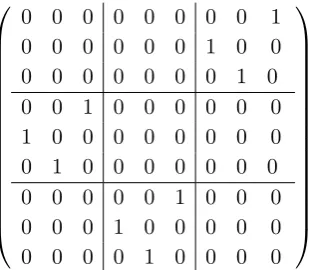
Let each P of the set of n! P matrices be coded within an n2xn2 matrix Q such that
the block structure of each Q is the component structure of each P. See an example in Figure 1 (n=3). The general form of Q is shown in Figure 2 (n=4) where components of Q (q variables) are written asqu,i,v,j, referring to component (v, j) in block (u, i); and
components ofP (pvariables) are written as pu,i referring to component (u, i) inP. Note
that when j < i, qu,i,v,j is written as qv,j,u,i, a convenience based upon interpretation of
these variables as applied to a model of the Hamilton cycle decision problem.
System 1 is a compact system of linear equations with fractional and integer extrema8.
Each integer extreme is a permutation matrixP that uniquely extends to 0/1 qvariables i.e. there exist precisely n! unique 0/1 assignments ofq (or p) variables such that n(n2−1) (or n) q (or p) variables set at unit level that cause by linear dependencies (System 1), an assignment of n (or n(n2−1))p ( or q) variables at unit level [24].
System 1: P
ipu,i = 1, u= 1,2, ..., n P
upu,i = 1, i= 1,2, ..., n
F or all u, i= 1,2, ..., n
P
j6=i1qu,i,v,j =pu,i, v = 1,2, ..., n, v 6=u. P
v6=u 1q
u,i,v,j =pu,i, j = 1,2, ..., n, j 6=i.
1Note: For i > j, write q
v,j,u,i in place of qu,i,v,j.
For qu,i,v,j=0, precisely those P for which pu,i = pv,j = 1 are infeasible wrt System 1.
Consider System 2 below, where a set of q variables have been set zero (via set E) corresponding with elements ofE, pairs of pvariables that cannot both be at unit level in any 0/1 solution. We code for sets of cycles excluded fromGas follows. For directed graph
8See section 2.1 re: likely non-existence of any compact formulation that models any NP-complete
0 0 0 0 0 0 0 0 1 0 0 0 0 0 0 1 0 0 0 0 0 0 0 0 0 1 0 0 0 1 0 0 0 0 0 0 1 0 0 0 0 0 0 0 0 0 1 0 0 0 0 0 0 0 0 0 0 0 0 1 0 0 0 0 0 0 1 0 0 0 0 0 0 0 0 0 1 0 0 0 0
Figure 1: An example of the block structure of Q defined by the component structure of
P,n = 3.
p11 0 0 0 0 p12 0 0 0 0 p13 0 0 0 0 p14
0 q1122 q1123 q1124 q2112 0 q1223 q1224 q2113 q2213 0 q1324 q2114 q2214 q2314 0
0 q1132 q1133 q1134 q3112 0 q1233 q1234 q3113 q3213 0 q1334 q3114 q3214 q3314 0
0 q1142 q1143 q1144 q4112 0 q1243 q1244 q4113 q4213 0 q1344 q4114 q4214 q4314 0
0 q2112 q2113 q2114 q1122 0 q2213 q2214 q1123 q1223 0 q2314 q1124 q1224 q1324 0
p21 0 0 0 0 p22 0 0 0 0 p23 0 0 0 0 p24
0 q2132 q2133 q2134 q3122 0 q2233 q2234 q3123 q3223 0 q2334 q3124 q3224 q3324 0
0 q2142 q2143 q2144 q4122 0 q2243 q2244 q4123 q4223 0 q2344 q4124 q4224 q4324 0
0 q3112 q3113 q3114 q1132 0 q3213 q3214 q1133 q1233 0 q3314 q1134 q1234 q1334 0 0 q3122 q3123 q3124 q2132 0 q3223 q3224 q2133 q2233 0 q3324 q2134 q2234 q2334 0
p31 0 0 0 0 p32 0 0 0 0 p33 0 0 0 0 p34
0 q3142 q3143 q3144 q4132 0 q3243 q3244 q4133 q4233 0 q3344 q4134 q4234 q4334 0
0 q4112 q4113 q4114 q1142 0 q4213 q4214 q1143 q1243 0 q4314 q1144 q1244 q1344 0 0 q4122 q4123 q4124 q2142 0 q4223 q4224 q2143 q2243 0 q4324 q2144 q2244 q2344 0
0 q4132 q4133 q4134 q3142 0 q4233 q4234 q3143 q3243 0 q4334 q3144 q3244 q3344 0
p41 0 0 0 0 p42 0 0 0 0 p43 0 0 0 0 p44
Figure 2: General Form ofQ Matrix,n = 4.
G, we examine all arcs (u, v) not inG, accounting for every sequence position of every arc in every cycle not in G. E is sufficient since P corresponds with a cycle not in G if and only if the cycle makes use of at least one arc not inGi.e. requiring thatpu,i =pv,i+1 = 1.
We can exclude these cycles by placing 0’s in positions (u, i, v, i+ 1) of the Q matrix in Figure 2. System 2 is a relaxed model of the Hamilton cycle decision problem. Its set of integer extrema correspond with cycles in G if and only if for each extreme P, the set of
{pu,i, pv,j} 6∈ E satisfying pu,i = pv,j = 1 define P. G is non-Hamiltonian if and only if
System 2 is either infeasible or has only fractional extrema.9
It’s also possible to make deductions from E in ways that the WCA cannot, in advance of the WCA for application in the WCA (implemented in our code). Using Dijkstras algorithm, the shortest path between vertices u and v is of length k, and thus paths of lengthk−1, k−2, ....1 do not exist i.e. {pu,i, pv,i+k−1},{pu,i, pv,i+k−2}, ...,{pu,i, pv,i+1}can
9This is how we use information from a model of the non-Hamilton cycle decision problem to create
be added toE at the outset. We gain this new information (the shortest path matrix) in polynomial time, therefore called polynomial time accessible information.
System 2: P
ipu,i = 1, u= 1,2, ..., n P
upu,i = 1, i= 1,2, ..., n
F or all u, i= 1,2, ..., n
P
j6=i1qu,i,v,j =pu,i, v = 1,2, ..., n, v 6=u. P
v6=u 1q
u,i,v,j =pu,i, j = 1,2, ..., n, j 6=i.
F or each{pu,i, pv,j} ∈E assign qu,i,v,j = 0.
pu,i, qu,i,v,j ≥0.
1Note: For i > j, write q
v,j,u,i in place of qu,i,v,j.
1.4
Introduction to the WCA
We assume that System 2 has an integer solution P and we seek to deduce infeasibility in the case of non-Hamiltonian G. We systematically choose and then overlay pairs of blocks in Q consistent with a subset of the component structure of an assumed P and then model P’s common non-zero p variables as arcs of an undirected bipartite graph (row and column vertices). This is equivalent to assuming a necessary condition for both blocks to participate in a match i.e. that aqvariable might be allowed to attain unit level in a solution to System 2. So we effectively set a variable at unit level, and if the LP is infeasible (although we use Boolean closure for implementation) or if the LP is feasible but there is no match, we deduce that the variable can be set zero. In this way, the WCA iteratively deduces additional q variables to be set zero and corresponding pairs of
pvariables to be added toE. Input for the WCA is thereforeE. Output from the WCA is ˜
E, called aweak closure set of E, defined temporarily (formalized in section 2.4.3) below. Formal presentation of the WCA follows in section 4.
Definition 1.1 DefineE˜ = E ∪ {all pairs of pvariables whose correspondingq variables are deduced zero via the WCA}.
We recognize non-Hamiltonicity if ˜E is the set of all pairs of p variables. Pre-emptively we might also test and confirm infeasibility of System 2 (but replace E with ˜E) and we say that the WCA decides non-Hamiltonicity (temporarily ignoring a feasible System 2 for which there exists no integer solutions).
guessed and verified E, and 2) decide non-Hamiltonicity for G using a polynomial time deterministically computed E. In the former case, this amounts to the study of NP
versus coNP, and in the latter case, study of P versus NP. Regarding (1), verifying non-Hamiltonicity is about verifying that System 2 admits no integer solution. E is given and or/guessed in a ‘known way’ sufficient for the WCA to verify non-Hamiltonicity i.e. thatG is non-Hamiltonian, requires knowledge that each element ofE is ‘a priori’ known to be a pair of pvariables whose correspondingq variable can be set zero. Regarding (2), deciding non-Hamiltonicity is about deciding that System 2 admits no integer solution. We compute E and we implement the WCA as a tool to help close E so that we can recognize non-Hamiltonicity. But in both cases, when the WCA fails to close E, we cannot decide if either G is Hamiltonian i.e. recognizing that E˜ cannot be the set of all pairs of pvariables, or that Gis non-Hamiltonian and that E is not sufficient and/or the WCA is unable to close E to be the set of all pairs of p variables. This comment relates to properties of E/G, i.e. the existence of classes of graphs with the property that the WCA always closes E.
2
Towards Development of a Theory
As an overall approach in the context of what’s known and what not to do, we first show how the ideas proposed in this paper at first glance, appear to avoid some of the known ‘no-go’ avenues and perhaps have some merit toward making headway in the study of these hard problems. Definitions and a proposed closure theory follows in sections 2.3 and 2.4.
2.1
About What’s Known and What Not To Do
Recall that the Hamilton cycle decision problem is the TSP with equally weighted arcs. Rather than view the TSP polytope as the convex hull of cycles, it’s more insightful to ap-preciate its complicated and beautiful structure regarding how it models ‘YES’ decisions. A set of graph instances that contain the same set of cycles corresponds with the same
d-supporting hyperplane of the TSP polytope, defined by the affine hull of these cycles. There exist O(n!) isomorphic d-supporting hyperplanes (up to permutation of vertex la-bels) for each set of these instances, and there exist O(2n2) graph instances whose affine
isomorph of every graph). The set ofD-facets (facets) of the TSP polytope are unknown, their number is unknown, nor can an arbitrary inequality be verified in polynomial time as inducing a facet of the TSP polytope.
In May of 2012, it was proven that no compact formulation of the TSP polytope exists [18] (For more background on the TSP, see [3, 31].). From [18], ‘We solve a 20-year old problem posed by Yannakakis and prove that there exists no compact LP whose associ-ated polytope projects to the traveling salesman polytope, even if the LP is not required to be symmetric. Moreover, we prove that this holds also for the cut polytope and the stable set polytope. These results were discovered through a new connection that we make between one-way quantum communication protocols and semidefinite programming refor-mulations of LPs.’. This result is significant having resolved a 20-year old problem, but not surprising, discussed above.
Proponents of P=NP are likely indifferent to this result since they don’t necessarily invoke (extended) formulations of the TSP polytope in attempted proofs e.g. Swart [43]. Lipton also notes this in his blog, in the spirit of not yet dismissing the existence of compact formulations of NP-complete problems. He also comments ‘Then we need to see how far the logic of this paper [18] (and a FOCS 2012 followup noted on the blog of my Tech colleague Pokutta) extends to alternative formulations.’. What exactly is an alternative formulation? The usual thought is to imagine a compact LP that models an
NP-complete problem that is feasible if and only if the decision for a problem instance is ‘YES’ (no need to illustrate a solution). These ideas are well known, at least since LP was shown to be in P[29, 30]. But LP is also P-complete. ThusP =NPif and only if there exists such a formulation (no need to illustrate a formulation). This is common knowledge, indirectly noted by another blogger [32]‘... as linear programming isP-complete, proving in full generality that such a problem cannot be solved by linear programming is equivalent to proving P 6=NP.’.
2.2
Force Infeasibility and Start-Stay-Stop Tractable
We comment that the success of the WCA depends upon deciding infeasibility of System 2 i.e. System 1 together with a subset of q variables set at zero level. Either all pairs of p variables are added to ˜E via the WCA, in which case System 2 is infeasible, or we explicitly monitor the feasibility of System 2 during implementation of the WCA. We wonder about the complexity of computing or verifying sufficient information aboutE so as to efficiently ‘collapse’ the feasible region of System 2 via the WCA. Hence we define and discuss the feasible region of Systems 1 & 2.
Definition 2.1 Define polytope Q as the solution set of System 1.
Noting ‘what not to do’ from above, we now show how we develop the model and algorithm to respect some of these boundaries. We first comment that cycles are permutations of vertex labels and that combinatorial decision problems are all about understanding the set of permutations. So it makes sense to map cycles to permutations and work entirely with permutations. Given the Birkhoff-von Neumann theorem and matching algorithm, we combine these ideas attempting to force / decide infeasibility of System 2.
We first describe in more detail, how Birkhoff-like polytope Qis unlike the TSP polytope in that it’s tractable yet perhaps still useful. PolytopeQwas originally conceived by Ted Swart in 1990. Its set of 0/1 extrema are in bijective correspondence with extrema of the Birkhoff polytope a.k.a. cycles of a complete directed graph. They span the same affine subspace as does af f(Q). Thus Q’s set of fractional extrema are affine combinations of its 0/1 extrema, and they project interior to the Birkhoff polytope i.e. onto images of convex combinations of integer extrema. The image of Qis the Birkhoff polytope. As an aside, we also note that Q is the second member in a sequence of relaxed formulations of polyhedra whose limiting polytope is Q0/1 in [12], the convex hull of integer extrema of
Q. See [24, 25] for related work. We also note that by restricting the feasible region to
facets of Q, we do not introduce additional extrema, unlike cutting plane methods etc. We confirmed that qu,i,v,j=0 are facets of Q (for n=4, 5) [12] and this led to the creation
of E.
Elements ofEseed the ‘sequence of steps’ referenced above, and how we go about ‘shrink-ing the feasible region’ is described generally below. These initial set of constraints, to-gether with the WCA dynamically generate more constraints i.e. they help to identify q
variables that can be set zero and cause moreqvariables to be set zero. The algorithm we present implements LP techniques, testing individual q variables to be set zero (below). Our FORTRAN code implements Boolean closure (speedier).
algorithm is invoked to compute minimal paths of length m between pairs of vertices implying that no paths of length less thanmexist. These paths are subpaths of Hamilton cycles not inG, coded as disallowed subsequences of vertex permutations (cycles). Corre-sponding variables are set zero, interpreted as: Hamilton cycles inGcannot use subpaths corresponding to these variables. We note how this ‘should a.k.a. face value’ help cause exclusion of sufficient numbers of permutations so as to decide infeasibility. This is an example of adding polynomial time accessible information to E i.e. recall this term from section 1.
The idea of ‘staving off’ intractabilities from above is the design intent of the WCA. For non-Hamiltonian G, we try to draw conclusions by assuming the existence of an integer solution for which aq variable attains unit level and we hope to recognize a contradiction, maintaining ‘polynomiality’. Weak closure is a term we use to describe a process that assumes the existence of a solution to a mixed 0/1 LP (System 2) with a particular variable set at zero or one, and 1) after application of any/all techniques that can be thought of e.g. matching, Boolean closure or LP, deduces a contradiction in order to conclude that the opposite of the assumption is true, and 2) assigns the variable accordingly which may or may not imply integral assignments to even more variables. For example, suppose a particular p or q variable is deduced to be set one. Then the complementary row and column variables are deduced (and can be set) to be zero. For q variables, this has implication in two blocks. In the context of polytope Q, by setting sufficient numbers of variables in System 2 to zero, it’s also possible to deduce that some pvariables must also be zero, and this can result in assigning a whole block of q variables to be zero. Most generally, pandq variables can be deduced to be zero as follows. We first assume that an integer solution exists, and we choose a variable to maximize to unit level. If the variable cannot attain unit level, say it’s maximum is 0.9 (LP), then it’s set to zero level, perhaps excluding many integer and fractional solutions. Likewise if a variable cannot attain zero level, it’s set to unit level, and by double stochastity this implies that many more variables are again set to zero level.
In summary then, deducing those variables to be set zero begins to characterize every possible 0/1 solution, all of which lie in intersecting sets of facets of Q. Applied to all
O(n4) variables as iterations progress, and if it’s possible to set sufficient numbers of
q variables to zero, we hope to decide either infeasibility or the existence of an integer extreme. For non-HamiltonianG, there are no integer extrema and so we hope for a quick collapse ofQ.
2.3
Formal Terminology and Exclusion Set
E
Recall that all possiblen! cycles inG start and end at vertex n+ 1.
the arc set ofG, and this suggests other terms like ‘path(s) (not) inG’ and ‘cycle(s) (not) inG. That is, a path or cycle not in Grequires that at least one arc in the path or cycle not be in G, i.e. paths and cycles in G require that all arcs in these paths and cycles be in G. Consider now the set of all cycles in G. The complement of this set is the set of cycles not in G, called the set of extraneous cycles. These cycles are directed circuits containing all vertices in G, at most n arcs in G, and, at least one arc not in G, perhaps all arcs not in G.
About cycles and permutations: A cycle is a permutation of vertex labels that starts and ends at vertex n+ 1. Cycles and extraneous cycles are coded as permutations and extraneous permutations, respectively.
About mapping cycles to permutations: Assign pu,i=1 if and only if the ith arc in a cycle
or extraneous cycle of G enters vertexu, starting and ending at vertex n+ 1..
Definition 2.2 An inducer is the set{pu,i, pv,j}, and is notation for ‘theith arc in a cycle
or extraneous cycle enters vertex u and the jth arc in a cycle or extraneous cycle enters
vertex v’, synchronizing two sequence positions of a cycle with two vertices of G.
An interpretation of a cycle in Gis usually in terms of arcs used in a graph that connect vertices and orders the way in which vertices are ‘visited’ i.e. a description of a particular permutation of vertex labels. Observe how{pu,i, pv,i+1}codes all cycles that explicitly use
arc (u, v) interpreted as coding for all cycles whose path length from uto v is one. If we instead were to write inducer {pu,i, pv,j} as{pu,i, pv,i+m} we can more easily see that this
is code for the set of n-permutations matrices whose corresponding Hamilton cycle path length from u tov is m. This is an important note referenced in section 3.
Definition 2.3 P erm({pu,i, pv,j}) is the set of permutations satisfying pu,i =pv,j=1 and
‘{pu,i, pv,j} induces a set of (n-2)! permutations’.
A single permutation matrix P is uniquely defined by a set of n(n2−1) inducers. i.e. p ∼=
n
{pu,i, pv,j}l,l = 1,2, ...,n(n
−1) 2
o
.
Definition 2.4 n{pu,i, pv,j}l, l = 1,2, ..., n(n
−1) 2 , ..., k
o
is said to be a cover of P and P is also said to be covered by a set of inducers.
Definition 2.6 F = {pu,i, pv,j}1,{pu,i, pv,j}2, ...,{pu,i, pv,j}M ⊆ P is called an
induc-tion set.
Definition 2.7 P erm(F) =P erm({pu,i, pv,j}1)∪P erm({pu,i, pv,j}2)∪, ...,∪P erm({pu,i, pv,j}M),
and F is said to induce all of these permutations.
Definition 2.8 Let an instance of G be given. Exclusion set E is an induction set such that P is induced by E if and only if P is in correspondence with an extraneous cycle.
An exclusion set can be constructed by noting that an extraneous cycle contains at least one arc not in G e.g. (u, v). The complete set of extraneous permutations corresponding to these extraneous cycles is induced by{{pu,k, pv,k+1},k = 1,2, ..., n−1}. By indexingk,
arc (u, v) can play the role of (n-1) sequence positions in disjoint sets of extraneous cycles. Considering all O(n2) arcs not in G, each playing the role of all O(n) possible sequence
positions, it’s possible to construct the set of extraneous permutations corresponding to the set of extraneous cycles coded by the union ofO(n3){pu,k, pv,k+1}. We construct set
E ⊂ P in Algorithm 1 in section 3 to be O(n4), that accounts for some sets of paths
longer than one arc not in G.
2.4
Closure Set
E, Complement of Closure Set
¯
E
¯
& Perm(
E),
¯
and Weak Closure Set
E
˜
2.4.1 Closure Set E¯, Uniqueness and Link to Hamiltonicity
Note that distinct exclusion sets can induce the same set of extraneous permutations e.g. two distinct non-Hamiltonian graphs.
Definition 2.9 Two exclusion setsE1 andE2 are equivalentE1 ≡E2 ⇔Perm(E1)=Perm(E2).
Definition 2.10 The equivalence class ofE is E(E), the set of all exclusion sets equiva-lent to E.
Definition 2.11 A closure (set) of E is E¯ ∈ E(E) of maximum cardinality.
A closure set is unique and Lemma 2.1 is easy to understand. Imagine the task of ex-haustively enumerating each distinct extraneous permutation in P erm(E1)=P erm(E2), listed as a row in a table whose columns are the set of all n2(n2−1)2 candidate inducers
{pu,i, pv,j} ∈ P. For each extraneous permutation, assign the column entry corresponding
to candidate inducer {pu,i, pv,j} to be one if and only if pu,i = pv,j=1. Build the closure
set as follows. For each column, add inducer {pu,i, pv,j} to the closure set if the column
contains (n-2)! ones, yielding one largest set. It follows that ¯E ∈ E(E) exists and is unique, and ¯E =P if and only if a graph is non-Hamiltonian i.e the set of cycles not in
G is the set of all cycles. This is the converse of Theorem 2.1 below. ¯E might be viewed as a certificate that validates whether or not P erm(E) = P erm(P), and we note that the Hamilton cycle decision problem is therefore a special case of deciding arbitraryF ?
≡P.
Theorem 2.1 G is Hamiltonian ⇔ E¯ ⊂ P ⇔ |E¯| < n2(n2−1)2.
2.4.2 Complement of Closure Set E¯ and Complement of Perm(E¯)
Definition 2.12 The complement of E¯ is E¯C = ( ¯E)C =P\E¯.
Definition 2.13 The complement ofP erm( ¯E)isP ermC( ¯E) = (P erm( ¯E))C =P erm(P)\P erm( ¯E).
P ermC( ¯E) and ¯EC are related. Letp∈P ermC( ¯E),p∼=
n
{pu,i, pv,j}l,l = 1,2, ...,n(n
−1) 2
o
. Each{pu,i, pv,j}l ∈E¯
C
, otherwise there exists{pu,i, pv,j}l ∈E¯ ⇒p∈P erm( ¯E), a
contra-diction. Therefore if p ∈ P ermC( ¯E) then P is covered by a set of inducers in ¯EC. But what about the converse? Does there exist an inducer in ¯EC that is not part of a covering of any p ∈ P ermC( ¯E)? Suppose that {pu,i, pv,j} ∈ E¯
C
is such an inducer. Then all P
satisfying {pu,i, pv,j} = 1 are members of Perm( ¯E) ⇒ {pu,i, pv,j} ∈E¯ by the definition of
closure, a contradiction. This leads to Lemmae 2.2 and 2.3.
Lemma 2.2 G is Hamiltonian ⇔ P ermC( ¯E)6=∅ ⇔ E¯C 6=∅.
Lemma 2.3 Let p∼=
n
{pu,i, pv,j}1,{pu,i, pv,j}l, l = 2, ...,n(n
−1) 2
o
. Thus p∈P ermC( ¯E)⇔
{pu,i, pv,j}1 ∈E¯
C
⇔ n{pu,i, pv,j}1,{pu,i, pv,j}l, l = 2, ..., n(n
−1) 2
o
⊆E¯C.
Simple consequences of Lemmae 2.2 and 2.3 are: 1) G is non-Hamiltonian if and only if ¯
2.4.3 Weak Closure Set E˜ and Prelude to WCA
We introduce the concept of weak closure set ˜E, an approximation of ¯E. Recall that ˜E
was temporarily defined in section 1.4.
Definition 2.14 Let an instance of G be given, together with E. A weak closure (set) of E is E˜ ∈ E(E), where E ⊆E˜ ⊆E¯.
Theorem 2.2 If E˜ =P ⇔ |E˜|= n2(n2−1)2 then G is non-Hamiltonian.
3
Construction of Exclusion Set
E
See Algorithm 1 below. Recall thatGis connected and that it’s sufficient for an exclusion set to account only for arcs not in G i.e. recall the comments following presentation of System 1. Also recall that inducer {pu,i, pv,j} (i < j) codes sets of permutations
corresponding with cycles whose path length fromu tov is j−i. Thus for arc (u, v) not inG, elements of E are inducers of the form {pu,i, pv,i+1}, and we also include additional
inducers of the form {pu,i, pv,i+m}whenever it’s possible to account for no paths of length
m inG, from vertexu to vertex v. We do this by implementing Dijkstras algorithm with equally weighted arcs to find minimal length paths between all pairs of vertices, coded to returnm =n+ 1 if no path exists. We account for all paths of length one not in G(arcs not in G), and, all paths of length two not in G by temporarily deleting the arc between adjacent vertices.
Begin as follows. Ifuis adjacent tovthen temporarily delete arc (u,v) and apply Dijkstras algorithm to discover a minimal path of length m > 1. No paths of length k can exist,
k = 1, ..., m−1 and inducers are discovered that 1) for k = 1 and u not adjacent to v
correspond with arcs in extraneous cycles5, and 2) for k > 1 corresponding with paths of length k in extraneous cycles. Thus while coding for all arcs not in G is sufficient to exclude integer solutions of System 2 in the case of non-Hamiltonian G, we also code for path segments not inG in order to bolster our input set of q variables to be set zero. The general case is described in section 2.3. But two special cases arise. Case 1. Last arc in cycle: Recall that every n + 1th arc in a cycle enters vertex n + 1 by definition. Therefore observe arcs (u,n+ 1) not in G, temporarily deleted or otherwise, noting how
5Using projection and lifting techniques, based upon ideas presented here, a compact formulation
corresponding sets of extraneous cycles can be coded by permutations for which the nth
arc in a cycle enters vertex u i.e. pu,n = 1. This is the case for k=1, and u not adjacent
tov when Dijkstras algorithm returnsm= 2. If Dijkstras algorithm returns m= 3, then again for k=1 and if uis not adjacent to v codepu,n= 1, and for k=2, no paths of length
two exist and these sets of extraneous cycles can be coded by permutations for which the
n−1th arc in a cycle enters vertex u i.e. p
u,n−1 = 1. Continuing in this way, code all
possiblen+ 1−kth arcs in extraneous cycles, in paths of lengthk not inG, to enter vertex
ui.e. pu,n+1−k= 1, k = 1,2, ..., m−1. Case 2. First arc in cycle: Recall every first arc in
every cycle exits vertex n+ 1. Observe and code all arcs (n+ 1,v) in extraneous cycles, in paths of length k not inG by coding all possiblekth arcs to enter vertexv i.e. pv,k=1,
k = 1,2, ..., m−1.
Recall thatG is strongly connected. But if an arc is temporarily deleted, it’s possible for no path to exist between a given pair of vertices. This useful information indicates an arc is essential under the assumption of the existence of a Hamilton cycle. In case 1, this implies that a particularpu,nis necessary, and by integrality must be at unit level in every
assignment of variables, assuming the graph is Hamiltonian (until deduced otherwise, if ever). Thus all other P’s in the same row (and column) can be set at zero level. This is accounted in the algorithm. Recall that m =n+ 1 in the case that Dijkstras algorithm returns no minimal path. Thekloop appends the necessary set of{pv,j, pu,n+1−k}inducers
to E effectively setting variables in blocks (u,1,) through (u,n−1) to zero. When the WCA is implemented,pu,n must attain unit level via double stochastity, and this implies
that the other P’s in the same column are deduced to be at zero level, again via double stochastity. Similarily for Case 2. In the general case, it’s also possible for no path to exist between a given pair of vertices (u,v) (when an arc is temporarily deleted). Under the assumption of the existence of a Hamilton cycle, this arc is essential and can play the role of sequence position 2 through n-1 and so in each case, all complementary row (and column) inducers are assigned to E. When the WCA is implemented, a single q variable remains in each row and therefore is equated with that block’s pu,i variable via ‘scaled’
double stochastity within the block i.e. rows and columns in the block sum to pu,i. All
Input: Arc Adjacency matrix for G.
Output: E.
E ← ∅;
Case 1: for u= 1,2, ..., n do
Arc←G(u, n+ 1);G(u, n+ 1) ←0;m← DijkstrasAlgorithm(G,u,n+ 1);
for k=Arc+ 1, Arc+ 2, ..., m−1do
E ←E∪ {pv,j, pu,n+1−k}, v = 1,2, ..., n, v 6=u;j = 1,2, ..., n, j 6=n+ 1−k;
Note: It’s sufficient to code only for j < n+ 1−k);
end
G(u, n+ 1) ←Arc;
end
Case 2: for v = 1,2, ..., n do
Arc←G(n+ 1, v);G(n+ 1, v)←0;m ←DijkstrasAlgorithm(G,n+ 1,v);
for k=Arc+ 1, Arc+ 2, ..., m−1do
E ←E∪ {pv,k, pu,i}, u= 1,2, ..., n, u6=v;i= 1,2, ..., n, i6=k;
Note: It’s sufficient to code only for k < i);
end
G(n+ 1, v)←Arc;
end
General Case. for u= 1,2, ..., n do for v = 1,2, ..., n;v 6=u do
Arc←G(u, v);G(u, v)←0;m ← DijkstrasAlgorithm(G,u,v);
for k=Arc+ 1, Arc+ 2, ..., m−1 do
E ←E∪ {pu,l, pv,l+k}, l= 1,2, ..., n−k;
end
G(u, v)←Arc;
end end
RETURN E;
4
The Weak Closure Algorithm (WCA)
The algorithm deduces values of variables of System 2 by contradiction. Variables are tested at zero and/or unit levels and if System 2 is infeasible, we deduce the value of the variable as the opposite of its assigned test value. This is Algorithm 2 below, supported by Routines 1 through 4 (Appendix).
In line 1, we test System 2 for infeasibility (non-Hamiltonicity), settingq variables to zero / unit level viaImplementClosure(Routine 1). We first test for no match with respect to the set of p variables, in which case we return the decision ‘Infeasible’. Otherwise we exhaustively minimize / maximize each ˜qu,i,v,j (in correspondence with each{p˜u,i,p˜v,j} ∈ P\E˜\F˜) in order to decide whether or not ˜qu,i,v,j can attain zero and/or unit value in
a feasible solution of System 2 (replace E with ˜E). If it cannot attain unit level (zero level) then ˜qu,i,v,j is set to zero level (unit level), and {p˜u,i,p˜v,j} is added to ˜E ( ˜F). Note
that an assignment to unit level invokes many more ˜q variable zero assignments. See
Assign q˜u,i,v,j = 1 (Routine 4). We repeat this process until all q variables can attain
both zero and unit level in feasible solutions of System 2. However, if Routine 1 returns the decision ‘Infeasible’, the WCA deduces non-hamiltonicity. If Routine 1 returns the decision ‘Feasible Integer Solution’, the WCA deduces Hamiltonicity. Otherwise Routine 1 returns ‘Feasible Fractional Solution’ and the WCA continues to a nested version of what we just described.
In this nested stage, we systematically assign each ˜qu,i,v,j to be 0 and/or 1 (in
correspon-dence with each{p˜u,i, pv,j} ∈ P\E˜\F˜). Recall that a feasible solution with this assignment
is guaranteed to exist since this is the exit criteria for Routine 1. We then assume the existence of a feasible integer solution and test our hypothesis. Thus we test all ˜q˜u,i,v,j
re: zero and unit level just as we did in Routine 1, we code this as TestAssumption
(Routine 3). This is the very same closure technique as implemented in Routine 1. We then exhaustively test and assign each of the remaining variables at zero / unit levels. If Routine 3 returns the decision ‘Infeasible’, the WCA deduces the correct assignment of ˜qu,i,v,j as the opposite of its assumed assignment, and the WCA starts again with this
new information. See the code that follows lines 2 & 3. If Routine 3 returns the decision ’Feasible Integer Solution’, the WCA deduces Hamiltonicity. Otherwise Routine 3 returns ‘Feasible Fractional Solution’ and we make no deductions about ˜qu,i,v,j and we test another
˜
qu,i,v,j until all variables have been tested.
When the WCA sets a qvariable to unit level, the set of complementary row and column
q variables are set to zero for computational convenience (size and speed) in Routines 2 & 4. There’s no need to test them. For non-HamiltonianG and knowing that there exist no 0/1 solutions, we hope to speed-up the WCA.
Finally, the WCA can exit ‘Undecided’ with a set of ˜qu,i,v,j that attain both zero and
Input: (System 2, E, Matrix Q)
Output: (Decision)
Matrix ˜Q← MatrixQ ∪ {qu,i,v,j ←0,foreach {pu,i, pv,j} ∈E}; ˜LP ← System 2;
˜
E ←E; ˜F ← ∅;
while (not true that lines 1, 2 or 3 return ‘Feasible Integer Solution’) do Start Again;
1 ImplementClosure( ˜LP, ˜E, ˜Q, ˜F);
if Decision = ‘Infeasible’ then
EXIT non-Hamiltonian
else
foreach {p˜u,i,p˜v,j} ∈ P\E˜\F˜ do
˜ ˜
Q←Q˜; LP˜˜ ←LP˜ ; E˜˜ ←E˜;F˜˜ ←F˜;
Assume q˜u,i,v,j = 1(u, i, v, j,LP˜˜ , E˜˜,Q˜˜, F˜˜); 2 TestAssumption(LP˜˜ ,E˜˜,Q˜˜,F˜˜);
if Decision = ‘Infeasible’ then
Assign q˜u,i,v,j = 0≡ {LP˜ ←LP˜ and {Q˜ ←q˜u,i,v,j ←0};
˜
E ←E˜∪ {p˜u,i,p˜v,j}};
goto Start Again;
else
˜ ˜
Q←Q˜; LP˜˜ ←LP˜ ; E˜˜ ←E˜;F˜˜ ←F˜;
Assume q˜u,i,v,j = 0≡ {LP˜˜ ←LP˜ and {Q˜˜ ←q˜˜u,i,v,j ←0};
˜ ˜
E ←E˜∪ {p˜˜u,i,p˜˜v,j}};
3 TestAssumption(LP˜˜ ,E˜˜,Q˜˜,F˜˜);
if Decision = ‘Infeasible’ then
Assign q˜u,i,v,j = 1(u, i, v, j, ˜LP, ˜E, ˜Q,F˜);
goto Start Again;
else
˜
qu,i,v,j attains 0 and 1 in Feasible Fractional Solutions of ˜LP.;
end end end
All ˜qu,i,v,j attain 0 and 1 in Feasible Fractional Solutions of ˜LP.;
EXIT Undecided
end end
EXIT Hamiltonian
5
Results and Discussion
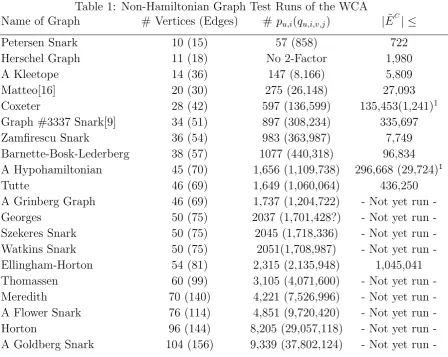
Over 100 non-Hamiltonian graphs (10 through 104 vertices) and 2000 randomized 31 vertex non-Hamiltonian graphs are tested and correctly decided non-Hamiltonian via the WCA, coded in F77, run on a Mac Mini Desktop using Absoft Fortran 13.01. A summary set of details for 20 of these graphs are shown in table 1 below2. The heading #
pu,i(qu,i,v,j) refers to the count of non-zero components inQafter implementing Algorithm
refalg:ExcSets, before implementing the WCA. Note that pu,i =qu,i,u,i, and we only count
qu,i,v,j i < j. The heading|E˜
C
| ≤refers to an upper bound on|E˜C|for 11 selected graphs, each modified to include the tour 1−2−...−n−n+ 1, simply to observe ˜EC. Two of these graphs are also hypohamiltonian, and the count in parentheses is an upper bound on|open(V)| after removing a vertex.
Table 1: Non-Hamiltonian Graph Test Runs of the WCA Name of Graph # Vertices (Edges) # pu,i(qu,i,v,j) |E˜
C
| ≤
Petersen Snark 10 (15) 57 (858) 722 Herschel Graph 11 (18) No 2-Factor 1,980 A Kleetope 14 (36) 147 (8,166) 5,809 Matteo[16] 20 (30) 275 (26,148) 27,093 Coxeter 28 (42) 597 (136,599) 135,453(1,241)1
Graph #3337 Snark[9] 34 (51) 897 (308,234) 335,697 Zamfirescu Snark 36 (54) 983 (363,987) 7,749 Barnette-Bosk-Lederberg 38 (57) 1077 (440,318) 96,834 A Hypohamiltonian 45 (70) 1,656 (1,109,738) 296,668 (29,724)1 Tutte 46 (69) 1,649 (1,060,064) 436,250 A Grinberg Graph 46 (69) 1,737 (1,204,722) Not yet run -Georges 50 (75) 2037 (1,701,428?) Not yet run -Szekeres Snark 50 (75) 2045 (1,718,336) Not yet run -Watkins Snark 50 (75) 2051(1,708,987) Not yet run -Ellingham-Horton 54 (81) 2,315 (2,135,948) 1,045,041 Thomassen 60 (99) 3,105 (4,071,600) Not yet run -Meredith 70 (140) 4,221 (7,526,996) Not yet run -A Flower Snark 76 (114) 4,851 (9,720,420) Not yet run -Horton 96 (144) 8,205 (29,057,118) Not yet run -A Goldberg Snark 104 (156) 9,339 (37,802,124) Not yet run
-1 Hypohamiltonian. We also confirmed existence of non-empty ˜EC after removing a vertex and
5.1
About Tweaking Input to the WCA
Plenty of special case graphs exist for which some pre-processing may help improve run-times. For example, if G is undirected and Hamiltonian, G can be made directed by deleting an arc in one direction, and remains Hamiltonian. Some arcs may be better candidates for deletion than others re: performance. Assuming that the WCA can’t always close E for non-Hamiltonian G (otherwise P=NP), a lucky choice of arc might also cause E to close where it did not originally close.
For three regular undirected Hamiltonian graphs, we can choose a vertex and delete an edge (two arcs in opposite directions). Two degree two vertices result. If G remains Hamiltonian, we can again impose direction through one of these vertices, causing six arcs to be deleted (improved performance) and this directed graph remains Hamiltonian. Repeating this process for each of three edges, it must be the case thatE cannot close for at least one of these cases, otherwise G is non-Hamiltonian. Thus for non-Hamiltonian
G, we can hope that for the right choice of vertex, in all three casesE becomes closed i.e. deciding non-Hamiltonicity. For each of these three cases, we can also impose direction in two different ways, on the second degree two vertex. This causes up to six more arcs to be deleted for each way. For non-Hamiltonian G, we hope that E becomes closed for each way, for each of three cases, for a lucky choice of vertex. Note that we performed and validated these tests and ideas for the Petersen graph (non-Hamiltonian), and the Petersen graph with an extra edge (Hamiltonian).
5.2
About Generalizing the WCA
As currently implemented, the WCA tests all {pu,i, pv,j} to be at 0/1 level. In general, p
variables can be triples, quadruples and so on. A generalized WCA involves testing all generalized p variables e.g. {pu,i, pv,j, pw,k} or {pu,i, pv,j, pw,k, px,l} to be at 0/1 level etc.,
invoking higher order models until there are as many variables as permutations. Low order implementations might be useful for some classes of non-Hamiltonian graphs, assuming there exist useful complexity bounds regarding the amount of computation sufficient to
guarantee collapse of corresponding polyhedra. We note that higher order models capture increasingly more intricate and specialized information. For example, if we deduce that
{pu,i, pv,j, pw,k} = 0, we interpret that there are no cycles for which the ith arc enters
vertex u and the jth arc enters vertex v and the kth arc enters vertex w. This suggests
an approach toward building tough counter examples for the WCA i.e. construct a graph that is dense with little pieces of paths whose corresponding variables are not linearly dependent. To be clear, in the General Case of Algorithm 1, fewer variables are set zero
2In addition the those graphs listed in Table 1, the WCA closed 10 more varieties of Goldberg, Flower,
if we detect shortest paths of low length. While the structure of the graph decides how equations relate variables to one another, at face value, this might be a good working rule.
5.2.1 How to Create an Exclusion Set That Models the Graph non-Isomorphism Decision Problem
From [25], ‘These [modelling] techniques might be applicable to the graph isomorphism [decision] problem. Recall that graph G is isomorphic to graph H if and only if there exists permutation matrix P such that PTGP = H ... to investigate the possibility of modelling the set of permutations satisfying either PTGP = H or PTGP 6= H.’. We can create E as follows. Construct PTGP = H i.e. the set of n2 equations composed of
sums of products of pairs of components of P, their sum being either 0 or 1, depending on H. Each term of the form pu,i·pv,j in each of the equations set zero is non-negative
and must therefore be at zero level in every solution of PTGP =H. Define E as the set
of corresponding {pu,i, pv,j}. It must be the case that for each {pu,i, pv,j}, either pu,i = 0
or pv,j = 0 or pu,i = pv,j = 0 in System 2 i.e. assign qu,i,v,j = pu,i ·pv,j. Recall that by
assigning corresponding qu,i,v,j = 0 in System 2, precisely those P solutions of System 2
satisfying qu,i,v,j = pu,i·pv,j = pu,i = pv,j = 1 are excluded. The complement set of P
solutions of System 2 is therefore the set of all possible P that map precisely all zeroes of
G to all zeroes of H. But if P exists, PTGP must also preserve the arc count of G, by
definition and it therefore follows that, if P is a solution of System 2 thenPTGP =H i.e. ifPTGP 6=H, there exists noP solution of System 2. ThusEis sufficient to exclude allP
solutions to System 2. These ideas follow directly from study of a proposed model of the graph non-isomorphism problem. That is, the set of extrema of a compact formulation of the union of sets of Birkhoff polyhedra, each polytope the solution set of assignment constraints in correspondence with each assignment of pu,i = pv,j = 1 (using projection
and lifting techniques) are not solutions of Systems 2.
5.3
About the WCA Terminating With a Feasible LP for
non-Hamiltonian
G
In these cases, the LP can be made infeasible by choosing additionalqu,i,v,j variables to be
set zero where the goal of the WCA is now proposed as a tool to verify non-Hamiltonicity. For example, choose a row/column of matrix Q for which many of the qu,i,v,j variables
have already been set zero and begin to hopefully ‘set in motion’ a remaining cascade of additional qu,i,v,j variables that become zero, via application of the WCA. There may
exist a ‘best way’ to do this no matter that the problem remains to confirm that the set of additional qu,i,v,j variables that we choose to set zero in fact can be verified zero via some
be used as a tool to provide hints about additional qu,i,v,j variables to be investigated and
‘a priori’ set zero. That is, while not originally included inE, if discovered, they can now be included and application of the WCA terminates infeasible. This revised set of input constitutes ‘a polynomial sized set of correctly guessed information’ necessary to verify a correctly guessed non-Hamiltonion G in polynomial time. This amounts to studying a
coNP-complete problem inO(n4) variables as a set of smaller instances of ‘core’ (relative
to the WCA) coNP-complete problems in the case of verifying a correctly guessed set of variables to be set zero.
More generally, knowing that E ≡E˜ ≡E¯ =P, it follows that P erm( ˜E) is the set of all
P. Therefore P ermC( ˜E) = ∅ and by application of the converse of Lemma 2.2, ˜EC ≡ ∅
and therefore covers no P. A general approach toward resolving the existence of a cover of P is to assume it exists and show a contradiction, like the WCA, however possible. Maybe after application of the WCA, the problem is reduced in a way that can yield other insights. One thought is to model the new problem as a smaller instance of non-Hamiltonicity and re-apply the WCA. But this ‘recursive’ approach might simply devolve into an exhaustive technique.
We now comment thatC7−21 [7] is a non-Hamiltonian graph for which, after application of the WCA we discover that E= ˜E and the WCA terminates with a feasible LP i.e. no matter that we know E ≡ P, the WCA can deduce no additional q variables to be set zero. Note that C7−21 is an undirected 21 vertex graph. It’s composed of a 14 vertex complete graph, and seven wheels. Each of vertices 15 through 21 is the centre of a wheel adjacent to vertices one through seven. The minimum vertex degree is seven.
5.4
Next Steps
5.4.1 State Matrices
Perhaps a more general way to study the WCA, applicable to all of the ideas that we present is to view the Q matrix in Figure 2 as a state matrix. The problem then is to create and study the WCA, including higher order implementations of the WCA, as generating a sequence of states. Properties of these state sequences may be predictive of certain kinds of outcomes e.g. whether or not a final state of a zeroed Q matrix can be expected etc. This depends upon the complexity of generating new states that can be recognized as deciding the problem. The idea of investigating recurrence relations between states might also be useful etc., the goal being to recognize / test each state re: deciding Hamiltonicity.
5.4.2 Upper Bounds
Understanding|E|relative to both the WCA (closure) and classes of non-HamiltonianG
is important. Can we associate classes of non-Hamiltonian graphs, |E| and a guarantee of closure? Can we associate classes of non-Hamiltonian graphs with the complexity of computing additional components of E necessary to guarantee closure? How should we study the relationship between E, non-Hamiltonian G and the WCA? We propose a structured set of tests of the WCA using large randomized classes of non-Hamiltonian graphs with the intent of establishing some highly probable upper bounds on |E| and a guarantee of closure.
5.4.3 Efficiency
It would be important to investigate other techniques that decide non-Hamiltonicity and compare them to the WCA as currently implemented and also higher order implementa-tions. We can begin these comparisons by studying patterns of successes and failures i.e. the hope is to gain insight about a theory to develop a more robust WCA-like technique. This could involve studies of 1) counter-examples, or 2) three regular graphs (counter examples and successes), or 3) subsets of graphs e.g. snarks etc. We propose the con-struction of a large set of non-Hamiltonian G for some class of graphs e.g. snarks, and compute, tabulate and organize in some way, minimal|E|sufficient for the WCA to close
E for comparison to other methods that decide non-Hamiltonicity. It may be necessary to create computer code that dynamically generalizes the WCA via increased nesting of assignment polyhedra (leading to higher order |E|) as discussed above.
5.4.4 The WCA in Another Context
the Hamilton cycle decision problem using pi,j,k variables and triply stochastic matrices
defined in a suitable way, where k is the sequence position of arc (i, j) in a cycle. This is a more natural way to understand cycles using permutations. We can again code information about missing arcs and paths from its coNP counter model and create a corresponding WCA. Maybe there exists an insightful relationship to three regular graphs, another approach toward study of NP-completeness.
5.5
Closing Remarks
There is one final thought to be appreciated that captures the large view of our intent to study coNP. There exists an underlying recursive relationship between the n2 −2n+ 1
dimensional Birkhoff polytope and its sub-polytope, the n2 −3n + 2 dimensional TSP
polytope. The set of extrema of the TSP polytope is the set of Hamilton cycles of a complete n vertex graph, and is a sub-polytope of the Birkhoff polytope whose set of extrema is the set of all n-permutations. But these permutations, via the ideas presented in this paper are in correspondence with the set of all Hamilton cycles of a complete
n+ 1 vertex graph, whose convex hull after mapping back to cycles as presented at the outset, is the set of extrema of the TSP polytope of a complete graph on n+ 1 vertices, a sub-polytope of the Birkhoff polytope whose set of extrema is the set of all (n+ 1)-permutations. But these permutations (via the ideas presented in this paper) are in correspondence with the set of all Hamilton cycles of a complete n+ 2 vertex graph, whose convex hull after mapping back to cycles is the set of extrema of the TSP polytope of a complete graph on n+ 2 vertices, a sub-polytope of the Birkhoff polytope whose set of extrema is the set of all (n+ 2)-permutations, and so on. If we imagine that the Birkhoff polytope isthe example of symmetry and tractability while the TSP polytope is
Input: ( ˜LP, ˜E, ˜Q, ˜F)
Output: (Decision, ˜LP, ˜E, ˜Q, ˜F)
while (not true that lines 1 or 2 return ‘Infeasible’ or ‘Feasible Integer Solution’)
do
Top p;
for k, l= 1,2, ..., n;do
Pk,l ←1;
if q˜k,l,kl = ˜pk,l = 0 then
Pk,l ← 0; ˜LP ←LP˜ and {Q˜ ←q˜k,l,∗,∗ ←0}; ˜E ←E˜ ∪ {p˜k,l,p˜∗,∗};
end end
if Match(P) then
Top q;
foreach {p˜u,i,p˜v,j} ∈ P\E˜\F˜ do 1 Maximize ˜qu,i,v,j subject to ˜LP;
if M ax <1 then
Assign q˜u,i,v,j = 0≡ {LP˜ ←LP˜ and {Q˜ ←q˜u,i,v,j ←0};
˜
E ←E˜∪ {p˜u,i,p˜v,j}};
goto Top q;
else
2 Minimize ˜qu,i,v,j subject to ˜LP;
if M in >0 then
Assign q˜u,i,v,j = 1(u, i, v, j, ˜LP, ˜E, ˜Q,F˜);
goto Top p;
end end
˜
qu,i,v,j attains 0 and 1 in Feasible Fractional Solutions of ˜LP.;
end
All ˜qu,i,v,j attain 0 and 1 in Feasible Fractional Solutions of ˜LP.;
RETURN Feasible Fractional Solution, ˜LP, ˜E, ˜Q, ˜F
else
RETURN Infeasible, ˜LP, ˜E, ˜Q, ˜F
end end
if (true that lines 1 or 2 return ‘Infeasible’ or ‘Feasible Integer Solution’) then
RETURN Feasible Integer Solution, ˜LP, ˜E, ˜Q, ˜F
else
RETURN Infeasible, ˜LP, ˜E, ˜Q, ˜F
end
Input: (u, i, v, j,LP˜˜ , E˜˜, Q˜˜, F˜˜)
Output: (LP˜˜ , E˜˜, Q˜˜, F˜˜) ˜
˜
LP ←LP˜˜ and Q˜˜ ←q˜˜u,i,v,j ←1;F˜˜ ←F˜˜∪ {p˜˜u,i,p˜˜v,j};
˜ ˜
LP ←LP˜˜ and Q˜˜ ←q˜˜u,i,u,i= ˜p˜u,i ←1;LP˜˜ ←LP˜˜ and Q˜˜ ←q˜˜v,j,v,j = ˜p˜v,j ←1;
begin ‘Zero’ blocks in block rowsu & v inQ˜˜ EXCEPT blocks [u, i] & [v, j].
{LP˜˜ ←LP˜˜ and {Q˜˜ ←q˜˜u,l,∗,∗ ←0 & ˜p˜u,l←0}, E˜˜ ←E˜˜∪ {p˜˜u,l,p˜˜∗,∗},
l = 1,2, ..., n, l6=i};
{LP˜˜ ←LP˜˜ and {Q˜˜ ←q˜˜∗,∗,v,l ←0 & ˜p˜v,l ←0},E˜˜ ←E˜˜∪ {p˜˜∗,∗,p˜˜v,l},
l = 1,2, ..., n, l6=j};
end
begin ‘Zero’ blocks in block columns i & j inQ˜˜ EXCEPT blocks [u, i] & [v, j].
{LP˜˜ ←LP˜˜ and {Q˜˜ ←q˜˜l,i,∗,∗ ←0 & ˜p˜l,i←0}, E˜˜ ←E˜˜∪ {p˜˜l,i,p˜˜∗,∗},
l = 1,2, ..., n, l6=u};
{LP˜˜ ←LP˜˜ and {Q˜˜ ←q˜˜∗,∗,l,j ←0 & ˜p˜l,j ←0}, E˜˜ ←E˜˜∪ {p˜˜∗,∗,p˜˜l,j},
l = 1,2, ..., n, l6=v};
end
begin ‘Zero rows u& v in blocks [u, i] & [v, j] EXCEPT components [u, i] & [v, j].
{LP˜˜ ←LP˜˜ and {Q˜˜ ←q˜˜u,l,v,j ←0, E˜˜ ←E˜˜∪ {p˜˜u,l,p˜˜v,j},l = 1,2, ..., n, l6=i}; {LP˜˜ ←LP˜˜ and {Q˜˜ ←q˜˜u,i,v,l ←0,E˜˜←E˜˜∪ {p˜˜u,i,p˜˜v,l},l = 1,2, ..., n, l6=j};
end
begin ‘Zero columns i & j in blocks [u, i] & [v, j] EXCEPT components [u, i] & [v, j].
{LP˜˜ ←LP˜˜ and {Q˜˜ ←q˜˜l,i,v,j ←0, E˜˜ ←E˜˜∪ {p˜˜l,i,p˜˜v,j}, l = 1,2, ..., n,l 6=u}; {LP˜˜ ←LP˜˜ and {Q˜˜ ←q˜˜u,i,l,j ←0, E˜˜ ←E˜˜∪ {p˜˜u,i,p˜˜l,j}, l= 1,2, ..., n, l 6=v};
end
RETURN LP˜˜ ,E˜˜, Q˜˜, F˜˜
Input: (LP˜˜ ,E˜˜, Q˜˜, F˜˜)
Output: (Decision,LP˜˜ , E˜˜,Q˜˜, F˜˜)
while (not true that lines 1 or 2 return ‘Infeasible’ or ‘Feasible Integer Solution’)
do
Top p;
for k, l= 1,2, ..., n;do
Pk,l ←1;
if q˜˜k,l,kl = ˜p˜k,l = 0 then
Pk,l ← 0; LP˜˜ ←LP˜˜ and {Q˜˜ ←q˜˜k,l,∗,∗ ←0};E˜˜ ←E˜˜ ∪ {p˜˜k,l,p˜˜∗,∗};
end end
if Match(P) then
Top q;
foreach {p˜˜u,i,p˜˜v,j} ∈ P\E˜˜\F˜˜ do 1 Maximize ˜q˜u,i,v,j subject to LP˜˜ ;
if M ax <1 then
Assign q˜˜u,i,v,j = 0≡ {LP˜˜ ←LP˜˜ and {Q˜˜ ←q˜˜u,i,v,j ←0};
˜ ˜
E ←E˜˜∪ {p˜˜u,i,p˜˜v,j}};
goto Top q;
else
2 Minimize ˜q˜u,i,v,j subject toLP˜˜ ;
if M in >0 then
Assign q˜˜u,i,v,j = 1(u, i, v, j,LP˜˜ , E˜˜, Q,˜˜ F˜˜);
goto Top p;
end end
˜ ˜
qu,i,v,j attains 0 and 1 in Feasible Fractional Solutions of LP˜˜ .;
end
All ˜q˜u,i,v,j attain 0 and 1 in Feasible Fractional Solutions of LP˜˜ .;
RETURN Feasible Fractional Solution, LP˜˜ ,E˜˜, Q˜˜, F˜˜
else
RETURN Infeasible, LP˜˜ ,E˜˜, Q˜˜, F˜˜
end end
if (true that lines 1 or 2 return ‘Infeasible’ or ‘Feasible Integer Solution’) then
RETURN Feasible Integer Solution, LP˜˜ , E˜˜,Q˜˜, F˜˜
else
RETURN Infeasible, LP˜˜ ,E˜˜, Q˜˜, F˜˜
end
Input: (u, i, v, j, ˜LP, ˜E, ˜Q, ˜F)
Output: ( ˜LP, ˜E, ˜Q, ˜F) ˜
LP ←LP˜ and Q˜ ←q˜u,i,v,j ←1; ˜F ←F˜∪ {p˜u,i,p˜v,j};
˜
LP ←LP˜ and Q˜ ←q˜u,i,u,i= ˜pu,i ←1; ˜LP ←LP˜ and Q˜ ←q˜v,j,v,j = ˜pv,j ←1;
begin ‘Zero’ blocks in block rowsu & v in ˜Q EXCEPT blocks [u, i] & [v, j].
{LP˜ ←LP˜ and {Q˜ ←q˜u,l,∗,∗ ←0 & ˜pu,l←0}, ˜E ←E˜∪ {p˜u,l,p˜∗,∗},
l = 1,2, ..., n, l6=i};
{LP˜ ←LP˜ and {Q˜ ←q˜∗,∗,v,l ←0 & ˜pv,l ←0}, ˜E ←E˜∪ {p˜∗,∗,p˜v,l},
l = 1,2, ..., n, l6=j};
end
begin ‘Zero’ blocks in block columns i & j in ˜Q EXCEPT blocks [u, i] & [v, j].
{LP˜ ←LP˜ and {Q˜ ←q˜l,i,∗,∗ ←0 & ˜pl,i←0}, ˜E ←E˜∪ {p˜l,i,p˜∗,∗},
l = 1,2, ..., n, l6=u};
{LP˜ ←LP˜ and {Q˜ ←q˜∗,∗,l,j ←0 & ˜pl,j ←0}, ˜E ←E˜∪ {p˜∗,∗,p˜l,j},
l = 1,2, ..., n, l6=v};
end
begin ‘Zero rows u& v in blocks [u, i] & [v, j] EXCEPT components [u, i] & [v, j].
{LP˜ ←LP˜ and {Q˜ ←q˜u,l,v,j ←0, ˜E ←E˜∪ {p˜u,l,p˜v,j},l = 1,2, ..., n, l6=i}; {LP˜ ←LP˜ and {Q˜ ←q˜u,i,v,l ←0, ˜E ←E˜∪ {p˜u,i,p˜v,l},l = 1,2, ..., n, l6=j};
end
begin ‘Zero columns i & j in blocks [u, i] & [v, j] EXCEPT components [u, i] & [v, j].
{LP˜ ←LP˜ and {Q˜ ←q˜l,i,v,j ←0, ˜E ←E˜∪ {p˜l,i,p˜v,j}, l = 1,2, ..., n,l 6=u}; {LP˜ ←LP˜ and {Q˜ ←q˜u,i,l,j ←0, ˜E ←E˜∪ {p˜u,i,p˜l,j}, l= 1,2, ..., n, l 6=v};
end
RETURN ˜LP, ˜E, ˜Q, ˜F
Routine 4: Assign ˜qu,i,v,j = 1
References
[1] S. Aaronson, Is P versus NP formally independent?, Bull. Eur. Assoc. Theor.
Comput. Sci., 81 (2003).
[3] D. Applegate, R. Bixby, V. Chv`atal, and W. Cook, TSP cuts which do not conform to the template paradigm., Computational Combinatorial Optimization. Schlofl Dagstuhl 2000. Lecture Notes in Computer Science. Springer Berlin, 2241 (2001), pp. 261–303.
[4] D. Applegate, R. Bixby, V. Chv`atal, and W. Cook, Implementing the Dantzig-Fulkerson-Johnson algorithm for large traveling salesman problems, Math. Prog. Ser. B. ISMP 2003 Copenhagen, 97 (2003), pp. 91–153.
[5] D. Applegate, R. Bixby, V. Chv`atal, and W. Cook, The Traveling Sales-man Problem: A Computational Study, Princeton Series in Applied Mathematics, Princeton University Press, Princeton, NJ, 2006.
[6] L.J. Billera and A. Sarangarajan, All 0/1 polytopes are traveling salesman polytopes, Combinatorica, 16 (1996), pp. 175–188.
[7] J.A. Bondy,Graph theory, Graduate texts in mathematics 244, Springer, New York,
2008.
[8] R.V. Book, Relativizations of the P =? NP problem and other problems: some developments in structural complexity theory, Algorithms and Computation. Lecture Notes in Computer Science. Springer Verlag. Nagoya, 650 (1992), pp. 175–186.
[9] G. Brinkmann, K. Coolsaet, J. Goedgebeur, and H. Melot, House of Graphs: a database of interesting graphs, Discrete Applied Mathematics. Available at http://hog.grinvin.org, 161 (2013), pp. 311–314.
[10] M. Conforti and L. Wolsey, Compact formulations as a union of polyhedra, Math. Prog. Ser. A, 114 (2008), pp. 277–289.
[11] S. Cook, Website of: Clay Mathematics Institute. The
P versus N P problem. Retrieved January 31, 2013,
http://www.claymath.org/millennium/P vs NP/pvsnp.pdf, (2006).
[12] M. Demers and S.J. Gismondi, Enumerating facets of Q0/1, Util. Math., 77
(2008), pp. 125–134.
[13] David Deutsch, Quantum theory, the church-turing principle and the universal quantum computer, Proceedings of the Royal Society of London. A. Mathematical and Physical Sciences, 400 (1985), pp. 97–117.
[15] M.N. Ellingham and J. D. Horton,Non-hamiltonian 3-connected cubic bipartite graphs, Journal of Combinatorial Theory Series B, 34 (2003), pp. 350–353.
[16] Mathematics Stack Exchange,graph6 string: Sspp?wc g ?w?o???i???ag?bo?g. Retrieved May 7, 2016, http://math.stackexchange.com/questions/367671/smallest-nonhamiltonian-3-connected-graph-with-chromatic-index-3, (2016).
[17] M. Ferrara, M. S. Jacobson, and J. S. Powell, Characterizing degree-sum maximal nonhamiltonian bipartite graphs, Discrete Math, 312 (2012), pp. 459–461.
[18] S. Fiorini, S. Masser, S. Pokutta, H. R. Tiwary, and R. de Wolf, Lin-ear vs. semidefinite extended formulations: exponential separation and strong lower bounds, Proc. 44th symposium on Theory of Computing, (2012), pp. 95–106.
[19] Lance Fortnow,The status of the p versus np problem, Commun. ACM, 52 (2009),
pp. 78–86.
[20] , The Golden Ticket: P, NP, and the Search for the Impossible, Princeton Series in Applied Mathematics, Princeton University Press, Princeton, NJ, 2013.
[21] M.R. Gary, D.S. Johnson, and R.E. Tarjan, The planar hamilton circuit problem is np-complete, SIAM J. Comput., 5 (1976), pp. 704–714.
[22] J. P. Georges, Non-hamiltonian bicubic graphs, Journal of Combinatorial Theory
Series B, 46 (1989), pp. 121–124.
[23] S.J. Gismondi,AnO(n3)sized external representation of a factorial faceted factorial extreme point polytope, Util. Math., 63 (2003), pp. 109–114.
[24] , Subgraph isomorphism and the Hamilton tour decision problem using a
lin-earized form of P GPt, Util. Math., 76 (2008), pp. 229–248.
[25] , Modelling decision problems via birkhoff polyhedra, Journal of Algorithms and Computation, 44 (2013), pp. 61–81.
[26] S.J. Gismondi and E.R. Swart,A factorial faceted, factorial extreme point poly-tope crafted from the assignment polypoly-tope, Util. Math., 60 (2001), pp. 181–192.
[27] , A model of the coNP-complete non-Hamilton tour decision problem, Math.
Prog. Ser. A, 100 (2004), pp. 471–483.
[29] D.S. Johnson, The NP-completeness column: An ongoing guide, J. Algorithms, 8
(1987), pp. 438–448.
[30] , The NP-completeness column: An ongoing guide, J. Algorithms, 13 (1992),
pp. 502–524.
[31] E.L. Lawler, J.K. Lenstra, A.H.G. Rinnooy Kan, and Shmoys D.B., The Traveling Salesman Problem, John Wiley and Sons, New York, 1985.
[32] R. Lipton, Website of: Gdel?s Lost Letter and P=NP. How not
to prove integer factoring is in P. Retrieved January 30, 2013,
http://rjlipton.wordpress.com/2012/09/26/how-not-to-prove-integer-factoring-is-in-p/, (2012).
[33] R. Lipton and K. Regan, Website of: Gdel?s Lost Letter
and P=NP. Barriers to P=NP proofs. Retrieved December 3, 2012,
http://rjlipton.wordpress.com/2012/11/29/barriers-to-pnp-proofs/, (2012).
[34] P. V. Roldugin, Construction of maximally non-hamiltonian graphs (Russian). Translation, Discrete Math. Appl., 13 (2003), pp. 277–289.
[35] , On the number of maximally non-hamiltonian graphs. (Russian). Translation, Math. Notes, 75 (2004), pp. 652–659.
[36] Alexander Schrijver, Combinatorial optimization: polyhedra and efficiency,
vol. 24, Springer, 2003.
[37] Peter W Shor, Algorithms for quantum computation: discrete logarithms and fac-toring, in Foundations of Computer Science, 1994 Proceedings., 35th Annual Sym-posium on, IEEE, 1994, pp. 124–134.
[38] , Polynomial-time algorithms for prime factorization and discrete logarithms on a quantum computer, SIAM Journal on Computing, 26 (1997), pp. 1484–1509.
[39] M. Sipser, The history and status of the P versus NP question, Proc. 24th Annual
ACM STOC., (1992), pp. 603–618.
[40] , Beyond computation: The p vs np problem. website
of: Clay Math Public Lectures. Retrieved January 20, 2014,
[41] L. Stacho,Non-isomorphic smallest maximally non-hamiltonian graphs, Ars
Com-bin., 48 (1998), pp. 307–317.
[42] Eric W. Weisstein, Website of: Wolfram
Math-World, Nonhamiltonian graph. Retrieved December 23, 2012,
http://mathworld.wolfram.com/NonhamiltonianGraph.html, (2012).
[43] G.J. Woeginger, Website of: Gerhard J Woeginger, The P-versus-NP page. Re-trieved November 7, 2012, http://www.win.tue.nl/ gwoegi/P-versus-NP.htm, (2012).
[44] J. Zaks,Non-hamiltonian non-grinbergian graphs, Discrete Mathematics, 17 (1977),