*Corresponding author.
Email address: [email protected]
DOI: 10.22051/JITF.2018.17746.1012
Transparency of overdense plasma with V shape density profile
S. O. Mirabootalebi1*, S. Miraboutalebi 2, S. Rajaei3
1Faculty of Engineering, Shahid Bahonar University of Kerman, Kerman, I. R. Iran
2
Physics Department, Islamic Azad University, North Tehran Branch, Tehran, I. R. Iran
3
Physics Department, Qom University, Qom, I. R. Iran
ARTICLE INFO ABSTRACT
Article history:
Received 30 October 2017 Revised 24 February 2018 Accepted 11 March 2018 Available online 18 March 2018
Keywords: Over dense plasma Surface wave Linear density Stratified plasma slab Anomalous transmission
In this study, we investigate the transparency of an over-dense inhomogeneous plasma slab. This anomalous transmission is achieved when the conditions are provided for the incident electromagnetic wave to excite coupled surface waves on both sides of the slab. These conditions require that the homogeneous overdense plasma, or the metallic film, is placed between two dielectric layers. Here, the inhomogeneity of the plasma allows us to naturally establish the conditions by considering a specific shape for the geometry of the density profile. Within this profile, the density linearly grows up from both sides of the slab while the corresponding dielectric permittivity simultaneously gains negative values. We obtain the exact solutions of the wave equations inside the plasma and study the conditions for high transparency. The transmission losses due to the collision effects are also discussed.
1 Introduction
In recent years, there has been a growing interest on the optical properties of the left handed materials (LHM). These materials have negative dielectric permittivity and permeability that include metallic films and dense plasma layers [1]-[4]. These structures have novel properties in many fields of science and technology, for example; supper lenses and sub-wavelength lithography [5]-[8], invisible coatings [9]-[14], Faraday rotation [15], plasma heating [16], and plasmons resonant absorption [17]-[18].
Media with negative dielectric permittivity are generally opaque to the electromagnetic waves. However, under resonant conditions, these structures become totally transparent. Many experimental and theoretical studies have been devoted to understand the interaction of electromagnetic waves with these
materials. The investigations show that the anomalous transmission of the waves takes place in these materials because of the amplification of the evanescent waves by the excitation of the surface plasmons [19]. An incident ordinary electromagnetic wave cannot excite plasmons, however the evanescent electromagnetic waves can excite them. The diffracting gratings can be used to produce the evanescent waves and allow the excitation of plasmons [20]. However, applying the mechanism of total internal reflection of a near boundary inhomogeneity of the dielectric permittivity can provide the required evanescent waves [21].
94 to be placed between two dielectric layers (with
0). This structure is also equipped with two prism on both sides. The incident electromagnetic wave on this symmetric structure of prism, positive dielectric and metallic film, is reflected at the prism dielectric boundary. The electromagnetic wave then becomes evanescent within the dielectric layer and the conditions for the excitation of the surface waves on the interface between the dielectric and the metallic film are fulfilled. The surface waves excite simultaneously on both sides of the slab and transfer the energy of the incident electromagnetic wave trough the metallic film. In these studies, the dielectrics and the metallic film are considered as homogeneous mediums with constant dielectric permittivity which are changed discontinuously at the interfaces.
Here, we consider the inhomogeneous plasma layers which play effectively the role of both dielectric and the metallic films. We show that by imposing a specific spatial geometry for the density of the plasma layers, the conditions for the anomalous light transmission can be achieved. We consider a geometry of the density profile of the plasma in which the dielectric permittivity linearly and continuously decreases from a positive value to a negative value. If this reduction takes place from both sides of the slab, the surface waves simultaneously excite from both sides. Consequently, the energy of the incident electromagnetic wave is carried out from the slab. The geometry we apply here on the density of the plasma also has been considered in our previous work [23]. The behavior of the surface waves and the distribution of the electric field inside the plasma medium have been discussed there. Here, we study the suitable conditions for the anomalous transmission and the high transparency of the slab. In this regards, we calculate the transmission and the reflection amplitudes from the entire structure and discuss the main parameters involved in the high transparency conditions of the slab.
The organization of this paper is as follows: The fundamental equations are studied in section two. The proposed density profile is modeled in section three. In section four, the anomalous transmission of the electromagnetic waves through the entire slab is obtained and discussed. Finally, section five presents the results.
2 The Model
We consider a plane monochromatic wave of frequency , incident to a layer of inhomogeneous cold plasma layer immersed in vacuum. In the plasma layer, the electromagnetic fields and and the velocity obey the following linearized set of fluid-Maxwell equations:
, (1)
4 1 , (2)
́ . (3)
Here is the plasma density which depends on the coordinate where ́ denotes the collision frequency. Considering the time dependency of the field equations as #$%&, from Eq. (1)-(3), the wave equation becomes:
. ' 0 , (4)
where ' %( and is the effective dielectric permittivity of the plasma defined as:
1 %)*
+ %* , , 1 - , (5)
and %.́. We assume that the ions are motionless and / 0123 4 5*
6 is the plasma frequency while and are the charge and the mass of the electron. Letting the -coordinate into the plasma layer and 7 and 8 running along the interface, we consider the variation of all physical quantities as 9 $:;< where
'< ' sin @ and @ is the incident angle. In this case, for a p-polarized wave specified with 0,0, A , Eq. (4) yields:
B A
B ' C sin @D A 0 (6)
3 The dielectric permittivity profile
95 / and 0. In these cases, the plasma behaves as a LHM medium and is normally opaque for the incident electromagnetic wave. However, it has been shown that the layer could become totally transparent by fulfilling the condition for the propagating the incident wave to excite coupled surface modes or plasmons, at the surface of the layer. In fact, plasmons are trapped surface modes propagating along the interfaces between two media with different permittivity sign such as a dielectric-metal boundary.
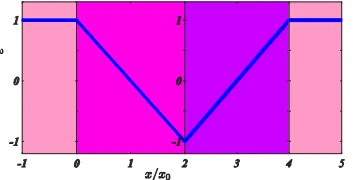
Here, we study the electromagnetic waves transmission of an inhomogeneous plasma layer. The required dielectric layers can be provided by the plasma layer itself. We suppose that the plasma gradually obtains negative dielectric permittivity. According to Fig. (1), the dielectric permittivity decreases from E F, to negative values equal to - F.
Fig. 1. The profile of the effective dielectric permittivity E as a
function of position G
GH.
Then in order to provide the conditions for the excitation of the coupled surface modes, E symmetrically grows up to the positive values and reaches E F at the rear side of the slab. In this way, the layer behaves as an ordinary dielectric media with E H for H G GH and IGH G JGH where GH is a characteristic length. However, for GH G IGH we have an LHM media, namely E H. The dielectric profile has the following form:
K 13 / ,/ , 20 24 . (7)
In region 0 2 the wave equation (Eq. (6)) becomes:
B A
B ' Ccos @ , DA 0 . (8)
Put:
Q R, S'
T U
, cos , (9)
Eq. (8) becomes:
B A Q
BQ QA Q 0 . (10)
Solutions of this equation is given by the Airy functions of the first kind (V-) and the second kind (W-) which can be written as follows:
A Q XTV- Q X W- Q , (11)
where X$’s are constants.
In region 2 4 , one finds a similar wave equation for the variable:
Y R, S'
T U
, cos @ 4 , (12)
with solutions:
A Y ZTV- Y Z W- Y , (13)
where Z$’s are another integration constants.
4 The anomalous transmission
Consider the dielectric permittivity profile according to the geometry of Fig. 1. The field components in the plasma region are given by Eqs. (11) and (13) for regions H G [GH and [GH G JGH, respectively. Hence, the constant parameters \]’s and ^]’s give the electric field amplitudes in these regions. The field component in the vacuum regions G H is given by:
A A $4:3_`a b c #$4:3_`a b , (14) where A and c denote the incident and the reflected field amplitudes, respectively. For the vacuum region, at the rear side of the slab, namely for 4 , the field component becomes:
A d $4:3_`a b , (15)
96 all boundaries of Fig. 1. By matching the solutions at the boundaries, a system of six equations can be obtained for the unknown coefficients. By solving the equations, the field amplitudes in all regions can be determined in terms of the incident wave amplitude A . At the first boundary, located at 0 one finds:
gAA cc -hiXXTV- Q X W- Q ,
TVj- Q X Wj- Q k , (16)
where the prime sign indicates the differentiation with respect to the argument of the function, also:
h icos @ ,' T/Uk#T , (17)
Q h ,1 (18)
where Q denotes the amount of Q given in Eq.(9), at 0, namely Q Q 0 . On the second boundary ( 2 ), we have:
g XXT ZT V- Q Z X W- Q ,
T ZT Vj- Q Z X Wj- Q ,
(19) where:
Q R', S
T/U
, l, @ 2 , (20)
and Q Q 2 Y 2 . Also at the third boundary ( 4 ), the boundary conditions are: g ZTV- Q Z W- Q d 0$:343_`a b ,
-hiZTVj- Q Z Wj- Q k d 0$:343_`a b , (21)
here we also have Y 4 Q . By solving Eqs. (16), (19) and (21) the unknown coefficients X$, Z$, d and, c can be found. The results are presented in the figures.
Fig. 2. The electric field distribution m
Hm [
as a function of the
position G
GHfor four different values of the incident angl n.
Figure 2 shows the electric field distribution mff
3m as a
function of 44
3 for different incident angle @. This
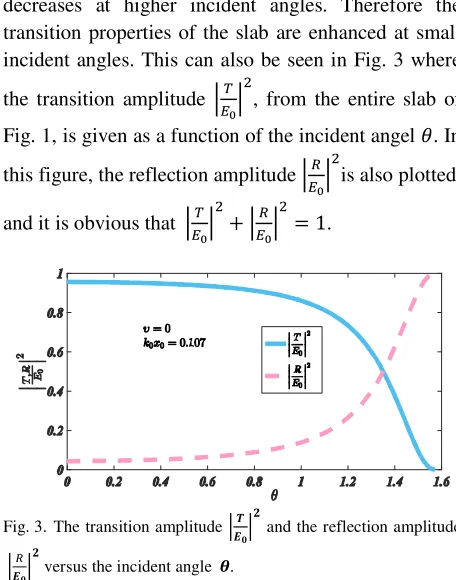
figure indicates the formation of the surface waves at the boundaries of the plasma region. According to this figure, the fluctuations reduce and the wave amplitude decreases at higher incident angles. Therefore the transition properties of the slab are enhanced at small incident angles. This can also be seen in Fig. 3 where the transition amplitude mfo
3m , from the entire slab of
Fig. 1, is given as a function of the incident angel @. In this figure, the reflection amplitude mfp
3m is also plotted,
and it is obvious that mfo
3m m
p
f3m 1.
Fig. 3.The transition amplitude mq
Hm [
and the reflection amplitude
mp Hm
[
versus the incident angle n.
The effects of the value of ' on the transition properties of the slab are shown in Fig. 4. This figure illustrates that the transition of the electromagnetic waves can occur at small values of ' and specifically at ' 0.2 . Therefore for the proposed model, the transition takes place at small widths of overdense plasma layer or metallic film, namely for .1r . For thicker layers, the reflection gets a higher share and is dominated. This is a feature of the anomalous light transition through an over-dense plasma layer or a metallic film. In fact, it has already been shown that the anomalous transition takes place for small thickness layers in the case of homogenous media [5].
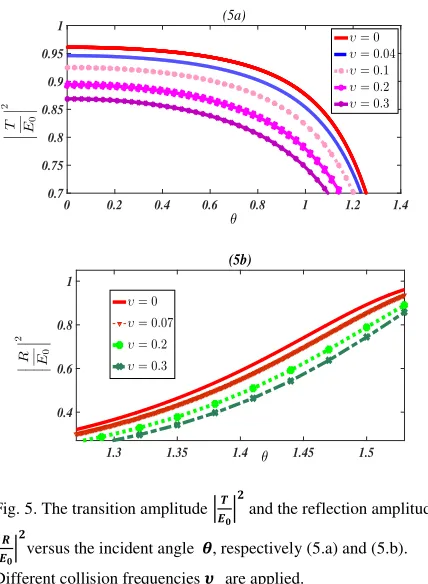
The effect of collision frequency on the transmission amplitude can be seen in Fig. 5 where
97
0.2 0.4 0.6 0.8 1 1.2 1.4 1.6
k0x0
0 0.2 0.4 0.6 0.8 1
- - -
-T E0
- - -
-2
θ= 0
θ=π
6
θ=π
4
θ=π
3
θ=π
2
Fig. 4. The transition amplitude mq
Hm [
versus the value of tHGH for
different incident angels n.
According to Fig. 5, by increasing the collision effects, the transmission and also the reflection reduce.
0 0.2 0.4 0.6 0.8 1 1.2 1.4
θ
0.7 0.75 0.8 0.85 0.9 0.95 1
- - -
-T E
0
- - -
-2
(5a)
υ= 0
υ= 0.04
υ= 0.1
υ= 0.2
υ= 0.3
Fig. 5. The transition amplitude mq
Hm [
and the reflection amplitude
mu Hm
[
versus the incident angle n, respectively (5.a) and (5.b).
Different collision frequencies v are applied.
5 Conclusions
In this study, we studied the anomalous transmission of light through an inhomogeneous over-dense plasma layer or a metallic film. It has already been shown that this anomalous transmission can be obtained for the homogenous medium through a mechanism of the simultaneous excitation of coupled surface waves. Through this mechanism, a homogenous dense plasma with 0, as a left-handed material, is considered to be sandwiched between two diffracting layers such as grating and dielectric layers with 0.
Here, we considered an inhomogeneous plasma layer with linear density which gradually becomes over-dense [23]. In this way, the effective dielectric permittivity reduces linearly to negative values (ultimately 1) from the positive values (initially from 1). In order to provide the conditions for the excitation of coupled surface waves, we also considered a plasma medium placed adjacent to the first one, in which the dielectric permittivity from the negative values acquires the positive values. In previous studies, we examined the conditions for the excitation of the surface waves for the structure. Here, continued the previous studies, [23], we obtained the conditions for the transparency of the entire slab. We observed that the anomalous transmission only can be achieved for the incident electromagnetic waves with certain frequencies. In fact, the characteristic parameter of the thickness of the slab, namely must fulfill the condition .
1r . Therefore, in order to have high transparency, the slab thickness must be small with respect to the wave length of the incident wave. The requirement of this condition has already been seen for the anomalous transmission of the homogeneous over-dense plasma [1] and [19]. This characteristic helps us to construct sub-wavelength super lenses with minimal chromatic aberration. Also, we observed that by increasing the incident angle, the wave transmission decreases and the reflection increases. Indeed, the anomalous transparency can be obtained for a range of incident angles, while in the case of homogeneous over-dense plasma the high transparency can be seen only at some specific resonant angles which are sharply distributed. This feature has significant effects on the transmission properties of the natural plasma mediums which gradually become dense and behave like LHM mediums. This particular property of the construction should be taken into account in designing more effective super lenses. We also consider the dissipation effects and showed that by increasing the collision frequency, the transmission and reflection amplitudes decrease. Therefore the dissipations, as expected, reduce the transmission ability of the structure. This effect also can be seen in the homogeneous case [23].
1.3 1.35 1.4 θ 1.45 1.5
0.4 0.6 0.8 1
- - -
-R E
0
- - -
-2
(5b)
υ= 0
υ= 0.07
υ= 0.2
98
References
[1] R. Dragila, B. Luther-Davies and S. Vukovic. “High transparency of classically opaque metallic films.” Physical Review Letters, 55 (1985) 1117. [2] R. Dragila and S. Vukovic. “Surface-wave-induced high transparency of an overdense warm plasma layer.” Optics Letters, 12 (1987) 573.
[3] T. W. Ebbesen, H. J. Lezec, H. F. Ghaemi, T. Thio, P. A. Wolff. “Extraordinary optical transmission through sub-wavelength hole arrays.” Nature, 391
(1998) 667.
[4] J. Valentine, S. Zhang, T. Zentgraf, E. Ulin-Avila, D. A. Genov, G. Bartal, and X. Zhang. “Three-dimensional optical metamaterial with a negative refractive index.” Nature, 455 (2008) 376.
[5] J. B. Pendry. “Negative refraction makes a perfect lens.” Physical Review Letters, 85 (2001) 3966. [6] R. Merlin “Analytical solution of the almost-perfect-lens problem.” Applied Physics Letters, 84
(2004) 1290.
[7] L. Rajaei, S. Miraboutalebi and B. Shokri. “Transmission of electromagnetic wave through a warm over-dense plasma layer with dissipative factor.” Physica Scripta, (2011) 8949.
[8] A. A. Orlov, S. V. Zhukovsky, I. V. Iorsh, and P. A. Belov. “Controlling light with plasmonic multilayers.” Photonics and Nanostructures-Fundamentals and Applications, 12 (2014) 213. [9] D. Schurig, J. J. Mock, B. J. Justice, S. A. Cummer, J. B. Pendry, A. F. Starr, D. R. Smith. “Metamaterial electromagnetic cloak at microwave frequencies.” Science, 314 (2006) 977.
[10] J. B. Pendry, D. Schurig, D. R. Smith. “Controlling electromagnetic fields.” Science, 312
(2006) 1780.
[11] W. Cai, U. K. Chettiar, A. V. Kildishev, V. M. Shalaev. “Optical cloaking with metamaterials.” Nature Photonics, 1 (2007) 224.
[12] H. Chen, C. T. Chan, and P. Sheng. “Transformation optics and metamaterials.” Nature
Materials, 9 (2010) 387.
[13] S. Larouche, Y. J. Tsai, T. Tyler, N. M. Jokerst, and D. R. Smith. “Infrared metamaterial phase holograms.” Nature Materials, 11 (2012) 450.
[14] W. X. Jiang, T. J. Cui, and G. X. Yu. “Theoretical model of lossy acoustic bipolar cylindrical cloak with negative index metamaterial.” Japanese J. of Applied Physics, 56 (2017) 097302.
[15] L. Rajaei, S. Miraboutalebi, and M. Nejati. “Faraday rotation of over-dense magnetized plasma” Contributions to Plasma Physics, 55 (2015) 513. [16] L. Rajaei, S. Miraboutalebi, and B. Shokri. “Plasmon mechanism of overdense plasma heating.” Contributions to Plasma Physics, 55 (2015) 321. [17] Yu. P. Bliokh, J. Felsteiner and Y. Z. Slutsker. “Total absorbtion of an electromagnetic wave by an overdense plasma.” Physical Review Letters, (2005) 165003.
[18] T. Suyama, Y. Okuno and T. Matsuda. “Surface plasmon resonance absorption in a multilayered thin film grating.” J. Electromagnetic Waves and Applications, 23 (2009) 1773.
[19] Yu. P. Bliokh. “Plasmon mechanism of light transmission through a metal film or a plasma layer.” Optics Communications, 259 (2006) 436.
[20] K. Y. Bliokh, Y. P. Bliokh, V. Freilikher, S. Savel’ev and F. Nori. “Colloquium: Unusual resonators: Plasmonics, metamaterials, and random media.” Review of Modern Physics, 80 (2008) 1201. [21] K. R. Welford and J. R. Sambles. “Couled surface plasmons in a symmetric system.” J. Modern Optics,
35 (1988) 1467.
[22] E. Fourkal, I. Velchev, C. M. Ma, and A. Smolyakov. “Evanescent wave interference and the total transparency of a warm high-density plasma slab.” Physic of Plasmas, 13 (2006) 092113.
[23] S. Miraboutalebi, M. K. Khadivi Boroujeni, L. Rajaei and N. Ahmadi. “Surface wave excitations in collisional inhomogeneous overdense plasma.” IJPR,