Modeling of the Effect of Coping with Stress Styles on Generalized
Anxiety Disorder by Brain's Executive Functions
Zandkarimi G.
1, Yazdi SM.
1, Khosravi Z.
1, Dehshiri G.
11Department of Psychology, Faculty of Educational Sciences and Psychology, Al-Zahra University, Tehran, Iran
Submitted: 10 July 2015 Accepted: 29 October 2015
Int J Behav Sci. 2016; 9(4): 256-262
Corresponding Author: Zandkarimi G. PHD Department of Psychology Faculty of Educational Sciences and Psychology
Al-Zahra University Tehran
Iran E-mail:
Abstract
Introduction: The purpose of this study was to investigate the executive functions (EFs) as the mediators between coping with stress styles andgeneralized anxiety disorder (GAD). We examined two styles of coping with stress (problem focused coping (PFC) and emotion focused coping (EFC)) and eight executive functions (inhibition, flexibility, focusing, working memory, decision making, reasoning, problem solving, and meta-cognition).
Method: This research was administrated in 250 GAD clinical patients that selected as available samples. SCID interview and DASS-21 applied to diagnose the moderate level of GAD as well as to quantification of the data. The N-Back, Strop, Tower of London and the other tests were the software tests to measure the executive functions.
Results: Results showed that the model of coping with stress styles with eight EF mediators to GAD contains the goodness of fit. Both inhibition and flexibility were the mediators that affected GAD were determined as proprietary EFs of this disorder. The meta-cognition was an EF that was affected from both inhibition and working memory.
Conclusion: Findings generally showed that PFC is not applied by GAD patients and do not affect GAD except by meta-cognition whereas EFC affect it by inhibition, flexibility, working memory and decision making.
Keywords: Coping with stress styles, Executive functions, Flexibility, Generalized Anxiety Disorder, Inhibition
Introduction
As specified by the Barkely's model (5) the inhibition and working memory are the most important EFs that affect the performance of the other EF units.
Prefrontal cortex is the largest part of the brain's cortex involves 28 percent of the cortex that is connected with motor processing and higher mental processing (1). This part involves the complex movement controls and the assignments that are required to the information integrity over the time (2). Baddely showed that prefrontal cortex forms the complex cognitive functions through the collaboration with temporal and parietal cortexes(3). For example, one should note the role of parietal dorso-prefrontal system which is created by the parietal-dorso-prefrontal collaboration and leads to working memory formation. The dorso-lateral part of prefrontal cortex is the origin of brain EFs. EFs are the wide range of the superior cognitive processing that organize the behavioral responses through inhibition, flexibility, focusing, working memory, decision making, reasoning, problem solving, and meta-cognition. The outcomes of their performance are cognitive, behavioral, and emotional management (4),(5). Besides, executive functions manage complex cognitive processing that result in goal-oriented behaviors. Barkely notes that the main task of EFs are supervising and managing the cognitive processes (6). He emphasizes that the EFs interact with each other and the outcomes of these interactions are the formation of complex system of regulation and management processes that act as an integrated model. Therefore, impairment in a part of the system may impact and disrupt the other parts of the model. As specified by the Barkely's model (5) the inhibition and working memory are the most important EFs that affect the performance of the other EF units.
Lazarus and Folkman explain the coping styles as cognitive-behavioral changing processes are applied by person to flight, avoid, and reduce or control the stress factors that have three major functions: first, providing desired information about situation; second, information processing and third, keeping freedom, independence and using the skills (7). They consider coping styles as a formal, complex and acquisitive processes that are totally divided in two categories:
1. Problem focused coping (PFC) involves logical responses to change the stressor origin. This coping style focuses on threat source and aims at cognitive evaluation, rational analysis; and identifying the problem solutions.
2. Emotion focused coping (EFC) involves coping with emotions due to threat source that eventually leads to reduce or manage the distress (7). It includes avoidance, escape, aggression, dependence to others …, etc. Generally, PFC is activated in controllable situations conversely EFC is activated in uncontrollable situations; nevertheless, the influx of psychological stressors arouse both styles.
The main features of GAD are anxiety plus excessive worry (anticipation combined with concern) about some kind of events or activities that happen at least for six months. The intensity, duration and frequency of the anxiety symptoms are much more extreme than the person's toleration to encounter with a scary event (8).
Three of the six main symptoms of GAD are enough to diagnose the GAD: restless and worry, tiredness, focus difficulties, irritability, muscle tension, and sleep difficulties (8).
How to express and cope with stress relates to dorso-lateral cortex's destruction (9). Some especially severe stressors create negative feedback on cognitive functions such as working memory that is one of the dorso-lateral cortex functions. Coping with stress styles directly trace cognitive functions to encounter with life situations and this will consequently lead to end or persistence the situational stressors (10). Strong evidences represent that there are positive and significant correlations between cognitive insufficiency and coping with stress styles as any executive dysfunction may leave destructive and disruptive impact on choosing the adaptation strategies in stressful situations (11). These insufficiencies prevent people to search more information about problem and to plan for problem solving and consequently, they over apply emotional or avoidance coping styles (12), (13). When the attention is attracted by internal or external events the coping strategies are affected and obviously, working memory processing is disrupted while coping with stress. The powerful working memory makes the access of goals possible (14) and increases the attentional control (15).These findings represent that working memory is very necessary to set thoughts in coping with stress that strongly needs attention.
Anxious people learn to avoid the decisions that have immediate benefits (16). Their emotional regulation which is likely due to long term visceral responses is weak in decision making tasks (17); however, all the anxiety groups suffer from decision making dysfunction (18). Results of Russo, Mahon and Burdick showed that anxiety is significantly correlated with problem solving, decision making and selective attention (19); however, training the decision making and problem solving strategies could positively affect these people's helplessness (20). Patients are weak in functioning and choose less and safer benefits with low risk and variation (21). Moreover, they choose the situations with less punishment and possibilities.
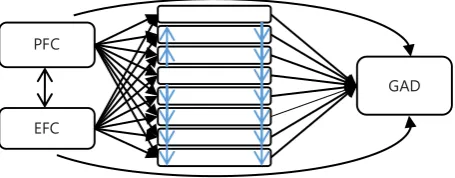
model to determine the contribution of each component of EFs in GAD. However the long-term and practical targets are to develop the existing knowledge about EFs in anxiety and to take an important step in GAD's differential diagnosis and etiology that lead to providing an effective therapeutic protocol for anxiety treatments. The proposed model of this research which is provided below represents the direct and indirect effects produced by coping styles and EF mediators on GAD plus inhibition and working memory impacts on other EFs:
Figure 1. The conceptual framework coping with stress styles, EF mediators, and GAD. GAD = Generalized Anxiety Disorder;
PFC = Problem Focused Coping; EFC = Emotion Focused Coping.
Methods
The research participants consisted of 250 GAD patients from Tehran mental health clinics and hospitals that were selected by convince sampling method. The participants' entry criteria were GAD clinical diagnosis without co-morbid depression disorders. They were between 20-40 years old (85 men and 115 women) that the average number of 27.5 and 33 percent are holding their high school diploma, 36 percent a college degree and 24 percent a Bachelor degree. Since there are no differences in clinical symptoms between men and women [8], the gender was not a control variable in this study. Any psychological or therapeutic treatment was controlled before the assessment for the effects of these interventions could affect the pure data.
The predictor variables were coping with stress styles (EFC and PFC) and the mediators were eight EFs (inhibition, cognitive flexibility, focusing, working memory, decision making, reasoning, problem solving, and meta-cognition) between coping styles and GAD.
GAD diagnosis was performed by semi-structured inventory (SCID-I); however, to make the GAD data quantitative, we used Depression, Anxiety and stress scale-21 (DASS-21) (24). Working conditions and control questionnaire (WOCCQ) with 65 items was applied to measure the coping with stress styles [7]. Wason selection task is a test to measure conditional reasoning (25). The conditional reasoning is characterized by “if "p" then "q" or if "not p" then "not q"” 12 questions that assess the capability of this kind of reasoning. The N-Back scale (26) is an appropriate tool to measure focusing, working memory and decision making. This test involves three levels of measuring (1-Back, 2-Back and 3-Back) using the numbers as stimulus that run respectively. There were 120 trials in every levels of N-Back which present in 0.5 second
on the monitor. Participants should select the correct or incorrect button immediately. The reaction time, correct responses and incorrect responses are the criteria to evaluate the focusing, working memory and decision making. The Strop test (27) is a test for accessing the cognitive inhibition and flexibility. The stimulus was the inconsistently colored words that were presented in 48 trials (Each one were present in 0.5 second) and measures this inconsistency interference with the responses. The mean scores of the responses delay and interference responses are the criteria to measure the flexibility and inhibition. Furthermore, the Tower of London test (28) applied for measuring the problem solving capability. Participants should solve 12 questions by using three rings that have to be placed in three unequal columns. The correct responses were the criteria to measure this EF. These three tools (Strop Test, N-Back and Tower of London Test) were developed as software and operated on five laptops that ran on the Microsoft Windows 7 home premium version 6.1.7600.
We used Behavior Rating Inventory of Executive
Function–Adult Version (BRIEF-A) for assessing the meta-cognition (29). This involves five subscales including initiate, organization, planning, working memory and self-regulatory subscales which were implemented in this study to measure the
meta-cognition. In order to make the test reliable, the
researchers obtained the Cronbach's alpha
coefficients for all of them which were 0.82 to 0.85 and there were significant values in evaluating the behavioral science test reliabilities. The criterion validity of DASS-21 with correlation of Beck anxiety inventory (BAI) is 0.81 (30). Aghauseffi reported that the constructive validity of the WOCQ inventory is acceptable (31). The criterion validity of Tower of London with correlation of Porteus mazes
was 0.44 (32). Furthermore, the constructive
validities of Strop and N-Back tests are significant (33),
(34). All tests were counter balanced to reduce the
test effects. Moreover, it was not possible to present the tests in two or more sessions and control the tiredness effect as patients would meet their psychologists at first session and assessment process was in conflict with any intervention. Therefore to investigate the size of this effect we polled them. 50 percent of people were not tired and enjoyed, 28 percent were not tired, 17 percent were indifferent and 4 percent were tired to the extent that they wouldn't have enough energy to start the first treatment session. The data of this group (10 people) were excluded.
Results
The results represent the correlation between predictor and mediator variables and GAD as well as correlation between predictors and mediators with each other. Table 1 displays the descriptive statistics and correlation matrix of predictor and criterion variables:
PFC
EFC
Table 1. Descriptive statistics and correlation matrix of coping styles, EFs, and GAD
Variables 1 2 3 4 5 6 7 8 9 10 11
1. GAD 1
2. PFC -.18** 1
3. EFC .52** -.08** 1
4. Inhibition -.45** -.10 -.49** 1
5. Flexibility -.33** -.01 -.29** -.28** 1
6. Focus -.09 -.05 -.01 -.03 -.04 1
7. Working memory -.46** -.16** -.51** -.44** .18** .02 1
8. Decision making -.51** .06 -.42** .34** .16** .10 .41** 1
9. Reasoning .00 -.36** -.03 -.02 -.08 .02 .01 -.04 1
10. Problem solving -.06 -.05 .00 .00 .00 .07 -.08 -.05 .05 1
11. Meta-cognition -.26** -.13** -.32** .21** -.28** .39** .37** .43** .15** .06 1
Mean 11.47 34.58 36.85 8.43 86.85 40.25 46.50 58.32 5.35 26.55 4.36
STD 1.01 12.24 12.00 3.18 56.85 20.24 22.46 25.39 3.34 6.14 3.14
**p< 0.01
Note. STD = Standard Deviation.
We used the structural equation modeling (SEM) and maximum likelihood methods by Lisrel software to investigate the fitness of the research model. All of the SEM assumptions were regarded in this research (e.g. data
normality, interval scale, the absence of Multicollinearity between variables…., etc). First the univariate normality and then the multivariate normality were investigated. Table 3 demonstrates the effect coefficients and tolerated values of all the model effects and paths:
Table 2. Standard effect coefficients and tolerate values
Effect Est. T value Effect Est. T value
PFC Inhibition 0.06 1.53 EFC Inhibition -0.56 -14.61*
PFC Flexibility -0.02 -0.45 EFC Flexibility -0.21 -3.09*
PFC Focus -0.06 -1.26 EFC Focus -0.55 -8.60*
PFC Work M. 0.12 3.17* EFC Work M. -0.53 -8.14*
PFC Decision -0.03 -0.68 EFC Decision -0.11 -1.55
PFC Reasoning 0.46 10.34* EFC Reasoning -0.02 -0.28
PFC Problem S. 0.09 1.89* EFC Problem S. -0.00 -0.03
PFC Meta-Cog. 0.10 2.11* EFC Meta-Cog. -0.25 -4.30*
PFC GAD -0.10 -2.46* EFC GAD 0.28 3.06*
Inhibition Flexibility -0.85 -16.17* Work M. Flexibility 0.23 3.96*
Inhibition Focus 0.08 1.43 Work M. Focus 0.11 1.54
Inhibition Work M. 0.25 5.12* Work M. Decision 0.36 5.89*
Inhibition Decision 0.07 1.34 Work M. Reasoning 0.08 1.48
Inhibition Reasoning 0.03 0.48 Work M. Problem S. 0.18 2.57*
Inhibition Problem S. 0.03 0.52 Work M. Meta-Cog. 0.35 5.47*
Inhibition Meta-Cog. 0.12 2.28* Decision GAD -0.20 -4.91*
Inhibition GAD -0.89 -11.17* Reasoning GAD -0.02 -0.56
Flexibility GAD -0.82 -13.52* Problem S. GAD -0.05 -0.92
Focus GAD -0.03 -0.91 Meta-Cog. GAD -0.32 -8.21*
Work M. GAD -0.19 -3.08* EFC Inhibition Flexibility GAD -0.40 -8.81* EFC Inhibition GAD 0.50 8.87* EFC Inhibition Work. M. GAD 0.02 0.42 EFC Flexibility GAD 0.17 3.03* EFC Inhibition Meta-Cog. GAD 0.02 0.44 EFC work M. GAD 0.10 1.99* EFC Work. M. Flexibility GAD 0.10 1.98* EFC Decision GAD 0.02 0.56 EFC Work. M. Decision GAD 0.04 1.21 PFC Meta-Cog. GAD 0.03 0.86 EFC Work. M. Meta-Cog. GAD 0.06 1.87 * T value > 1.96
Note. Est. = Estimate; Work M. = Working memory; Decision = Decision making; Problem S. = Problem solving; Cog. = Meta-cognition;
According to Table 2 the significant effects are showed upper than 1.96 T values. The significant paths from PFC to EFs are reasoning and meta-cognition as well as from
EFC to EFs are inhibition, flexibility, working memory and decision making.
Table 3. Coping with Stress, EFs & GAD models' Coefficient Fitness indexes
P GFI
IFI RMR
NNFI NFI
CFI RMSEA
Chi2:df
0.65 0.90
0.90 0.05
0.91 0.91
0.90 0.05
(154.44 : 78) = 1.98
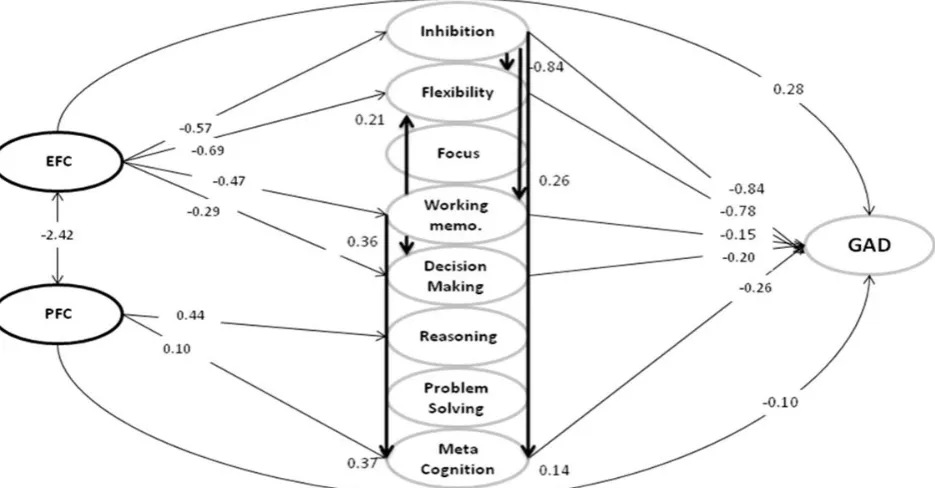
So this theatrical model is approved. To evaluate the new standard effect coefficients and tolerate values, the non-significant effects were excluded. The developed
model by Lisrel software with standard effect coefficients is presented below:
Figure 2. Model of coping with stress, EFs and GAD associate with direct and indirect effects
Discussion
Our study expanded on the results of previous studies about deficits in coping styles and executive functions in GAD (12), (13). We predicted direct effects from coping styles to GAD. Moreover, we assumed that GAD may receive some indirect effects from coping styles by EFs mediators. The results in the eight EF domains (inhibition, flexibility, focusing, working memory, decision making, reasoning, problem solving and meta-cognition) confirm the hypothesis that GAD patients are indirectly affected with coping styles. In this impact model the role of emotion focused style is more serious than problem focused style. These finding are in accordance with the previous findings (22), (23) and the model represents the contribution of predictor and mediator variables in determining the direct and indirect effects on GAD. It could be inferred from the model that the most powerful and negative effect is specified from EFC to inhibition to GAD which significantly supports Barkley's suggestion i.e., the inhibition is the most important EF which controls the other EFs activity (5). We found that the inhibition impacts on the other EFs are significant merely on flexibility, working memory and meta-cognition but the effect on flexibility is significantly high and negative. This means that the brain's cognitive inhibition limited the flexibility function when dealing with difficult assignments. Flexibility helps both to easily alter the attention route and to learn the new subjects. It seems that the inhibition tasks are in conflict with the flexibility functions. These findings are in line with the previous finding (16, 35) in a way that the EFs are essential to control the stress. The results postulate the most effective EFs are cognitive inhibition
and flexibility that negatively shape the bond between EFC and GAD. Accordingly, the inhibition and flexibility are the proprietary EFs of GAD. It means EFC could predict deficits on cognitive inhibition and flexibility processing and eventually, leads to GAD.
The effects of working memory on the EFs are positive and only significant for flexibility, decision making and meta-cognition. Consequently, both inhibition and working memory affect flexibility and meta-cognition; in fact, they represent that the role of these two variables are rather similar to manage and control the other EFs especially in meta-cognition. Many recent studies have shown that the working memory has an undeniable role in anxiety (36), (37), (3), (38) and our research represents that this role passes through the EFC to GAD. EFC indirectly and negatively affects inhibition, working memory, flexibility, and decision making and then this negative path leads to anxiety as well as EFC which positively and directly affects GAD. This means that the coping styles of those who suffer from avoidance, flight, aggressiveness etc., will increase their anxiety symptoms.
especially between problem solving, reasoning and problem focused coping style.
Generally, this study should be interpreted in the context of considerable diversity of neuropsychological test methods, large sample size (that significantly increased the statistical power), individual and experimental measuring methods and clinical interviews that will accordingly be led to the valuable information about EFs and GAD. In return, confrontation with technological and modality limitation is one of the problems of every studies. First, it is important to notice the use of the FMRI and PET scans to study on brain prefrontal reactions when participants involve with the tests. But these methods were absent in this study due to lack of laboratory equipments. Second, we should consider the comorbid disorders with GAD while there were just depressive disorders which were excluded from the sample size. The personality disorders that may affect the study findings were not excluded from this research. Third, the participants' intelligence has to be controlled
for this variable might affect the executive functioning in people. These limitations should be considered in future researches.
Conclusion
Our research suggests that mediating the executive functions leads to indirect effect from coping styles to GAD. EFC is more considerable coping style than PFC and manipulates the inhibition and flexibility functions that are two proprietary executive functions in GAD as well as significantly predict the GAD symptoms. Particularly, Inhibition and working memory similarly affect the other EFs as well as the inhibition role is more significant than working memory in these criteria. For future studies, the role and efficiency of inhibition and flexibility in etiology and treatment of anxiety disorders are suggested.
References
1. Stuss D, Knight R. Principles of frontal lobe function. Oxford: Oxford University Press; 2002.
2. Gazzaniga MS. Cerebral specialization and inter hemispheric communication: Does the corpus callosum enable the human condition? . J Brain. 2000;137(7):1293-326.
3. Baddeley A, Banse R, Huang Y, Page M. Working memory and emotion: detecting the hedonic detector. J Cog Psychol. 2012;24(1):6-16.
4. Salloway S, Boyle P, Correia S, Malloy P, Cahn-Weiner D, Schneider L, et al. The Relationship of MRI Sub-cortical Hyper-intensities to Treatment Response in a Placebo-Controlled Trial of Sertraline in Geriatric Depressed Outpatients. American J Gen Psycho. 2003;10:107-11.
5. Barkley RA, Murphy KR, Fischer M. ADHD in adults: What the science says. New York: Guilford.; 2008.
6. Barkley RA. Executive functions and self-regulation: An evolutionary neuropsychological perspective. Neuropsy Rev. 2001;11:1-29.
7. Lazarus A, Folkman S. Stress, appraisal and coping New York: Springer; 1984.
8. APA. Diagnostic and statistical manual of mental disorders (5 th Edition). Washington DC: Author; 2014.
9. Koenigs M, Grafmanb J. The functional neuro-anatomy of depression: Distinct roles for ventromedial and dorsolateral prefrontal cortex. Behave Brain Res. 2009;201(2):239-4. 10. Shahabi Z. Investigation of the personality types and Optimism
/ pessimism in Government offices in Tehran. Tehran: Al-Zahra University [Persian]; 2011. [Persian]
11. Hughes A, Beier M, Hartoonian N, Turner A, Amtmann D, Ehde D. Self-efficacy as a longitudinal predictor of perceived cognitive impairment in individuals with multiple sclerosis. Archives of Physical Medicine and Rehabilitation; http://www.sciencedirect.com/science/article/pii/S00039993150 00374; 2015.
12. Pu S, Nakagome K, Yamada T, Yokoyama K, Matsumura H, Mitani H, et al. The relationship between the prefrontal activation during a verbal fluency task and stress-coping style in major depressive disorder: A near infrared spectroscopy study. J Psych Res. 2012;46:1427-34.
13. Cook S, Salmon P, Dunn G, Holcombe C, Cornford P, Fisher P. A prospective study of the association of Meta cognitive beliefs and processes with persistent emotional distress after diagnosis of cancer. J Cog Ther. 2015;39(1):51-60.
14. McAvinue L, Golemme M, Castorina M, Tatti E, Pigni F, Salomone S, et al. Evaluation of working memory training scheme in older adults. Front Aging Neurosci. 2013;5:20-30. 15. Dahlin K. Effects of working memory training on reading in
children with special needs. J Read & Writ. 2011;24:479-91.
16. Mueller EM. Future-oriented decision-making in generalized anxiety disorder is evident across different versions of the Iowa Gambling task. J Behave Ther & Exp Psych. 2010;41:165-71. 17. Verkuil B. Effects of explicit and implicit preservative cognition
on cardiac recovery after cognitive stress. Inter J Psychophysio. 2009;74:220-8.
18. Devisser L. Trait anxiety affects decision-making differently in healthy men and women: Towards gender-specific endophenotypes of anxiety. J Neuropsychol. 2010;48:1598-606. 19. Russo M, Mahon K, Burdick K. Measuring cognitive functions in MDD: Merging assessment tools. J Dep Anx. 2015;32:262-9. 20. Kiosses D, Ravdin L, Gross J, Raue P, Kotbi N, Alexopoulos G. Problem adaptation therapy for older adults with major depression and cognitive impairment as randomized clinical trial. JAMA Psych. 2015;72(1):22-30.
21. Han G. Selective neuro-cognitive impairments in adolescents with major depressive disorder. J Adolesc. 2012;35:11-20. 22. Ebrahimi-kheirabadi A, Moradi, A., Hasani, J. Effectiveness of
cognitive-behavioral therapy in attentional bias components of patients with generalized anxiety disorder: A single subject study. J Behave Science. 2015;9(2):121-8. [Persian]
23. Lincoln TM, Lange J, Burau J, Exner C, S. M. The effect of state anxiety on paranoid ideation and jumping to conclusions: An experimental investigation. Schizo Bullet. 2010;36(6):1140-8. 24. Lovibond S, Lovibond P. Manual for the Depression Anxiety
Stress Scales (DASS). New South Wales: Psychology Foundation Monograph; 1995.
25. Wason P, Johnson-Laird P. Psychology of reasoning: structure and content. Cambridge: Harvard University; 1972.
26. Chen Y, Mitra S, Schlaghecken F. Sub-processes of working memory in the N-back test: An investigation using ERPs. Clinic Neurophysio. 2008;119(7):1546-59.
27. Strop J. Studies of interference in serial verbal reactions. J Exp Psychol. 1935;28:643-62.
28. Culbertson W, Zillmer E. The tower of London DX: a standard approach to assessing executive functioning in children. Arch Neurophysio. 1998;13:285-301.
29. Roth R, Isquith P, Gioia G. Behavior Rating Inventory of Executive Function Adult Version. Lutz: Psychological Assessment Resources Inc; 2005.
30. Brown T, Akiyama M, White I, Jayaratne T, Anderson E. Differentiating contemporary racial prejudice from old-fashioned racial prejudice. Race Soci Prob. 2009;1(2):97-110. 31. Aghauseffi A. The Role of personality and coping styles in
depression and the application of treatment on personality and depression. Iran: Tarbiat Modarres University; 2011. [Persian] 32. Kafer K, M. H. On testing the validity of
planning/problem-solving tasks in a normal population. J Inter Neuropsychol Soci. 1997;3:108-19.
34. May C, Hasher L. Synchrony effects in inhibitory control over thought and action. J Exp Psycho Hum Percept Perform. 1998;24:363-79.
35. Mani A, Sahraian A, Fouladivanda Z. Assessment of cognitive inhibition in patients with obsessive-compulsive disorder. Shiraz E-Med J. 2014;15(2):1-4. [Persian]
36. Calvin E, Hunter S, Ross R. Preschoolers of mothers with affective and anxiety disorders show impairments in cognitive inhibition during a chimeric animal strop. Inter Neuropsych Dis J. 2013;1(1):1-15.
37. Sattary-Najaf-Abady R, Heidary H. The effectiveness of meta-cognitive treatment on test anxiety. J Behave Science. 2015;9(1):27-32. [Persian]