Original Article
J Reprod Infertil. 2012;13(2):101-110
Adolescent Males and Young Females in Tehran: Differing Perspectives,
Behaviors and Needs for Reproductive Health and Implications for Gender
Sensitive Interventions
Farideh Khalaj Abadi Farahani 1, 2*, Iqbal Shah 3, John Cleland 4, Mohammad Reza Mohammadi 5
1- Department of Population, Health & Family Planning, Population Studies and Research Centre in the Asia and the Pacific, Tehran, Iran
2-Midwifery and Reproductive Health Department, Faculty of Medical Sciences, Tarbiat Modares University, Tehran, Iran 3- Department of Reproductive Health and Research, World Health Organisation, Geneva, Switzerland
4- Centre for Population Studies, London School of Hygiene and Tropical Medicine, London, England 5- Department of Psychiatry, School of Medicine, Tehran University of Medical Sciences, Tehran, Iran
Abstract
Background: Despite cultural and religious prohibitions against premarital heterosexual rela-tionships and intimacy, some recent evidence suggests some rise in premarital heterosexual interactions and relationships among young people. On the other hand, although HIV in Iran is a concentrated epidemic and mainly reported among high risk groups such as injecting drug users (IDUs), but there are evidences that the mode of transmission is shifting towards sexual contacts. This trend has caused concern among health policy makers in terms of prevention of STDs and HIV/AIDS particularly, among young people. This paper was prepared with the aim of high-lighting how gender contributes to variation in reproductive health needs and conduct of young people in Iran.
Method: This paper is based on a secondary analysis and compares comparable reproductive beliefs and conducts of women and men based on the data of two surveys conducted in Tehran in 2002 and 2005. A survey among 1385 adolescent males and another survey among 1743 fe-male undergraduate students in four multidisciplinary universities in Tehran. Both surveys used anonymous self-administered questionnaires. To make the two samples comparable, the data of unmarried female university undergraduate students who resided in Tehran were merged with the data of adolescent male students who intended to pursue higher education. Common vari-ables of the two surveys were identified, homogenized, merged and analysed.
Results: Reproductive health knowledge among male adolescents was poor compared to that of their female peers. Although premarital friendships were moderately acceptable from view points of both males and females, the majority were against premarital sex, particularly among female participants. There were evidences of gender-based double standards in perceptions of premarital sexuality among both males and females; particularly, it was stronger among males than females. Male adolescents reported earlier and greater experiences of premarital hetero-sexual intimacy and hetero-sexual contact than females. Multiple partners were also more common among males than females. Females had a tendency to regret first sexual contact more than males, which reflects that first sex is more likely to be unplanned and unwanted among females compared to males.
Conclusion: Significant gender–based double standards prevailed current sexual attitudes and conduct of young people in Iran. Gender norms which encourage unmarried men to practice pre-marital sex lead to an earlier transition of men to sexual relations and multiple sexual partners. Due to poor knowledge and various misconceptions about sexual health and lack of consistent contraceptive and condom use among adolescents and young people in Iran, both young men and women are susceptible to sexual and reproductive health hazards such as sexually transmit-ted infections (STIs), HIV/AIDS, pregnancy and unsafe abortion. Changing gender norms asso-ciated with sexuality may lead to promotion of safer sexual behaviors particularly among young people. Current reproductive health and HIV prevention programs should take into account gender-based double standards among young people and their unmet reproductive health needs.
Keywords: Adolescents, Attitude, Gender, Reproductive behavior, Sexual behavior, young people.
To cite this article: Khalaj Abadi Farahani F, Shah I, Cleland J, Mohammadi MR. Adolescent Males and Young Females in Tehran: Differing Perspectives, Behaviors and Needs for Reproductive Health and Implications for Gender Sensitive Interventions. J Reprod Infertil. 2012;13(2):101-110.
* Corresponding Author:
Farideh Khalaj Abadi Farahani, Department of Population, Health and Family Planning, Population Studies and Research Center in the Asia and the Pacific, No. 4, 2nd Behestan, Pasdaran Ave., Postal Code: 1946893451, Tehran, Iran, E-mail:
faridehfarahani@yahoo. com
Received: Nov. 4, 2011
Accepted: Jan. 1, 2012
J Reprod Infertil, Vol 13, No 2, Apr/Jun 2012 102
Reproductive Behaviors and Needs of Youth by Gender
JRI
Introduction
ran has a young population of those aged 15−29 constituting nearly 35% of its total population (1). Due to significant aspirations among females for higher education and changes in gender roles, marriage age has increased sig-nificantly over the past decades in Iran. Increasing premarital heterosexual relationships and liaisons among young people and their social, psycho-logical, and health consequences are also issues that concern parents, teachers, policy makers, and community leaders.
Historically, a strong socio-cultural and religious belief system surrounds sexuality in Iranians, in which sexual intercourse is confined within mar-riage and any intimacy and sexual contact before or out of marital lock is considered a sin and a taboo. The virginity of a woman must be kept and proven until marriage. The dignity and reputation of a girl and her family are at a high risk from loss of virginity before marriage. Within this context, the age of marriage and age at first sexual inter-course are highly correlated (2).
Nevertheless, due to factors such as access to global media, increase in age at marriage and a widening gap between puberty and marriage, greater heterosexual communication via commu-nicative technologies such as e-mails, chat rooms and cell-phones, relationship among unmarried adolescents and young people appear to be in-creasing. A rise in other risk-taking behaviors such as smoking, drinking alcohol and using il-legal drugs which predispose youth towards het-erosexual relationships is also another reason for possible changes in sexual behaviors.
In 2002, a study was conducted among male adolescent aged 15−18 years in Tehran to assess their reproductive health knowledge, attitude and conduct. This study focused on Tehran because the population of Tehran accounts for about one-fifth of the Iranian population and encompasses many of the country’s socioeconomic and ethnic groups; therefore, the study population represent-ed a heterogeneous group of the youth. Tehran is also a major metropolitan area which its popula-tion is more likely to origin from other provinces. Due to the limited social tolerance of such re-search in 2002, the study was confined to adoles-cent males only. Another study was conducted in 2005−2006 which focused on female students only using a comprehensive mixed method ap-proach. It assessed norms, attitudes and sexual
conduct of female students in Tehran. Due to practical issues and sensitivity of the subjects, none of these studies was carried out among both sexes; hence, gender differences could not be examined in reproductive health needs and prac-tice of young people.
The aim of this paper is to assess how and to what extent reproductive health knowledge, atti-tude and sexual conduct of young people in Teh-ran differ by gender. Comparable variables of the two surveys among adolescent males (2002) and female students (2005) were examined and com-pared. Although age gap existed between the two samples, the data were interpreted considering the existing age gap. The limitations of each study and gaps in knowledge for further research were outlined.
Addressing gender differences in sexual and re-productive health issues is critical to tailoring effi-cient program and policies designated for young people’s sexual and reproductive well-being.
Methods
The study on adolescent males aged 15−18 was a community-based cross-sectional survey conduct-ed in 2002. The sample was derivconduct-ed from cluster sampling of the 22 main municipal districts of Tehran. Details of materials and methods and sampling method have been reported in the two papers published on the first study among adoles-cents (3, 4).
The second survey had been conducted in 2005– 2006 among female students at four multidiscip-linary universities (private and public) in Tehran. The materials and methods and sampling methods of the study among female students are also ex-plained in the recently published paper of this study (5).
Since adolescent males were recruited from the general population, in contrast to the female stu-dents who were recruited from universities, it was tried to select those males who were more likely similar to female students socio-economically. Hence, we selected those males who reported willingness to continue their higher education in universities. Moreover, female students who were unmarried and resided in Tehran were selected. This strategy helped the comparability of the two samples in this paper. Although, differences in knowledge and attitudes of males and females might be due to their differences in both gender and age, selected sexual behavior of male
Khalaj Abadi Farahani F, et al.
JRI
J Reprod Infertil, Vol 13, No 2, Apr/Jun 2012 103 cents (sexual debut and protection at first sex,
etc.) are retrospectively explored and can be com-pared with corresponding sexual behaviors of fe-male individuals during their adolescence. In fact, sexual experiences of female students during their adolescent years have been compared with sexual behaviors of male adolescent at the time of the study.
Common variables were recognised and after merging the data, comparable variables and their direction of responses were checked for compar-ability and adapted appropriately. Selected demo-graphic characteristics, access to media, certain behaviors and habits, knowledge on some aspects of reproductive health and attitude towards pre-marital heterosexual relationships, as well as their conduct were compared using SPSS version 18. Chi-square, t-test, ANOVA and life table analysis, as well as multivariate analysis were employed to analyze the data.
Demographic and family characteristics of the merged samples in the two studies were compared first. Thereafter, reproductive health knowledge was compared between males and females by comparing the percentages of correct responses to identical questions. Then differences in attitude towards different extent of premarital relation-ships including sex were also compared between males and females. Selected types of heterosexual relationships and sexual practices were compared between adolescent males and female students too. Variables which are more comparable such as
age at first sex, protection at first sex and their first sexual partner were put side by side. Finally, determinants of personal attitude and sexual be-havior by gender were examined using a logistic regression model.
Results
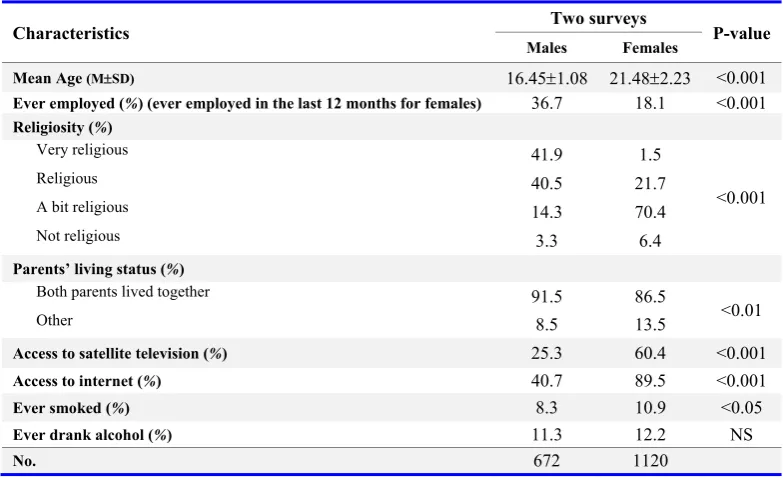
Respondents’ characteristics: The mean age of 672 adolescent males and 1120 female students were 16.4±1.08 and 21.5±2.23 years, respectively.
More than 80% of adolescent males considered themselves to be highly religious, while only 23% of female students reported to be so. The preva-lence of ever smoking or ever drinking alcohol among males was 8.3% and 11.3%, respectively, while the corresponding rates among female stu-dents were 10.9% and 12.2%, respectively. Ex-perience of ever being employed was significantly greater among males than among females (36.7%
vs. 18.1%, respectively, p <0.001).
One-fourth (25.3%) of males reported access to satellite TV and one-third (40.7%) to internet, while more than half (60.4%) of female students had access to satellite TV within the preceding month while 12% reported daily access to satellite programs and the majority of female students re-ported access to internet (89.5%). About 26% of females, reported using chat rooms while using internet. Both studies reported that the majority of males and females reported that their parents lived together (91.5% and 86.5%, respectively).
Reproductive health knowledge: Reproductive
Table 1. Comparison of socio-demographic characteristics of the samples in the two studies
Characteristics Two surveys P-value
Males Females
Mean Age (M±SD) 16.45±1.08 21.48±2.23 <0.001
Ever employed (%)(ever employed in the last 12 months for females) 36.7 18.1 <0.001
Religiosity (%)
Very religious 41.9 1.5
<0.001
Religious 40.5 21.7
A bit religious 14.3 70.4
Not religious 3.3 6.4
Parents’ living status (%)
Both parents lived together 91.5 86.5
<0.01
Other 8.5 13.5
Access to satellite television (%) 25.3 60.4 <0.001
Access to internet (%) 40.7 89.5 <0.001
Ever smoked (%) 8.3 10.9 <0.05
Ever drank alcohol (%) 11.3 12.2 NS
No. 672 1120
J Reprod Infertil, Vol 13, No 2, Apr/Jun 2012 104
Reproductive Behaviors and Needs of Youth by Gender
JRI
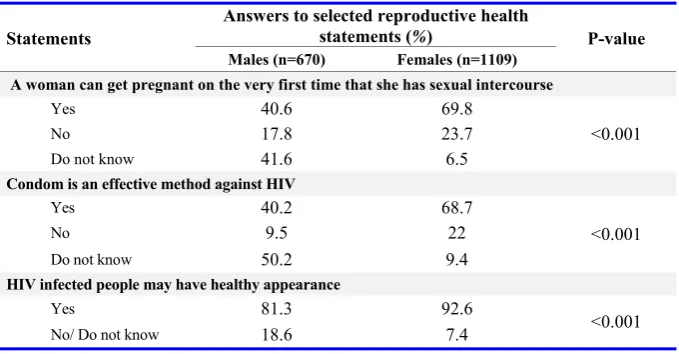
health awareness of adolescent males varied wide-ly by subject, but misperceptions were common. While nearly 70% of female students knew that a woman can get pregnant at first intercourse only 40.6% of males knew this fact. Nearly 69% of female students were aware of the protective role of condoms against HIV and 95% of the adoles-cent males had heard about STIs and HIV/AIDS, however, misperceptions were widespread among males. For instance, 81% of the males knew that people infected with HIV could be asymptomatic. By contrast awareness of female students about HIV was considerably better and nearly 92.6% were aware of healthy appearance of HIV infected people (Table 2).
The extent of agreement towards selected com-mon attitudinal statements between the two sur-veys was compared and nearly 33.7% of males disagreed with premarital friendship with the op-posite sex among young people, while 46.3% of female students favored this attitude (P <0.001). While nearly, 20% of female students were unsure about their responses, this uncertainty among ado-lescent males was only 11.5%. About 54.7% of males were strongly in favor of premarital friend-ship but the corresponding percentage among fe-male students was about 33.9%. These findings show that females are more cautious and modest in their attitudes regarding premarital friendships while adolescent males appear to be more certain and definite in their attitudes. Although males were younger than females, they reported greater support for premarital heterosexual friendships and were more certain in their views than females.
The majority of adolescent males and female students were reportedly against premarital sexual
relationships even when a romantic relationship was considered. 58.2% of male participants and 62.3% of females disagreed with premarital sex-ual relationships. Stronger disagreement was more evident among females than males, although the difference was not significant. In contrast to pre-marital heterosexual friendships, males were more uncertain about their views towards premarital sexual relationships than female students (14.3%
vs. 12.3%).
More than two-thirds (72.1%) of males disagreed with premarital sex for unmarried women and slightly higher numbers of female students held this view (76.1%). Uncertainty about sexual rela-tionships of females was more apparent among adolescent males than female students (14.6% vs.
11.4%). Among adolescent males, 42.6% strongly disagreed with premarital sexual relationships for young people while 60% showed strong disagree-ment with premarital sex for women. The corres-ponding figures reported by female students were 45% and 54.8%, respectively. This result reflects that gender inequality is more pervasive among males than females. Surprisingly, in spite of the fact that a minority of young people strongly sup-ported premarital sex for females− nearly 8.4% of adolescent males strongly approved such relation-ships compared to only 4.4% of females. The comparison of rates regarding premarital sex for young people and for women, indicates a remark-able decline in the percentage of females with strong liberal attitudes towards premarital sex for young people when these sexual relationships are considered for females (11.3% vs. 4.3%).
Premarital sexual experience: Nearly 23.5% of adolescent males who intended to continue their
Table 2. Percentage distribution of respondents by their knowledge about specified aspects of reproductive health
Statements
Answers to selected reproductive health
statements (%) P-value
Males (n=670) Females (n=1109) A woman can get pregnant on the very first time that she has sexual intercourse
Yes 40.6 69.8
<0.001
No 17.8 23.7
Do not know 41.6 6.5
Condom is an effective method against HIV
Yes 40.2 68.7
<0.001
No 9.5 22
Do not know 50.2 9.4
HIV infected people may have healthy appearance
Yes 81.3 92.6
<0.001
No/ Do not know 18.6 7.4
Khalaj Abadi Farahani F, et al.
JRI
J Reprod Infertil, Vol 13, No 2, Apr/Jun 2012 105 higher education in university, reported ever
having the experience of premarital sexual con-tact, while any type of sexual contact before mar-riage was reported by about 25.6% of unmarried female students who resided in Tehran. Sexual contact in both studies applied to all different types of sex, including non-penetrative and pene-trative sex or intercourse. Sexual contact in Farsi is called as “Tamas-e-Jensi” and sexual inter-course is used as “mogharebat-e-Jensi” or “Naz-diki-e-Jensi”.
Age at first sexual contact: The cumulative per-centages of “age at first sex” were compared be-tween adolescent males and female students before age 18. Eight percent of adolescent males initiated their first sex by age 15 and 15% initiated sex by age 18, while the corresponding figures among female students were only 1% and 4%. This finding shows that males experience their
first sex considerably earlier than girls in Iran. The nature of adolescent males' first sexual part-ner, however, remains unclear.
Figure 1 shows the cumulative percentage of age at sexual debut among adolescnet males and fe-male students. This figure clearly indicates that to what extent males initiates premarital intimate and sexual relationships with the opposite sex compared to females.
Accordingly, although, males are younger, they initiate sex much earlier than females. This can be due to under-reporting of females and over-re-porting of males. One noticeable finding is that the partners of adolescent boys are very similar in age, (15.5 vs. 14.7, respectively) while female students' partners are much older than them (mean age: 26.8 vs. 19.7 years, respectively). Although males are younger than females, but the number of their partners are twice as that of females (4.1
Table 4. Details of sexual conduct among sexually experienced adolescent boys and female students in Tehran
Males Females P-value
Mean age at sexual debut (M±SD) 14.7±2.07 19.7±2.20 <0.001
Mean age of sexual partner at sexual debut (M±SD) 15.5±4.19 26.8±14.6 <0.001
Mean number of sexual partners ever had (M±SD) 4.1±4.0 2.1±1.8 <0.001
Regret at first sex (%) 28.7 59.1 <0.001
Contraceptive Method used at sexual debut (%) 51.0 22.0 <0.001
No. 145 248
Table 3. Attitudes towards premarital relationships with the opposite sex by gender
Statements Attitude (%) P-value
Males Females Unmarried girls and boys should not have premarital heterosexual friendships
Strongly agree 19.8 30.3
<0.001
Agree 13.9 16.0
Unsure 11.6 19.8
Disagree 13.7 15.7
Strongly disagree 41.0 18.2
Unmarried girls and boys should not have premarital sexual relationships
Strongly agree 42.6 45.0
0.096
Agree 15.6 17.3
Unsure 14.3 12.3
Disagree 11.3 13.1
Strongly disagree 16.1 12.3
Girls should not have sex until marriage
Strongly agree 60.0 54.8
<0.001
Agree 12.1 21.3
Unsure 14.6 11.4
Disagree 4.6 8.1
Strongly disagree 8.7 4.4
J Reprod Infertil, Vol 13, No 2, Apr/Jun 2012 106
Reproductive Behaviors and Needs of Youth by Gender
JRI
vs. 2.1, respectively). Females reported greater re-gret after first premarital heterosexual relationship (59.1% vs. 28.7%, respectively). Interestingly, adolescent males reported greater use of contra-ception than female students (51% vs. 22%, re-spectively).
Interestingly adolescent males’ perception of their peers’ involvement in premarital friendship with the opposite sex was extensively greater than that of female students in such relationships.
When adolescent males were asked how many of their peers had had girlfriends, they reported that on average 64% (median=70%) of their peers had done so. Almost 48% of boys thought that nearly all of their peers (more than two-thirds) had had girlfriends while only 12% of female students perceived that all their peers had had boyfriends.
Determinants of premarital sexual contact among youth in Tehran: The results of logistic regression analysis showed that older age, male gender, prior employment, lower endorsement of religion, ac-cess to satellite, smoking and drinking were all predictors of premarital experience of any sexual contact among youth in Tehran. Being a male, in-creased the odds of premarital sex experience about 4 times (OR=4.24, p <0.001). Every year of age increase, resulted in 1.18 times greater pre-marital sexual contact (P <0.001). Having prior experience of employment also added the odds of premarital sex (OR=1.54, p <0.05). Lower religi-osity was a strong predictor of premarital sex (OR=3.33, p <0.001), as well as access to satellite (OR=2.35, p <0.001). Smoking and alcohol use were also significant predictors of premarital sex-ual contact (OR=2.47, OR=5.31, p <0.001, re-spectively).
Discussion
Considering the age difference between males and females in this paper, female students appear-ed to be significantly more knowlappear-edgeable than the male adolescents about some aspects of re-productive health. This can be due to their attend-ance in family planning classes held in univer-sities. However, the qualitative study of the study among female students revealed poor awareness and some misconceptions about mode of sexual transmission of HIV among females. Female were were poorly informed about the association be-tween different types of sex and HIV and STIs transmission (6).
Male and female participants in the reviewed
Table 5. Adjusted odds ratio of factors associated with ever having premarital sex among young people in
Tehran
Associated factors Ever having premarital sex
Adjusted OR 95 (%) CI
Age 1.18*** 1.11-1.27
Gender
Females 1.00
2.50-7.19
Males 4.24***
Ever employed
No 1.00
1.15-2.06
Yes 1.54**
Religiosity
Very important 1.00
Important 1.25 0.80-1.95
A little important 2.39*** 1.48-3.87
Not important 3.33*** 1.70-6.53
Access to satellite TV programs
No 1.00
1.74-3.16
Yes 2.35***
Access to internet
No 1.00
Yes 0.965 0.69-1.35
Ever smoking
No 1.00
1.65-3.69
Yes 2.47***
Ever Drinking
No 1.00
3.67-7.68
Yes 5.31***
Constant 0.002***
*p <0.05, **p <0.01, ***p <0.001
Note: Cox & Snell R Square=0.199, Negelkerke R Square=0.295
Figure 1. Cumulative percentages by age at sexual debut among adolescent males and female university students in Tehran, in 2002, 2005, respectively
Khalaj Abadi Farahani F, et al.
JRI
J Reprod Infertil, Vol 13, No 2, Apr/Jun 2012 107 studies held moderately permissive attitudes
to-wards premarital heterosexual friendships, but the majority (more than 60%) of both sexes disap-proved or proscribed premarital sexual relation-ships. In this regard, female students showed stronger disagreement to premarital sex in com-parison to male adolescents which reflects that females are more conservative than males in their attitudes towards premarital sex. These disagree-ments became more evident among males when such relationships were considered for unmarried females. These results suggest gender–based double-standards in attitudes towards premarital sex among both females and males in Iran. Inter-estingly, beliefs on gender inequality with regard to premarital sex, for the majority of whom were against such relationships, were more evident among males than females which might stem from beliefs learned from within families and commu-nity. A study among parents of adolescent males in 2003 in Tehran revealed more liberal attitudes among fathers than mothers in terms of premarital friendships with the opposite sex. Nearly half of fathers were permissive of such relationships while only 28% of mothers held such beliefs (7). A qualitative study among African-American ado-lescents aged 14−17 in 2007 indicated the role of mothers in imparting sexual double standards to their children; mothers typically use a proactive approach with sons and a neutral or prohibitive approach with daughters (8).
Various case studies in developing countries, particularly in Asia indicated similar gender-based double standards. Studies in Thailand, Vietnam and Peru showed similar gender double standards with regard to premarital sex (9, 10). Some other studies in Turkey and China also indicated more favorable attitudes towards premarital sex among males than females (11, 12).
Various justifications for gender double stand-ards are reported in different studies even by fe-males, some of which are applicable in the Iranian context; such as beliefs in men’s need to gain sex-ual experience before marriage, or men’s uncon-trollable sexual urges (9). It is widely believed that sexually experienced unmarried men are not labelled as loose by the society, while females who get involved in premarital sex are faced to social judgment and are labelled as immoral girls. Due to this social expectation, premarital sex for men does not often jeopardise their marital pro-spects while it is more likely to jeopardise those of females (9).
Prevalence of sexual relationships between ado-lescent males and female students showed that males are more likely involved in such relation-ships than females. The fact that the mean age of males in the first study was less than the mean age of female students in the second study, it is predicted that the rate of such relationships among males between the ages of 18 and 24 was even greater. In addition, since in the study on adoles-cent males only one question enquired their in-volvement in sexual contact or “tamas-e-Jensi”, and no other additional questions were asked about the exact type of the contact, there is one possibility that few adolescents reported their het-erosexual physical intimacy or any other non-penetrative sex as sexual contact. However, this is a precaution which should be taken into account in interpreting these results. A review of case studies conducted in developing countries showed that, similarly, young males were considerably more likely to be sexually experienced than young females (9). Between 2%−11% of young females in Asia reported sexual activity. Although 23% of female students in Tehran reported any type of sex, but only about 11% reported sexual inter-course (6) which is consistent with the findings of other countries in Asia. Case studies in develop-ing countries also revealed that one-third of fe-males and half of fe-males were sexually experi-enced (9). These differences in sexual practices by gender can be attributed, to some extent, to over-reporting among males and underover-reporting among females due to cultural expectations and norms.
Another finding is that men’s perception of peers’ premarital sexual relationships is consider-ably higher than females for such perception. Two explanations exist for such results. One is the fact that males experience premarital sex more than females and the other possibility is that females tend to hide their sexual relationships from their peers whereas males tend to over-report it to prove their masculinity to gain more credibility before their peers.
With regard to the age of sexual debut, the cu-mulative percentage shows that males initiated sexual contact much earlier than females. How-ever, this rate among females might be higher if females who are not enrolled to the universities are considered too.
Among sexually experienced youth, median age of female students in Tehran for sexual debut was 20 years, while it was only 15 for adolescent males which reflect a remarkable gender
J Reprod Infertil, Vol 13, No 2, Apr/Jun 2012 108
Reproductive Behaviors and Needs of Youth by Gender
JRI
ence in sexual transition (6). Age at sexual debut was shown in other case-studies in developing countries to be notably lower among males than among females (9). Case studies in Africa and Asia revealed that typically the median age at sexual debut was between 18−20 years among females and 15−20 among males (9). A study among vocational students in northern Thailand showed similar gender differences in sexual initi-ation (13).
This huge difference between males and females in initiation of sex raises a question about the part-ners of adolescent males. In fact, if younger ado-lescent females or same age females would be their sexual partners, the rate of premarital sex among females would be roughly the same as males. There are two possibilities; one is that males tend to have their sexual debut with sex-ually experienced females who tend to change their partners frequently or they may have their first sex with ever married older females.
Multiple sexual partners were also another dis-tinguishing characteristic of sexual experiences of males compared to females. Although multiple sexual partners were also common among fe-males, they reported significantly fewer life time sexual partners than males. 30% of sexually ex-perienced males reported more than five lifetime sexual partners, considering the age range of males which was 15 to 18 years; these rates among males are alarming particularly when con-dom use is inconsistent. Other case studies in de-veloping countries showed that large percentages of sexually active youth have engaged in sexual relationships with more than one partner and males are more likely to report multiple sexual partners than females. One reason for gender dif-ferences with regard to the number of partners is due to their earlier initiation of sexual activity among males compared to females and also type of partners. Females tend to acquire a steady part-ner with marriage in mind while males tend to ac-quire partners casually or indiscriminate/g more than females (9).
About one-third of male adolescents had their first sex with an older female partner which is not negligible. There is no in-depth knowledge about the type of female sexual partners, the marital status of their female partners, or whether their partners were prostitute or not. More exploration is needed in this regard.
Only a small percentage of male adolescents
(one-fourth) reported condom use at their sexual acts, but they, in fact, did not use it consistently. Hence, male adolescents who have multiple sex-ual partners and do not use condoms consistently are predisposed to high risks of STDs and HIV infection and even due to the lack of consistent contraceptive use, pregnancy and unsafe abortion is another risk which threatens their sexual part-ner’s well-being. Among sexually experienced fe-male students who reported vaginal intercourse, only one-third reported condom use at first va-ginal sex and 36% in the last intercourse. Con-doms mainly used to protect against pregnancy rather than STDs or HIV infection. Since in the study among adolescent males, the type of sex was not enquired and also their contraceptive use at first and last sex were not ascertained, it is dif-ficult to claim that males tend to use condoms more than women, but the only common feature is that condoms are not used consistently and are not used for protecting against STDs or HIV among males and females, but against pregnancy. Hence adolescents and young people who practice non-vaginal penetrative sex (anal or oral sex) are less likely to use condoms.
Gender-based double standards in many devel-oping countries, particularly in Asia that sexual activity for males is encouraged and premarital sex is discouraged for females, constitute sexual attitudes and behaviors of young people.
This paper illustrates that young men in Iran initiate premarital sex earlier than females, they have more sexual partners and do not protect themsleves consistently against sexually trans-mitted disease. They are less knowledgable about sexual risks and less likely express regret after first sex compared to young women. Young men held more liberal attitudes towards premarital sex than females and considered more conservative views towards such relationships for females than males.
First sex is more wanted and more voluntarily for men but it is mostly unwanted and unplanned for females.
Regret at first sex is associated with different perception about the social acceptability of pre-marital sexual behavior for males and females. Males tend to believe that their sexual activity is evidence of their masculinity and it is not against cultural and social norms, whereas females per-ceive premarital sex is socially unacceptable for females or may jeopardise their chances of subse-
Khalaj Abadi Farahani F, et al.
JRI
J Reprod Infertil, Vol 13, No 2, Apr/Jun 2012 109 quently getting married. The basis of this
percep-tion is gender inequality and double standards within family and society. Premarital sexual activ-ity is less likely to jeopardise marital prospects for males as compared to females.
Sexual and reproductive health is strongly influ-enced by gender norms. Norms favoring males’ dominance in sexual interaction, cause females' inability to negotiate sex, condom use, or mono-gamy and leaves the majority of women and girls worldwide at high risk for unwanted pregnancy, illness and death from pregnancy-related causes and sexually transmitted infections. Research has consistently shown that men play key roles in the spread of sexually transmitted disease, and that women bear greater reproductive health hazards (14, 15).
Altering social norms seems to be vital to the equitable distribution of resources and rights be-tween both sexes. Men may engage in high-risk behaviors more frequently in order to meet the perceived expectations of social norms related to gender. Men may also express desires to display effeminate characteristics due to social prohib-itions on homosexuality or social definprohib-itions of masculinity. Men’s greater likelihood of having multiple partners and women’s difficulty in nego-tiating condom use or the conditions of sexual encounters threaten the sexual health of young people. Therefore, socialised paradigms of mascu-linity and gender norms should be altered (14).
One limitation of this secondary analysis is that the two samples have some differences with re-gard to the socio-demographic characteristics of the participants due to the fact that two studies were not designed to be similar. The sample of adolescent males was collected in a population-based survey in 2002, while the sample of the study among females was based on a survey in 2005 using two-stage stratified random cluster sampling from four multidisciplinary universities in Tehran. The two studies were the two available sources of data to the authors for doing a second-ary analysis. Although samples have other dis-similarities such as age range and socio-economic characteristic, but the only important concern of this study was their difference by gender. Mean age of adolescent males was nearly 5.5 years younger than the mean age of female students.
Moreover, females who had enrolled in the uni-versities might have had better educational aspir-ations which is protective for non-participation in premarital sex (16). The economical and
educa-tional status of their families also could probably have been better than those of adolescent males. The sample of adolescent males tended to consist of all different socio-economic groups, with both better or lower socio-economic status. Giving these facts, all interpretations of this paper should take into account these potential dissimilarities.
Further studies, particulay, those with qualitative or quantitatve methods are suggested to gain in-depth knowledge about sexual experiences of young men comprising of both adolescent and young males. There are no detailed and in-depth information about type of sex they practice, their protections at first and the most recent sexual intercourse, their motivations and feeling, sexual partners, ways of acquiantnce and history of STDs and pregnancy in their sexual partners, marital prospects, etc.
Conclusion
These results suggest that a significant minority of young men and women are involved in pre-marital heterosexual relationships and intimacy. Due to gender double standards with regard to sexuality and marriage, males tend to get involved in premarital sex earlier and more frequently than females which is mostly unsafe and poses them, their sexual partners and future spouses at risks of STIs and HIV. Hence, policy makers need to in-corporate gender issues in their interventional programs to prevent STIs and HIV and unsafe sex or even to encourage abstinence until marriage among adolescents and youth. Families and media also need to promote equal gender norms with regard to such relationships before marriage.
Acknowledgement
The authors also acknowledge all the co-authors of the study among adolescent males in 2002 and the Family Research Institute under Shahid Be-heshti University in Tehran and Centre for Popu-lation Studies, London School of Hygiene and Tropical Medicine for their active cooperation in conducting the second study among female stu-dents.
References
1. Mahmoodi H, Sadeghi R. [Population, health, sus-tainable development with focus on young people; Challenges and issues]. In: Population Studies and Research Center in Asia and the Pacific. 4th Con-ference of the Population Association of Iran; 2008 Mar 4-5; Tehran. Tehran: Population Studies and
J Reprod Infertil, Vol 13, No 2, Apr/Jun 2012 110
Reproductive Behaviors and Needs of Youth by Gender
JRI
Research Center in Asia and the Pacific; 2008. P. 67-99, Persian.
2. Saeednia M. [Collection of laws and regulations of children and adolescents]. 1st ed. Tehran: Pejman; 2006. p. 189-90.
3. Mohammad K, Farahani FK, Mohammadi MR, Ali-khani S, Zare M, Tehrani FR, et al. Sexual risk-taking behaviors among boys aged 15-18 years in Tehran. J Adolesc Health. 2007;41(4):407-14. 4. Mohammadi MR, Mohammad K, Farahani FK,
Ali-khani S, Zare M, Tehrani FR, et al. Reproductive knowledge, attitudes and behavior among adolescent males in Tehran, Iran. Int Fam Plan Perspect. 2006; 32(1):35-44.
5. Farahani FK, Cleland J, Mehryar AH. Associations between family factors and premarital heterosexual relationships among female college students in Tehran. Int Perspect Sex Reprod Health. 2011;37(1): 30-9.
6. Khalaj Abadi Farahani F, Cleland J. Norms, attitude and sexual conduct of female college students in Tehran; Implications for sexual and reproductive health policy and research in Iran [PhD Thesis]. [London]: London School of Hygiene and Tropical Medicine; 2008. 325 p.
7. Mohammadi MR, Alikhani S, Khalaj Abadi Faraha-ni F, Bahonar A. Parents' attitudes towards adoles-cent Boy's reproductive health needs and practice in Tehran. Iran J Psychiatry. 2007;2(1):13-24.
8. Fasula AM, Miller KS, Wiener J. The sexual double standard in African American adolescent women's sexual risk reduction socialization. Women Health. 2007;46(2-3):3-21.
9. Brown AD, Jejeebhoy SJ, Shah I, Yount KM. Sex-ual relations among young people in developing
countries: evidence from WHO case studies. Occa-sional Paper No 4. Geneva: WHO, Department of Reproductive Health and Research; 2001. p. 6-43. 10. Isarabhakdi P. Factors associated with sexual
be-haviour and attitudes of never-married rural Thai youth. Warasan Prachakon Lae Sangkhom. 1999;8 (1):21-44.
11. Wang B, Li X, Stanton B, Kamali V, Naar-King S, Shah I, et al. Sexual attitudes, pattern of communi-cation, and sexual behavior among unmarried out-of-school youth in China. BMC Public Health. 2007;7:189.
12. Ozan S, Aras S, Semin S, Orcin E. Sexual attitudes and behaviors among medical students in Dokuz Eylul university, Turkey. Eur J Contracept Reprod Health Care. 2005;10(3):171-83.
13. Liu A, Kilmarx P, Jenkins RA, Manopaiboon C, Mock PA, Jeeyapunt S, et al. Sexual initiation, sub-stance use, and sexual behavior and knowledge among vocational students in northern Thailand. Int Fam Plan Perspect. 2006;32(3):126-35.
14. White V, Greene M, Murphy E. Men and re-productive health programs: Influencing gender norms. Washington DC: The synergy project/social & scientific systems; 2003. 58 p.
15. Terry PE, Mhloyi M, Masvaure TB, Adlis SA. Gender equity and HIV/AIDS prevention: com-paring gender differences in sexual practice and beliefs among Zimbabwe university students. Int Q Community Health Educ. 2005-2006;24(1):29-43. 16. Vesely SK, Wyatt VH, Oman RF, Aspy CB,
Keg-ler MC, Rodine S, et al. The potential protective effects of youth assets from adolescent sexual risk behaviors. J Adolesc Health. 2004;34(5):356-65.