
DEMOGRAPHIC RESEARCH
VOLUME 28, ARTICLE 3, PAGES 63-76
PUBLISHED 9 JANUARY 2013
http://www.demographic-research.org/Volumes/Vol28/3/ DOI: 10.4054/DemRes.2013.28.3
Descriptive Finding
Disentangling how educational expansion did
not increase women's age at union formation
in Latin America from 1970 to 2000
Albert Esteve
Luis Ángel López-Ruiz
Jeroen Spijker
© 2013 Esteve, López-Ruiz & Spijker.
This open-access work is published under the terms of the Creative Commons Attribution NonCommercial License 2.0 Germany, which permits use, reproduction & distribution in any medium for non-commercial purposes, provided the original author(s) and source are given credit.
1 Introduction 64
2 Data and method 66
2.1 Ever married and ever in union 67 2.2 Years of schooling and control variables 68
3 Results 68
4 Summary and discussion 71
Disentangling how educational expansion did not increase women's
age at union formation in Latin America from 1970 to 2000
Albert Esteve1
Luis Ángel López-Ruiz2
Jeroen Spijker3
Abstract
BACKGROUND
One of the most salient features of Latin American marriages over the last few decades is the stable timing of their union formation, despite educational expansion, the postponement of and retreat from marriage, and the increase in non-marital cohabitation.
OBJECTIVE
We examine why educational expansion did not influence the aggregated indicators of women's timing of union formation.
METHODS
We used recently harmonised international census microdata for eight Latin American countries from the 1970s to the 2000s.
RESULTS
The results from a logistic regression analysis show that this apparent stability was produced by contrasting shifts that occurred in various educational groups. In most countries the postponement effect that was expected from educational expansion was offset by earlier union formation (mostly through non-marital cohabitation) among the least educated (and formally largest) groups, whereas highly educated women showed no change.
1
Universitat Autònoma de Barcelona, Centre d'Estudis Demogràfics, 08193 Bellaterra (Barcelona), Spain. E-mail: [email protected].
2 Universitat Autònoma de Barcelona, Centre d'Estudis Demogràfics, 08193 Bellaterra (Barcelona), Spain.
E-mail: [email protected].
3 Universitat Autònoma de Barcelona, Centre d'Estudis Demogràfics, 08193 Bellaterra (Barcelona), Spain.
1. Introduction
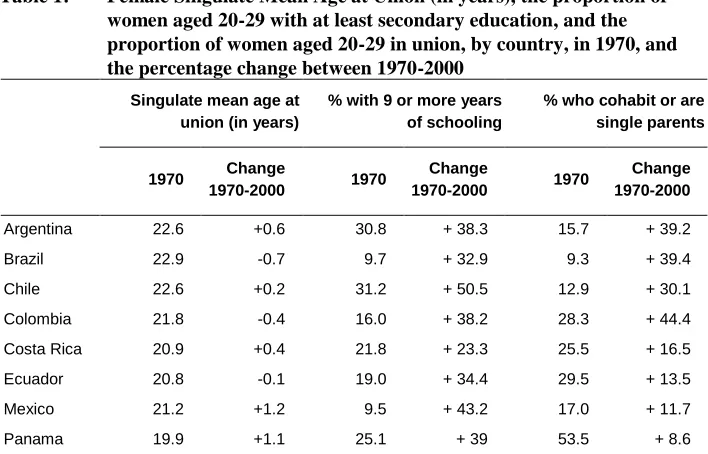
Age at union formation has remained relatively constant in Latin America over the last few decades in a context of intense educational expansion, booming non-marital cohabitation, and marriage retreat and postponement (Fussell and Palloni 2004; Cerrutti and Binstock 2009; García and Rojas 2002; Castro 2002; Heaton et al. 2002; Mensch et al. 2005; Singh and Samara 1996; United Nations 1990; Weinberger et al. 1989; Westoff 2003; Esteve et al. 2012). Table 1 provides figures to illustrate these trends for women aged 20-29 in eight Latin American countries since 1970. The absolute difference in the age at union formation between the most recent and the oldest census is approximately one year or less in all countries. Since 1970 the proportion of young women with nine or more years of schooling has more than doubled (or even tripled), and the share of cohabitation among all unions showed even greater increases (e.g., from 9.3% to 48.7% among Brazilian women and from 28.3% to 72.7% among Colombian women).
Table 1: Female Singulate Mean Age at Union (in years), the proportion of women aged 20-29 with at least secondary education, and the proportion of women aged 20-29 in union, by country, in 1970, and the percentage change between 1970-2000
Singulate mean age at union (in years)
% with 9 or more years of schooling
% who cohabit or are single parents
1970 Change
1970-2000 1970
Change
1970-2000 1970
Change 1970-2000
Argentina 22.6 +0.6 30.8 + 38.3 15.7 + 39.2
Brazil 22.9 -0.7 9.7 + 32.9 9.3 + 39.4
Chile 22.6 +0.2 31.2 + 50.5 12.9 + 30.1
Colombia 21.8 -0.4 16.0 + 38.2 28.3 + 44.4
Costa Rica 20.9 +0.4 21.8 + 23.3 25.5 + 16.5
Ecuador 20.8 -0.1 19.0 + 34.4 29.5 + 13.5
Mexico 21.2 +1.2 9.5 + 43.2 17.0 + 11.7
Panama 19.9 +1.1 25.1 + 39 53.5 + 8.6
These trends are puzzling to social scientists who are aware of the classic association between educational attainment and age at union formation. Despite different views on what drives family change, the effect of education on marriage/union timing is commonly agreed on. Both structural and ideational aspects of education predict marriage postponement as education increases, and there is widespread evidence to confirm this claim (Oppenheimer 1988, Mensch et al. 2005; Jejeebhoy 1996; Singh and Samara 1996; United Nations 1990; Westoff 2003). At the individual level, the evidence from Latin America conforms to the fact that women with more years of schooling are more likely to enter into unions at later ages (Heaton et al. 2002); whereas at the population level, young cohorts with higher levels of educational attainment do not enter into unions at later ages compared to older cohorts with less formal education.
In this sense the Latin American experience contrasts sharply with that of Europe and North America, where modernisation in both the public and private spheres has been associated with delays in first marriages/unions and increases in non-marital cohabitation, especially since the 1970s (Oppenheimer 1988; Sobotka and Toulemon 2008; Thornton et al. 2007; van de Kaa 1987). If we accept the premise that formal education delays the timing of first union (marriage and cohabitation), we would expect educational expansion to increase the number of young adults who have never been in a union and cause the average age at union formation to increase. One necessary condition for a postponement of union entry is that the educational gradient of union formation remains positive and constant over time. Conversely, considering marriage patterns to be stable and independent of educational expansion, age at union formation would remain the same despite more people attaining higher levels of education. Finally, the average age at union formation could remain the same, despite educational expansion, if the educational gradient changes over time.
2. Data and method
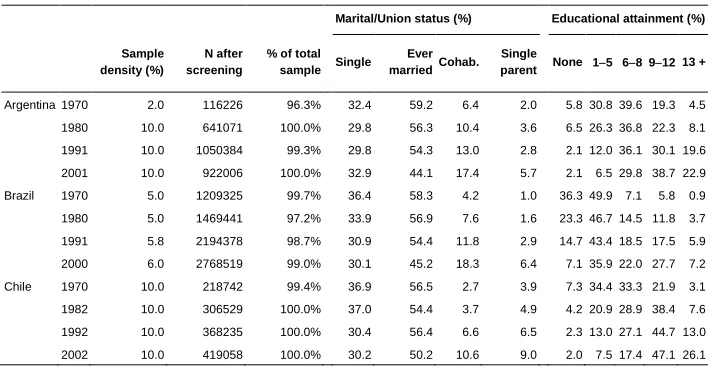
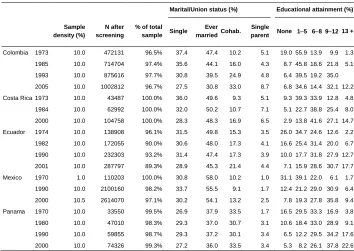
We used the Integrated Public Use of Microdata Series (IPUMS) international database (Minnesota Population Center 2011). Eight Latin American countries (Argentina, Brazil, Chile, Colombia, Costa Rica, Ecuador, Mexico, and Panama) were selected on the basis of the availability of at least two census samples between 1970 and 2000 and comparable available data on union status and education. Because we are interested in union formation patterns we selected only individuals aged 15 to 50. Table 2 describes the data. The use of census data was considered appropriate because it allows the relationship between educational attainment and union formation to be examined for a more extended period of time and a larger number of countries to be compared than other data. Below, we describe the main variables of interest for our study: ‘ever married’, ‘ever in union’, ‘years of schooling’, and control variables.
Table 2: Sample characteristics and descriptions of the main variables
Marital/Union status (%) Educational attainment (%)
Sample
density (%)
N after screening
% of total sample Single
Ever married Cohab.
Single
parent None 15 68 912 13 +
Argentina 1970 2.0 116226 96.3% 32.4 59.2 6.4 2.0 5.8 30.8 39.6 19.3 4.5
1980 10.0 641071 100.0% 29.8 56.3 10.4 3.6 6.5 26.3 36.8 22.3 8.1
1991 10.0 1050384 99.3% 29.8 54.3 13.0 2.8 2.1 12.0 36.1 30.1 19.6
2001 10.0 922006 100.0% 32.9 44.1 17.4 5.7 2.1 6.5 29.8 38.7 22.9
Brazil 1970 5.0 1209325 99.7% 36.4 58.3 4.2 1.0 36.3 49.9 7.1 5.8 0.9
1980 5.0 1469441 97.2% 33.9 56.9 7.6 1.6 23.3 46.7 14.5 11.8 3.7
1991 5.8 2194378 98.7% 30.9 54.4 11.8 2.9 14.7 43.4 18.5 17.5 5.9
2000 6.0 2768519 99.0% 30.1 45.2 18.3 6.4 7.1 35.9 22.0 27.7 7.2
Chile 1970 10.0 218742 99.4% 36.9 56.5 2.7 3.9 7.3 34.4 33.3 21.9 3.1
1982 10.0 306529 100.0% 37.0 54.4 3.7 4.9 4.2 20.9 28.9 38.4 7.6
1992 10.0 368235 100.0% 30.4 56.4 6.6 6.5 2.3 13.0 27.1 44.7 13.0
Table 2: (Continued)
Marital/Union status (%) Educational attainment (%)
Sample
density (%)
N after screening
% of total sample Single
Ever married Cohab.
Single
parent None 15 68 912 13 +
Colombia 1973 10.0 472131 96.5% 37.4 47.4 10.2 5.1 19.0 55.9 13.9 9.9 1.3
1985 10.0 714704 97.4% 35.6 44.1 16.0 4.3 8.7 45.8 18.6 21.8 5.1
1993 10.0 875616 97.7% 30.8 39.5 24.9 4.8 6.4 39.5 19.2 35.0
2005 10.0 1002812 96.7% 27.5 30.8 33.0 8.7 6.8 34.6 14.4 32.1 12.2
Costa Rica 1973 10.0 43487 100.0% 36.0 49.6 9.3 5.1 9.3 39.3 33.9 12.8 4.8
1984 10.0 62992 100.0% 32.0 50.2 10.7 7.1 5.1 22.7 38.8 25.4 8.0
2000 10.0 104758 100.0% 28.3 48.3 16.9 6.5 2.9 13.8 41.6 27.1 14.7
Ecuador 1974 10.0 138908 96.1% 31.5 49.8 15.3 3.5 26.0 34.7 24.6 12.6 2.2
1982 10.0 172055 90.0% 30.6 48.0 17.3 4.1 16.6 25.4 31.4 20.0 6.7
1990 10.0 232303 93.2% 31.4 47.4 17.3 3.9 10.0 17.7 31.8 27.9 12.7
2001 10.0 287797 89.3% 28.9 45.3 21.4 4.4 7.1 15.9 28.6 30.7 17.7
Mexico 1970 1.0 110203 100.0% 30.8 58.0 10.2 1.0 31.1 39.1 22.0 6.1 1.7
1990 10.0 2100160 98.2% 33.7 55.5 9.1 1.7 12.4 21.2 29.0 30.9 6.4
2000 10.5 2614070 97.1% 30.2 54.1 13.2 2.5 7.8 19.3 27.8 35.8 9.4
Panama 1970 10.0 33550 99.5% 26.9 37.9 33.5 1.7 16.5 29.5 33.3 16.9 3.8
1980 10.0 47010 98.3% 29.3 37.0 30.7 3.1 10.6 18.4 33.0 28.9 9.1
1990 10.0 59855 98.7% 29.3 37.2 30.1 3.4 6.5 12.2 29.5 34.2 17.6
2000 10.0 74326 99.3% 27.2 36.0 33.5 3.4 5.3 8.2 26.1 37.8 22.6
Source: IPUMS-International (Minnesota Population Center 2011).
2.1 Ever married and ever in union
was used to identify single individuals who may have been in a consensual union in the past. The explicit assumption here is that those who have children have experienced a relationship (even if short) with someone of the opposite sex. Although this method may erroneously capture a certain percentage of children resulting from sexual intercourse outside of relationships, we accept these possible biases because we would otherwise miss a great number of women who have ever been in a union, given that after the dissolution of a union it cannot be ascertained whether individuals are recorded as single or not. This approach has previously been suggested and tested by Esteve et al. (2011) and Ruiz and Rodríguez (2011) against other sources that used more direct questions on consensual unions in which similar results were obtained. The proportions according to the different union statuses are summarised in Table 2.
2.2 Years of schooling and control variables
Our second variable of interest is the respondents’ level of educational attainment in terms of years of schooling (the IPUMS-International variable YRSCHL), which we grouped into the categories ‘none’, ‘1–5 years’, ‘6–8 years’, ‘9–12 years’ and ‘13+ years’ of completed education. This scheme follows the United Nations’ recommendation of six years of primary, three years of lower secondary, three years of upper secondary, and university/tertiary-level education, which is also typical in Latin America. Sample proportions are provided in Table 2.
The analysis also includes several control variables: single age (between 15 and 50), time (taken as a function of the census year, with 1970 being equal to zero), and country as a fixed effect. Countries were not analysed separately because results showed similar concurrent trends in educational expansion and average age at union formation, despite differences in absolute levels (results available on request).
3. Results
schooling categories. Argentina is taken as the reference country, although similar results were found for the other countries under the model specifications. In addition, an estimate of the change in ever in cohabitation is provided (i.e., change in ever in union minus change in ever married). Negative values indicate that the proportion of a given dimension (i.e., ever married, ever in cohabitation, ever in union) in 2000 was lower than in 1970, and positive values indicate that proportions are higher. The lack of difference in the proportion of women ever in union, regardless of the change in marriage or cohabitation, indicates the lack of change in the timing of union formation. Negative values indicate a sign of postponement, whereas positive values indicate a sign of acceleration.
The data show that of the five years-of-school categories, the proportion of women ever in union remains constant only among those with no education and those with at least 13 years of education. In these cases the decrease in marriage is completely offset by a similar increase in the proportion of cohabiting couples. In the intermediate categories, which comprise the bulk of the population and where most of the educational expansion occurred, the share of women in union at young ages increased over time. This trend indicates that women with similar levels of schooling are entering into union at younger ages compared with previous cohorts, primarily through cohabitation. The rise in the proportion of cohabiting women is larger than the decrease in the ever married.
Figure 1: Estimated difference between 1970 and 2000 in the proportion of females ever in union, ever married, and currently cohabiting, by age and years of schooling. Argentina 1970–2000
Data source: IPUMS-International (Minnesota Population Center, 2011). Note: Argentina was used as reference. However, any other country from the sample would have resulted in the same trend (only the absolute level would vary).
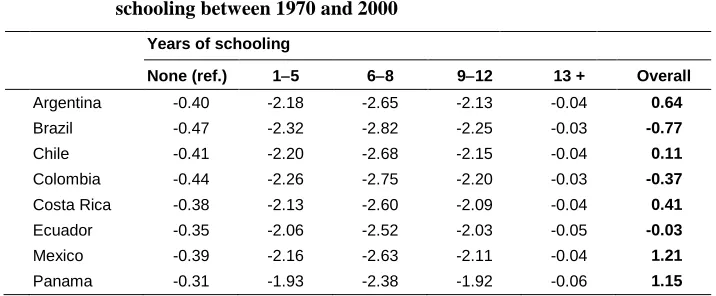
Table 3: Predicted time change in female SMAU as a function of years of schooling between 1970 and 2000
Years of schooling
None (ref.) 15 68 912 13 + Overall
Argentina -0.40 -2.18 -2.65 -2.13 -0.04 0.64
Brazil -0.47 -2.32 -2.82 -2.25 -0.03 -0.77
Chile -0.41 -2.20 -2.68 -2.15 -0.04 0.11
Colombia -0.44 -2.26 -2.75 -2.20 -0.03 -0.37
Costa Rica -0.38 -2.13 -2.60 -2.09 -0.04 0.41
Ecuador -0.35 -2.06 -2.52 -2.03 -0.05 -0.03
Mexico -0.39 -2.16 -2.63 -2.11 -0.04 1.21
Panama -0.31 -1.93 -2.38 -1.92 -0.06 1.15
Source: IPUMS-International (Minnesota Population Center 2011).
4. Summary and discussion
In this paper we have investigated the relationship for women between years of schooling and the timing of first unions in eight Latin American countries from 1970 to 2000, in the context of educational expansion, declining marriage rates, and increasing non-marital cohabitation. To this end we used census data from the IPUMS international database. Our research was motivated by the apparent contradiction between the remarkable stability in age at union formation in Latin America during this period and the steady increase in time that younger generations spend at school.
Our analysis demonstrates that this apparent lack of change (or at most, a slight increase) at the population level is attributable to several contrasting trends, as the expected effects of educational expansion were offset by the younger age at union formation. This observation also implies that the relationship between education and first-union formation changed over time. Compositional changes in the education structure were offset by early in union formation in all educational strata to keep the age-specific proportions of ever in union constant over time.
marriage by cohabitation between generations in the studied period was observed to be associated with a downward trend in women's age at union formation, because marriage is being postponed and/or replaced by cohabitation at earlier ages.
The education-specific patterns described herein can be extrapolated to all of the Latin American countries represented in the study. This suggests that the mechanisms behind the known association between education and union formation timing are similar across countries. This finding justified our approach of not running separate models for each country, despite the cultural and historical differences.
References
Cerrutti, M. and Binstock, G. (2009). Familias latinoamericanas en transformación: desafíos y demandas para la acción pública. Santiago de Chile: Naciones Unidas (CEPAL Serie Políticas Sociales, 147).
Castro, T. (2002). Consensual unions in Latin America: Persistence of a dual nuptiality system. Journal of Comparative Family Studies 33(1): 35.
Esteve, A., Garcia, J. and McCaa, R. (2011). La enumeración de la soltería femenina en los censos de población: sesgo y propuesta de corrección [The enumeration of unmarried women in population censuses: biases and proposed corrections]. Papeles de Población 16(66): 9-40.
Esteve, A., Lesthaeghe, R. and López-Gay, A. (2012). The Latin American Cohabitation Boom, 1970-2007. Population and Development Review 38(1): 55-82. doi:10.1111/j.1728-4457.2012.00472.x.
Fussell, E. and Palloni, A. (2004). Persistent marriage regimes in changing times. Journal of Marriage and Family 66(5):1201-1213. doi:10.1111/j.0022-2445.2004.00087.x.
García, B. and Rojas, O. (2002). Cambio en la Formación y Disoluciones de las Uniones en América Latina [Change in the formation and dissolution of unions in Latin America]. Papeles de Población (32): 12-31.
Heaton, T., Forste, R. and Otterstrom, S. (2002). Family transitions in Latin America: First intercourse, first union and first birth. International Journal of Population Geography 8:1-15. doi:10.1002/ijpg.234.
Jejeebhoy, S.J. (1996). Women's education, autonomy, and reproductive behaviour: Experience from developing countries, international studies in demography. Oxford: Oxford University Press.
Mensch, B.S., Singh, S. and Casterline, J.B. (2005). Trends in the timing of first marriage among men and women in the developing world. Policy Research Division Working Paper no. 202. New York: Population Council.
Minnesota Population Center. (2011). Integrated Public Use Microdata Series, International: Version 5.0 (Machine-readable database). Minneapolis: University of Minnesota.
Oppenheimer, V.K. (1988). A Theory of Marriage Timing. The American Journal of Sociology 94(3): 563-591. doi:10.1086/229030.
Ruiz, M. and Rodríguez, J. (2011). Familia y Nupcialidad en los censos latinoamericanos recientes: una realidad que desborda los datos. Santiago de Chile: Naciones Unidas (CEPAL Serie Población y Desarrollo).
Rosero-Bixby, L., Castro-Martín, T. and Martín-García, T. (2009). Is Latin America starting to retreat from early and universal childbearing? Demographic Research 20(9): 169-194.
Singh, S. and Samara, R. (1996). Early marriage among women in developing countries. International Family Planning Perspectives 22 (4):148-157.
doi:10.2307/2950812.
Sobotka, T. and Toulemon, L. (2008). Overview Chapter 4: Changing family and partnership behaviour: Common trends and persistent diversity across Europe. Demographic Research 19(8): 85-138.
doi:10.4054/DemRes.2008.19.6.
Solís, P. and Puga, I. (2009). Los nuevos senderos de la nupcialidad: cambios en los patrones de formación y disolución de las primeras uniones en México In: Rabell-Romero, C. (ed.). Tramas Familiares en el México contemporáneo. Mexico city: Instituto de Investigaciones Sociales, UNAM and El Colegio de México: pp. 179-198.
Thornton, A., Axinn, W.G. and Xie, Y. (2007). Marriage and cohabitation. Chicago: University of Chicago Press.
United Nations. (1990). First marriage: Patterns and determinants. New York: United Nations.
Van de Kaa, D.J. (1987). Europe’s second demographic transition. Population Bulletin 42(1): 1-59.

![Bis[(E) 4 chloro 2 (cyclohexyliminomethyl)phenolato]nickel(II)](data:image/gif;base64,R0lGODlhAQABAIAAAP///wAAACH5BAEAAAAALAAAAAABAAEAAAICRAEAOw==)