Weak gravitational lensing by Einstein-non-linear-Maxwell-Yukawa black hole
Wajiha Javed,1,∗ Muhammad Bilal Khadim,1,† and Ali ¨Ovg ¨un2, 3,‡1Division of Science and Technology, University of Education, Township-Lahore, Pakistan 2Instituto de F´ısica, Pontificia Universidad Cat´olica de Valpara´ıso, Casilla 4950, Valpara´ıso, Chile.
3Physics Department, Arts and Sciences Faculty, Eastern Mediterranean University, Famagusta, North Cyprus via Mersin 10, Turkey. (Dated: January 12, 2020)
In this article, we analyze the weak gravitational lensing in the context of Einstein-non-linear Maxwell-Yukawa black hole. To this desire, we derive the deflection angle of light by Einstein-non-linear Maxwell-Yukawa black hole using the Gibbons and Werner method. For this purpose, we obtain the Gaussian optical curvature and implement the Gauss-Bonnet theorem to investigate the deflection angle of Einstein-non-linear Maxwell-Yukawa black hole. Moreover, we derive the deflec-tion angle of light in the presence of plasma medium. We also analyze the graphical behavior of deflection angle by Einstein-non-linear Maxwell-Yukawa black hole in the presence of plasma as well as non-plasma medium.
PACS numbers: 95.30.Sf, 98.62.Sb, 97.60.Lf
Keywords: Weak gravitational lensing; Einstein-non-linear Maxwell-Yukawa black holes; Deflection angle; Gauss-Bonnet theorem.
I. INTRODUCTION
In our universe the black holes are essential components and when stars die, they collapse and become very small objects which is the most important discoveries of astrophysics. To test the fundamental laws of universe black holes provide a golden opportunity. For example neutron star merges and the gravitational waves from black holes has been discover recently. Therefore, the gravitational lensing by black holes has attain incredible attention in the last few decade, essentially because of the solid proof about the presence of supermassive black holes at the focal point of galaxies [1,2]. By utilizing the gravitational lensing we can simplified the study of black holes, which is a general investigative method for acquiring the time delays of the images, magnification and positions. Erasmus Darwin [3] was the first who introduced the schwarzschild geometry. After very soon in1985 Walliam Herschel [4] published his similar article and after that many authors [5,6], extended this geometry to general spherically symmetric black holes and Reissner-Nordstrom geometry. Kerr black holes [7]-[10] was also discussed for acquiring the time delays of the images , magnification and positions by using gravitational lensing. Many modification has been done through deflection of light and modification in the reference of non-linear electrodynamics (NLE) [11] has been studied through the various alternative gravity theories [12]. Classically, a black hole contains singularity and also horizon because in general theory of relativity the specetime singularities create a dozen of problems which are physical as well as mathematical. Therefore many people use various methods to remove these singularities from the black holes such as modified gravity, effect of quantum gravity and NLE. Bozza [13,14] discussed these topics in his recent article in details which also include observational prospectus and additional references [15]-[67].
The main focus of this article is to calculate the deflection angle of photon by using GBT. The aspect of deflection of light has been widely studied in different astrophysical system in the influence of strong as well as weak gravita-tional lensing [20]-[24]. Gibbons and Werner [25] made a very important role who contended about the significance of global topology on the deflection of light by utilizing the optical geometry and GBT. Additionally, they have cal-culated deflection angle for the schwarzschild black holes which is different from the other method by supposing domain outside of the light ray, where the mass is closed in the given area on space is strongly related to the lensing effect. Recently, Gibbons and Werner (GW) [25] computed the deflection angle by applying GBT as follows
α=−
Z Z
D∞
KdS.
∗
Electronic address:[email protected]; [email protected]
†Electronic address:[email protected]
‡Electronic address:[email protected]; [email protected]; URL:https://aovgun.weebly.com
Here, K is Gaussian curvature anddS represents the surface element. Afterwards, Werner [26],[27] extend this method and obtained the deflection of light by Kerr-Newman BH by applying the Nazims’s method for Rander-Finsler metric. Recently, deflection angle for a static spherically symmetric and asymptotically flat spacetime by using the finite distance from an observer to a light source has been calculated by Ishihara et al. [28]-[31]. Moreover, Asada et al. [32]in stationary axisymmetric spacetime have calculated the weak gravitational lensing. In all of these methods by using GBT they have calculated the weak gravitational lensing which shows global properties. The study of gravitational lensing in the presence of plasma medium discussed in number of cases. Initially, Bisnovatyi-kogan and Latimer [33]-[34] show that the gravitational deflection in plasma is different from vacuum deflection angle due to presive properties of plasma. Recently, Gallo and Crisnejo [35] have studied the deflection angle of photon in a plasma medium.
Weak gravitational lensing for hairy BH in the back burner of Einstein-Maxwell theory (EMT) with a non-minimally coupled dilaton has been examined by Javed et al. [36]. After that, there is a lot of literature [37]-[78] related to the investigation of weak gravitational lensing through the method of GBT on various black holes, cosmic strings and wormholes. In this paper, we study the weak gravitational lensing by Einstein-non-linear Maxwell-Yukawa black holes.
This paper is composed as follows; In Section 2 We concisely review about Einstein-non-linear Maxwell-Yukawa black hole. In Section 3, By using the Gauss-Bonnet theorem we compute the deflection angle of Einstein-non-linear Maxwell-Yukawa black hole. In Section 4, we enhance our work to investigate the deflection angle in the influence of plasma medium and in addition we demonstrate the graphical impact of deflection angle in the context of Einstein-non-linear Maxwell-Yukawa black hole for plasma as well as non-plasma medium. In Section 5, we recap our results which we obtain in present work.
II. COMPUTATION OF WEAK LENSING BY EINSTEIN-NON-LINEAR MAXWELL-YUKAWA BLACK HOLE AND
GAUSS-BONNET THEOREM
The Einstein-non-linear Maxwell-Yukawa BH in a static and spherically symmetric form is given as [79]
ds2=−f(r)dt2+ dr
2
f(r)+r
2(dθ2+ sin2θdφ2),
(1)
The metric functionf(r)yields
f(r)'1 +2M
r −
4qC0 r2 +
4qC0α
3r −qC0α
2+O(α3). (2)
Here,M rendered as mass of BH,C0is an integration constant [80],qrepresents charge of BH that is located at the
origin andαis a positive constant and it can be chosen asα= 1.
The optical spacetime simply written in equatorial plane (θ= π2) to get null geodesics (ds2= 0)
dt2= dr
2
f(r)2 + r2dφ2
f(r) (3)
From Eq.1we obtain non-zero Christopher symbols given below
Γ000=−f
0(r)
f(r) , Γ
0 11=
2f(r)−rf0(r) 2rf(r) , Γ
1 01=
r2f0(r)−f(r)2r
2 . (4)
Now, we calculate the Ricci Scalar corresponds to the optical metric by using the non-zero Christopher symbols that are stated as:
R=−f
0(r)2
2 +f
00(r)f(r). (5)
The Gaussian optical curvature that is evaluated as follows:
K=RicciScalar
After simplifying, Gaussian optical curvature for Einstein-non-linear Maxwell-Yukawa black hole is stated as:
K=−f
0(r)2
4 +
f(r)f00(r)
2 , (7)
wheref(r)is given in Eq. 2so that Gaussian optical curvature for Einstein-non-linear Maxwell-Yukawa black hole in leading order term is obtained as;
K ≈ −12C0q
r4 + 4 C0qα
3r3 +
2r−3−24C0q
r5 + 4 C0qα
r4
M. (8)
III. DEFLECTION ANGLE OF EINSTEIN-NON-LINEAR MAXWELL-YUKAWA BLACK HOLES AND GAUSS-BONNET
THEOREM
Now, by utilizing GBT, we evaluate the deflection angle of photon by Einstein-non-linear Maxwell-Yukawa BH. By using GBT in the regionGR, given as
Z
GR
KdS+ I
∂GR
kdt+X t
ˆ
α= 2πX(GR), (9)
where,krepresent the geodesic curvature, andKdenotes the Gaussian optical curvature and one can definekas
k = ¯g(∇αˆα,ˆ αˇ)in such a way thatg¯( ˆα,αˆ) = 1, whereαˆ represent the unit acceleration vector andαtdenotes the exterior angle attthvertex respectively. AsR → ∞, we obtain the jump angles equal toπ/2, henceαO+αS →π. Here,X(GR) = 1is a Euler characteristic number andGRdenotes the non-singular domain. Therefore, we obtain
Z Z
GR
KdS+ I
∂GR
kdt+ ˆα= 2πX(GR). (10)
where, the total jump angle isαˆ =π, WhenR→ ∞, then the remaining part isk(DR) =| ∇D˙RD˙R|. Considering the radial component for geodesic curvature that is described as:
(∇D˙R
˙
DR)r= ˙DφR∂φD˙rR+ Γ r φφ( ˙D
φ R)
2. (11)
At very highR,DR :=r(φ) =R=const. Thus, the leading term of equation Eq. 11vanishes and( ˙DRφ)2 = f2(1r?).
RecallingΓr φφ =
2f(r)−rf0(r)
2rf(r) , we get
(∇D˙r R
˙
DrR)r→ −1
R , (12)
and which proves that the geodesic curvature is not effected to the topological defects (i.e.,k(DR)→R−1). We can writedt=Rdφ. Thus;
k(DR)dt= 1
RRdφ. (13)
From the pervious results, we get
Z Z
GR
Kds+ I
∂GR
kdt=R→∞ Z Z
S∞
KdS+ Z π+α
0
dφ. (14)
At0thorder weak field deflection limit of the light is defined asr(t) =b/sinφ. Therefore, the deflection angle stated as:
α=−
Z π
0
Z ∞
b/sinφ
Kpdetgdudφ,¯ (15)
here we put the leading term of Eq. 8into above Eq.15, so the obtained deflection angle upto leading order term is computed as:
α'4M b +
C0M α qπ b2 + 8
C0qα
3b −3 C0qπ
b2 −
32C0M q
IV. WEAK LENSING BY EINSTEIN-NON-LINEAR MAXWELL-YUKAWA BLACK HOLE IN A PLASMA MEDIUM
This portion is based on the investigation of weak gravitational lensing by Einstein-non-linear Maxwell-Yukawa black hole in plasma medium. For Einstein-non-linear Maxwell-Yukawa black hole the refractive index n(r), is obtain as,
n(r) = s
1− ω
2
e
ω2
∞
f(r), (17)
whereωeandω∞are electron plasma frequency and photon frequency measured by an observer at infinity
respec-tively, then the corresponding optical metric illustrated as
dt2=goptij dxidxj =n2(r)
−f(r)dt2+ dr
2
f(r)+r
2(dθ2)
. (18)
The metric functionf(r)is defined in Eq. 2.4and the non-zero christopher symbols corresponding to the optical metric are computed as:
Γ000 =
1 +ω
2
ef(r)
ω2
∞
−ω2
ef0(r) 2ω2
∞
−−f
0(r)
f(r) ,
Γ101 =
1 +ω
2
ef(r)
ω2
∞
−ω2ef0(r) 2ω2
∞
+2f(r)−rf
0(r)
2rf(r) ,
Γ011 =
1 +ω
2
ef(r)
ω2
∞
ω2
ef(r)f0(r)r2 2ω2
∞
+r
2f0(r)−f(r)2r
2 .
(19)
Now, by using the above non-zero christopher symbols the value of Gaussian optical curvature is found as:
K ≈3 ωe
2M
r3ω
∞2
+ 2M
r3 −104
C0qM ωe2
ω∞2r5
−24C0qM
r5 −20
C0qωe2
ω∞2r4
−12C0q
r4 + 16
qα C0ωe2M
ω∞2r4
+ 4qα C0M
r4 (20)
+2qαC0ωe
2
r3ω
∞2
+ 4/3qα C0
r3 .
For this, we use GBT to compute the deflection angle in order to relate it with non-plasma. As follows, for calculating angle in the weak field area, as the light beams become a straight line. Therefore, the condition at zero order is
r= sinφb .
α=−lim R→0
Z π
0
Z R
b sinφ
KdS (21)
So, the deflection angle in the presence of plasma medium is defined as;
α' 4m b + 4
qα C0M ωe2π
b2ω
∞2
+C0qM α π
b2 + 4
C0qα ωe2
bω∞2
+ 8/3qC0α
b −5
C0qωe2π
b2ω
∞2
−3qC0π
b2 −
416qC0M ωe2 9b3ω
∞2
(22)
−32C0qM
3b3 + 6 M ωe2
bω∞2
.
The above result tells us that photon rays are moving into medium of homogeneous plasma. One can see that the plasma effect can be removed by neglecting ωe
ω∞ term from Eq.22and it reduced into Eq.16.
V. GRAPHICAL INFLUENCE OF DEFLECTION ANGLE ON EINSTEIN-NON-LINEAR MAXWELL-YUKAWA BLACK
HOLE
q=10
q=20
q=30
q=40
q=50
10 20 30 40 50 0
5 10 15 20
b
(i)M=1 ,α=1 c=1
M=1 M=2 M=3 M=4 M=5
10 20 30 40 50
0 1 2 3 4 5
b
(i)c=1 ,q=1α=1
Figure 1:αversusb.
• Figure 1indicates the behavior of deflection angle w.r.tbby fixing the value ofM,c,αand varyingq. It is to be observed that for small constant value ofM andq ≥0the behavior of deflection angle gradually decreasing. For valuesq < 0we noticed that the deflection angle gradually negatively increasing. For large value ofM
andq≥0the deflection angle decreasing gradually.
• Figure 2represents the behavior of deflection angle w.r.tbby varying the massM and takingq,c,αfixed. We
noticed that for values ofM ≥0the behavior of deflection angle gradually positively decreasing, on the other hand for the large values ofM <0the behavior of deflection angle negatively increasing. But for large value of
qand ifM ≥0the behavior of deflection angle is decreasing, on contrary forM <0the behavior of deflection angle gradually negatively increasing.
α=-10
α=-20
α=-30
α=-40
α=-50
10 20 30 40 50
-25
-20
-15
-10
-5 0
b
σ
(i)M=1 ,q=1 c=1
c=1
c=2
c=3
c=4
c=5
10 20 30 40 50
0 1 2 3 4 5
b
(i)M=1 ,q=1α=1
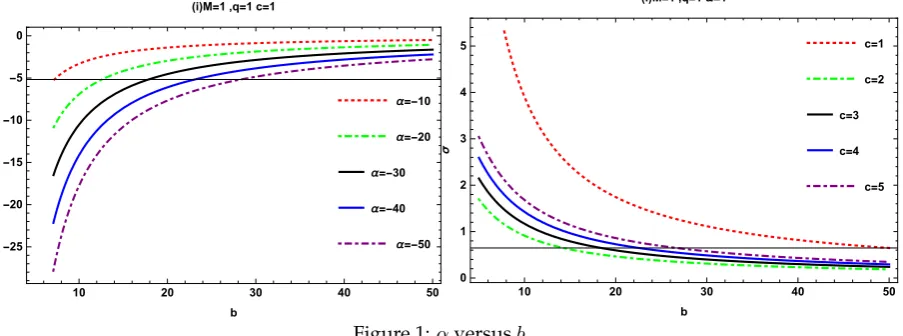
Figure 1:αversusb.
• Figure Leftindicates the behavior of deflection angle w.r.tbby fixing the value ofαand varyingq.c,M It is to be observed that for values ofα≥0the behavior of deflection angle gradually decreasing. For small values of
αwe noticed that the behavior of deflection angle overlaping. For valueα <0the deflection angle gradually negatively increasing.
• Figure Rightrepresents the behavior of deflection angle w.r.tbby varying thecand takingq,α,M fixed. We
noticed that for values ofb > 5 andc ≥ 0the behavior of deflection angle gradually positively decreasing, on the other hand for the values ofb < 5the behavior of deflection angle linear. For the values ofc <0the behavior of deflection angle is negatively decreasing.
VI. GRAPHICAL ANALYSIS FOR PLASMA MEDIUM
β=1 β=2 β=3 β=4 β=5
0 20 40 60 80 100
0 5 10 15 20 25 30 35
b
σ
(i)M=1 ,q=1 ,α=10 ,c=1
q=10 q=20 q=30 q=40 q=50
0 20 40 60 80 100
0 50 100 150 200
b
(i)M=1 ,β=1 ,α=5 ,c=1
Figure 2:α˜versusb.
• Left plot, shows the behavior of deflection angle w.r.tbby taking the fixed values ofM,q,c,αand by varying
β. It is to analyzed that initially the behavior of deflection angle is positively decreasing forβ ≥ 0. But for
β <0, the behavior of deflection angle gradually negatively increasing. Furthermore, in the absence of charge and value ofβ ≥0the behavior of deflection angle positively decreasing.
• Right plot, illustrate the behavior of deflection angle w.r.tbby varying BH chargeqand for fixedM,α,cand
β. We examined that for positive values ofqthe deflection angle gradually positively decreasing. While, for negative values ofqthe behavior of deflection angle is gradually increasing. For large value ofM ,βandq >0 the behavior of deflection angle also gradually decreasing.
α=10
α=20
α=30
α=40
α=50
0 20 40 60 80 100
-50 -40 -30 -20 -10 0
b
(i)M=1 ,β=1 ,q=1 ,c=1
c=1 c=2 c=3 c=4 c=5
0 20 40 60 80 100
0 10 20 30 40
b
(i)M=1 ,β=1 ,q=1 ,α=1
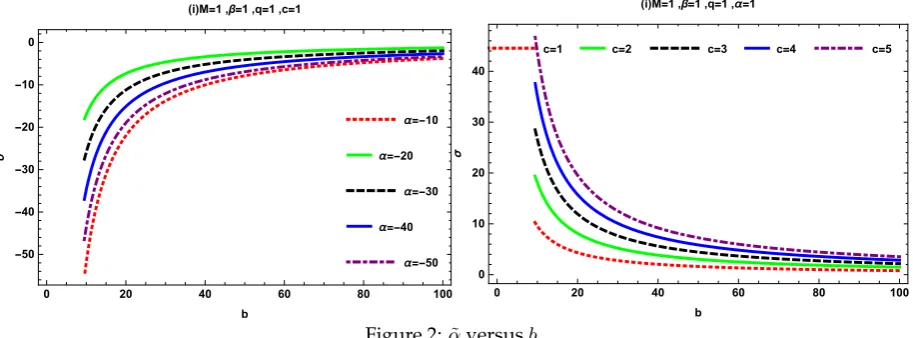
Figure 2:α˜versusb.
• Left plot, examines the behavior of deflection angle w.r.tbby taking the fixed values ofβ,q,c,Mand by varying
α. We noticed that for small values ofα,andβ = 1,q= 1then the deflection angle cannot define the behavior. While, for large values of αthe behavior 0f deflection angle is positively decreasing. For values of α <the behavior of deflection angle gradually increasing.
• Right plot, we analyzed the behavior of deflection angle w.r.tbby varyingcand for fixedM,α,qandβ. we
M=2 M=4 M=6 M=8 M=10
20 40 60 80 100
0 2 4 6 8
b
(i)c=1 ,β=1 ,q=1 ,α=1
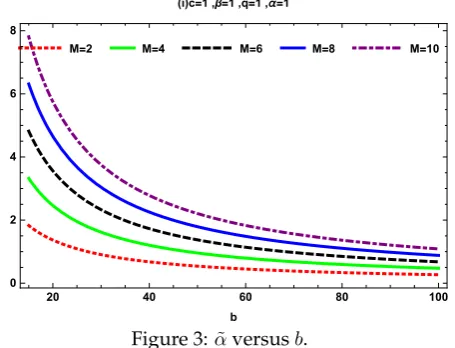
Figure 3:α˜versusb.
• Figure 3, manifest the influence of deflection angle w.r.tbfor constant values ofq,β,c,αand varyingM. It has been noted that for small range ofb < 15the behavior of deflection angle not defined. on the other hand for largeb≥15and forM ≥0the deflection angle positively decreasing and the behavior of deflection angle is negatively increasing for values ofM <0.
VII. CONCLUSION
The present paper is about the investigation of deflection angle by Einstein-non-linear Maxwell-Yukawa BH in non-plasma as well as plasma medium. In this regard, we study the weak gravitational lensing by using GBT and obtain the deflection angle of photon for Einstein-non-linear Maxwell-Yukawa BH. The obtained deflection angle is given as follows:
α'4M b +
C0M α qπ b2 + 8
C0qα
3b −3 C0qπ
b2 −
32C0M q
3b3 +O(q
2, M2, C2 0).
We examine that by the reduction of some parameters the obtained deflection angle converted into the Schwarzschild deflection angle up to the first order terms. We also discuss the graphical effect of different parameters on deflection angle by Einstein-non-linear Maxwell-Yukawa BH.
We also observed that deflection angle in the presence of plasma medium given by Eq.(4.5). which is;
α'4m b + 4
qα C0M ωe2π
b2ω
∞2
+C0qM α π
b2 + 4
C0qα ωe2
bω∞2
+ 8/3qC0α
b −5
C0qωe2π
b2ω
∞2
−3qC0π
b2 −
416qC0M ωe2 9b3ω
∞2
(23)
−32C0qM
3b3 + 6 M ωe2
bω∞2
+O(q2, M2, C02, ωe3)
If the ωe
ω∞ then the plasma effect can be removed. Furthermore, we scrutinized the graphical impact of deflection
angle on Einstein-non-linear Maxwell-Yukawa BH in plasma medium versus some parameters.
Acknowledgments
This work was supported by Comisi ´on Nacional de Ciencias y Tecnolog´ıa of Chile through FONDECYT GrantNo
3170035 (A. ¨O.).
[1] S. Guillessen et al., Astrophys.692, (2009)1075.
[2] B.P Abbott,LIGO Scientific and virgo collabrationPhys. Rev. Lett.116(6),(2016)061102. [3] C. Darwin, proc. Roy.Soc London ,249,(1959)180.
[6] R. D. Viollier, F. R. Leimgruber and D. Trautmann, Phys. Lett.B297,(1992)132. [7] N. Bilic and R. D. Viollier, Phys. Lett.B408,(1997)75.
[8] Akhmedov, E.T., Akhmedova, V. and Singleton, D.: Phys. LettB642(2006)124 Phys. Rev. Lett.116(6). [9] M. Barriola and A. Vilenkin, Phys. Rev. Lett.63,(1989)341.
[10] P. Jetzer, Phys. Rept.220,(1992)163.
[11] W. Javed, J. Abbas, and A. ¨Ovg ¨un, Eur. Phys. J. C79, no. 8, 694 (2019). [12] S. vazques and E. Esteban, Nuovo cim.119B,(2004)489.
[13] V.Bozza, Phy.Rev.D66,(2002)103001.
[14] A unifed treatment, Phys. Rev.D97, (2018)124016.
[15] Vieira, H. S., Bezerra, V. B. and Muniz, C.R.: Annals Phys.350,(2014)4.
[16] V. Morozvan B. Ahmadov and A.Tursunov, Astrophys space sci.346,(2013)513. [17] S. Mao, Bpaczynski, AstrophysJ374, (1991)37.
[18] M. Barriola and A. Vilenkin, Phys. Rev. Lett.63, 341 (1989). [19] E.F. Eiro .G.E Romero. D.F Torres, Phys.Rev.D66(2002)024010. [20] D.Valls-Gabaud, AIP conf.proc.861,(2006)1163.
[21] K. Jusufi, A. ¨Ovg ¨un, J. Saavedra, P. A. Gonzalez and Y. Vasquez, Phys. Rev. D97, 124024 (2018). [22] Akhmedova, V., Pilling, T., de Gill, A. and Singleton, D.: Phys. Lett,B666(2008)269.
[23] Parikh, M.K. and Wilczek, F. Phys. Rev. Lett.85,(2000)5042
[24] A.Einstein, Lens-like action of star by the deviation of light in the gravitational field. Science84(1936)506. [25] G. W. Gibbons and M. C. Werner, Class. Quant. Grav.25, 235009 (2008).
[26] M. C. Werner, Gen. Rel. Grav.44, 3047 (2012). [27] H. Arakida, M. Kasai, Phys.Rev.,D85,(2012)023006.
[28] A. Ishihara, Y. Suzuki, T. Ono and H. Asada, Phys. Rev. D95, no. 4, 044017 (2017).
[29] A. Ishihara, Y. Suzuki, T. Ono, T. Kitamura and H. Asada, Phys. Rev. D 94, no. 8, 084015 (2016). [30] T. Ono, A. Ishihara and H. Asada, Phys. Rev. D99, no. 12, 124030 (2019).
[31] X.Er and S. Mao Mon Not Roy Astron soc.437,(2013)2180.
[32] T. Ono, A. Ishihara and H. Asada, Phys. Rev. D98, no. 4, 044047 (2018). [33] G. S. Bisnovatyi-Kogan and O. Y. Tsupko, Grav. Cosmol.20, no. 3, 220 (2014). [34] O. Y. Tsupko and G. S. Bisnovatyi-Kogan, Phys. Rev. D87, no. 12, 124009 (2013) [35] G. Crisnejo, E. Gallo, Phys. Rev. D 97(12), 124016 (2018).
[36] W. Javed, j. Abbas and A. ¨Ovg ¨un, Phys. Rev. D100, no. 4, 044052 (2019). [37] A. Rogers, Mon. Not. Roy. Astron. Soc.451, no. 1, 17 (2015).
[38] V.Morozvan B.Ahmadov and A.Tursunov, Astrophys space sci346,(2013)513. [39] Nozari, K. and Mehdipour, S.H.: Europhys. Lett.84,(2008)20008.
[40] Sharif, M. and Javed, W.: Eur. Phys. J.C72(2012)1997.
[41] Vieira, H. S., Bezerra, V. B. and Muniz, C.R.: Annals Phys.350(2014)4. [42] K. Jusufi and A. ¨Ovg ¨un, Phys. Rev. D97, no. 2, 024042 (2018). [43] G.W. Gibbons and C. M.Warnick, Phys. Rev. D 79, 064031 (2009).
[44] G.W. Gibbons, C. A. R. Herdeiro, C. M.Warnick and M. C.Werner, Phys. Rev. D 79, 044022 (2009). [45] G.W. Gibbons and M. Vyska, Class. Quant. Grav. 29, 065016 (2012).
[46] C. Bloomer, arXiv:1111.4998 [math-ph].
[47] G.W. Gibbons, Class. Quant. Grav. 33, no. 2, 025004 (2016). [48] P. Das, R. Sk and S. Ghosh, Eur. Phys. J. C 77, no. 11, 735 (2017). [49] I. Sakalli and A. Ovgun, EPL 118, no. 6, 60006 (2017).
[50] K. Jusufi, M. C.Werner, A. Banerjee and A. ¨Ovg ¨un, Phys. Rev. D 95, no. 10, 104012 (2017). [51] T. Ono, A. Ishihara and H. Asada, Phys. Rev. D96, no. 10, 104037 (2017).
[52] K. Jusufi, I. Sakalli and A. ¨Ovg ¨un, Phys. Rev. D96, no. 2, 024040 (2017). [53] H. Arakida, Gen. Rel. Grav.50, no. 5, 48 (2018).
[54] A. ¨Ovg ¨un, I. Sakalli and J. Saavedra, JCAP1810, no. 10, 041 (2018) [55] A. ¨Ovg ¨un, I. Sakalli and J. Saavedra, Annals Phys.411, 167978 (2019). [56] A. ¨Ovg ¨un, G. Gyulchev and K. Jusufi, Annals Phys.406, 152 (2019). [57] A. ¨Ovg ¨un, K. Jusufi and I. Sakalli, Annals Phys.399, 193 (2018). [58] K. Jusufi and A. ¨Ovg ¨un, Phys. Rev. D97, no. 6, 064030 (2018). [59] A. ¨Ovg ¨un, Phys. Rev. D98, no. 4, 044033 (2018)
[60] T. Ono, A. Ishihara and H. Asada, Phys. Rev. D99, no. 12, 124030 (2019). [61] G. Crisnejo, E. Gallo and A. Rogers, Phys. Rev. D99, no. 12, 124001 (2019). [62] Z. Li and T. Zhou, arXiv:1908.05592 [gr-qc].
[63] Z. Li and J. Jia, arXiv:1912.05194 [gr-qc].
[64] Z. Li, G. He and T. Zhou, arXiv:1908.01647 [gr-qc]. [65] A. ¨Ovg ¨un, Universe5, no. 5, 115 (2019).
[66] W. Javed, R. Babar, A. Ovgun, Phys. Rev. D99, no. 8, 084012 (2019).
[67] W. Javed, A. Hazma and A. ¨Ovg ¨un, Preprints 2019, 2019110142 (doi:10.20944/preprints201911.0142.v1) [68] A. ¨Ovg ¨un, Phys. Rev. D99, no. 10, 104075 (2019).
[70] G. Crisnejo, E. Gallo, and J. R. Villanueva, Phys. Rev. D100, no. 4, 044006 (2019). [71] W. Javed, R. Babar, and A. ¨Ovg ¨un, Phys. Rev. D100, no. 10, 104032 (2019) [72] K. de Leon and I. Vega, Phys. Rev. D99, no. 12, 124007 (2019)
[73] Y. Kumaran and A. ¨Ovg ¨un, Chin. Phys. C44, 025101 (2020).
[74] W. Javed, J. Abbas, Y. Kumaran and A. ¨Ovg ¨un, Preprints 2019, 2019110210 (doi: 10.20944/preprints201911.0210.v1). [75] A. ¨Ovg ¨un, I. Sakalli and J. Saavedra, arXiv:1908.04261 [gr-qc].
[76] K.Jusufi, A. ¨Ovg ¨un, A. Banerjee, and I. Sakalli, Eur. Phys. J. Plus134, no. 9, 428 (2019). [77] K. Jusufi, A. ¨Ovg ¨un, and A. Banerjee, Phys. Rev. D96, no. 8, 084036 (2017).
[78] Z. Li and A. ¨Ovg ¨un, arXiv:2001.02074 [gr-qc] (Accepted to publish in PRD).
[79] S. Habib Mazharimousavi and M. Halilsoy, Int. J. Mod. Phys. D28, no. 09, 1950120 (2019).