1
Current Status of the Degradation of Aliphatic and Aromatic Petroleum Hydrocarbons by Thermophilic Microbes and Future Perspectives
Alexis Nzila
Department of Life Sciences, King Fahd University of Petroleum and Minerals Dhahran, Saudi Arabia
Corresponding author: Dr Alexis Nzila, King Fahd University of Petroleum and Minerals, Department of Life Sciences, PO Box 468 Dhahran, 31261 Saudi Arabia.
Tel: +966-13-860-7716; fax: +966-13-860-7031; email: [email protected]
2 Abstract
Contamination of the environment by petroleum products is a growing concern worldwide, and strategies to remove these contaminants have been evaluated. One of these strategies is biodegradation, which consists of the use of microorganisms. Biodegradation is significantly improved by increasing the temperature of the milieu, thus, the use of thermophiles, microbes that thrive in high-temperature environments, will render this process more efficient. For instance, various thermophilic enzymes have been used in industrial biotechnology because of their unique catalytic properties. Biodegradation has been extensively studied in the context of mesophilic microbes, and the mechanisms of biodegradation of aliphatic and aromatic petroleum hydrocarbons have been elucidated. However, in comparison, little work has been carried out on the biodegradation of petroleum hydrocarbons by thermophiles. In this paper, a detailed review of the degradation of petroleum hydrocarbons (both aliphatic and aromatic) by thermophiles has been carried out. This work has identified the characteristics of thermophiles, and unravelled specific catabolic pathways of petroleum products that are only found in thermophiles. Gaps that limit our understanding of the activity of these microbes have also been highlighted, and finally, different strategies that can be used to improve the efficiency of degradation of petroleum hydrocarbons by thermophiles have been proposed.
3 Introduction
Contamination with petroleum hydrocarbons, as the result of oil exploitation, transport and refinement, is a growing concern worldwide. Thus, their removal from the environment remains a priority. Several approaches exist, however, biodegradation, which exploits the ability of microorganisms to use pollutants as a source of carbon and energy, remains the most attractive since it is relatively cheaper and environmentally friendlier than chemical and physical approaches.
Petroleum hydrocarbon consists of alkanes (aliphatic compounds with up to 40 or more carbon [C] atoms); monocyclic aromatic hydrocarbons (MAHs, such as benzene, phenol, and their derivatives); polycyclic aromatic hydrocarbons (PAHs), which are subdivided further into low- and high-molecular weight PAHs (LMW-PAHs and HMW-PAHs, respectively). LMW-PAHs consist of 2–3 rings such as naphthalene (NAPH), phenanthrene (PHEN), anthracene (ANTH), and fluorene (FLR), while HMW-PAHs contain four or more rings, and these include fluoranthene (FLT), pyrene (PYR), benzo[a]pyrene (BZP) and benzo[a]anthracene (BZA) [1, 2].
Generally, aliphatic compounds are more amenable to biodegradation than aromatic compounds, and the higher the number of rings, the more difficult is the biodegradation. Nevertheless, the literature is replete with reports on the biodegradation of petroleum hydrocarbons including HMW-PAHs, in mesophilic conditions. Mesophiles (bacteria that grow optimally at 20-40 oC) that degrade petroleum hydrocarbons have been extensively studied (primarily in low salinity, <4% NaCl, and at neutral pH), and are estimated to belong to more than 65 genera [3], and readers are referred to the following excellent reviews on this topic [2, 4-8].
4
Thermophiles fall into three groups. The moderate and extreme thermophiles, with optimum biodegradation temperatures of 40–59 oC and 60–85 oC, respectively, and the hyper-thermophiles, with optimum temperatures >85 oC [13, 14]. Several advantages are associated with the use of thermophiles (Figure 1). High temperatures lead to increased kinetic reactions (thus, high reaction rates) and high mass transfer, thus increasing the biodegradation. In addition, high temperature has a significant influence on the bioavailability of petroleum hydrocarbons, especially PAHs, by decreasing their viscosity, leading to an increase in their diffusion coefficients, therefore improving their availability to microorganisms [14]. All of these properties have made thermophiles a valuable source of enzymes in industrial biotechnology [15-17].
5
degradation, and also comparative information between thermophiles and mesophiles in relation to petroleum product degradation. In the current review, work carried out on this topic since the 1980s has been reviewed, and detailed observations of this work (in comparison to that of mesophiles) have led to the unravelling of important and unique features of thermophiles involved in the degradation of petroleum hydrocarbons, and these characteristics have not been described so far. For instance, more than 75% of PHDT belong to one single genus, Geobacillus, a situation different from that which prevails in mesophiles. Unique catabolic pathways (present only in PHDT) have been highlighted. More importantly, gaps that limit our understanding of the activity of these microbes have also been presented, and finally, different strategies that can be used to improve the efficiency of PHDT have been proposed. Overall, this review opens up new research avenues on this topic.
2. Summary of work on PHDT
In 2001, Nazina et al. re-examined the genus Bacillus and proposed a new genus, Geobacillus, for some bacteria that were initially classified as Bacillus. Specifically, those authors proposed that species such as Bacillus stearothermophilus, Bacillus thermoleovorans and Bacillus
thermodenitrificans should be classified in the genus Geobacillus, as the renamed species G.
stearothermophilus, G. thermoleovorans, and G. thermodenitrificans [22]. Thus, to be in line with
this new proposed classification, in this review, the aforementioned Bacillus species were named
Geobacillus species even if they were reported before 2001.
2.1. Alkane biodegradation
The first report on PHDT dates back to the mid-1960s. Mateles et al. isolated a thermophile,
Geobacillus stearothermophilus, from soil water/soil samples from the US, by enrichment in the
6
Yellowstone National Park (Table 1, ST3). These strains could degrade C10–C20 n-alkanes and C6– C8 alkenes at an optimum temperature of 60 oC, but not those <C9 (alkanes) nor <C6 (alkenes) [25]. Further investigations showed that YS-3 and YS-4 belong to the species Thermoleophilum
minutum and Thermoleophilum album, respectively [26]. The inability of these strains to utilize
shorter chain n-alkanes will be discussed in section 3.2.
Using a sample from a hot water spring on Kunashir Island, Russia, Loginova et al. isolated two thermophilic bacterial strains, G. stearothermophilus and Thermus ruber, capable of growing in the presence of paraffins at an optimum temperature of 60 oC [27] [ST4]. A few years later, in 1984, using an inoculum consisting of mud and water from various sites across the United States, a thermophilic strain, T. album, was isolated by an enrichment experiment at 60 °C, in the presence of n-heptadecane. This strain was capable of degrading C13–C20 n-alkanes [28] [ST5]. Three years later (ST6), the same research group, using the same methodology and the same inoculum, reported the isolation of a thermophilic bacterium G. thermoleovorans that degraded C13–C20 n-alkanes within the temperature range of 55–65 oC. Interestingly, this bacterium could not grow in the presence of n-alkanes with <C9 and >C20 [29].
Two strains of G. stearothermophilus (KTCC-B2M and KTCC-B7S) were isolated by enrichment of oil-contaminated samples from Kuwait, in the presence of crude oil. The two strains could degrade C15–C18 n-alkanes, while n-alkanes with lower carbon numbers, alkenes and aromatics were less efficiently degraded [30] [ST7]. In another study, two anaerobic facultative strains, G.
thermoleovorans B23 and H41, were isolated from produced water from deep petroleum reservoirs
in Japan. These strains could degrade C13–C26 n-alkanes within a temperature range of 50–80 °C. However, less degradation was observed when shorter alkane chains (<C12) were used [31] [ST8]. Further investigations demonstrated that these strains could degrade n-alkanes through terminal oxidation, followed by β-oxidation [31].
7
section 3.3.1, alkB, a gene encoding the enzyme system responsible for the first step of the degradation of n-alkanes, was not found in this strain [32] [ST9]; instead, a novel alkane monooxygenase, LadA, was identified [33]. In a different study, various species of Geobacillus (G.
thermoleovorans strain 27, Geobacillus caldoxylosilyticus 17, Geobacillus pallidus 2, Geobacillus
toebii 1, Geobacillus sp. 3) that degrade n-hexadecane have been isolated following an enrichment
of contaminated soil samples. In that study, evidence indicated that the expression of alkB gene was induced by n-hexadecane [34] [ST10]. The use of the same substrate, n-hexadecane, in the enrichment of a medium containing an inoculum from Dongxin oil reservoir, China, led to the isolation of a thermophilic bacterium TH2, that was able to degrade petroleum hydrocarbons, mainly n-alkanes, at an optimum temperature of 70 oC [35] [ST11]. In that study, species identification was not carried out.
Recently, Tourova et al. reported three strains, G. toebii В-1024, Geobacillus sp. 1017 and
Aeribacillus pallidus 8m3, capable of degrading C10–C30 n-alkanes (ST12) [36]. The alkB gene,
encoding rubredoxin-dependent alkane monooxygenase, was found in these three strains, while another gene, ladA gene, which codes for flavin-dependent alkane monooxygenase, was only present in the strains В-1024 and 1017 [36]. That study revealed (as will be discussed in section 3.3.1), for the first time, the simultaneous presence of alkB and ladA genes, responsible for oxidation of medium-chain and long-chain n-alkanes [36]. In addition, the genome of
Geobacillus sp. 1017 was sequenced, and several key genes associated with the degradation of
petroleum hydrocarbons have been identified [37].
In the aforementioned studies, bacteria were isolated following enrichment in the presence of hydrocarbons. However, in 2006, hydrocarbon degrading bacteria were isolated using an alkJ
probe, an alkane hydroxylase gene involved in the degradation of n-alkanes [38] (ST13). Bacteria in volcanic samples from Greece were first cultured in rich media in a temperature range of 60–80 oC, and around 150 strains were isolated. Thereafter, genetic investigations using the alkJ probe led to the identification of 10 strains, and 4 were G. thermoleovorans, 3 G.
stearothermophilus, 2 Geobacillus anatolicus and 1 Bacillus aeolius [38]. Further studies
8 2.2. Monocyclic aromatic hydrocarbons (MAHs)
The first evidence of MAH biodegradation was provided in 1974. A strain of G.
stearothermophilus PH24 was selected from industrial sediment and grew at 55 oC in the presence
of phenol. Further studies indicated that, in addition to phenol, this strain could also degrade catechol, at an optimum temperature of 50 oC [39] [ST14]. Evidence was also provided that this strain could cleave catechol at the meta-position. A year later, the same strain was shown to degrade other MAHs including o-, m- and p-cresol, 3-methylcatechol and 4-methylcatechol [40, 41] [ST15].
Using soil that had been pasteurised for 10 min at 80 oC, Adams and Ribbons isolated a strain of
G. stearothermophilus IC3by enrichment in the presence of phenol and cresol. In addition to
m-cresol and phenol, this strain could also utilize benzoic acid, and the degradation of phenol led to catechol, followed by cleavage at the meta-position [42] [ST16]. A year later, another phenol-degrading G. stearothermophilus strain BR219 was isolated (by enrichment in the presence of phenol), using river sediment from the USA (ST17) [43]. Further investigation led to the characterization of phenol hydroxylase, the first enzyme involved in phenol degradation [44].
Dong et al. (1992) reported the isolation of a G. stearothermophilus strain FDTP-3; however, detailed information was not available on the source of the inoculum and the conditions of the isolation [45] [ST18]. The strain could degrade phenol along with catechol, but not benzoic acid. Two genes of the meta pathway of phenol degradation, phenol hydroxylase and catechol 2,3-dioxygenase, were also characterized by cloning in Escherichia coli [45, 46]. Using phenol as the sole substrate, a Geobacillus sp. A2 strain was isolated from a hot spring sample (from Iceland), in an enrichment experiment at 70 oC [46, 47] [ST19]. This strain could grow efficiently in the presence of phenol or isomers of cresol (o-, m-, and p-cresol) at 70 oC. In addition, the cleavage of the aromatic ring proceeds through the meta-position. Genetic analysis showed that this A2 strain was closely related to G. thermoleovorans [46, 47]. In a different study, two strains, Thermus
aquaticus ATCC 25104 and Thermus sp. ATCC 27978, were shown to degrade the MAHs
9
radioactive 14CO2 was identified, illustrating the complete mineralization of these compounds [48]. In another study, three strains of phenol degrading Bacillus were isolated following an enrichment of contaminated samples in the presence of phenol, at 50 oC [49] [ST21]. These strains could degrade phenol (along with o-, m-, and p-cresol) in an optimum temperature range of 50–55 °C, and this degradation (for phenol) is carried out via the meta-pathway. The presence of catechol 2,3-dioxygenase was also detected in this study [49].
A halotolerant and thermophilic strain, Aeribacillus pallidus VP3, was isolated following enrichment of an inoculum consisting of production water from a Tunisian oil field, in the presence of the MAH vanillic acid, at 55 oC. The selected strain VP3 could degrade several MAH compounds including benzoic, p-hydroxybenzoic, protocatechuic, gallic, p-coumaric, ferulic and caffeic acids [50] [ST22].
All of the aforementioned studies were carried out in bacteria. However, archaea have also been shown to degrade MAHs. For instance, a thermophilic strain of Sulfolobus solfataricus P2 isolated from a volcanic site, was sequenced, and its genome revealed the presence of genes encoding enzymes involved in MAH degradation, including mono- and dioxygenases [51]. This information led Izzo et al. to investigate the ability of this archaean strain to grow in the presence of MAH [52] [ST23]. The results indicated that S. solfataricus P2 could actively grow on phenol as the sole source of carbon, at an optimum temperature of 80 oC, and the presence of phenol induced the expression of enzymes involved in the degradation of MAHs. As will be discussed in section 4.1.2, this study illustrates the usefulness of the exploitation of genome information to identify potential substrates (pollutants) that a given microorganism can degrade [52].
2.3 Polycyclic aromatic hydrocarbons (PAHs)
10
The ability of two thermophilic strains, Bacillus subtilis BUM and Mycobacterium vanbaalenii
BU42, degrading PHEN were tested in degrading BZP at 55 oC. Neither of the strains could degrade BZP when used as the sole source of carbon [54]. However, when BZP was used as co-substrate with PHEN, the strain BUM could degrade BZP, while the strain BU42 could not [54] [ST25]. This investigation illustrated the usefulness of cometabolism (in the case of the BUM strain) in the removal of recalcitrant PAH, as will be discussed in section 4.4.2.
Another example of HMW-PAH degradation by cometabolism was provided by Feitkenhauer and Markl [55] [ST26]. Using a mixture of thermophilic bacteria Bacillus sp. and Thermus sp. pre-isolated from hot springs, compost piles and industrial wastewater, the authors showed that these two strains could degrade the PAHs acenaphthene, FLT, PYR and BZP, but only in the presence of hexadecane [55] [ST26]. In this context of cometabolism, hexadecane was the growth substrate, while PAHs were non-essential substrates, as will be discussed in section 4.4.2.
Using soil samples from contaminated areas in Kowait as inoculum, several thermophilic bacteria were isolated by enrichment in the presence of a mixture of the following PAHs (NAPH, PHEN, ANTH, PYR and FLR) and the heterocyclic polyaromatics (benzothiophene, dibenzothiophene dibenzofuran and carbazole), at 60 oC. Several thermophilic bacteria were isolated, including
Bacillus firmus, Bacillus pallidus, Anoxybacillus sp., Paenibacillus sp., and Saccharococcus sp.
[56] [ST27]. Interestingly, when glucose was used as substrate, the thermophilic bacteria growth was inhibited, and this inhibition was explained by catabolite repression, in which glucose acts as a repressor for the synthesis of some enzymes involved in the biodegradation of PAHs [56]. The existence of this inhibitory effect in the context of cometabolism during degradation of petroleum hydrocarbons has already been reported [57], and as will be discussed in section 4.4.2, this inhibition puts a caveat on the process of cometabolism.
11
identification of key NAPH metabolites [59, 60] [ST29]. As will be discussed in section 3.3.3, overall, the NAPH degradation pathway differs from that of mesophilic bacteria. The same strain has also been shown to degrade PHEN and ANTH, and several of their metabolites have been identified [60] [section 3.3.3]. In another study, a NAPH degrading thermophilic bacterium,
Geobacillus sp. G27, was isolated from a geothermal oil field in Lithuania. The strain could
degrade NAPH, along with ANTH, protocatechuic acid, benzene-1,3-diol, phenol and benzene at an optimum temperature of 60 oC. However, no growth was observed with catechol [61] [ST30]. Chromatographic analyses have indicated that the first NAPH ring opening occurred via ortho-cleavage, leading to protocatechuic acid, as will be discussed in section3.3.3.
Early on, in 2000, the enrichment of a hydrocarbon contaminated soil from Germany in the presence of NAPH at 60 oC led to the isolation of a G. thermoleovorans Hamburg 2 strain [62] [ST31]. Further studies showed the presence of some NAPH metabolites generated by this strain, such as benzoic acid, which has not been commonly reported in mesophiles (section3.3.3).
Two strains of Geobacillus genus, G. pallidus XS2 and XS3, isolated from oil contaminated soil from China, were reported to degrade PHEN and FLR. The strains were selected following enrichment in the presence of PHEN, FLR and crude oil, at 60 oC. Further analyses showed that more than 70% of the tested PAHs were degraded within 20 days (from 250 mg/L), and in addition, the strain could degrade n-alkanes and produce bioemulsifier [63] [ST32]. In another study, the enrichment of a soil sample from a Chinese oilfield, in the presence of the crude oil at 70 oC, led to the isolation of Geobacillus sp. SH-1. This strain could degrade NAPH and C12–C23 n-alkanes [64] [ST33]. Several metabolites of NAPH have been identified (section 3.3.3).
12
characterization of the catechol dioxygenase enzyme, a clear illustration of the ability of this strain to convert BZP to aliphatic derivatives [66] [ST35].
3. General findings
3.1. Geobacillus are the most dominant PHDT
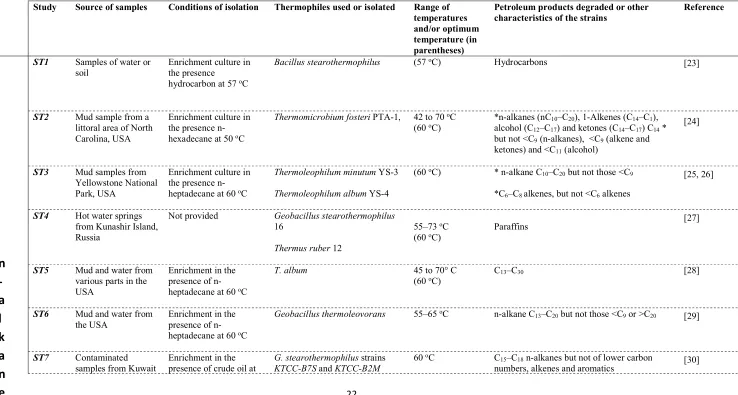
As Table 1 shows, a total of 49 different strains of thermophilic bacteria and one archaea (S.
solfataricus) degrading hydrocarbons were isolated and/or characterized, and they all fall in the
following 12 genera (Figure 2): Thermomicrobium, Sulfolobus, Anoxybacillus, Paenibacillus,
Saccharococcus, Mycobacterium and Nocardia at 1.7% each, Aeribacillus (3%), Thermoleophilum
(5%), and Bacillus (10%); the most striking observation was that the bulk of strains, around 63%, belong to the genus Geobacillus.
13
among others. Thermophiles are known to be distributed in more than 70 genera, with a total of 140 species [35]. Although only seven genera of these thermophiles have been reported in this review, however, the skewness of species to Geobacillus genus deserves further discussion.
In comparison, the distribution of the mesophiles that degrade hydrocarbons is wider. More than 150 different genera have been reported, and a careful observation of the seminal reviews on this topic clearly shows that not a single genus represents even more than 25% of the reported species [4, 5, 7, 67]. This begs the question why do thermophiles degrading hydrocarbons belong predominantly to the genus Geobacillus?
Bacteria of Geobacillus genus are endospore-forming microbes, and are aerobic or facultative anaerobic. They are primarily thermophiles, thus are appropriate to proliferate in environments where temperatures are relatively high. However, surprisingly, they have even been found in a wide range of moderate and low-temperature environments, including the deep sea, which are below their minimum requirement for growth [17, 68]. Evidence indicates that their endospores resist high stress conditions, including temperature variation, UV light and desiccation [68]. These bacteria are also characterized by their lower size of spores (around 1 µm diameter), allowing them to remain suspended in the atmosphere for long periods, time that can be sufficient for their widespread distribution to all continents [17, 68]. In addition, genomic investigations show that these microbes have a battery of gene encoding transporters and hydrolytic enzymes, specifically those adapted to using plant biomass as a source of carbon and energy [17, 68-70]. These observations, coupled with the high reproduction rate of Geobacillus, have been proffered to be the driving factors for the ubiquitousness of this thermophilic genus on earth [17, 68-70]. However, their high presence in environments contaminated with petroleum products underscores that these bacteria are also endowed with gene encoding enzymes involved in the degradation of both aliphatic and aromatic products [17], and as discussed in section 3.3, some of these catabolic genes (or enzymes) have been characterized.
It is also worth noting that, among the Geobacillus genera, G. stearothermophilus and G.
thermoleovorans represent 67% of all Geobacillus species. G. stearothermophilus is the most
14
3.2. Short chain n-alkanes are less efficiency degraded
Most studies in which several n-alkanes were investigated showed clearly that, in general, shorter chain n-alkanes (generally <C9) were less efficiently degraded than longer chain (>C25) [ST2, 3,4,5,6,7,8,9].
These observations are in line with those made on mesophiles, that midsized n-alkanes (C10–C20) are generally more amenable to degradation than shorter or longer chain n-alkanes. One of the reasons for the slow utilization of longer chains is their low water solubility, thus their low bioavailability compared to midsized alkanes [71]. On the other hand, although short-chain n-alkanes have higher aqueous solubility, they are toxic to microbes or cells, and the mechanisms of this toxicity are associated with their uptake and dissolution in the cell membrane [71]. Thus, though short chain n-alkanes are more bioavailable than midsized or long chain n-alkanes, they are associated with cell toxicity, hence their inhibition of microbial growth.
3.3. Specific observations in relation to mechanisms of degradation 3.3.1. n-Alkanes
In general, the mechanisms of n-alkane degradation proceed in a similar fashion with both mesophiles and thermophiles. This process is initiated by the action of monooxygenases, enzymes that incorporate one atom of O2 into the n-alkane chain, or by dioxygenases, enzymes that can incorporate two O2 atoms. Both pathways will lead to the generation of alcohol, which will then be converted into fatty acids, and the latter will then be subjected to β-oxidation to generate energy and CO2 through the central metabolism of the bacteria [72]. The genes involved in this pathway have been studied in mesophiles, specifically in the Pseudomonas genus. The n-alkane pathway is controlled by two operons: the alkBFGHJKL operon encodes components of the alkB system, the membrane-bound n-alkane hydroxylase system, and the alkT/alkS operon. The latter, lkT/alkS operon, encodes rubredoxin reductase enzyme, which also regulates the expression of the
alkBFGHJKL operon [73, 74]. This AlkB gene has also been characterized in thermophilic bacteria
Geobacillus and Aeribacillus [34, 36] [ST10,12]. Thus, it is likely that other genes belonging to
these operons are present in thermophiles that degrade petroleum products. For instance, as will be discussed in section4.1.2, the alkJ gene from Pseudomonas has been used to detect and isolate n-alkanes utilizing thermophilic strains of G. thermoleovorans, G. stearothermophilus, G. anatolicus
15
In addition to the AlkB system, two other oxygenases have been reported in mesophiles. These are cytochrome P450 monooxygenases, which belong to the cytochrome CYP153 family [75], and flavin-dependent dioxygenases, encoded by the almA gene [76]. AlkB and CYP153 enzymes are generally implicated in the oxidation of medium-chain C5–C17 n-alkanes while the almA system is associated with the oxidation of long-chain C10–C30 n-alkanes [73, 75, 76].
Interestingly, so far, the two systems, CYP153 and AlmA, have not been reported in thermophilic bacteria degrading n-alkanes. Instead, these thermophiles express a novel type of alkane monooxygenase system, LadA, which was initially discovered in a G. thermodenitrificans NG80-2 strain [32, 33] [ST9]. Similar to AlmA, LadA is a flavin-dependent monooxygenase of the family of bacterial luciferases, and is responsible for the degradation of long-chain n-alkanes C15–C36. Recently, the simultaneous presence of alkB and ladA genes has been reported in two strains of
Geobacillus and one of Aeribacillus [36] [ST12].
In summary, both mesophiles and thermophiles express AlkB monooxygenase enzymes; however, in addition, mesophiles have CYP153 and AlmA enzymes, while thermophiles express LadA monooxygenases.
3.3.2. MAHs
16 3.3.3. PAHs
The mechanism of PAH degradation in thermophiles has received little attention. So far, in total, only five reports have studied this. Four have been dedicated to NAPH (ST29, 30, 31, 33), and in one of them (ST29), the analyses were extended to PHEN and ANTH; and one study investigated the biotransformation of BZB (ST35).
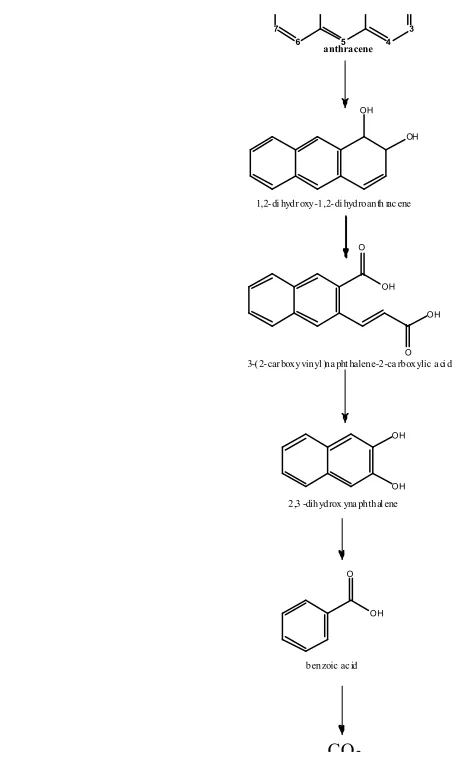
Like mesophiles, thermophiles initiate the degradation of PAHs (in this case, NAPH, PHEN and ANTH) by the action of mono- or dioxygenases, enzymes that mediate the formation of mono- and then di-hydroxylated aromatic compounds. As Figures 4-6 show, the mono- and di-hydroxylated derivatives of NAPH, PHEN and ANTH have been identified (ST29,30,31,33). Thereafter, these di-hydroxy-aromatic compounds are subjected to cleavage, either between the hydroxyl groups (meta-cleavage) or proximal to one of the two hydroxyl groups (ortho-cleavage) to generate an aromatic compound with less than 1 ring. A careful observation of NAPH degradation (Figure 4)
5
4 3
2 6
Figure 3: Pahtways of phenol degradation. So far, only the meta-cleavage pathway has been described in thermophilic bacteria, yet both pathways (meta- and ortho-) are present in mesophilic bacteria.
OH
OH
OH
OH COOH
OH
CO2(mineralisation)
COOH COOH
Meta-cleavage Ortho-cleavage
phenol hydroxylase
2,3 catechol dioxygenase
2
1
phenol
catechol
17
indicates that cleavage of the first ring occurs at the meta-position. For instance, the derivatives 3-(2-hydroxyphenyl)-propanoic acid (ST31), 2-hydroxycinnamic acid (ST29), 4-(2-hydroxyphenyl)-2-oxo-but-3-enoic acid (ST31,33) and (2E)-3-(2-hydroxyphenyl)prop-2-enal (ST33) are likely to result from the ring opening of 1,2-dihydroxynaphthalene at the meta-position. Likewise, the existence of 3-(2-carboxyphenyl)-2-propenoic acid (2-carboxycinnamic acid) [ST29,31] could result from the meta-cleavage of 2,3-dihydroxynaphthalene (Figure 4).
Study ST30 identified protocatechuic acid, and so far, the existence of this metabolite has not yet been identified in mesophiles, although it has been proposed [78].
Three studies (ST29,31,33) out of four on NAPH degradation showed the presence of benzoic acid metabolite. To the best of the knowledge of the writer, in only one study has this compound been reported in the context of NAPH degradation in mesophiles [79]. This metabolite has also been reported in the context of ANTH degradation (in mesophiles), and was proposed to be derived from decarboxylation of phthalic acid [80]. Interestingly, phthalic acid has been reported in thermophiles (ST30,31). Thus, the fact that most studies on NAPH degradation have identified
7 6 5 8 4 3 2 1 OH
1-n apht hol
OH OH
1, 2-d ihydroxynapht halene 2,
O OH O OH
4-(2-hydroxyphenyl)-2-ox o-but -3-e noic aci d
O O
coum arin
O OH OH
2-hydroxyci nn amic ac id
O
chroman-2 -on e
O
OH OH
C is-1,2 -dihy dro-1, 2-dihydroxyna phth al ene
ST 30, 31,33
ST2 9 S T31 S T30 O OH OH
3-(2 -hydroxyphenyl)-propanoic acid
ST3 1
S T 29 , 30, 33
ST3 1,33 ST 29
napht hal ene
18
benzoic acid highlights the preference of thermophiles for this reaction (decarboxylation of phthalic acid). This benzoic acid was also reported in the degradation of ANTH by the thermophilic strain N. otitidiscaviarum TSH1 (Figure 5, ST29).
In relation to PHEN (Figure 5), the metabolite 4-[1-hydroxy(2-naphthyl)]-2-oxobut-3-enoic acid could be derived from the first ring opening, at the meta-position, of 3,4-dihydroxyphenanthrene while 2,2-biphenic acid could result from ortho-cleavage of 9,10-dihydroxyphenanthrene. However, the observation of ANTH degradation (Figure 6) indicates that the first ring opening is the result of the ortho-cleavage of dihydroxy-anthracene (which is probably derived from 1,2-dihydroxy-1,2-dihydroanthracene) to generate 3-(2-carboxyvinyl)naphthalene-2-carboxylic acid, another identified metabolite (Figure 6, ST29).
2 3
4
5 6 7 8 9
10 1
phenanthrene
HO OH
3 ,4-dihydroxyphenanthrene
O OH O OH
4-[1-h ydroxy(2-naphthy l)]-2-oxo but-3-enoic acid
O
OH OH
19
In summary, in thermophiles, the first ring opening of NAPH occurs at the meta-position only, as is the case with phenol, and that of ANTH proceeds through ortho-cleavage, while both meta- and ortho-cleavage exist in PHEN degradation.
4. Gaps and strategies to improve biodegradation by thermophiles 4.1. Isolation of more thermophilic microbes
4.1.1. Use of experimental set-up
Table 1 shows that most strains were active within the range 40–80 oC, with optimum temperatures of <70 oC (most of them being around 60 oC). Only one strain, S. solfataricus P2, an archaea, had an optimum temperature >70 oC (optimum temperature being 80 oC) [ST23]. As
3 4 5 6 7
anthracene
OH OH
1,2-di hydr oxy-1,2-di hydroanth rac ene
O
OH
O OH
3-(2-car boxyvinyl )na pht halene-2-ca rboxylic a ci d
OH OH
2,3 -dihydrox yna phthal ene
O
OH
benzoic ac id
20
discussed in section 1, these microbes fall into the group of moderate- and extreme-thermophiles. Thus, so far no hyper-thermophiles (whose optimum temperatures are >85 oC) that degrade petroleum hydrocarbons have been described. The following reasons could explain the absence of the hyper-thermophiles.
First, most conditions of isolation of these thermophilic strains had involved the enrichment technique. In this approach, inocula or samples that are presumed to contain microbes are incubated at a fixed temperature, in the presence of the substrate of interest, and most of these enrichment experiments were carried out at temperatures <70 oC; in fact, 55 and 60 oC were the most commonly used temperatures. During the enrichment process, microbes that are favoured are those whose growth is optimum at temperatures set in the experiments, therefore it is not surprising that most strains had optimum temperatures <70 oC and no hyper-thermophiles were selected during these experiments.
Thus, it is reasonable to argue that, so far, researchers have deliberately focused their work on moderate- and extreme-thermophiles. Working on hyper-thermophiles requires maintaining temperature of 85–120 oC throughout the experimental conditions, which can be a limitation in the context of routine cultures. This may explain why most enrichment experiments were carried out at temperatures <70 oC, even when samples that are likely to contain hyper-thermophiles were used as inocula (for instance, samples isolated near a volcanic site, in ST13). Thus, the degradation of petroleum hydrocarbons by hyper-thermophiles awaits exploration.
4.1.2. Genomic approach
Genetic approaches can also be used to isolate pollutant-degrading microbes in general or PHDT in particular. This strategy employs molecular probes that are based on the sequences of key genes encoding catabolic enzymes in the pollutant degradation pathway. The advantage of this approach is that the probe can be tailored to target a specific enzyme, thus a specific pathway, therefore excluding microbes that do not have that particular pathway. As discussed in section 3.3.1, this approach has been used to isolate PHDT. For instance, using alkJ gene encoding alkane hydroxylases from Pseudomonas putida and Pseudomonas oleovorans (2 mesophiles), Meintanis et al. screened a pool of 150 thermophilic bacteria isolated from a volcanic site for the presence of
21
In mesophiles, this approach has also been used to identify bacteria that degrade the recalcitrant PAHs (especially pyrene) by using a probe based on the sequence of the aromatic ring hydroxylating dioxygenase enzyme (ARHDO), responsible for initial dihydroxylation [81-83]. As shown in Table 1, only a few thermophiles that degrade complex PAH compounds have been isolated so far. Thus, for instance, the use of ARHDO probes (based on sequences from mesophiles) could provide an opportunity to isolate and characterize more thermophiles that degrade PAHs.
PHDT can also be identified by exploiting the available information on the genome sequences of thermophiles. Specific genes encoding enzymes involved in petroleum hydrocarbon (or any pollutant) degradation can be sought in the genome sequences, and if these genes are present, in
vitro studies can be initiated to assess the thermophile’s ability to grow in the presence of these
pollutants. As discussed in section 2.2 (ST23), this approach has successfully been tested, and led to the identification of the archaean strain S. solfataricus P2 as a MAH degrader. Thus, more PHDT can be identified by employing this strategy, since the genomes of a sizable number of thermophilic strains have now been sequenced (https://www.ncbi.nlm.nih.gov/genome).
4.2. Improving biodegradation
Several strategies to improve biodegradation of the pollutants have been evaluated in the context of mesophiles. The same strategies can be applied and can add value to the degradation of petroleum hydrocarbons by thermophiles. These strategies are summarized next.
4.2.1. Bioaugmentation
22
Table 1: Summary of studies on biodegradation of petroleum products by thermophilic microbes.
Study Source of samples Conditions of isolation Thermophiles used or isolated Range of temperatures and/or optimum temperature (in parentheses)
Petroleum products degraded or other
characteristics of the strains Reference
ST1 Samples of water or soil
Enrichment culture in the presence
hydrocarbon at 57 oC
Bacillus stearothermophilus (57 oC) Hydrocarbons {Mateles, 1967 #6396}
[23]
ST2 Mud sample from a littoral area of North Carolina, USA
Enrichment culture in the presence n-hexadecane at 50 oC
Thermomicrobium fosteri PTA-1, 42 to 70 oC
(60 oC) *n-alkanes (nCalcohol (C 10–C20), 1-Alkenes (C14–C1), 12–C17) and ketones (C14–C17) C14 * but not <C9 (n-alkanes), <C9 (alkene and ketones) and <C11 (alcohol)
(Phillips and Perry 1976)
[24]
ST3 Mud samples from Yellowstone National Park, USA
Enrichment culture in the presence n-heptadecane at 60 oC
Thermoleophilum minutum YS-3
Thermoleophilum album YS-4
(60 oC) * n-alkane C
10–C20 but not those <C9
*C6–C8 alkenes, but not <C6 alkenes
(Merkel et al. 1978, Zarilla and Perry 1986)
[25, 26]
ST4 Hot water springs from Kunashir Island, Russia
Not provided Geobacillus stearothermophilus
16
Thermus ruber 12
55–73 oC
(60 oC) Paraffins
(Logino va et al. 1981)
[27]
ST5 Mud and water from various parts in the USA
Enrichment in the presence of n-heptadecane at 60 oC
T. album 45 to 70° C
(60 oC) C13–C30 [28]
ST6 Mud and water from the USA
Enrichment in the presence of n-heptadecane at 60 oC
Geobacillus thermoleovorans 55–65 oC n-alkane C
13–C20 but not those <C9 or >C20
(Zarilla and Perry 1987)
[29]
ST7 Contaminated
samples from Kuwait Enrichment in the presence of crude oil at G. stearothermophilusKTCC-B7S and KTCC-B2M strains 60
oC C
15–C18 n-alkanes but not of lower carbon numbers, alkenes and aromatics
(Sorkhoh et al. 1993)
23 60 oC
ST8 Production water samples from deep petroleum reservoirs, Japan
No enrichment
G.thermoleovorans
B23 and H41
50–80 °C
(70 oC for B23)
(65 oC for H41)
*C13–C26 n-alkanes but not for C9–C12
*Evidence of terminal oxidation of n-alkanes
(Kato et al. 2001)
[31]
ST9 Deep subterranean oil
reservoir, China Enrichment in the presence of crude oil at 73 oC
Geobacillus thermodenitrificans
NG80-2 45–73
oC
(65 oC) *CC 15–C36 n-alkanes but not the short-chain (C8– 14) and those longer than C40
*No alkB gene homologs found in NG80-2
[32]
ST10 Soil samples, Ireland Enrichment at 60 oC in
the presence of n-hexadecane
G. thermoleovorans 27,
Geobacillus caldoxylosilyticus 17, Geobacillus pallidus 2,
Geobacillus toebii 1,
Geobacillus sp. (60
oC)
*n-hexadecane
* Expression of AlkB gene induced by n-hexadecane
(Marchant et al. 2006)
[34]
ST11 Samples from wells
in the Dongxin reservoir
(temperature 60–80 °C), China
Enriched culture in the presence of
n-hexadecane
Thermophilic strain TH-2 40–85 oC
(70 oC) Degradation of the petroleum hydrocarbons, mainly n-alkanes [35]
ST12 Formation water
from the Dagang oilfield and from a thermal spring in the Baikal rift zone, Russia
Not explained G. toebii В-1024,
Geobacillus sp. 1017,
Aeribacillus pallidus 8m3
38–70 °С
(60 oC) *С*С10–С30 n-alkanes (for B-1024) 13–С19 n-alkanes (for 1017) *C11–C29 n-alkanes (for 8m3)
*Simultaneous presence of alkB and ladA
genes involved in the degradation of alkanes
(Tourova et al. 2016)
[36]
ST13 Samples from active
volcano of Santorini, Greece,
Bacteria were identified
by alkJ probe, following
culture in rich medium at 60–80 oC
G. thermoleovorans (4 strains)
G. stearothermophilus (3 strains)
Geobacillus anatolicus (2 strains)
Bacillus aeolius (1 strain)
60–80 oC *Long chain alkanes of crude oil *Use of alkJ probe to identify and select petroleum hydrocarbon degrading thermophiles (PHDT)
(Meintanis et al. 2006)
[38]
ST14 Industrial sediment,
UK
Enrichment in the presence of phenol, at 55
G. stearothermophilus PH24 (50 oC) *Phenol and catechol
* Cleavage of catechol at the meta-position
(Buswell 1974)
24 oC
ST15 Same as in ST13 Same as in ST13 Same strain as in ST13 (G.
stearothermophilus PH24) Same as in ST13 o-cresol, m-cresol, or p-cresol, 3-methylcatechol and 4-methylcatechol
(Buswell 1975, Buswell and Twomey 1975)
[40,41]
ST16 Soil samples that had
been pasteurized for 10 min at 80 oC
Enrichment in the presence of m-cresol and phenol
G. stearothermophilus IC3 (50 oC) *Phenol, m-cresol and benzoic acid
* Phenol degradation via catechol, and cleavage via meta-position
(Adams and Ribbons 1988)
[42]
ST17 River sediment
Tittabawassee, USA Enrichment in the presence of phenol, at 55 oC
G. stearothermophilus BR219 (55 oC) *Phenol
*Characterization of phenol hydroxylase, the first enzyme in phenol degradation
(Gurujeyalakshmi and Oriel 1989, Kim and Oriel 1995)
[43, 44]
ST18 Not provided Not provided G. stearothermophilus FDTP-3 60–65°C *Phenol and catechol but no benzoic acid *catechol 2,3-dioxygenase gene was also characterized
(Dong et al. 1992)
[45]
ST19 Water and mud from
a hot spring, Iceland Enrichment in the presence of phenol at 70 oC
G. thermoleovorans A2 (65 °C) *Phenol and o-cresol, m-cresol, p-cresol,
*meta-cleavage of phenol
(Mutzel et al. 1996, Duffner and Muller 1998)
[46, 47]
ST20 Not provided Not provided Thermus aquaticus ATCC25104
Thermus spATCC 27978
(70 oC)
(60 oC)
* Degradation of BTEX (benzene, toluene, ethylbenzene, and xylenes)
* I4C-labeled benzene and toluene were metabolized to 14CO
2
(Ching‐I and T. 1995)
[48]
ST21 Samples from a waste
treatment plant (UK) and a phenol-contaminated industrial effluent (lake Zealand)
Enrichment in presence
of phenol at 50 oC Bacillus sp. 50–55°C *Phenol degradation * Detection of catechol 2,3-dioxygenase * Cleavage of aromatic via the meta-pathway * Catechol 2,3-dioxygenase was inactivated at high oxygen
(Ali et al. 1998)
[49]
ST22 Production water
from an oil field, Tunisia
Enrichment in the presence of vanillic acid
Aeribacillus pallidus, VP3 37–65 oC
(55 oC) *Degradation of various aromatic compounds including benzoic, p-hydroxybenzoic, protocatechuic acids
* Strain was also halotolerant (can grow in the presence of 100 g l-1 of NaCl)
(Mnif et al. 2014)
[50]
ST23 Volcanic site at
Pisciarelli Solfatara,
Already preselected Sulfolobus solfataricus P2 (80 oC) Anaerobic degradation of phenol (Izzo et al. 2005, Chae et al. 200 ) [51, 52]
25 Italy
ST24 Compost from a field
in Okayama, Japan Enrichment culture in the presence of biphenyl as sole source of carbon, at 60 oC
Geobacillus sp. JF8 (60 oC) * Biphenyl, chlorobiphenyl, NAPH, benzoic
acid and salicylic acid but not PHEN, ANTH, benzene and xylene
*Related to G. Stearothermophilus
(Shimura et al. 1999) [53]
ST25 PAH-contaminated soil collected from Hong Kong
Not provided Bacillus subtilis BUM and
Mycobacterium vanbaalenii
BU42
(55 oC) Both strains could utilize PHEN as sole source of carbon
*None of the strains could utilize BZP as sole source of carbon
* In the presence of PHEN, only the strain BUM could degrade BZP
(Zhao and Wong 2010)[54]
ST26 Hot springs, compost
and industrial wastewater
Not provided Preselected mixture of strains of
Geobacillus spp. Thermus sp.
60–70 oC
*Degradation of acenaphthene FLT, PYR and BZP, in the presence of hexadecane
(Feitkenhauer and Markl 2003) [55]
ST27 Soil samples from
contaminated areas in Kowait
Enrichment in the presence of a mixture of PAHs and heterocyclic polyaromatics
Bacillus firmus, Bacillus pallidus,
Anoxybacillus sp., Paenibacillus
sp., Saccharococcus sp.
(60 oC)
*Degradation of NAPH, PHEN, ANTH, PYR and FLR, benzothiophene, dibenzothiophene dibenzofuran and carbazole
* Inhibition of degradation of PAHs and heterocyclic compounds in the presence of glucose
(Mohamed et al. 2006) [56]
ST28 Compost sample Incubation in the
presence of PHEN at 60
oC Geobacillus sp. (3 strains) (60
oC) PHEN, FLR and FLT degradation
(Viamajala et al. 2007) [58]
ST29 Petro-industrial
wastewater soil, Iran Selection in the presence of PHEN at 50 oC Nocardia otitidiscaviarum TSH1 30–55 oC
(50 oC) *NAPH, PHEN and ANTH degradation * Evidence of meta-cleavage of NAPH *Detection of various metabolites of NAPH
(Zeinali et al. 2008a, Zeinali et al. 2008b) [59-60]
ST30 Geothermal oil field
in Lithuania
Pre-culture in rich medium following screening in a culture in the presence of NAPH
Geobacillus sp. G27 (60 °C) *Growth in the presence NAPH and ANTH,
protocatechuic acid, benzene, phenol and benzene-1, 3-diol
*No growth in the presence of catechol *Degradation of NAPH through protocatechuic acid via ortho-cleavage pathway
(Bub inas et al. 2008) [61]
26
ST31 Hydrocarbon
contaminated compost, Germany
Enrichment in the presence of NAPH, at 60 oC
G. thermoleovorans Hamburg 2 (60 °C) *Degradation of NAPH
*Detection of phthalic and benzoic acid as NAPH metabolites
(Annweiler et al. 2000) [62]
ST32 Contaminated soil
samples from Yumen oilfield, China
Enrichment in the presence of PHEN, FLR and crude oil at 60 oC
Geobacillus pallidus XS2 and
XS3 (60
oC) *PHE, FLR and crude oil
*Preference of nC8–C19 for XS2 strain and n-C20–C38 for XS3 strain
* Production of emulsifier by the 2 strains
(Zheng et al. 2011) [63]
ST33 Soil from a deep oil
well, China Enrichment in the presence of crude oil at 70 oC
Geobacillus sp. SH-1 45–80 oC
(60 oC) * Degradation of NAPH and nCcrude oil) 12–C23 (from * Detection of NAPH metabolites
(Zhang et al. 2012) [64]
ST34 Produced water from Dagang petroleum reservoir at 73 oC, China
Already growing in
petroleum environment G. stearothermophilus strain A-2 40–75 oC
(60 oC) * NAPH, methylated-PHEN, FLR, benzo [b] fluorenes and long-chain alkanes (C 22–C33) *Low degradation of shorter chains (C14–C21) *Production of bio-emulsifier
(Zhou et al. 2018) [65]
ST35 Hot spring from
Guerrero State, Mexico
Non explained Bacillus licheniformis M2-7 (50 °C) * BZP
* Identification of phthalic acid as a BZP metabolite
*Characterization of catechol dioxygenase enzyme
27 4.2.2. Cometabolism
Cometabolism has been widely used in mesophilic conditions to increase pollutant degradation [5]. This approach uses two different substrates (pollutants), a non-growth and a growth-promoting substrate. As the name indicates, the non-growth substrate alone does not efficiently support microbial growth, leading to slow growth. However, when the growth-promoting substrate is added, microbial growth will increase, and this, in turn, will lead to degradation of the non-growth substrate [5].
Interestingly, three studies have evaluated this concept of cometabolism in the context of thermophiles (ST25,26,27). In the first (ST25), the strain B. subtilis BUM could not degrade the recalcitrant BZP when used as sole substrate. However, the addition of PHEN, a growth-promoting substrate, led to the degradation of BZP, a classic illustration of cometabolism. Likewise, in ST26, the degradation of the PAH compounds acenaphthene and FLT, PYR and BZP by a mixture of strains of Geobacillus sp. and Thermus sp. were augmented when the n-alkane hexadecane was used as a growth-promoting substrate.
28 4.2.3. Use of other emerging approaches 4.2.3.1. Genetically modified microorganisms
The use of genetically modified microorganisms (GMM) to increase the ability of microbes to degrade pollutants has been evaluated in mesophiles. For instance, in the context of aromatic compound degradation, two strains of Pseudomonas sp. and Pseudomonas putida have been engineered by transfection with plasmids containing genes that mediate the degradation of monoaromatic compounds, and these strains could actively degrade derivatives of benzoic acid [90, 91]. So far, this approach has not been exploited in thermophiles, yet genes that mediate the degradation of n-alkanes and monoaromatic compounds have been characterized in thermophiles, thus could be used in transfection studies.
4.2.3.2. Nanotechnology
Reports have indicated that the use of nanomaterials or nanoparticles can lead to an increase in pollutant degradation by microbes. These materials are characterized by small size (1–100 nm), thus providing a large surface/volume ratio, leading to an increase in substrate adsorption, thus a better degradation. Recent reports have evaluated this approach in the context of pollutant degradation by mesophiles [92-95]. This approach could also be extended to thermopiles, if the stability of these nanoparticles is unaffected by high temperature.
5. Concluding remarks and future perspectives
It is well established that increasing temperature leads to better degradation of pollutants. Thus, the use of thermophilic microbes provides an effective strategy to improve the overall biodegradation process. Yet, so far, most of the work on biodegradation has been carried out using mesophiles, and little is known about thermophiles.
This literature review has highlighted important findings on PHDT. For instance, more than 60% of PHDT strains isolated so far belong to one single genus, Geobacillus, while the family
Bacillaceae represents more than 80% of strains. Some PHDT express a specific n-alkane
29
This review has also highlighted important gaps in our understating of PHDT. For instance, up to the present time, all PHDT described so far belong to the group of moderate- and extreme-thermophiles, and not a single hyper-thermophile has been reported so far. Thus, this research topic awaits elucidation. In addition, the detailed PHDT mechanisms of degradation have been elucidated in n-alkane and monoaromatic compounds, however, little has been carried out on PAHs, especially on complex PAHs.
Various strategies, such as bioaugmentation, cometabolism, GMM and nanotechnology, have been tested to improve the efficiency of pollutant degradation by mesophiles, and some of these strategies have been used in real conditions of bioremediation. So far, experiments on PHDT degradation been carried out in the laboratory context and at a low scale only. Using the vast amount of information on mesophiles, experiments can now be scaled up for the bioremediation of contaminated samples by thermophiles.
Acknowledgments
This work was funded by the Deanship of Scientific Research (DSR) of the King Fahd University of Petroleum and Minerals (KFUPM), grant IN171022. The author is also grateful to KFUPM for personal support.
References
1. Abdel-Shafy, H. I.; Mansour, M. S. M. A review on polycyclic aromatic hydrocarbons: Source, environmental impact, effect on human health and remediation. Egypt J Pet 2016, 25 (1), 107-123.
2. Nzila, A. Biodegradation of high-molecular-weight polycyclic aromatic hydrocarbons under anaerobic conditions: Overview of studies, proposed pathways and future perspectives. Environ Pollut 2018, 239, 788-802.
3. Sabathé, F.; Bélaїch, A.; Soucaille, P. Characterization of the cellulolytic complex (cellulosome) of Clostridium acetobutylicum. FEMS Microbiol Lett 2002, 217.
30
5. Nzila, A. Update on the cometabolism of organic pollutants by bacteria. Environ Pollut 2013,
178, 474-82.
6. Juhasz, A. L.; Naidu, R. Bioremediation of high molecular weight polycyclic aromatic hydrocarbons: a review of the microbial degradation of benzo[a]pyrene. Int Biodeterior Biodegrad 2000, 45 (1–2), 57-88.
7. Kanaly, R. A.; Harayama, S. Advances in the field of high-molecular-weight polycyclic aromatic hydrocarbon biodegradation by bacteria. Microb Biotechnol 2010, 3 (2), 136-64. 8. Ghosal, D.; Ghosh, S.; Dutta, T. K.; Ahn, Y. Current state of knowledge in microbial
degradation of polycyclic aromatic hydrocarbons (PAHs): A review. Front Microbiol 2016, 7, 1369.
9. Pikuta, E. V.; Hoover, R. B.; Tang, J. Microbial extremophiles at the limits of life. Crit Rev Microbiol 2007, 33 (3), 183-209.
10. Fathepure, B. Z. Recent studies in microbial degradation of petroleum hydrocarbons in hypersaline environments. Front Microbiol 2014, 5, 173.
11. Martins, L. F.; Peixoto, R. S. Biodegradation of petroleum hydrocarbons in hypersaline environments. Braz J Microbiol 2012, 43 (3), 865-72.
12. Sorokin, D. Y.; Janssen, A. J. H.; Muyzer, G. Biodegradation potential of halo(alkali)philic prokaryotes. Crit Rev Environ Sci Technol 2012, 42 (8), 811-856.
13. Mehta, D.; Satyanarayana, T. Diversity of hot environments and thermophilic microbes. In Thermophilic Microbes in Environmental and Industrial Biotechnology: Biotechnology of Thermophiles, Satyanarayana, T.; Littlechild, J.; Kawarabayasi, Y. Eds. Springer Netherlands: Dordrecht, 2013; pp 3-60.
14. Guedon, E.; Desvaux, M.; Petitdemange, H. Improvement of cellulolytic properties of Clostridium cellulolyticum by metabolic engineering. Appl Environ Microbiol 2002, 68. 15. Mehta, R.; Singhal, P.; Singh, H.; Damle, D.; Sharma, A. K. Insight into thermophiles and
their wide-spectrum applications. 3 Biotech 2016, 6 (1), 81.
16. Straub, C. T.; Zeldes, B. M.; Schut, G. J.; Adams, M. W.; Kelly, R. M. Extremely thermophilic energy metabolisms: biotechnological prospects. Curr Opin Biotechnol 2017,
45, 104-112.
17. Hussein, A. H.; Lisowska, B. K.; Leak, D. J. Chapter One – The genus Geobacillus and their biotechnological potential. In Advances in Applied Microbiology, Sariaslani, S.; Gadd, G. M. Eds. Academic Press: 2015; Vol. 92, pp. 1-48.
18. Perfumo, A.; Banat, I. M.; Marchant, R. The use of thermophilic bacteria in accelerated hydrocarbon bioremediation. WIT Trans Ecol Environ 2006, 88, 11.
31
20. Müller, R.; Antranikian, G.; Maloney, S.; Sharp, R. Thermophilic degradation of environmental pollutants. In Biotechnology of Extremophiles, Antranikian, G., Ed. Springer Berlin Heidelberg: Berlin, Heidelberg, 1998; pp 155-169.
21. Arulazhagan, P.; Mnif, S.; Rajesh Banu, J.; Huda, Q.; Jalal, M. A. B. HC-0B-01: Biodegradation of hydrocarbons by extremophiles. In Biodegradation and Bioconversion of Hydrocarbons, Heimann, K.; Karthikeyan, O. P.; Muthu, S. S., Eds. Springer Singapore: Singapore, 2017; pp 137-162.
22. Nazina, T. N.; Tourova, T. P.; Poltaraus, A. B.; Novikova, E. V.; Grigoryan, A. A.; Ivanova, A. E.; Lysenko, A. M.; Petrunyaka, V. V.; Osipov, G. A.; Belyaev, S. S.; Ivanov, M. V. Taxonomic study of aerobic thermophilic bacilli: descriptions of Geobacillus subterraneus gen. nov., sp. nov. and Geobacillus uzenensis sp. nov. from petroleum reservoirs and transfer of Bacillus stearothermophilus, Bacillus thermocatenulatus, Bacillus thermoleovorans, Bacillus kaustophilus, Bacillus thermodenitrificans to Geobacillus as the new combinations G. stearothermophilus, G. th. Int J Syst Evolut Microbiol 2001, 51 (2), 433-446.
23. Mateles, R. I.; Baruah, J. N.; Tannenbaum, S. R. Growth of a thermophilic bacterium on hydrocarbons: a new source of single-cell protein. Science 1967, 157 (3794), 1322-1323. 24. Phillips, W. E.; Perry, J. J. Thermomicrobium fosteri sp. nov., a hydrocarbon-utilizing
obligate thermophile1. Int J Syst Evolut Microbiol 1976, 26 (2), 220-225.
25. Merkel, G. J.; Underwood, W. H.; Perry, J. J. Isolation of thermophilic bacteria capable of growth solely in long-chain hydrocarbons. FEMS Microbiol Lett 1978, 3 (2), 81-83.
26. Zarilla, K. A.; Perry, J. J. Deoxyribonucleic acid homology and other comparisons among obligately thermophilic hydrocarbonoclastic bacteria, with a proposal for Thermoleophilum minutum sp. nov.†. Int J Syst Evolut Microbiol 1986, 36 (1), 13-16.
27. Loginova, L. G.; Bogdanova, T. I.; Seregina, L. M. [Growth of obligate-thermophilic bacteria on a medium with paraffin]. Mikrobiologiia 1981, 50 (1), 49-54.
28. Zarilla, K. A.; Perry, J. J. Thermoleophilum album gen. nov. and sp. nov., a bacterium obligate for thermophily and n-alkane substrates. Arch Microbiol 1984, 137 (4), 286-290. 29. Zarilla, K. A.; Perry, J. J. Bacillus thermoJeovorans, sp. nov., a species of obligately
thermophilic hydrocarbon utilizing endospore-forming bacterial. System. Appl. Microbial.
1987, 9, 258-264
30. Sorkhoh, N. A.; Ibrahim, A. S.; Ghannoum, M. A.; Radwan, S. S. High-temperature hydrocarbon degradation by Bacillus stearothermophilus from oil-polluted Kuwaiti desert. Appl Microbiol Biotechnol 1993, 39 (1), 123-126.
32
32. Wang, L.; Tang, Y.; Wang, S.; Liu, R. L.; Liu, M. Z.; Zhang, Y.; Liang, F. L.; Feng, L. Isolation and characterization of a novel thermophilic Bacillus strain degrading long-chain n-alkanes. Extremophiles 2006, 10 (4), 347-56.
33. Feng, L.; Wang, W.; Cheng, J.; Ren, Y.; Zhao, G.; Gao, C.; Tang, Y.; Liu, X.; Han, W.; Peng, X.; Liu, R.; Wang, L. Genome and proteome of long-chain alkane degrading Geobacillus thermodenitrificans NG80-2 isolated from a deep-subsurface oil reservoir. Proc Natl Acad Sci
USA 2007, 104 (13), 5602-7.
34. Marchant, R.; Sharkey, F. H.; Banat, I. M.; Rahman, T. J.; Perfumo, A. The degradation of n-hexadecane in soil by thermophilic geobacilli. FEMS Microbiol Ecol 2006, 56 (1), 44-54. 35. Hao, R.; Lu, A.; Zeng, Y. Effect on crude oil by thermophilic bacterium. J Pet Sci Eng 2004,
43 (3), 247-258.
36. Tourova, T. P.; Sokolova, D. S.; Semenova, E. M.; Shumkova, E. S.; Korshunova, A. V.; Babich, T. L.; Poltaraus, A. B.; Nazina, T. N. Detection of n-alkane biodegradation genes alkB and ladA in thermophilic hydrocarbon-oxidizing bacteria of the genera Aeribacillus and Geobacillus. Microbiology 2016, 85 (6), 693-707.
37. Kadnikov, V. V.; Mardanov, A. V.; Poltaraus, A. B.; Sokolova, D. S.; Semenova, E. M.; Ravin, N. V.; Tourova, T. P.; Nazina, T. N. Genome sequencing and annotation of Geobacillus sp. 1017, a hydrocarbon-oxidizing thermophilic bacterium isolated from a heavy oil reservoir (China). Genomics Data 2017, 11, 95-97.
38. Meintanis, C.; Chalkou, K. I.; Kormas, K. A.; Karagouni, A. D. Biodegradation of crude oil by thermophilic bacteria isolated from a volcano island. Biodegradation 2006, 17 (2), 105-11. 39. Buswell, J. A. The meta-cleavage of catechol by a thermophilic bacillus species. Biochem
Biophys Res Commun 1974, 60 (3), 934-941.
40. Buswell, J. A. Metabolism of phenol and cresols by Bacillus stearothermophilus. J Bacteriol
1975, 124 (3), 1077-83.
41. Buswell, J. A.; Twomey, D. G. Utilization of phenol and cresols by Bacillus stearothermophilus, strain PH24. J Gen Microbiol 1975, 87 (2), 377-9.
42. Adams, D.; Ribbons, D. W. The metabolism of aromatic compounds by thermophilicBacilli. Appl Biochem Biotechnol 1988, 17 (1), 231-244.
43. Gurujeyalakshmi, G.; Oriel, P. Isolation of phenol-degrading Bacillus stearothermophilus and partial characterization of the phenol hydroxylase. Appl Environ Microbiol 1989, 55 (2), 500-502.
44. Kim, I. C.; Oriel, P. J. Characterization of the Bacillus stearothermophilus BR219 phenol hydroxylase gene. Appl Environ Microbiol 1995, 61 (4), 1252-1256.
33
stearothermophilus FDTP-3 and their expression in Escherichia coli. Appl Environ Microbiol
1992, 58 (8), 2531-2535.
46. Mutzel, A.; Reinscheid, U. M.; Antranikian, G.; Müller, R. Isolation and characterization of a thermophilic bacillus strain, that degrades phenol and cresols as sole carbon source at 70 °C. Appl Microbiol Biotechnol 1996, 46 (5), 593-596.
47. Duffner, F. M.; Muller, R. A novel phenol hydroxylase and catechol 2,3-dioxygenase from the thermophilic Bacillus thermoleovorans strain A2: nucleotide sequence and analysis of the genes. FEMS Microbiol Lett 1998, 161 (1), 37-45.
48. Chen, C. I.; Taylor, R. T. Thermophilic biodegradation of BTEX by two Thermus species. Biotechnol Bioeng 1995, 48 (6), 614-624.
49. Ali, S.; Fernandez-Lafuente, R.; Cowan, D. A. Meta-pathway degradation of phenolics by thermophilic Bacilli. Enzyme Microbial Technol 1998, 23 (7), 462-468.
50. Mnif, S.; Sayadi, S.; Chamkha, M. Biodegradative potential and characterization of a novel aromatic-degrading bacterium isolated from a geothermal oil field under saline and thermophilic conditions. Int Biodeterior Biodegrad 2014, 86, 258-264.
51. Chae, J. C.; Kim, E.; Bini, E.; Zylstra, G. J. Comparative analysis of the catechol 2,3-dioxygenase gene locus in thermoacidophilic archaeon Sulfolobus solfataricus strain 98/2. Biochem Biophys Res Commun 2007, 357 (3), 815-9.
52. Izzo, V.; Notomista, E.; Picardi, A.; Pennacchio, F.; Di Donato, A. The thermophilic archaeon Sulfolobus solfataricus is able to grow on phenol. Res Microbiol 2005, 156 (5), 677-689. 53. Shimura, M.; Mukerjee-Dhar, G.; Kimbara, K.; Nagato, H.; Kiyohara, H.; Hatta, T. Isolation
and characterization of a thermophilic Bacillus sp. JF8 capable of degrading polychlorinated biphenyls and naphthalene. FEMS Microbiol Lett 1999, 178 (1), 87-93.
54. Zhao, Z.; Wong, J. W.-C. Rapid biodegradation of benzo[a]pyrene by Bacillus subtilis BUM under thermophilic condition. Environ Eng Sci 2010, 27 (11), 939-945.
55. Feitkenhauer, H.; Markl, H. Biodegradation of aliphatic and aromatic hydrocarbons at high temperatures. Water Sci Technol 2003, 47 (10), 123-30.
56. Mohamed, M. E.; Al-Dousary, M.; Hamzah, R. Y.; Fuchs, G. Isolation and characterization of indigenous thermophilic bacteria active in natural attenuation of bio-hazardous petrochemical pollutants. Int Biodeterior Biodegrad 2006, 58 (3), 213-223.
57. Rubin, H. E.; Alexander, M. Effect of nutrients on the rates of mineralization of trace concentrations of phenol and p-nitrophenol. Environ Sci Technol 1983, 17 (2), 104-107. 58. Viamajala, S.; Peyton, B. M.; Richards, L. A.; Petersen, J. N. Solubilization, solution
equilibria, and biodegradation of PAH's under thermophilic conditions. Chemosphere 2007,
34
59. Zeinali, M.; Vossoughi, M.; Ardestani, S. K. Naphthalene metabolism in Nocardia otitidiscaviarum strain TSH1, a moderately thermophilic microorganism. Chemosphere 2008,
72 (6), 905-9.
60. Zeinali, M.; Vossoughi, M.; Ardestani, S. K. Degradation of phenanthrene and anthracene by Nocardia otitidiscaviarum strain TSH1, a moderately thermophilic bacterium. J Appl Microbiol 2008, 105 (2), 398-406.
61. Bubinas, A.; Giedraitytė, G.; Kalėdienė, L.; Nivinskiene, O.; Butkiene, R. Degradation of naphthalene by thermophilic bacteria via a pathway, through protocatechuic acid. cent.eur.j.biol. 2008, 3 (1), 61-68.
62. Annweiler, E.; Richnow, H. H.; Antranikian, G.; Hebenbrock, S.; Garms, C.; Franke, S.; Francke, W.; Michaelis, W. Naphthalene degradation and incorporation of naphthalene-derived carbon into biomass by the thermophile Bacillus thermoleovorans. Appl Environ Microbiol 2000, 66 (2), 518-23.
63. Zheng, C.; He, J.; Wang, Y.; Wang, M.; Huang, Z. Hydrocarbon degradation and bioemulsifier production by thermophilic Geobacillus pallidus strains. Bioresour Technol
2011, 102 (19), 9155-61.
64. Zhang, J.; Zhang, X.; Liu, J.; Li, R.; Shen, B. Isolation of a thermophilic bacterium, Geobacillus sp. SH-1, capable of degrading aliphatic hydrocarbons and naphthalene simultaneously, and identification of its naphthalene degrading pathway. Bioresour Technol
2012, 124 (0), 83-89.
65. Zhou, J.-F.; Gao, P.-K.; Dai, X.-H.; Cui, X.-Y.; Tian, H.-M.; Xie, J.-J.; Li, G.-Q.; Ma, T. Heavy hydrocarbon degradation of crude oil by a novel thermophilic Geobacillus stearothermophilus strain A-2. Int Biodeterior Biodegrad 2018, 126, 224-230.
66. Guevara-Luna, J.; Alvarez-Fitz, P.; Rios-Leal, E.; Acevedo-Quiroz, M.; Encarnacion-Guevara, S.; Moreno-Godinez, M. E.; Castellanos-Escamilla, M.; Toribio-Jimenez, J.; Romero-Ramirez, Y. Biotransformation of benzo[a]pyrene by the thermophilic bacterium Bacillus licheniformis M2-7. World J Microbiol Biotechnol 2018, 34 (7), 88.
67. Haritash, A. K.; Kaushik, C. P. Biodegradation aspects of polycyclic aromatic hydrocarbons (PAHs): a review. J Hazard Mater 2009, 169 (1-3), 1-15.
68. Zeigler, D. R. The Geobacillus paradox: why is a thermophilic bacterial genus so prevalent on a mesophilic planet? Microbiology 2014, 160 (Pt 1), 1-11.
69. Bezuidt, O. K.; Pierneef, R.; Gomri, A. M.; Adesioye, F.; Makhalanyane, T. P.; Kharroub, K.; Cowan, D. A. The Geobacillus pan-genome: implications for the evolution of the genus. Front Microbiol 2016, 7 (723).
35
71. Maier, R. M.; Gentry, T. J. Microorganisms and organic pollutants. In Environmental Microbiology: , Elsevier Inc..: United States, 2014; Vol. Third Edition pp 415-439.
72. Rojo, F. Degradation of alkanes by bacteria. Environ Microbiol 2009, 11 (10), 2477-90. 73. Nie, Y.; Chi, C. Q.; Fang, H.; Liang, J. L.; Lu, S. L.; Lai, G. L.; Tang, Y. Q.; Wu, X. L.
Diverse alkane hydroxylase genes in microorganisms and environments. Sci Rep 2014, 4, 4968.
74. van Beilen, J. B.; Funhoff, E. G. Alkane hydroxylases involved in microbial alkane degradation. Appl Microbiol Biotechnol 2007, 74 (1), 13-21.
75. van Beilen, J. B.; Funhoff, E. G.; van Loon, A.; Just, A.; Kaysser, L.; Bouza, M.; Holtackers, R.; Röthlisberger, M.; Li, Z.; Witholt, B. Cytochrome P450 alkane hydroxylases of the CYP153 family are common in alkane-degrading eubacteria lacking integral membrane alkane hydroxylases. Appl Environ Microbiol 2006, 72 (1), 59-65.
76. Throne-Holst, M.; Wentzel, A.; Ellingsen, T. E.; Kotlar, H.-K.; Zotchev, S. B. Identification of novel genes involved in long-chain n-alkane degradation by Acinetobacter sp. strain DSM 17874. Appl Environ Microbiol 2007, 73 (10), 3327-3332.
77. Omokoko, B.; Jäntges, U. K.; Zimmermann, M.; Reiss, M.; Hartmeier, W. Isolation of the phe-operon from G. stearothermophilus comprising the phenol degradative meta-pathway genes and a novel transcriptional regulator. BMC Microbiol 2008, 8 (1), 197.
78. Nzila, A.; Thukair, A.; Sankara, S.; Chanbasha, B.; Musa, M. M. Isolation and characterization of naphthalene biodegrading Methylobacterium radiotolerans bacterium from the eastern coastline of the Kingdom of Saudi Arabia. aep 2016, 42 (3), 25.
79. Xu, P.; Ma, W.; Han, H.; Jia, S.; Hou, B. Isolation of a naphthalene-degrading strain from activated sludge and bioaugmentation with it in a MBR treating coal gasification wastewater. Bull Environ Contam Toxicol 2015, 94 (3), 358-364.
80. Swaathy, S.; Kavitha, V.; Pravin, A. S.; Mandal, A. B.; Gnanamani, A. Microbial surfactant mediated degradation of anthracene in aqueous phase by marine Bacillus licheniformis MTCC 5514. Biotechnol Rep 2014, 4, 161-170.
81. Debruyn, J. M.; Chewning, C. S.; Sayler, G. S. Comparative quantitative prevalence of Mycobacteria and functionally abundant nidA, nahAc, and nagAc dioxygenase genes in coal tar contaminated sediments. Environ Sci Technol 2007, 41 (15), 5426-32.
82. DeBruyn, J. M.; Mead, T. J.; Sayler, G. S. Horizontal transfer of PAH catabolism genes in Mycobacterium: evidence from comparative genomics and isolated pyrene-degrading bacteria. Environ Sci Technol 2012, 46 (1), 99-106.