Fission life-time calculation using a complex absorbing potential
Guillaume Scamps1,aand Kouichi Hagino1,2,b
1Department of Physics, Tohoku University, Sendai 980-8578, Japan
2Research Center for Electron Photon Science, Tohoku University, 1-2-1 Mikamine, Sendai 982-0826, Japan
Abstract.
A comparison between the semi-classical approximation and the full quantum calculation with a complex absorbing potential is made with a model of the fission of258Fm. The
potential barrier is obtained with the constrained Skyrme HF+BCS theory. The life-time obtained by the two calculations agree with each other the difference being only by 25%.
1 Introduction
The description of the quantum tunneling is important to predict the life-time of a spontaneous fis-sion as well as fisfis-sion product yields. A standard strategy to compute the fisfis-sion life-time is to first determine a potential energy surface using the liquid drop model with shell correction [1–3] or the self-consistent mean field theory [4–17]. The life-time is then calculated using the semi-classical approximation to determine the fission path that minimizes the action [1, 7, 9, 18–20].
In a previous study [21], we developed a method to obtain the fission life-time using a fully quantum approach with a complex absorbing potential. This method has been tested on a schematic model.
In the present work, we test the semi-classical approximation in a more realistic application, by comparing the full quantum approach to the semi-classical calculation using a potential determined with the constrained Hartree-Fock method with a Skyrme interaction.
2 Complex absorbing potential method
In order to describe the evolution of a quantum system into the continuum spectrum, a possibility is to add an imaginary potential at large distances in order to absorb the wave function, in which the absorbed component of the wave function is assumed to be emitted in the continuum. The modified hamiltonian ˆH = Hˆ +iW(R) is then composed of the original hamiltonian ˆH and the imaginary potentialiW(R). The time dependent Shrödinger equation for the system becomes,
id
dt|Ψ(t)=
ˆ
H+iW(R)|Ψ(t). (1)
ae-mail: [email protected]
This time-dependent equation is often solved numerically with the Runge-Kutta or other iterative methods. Nevertheless, those iterative methods are limited to the case where the phenomenon of interest takes place in a time scale of the order of magnitude of the characteristic time scale of the system. This is not the case for the spontaneous fission, where the fission life time can be of the order magnitude of years while the characteristic time scale of the nuclear system is the zepto second .
Alternatively, one can integrate the time dependent equation as,
|Ψ(t)=e−itHˆ|Ψ0. (2)
In order to compute easily the exponential of the matrix, we expand the hamiltonian H on the biorthogonal basis [22–24] with the left and right eigenfunctions,
H|ϕri=Ei|ϕri and ϕli|H=Eiϕli|, (3)
with complex eigenvalueEi. Using the completeness relation for the bi-orthogonal basis
i|ϕriϕli|= 1, we obtain the simple evolution,
|Ψ(t)=
i
e−itEiϕl
i|Ψ0|ϕri. (4)
It is then possible to describe easily the evolution of the wave packet for a very long time once we compute the overlapϕli|Ψ0.
We note that each eigenstate|ϕriis associated with a complex energy,Ei = Eir−iΓi/2, withΓ
being the resonance width which is related to the life time,τi=/Γi.
3 Results
In the precedent study [21], we tested this method in a model case consisting of a schematic barrier. In the present study, we use a more realistic potential using the constrained Hartree-Fock+BCS theory. The calculation is carried out for the258Fm with the Skyrme interaction Skm* and a volume type of pairing. The constrained Hartree-Fock BCS equation is solved using the EV8 code [25]. A constraint is applied on the value of the average separationRof the two fragments as in Ref. [26] assuming a symmetric fission with a neck position atz=0.
The obtained potential is shown in fig. 1. The collective hamiltonian is assumed here to have only one dimension,
H(R)=−
2
2M
∂2
∂R2 +V(R). (5) In this equation the massM is assumed to be a constant with a value to reproduce the experimental spontaneous half-life of258Fm,τ
exp=0.37 ms [27], using the semi classical approximation. With this approximation, the life time is determine as,
τ=2Ωπe−2S/, (6)
withΩ =2(E0−V0)/and the action integralS,
S =
R1
R0
-1920 -1915 -1910 -1905 -1900 -1895 -1890
V
[MeV]
6 7 8 9 10 11 12 13
R [fm]
Figure 1. The potential energy as a function of the separation between the two fragments for the symmetric fission of258Fm. The original potential is shown with the red solid line. The modified potential for the initial
wave function and dynamics are shown respectively by the green dashed line and the blue dotted line.
10−30
10−20
10−10
1
|
ϕ
r(R1
)
|
2,|Ψ
0
(
R
)
|
2[fm
−
1]
4 6 8 10 12 14 16 18
R [fm]
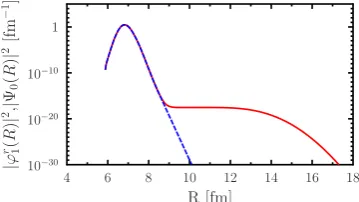
Figure 2.The initial wave function (the blue dashed line) and the resonant wave function (the red solid line).
Here,R0andR1are the inner and outer turning points, respectively defined asV(R0)=V(R1)=E0,E0 is taken as the energy obtained by solving the static Schrödinger equation by restricting the space be-fore the barrier. The mass that reproduces the experimental life-time isM=480 MeV (10−22s)2fm−2. As mentioned earlier, the goal of the present contribution is not to predict the fission life time but to show the feasibility of this approach and to compare the result with the semi-classical approximation. To solve the tunneling problem, we first determine the initial wave function|Ψ0with a modified potential in order to have a bound state inside the barrier. That is the potential is replaced after the barrier by a constant value outside the barrier, afterR =8.5 fm. The lowest energy bound state is chosen as the initial wave function and is shown in fig. 2.
To obtain the resonant state, an imaginary potential is then added to the hamiltonian [28, 29],
iW(R)=iW0(R−Ra)2θ(R−Ra), (8)
withW0=−0.1 MeV.fm−2andRa=10.8 fm. We also modified the real potential for the dynamics and
is chosen to be constant afterR=9.5 fm. We take this prescription in order to stabilize the results with
the choice of the imaginary potential. That is, with this prescription, the results are independent of the distance between the barrier and the position of the imaginary potential. Among the eigenfunctions of this Hamiltonian, we select the physical resonance wave function as the state|ϕr
determine the decay half-life. The resultant value is 0.290 ms, which agrees well with the semi-classical approximation,τ=0.37 ms. The difference is only by 25%
4 Summary
A comparison between the semi-classical approximation and the full quantum calculation with a com-plex absorbing potential was made with a model for the fission of258Fm. We found that those two calculations lead to a similar result to each other. A difference of 25% was found between the two results, that could be attribute to the assumption of harmonicity for the confining potential or to the accuracy of the semi-classical approximation. In this paper, we considered a schematic constant mass for the fission motion, but we plan for a future application to use the mass from a microscopical calculation.
Acknowledgement
G.S. acknowledges the Japan Society for the Promotion of Science for the JSPS postdoctoral fel-lowship for foreign researchers. This work was supported by Grant-in-Aid for JSPS Fellows No. 14F04769.
References
[1] M. Brack, J. Damgaard, A.J. Jensen, H.C. Pauli, V.M. Strutinsky, and C.Y. Wong, Rev. Mod. Phys.44, 320 (1972).
[2] P. Möller, D.G. Madland, A.J. Sierk, and A. Iwamoto, Nature409, 785 (2001).
[3] P. Möller, A.J. Sierk, T. Ichikawa, A. Iwamoto, R. Bengtsson, H. Uhrenholt, and S. Aberg, Phys. Rev. C79, 064304 (2009).
[4] J. Skalski, Phys. Rev. C77, 064610 (2008).
[5] A. Staszczak, A. Baran, J. Dobaczewski, and W. Nazarewicz, Phys. Rev. C80, 014309 (2009). [6] A. Baran, J.A. Sheikh, J. Dobaczewski, W. Nazarewicz, and A. Staszczak, Phys. Rev. C 84,
054321 (2011).
[7] J. Sadhukhan, K. Mazurek, A. Baran, J. Dobaczewski, W. Nazarewicz, and J.A. Sheikh, Phys. Rev. C88, 064314 (2013).
[8] J.D. McDonnell, W. Nazarewicz, J.A. Sheikh, A. Staszczak, and M. Warda, Phys. Rev. C90, 021302(R) (2014).
[9] J. Sadhukhan, J. Dobaczewski, W. Nazarewicz, J. A. Sheikh, and A. Baran, Phys. Rev. C90, 061304(R) (2014).
[10] M. Warda and J.L. Egido, Phys. Rev. C86, 014322 (2012).
[11] R. Rodriguez-Guzman and L.M. Robledo, Phys. Rev. C89, 054310 (2014).
[12] S.A. Giuliani, L.M. Robledo, and R. Rodriguez-Guzman, Phys. Rev. C90, 054311 (2014). [13] H. Goutte, J.F. Berger, P. Casoli, and D. Gogny, Phys. Rev. C71, 024316 (2005).
[14] R. Bernard, H. Goutte, D. Gogny, and W. Younes, Phys. Rev. C84, 044308 (2011).
[15] H. Abusara, A.V. Afanasjev, and P. Ring, Phys. Rev. C82, 044303 (2010); Phys. Rev. C85, 024314 (2012).
[16] B.-N. Lu, E.-G. Zhao, and S.-G. Zhou, Phys. Rev. C85, 011301 (2012); Phys. Rev. C89, 014323 (2014).
[18] A. Schmid, Ann. Phys.170, 333 (1986).
[19] T. Kindo and A. Iwamoto, Phys. Lett.B225, 203 (1989). [20] A. Iwamoto, Z. Phys.A349, 265 (1994).
[21] G. Scamps and K. Hagino, Phys. Rev. C91, 044606 (2015).
[22] P. Morse and H. Feshbach,Methods of Theoretical Physics(McGraw-Hill, New York, 1952), p. 884.
[23] M.S. Hussein, M.P. Pato, and A.F.R. de Toledo Piza, Phys. Rev. C51, 846 (1995). [24] K. Hagino and N. Takigawa, Phys. Rev. C58, 2872 (1998).
[25] P. Bonche, H. Flocard, and P.-H. Heenen, Comput. Phys. Commun.171, 49 (2005). [26] C. Simenel and A.S. Umar, Phys. Rev. C89, 031601(R) (2014).
[27] N. Holden and D. Hoffman, Pure Appl. Chem.72, 1525 (2000). [28] M. Ito and K. Yabana, Prog. Theo. Phys.113, 1047 (2005).