Abstract
The recommendations of the panel of experts on the further development of the ‘High-Tech Strategy’ of the Government of the Federal Republic of Germany designate the biologization of economic processes along with digitization as the central driver of societal change. Various fields such as the 'biologization of materials research' were then defined in the 'Bio-Agenda' in order to walk the path from biology to innovation.
In view of this perspective, we describe how the use of biological materials and mechanisms can lead to resource conservation, the production of intelligent materials and new technological and medical applications. Our strategy, based on research on ‘Biointerfaces in Technology and Medicine’, aims at the development of modular biohybrid systems that could be used as 'biofactories of the future' for sustainable production processes.
To achieve this goal, in a first phase already known technologies have to be further refined and integrated in order to obtain and apply compartmentalized reaction systems on different length and time scales. In a second phase, the resulting functional units will be employed to develop dissipative systems useful for biomedical applications and advanced production processes.
From a technical point of view, future success in creating 'something entirely new' will depend crucially on robust and complementary research capabilities. Since the close connection of engineering and life sciences at KIT provides an excellent basis for this endeavor, we consider the above perspectives to be feasible.
Keywords
White Paper on the
Biologization of Materials Research
Christof M. Niemeyer,a Martin Bastmeyer,b Stefan Bräse,c Jörg Lahann,d Christof Wöll.d
With this white paper, we wish to contribute to the current discussion on seizing the opportunities offered by biology for future development of information-based approaches to sustainable economy. Based on fundamental principles of living systems, we elaborate on the importance of the biologization of materials research. Nature shows impressively that systems of almost incredible complexity can be created with minimal energy consumption but maximal capabilities for programmable replication, repair, regulation and environmental responsiveness. The biologization of materials research serves to unlock this potential.
To this end, we need to improve our knowledge on the fundamental processes of life - self-assembly, self-organization and compartmentalization. Our strategy is to use tools from chemical, biological and engineering disciplines to create natural and synthetic biomaterials that can be exploited for the manufacture of tailored biointerfaces. These constitute the physical and functional interconnection between engineered man-made materials and living systems. We are using eukaryotic and microbial cell populations to create hybrid biosystems of high complexity and functionality. In-depth research into these systems provides the fundamental knowledge that can be directly translated into biotechnological applications. Current examples include the use of hybrid systems in medicinal stem cell research, biofilm technology, biocatalysis and sensing. However, since the hybrid systems can give us detailed insights into the functioning of life, they should open the door to novel biomimetic evolution processes. These can lead to the realization of visionary perspectives for specific technical/industrial applications, like self-growing systems for manufacturing of devices for communication, energy technologies, and other high-technology goods.
From our perspective of research on biological interfaces for technology and medicine, we will here provide a brief overview on the biologization of materials research by briefly outlining basic principles and concepts (Chapter 1), suitable chemistries for bio-instructive, scale-bridging materials (Chapter 2), experimental approaches to tailorable biointerfaces for the study of cell populations (Chapter 3), and the hybridization of biological and technical components for applications in biotechnology and other fields (Chapter 4).
Our survey leads to tentative conclusions and recommendations (Chapter 5). A particular focus is directed towards the development of efficient methods for screening of biomaterial libraries in the context of biological guests as well as interfaces for functional coupling of materials with living cells on the nanometer length scale. A combined effort of multiple disciplines with massive support by computer-aided technologies will be needed. Future success in uniting exploratory elements of research in biology and creative elements of engineering to create something entirely new, critically will hinge on robust and complementary research capacities in design, synthesis, engineering, fabrication, characterization, simulation and computer learning.
---
aInstitute for Biological Interfaces-1, bZoological Institute, cInstitute for Toxicology and Genetics, dInstitute for Functional Interfaces, Karlsruhe Institute of Technology (KIT), Hermann-von-Helmholtz-Platz 1, D-76344 Eggenstein-Leopoldshafen.
1. Some principles of life and engineering sciences
Synergetics is an interdisciplinary science founded in the late 1960s by the German physicist Hermann Haken. He explained the formation and self-organization of patterns and structures in open systems far from thermodynamic equilibrium and offered a wealth of vivid examples of how, through the appropriate interaction of individual parts to form new structures and modes of operation, the whole system can adapt to its environment.1 Biological evolution is
such a synergetic system. On the basis of the generic principles of self-organization, complex living systems have evolved, which in turn have created technical systems that determine our industrial society.
1.1 Biosystems inherently grow functionally from bottom-up. The decisive criterion for life is that autonomous units are continuously renewed by metabolism. Here the metabolism with the help of a material and energy flow enables a structural hierarchy and dynamics in the materials of life to produce complex functionality.2 Biological systems have the inherent property of
creating such higher-order hierarchical structures through a process known as ‘self-organization’. This term summarizes
processes that require continuous energy supply in order to achieve a higher energetic state, i.e., systems far away from thermodynamic
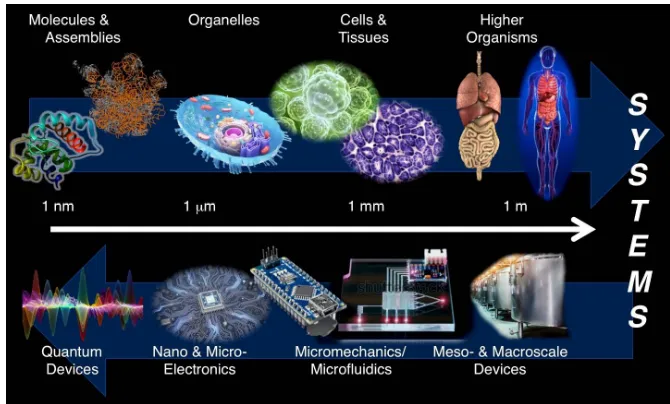
equilibrium. On the basis of this principle, billions of years of evolution have created hierarchically organized living systems that range in size from nanometers to meters and can be of incredibly high
complexity and
functionality (Fig 1).
Self-organizing processes must be distinguished from ‘self-assembly’ processes
because self-assembly does not require any energy input, rather, in the course of self-assembly energy is released (binding energy), which is lost in the process as heat and/or increase in entropy. What both processes have in common though, is that they are not exposed to any external organizing influence. While self-assembly processes are increasingly implemented in technical fabrication routines, self-organization, so far, remains largely unexploited.3
1 Hermann Haken: “The Science of Structure: Synergetics”, Van Nostrand Reinhold, 1981; H. Haken:
"Synergetics, an Introduction: Nonequilibrium Phase Transitions and Self-Organization in Physics, Chemistry, and Biology", 3rd ed. New York: Springer-Verlag, 1983; H. Haken: “Erfolgsgeheimnis der Natur“, Ullstein, 1984.
2 Prigogine, I., Nicolis, G. (1971) Biological order, structure and instabilities. Q Rev Biophys 4, 107; Lakes, R.
(1993) Materials with structural hierarchy. Nature 361, 511; Fratzl, P., Weinkamer, R. (2007) Nature’s hierarchical materials. Progress in Materials Science 52, 1263
3 Palacci, J., et al. (2013) Living Crystals of Light-Activated Colloidal Surfers. Science 339, 936; Chen, A. Y., et al.
(2014) Synthesis and patterning of tunable multiscale materials with engineered cells. Nat. Mater. 13, 515; Maiti, S., Fortunati, I., Ferrante, C., Scrimin, P., Prins, L. J. (2016) Dissipative self-assembly of vesicular nanoreactors. Nat. Chem. 8, 725; Sorrenti, A., Leira-Iglesias, J., Markvoort, A. J., de Greef, T. F. A., Hermans, T. M. (2017) Non-equilibrium supramolecular polymerization. Chem. Soc. Rev. 46, 5476-5490; te Brinke, E., Groen, J., Herrmann, A., Heus, H. A., Rivas, G., Spruijt, E., Huck, W. T. S. (2018) Dissipative adaptation in driven self-assembly leading to self-dividing fibrils. Nat. Nanotechnol. 13, 849-855; Grzybowski, B. A., Huck, W. T. S. (2016) The nanotechnology of life-inspired systems. Nat. Nanotechnol. 11, 585.
1.2 Technical systems are engineered ‘top-down’ to acquire functionality. Based on miniaturization methods, technical systems and devices of ever-increasing sophistication have been engineered in the past centuries. Indeed, engineering and materials sciences have enabled the rise of our modern society as they form the basis of today's manufacturing industry, which is a major pillar of our economic system. Technical systems, ranging from macroscopic machines over mesoscale devices and micromechanic units to microelectronics, are all fabricated by top-down approaches, i.e., through energy-intensive miniaturization of larger materials. Top-down methods have their current size limitations at the 10-100 nm range. Furthermore, with increasing miniaturization, the established manufacturing processes become much more complex, energy-demanding and expensive. In order to escape this dilemma and to be able to produce smaller structural and functional units, it is necessary to break radically new ground in research and development. This can be done through the use of biology’s principles and materials.4
1.3 Biomimetics – we are learning from Nature. Biomimetics is an interdisciplinary field in
which principles from engineering, chemistry and biology are applied to the synthesis of materials, synthetic systems or machines which have functions that mimic biological processes. Biomaterials are natural or synthetic materials that interact with any part of a biological system.5 Biomaterials are being used in biomedical sciences, such as
regenerative medicine, tissue engineering and drug delivery, whereas biomimetic designs are also used for technical systems, such as constructions, machines or instrumentation.
Well known principles exploited in bioinspired material systems include the lotus effect in wetting and self-cleaning, moths' eyes nanoscale structures to minimize light reflection, dolphins’ and sharks’ skin to reduce flow resistance and biofouling, microscopic bristles of gecko feet as adhesives, or the implementation of biological principles for construction of lightweight supporting structures and ‘electronic nose’ devices. While these examples have in common that natural models and designs are being harnessed, fabrication processes are still based on energy-intensive computer-aided ‘top-down’ engineering.
In contrast, Nature impressively demonstrates that systems of enormous complexity can be created with low energy consumption by ‘self-organization’ in a continuous development procedure. This evolution is characterized by growing, testing and selecting hierarchical systems of scale-bridging dimensions that range from atoms over molecules and supramolecular machinery to living cells and higher organisms (Figure 1).
Inherent properties of living systems include their optimized consumption of available (materials and energy) resources, incorporated structures for information storage and processing, replication, regulation, repair and adaptability to environmental changes through mutation and selection.
1.4 Compartmentalization – the key to complexity. As an essential outcome of ‘grow and
select’ strategies, natural evolution has invented ‘compartments’ as key construction elements. Compartmentalization is the general approach to spatially separate two or more active components of a system to prevent malfunctions from spreading and unproductive crosstalk. Classical engineering has long implemented compartmentalization in technical systems. As a simple example, pistons in a cylinder, carburettor and exhaust system can be seen as compartments of an engine and the engine as a compartment of a car. Again, the fabrication of such man-made compartments is based on rational engineering, whereas Nature makes its functional systems by autonomous growth. Can we ever create biomimetic processes with which our modern devices can be manufactured by self-growing systems?
4 Niemeyer, C. M. (2001) Nanoparticles, Proteins, and Nucleic Acids: Biotechnology Meets Materials Science.
Angew Chem Int Ed 40, 4128; Niemeyer, C. M. (2002) Nanotechnology: Tools for the biomolecular engineer. Science 297, 62.
5 https://www.nature.com/subjects/biomimetics;
In biological systems, compartmentalization is achieved by physically constrained cascades of multiple catalytically active proteins, which are essential parts in metabolic and signaling pathways.6 In a joint effort, research in biology,
chemistry, physics and engineering has begun to explore the basic principles of biological compartmentalization in order to exploit them for applications in biotechnology and biomedicine.7
Examples of current research include continuous flow systems for chemical synthesis and biocatalysis, analytical lab-on-a-chip and organ-on-a-chip devices, synthetic biology and the construction of chimeras of living organisms and machines.8 Despite initial advances, however,
these fields are only in their infancy, and substantial trans-disciplinary research is urgently needed to achieve a better understanding of natural engineering principles and to use them for technical applications.
1.5 Information-based strategies unite
exploratory biology and creative engineering.
Due to the above described weaknesses of
top-down methods, purely technical approaches are not sufficient to develop long-term technologies for a sustainable economy or future medical therapies. Approaches will only be successful in the long term if they are developed in close cooperation between the engineering and life sciences. This cooperation has a long history in which chemistry and materials science play an outstanding role.9
The next generation of applications in industrial and medicinal (white and red) biotechnology will require novel innovative small molecules and scale-bridging materials to produce integrated systems with bioinstructive properties that serve as operating systems for functional cell populations. Since experiments and simulations in biosciences, chemistry and materials research provide more and more data, the paradigms of ‘data-driven’ and ’information-based’ sciences are emerging. As in many other fields of science, the aim is to use large amounts of data to gain new insights into complex processes that are not accessible by experiment or simulation.10
Data science links exploratory biology and creative engineering in two ways. On the one hand, it allows to analyze and interprete ‘big data’ sets obtained from technical solutions that already exist and are continuously improved and adopted to tackle biological questions (e.g., microscopy, imaging, large scale ‘Omics’ methods; see 3.5). On the other hand, data science serves the research and implementation of bioinspired technical solutions to develop novel innovative products (learning from nature). The inherent feedback loop from design and theory to experimental sciences, often termed as ‘digital twin’, can also favorably used in
6 Savage, D. F., Afonso, B., Chen, A. H., Silver, P. A. (2010) Spatially ordered dynamics of the bacterial carbon
fixation machinery. Science 327, 1258; Good, M. C., Zalatan, J. G., Lim, W. A. (2011) Scaffold proteins: hubs for controlling the flow of cellular information. Science 332, 680;
7 Rabe, K. S., Muller, J., Skoupi, M., Niemeyer, C. M. (2017) Cascades in Compartments: En Route to
Machine-Assisted Biotechnology. Angew Chem Int Ed Engl 56, 13574, and references cited therein.
8 Giselbrecht, S., Rapp, B. E., Niemeyer, C. M. (2013) The chemistry of cyborgs. Interfacing technical devices
with organisms. Angew Chem Int Ed Engl 52, 13942
9 Niemeyer, C. M. (2017) Engineering for Life Sciences: A Fruitful Collaboration Enabled by Chemistry
(Editorial). Angew Chem Int Ed Engl 56, 1934
10 Bell, G., Hey, T., Szalay, A. (2009) Beyond the Data Deluge. Science 323, 1297
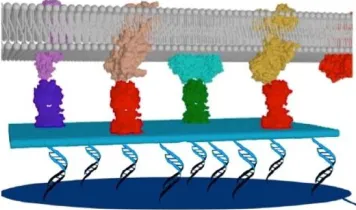
Fig. 2: Cascade reactions in compartments are an emerging approach in industrial biotechnology.7
the biologization of materials research. Supported by concepts based on artificial intelligence and machine learning, a ‘digital twin’ of a biohybrid system, for example, could predict the optimal materials, surface properties and dynamic environmental conditions of in vitro flow systems in order to enable expansion and controlled differentiation of stem cells or to gain the maximal productivity of microbial consortia for the production of fine chemicals.
In the following, we discuss the state of the art and the scope of currently emerging trends in chemistry and materials science that can serve as basic enabling technologies for the development of future biohybrid systems.
2
Innovative chemistry supplies bioinstructive, scale-bridging materials
Based on the developments of the past centuries, chemistry, as an exact natural science, laid the foundation for one of today's most important branches of industry, which facilitates the production of everyday goods, foodstuffs (also as auxiliary substances, such as fertilizers and pesticides) and health care products (e.g. pharmaceuticals). Since we limit our consideration to possible applications in white and red biotechnology, we here focus on
chemical approaches to bioinstructive scale-bridging material systems. We will also
refer to applications outside the life sciences when biomaterials or biological design principles are involved.
2.1 Combinatorial machine-assisted organic synthesis. The consequent use of
combinatorial chemistry, robotics and chemoinformatics is essential to open the door to new bioinstructive agents and materials. Combinatorial chemistry is in essence a systematic covering of the chemical space as an alternative to the focused approach which is governed by design and/or trial and error. It began its triumphal march in organic synthesis more than 20 years ago and is now an indispensable pillar of modern drug research.11 Combinatorial
libraries provide not only small molecular entities but also give access to novel materials useful, for instance, as drug delivery systems12 or to design self-assembling material
systems, such as metal organic frameworks (discussed below, 2.4).
In recent times, combinatorial organic chemistry is often combined with highly parallelized synthesis where cascades of reactions are conducted in fluidically coupled reaction vessels through extensive use of machine assistance.13 This approach, dubbed as ‘continuous flow chemistry’, has yielded impressive synthesis campaigns for pharmaceuticals and other small molecules in recent times.14 While machine assisted synthesis is straight on its way to a
routine method for small molecule production, the use of end-to-end automated
technology platforms that cover the entire process from synthesis to functional analysis of
macromolecular and colloidal compounds is still in its infancy (discussed below, 4.4).
2.2 Polymers – synthetic and biogenic macromolecules. Polymers are synthetic or
natural high molecular weight macromolecules, composed of repeated subunits (monomers) that range from synthetic plastics, such as polystyrene, to natural biopolymers, such as
11 Szostak, J. W. (1997) Introduction: Combinatorial Chemistry. Chem. Rev. 97, 347-348; Horton, D. A.;
Bourne, G. T.; Smythe, M. L. (2003) The combinatorial synthesis of bicyclic privileged structures or privileged substructures. Chem. Rev. 103, 893-930.
12 Akinc, A.; et al (2008) A combinatorial library of lipid-like materials for delivery of RNAi therapeutics. Nat.
Biotechnol. 26, 561-569; Lynn, D. M.; Anderson, D. G.; Putnam, D.; Langer, R. W.(2001) Accelerated
Discovery of Synthetic Transfection Vectors: Parallel Synthesis and Screening of a Degradable Polymer Library. J. Am. Chem. Soc. 123, 8155-8156; Li, L.; Zahner, D.; Su, Y.; Gruen, C.; Davidson, Gary; Levkin, P. A. (2012) Biomaterials 33, 8160-8166.
13 Ley, S. V., Fitzpatrick, D. E., Ingham, R. J., Myers, R. M. (2015) Organic synthesis: march of the machines.
Angew Chem Int Ed Engl 54, 3449.
14 Li, J., et al. (2015) Synthesis of many different types of organic small molecules using one automated
cellulose or DNA. As their physical and biological properties can be specifically adjusted by chemical synthesis, polymers play an outstanding role as materials for countless everyday commodities but also for products in electronics and medical sciences. While some natural biopolymers (e.g., DNA, and proteins) have a precisely determined molecular composition and weight, synthetic polymers are usually mixtures of differently sized macromolecules. Since the size distribution can have unfavorable effects on the material properties, a major effort in current research is concerned with the development of monodisperse polymers that can be designed from scratch and prepared by use of orthogonal (e.g., light-directed) couplings to contain predefined sequences of building blocks.15 As we discuss below (3.3),
polymers have proven their potential as designer materials for building biointerfaces useful for numerous applications in technology and medicine. Light-directed polymerization routes are of particular interest because they can be utilized for multi-material 3D additive manufacturing, such as 3D laser lithography, that provide access to a wide range of high-end metamaterials for bioinstructive, mechanical and plasmonic devices (see 4.3, 4.4).16
2.3 DNA-based materials – sequence-defined polymers and supramolecular
assemblies. Another promising approach to scale bridging materials takes advantage of
natural polymers, DNA and polypeptides, which can be produced by automated solid phase synthesis as well as by biochemical and molecular biology-based methods. DNA-based materials are currently attracting a lot of interest in the area of life sciences because they are readily available, highly biocompatible and, in particular, because they can be rationally designed with arbitrary functions to enable degradation, selective binding and adhesion of molecular entities and cells, cellular uptake and drug delivery.
Through derivatization with non-nucleic acids, even catalytic, optical or electronic properties can be engineered into these materials, to enable fabrication of a broad range of devices useful for applications in the life and materials sciences.17
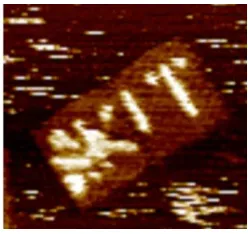
Due to their chemical structure, DNA materials can be used to build scale-spanning structures ranging from the atomic regime of base pairs to the hundred nanometer regime of so-called ‘DNA origami structures’. These are supramolecular assemblies that can be rationally engineered with high precision to yield nanoscaled monodisperse 2D and 3D particles applicable, for instance, as molecular pegboards for the bottom-up assembly of proteins or
nanoparticles.18 As detailed below (3.2, 4.2), DNA materials are already being used for
biological applications (drug delivery, nanomedicine) and current work aims at the development of programmable biointerfaces for biocatalysis, the instruction and interrogation of living cells and even automated platforms for creation of DNA-based material systems.17e
15 Zydziak, N., Konrad, W., Feist, F., Afonin, S., Weidner, S., Barner-Kowollik, C. (2016) Coding and decoding
libraries of sequence-defined functional copolymers synthesized via photoligation. Nat. Commun. 7, 13672; Houck, H. A., Du Prez, F. E., Barner-Kowollik, C. (2017) Controlling thermal reactivity with different colors of light. Nat. Commun. 8, 1869
16 Gräfe, D., Wickberg, A., Zieger, M. M., Wegener, M., Blasco, E., Barner-Kowollik, C. (2018) Adding
chemically selective subtraction to multi-material 3D additive manufacturing. Nat. Commun. 9, 2788; Frenzel, T., Kadic, M., Wegener, M. (2017) Three-dimensional mechanical metamaterials with a twist.
Science 358, 1072
17 a) Seeman, N. C. (2003) DNA in a material world. Nature 421, 427; b) Rabe, K. S., Niemeyer, C. M. (2009)
Gene jelly. Nat. Mater. 8, 370; c) Yang, D., et al. (2014) DNA materials: bridging nanotechnology and biotechnology. Acc. Chem. Res. 47, 1902; d) Niemeyer, C. M. (2017) DNA nanotechnology: On-command molecular Trojans. Nat Nanotechnol 12, 1117; e) Hu, Y., Niemeyer, C. M. (2019) From DNA Nanotechnology to Material Systems Engineering. Adv. Mater. in press.
18 Rothemund, P. W. (2006) Folding DNA to create nanoscale shapes and patterns. Nature 440, 297; Sacca, B.,
Niemeyer, C. M. (2012) DNA origami: the art of folding DNA. Angew Chem Int Ed 51, 58.
2.4 Metal Organic Frameworks (MOFs) – supramolecular porous assemblies. MOFs are crystalline coordination networks, which are assembled from inorganic coupling units and organic linkers. In addition to existing applications in gas storage (e.g. hydrogen, methane, carbon dioxide) and separation (membranes), there is a huge potential in more advanced technologies like catalysis, drug release, fabrication of sensors, energy storage (batteries, capacitors), photovoltaics, and electronics.19 For the latter case, approaches to
grow well-defined, monolithic MOF thin films, SURMOFs, are required. This class of materials contains a virtually unlimited amount of members (already 70.000 different compounds have been characterized until early 2017), and several millions have been simulated by computer based methodologies.20
With regard to the development of bioinstructive, scale-bridging materials, it is important to emphasize that a large fraction of MOFs has been shown to be compatible with living cells.21
Furthermore, investigations have shown that MOFs can be used as matrices for the integration of enzymes. In several cases, the catalytic activity was found to be substantially higher when the biocatalyst was encapsulated in the MOF pores as compared to the free enzyme. It is also conceivable to formulate MOF systems as chiral carriers21c) or as
nanoparticles, incorporate bioactive enzymes or drugs and use the systems for targeted drug delivery to combat, for example, the multidrug resistance of cancer cells or bacteria. Altogether, MOFs are highly promising candidates for the development of scale bridging material systems, wherein self-assembled surface-bound hetero-multilayers can be used for targeted delivery of pharmacologically active compounds to cells or for the development of compartmentalized enzyme cascades (see 4.1).
2.5 Nanoparticles and Biomolecules - hybrid assemblies that connect materials and
life. Nanoparticles can be prepared readily in large quantities from various materials, such
as polymers, metals, metal oxides, and semiconductor materials (e.g., Ag2S, CdS, CdSe,
TiO2). Their size can be controlled from one to about several hundred nanometers and they
have highly interesting optical, electronic, and catalytic properties, which are very different from those of the corresponding bulk materials and which often depend strongly on the particle’s size in a predictable way. Therefore, nanoparticles are highly attractive building blocks for the generation of larger superstructures whose targeted manufacture is the subject of current research in materials science and which are already being used in device fabrication (e.g., Samsung’s QLED displays).
The marriage of nanoparticles and biomolecules bridges the gap between biology and
materials sciences in two ways. On the one hand, biomolecules, in particular proteins and
nucleic acids, can be grafted onto nanoparticles to add functionality, which, in turn, leads to novel properties of the hybrids. This approach is being used for the engineering of novel
19 Yaghi, O. M. (2016), Reticular Chemistry-Construction, Properties, and Precision Reactions of Frameworks J.
Am. Chem. Soc. 138, 15507-15509; Kitagawa, S.; Kitaura, R.; Noro, S. (2004), Functional porous
coordination polymers. Angew. Chem. Int. Ed. 43, 2334-2375;
20 a) Liu, J., Wöll, C. (2017) Surface-supported metal–organic framework thin films: fabrication methods,
applications, and challenges. Chem. Soc. Rev. 46, 5730; b) Wilmer, C. E., Leaf, M., Lee, C. Y., Farha, O. K., Hauser, B. G., Hupp, J. T., Snurr, R. Q. (2011) Large-scale screening of hypothetical metal–organic frameworks. Nat. Chem. 4, 83;
21 a) Horcajada, P., Gref, R., Baati, T., Allan, P. K., Maurin, G., Couvreur, P., Férey, G., Morris, R. E., Serre, C.
(2012) Metal–Organic Frameworks in Biomedicine. Chem. Rev. 112, 1232; b) Majewski, M. B., Howarth, A. J., Li, P., Wasielewski, M. R., Hupp, J. T., Farha, O. K. (2017) Enzyme encapsulation in metal–organic
frameworks for applications in catalysis. CrystEngComm 19, 4082; c) Cakici, M., Gu, Z.-G., Nieger, M., Bürck, J., Heinke, L., Bräse, S. (2015) Planar-chiral building blocks for metal–organic frameworks. Chem. Commun.
materials for sensing, delivery or structure formation.4, 22 On the other hand, the size,
structural and chemical composition of nanoparticles allows for specific integration of biomolecules into nanoscale environments and compartments (see 4.1), such that nano-particulate architectures can be used to study cellular processes (4.2).
3
Biointerfaces are the key to the exploration and utilization of biosystems.
For the biologization of materials research, the physical linking of biological systems with man-made materials is essential in order to develop models with which the interaction between life and matter can be investigated in depth and exploited for applications. Chemistry plays a key role in these developments as it combines the instrumental hardware of engineers with the specimens of life scientists. Chemical methods are needed to bring artificial material systems into contact with biological molecules, individual cells and associations of eukaryotic and microbial cell populations. Modern, powerful analysis and data processing methods are indispensable for the comprehensive analysis of hybrid systems produced in this way.
3.1 Bioconjugation chemistry. Over the past decades, ‘bioconjugation’ has emerged as a
crucial strategy to stably link biomolecules with other types of biomolecules, small-molecule compounds, particles or solid surfaces.23 The modification of biomolecules opens the door
to diverse applications, such as tracking cellular events, revealing enzyme function, determining molecular biodistributions, imaging specific biomarkers, or delivering drugs to targeted cells. Developments in bioconjugate chemistry are currently focused on (i) the development of ever more gentle and selective methods for functionalizing the often sensitive biomolecules by so-called 'bioorthogonal coupling methods',24 (ii) the linking of
different classes of functional biomolecules with each other (e.g., DNA-protein conjugates, protein glycoengineering),25 and (iii) the chemical modification of living cells and
organisms.26
From a technical point of view, materials’ surfaces must be designed in such a way that chemoselective coupling with the biomolecular component can take place. Current work clearly indicates that biomolecular linker systems are particularly advantageous in this respect, as they are often based on genetically encoded binding motifs.27 The development
of efficient and selective linker systems represents an important challenge for the further advancement of biohybrid systems.
22 a) Giljohann, D. A., et al., Mirkin, C.A. (2010) Gold nanoparticles for biology and medicine. Angew Chem Int
Ed Engl 49, 3280; b) Macfarlane, R. J., et al., Mirkin, C.A. (2011) Nanoparticle superlattice engineering with
DNA. Science 334, 204.
23 Hermanson, G. T., Bioconjugate Techniques, Academic Press, San Diego 1998; Niemeyer, C. M. (Ed.):
Bioconjugation Protocols: Strategies and Methods. in Methods in Molecular Biology, Humana Press, Totowa, NJ 2004.
24 Jonkheijm, P., Weinrich, D., Schroeder, H., Niemeyer, C. M., Waldmann, H. (2008) Chemical Strategies for
Generating Protein Biochips. Angew. Chem. Int. Ed. Engl. 47, 9618; Stephanopoulos, N., Francis, M. B. (2011) Choosing an effective protein bioconjugation strategy. Nat. Chem. Biol. 7, 876; Meldal, M., Schoffelen, S. (2016) Recent advances in covalent, site-specific protein immobilization. F1000Res 5, DOI
10.12688/f1000research.9002.1
25 Niemeyer, C. M. (2010) Semisynthetic DNA-Protein Conjugates for Biosensing and Nanofabrication. Angew
Chem Int Ed 49, 1200; Koehler, C., et al., Braese, S., Lemke, E. A. (2016) Genetic code expansion for
multiprotein complex engineering. Nat. Methods 13, 997.
26 Prescher, J. A., Bertozzi, C. R. (2005) Chemistry in living systems. Nat. Chem. Biol. 1, 13-21; Laughlin, S. T.,
Baskin, J. M., Amacher, S. L., Bertozzi, C. R. (2008) In Vivo Imaging of Membrane-Associated Glycans in Developing Zebrafish. Science 320, 664; Vogel, K., Glettenberg, M., Schroeder, H., Niemeyer, C. M. (2013) DNA-Modification of Eukaryotic Cells. Small 9, 255.
27 Peschke, T., Rabe, K. S., Niemeyer, C. M. (2017) Orthogonal Surface Tags for Whole-Cell Biocatalysis. Angew
3.2 DNA surface technology. An example that takes advantage of biomolecular linker systems and genetically encoded binding motifs can be traced back to the development of DNA microarray technology in the course of the human genome project in the 1980s. It led to the evolution of Industrial processes for large-scale fabrication of sophisticated DNA chips, which can nowadays contain millions of different DNA molecules and are routine tools for fundamental and applied biomedical research, such as genotyping and expression profiling.28 Based on the invention of the “DNA-directed immobilization” (DDI) technique,
DNA surfaces can also be utilized for functionalization of solid substrates with arbitrary compounds, such as small-molecules, nanoparticles and, in particular, proteins.29 DDI takes
advantage of DNA chips for self-assembly of non-nucleic acid compounds that are tagged with complementary oligonucleotides. This is a very mild and efficient process as indicated by hundreds of research papers, which include the use of variable materials (glass, polymers, gold, silicon) for the fabrication of complex surface-bound architectures comprising proteins, nanoparticles and even cells.30
The power of DNA surfaces as tools for fundamental biology and materials research can even be enhanced by implementation of DNA nanostructures. This approach integrates bottom-up and top-down fabrication and it allows one to produce large-area spatially ordered arrays of nanoparticles using lithographically confined DNA origami structures or create multiscale origami structures as interface for cells (MOSAIC).31 The latter is a
powerful method to present to adhered cells well-defined arrangements of ligands with full control over their number, stoichiometry, and precise nanoscale orientation. Hence, the integration of bottom-up
assembly outperforms top-down patterning methods and, thus, opens the door to novel applications in the life sciences that cannot be tackled by conventional technologies.
3.3 Innovative polymer surfaces. Because polymers offer a variety of ways to adjust both
the surface texture and the chemical and mechanical properties of bulk materials, these synthetic materials are particularly well suited for applications in the life sciences. Examples of current research include the development of polymer coatings for mediation of biomaterial–cell Interactions, biodegradable polymers, or ‘smart’ responsive polymers. Applications of these materials include tissue engineering, drug delivery, prosthetics as well as antimicrobial and bioinspired antifouling coatings.32
28 Pirrung, M. C. (2002) How to Make a DNA Chip. Angew Chem Int Ed 41, 1276; Pirrung, M. C., Southern, E. M.
(2014) The genesis of microarrays. Biochem Mol Biol Educ 42, 106;
29 Niemeyer, C. M., Sano, T., Smith, C. L., Cantor, C. R. (1994) Oligonucleotide-directed self-assembly of
proteins. Nucl. Acids Res. 22, 5530; Meyer, R., Giselbrecht, S., Rapp, B. E., Hirtz, M., Niemeyer, C. M. (2014) Advances in DNA-directed immobilization. Curr Opin Chem Biol 18C, 8
30 a) Chen, S., et al., (2016) Interrogating cellular fate decisions with high-throughput arrays of multiplexed
cellular communities. Nat. Commun. 7, 10309; b) Lin, Q.-Y., et al., Mirkin, C. A. (2018) Building superlattices from individual nanoparticles via template-confined DNA-mediated assembly. Science 359, 669; c) for a recent survey of the field, see Schneider, A.-K., Niemeyer, C. M. (2018) DNA Surface Technology: From Gene Sensors to Integrated Systems for Life and Materials Sciences. Angew Chem Int Ed 57, 16959.
31 a) Hung, A. M., et al., (2010) Large-area spatially ordered arrays of gold nanoparticles directed by
lithographically confined DNA origami. Nat Nanotechnol 5, 121; b) Angelin, A., et al., Hirtz, M., Niemeyer, C. M. (2015) Multiscale Origami Structures as Interface for Cells. Angew Chem Int Ed Engl 54, 15813.
32 Wilson, C. J., Clegg, R. E., Leavesley, D. I., Pearcy, M. J. (2005) Mediation of Biomaterial–Cell Interactions.
Tissue Engineering 11, 1; Peppas, N. A., Hilt, J. Z., Khademhosseini, A., Langer, R. (2006) Hydrogels in
Biology and Medicine: From Molecular Principles to Bionanotechnology. Adv. Mater. 18, 1345; Hunter, A. C., Moghimi, S. M. (2017) Smart polymers in drug delivery: a biological perspective. Polymer Chemistry 8, 41; Dalsin, J. L., Messersmith, P. B. (2005) Bioinspired antifouling polymers. Materials Today 8, 38.
Since cells react very sensitively to geometrical and mechanical cues of their environment, a particular challenge regards the engineering of polymer substrate surfaces with controllable topography at the micro- and nanoscale to control cell function.33 Solutions for this task can
be achieved by implementing top-down and bottom-up technologies. For instance, photolithographic segregation of polymers can yield synthetic surfaces with superhydrophilic and superhydrophobic patterns or hierarchical micro-nano roughness. Else, thermal molding of polymer films can be combined with DNA-based assembly schemes to steer adhesion propagation and differentiation of cell populations.34 As described below, these approaches
are increasingly used for in vitro studies on biological model systems (3.4), whereby the efficacy of the investigations can be enormously increased through implementation of high-throughput/high-content formats based on microarrays and microfluidics (3.5).
3.4 Cell populations on surfaces. Based on the societal relevance of applications in
biomedical sciences and biotechnology, current research at the interface of materials and life science is focusing on two highly challenging biological systems, eukaryotic cell populations, in particular stem cells, and microbial consortia, such as multi-species biofilms. A key objective is to rationally design and engineer tailored surfaces for sophisticated culture devices as an approach to specifically manipulate these multicellular systems at the molecular level. For example, innovative bioreactor surfaces could be used to create artificial organs or to expand and control the differentiation of stem cells,34a,, 35 required for
applications in, e.g., drug testing or cell therapy. Furthermore, advanced technical devices and surfaces for controlling biofilm formation and harnessing their unique, complex properties represent a major source of innovation in biotechnology, for example in bioproduction and water purification, as well as in strategies for limiting biofilm formation in clinical settings.36
Integrated in vitro studies of eukaryotic and microbial cell populations will also allow to tackle very general questions, such as how do specific (chemical, biological and physical) properties of artificial surfaces influence cell behaviour (e.g. adhesion, differentiation and growth)? Do the cellular systems share common principles of cell-surface interaction? Are there specificities which could be harnessed to favour species-specific adhesion? What are the underlying molecular mechanisms whereby the surface properties influence particular aspects of cellular behavior? Can we exploit this knowledge for innovative material-based approaches to control cells?
As explained below (Chapter 4), it seems plausible that future technological developments in materials and surface sciences in combination with nano- and micro-engineering will make it possible to answer these questions and use them for the translation into fundamentally new devices and processes in the fields of red and white biotechnology.
33 Bettinger, C. J., Langer, R., Borenstein, J. T. (2009) Engineering substrate topography at the micro- and
nanoscale to control cell function. Angew Chem Int Ed Engl 48, 5406; Ross, A. M., Jiang, Z., Bastmeyer, M., Lahann, J. (2012) Physical aspects of cell culture substrates: topography, roughness, and elasticity. Small 8, 336.
34 a) Jaggy, M., Zhang, P., Greiner, A. M., Autenrieth, T. J., Nedashkivska, V., Efremov, A. N., Blattner, C.,
Bastmeyer, M., Levkin, P. A. (2015) Hierarchical Micro-Nano Surface Topography Promotes Long-Term Maintenance of Undifferentiated Mouse Embryonic Stem Cells. Nano Lett. 15, 7146; b) Schneider, A. K., Nikolov, P. M., Giselbrecht, S., Niemeyer, C. M. (2017) DNA-SMART: Biopatterned Polymer Film
Microchannels for Selective Immobilization of Proteins and Cells. Small 13, 1603923.
35 a) Villa-Diaz, L. G., Ross, A. M., Lahann, J., Krebsbach, P. H. (2012) Concise Review: The Evolution of human
pluripotent stem cell culture: From feeder cells to synthetic coatings. STEM CELLS 31, 1; b) Villa-Diaz, L. G., et al., Lahann, J., Smith, G. D. (2010) Synthetic polymer coatings for long-term growth of human embryonic stem cells. Nat. Biotechnol. 28, 581.
36 Verstraete, W. (2015) The manufacturing microbe. Microb Biotechnol 8, 36; Flemming, H. C., et al. (2016)
3.5 High-throughput, high-content analytics. A comprehensive analysis to characterize the technical systems, their influence on the integrated biosystems and the inherent structure and functional dynamics of the biohybrid system is essential for advancement of the biologization of materials research. On the material side, multimodal methods for production and characterization are required, which allow a comprehensive analysis of the structure and chemical composition of the materials on the biologically relevant length scales from a few nanometers up to the mesoscale. Especially imaging methods (NMR, electron and scanning probe microscopy, tomography, TOF-SIMS) are suitable for this purpose. Imaging processes are also the most powerful tools on the biological side.37 So-called
‘superresolution microscopy’,38 in particular, provides detailed insights into structure and
dynamics of biological processes. It is foreseeable that this methodology, for instance, will allow to elucidate intracellular signaling cascades in living cells and tissues in real time and with near molecular resolution.
Also essential is the systematic use of the so-called ‘Omics’ technologies, with which the composition of the genome, transcriptome, proteome, metabolome and interactome can be analyzed across cells and organisms as a function of environmental conditions.39 The
enormously large data sets obtained from imaging and Omics analyses of the cellular systems will need to be efficiently processed in silico in order to enable ‘data driven’ generation of models and simulations that describe both the material and biosystems as well as the overall properties of biohybrid systems.
Combinatorial synthesis and microarray technologies are the key to throughput, high-content analytics, as they allow a huge number of experimental samples to be screened at low cost and time. While DNA microarrays are already well established,28 the development
of corresponding surface-bound libraries of peptides, proteins, glycans and eukaryotic or microbial cells is still in its beginning. It requires innovative concepts which usually depend on a high level of robotics and computer-aided automation.40
37 Kherlopian, A. R., Song, T., Duan, Q., Neimark, M. A., Po, M. J., Gohagan, J. K., Laine, A. F. (2008) A review of
imaging techniques for systems biology. BMC Systems Biology 2, 74; da Cunha, M. M. L., Trepout, S., Messaoudi, C., Wu, T.-D., Ortega, R., Guerquin-Kern, J.-L., Marco, S. (2016) Overview of chemical imaging methods to address biological questions. Micron 84, 23-36
38 Sydor, A. M., Czymmek, K. J., Puchner, E. M., Mennella, V. (2015) Super-Resolution Microscopy: From Single
Molecules to Supramolecular Assemblies. Trends in Cell Biology 25, 730
39 Karczewski, K. J., Snyder, M. P. (2018) Integrative omics for health and disease. Nat. Rev. Genetics 19, 299 40 a) Loeffler, F. F., et al., Bräse, T. S., Breitling, F., Nesterov-Mueller, A. (2016) High-flexibility combinatorial
peptide synthesis with laser-based transfer of monomers in solid matrix material. Nat. Commun. 7, 11844; b) Weinrich, D., Jonkheijm, P., Niemeyer, C. M., Waldmann, H. (2009) Applications of Protein Biochips in Biomedical and Biotechnological Research. Angew Chem Int Ed 48, 7744; c) Reisewitz, S., Schroeder, H., Tort, N., Edwards, K. A., Baeumner, A. J., Niemeyer, C. M. (2010) Capture and Culturing of Living Cells on Microstructured DNA Substrates. Small 6, 2162; d) Tronser, T., Popova, A. A., Levkin, P. A. (2017)
Miniaturized platform for high-throughput screening of stem cells. Curr. Opin. Biotechnol. 46, 141; e) Feng, W., Ueda, E., Levkin, P. A. (2018) Droplet Microarrays: From Surface Patterning to High-Throughput Applications. Adv. Mater. 30, 1706111; Bruchmann, J., Pini, I., Gill, T. S., Schwartz, T., Levkin, P. A. (2016) Patterned SLIPS for the Formation of Arrays of Biofilm Microclusters with Defined Geometries. Adv.
4
From material systems to biomimetic compartments and devices.
The efficient implementation of the biologization of materials research makes it is necessary to combine materials and biosystems into integrated units in order to exploit the fundamental biological principles of self-assembly, self-organization and compartmentalization for applications in biotechnology. Data-driven sciences and Information-based strategies will play a key role in bringing together exploratory biology and creative engineering elements to enable future devices of high complexity and utility.
4.1 Self-assembled carriers and chassis. Self-assembly, i.e., the autonomous
organization of components into patterns or structures without human intervention is used increasingly in many disciplines ranging from chemistry and biomimetics over band-gap materials and optoelectronics to microfabrication and new models for computation.41 As
detailed above, material systems based on polymers (2.2), DNA (2.3), MOFs (2.4) and nanoparticles (2.5) have the necessary biocompatibility, dimensionality and applicability for cross-scale designs required for the production of biomimetic and bioinstructive systems.
In recent years, biology has witnessed extraordinary scientific success through application of reduction-based engineering concepts to biological systems, including the use of scaffolds to enhance the efficiencies of enzyme cascade reactions. 42 The notion of novel,
compartmentalized carriers that can selectively transport and separate substrates and/or products for these enzyme reactions has emerged as a significant scientific challenge. For this purpose, suitable synthetic carriers that provide structural sophistication (compartmentalization, morphological diversity and dynamic environmental adaptation) are needed.
For example, arrangements of synthetic multienzyme cascades on DNA nanostructures are currently attracting much attention because they offer novel insights into natural spatially-interactive biomolecular networks and associated fundamental principles, such as ‘substrate channeling’. They could also be exploited for synthetic biology and the next generation of industrial biocatalysts because they can be steered by synthetic switches and are not limited in terms of the incorporated biocatalytic entities.7, 43 Furthermore, DNA Origami pegboard
carriers can be incorporated into microfluidic systems to create functionally coupled compartments for flow biocatalysis applications.
41 Whitesides, G. M., Mathias, J. P., Seto, C. T. (1991) Molecular self-assembly and nanochemistry: a chemical
strategy for the synthesis of nanostructures. Science 254, 1312; Whitesides, G. M., Grzybowski, B. (2002) Self-Assembly at All Scales. Science 295, 2418.
42 Purnick, P. E. M., Weiss, R. (2009) The second wave of synthetic biology: from modules to systems. Nat. Rev.
Mol. Cell Biol. 10, 410; Kuchler, A., Yoshimoto, M., Luginbuhl, S., Mavelli, F., Walde, P. (2016) Enzymatic
reactions in confined environments. Nat. Nanotechnol. 11, 409;
43 a) Fu, J., Liu, M., Liu, Y., Yan, H. (2012) Spatially-interactive biomolecular networks organized by nucleic acid
nanostructures. Acc Chem Res 45, 1215 b) Timm, C., Niemeyer, C. M. (2015) Assembly and Purification of Enzyme-Functionalized DNA Origami Structures. Angew Chem Int Ed Engl 54, 6745.
Another approach to compartmentalization is based on polymer particles, which can be prepared in large scale by electrohydrodynamic co-jetting or related techniques.44 Self-assembly
and phase separation processes lead to formation of multiple
distinctive domains and
micro/nanosized compartments inside and on the surface of such colloids. In addition to their use as scaffolds and carriers in enzyme technology, multicompartmentalized colloids hold a great potential as chassis for the development of artificial cells. They can be harnessed for mimicking cellular redox reactions, which are one of the most important processes in living organisms and remain a key hurdle in synthetic biology. Furthermore, since inorganic NPs and supraparticles can readily be used to create micro- and mesoscaled superlattices and hierarchically organized colloidal crystals by self-assembly, their applications extend beyond the life sciences to the fields of optical and electronic components.
4.2 Layered particle assemblies on surfaces. Self-assembly of colloidal components on
the surface of bulk materials offer an elegant route to the manufacturing of 2D layered materials. This class of materials displays a large anisotropy to their bonding, electrical and/or magnetic properties. Therefore, it is of tremendous interest for an enormous breadth of fields, ranging from semiconductor technology, electronics and energy storage over photofunctional and catalytic devices to biomedical applications.45 For example, this
approach provides a platform for the systematic study of light-matter interaction in NP-based materials.30b In the context of biosciences, such materials can be tailor-made for specific
applications, such as the targeted delivery of pharmacologically active cargo in prosthetics or protein and gene transfection methodologies in biomedical therapies (cell immunization, gene repair).
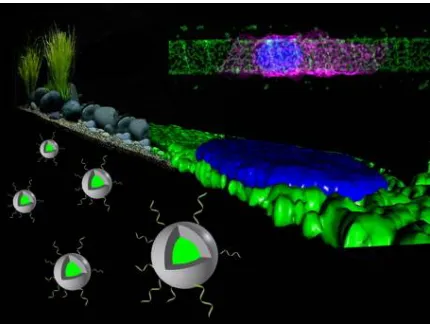
An example of how such materials can be integrated into larger microscaled architectures and used for the selective adhesion of cells is the 'Biopebbles' concept (Fig. 7). Similar as stone pebbles on the seabed attract marine organisms, DNA-decorated silica nanoparticles are attracting living cells. Since the particles can be encoded with arbitrary compounds (e.g., bioactive compounds) this phenomenon can be exploited for cell guidance and manipulation on top-down microstructured surfaces.46
44 a) Lee, K. J., Yoon, J., Lahann, J. (2011) Recent advances with anisotropic particles. Curr. Opin. Colloid Int. Sci.
16, 195; b) Xia, Y., et al., Glotzer, S. C., Kotov, N. A. (2011) Self-assembly of self-limiting monodisperse
supraparticles from polydisperse nanoparticles. Nat. Nanotechnol. 6, 580; c) Park, J. I., et al., Glotzer, S. C., Kotov, N. A. (2014) Terminal supraparticle assemblies from similarly charged protein molecules and nanoparticles. Nat Commun 5, 3593.
45 Heterostructures based on two-dimensional layered materials and their potential applications. Materials
Today 19, 322.
46 Leidner, A., Weigel, S., Bauer, J., Reiber, J., Angelin, A., Grösche, M., Scharnweber, T., Niemeyer Christof, M.
(2018) Biopebbles: DNA-Functionalized Core–Shell Silica Nanospheres for Cellular Uptake and Cell Guidance Studies. Adv. Funct. Mater. 28, 1707572.
Figure 6: Compartmentalized polymer particles that can serve as chassis for synthetic biology (Lahann lab).
Fig. 7: Colloidal superstructures assembled on micropatterns attract cells (Niemeyer lab).46
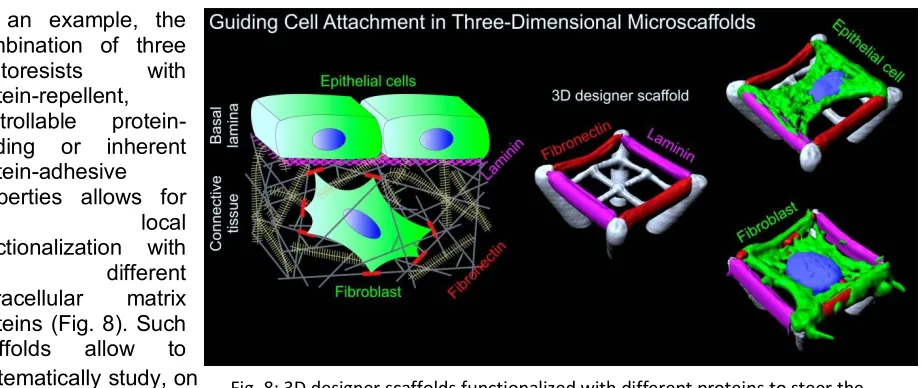
4.3 Designer petri dishes for single cells. Controlling eukaryotic cells by tailor-made materials is an intriguing goal, as it is an emerging way to “program” or instruct cell behavior without the need of genetic modifications of the cells. In the living organism cell behavior is critically influenced by the actions of different cues (biochemical factors or biophysical cues like flexibility) from the microenvironment, which act cooperatively in three dimensions. Consequently, several experimental 3D cell-culture models have been developed in recent years..47 Additive manufacturing using 3D laser microprinting has been emerged as a
powerful tool to manufacture complex 3D cellular microenvironments with a well-defined geometry. In most of the earlier studies scaffolds were stiff and composed of a single photoresist with a homogeneous surface coating of biomolecules. More recent developments demonstrate either flexible scaffolds that can be deformed by forces applied by single cells or scaffolds composed of two or more resists that allow for the precise functionalization with several biomolecules in 3D.48
As an example, the combination of three photoresists with protein-repellent, controllable protein-binding or inherent protein-adhesive properties allows for
the local
functionalization with
two different
extracellular matrix proteins (Fig. 8). Such scaffolds allow to systematically study, on the single cell level, the response (e.g., cell
mechanics, cell differentiation) to the well defined artificial environment. Such approaches will enable the detailed understanding of how man-made materials influence cellular behavior to derive novel means, materials and devices to steer cell differentiation. For future developments, dynamic cell culture scaffolds are highly desirable, which require resists with “switchable-on-demand” properties to fully control biological processes. For example, in vivo maintenance and differentiation of stem cells is controlled not only by static cell–cell and cell–matrix adhesions, but also by dynamic changes in the environment. Hence, dynamic variations in the protein composition and changes in the mechanical stiffness need to be developed and implemented into the manufacturing of artificial 3D growth substrates.
47 DeForest C. A., Anseth K. S. (2012) Advances in Bioactive Hydrogels to Probe and Direct Cell Fate. Annu. Rev.
Chem. Biomol. 3, 421; Greiner A.M., Richter B., Bastmeyer M. (2012) Micro-Engineered 3D Scaffolds for Cell Culture Studies. Macromolecular Biosciences 10, 1301; Chen, C.S. (2016) 3D Biomimetic Cultures: The Next Platform for Cell Biology. Trends Cell Biol. 26, 798.
48 Klein F., Striebel T., Fischer J., Jiang Z., Franz C.M., von Freyman G., Wegener M. and Bastmeyer M. (2011)
Elastic fully three-dimensional microstructure scaffolds for cell force measurements. Advanced Mater. 22, 868; Klein F., Richter B., Striebel T., Franz CM., von Freyman G., Wegener M. and Bastmeyer M. (2012) Two-Component Polymer Scaffolds for Controlled Three-Dimensional Cell Culture. Advanced Mater. 23, 1341; Richter B., Hahn V., Berthels S., Claus T.K., Wegener M., Delaittre G., Barner-Kowollik C. and Bastmeyer M. (2017) Guiding cell attachment in three-dimensional microscaffolds selectively functionalized with two distinct adhesion proteins. Adv. Mater. 29. doi: 10.1002/adma.201604342.
4.4 Microfluidics, robotics and data-driven science.
These are core areas of engineering
that are increasingly used in the production and operation of material- and biobased functional systems. Indeed, microfluidics should be considered as a key enabling technology, because it offers an extraordinary high degree of control over temperature profiles and diffusion-based mixing49 along with an excellent connectivity to high-throughputliquid handling, robotics, (in-line) analytics, and data acquisition. The intimate connectivity of robotic systems with large-scale acquisition and analysis of data is playing an increasingly important role with the emergence of the 'Internet of Things' (IoT). It should thus be stressed that information-based strategies are the unifying link between exploratory biology and creative engineering (see below, 1.5, 3.6).
Microfluidics-based end-to-end automated technology platforms are currently being developed to cover the entire process from synthesis to functional analysis in a variety of fields, ranging from synthetic organic chemistry (see above, 2.1) and synthetic biology50 to
biocatalysis7 and materials research.51 Such platforms are invaluable for the investigation of
biological and biohybrid systems, as they not only provide details on the composition and structure, but also enable new insights into the dynamics of the systems. This is essential to harness fundamental principles of self-organization for technical applications.
For example, we have developed a microfluidic platform, where readily available microfluidic chips are connected by automated liquid handling with analysis instrumentation, such as spectroscopy, microscopy,
chromatography and
tomography, to investigate the structure, function and dynamics of biofilms.52 As described above
(3.4), biofilms are multispecies microbial consortia, which are intensively studied not only for their effects on health and
environment but also because they have an enormous potential as tools for biotechnological processes. While currently available technologies do not allow a comprehensive description of the composition and dynamics of these biosystems, our integrated platform offers the detailed analysis of biofilm structure along with high spatio-temporal resolution in the analysis of metabolites and identification of members by single-cell genomics. This can be used, for example, to follow the self-organized separation of multispecies consortia along autonomously created gradients and compartments, to investigate the response and dynamic behavior of medical biofilms onto variable materials, or to optimize the productivity of biofilms in microfluidic reactors.
49 Mason, B. P., Price, K. E., Steinbacher, J. L., Bogdan, A. R., McQuade, D. T. (2007) Greener approaches to
organic synthesis using microreactor technology. Chem. Rev. 107, 2300; Wohlgemuth, R., Plazl, I., Znidarsic-Plazl, P., Gernaey, K. V., Woodley, J. M. (2015) Microscale technology and biocatalytic processes:
opportunities and challenges for synthesis. Trends Biotechnol 33, 302
50 Linshiz, G., Jensen, E., Stawski, N., Bi, C., Elsbree, N., Jiao, H., Kim, J., Mathies, R., Keasling, J. D., Hillson, N. J.
(2016) End-to-end automated microfluidic platform for synthetic biology: from design to functional analysis.
J. Biol. Eng. 10, 3
51 Lookman, T., Alexander, F. J., Krishnan, R., Information Science for Materials Discovery and Design, Springer,
New York 2015
52 Hansen, S. H., Kabbeck, T., Radtke, C. P., Krause, S., Krolitzki, E., Peschke, T., Gasmi, J., Rabe, K. S., Wagner,
M., Horn, H., Hubbuch, J., Gescher, J., Niemeyer, C. M. (2017) Machine-assisted cultivation and analysis of biofilms. bioRxiv DOI: 10.1101/210583
4.5 Additive manufacturing. This is a comprehensive term for processes for the fast and cost-effective production of models, samples, prototypes, tools and end products. On the basis of computer-internal data models, the products are manufactured from formless materials (liquids, gels, powders, etc.) or from shape-neutral workpieces (wires, foils, blocks) using chemical and/or physical processes.53 “3D printing” is a powerful emerging technology
of increasing importance for the tailored fabrication of functional materials for life science and technology.54 3D laser printing makes it possible to produce almost any 3D structures in
the lower micrometer regime, which can be equipped with tailored materials properties and even adaptive and bioinstructive characteristics due to
tailor-made polymers or other inks.
In addition to printing of artificial structures and devices for applications in optics and electronics (2.2) or cell biology (4.3), 3D bioprinting is currently intensively investigated for the top-down assembly of living and non-living biological materials. For example, bioprinting of cells aims to produce biological scaffolds for tissue engineering and stem cell technologies or even whole organs by machine-assisted fabrication processes.54b In addition to these perspectives
in red biotechnology, emerging applications in white biotechnology are aiming towards the development of enzyme-loaded cartridges for flow biocatalysis.55 These
developments suggest that in the not too distant future it will be possible to design complex and highly functional biocatalyst systems on the computer and manufacture them by automated processes that are less susceptible to disturbances and handling errors.
5
Conclusions and recommendations
Based on fundamental principles of living systems, we have elaborated in this white paper the importance of a biologization of material research. Nature shows impressively that systems of incredible complexity can be created with minimal energy consumption but maximal capability for programmable replication, repair, regulation and environmental responsiveness. Although biomimetics and bioinspired material systems are already being used for applications, the use of biological systems and principles is only just beginning. The biologization of materials research serves to unlock this potential.
53 VDI_Statusreport_AM_2014_WEB.pdf, accessed 19 September 2018; Kotz, F., Arnold, K., Bauer, W., Schild,
D., Keller, N., Sachsenheimer, K., Nargang, T. M., Richter, C., Helmer, D., Rapp, B. E. (2017) Three-dimensional printing of transparent fused silica glass. Nature 544, 337
54 a) Barner-Kowollik, C., Bastmeyer, M., Blasco, E., Delaittre, G., Müller, P., Richter, B., Wegener, M. (2017)
3D Laser Micro- and Nanoprinting: Challenges for Chemistry. Angew. Chem. Int. Ed. Engl. 56, 15828; b) Lee, J. M., Yeong, W. Y. (2016) Design and Printing Strategies in 3D Bioprinting of Cell-Hydrogels: A Review. Adv.
Healthcare Mater. 5, 2856;
55 a) Maier, M., Radtke, C. P., Hubbuch, J., Niemeyer, C. M., Rabe, K. S. (2018) On-Demand Production of
Flow-Reactor Cartridges by 3D Printing of Thermostable Enzymes. Angew Chem Int Ed Engl 57, 5539; b) Peschke, T., Skoupi, M., Burgahn, T., Gallus, S., Ahmed, I., Rabe, K. S., Niemeyer, C. M. (2017) Self-Immobilizing Fusion Enzymes for Compartmentalized Biocatalysis. ACS Catalysis 7, 7866; c) Peschke, T., Bitterwolf, P., Gallus, S., Hu, Y., Oelschlaeger, C., Willenbacher, N., Rabe, K. S., Niemeyer, C. M. (2018) Self-Assembling All-Enzyme Hydrogels for Flow Biocatalysis. Angew Chem Int Ed 57, 17028.
Fig. 10: The next wave of biocatalysis will be enabled by machine-assisted flow processes that require tailor-made materials to achieve efficient product conversion.55c Copyright