Article
Microstructural Characterization and Mechanical
Properties of 5 vol.% (TiB
w
+TiC
p
)/Ti Composite
Produced by Forging
J.C. Han
1, Z.D. Lü
2,
C.J. Zhang
2,*, S.Z. Zhang
2, H.Z. Zhang
3, P. Lin
2, P. Cao
3,** 1School of Mechanical Engineering, Taiyuan University of Technology, Taiyuan 030024, China. [email protected]
2
School of Materials Science and Engineering, Taiyuan University of Technology, Taiyuan 030024, China. [email protected]; [email protected]; [email protected];[email protected]
3 Department of Chemical and Materials Engineering, University of Auckland, Private Bag 92019, Auckland
1142, New Zealand. [email protected]; [email protected]
* Correspondence: [email protected] Tel.: +86-351-6010022 [email protected] Tel.: +64-9-923-6924
Abstract: In this study, a 5vol. % (TiBw+TiCp)/Ti composite pancake with a diameter of 260mm was prepared by casting followed by open die forging in (α+β) phase region. The microstructures of the composite pancake are inhomogeneous, in terms of both matrix microstructure and distribution of reinforcements. The matrix microstructures were gradually refined from the periphery to centre of the pancake. The TiBw and TiCp reinforcements tend to be uniformly distributed in the centre region and. It is suggested that the microstructure difference can be mainly ascribed to the temperature variation from the periphery to the centre. Additionally, tensile testing results showed that the centre region of the composite pancake exhibits higher strength than the peripheral region. The strengthening mechanism and the softening behavior of the composite pancake with temperature is discussed.
Keywords: Titanium matrix composites; Microstructure; Mechanical properties; Forging.
1. Introduction
Due to the high elastic modulus, specific strength, superior creep and fatigue resistances, titanium matrix composites (TMCs) have been emerged as attractive candidate materials for high-temperature structural applications in aerospace and automotive industries [1-4]. As one approach to produce TMCs, in situ synthesis techniques have drawn extensive interest because of their superior and isotropic properties along with the ease of fabrication [5-7]. Specifically, among the various reinforcements used in TMCs, TiB whiskers (TiBw) and TiC particles (TiCp) are believed to be the most suitable reinforcements since they offer clean interfaces and show thermodynamically stability [8-10]. Currently, combustion assisted cast has been generally adopted to produce in situ TMCs due to the obvious technical advantages [11-13].
However, along with the limited improvement in strength, the in situ TiBw/Ti or TiCp/Ti composites prepared by in situ casting routes demonstrate very low room-temperature ductility and poor temperature resistance, which is inadmissible for structural materials [14-15]. Hot working of the TMCs can result in enhanced properties by microstructure refinement and improvement of the distribution of reinforcements [16-17]. However, (TiBw+TiCp)/Ti composites are more difficult to process compared with the titanium alloys with minor boron or carbon addition. According to previous studies by Bhat [18] and Liu [19], the non-uniform deformation microstructure and the crack of reinforcements can inevitably come into being for several process variables. The non-uniform miscrostructure and reinforcement cracking will induce deformation incompatibility and flow localization during subsequent forming process and deteriorate the mechanical properties
of final products. Therefore, how to ensure homogeneous deformation microstructure and reduce the microvoids is of significantly importance and needs to be considered during processing of (TiBw+TiCp)/Ti composites. In fact, researches on the non-uniform deformation microstructures of Ti alloy [20] and TiAl [21] have been conducted. However, there are no systematic studies available on the microstructural homogeneity and the relative tensile properties of TiBw/Ti or TiCp/Ti composites during thermomechanical processing.
In this paper, the as cast 5vol. % (TiBw+TiCp)/Ti composite was subjected to (α+β) forging to study microstructural characteristics and relevant tensile properties of the composite pancake within different sampling points.
2. Materials and Methods
The materials used in the experiment was a near-α high-temperature titanium alloy (Ti-6Al-2.5Sn-4Zr-0.7Mo-0.3Si) reinforced with 5 vol.% (TiBw+TiCp) reinforcements. The composite ingot was first prepared by induction skull melting (ISM), via the reaction between Ti sponge and B4C, C powders [5]. The β transus temperature of the composite verified by differential scanning calorimetry (DSC) is approximately 1105oC. A cylindrical billet (Φ130mm×150mm) was cut from the composite ingot by electric discharge machining (EDM). Then the billet was subjected to open die forging, using a hydraulic press at 1050oC with a strain rate of 0.01s-1 followed by air cooling (the forging process is shown in Fig.1a). Prior to forging, the billet was preheated for 0.5-1h in a resistance furnace and then forged with a total deformation of 75%. Finally, a forged pancake with a diameter of 260 mm and a thickness of 37 mm was obtained without macroscopic cracks (Fig.1b). The composite pancake was cut by EDM for microstructural observation and tensile test. The four sampling points of the as forged composite pancake from periphery to centre are shown in Fig.1c.
Fig.1 Preparation of the as forged composite pancake: (a) forging process, (b) macrograph of composite pancake, (c) schematic diagram showing the sampling points taken from the composite
pancake.
3. Results and discussion
Fig.2 shows the deformation microstructure at different sampling points within the as-forged (TiBw+TiCp)/Ti composite. For the reinforcements, the dominating feature in the peripheral region is the crack of TiBw and TiCp with nearly random distribution. Moreover, the microvoids are usually observed near the ends of the reinforcements, as shown in Fig.2a. At other points from the one third r to the centre, the TiBw and TiCp are more or less aligned perpendicular to the forging direction. In addition, it is worth mentioning that the cracking of the reinforcements mainly occurs at the TiBw whiskers with high aspect ratio rather than at nearly equiaxed TiCp particles. The spaces between the fractured TiBw are filled with matrix leaving no noticeable voids, as shown in Fig.2b-d. Different matrix microstructures were observed at different sampling points. As shown in Fig.2a, the microstructure of the peripheral region is composed of nearly equiaxed α phase and transformed β phase, which does not have any deformation characteristics. Differently from Fig.2a, some coarse and elongated primary α phase appears in Fig.2b, which means that the dynamic recrystallization (DRX) did not proceed completely at the sampling points of one third r. From Fig.2c-d, it can be clearly seen that the microstructures at the sampling points of two thirds r and the centre area are characterized by dominant fine DRX grains plus few transformed β phase.
The TEM images in Fig. 3 reveals the matrix microstructures of the (TiBw+TiCp)/Ti composite pancake. In the peripheral region, the predominant feature in the matrix microstructure is the fine α subgrains. Each α subgrain is surrounded by adjacent α subgrain, as shown in Fig.3a. In addition, it can be seen from Fig.3b that some α subgrains display a large number of dislocations. Theα subgrains are generally induced by dislocation recovery due to the high stored energy generated during forging. However, the matrix microstructures within the centre area are significantly different from those within the periphery. As shown in Fig.3c-d, some fine equiaxed DRX α grains can be clearly seen and the dislocations density appears to be much lower.
Fig.3 TEM micrographs presenting the matrix microstructure of the (TiBw+TiCp)/Ti composite pancake in different sampling points: (a)-(b) near brim, (c)-(d) near centre.
Fig.4 EBSD analyses of the matrix microstructure within the composite pancake: (a) IPF map, (b) grain boundary map and (c) grain size distribution.
3.2 Tensile properties
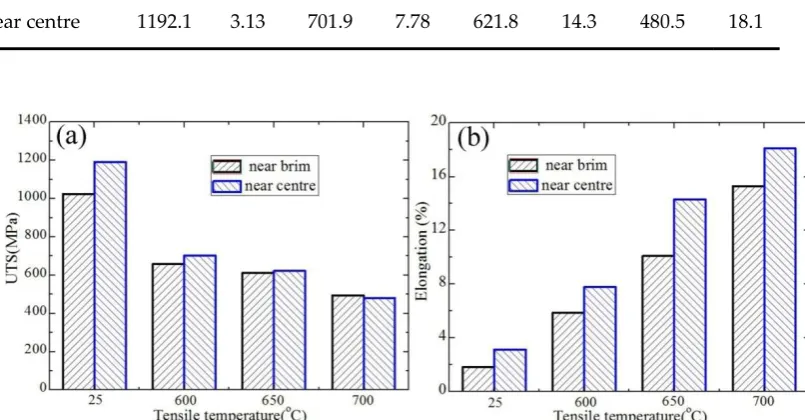
The tensile properties of the as-forged (TiBw+TiCp)/Ti composite samples taken from different sampling points and tested at various temperatures are listed in Table 1. Generally, (α+β) forging effectively improves both the strengths and the elongations, as compared with the as cast (TiBw+TiCp)/Ti composite [5]. The tensile properties of the (TiBw+TiCp)/Ti composite samples as a function of testing temperature are shown in Fig. 5. In general, the central area of the composite samples exhibits better tensile properties than those within the peripheral area. For example, at room temperature (RT), the ultimate tensile strength (UTS) and elongation to failure (δ) of the sample taken from peripheral region are 1023.7MPa and 1.82%, respectively. For high-temperature testing, the difference in the observed properties is only marginal between the samples taken from different locations. For instance, the UTS of the centre area is just 11MPa higher than that of the peripheral region if tested at 650oC. In addition, it is evident from Fig. 5 that the UTS and elongation of both the brim area and the centre area follow the similar trend, i.e. the strength decreases while the elongation increases with temperature.
Table 1 Room and elevated temperature tensile properties of 5vol.% (TiBw+TiCp)/Ti composite pancake with different sampling points.
Sampling points 25
oC 600oC 650oC 700oC
σb (MPa) δ (%) σb (MPa) δ (%) σb (MPa) δ (%) σb (MPa) δ (%)
near periphery 1023.7 1.82 657.6 5.86 610.9 10.1 493.9 15.3
Fig.5. Comparison of tensile properties of the (TiBw+TiCp)/Ti composite samples taken from different sampling points , at various tensile temperature: (a) UTS, (b) elongation.
3.3 Fracture morphology
Fig.6 Fracture surfaces of as-forged 5vol.% (TiBw+TiCp)/Ti composites at different temperature.(a) room temperature, (b)600 oC, (c)650 oC, (d)700 oC.
4 Discussion
4.1 Microstructure
As mentioned in Section 3.1, in the brim area of the pancake (Fig.2a), the microvoids located at the ends of the reinforcements are observed while no noticeable voids can be found in the centre area (Fig.2d). In fact, due to the different coefficients of thermal expansion between reinforcements and matrix [24], the stress concentration unavoidably generated during forging can exceed the ultimate strengths of the reinforcements, leading to fracture of the reinforcements. Owing to the positive temperature gradient from brim to centre in the forged pancake, the matrix flow is insufficient to well fill the resulting microvoids at the reinforcements (Fig.2a). While in the centre area, as a result of the relatively high temperature and large deformation, the voids between the reinforcement ends and matrix can be completely closed, as shown in Fig.2d. Similar results were also reported previously [25].
4.2 Tensile properties
In the current study, the strengths of the centre area within the (TiBw+TiCp)/Ti composite pancake are superior to those of the brim area. With respect to the strengthening effect, two main factors including grain refinement strengthening and load-carrying capacity of reinforcements, can be considered for the current (TiBw+TiCp)/Ti composite [14-15]. According to the classic Hall-Petch theory, the microstructural refinement of matrix can contribute to the improvement in the tensile strength below equi-cohesive temperature [26]. Therefore, strengthening effect caused by grain refinement of the current composite both at room temperature and 600°C can be discussed together because of that the equicohesive temperature of the matrix alloy within the composite can be regarded as 600°C [27]. As depicted in Fig.2, the coarse matrix microstructure of the brim area (Fig.2a) is gradually refined to equiaxed DRX grains accompanied by the reduction in the size of α grains(Fig.2d). Therefore the tensile strength of the composite is increased. Additionally, the enhancement in strengths can be partially owing to load-bearing effect arising from TiBw and TiCp reinforcements. The micrographs of fracture surfaces presented in Fig.6a and b reveal that most of the TiBw and TiCp fracture during tensile test, indicating the interfacial bonding is strong enough to transfer load from matrix to reinforcements. As shown in Fig.2d, the relatively evenly distributed TiBw and TiCp shown in the centre area undoubtedly improve the tensile strengths. Therefore, the centre area of the pancake exhibits higher tensile strengths than those within the brim area at a temperature from room temperature to 600°C.
At a temperature above 600oC, the composite samples still have high strength. This is due to the load-carrying capacity of TiBw and TiCp. Boehlert et al. [28] suggested that the load-sharing mechanism requires a good interface bonding between the matrix alloy and the reinforcement. This has been evidenced in Fig.6c. Ma [29] and Zhang [30] believed that the strengthening effect of reinforcements becomes more profound at high temperatures. In other words, the TiBw and TiCp tend to fracture prematurely under stress at low temperatures while the stress around the reinforcements can be released by the ductile matrix at higher temperatures. Therefore, the load transferring effect becomes more remarkable at 650oC, leading to the superior tensile strength of the centre area within the pancake. As the tensile temperature increases to 700oC, the prevailing characteristic of interfacial debonding shown in Fig.6d implies that load-carrying of TiBw and TiCp ceases. As a result, the centre area exhibits lower strength, as compared with the peripheral region.
5. Conclusions
The following conclusions can be drawn from this study:
2. The microstructure in the centre area consists of dominant DRX grains plus some refined subgrains and dislocations. The grain size ranges between 1μm and 7μm. Moreover, the TiBw and TiCp are uniformly distributed within the matrix.
3. Overall, the tensile properties of the composite samples taken from the central area of the pancake are better than those of the samples taken from the peripheral area. Grain refinement strengthening and load-carrying capacity of TiBw and TiCp independently or collectively dominate the strengthening mechanism.
Acknowledgement: The authors gratefully thank the financial support from the National Natural Science Foundation of China (Nos.51504163 and 51604191).
Author Contributions: All authors have contributed significantly. Changjiang Zhang, Peng Cao and Jianchao Han designed the project. Zhidan Lü, Jianchao Han, Hongzhou Zhang, Shuzhi Zhang
undertook the experiments and data collection. Peng Lin, Zhidan Lü and Changjiang Zhang analyzed the data. All authors contributed to the discussion of the results. Jianchao Han, Changjiang Zhang and Peng Cao wrote and revised the manuscript.
Conflicts of Interest: The authors declare no conflict of interest.
References
1. Huang L.Q.; Qian M.; Liu Z.M.; Nguyen V.T.; Yang L.; Wang L.H.; Zou J. In situ preparation of TiB nanowires for high-performance Ti metal matrix nanocomposites. J. Alloy. Compd. 2018, 735, 2640. 2. Tjong S.C.; Mai Y.M. Processing-structure-property aspects of particulate and whisker-reinforced
titanium matrix composites. Compos. Sci. Technol. 2008, 68, 583.
3. Huang L.Q.; Wang L.H.; Qian M.; Zou J. High tensile-strength and ductile titanium matrix composites strengthened by TiB nanowires. Scr. Mater. 2017,141, 133.
4. Ozerov M.; Klimova M.; Kolesnikov A.; Stepanov N.; Zherebtsov S. Deformation behavior and microstructure evolution of a Ti/TiB metal-matrix composite during high-temperature compression tests. Mater. Des. 2016,112, 17.
5. Zhang C.J.; Kong F.T.; Xiao S.L.; Zhao E.T.; Xu L.J.; Chen Y.Y. Evolution of microstructure and tensile properties of in situ titanium matrix composites with volume fraction of (TiB+TiC) reinforcements. Mater. Sci. Eng. A 2012,548, 152.
6. Liu Y.; Ding J.; Qu W.; Su Y.; Yu Z., Microstructure Evolution of TiC particles in situ, synthesized by laser cladding. Materials. 2017,10, 281.
7. Huang L.J.; Geng L.; Peng H.X.; In situ (TiBw+TiCp)/Ti6Al4V composites with a network reinforcement
distribution. Mater. Sci. Eng. A 2010527 6723.
8. Zhang W.C.; Wang M.M.; Chen W.Z.; Feng Y.J.; Yu Y. Preparation of TiBw/Ti-6Al-4V composite with an
inhomogeneous reinforced structure by a canned hot extrusion process. J. Alloy. Compd. 2016, 669, 79. 9. Li S.F.; Kondoh K.; Imai H.; Chen B.; Jia L.; Umeda J. Microstructure and mechanical properties of P/M
titanium matrix composites reinforced by in-situ synthesized TiC-TiB. Mater. Sci. Eng. A 2015, 628, 75. 10. Tabrizi S.G.; Sajjadi S.A.; Babakhani A.; Lu W. Influence of spark plasma sintering and subsequent hot
rolling on microstructure and flexural behavior of in-situ TiB and TiC reinforced Ti6Al4V composite. Mater. Sci. Eng. A 2015, 624, 271.
11. Qi J.Q.; Sui Y.W.; Chang Y.; He Y.Z.; Wei F.X.; Meng Q.K.; Wei Z.J. Microstructural characterization and mechanical properties of TiC/near-α Ti composite obtained at slow cooling rate. Mater. Charact. 2016,118,
263.
12. Qi J.Q.; Chang Y.; He Y.Z.; Sui Y.W.; Wei F.X.; Meng Q.K.; Wei Z.J. Effect of Zr, Mo and TiC on microstructure and high-temperature tensile strength of cast titanium matrix composites. Mater. Des.
2016, 99, 421.
13. Yang Z.F.; Lu W.J.; Zhao L.; Qin J.N.; Zhang D. Microstructure and mechanical property of in situ synthesized multiple-reinforced (TiB+TiC+La2O3)/Ti composites. J. Alloy. Compd. 2008, 455, 210.
15. Chandravanshi V.K.; Sarkar R.; Ghosal P.; Kamat S.V.; Nandy T.K. Effect of minor additions of boron on microstructure and mechanical properties of as-cast near α titanium alloy. Metall. Mater. Trans. A 2010, 41, 936.
16. Morsi K.; Patel V.V. Processing and properties of titanium-titanium boride (TiBw) matrix composites- a
review. J. Mater. Sci. 2007, 42, 2037.
17. Imayev V.; Gaisin R;. Gaisina E.; Imayev R.; Fecht H. J.; Pyczak F. Effect of hot forging on microstructure and tensile properties of Ti-TiB based composites produced by casting. Mater. Sci. Eng. A 2014, 609, 34. 18. Bhat R.B.; Tamirisakandala S.; Miracle D.B.; Ravi V.A. Thermomechanical response of a powder
metallurgy Ti-6Al-4V alloy modified with 2.9 pct boron. Metall. Mater. Trans. A 2005, 36, 845.
19. Liu B.; Li Y. P.; Matsumoto H.; Liu Y. B.; Liu Y.; Tang H. P.; Chiba A. Thermomechanical response of particulate-reinforced powder metallurgy titanium matrix composites-A study using processing map. Mater. Sci. Eng. A 2010, 527, 4733.
20. Huang D.M.; Wang H.L.; Chen X.; Chen Y.; Guo H. Influence of forging process on microstructure and mechanical properties of large section Ti-6.5 Al-1Mo-1V-2Zr alloy bars. T. Nonferr. Metal. Soc. 2013, 23,
2276.
21. Niu H.Z.; Kong F.T.; Chen Y.Y. Microstructure characterization and tensile properties of β phase containing TiAl pancake. J. Alloy. Compd. 2011, 509, 10179.
22. Huang L.J.; Zhang Y.Z.; Geng L.; Wang B.; Ren W. Hot compression characteristics of TiBw/Ti6Al4V
composites with novel network microstructure using processing maps. Mater. Sci. Eng. A 2013,580, 242. 23. Zhou W.; Ge P.; Zhao Y.Q. Finite element analysis of temperature field in forging process of Ti-1023 alloy.
Hot. Working. Technol. 2009, 38, 21.
24. Roy S.; Suwas S. The influence of temperature and strain rate on the deformation response and microstructural evolution during hot compression of a titanium alloy Ti-6Al-4V-0.1 B. J. Alloy. Compd.
2013, 548, 110.
25. Srinivasan R.; Bennett M.D.; Tamirsakandala S. Rolling of plates and sheets from as-cast Ti-6Al-4V-0.1B. J. Mater. Eng. Perform. 2008, 18, 390.
26. Armstrong R.; Codd I.; Douthwaite R.M.; Petch N.J. The plastic deformation of polycrystalline aggregates. Phil. Mag. 1962, 7, 45.
27. Xiao L.; Lu W.J.; Qin J.N. High-temperature tensile properties of in situ-synthesized titanium matrix composites with strong dependence on strain rates. J. Mater. Res. 2008, 23, 3066.
28. Boehlert C.J.; Tamirisakandala S.; Curtin W.A.; Miracle D.B. Assessment of in situ TiB whisker tensile strength and optimization of TiB-reinforced titanium alloy design. Scr. Mater. 2009, 61, 245.
29. Ma F.C.; Lu W.J.; Qin J.N.; Zhang D. Strengthening mechanisms of carbon element in in situ TiC/Ti-1100 composites. J. Mater. Sci. 2006, 41, 5395.