DOI: 10.1534/genetics.107.084798
Distinct Functions of MLH3 at Recombination Hot Spots in the Mouse
Anton Svetlanov,*
,1Frederic Baudat,
†,1Paula E. Cohen*
,1and Bernard de Massy
†,1,2*Department of Biomedical Sciences, Cornell University, Ithaca, New York 14850 and†Institute of Human Genetics, Centre National de la Recherche Scientifique, UPR1142, 34396 Montpellier, Cedex 5, France
Manuscript received November 20, 2007 Accepted for publication February 7, 2008
ABSTRACT
The four mammalian MutL homologs (MLH1, MLH3, PMS1, and PMS2) participate in a variety of events, including postreplicative DNA repair, prevention of homeologous recombination, and crossover formation during meiosis. In this latter role, MLH1–MLH3 heterodimers predominate and are essential for prophase I progression. Previous studies demonstrated that mice lacking Mlh1 exhibit a 90% reduction in crossing over at thePsmb9hot spot while noncrossovers, which do not result in exchange of flanking markers but arise from the same double-strand break event, are unaffected. Using a PCR-based strategy that allows for detailed analysis of crossovers and noncrossovers, we show here that Mlh3/ exhibit a 85–94% reduction in the number of crossovers at thePsmb9hot spot. Most of the remaining crossovers inMlh3/meiocytes represent simple exchanges similar to those seen in wild-type mice, with a small fraction (6%) representing complex events that can extend far from the initiation zone. Interestingly, we detect an increase of noncrossovers inMlh3/spermatocytes. These results suggest that MLH3 functions predominantly with MLH1 to promote crossovers, while noncrossover events do not require these activities. Furthermore, these results indicate that10% of crossovers in the mouse are independent of MLH3, suggesting the existence of alternative crossover pathways in mammals.
M
EIOTIC recombination between homologous chromosomes during prophase I can result in both crossover (CO) and noncrossover (NCO) prod-ucts. Most, if not all, of these events are initiated by the same double-strand break (DSB) event induced by SPO11, a conserved protein sharing sequence similar-ities with the catalytic subunit of TopoVI, a type II DNA topoisomerase from archae (reviewed in Keeney andNeale 2006), but are processed through distinct and
highly conserved molecular pathways, the details of which remain to be elucidated fully in mammals. What is clear from studies in a number of species is that the frequency and distribution of CO events are tightly controlled in prophase I, and that this control is essential for the accurate reductional segregation of chromosomes at the first meiotic division.
Studies inSaccharomyces cerevisiaehave shown that CO and NCO events result from two distinct pathways that differ in their specific DNA intermediates and func-tional requirements (Allers and Lichten 2001;
Hunter and Kleckner 2001). In particular, a specific
group of proteins composing the ZMM family, encoded by the yeastZIP1,ZIP2,ZIP3,ZIP4,MSH4,MSH5, and
MER3genes, acts early in the formation of most CO but
is not required for NCO formation (Borneret al.2004).
The yeast MutL homologs, Mlh1 and Mlh3, are also necessary for CO formation but act at a later step, presumably after the formation of the double-Holliday-junction intermediate (Hunterand Borts1997; Wang
et al. 1999; Arguesoet al. 2004). In mammals, MSH4
and MSH5 are thought to be required at an early step of meiotic recombination, given that mutant mice are defective in synapsis and that the proteins localize along chromosome axes as early as leptonema in both males and females (Kneitzet al.2000; Lenziet al.2005). These
proteins have also been proposed to have a later action on CO formation on the basis of their binding activities to double Holliday junctions (Snowdenet al.2004) and
the colocalization of MSH4 with MLH1 at midpachy-nema (Santucci-Darmaninet al.2000).
Mammalian MLH1 and MLH3 proteins also appear to be involved and required for CO formation on the basis of localization studies and the phenotypes ofMlh1
and Mlh3 mutant mice (Kolasand Cohen 2004). At
mid- to late pachynema, these proteins colocalize (Kolas
et al.2005) at the future sites of chiasmata (Marconand
Moens 2003). Both Mlh1 and Mlh3 nullizygous mice
show a strong defect in chiasma formation in both sexes (Bakeret al.1996; Edelmann et al.1996; Lipkinet al.
2002; Kan et al. 2008). However, recent analysis has
revealed different properties of these two MutL homo-logs: MLH3 accumulates at nascent CO sites prior to MLH1 in males and can continue to do so in mice lacking a functionalMlh1gene (Lipkinet al.2002; Kolas
1These authors contributed equally to this work.
2Corresponding author:Institute of Human Genetics, Centre National de
la Recherche Scientifique, UPR1142, 141 rue de la Cardonille, 34396 Montpellier, Cedex 5, France. E-mail: [email protected]
and Cohen 2004). Conversely, MLH1 requires MLH3
preloading at MSH4–MSH5 sites since no MLH1 is local-ized to meiotic chromosomes in spermatocytes from
Mlh3/ mice (Kolas and Cohen 2004; Kolas et al.
2005). At the same time, electron-dense meiotic nod-ules, the sites at which recombination events are taking place, persist on meiotic chromosomes from Mlh1/
mice but not on chromosomes from Mlh3/ mice
(Lipkin et al. 2002). Direct analysis at the DNA level
has shown that MLH1 is required for most but not all CO and not required for NCO formation (Guillonet al.
2005).
To examine the role of MLH3 directly on meiotic recombination events, we examined the CO and NCO frequencies at the well-characterizedPsmb9 recombina-tion hot spot on mouse chromosome 17, using a strategy that allows for detailed analysis of CO and NCO prod-ucts at this locus (GuillonanddeMassy2002; Guillon
et al.2005; BaudatanddeMassy2007b). Our analyses
of recombination in male and female germ cells demonstrate that, similar to Mlh1/ mice, Mlh3 null
animals exhibit an 85–94% reduction in the number of crossings over at thePsmb9hot spot, while the respective NCO frequencies remain unchanged. Most remaining crossovers in Mlh3/ spermatocytes represent simple
exchanges similar to those seen in wild-type mice. However, a small fraction (6%) of residual COs are complex events with exchange points far from the initiation zone and similar in profile to the residual CO events observed inMlh1/spermatocytes. A
signif-icant increase of NCO frequencies was observed in spermatocytes fromMlh3/mice, potentially indicating
a channeling of some CO intermediates into NCO products. These results suggest that MLH3 functions predominantly with MLH1 to promote crossing over and that, together, this heterodimer governs90% of all CO events in mouse meiocytes.
MATERIALS AND METHODS
Generation and maintenance of hybrid mice: Mice were housed in the Cornell University Animal Facility (Ithaca, NY) and all procedures utilizing these animals were reviewed and approved by the Cornell University Institutional Animal Care and Use Committee. Mice were maintained on standard labo-ratory chow under controlled conditions of light and tem-perature. The generation of Mlh3 mutant mice has been described previously (Lipkinet al.2002). Mice heterozygous at thePsmb9(wm7/b) locus and carrying one or two mutant alleles ofMlh3(Mlh31/1
,Mlh31/, orMlh3/) were generated by crossing the B10.A (R209) strain carrying thewm7 haplo-type (named R209, B10 background) and theMlh31/strain (B6 background). Progeny ofMlh31/mice (B6 background) crossed withMlh31/wm7/wm7(B6/B10 mixed background) mice were analyzed, providingMlh31/,Mlh31/1
, andMlh3/ littermates. Testes were dissected from mice at 11, 13, 15, 17, and 19 days postpartum (pp), while ovaries were taken from mice at 1 day pp. Genomic DNA preparations were used for subsequent PCR analysis of CO and NCO products.
Detection and mapping of COs and NCOs: COs were detected in two ways: (1) direct selection with two rounds of allele-specific PCR with primers specific for B6 on one side and for R209 on the other side of the hot spot (Guillonandde Massy2002) and (2) by a protocol allowing the detection of NCO in parallel to CO. In this protocol, B6-R209 (BR) COs were detected using in the first round of amplification (PCRI) a B6 allele-specific forward primer and a universal reverse primer. In the secondary amplification reactions (PCRII) a B6 allele-specific forward primer was used in combination with an R209 allele-specific reverse primer. Using the same PCRI products as substrates, an alternative secondary amplification is performed to detect NCO products with a gene conversion at theBsrFI site. This is achieved using an R209BsrFI-specific forward primer with a B6 allele-specific reverse primer. Although theBsrFI site is located near the center of the hot spot, given the short sizes of gene conversion tracts among NCOs, we estimate that those covering BsrFI represent less than half of the total (F. Baudatand B.deMassy, personal communication). For direct selection of COs, PCRI can be performed on pools of testis DNA containing up to 10,000 amplifiable molecules, whereas for the parallel detection of COs and NCOs, PCRI is performed on pools of testis DNA containing up to 400 amplifiable molecules. Both methods gave similar values of CO frequencies, which were therefore determined by averaging independent experiments using either protocol. For mapping analysis, the CO molecules were obtained from direct selection, using at the second PCR forward and reverse primers located at positions 402 and 4315, respectively, therefore leading to the amplification of a 4-kb product (see Figure 3). Details of the procedures and primer sequences are as described in Guillonet al.(2005). A small-scale experiment on 24 pools at all time points in wild type and Mlh3/ indicated that frequency of RB crossover molecules was similar to that of BR molecules as expected (data not shown). No significant difference of CO or NCO frequencies could be detected between1/1and1/mice. COs were first mapped by RFLP at 10 sites in the amplified region. Those showing unexpected patterns were sequenced over the whole 4-kb region. NCOs were tested for the presence ofStyI andSphI sites and were sequenced upstream of theBsrFI site. Those showing single-site conversions atBsrFI were se-quenced downstream of this site. Additional CO events were selected and analyzed fromMlh1/mice for mapping analysis.
RESULTS
A specific reduction of CO frequencies both in sper-matogenesis and in oogenesis inMlh3/mice:Using a
strategy and protocols similar to those developed for the analysis of recombination events in Mlh1/ mice
(Guillonet al.2005), we have measured the frequency
of COs and NCOs at thePsmb9recombination hot spot. The general strategy is as follows: mice heterozygous at Psmb9 (wm7/b) and homozygous mutant at Mlh3
(Mlh3/) were generated along withMlh31/orMlh31/1
controls. Analyses in males were performed on genomic DNA extracted from testes of mice from 11 to 19 days old, before the massive induction of apoptosis occurring at metaphase I (Lipkinet al.2002). Analyses in females
allowing the parallel detection of COs and NCOs. The allele-specific PCR strategy we have used allows the recovery of all CO molecules in the 4-kbp interval tested but only a fraction of NCOs, those with gene conversion tracts covering the centralBsrFI site (seematerials and methods).
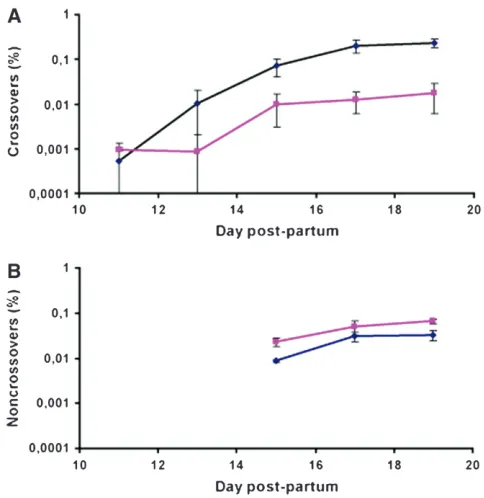
During meiosis in males, the frequency of CO events was found to be 85–94% lower in spermatocytes from
Mlh3/males compared to wild type at all time points
during the first wave of spermatogenesis where a significant number of events could be recovered,i.e., at 13, 15, 17, and 19 days. This reduction in CO content was statistically significant at 15, 17, and 19 days, using a one-tailedt-test (P-values of 0.0455, 0.0004, and 0.0004 at 15, 17, and 19 days, respectively). The kinetics of CO formation were similar in wild-type andMlh3/
sperma-tocytes, with a plateau reached at 17 days when cells progressing through the first wave of meiosis reach the end of the pachytene stage (Figure 1A). The analysis of events in female meiosis also indicated a 94% reduction in CO frequencies (one tailedt-test,P,0.0001; Table 1).
In striking contrast, no reduction in NCO frequencies inMlh3/mice was observed either in spermatocytes or
in oocytes (Figure 1B and Table 1). In fact, we detected an increase of 67–171% in NCO rates in Mlh3/
spermatocytes between days 15 and 19 postpartum. These differences between wild-type andMlh3/mice
are statistically significant (one-tailedt-test,P-values of 0.0291, 0.0386, and 0.0036 at 15, 17, and 19 days, respectively). The small difference between wild-type and Mlh3/ mice observed in oocytes was not
signifi-cant, however (P¼0.43963).
Properties of residual crossovers in the absence of MLH3: We have mapped the positions of exchange points among 122 and 308 CO products in wild-type and
Mlh3/mice, respectively. In wild-type mice, all COs but
one were simple exchange products with an exchange point in the interval between TaqI and Eco57I. The distribution of exchange points was similar to that in previous analyses (Guillon and de Massy 2002;
Guillonet al.2005).
InMlh3/males, most CO products (94%, 290/308)
have a structure similar to wild type, with one exchange point within the TaqI andEco57I interval and with the highest density in the BsrFI–StyI interval. The distribu-tion is globally similar to that observed in wild type, as in previous analyses, but with a higher density in theBsrFI–
StyI interval, suggesting that the conversion tracts associated with these CO events are shorter (Figure 2). The distributions of wild-type and Mlh3/ COs are
indeed statistically different (chi square, P ¼ 0.028). However, the remaining fraction of CO molecules (6%, 18/308) in Mlh3/males displays unusual structures,
and these are not observed in wild-type control males. Among these unusual recombinant molecules, we could identify three types of molecules: COs with one single exchange point located distal to the hot spot, COs with multiple exchange points (with mosaic structure), and
Figure1.—CO and NCO frequencies inMlh3/mice. (A) CO frequencies in wild-type (wt) (1/1or1/) andMlh3/ mice during the first wave of spermatogenesis. Values corre-spond to twice the frequency of BR recombinant molecules and were the average from two measurements at 11 and 13 days and from five to eight measurements at 15, 17, and 19 days. Frequencies are given6standard error (SE) (blue dia-monds, wt; pink squares,Mlh3/). (B) NCO frequencies in wt (1/1 or1/) and Mlh3/ mice during the first wave of spermatogenesis. Values correspond to the frequencies of NCOs with a gene conversion selected atBsrFI on the B6 pa-rental genome and were the average of two, four, and three measurements at 15, 17, and 19 days, respectively. Each fre-quency measurement was obtained from allele-specific PCR on 96 pools. Frequencies are given 6 SE (blue diamonds, wt; pink squares,Mlh3/).
TABLE 1
CO and NCO frequencies in ovaries from wt (+/+ and +/–) andMlh3–/–mice
CO frequencies (%)
Standard error (%)
No. of events
Mlh3/ 0.0087 0.0103 8
Mlh31/1
andMlh31/ 0.140 0.044 108
Ratio wt/mutant 16
NCO frequencies (%)
Standard error (%)
No. of events
Mlh3/ 0.051 0.035 35
Mlh31/1
andMlh31/ 0.046 0.012 45
Ratio wt/mutant 0.9
COs containing mixed-strand information (Figure 3). These CO products with mixed strands could be either molecules containing heteroduplex DNA or a mixture of a CO with a simple exchange and a CO with a mosaic structure. This second possibility is statistically compat-ible with the number of CO events per pool in these experiments (supplemental Table 1). In any case, these observations indicate a modification of the processing of recombination intermediates inMlh3/males. The
mapping of these products suggests that recombination intermediates extend farther away from the initiation zone than those generated in wild-type meiocytes and/ or that the repair of heteroduplex structures is altered in the absence of MLH3 protein. Although a qualita-tively similar observation was made in Mlh1/ males
(Guillon et al. 2005), we noted that the relative
proportion of COs with a single distal exchange point was higher in the absence of MLH3 as compared to that observed by Guillonet al.in the absence of MLH1. To more accurately compare the two mutant strains, we repeated these CO analyses fromMlh1/spermatocytes
using identical conditions to, and in parallel with, our studies inMlh3/spermatocytes. Although the relative
proportion of COs with a distal exchange point was higher inMlh3/spermatocytes compared toMlh1/
spermatocytes (50–55%vs. 17–30%), the difference is not statistically significant (supplemental Figure 1 and supplemental Table 1). It appears therefore that the absence of MLH1 or MLH3 has similar consequences for residual CO processing.
No detectable change in NCO maps inMlh3/mice:
The NCO products were selected at theBsrFI site where flanking markers are at 329 and 214 bp to the left and right, respectively. In both wild-type and Mlh3/
sper-matocytes most of the NCO products selected atBsrFI have a conversion tract including only theBsrFI marker (95 and 88%, respectively). Some rare products were observed to coconvert a marker flanking BsrFI. In addition, in spermatocytes and oocytes from Mlh3/
mice, some rare molecules were found to have mosaic structures or mixed strands (Figure 4). However, no significant difference in the frequencies of these differ-ent products could be detected between wild-type and
Mlh3/male or female mice.
DISCUSSION
The ability to detect recombinant molecules directly by allele-specific PCR has allowed us to analyze, at the DNA level, the effect of MLH3 deletion on meiotic recombination in mice, in terms of both frequency and mapping of CO and NCO events at thePsmb9hot spot. Our results show a differential effect between COs and NCOs with a strong reduction of CO frequency (85– 94%) whereas NCO frequency is not affected or slightly increased. The analysis of COs detected in the absence of MLH3 reveals a fraction of events that differ in the location of exchange points compared to wild-type meiocytes. This suggests that MLH3 plays a role in the processing of recombination intermediates.
The role of MLH3 and MLH1 in CO formation:The reductions of CO frequencies during the first wave of spermatogenesis and during oogenesis ofMlh3/mice,
demonstrated herein, reveal an essential role for MLH3 for CO formation. This finding is consistent with the reduction of chiasmata inMlh3/males (Lipkinet al.
2002) and implies that the effect on chiasma is not due to a defect in chiasma stabilization but results directly from a defect in CO formation. The quantitative effect on CO formation is identical to that previously de-scribed forMlh1/
mice (Guillonet al.2005), a result
consistent with the similar defect on chiasma formation also described in these two mutants. This suggests that both proteins act in the same pathway with respect to CO formation, which is supported by immunological studies that have shown the colocalization of MLH1 and MLH3 at pachynema (Kolaset al.2005) and at sites of
chiasmata (Marcon and Moens 2003). At the same
time, however, subtle differences in MLH1 and MLH3 focus dynamics indicate that the loss of either gene product might not necessarily have the same effect on CO frequency inMlh1/andMlh3/animals. First, in
males MLH3 foci form earlier (early pachynema) and possibly in greater initial numbers as compared to MLH1; second, meiotic nodules observed by electron microscopy are still detected inMlh1/
males but are
Figure2.—Mapping of exchange points among simple CO products inMlh31/1and
absent inMlh3/males (Lipkin
et al.2002); and third, the presence of MLH1 foci depends on preloading of MLH3, whereas a significant number of MLH3 foci are still detected in Mlh1/ (Kolas et al. 2005). These
differences in cytological observations compared to the similar defect in CO formation inMlh3/andMlh1/
males suggest that the persistent CO events observed at thePsmb9locus inMlh1/males are not due to residual
MLH3 activity and that neither MLH1 nor MLH3 can function independently of each other in the context of meiotic recombination events.
The localization of MLH1 and MLH3 to meiotic nodules is independent of the somatic repair MutS homolog heterodimers, MutSa (MSH2/MSH6) or MutSb (MSH2/MSH3) and instead operates through interactions with the meiosis-specific MutS complex, MutSg, that consists of MSH4 and MSH5. This sugges-tion is supported by the interacsugges-tion between human MSH4 and MLH3 (Santucci-Darmaninet al.2002) and
by the interaction and colocalization of MSH4 and MLH1 in mice (Santucci-Darmaninet al.2000) as well
as in humans (Oliver-Bonetet al.2005). According to
in vitro analysis of mismatch repair activity, MutL proteins are thought to be adaptors able to transduce signals, possibly involving protein conformational changes. MLH1/MLH3 might serve to modulate the accumulation of MSH4/MSH5 sliding clamps by stabi-lizing these structures and/or by facilitating the sliding
of MSH4/MSH5 along the chromosomes, thereby facilitating the loading of additional factors at the Holliday-junction structure and biasing these sites to-ward a CO fate. If recombination intermediates are not converted into COs inMlh1/andMlh3/meiocytes,
at least two outcomes can be envisioned: either they are left unresolved or they are processed into alternative products. We suggest that a fraction of these intermedi-ates are actually resolved into NCOs with the dissolution activity of BLM-TOP3a(Wuand Hickson2003). The
increase of NCO frequency detected in Mlh3/
sper-matocytes is consistent with this hypothesis. At the quantitative level, we cannot determine what fraction of COs is channeled into NCOs, as this would require knowledge of the gene conversion tract length and distribution among the NCO molecules. In addition, although the effect of unresolved intermediates on meiotic prophase progression is unknown, the analysis of RAD51C hypomorph mutant mice has led to the suggestion that unresolved intermediates would induce chromosome breakage (Kuznetsovet al.2007), a
phe-notype not observed in eitherMlh1/orMlh3/mice.
A residual activity of CO formation in the absence of MLH3:Our results also clearly show that a residual level of crossing over,10% of wild type, occurs inMlh3/
mice. If this subset of events also occurs in wild-type meiocytes, one implication is that MLH1/MLH3 foci would not be expected to mark all sites of COs. We note,
in fact, that a small difference in terms of genetic map length is observed when estimated from MLH1 foci or from genetic mapping (BaudatanddeMassy2007a).
Despite this, however, it is clear that the major pathway for CO formation in mouse is MLH3 (and MLH1) dependent. InS. cerevisae, it has been established that most of the Mlh1-independent COs result from the Mus81/Mms4 pathway (Hoffmannet al.2003; Argueso
et al.2004; Hollingsworthand Brill2004), while in
Schizosaccharomyces pombe, all COs require Mus81/Mms4 (Smithet al.2003). In the case of the latter organism,
single, not double, Holliday junctions have been shown to be intermediates of meiotic recombination (Cromie
et al.2006), and these are readily cleaved by the Mus81/ Mms4 proteinsin vitro(Boddyet al.2001; Osmanet al.
2003). Whether an analogous, ‘‘alternate’’ pathways exists in mice remains to be seen. The normal fertility of MUS81 mutant mice (Hollingsworth and Brill
2004; Dendougaet al.2005) is compatible with the idea
that any MUS81-driven recombination events would concern only a small fraction of CO events and/or would be elicited only in the absence of appropriate MLH1/MLH3 activity.
The mapping of the remaining COs that occur in
Mlh3/meiocytes also provides additional information
about COs generated by the MutLg-independent path-way. Two categories of CO products are detected: the majority (94%) have a single exchange point with a distribution similar to that seen in meiocytes from wild-type animals, and a smaller population (6%) have atypical exchange points (discussed below). Interest-ingly, the majority class shows a slight difference in
terms of distribution from that of wild type, with a narrower clustering of exchange points around the predicted region of initiation, suggesting that the mean length of the associated conversion tract is smaller. A similar effect was observed inMlh1/animals (Guillon et al.2005). This suggests a difference between the two pathways (MutLgdependent or independent), either in the formation or in the processing of intermediates. Whether the resolution of this MutLg-independent class of COs is also independent of MutSg remains to be seen. What is clear, however, is that the absence of mismatches among the COs recovered in the majority class indicates that the heteroduplex DNA generated during the formation of these COs have been repaired in the absence of MLH3. Given that a similar conclusion was reached from the analysis ofMlh1/male mice, if a
MutL activity is involved in mismatch repair, it is more likely to involve PMS2 assuming it can act with either MLH1 or some other partner.In vitrobiochemical data indicate that PMS2 and MLH3 do not form a complex with each other, ruling out a role for MLH3 in het-eroduplex repair, even inMlh1/animals.
Exchanges at distal locations in the absence of MLH3: The detailed mapping of CO products from
Mlh3/males reveals a small fraction (6%) of products
with unusual properties, not seen in wild-type meio-cytes, but also detected in the absence of MLH1. Fifteen of 18 of these CO events exhibit an exchange point located.1 kb away from the region of initiation. Among these distal events, 9 have a single exchange point. Such products could be derived from a DSB repair event ex-emplified in Figure 5, either resulting from
intermedi-Figure 4.—Mapping of NCO products in Mlh31/1
ates with a long heteroduplex on one side of the DSB or through migration of the double Holliday junction. Interestingly, long heteroduplex intermediates lead to a distal exchange product without (or with short) hetero-duplex only for one type of resolution (orientation 1 in Figure 5). The short heteroduplex formed could be either undetectable or repaired by a short patch repair pathway. Resolution in orientation 2 generates a prod-uct with a long heteroduplex and a reciprocal prodprod-uct with exchange points close to initiation. The detection of an increased number of events extending to more distal positions has been observed in pms1 and msh2
mutants ofS. cerevisiae(Alaniet al.1994). Such
obser-vations might indicate either that the heteroduplex extends to distal positions even in a MutL wild-type context or that the absence of mismatch repair leads to an increase in heteroduplex length. Furthermore, the detection of molecules with mosaic structures suggests that heteroduplex DNA has been repaired in a non-continuous way, possibly by an alternative repair path-way, such as the short patch repair pathways described in
msh2andpms2mutant strains ofS. cerevisiaeandS. pombe
(Fleck et al. 1999; Coic et al. 2000; Hoffmann et al.
2005) and in msh6mutants of Drosophila melanogaster
(Radfordet al.2007b).
In conclusion, our work provides precise information on the activity of MLH3 and its major partner, MLH1.
The activity of MLH3 on crossover control does not seem to be redundant to that of PMS2 or PMS1 in mice, and this meiosis-specific property of MLH3 seems to be conserved among species. InArabidopsis thaliana Mlh3
mutants show a defect in chiasma formation with 30% residual activity (Franklinet al.2006). In some species,
such as Caenorhabditis elegans, D. melanogaster, and S. pombe, Mlh3 is absent and it is postulated that either Pms2 substitutes for the CO function of Mlh3 in these species or crossover control does not require the MutLg
complex. This hypothesis could be consistent in D. melanogasterandS. pombe, where the nature of recombi-nation intermediates might differ from those occurring in mice as suggested by the requirement for COs on Mus81 inS. pombe(Smithet al.2003) and on mei9 inD.
melanogaster (Radford et al. 2007a). The crossover
control activity of this MutLg complex is thought to require the MutSgcomplex (MSH4 and MSH5) on the basis of immunolocalization and interaction analysis. Functional analyses in both S. cerevisiae and C. elegans
have shown that Msh4 was indeed required for crossover formation. In mice, however, testing directly the effect of MSH4 or MSH5 on crossing over is not currently feasible given that these mutants have earlier defects in the process of recombination, disrupting the pro-gression of meiotic prophase probably before DSBs can eventually be repaired. In light of the current
sults, together with previous studies demonstrating the importance of MLH1 in the majority of CO events in mice, we hypothesize that MSH4–MSH5 heterodimers function at the same cohort of CO events, sugges-ting that the residual 5–10% of COs that are not de-pendent on mismatch repair function are instead processed through an alternative pathway that is anal-ogous, functionally if not compositionally, to the yeast Mus81 pathway.
We thank J. Kim Holloway, Cornell University, for invaluable discussion and for reading this manuscript. This work was supported by grants from the Centre National de la Recherche Scientifique, Association pour la Recherche contre le Cancer (4626 and 3723) and Agence National de la Recherche (ANR-06-BLAN-0160-01) to B.d.M., by research funding from the National Institute of Child Health and Human Development to P.E.C. (HD41012), and by start-up funding from Cornell University College of Veterinary Medicine, also to P.E.C.
LITERATURE CITED
Alani, E., R. A. Reenan and R. D. Kolodner, 1994 Interaction
between mismatch repair and genetic recombination in Saccha-romyces cerevisiae. Genetics137:19–39.
Allers, T., and M. Lichten, 2001 Intermediates of yeast
mei-otic recombination contain heteroduplex dna. Mol. Cell 8: 225–231.
Argueso, J. L., J. Wanat, Z. Gemiciand E. Alani, 2004 Competing
crossover pathways act during meiosis inSaccharomyces cerevisiae. Genetics168:1805–1816.
Baker, S. M., A. W. Plug, T. A. Prolla, C. E. Bronner, A. C. Harris
et al., 1996 Involvement of mouse Mlh1 in DNA mismatch repair and meiotic crossing over. Nat. Genet.13:336–342. Baudat, F., and B. deMassy, 2007a Regulating double-stranded
DNA break repair towards crossover or non-crossover during mammalian meiosis. Chromosome Res.15:565–577.
Baudat, F., and B.deMassy, 2007b Cis- and trans-acting elements
regulate the mousePsmb9meiotic recombination hotspot. PLoS Genet.3:e100.
Boddy, M. N., P. H. Gaillard, W. H. McDonald, P. Shanahan, J. R.
Yateset al., 2001 Mus81-eme1 are essential components of a
Holliday junction resolvase. Cell107:537–548.
Borner, G. V., N. Klecknerand N. Hunter, 2004
Crossover/non-crossover differentiation, synaptonemal complex formation, and regulatory surveillance at the leptotene/zygotene transition of meiosis. Cell117:29–45.
Coic, E., L. Gluckand F. Fabre, 2000 Evidence for short-patch
mismatch repair in Saccharomyces cerevisiae. EMBO J. 19: 3408–3417.
Cromie, G. A., R. W. Hyppa, A. F. Taylor, K. Zakharyevich,
N. Hunteret al., 2006 Single Holliday junctions are
intermedi-ates of meiotic recombination. Cell127:1167–1178.
Dendouga, N., H. Gao, D. Moechars, M. Janicot, J. Vialardet al.,
2005 Disruption of murine Mus81 increases genomic instability and DNA damage sensitivity but does not promote tumorigene-sis. Mol. Cell. Biol.25:7569–7579.
Edelmann, W., P. E. Cohen, M. Kane, K. Lau, B. Morrowet al.,
1996 Meiotic pachytene arrest in MLH1-deficient mice. Cell 85:1125–1134.
Fleck, O., E. Lehmann, P. Scharand J. Kohli, 1999 Involvement of
nucleotide-excision repair in msh2 pms1-independent mismatch repair. Nat. Genet.21:314–317.
Franklin, F. C., J. D. Higgins, E. Sanchez-Moran, S. J. Armstrong,
K. E. Osmanet al., 2006 Control of meiotic recombination in
Arabidopsis: role of the MutL and MutS homologues. Biochem. Soc. Trans.34:542–544.
Guillon, H., and B.deMassy, 2002 An initiation site for meiotic
crossing-over and gene conversion in the mouse. Nat. Genet. 32:296–299.
Guillon, H., F. Baudat, C. Grey, R. M. Liskayand B.deMassy,
2005 Crossover and noncrossover pathways in mouse meiosis. Mol. Cell20:563–573.
Hoffmann, E. R., P. V. Shcherbakova, T. A. Kunkel and R. H.
Borts, 2003 MLH1 mutations differentially affect meiotic
func-tions inSaccharomyces cerevisiae.Genetics163:515–526. Hoffmann, E. R., E. Eriksson, B. J. Herbert and R. H. Borts,
2005 MLH1 and MSH2 promote the symmetry of double-strand break repair events at the HIS4 hotspot inSaccharomyces cerevisiae. Genetics169:1291–1303.
Hollingsworth, N. M., and S. J. Brill, 2004 The Mus81 solution
to resolution: generating meiotic crossovers without Holliday junctions. Genes Dev.18:117–125.
Hunter, N., and R. H. Borts, 1997 Mlh1 is unique among
mis-match repair proteins in its ability to promote crossing-over dur-ing meiosis. Genes Dev.11:1573–1582.
Hunter, N., and N. Kleckner, 2001 The single-end invasion: an
asymmetric intermediate at the strand break to double-Holliday junction transition of meiotic recombination. Cell 106:59–70.
Kan, R., S. Fei, N. K. Kolas, E. Avdievich, B. Kneitz et al.,
2008 Comparative analysis of meiotic progression in female mice bearing mutations in genes of the DNA mismatch repair pathway. Biol. Reprod.78:462–471.
Keeney, S., and M. J. Neale, 2006 Initiation of meiotic
recombina-tion by formarecombina-tion of DNA double-strand breaks: mechanism and regulation. Biochem. Soc. Trans.34:523–525.
Kneitz, B., P. E. Cohen, E. Avdievich, L. Zhu, M. F. Kaneet al.,
2000 MutS homolog 4 localization to meiotic chromosomes is required for chromosome pairing during meiosis in male and female mice. Genes Dev.14:1085–1097.
Kolas, N. K., and P. E. Cohen, 2004 Novel and diverse functions of
the DNA mismatch repair family in mammalian meiosis and recombination. Cytogenet. Genome Res.107:216–231. Kolas, N. K., A. Svetlanov, M. L. Lenzi, F. P. Macaluso, S. M. Lipkin
et al., 2005 Localization of MMR proteins on meiotic chromo-somes in mice indicates distinct functions during prophase I. J. Cell Biol.171:447–458.
Kuznetsov, S., M. Pellegrini, K. Shuda, O. Fernandez-Capetillo,
Y. Liuet al., 2007 RAD51C deficiency in mice results in early
prophase I arrest in males and sister chromatid separation at metaphase II in females. J. Cell Biol.176:581–592.
Lenzi, M. L., J. Smith, T. Snowden, M. Kim, R. Fishel et al.,
2005 Extreme heterogeneity in the molecular events leading to the establishment of chiasmata during meiosis i in human oocytes. Am. J. Hum. Genet.76:112–127.
Lipkin, S. M., P. B. Moens, V. Wang, M. Lenzi, D. Shanmugarajah
et al., 2002 Meiotic arrest and aneuploidy in MLH3-deficient mice. Nat. Genet.31:385–390.
Marcon, E., and P. Moens, 2003 MLH1p and MLH3p localize to
precociously induced chiasmata of okadaic-acid-treated mouse spermatocytes. Genetics165:2283–2287.
Oliver-Bonet, M., P. J. Turek, F. Sun, E. Koand R. H. Martin,
2005 Temporal progression of recombination in human males. Mol. Hum. Reprod.11:517–522.
Osman, F., J. Dixon, C. L. Doeand M. C. Whitby, 2003 Generating
crossovers by resolution of nicked Holliday junctions: a role for Mus81-Eme1 in meiosis. Mol. Cell12:761–774.
Radford, S. J., S. McMahan, H. L. Blanton and J. Sekelsky,
2007a Heteroduplex DNA in meiotic recombination in Dro-sophila mei-9 mutants. Genetics176:63–72.
Radford, S. J., M. M. Sabourin, S. McMahanand J. Sekelsky,
2007b Meiotic recombination in Drosophila Msh6 mutants yields discontinuous gene conversion tracts. Genetics 176: 53–62.
Santucci-Darmanin, S., D. Walpita, F. Lespinasse, C. Desnuelle,
T. Ashleyet al., 2000 MSH4 acts in conjunction with MLH1
during mammalian meiosis. FASEB J.14:1539–1547.
Santucci-Darmanin, S., S. Neyton, F. Lespinasse, A. Saunieres,
P. Gaudrayet al., 2002 The DNA mismatch-repair MLH3
pro-tein interacts with MSH4 in meiotic cells, supporting a role for this MutL homolog in mammalian meiotic recombination. Hum. Mol. Genet.11:1697–1706.
Smith, G. R., M. N. Boddy, P. Shanahan and P. Russell,
required for meiotic crossing over but not for gene conversion. Genetics165:2289–2293.
Snowden, T., S. Acharya, C. Butz, M. Berardini and R. Fishel,
2004 hMSH4-hMSH5 recognizes Holliday junctions and forms a meiosis-specific sliding clamp that embraces homologous chro-mosomes. Mol. Cell15:437–451.
Wang, T. F., N. Klecknerand N. Hunter, 1999 Functional
specific-ity of MutL homologs in yeast: evidence for three Mlh1-based heterocomplexes with distinct roles during meiosis in
recombi-nation and mismatch correction. Proc. Natl. Acad. Sci. USA 96:13914–13919.
Wu, L., and I. D. Hickson, 2003 The Bloom’s syndrome helicase
suppresses crossing over during homologous recombination. Na-ture426:870–874.