A fully distributed revocable ciphertext-policy hierarchical
attribute-based encryption without pairing
Mohammad Alia, Javad Mohajerib, Mohammad-Reza Sadeghia
aDepartment of Mathematics and Computer Science, Amirkabir University of Technology, Tehran, Iran. bElectronic Research Institute, Sharif University of Technology, Tehran, Iran.
Abstract
Several appealing features of cloud computing such as cost-effectiveness and user-friendliness have made many users and enterprises interested to outsource their sensitive data for sharing via cloud. How-ever, it causes many new challenges toward data confidentiality, access control , scalability, and flexibility. Ciphertext-policy Hierarchical attribute-based encryption (CP-HABE) can be a promising solution to the mentioned problems. But, the existing HABE schemes have several limitations in their key delegation and user revocation mechanisms. In this work, to solve these problems, we introduce the concept offully
dis-tributed revocable CP-HABE (FDR-CP-HABE) system and propose the first FDR-CP-HABE scheme. The
proposed scheme provides a high level of flexibility and scalability in the key delegation and user revo-cation mechanisms. Moreover, our proposed system is pairing-free and realizes lightweight computing in decryption phase. Indeed, by exploiting the computational operation outsourcing technique, most of the operations have been done by the powerful cloud service provider and very few computations have been leaved to the data user. Also, in our scheme the storage cost on the data user side has been decreased, compared to the other similar works. Moreover, using the hardness assumption of Decisional Bilinear Diffie-Hellman (DBDH) problem, we show that the proposed scheme is adaptively semantically secure in the standard model.
Keywords: Cloud computing, Hierarchical attribute-based encryption, Access control ,
Lightweight computation
1. Introduction
With cloud computing any data owner can store remotely his/her data in a cloud. It provides many facilities. Actually, the data user is not forced to have a high-capacity storage for saving his/her data and to carry a cumbersome device for accessing the data. By using this technology, anyone can access his/her data anytime and anywhere by any device. Also, each user can outsource his/her heavy computation tasks to the cloud, with no need to have a powerful device.
However, the users have to share his/her individual data with cloud. In this case, the shared data may be disclosed by the cloud, or some unauthorized data users obtain the shared data for hostile or profitable purposes. This issue arises the concern about the users privacy and data confidentiality. The most obvious way for addressing the mentioned problems is encrypting the data before sharing it. But using this approach makes a new problem of access control over the encrypted data.
Attribute-based encryption (ABE) [1] is a one-to-many applicable cryptographic primitive which offers data confidentiality and fine-grained access control over the outsourced encrypted data. In such schemes,
Email addresses:[email protected](Mohammad Ali),[email protected](Javad Mohajeri),[email protected]
an access structure is defined for controlling the users’ access to data outsourced to the cloud. According to the position of the embedded access structure, ABE schemes can be classified into two categories of key-policy ABE (KP-ABE) [2] and ciphertext-policy ABE (CP-ABE) [3]. In a KP-ABE an access structure is imposed on the data user’s secret-keys by the key generator authority. Each ciphertext is labeled by the data owner with a set of descriptive attributes. A data user can obtain the corresponding plaintext, only if his/her access structure is satisfied by the attribute set which has been determined by the data owner. While, in a CP-ABE the access structure is embedded in the ciphertext by the data owner, and data users’ secret-keys are assigned by the key generator authority according to the set of data users’ attributes. Data users whose attributes satisfy the access structure can decrypt the ciphertext.
In traditional CP-ABE schemes, it is assumed that there is a unique key generator authority which generates the attribute secret-keys of data users in the system. But in practice, when a large number of data users make queries for their secret-keys, the key generator authority can not answer them immediately and it causes delay in providing of services. Also, if the key generator authority can not work for a period of time, then key delegation and user revocation services is completely interrupted.
For addressing the mentioned problem, Wanget al.[4] proposed the CP-hierarchical ABE (CP-HABE) scheme, by combining a hierarchical identity-based encryption (HIBE) [5] and a CP-ABE scheme. In the proposed scheme there are several key generator authorities, named domain, that each of them administers a set of disjoint attributes. In other words, for each attributeain a universal attribute set there is a unique key generator authority which administers it. So, any data user for each his/her attribute makes a query to a specified key generator authority for the corresponding attribute secret-key. Also, if an attribute is revoked from some data users, the domain authority should update the attribute secret-keys of the other data users and also generate an update-key for the cloud to re-encrypt the ciphertexts which contains the attribute. In this case, sine each attribute is manged by a unique domain, several problems may be occur in key delegation and user revocation mechanisms. For example, if too many data users has a common attribute, then the corresponding domain has too many client. In this case, either the domain should improve its computation and communication power which it raises the costs, or the key delegation and the user revocation services will be disrupted. Also, as before, if the domain can not work in a time period, then key delegation and user revocation services corresponding to the attribute set managed by the domain will be stopped.
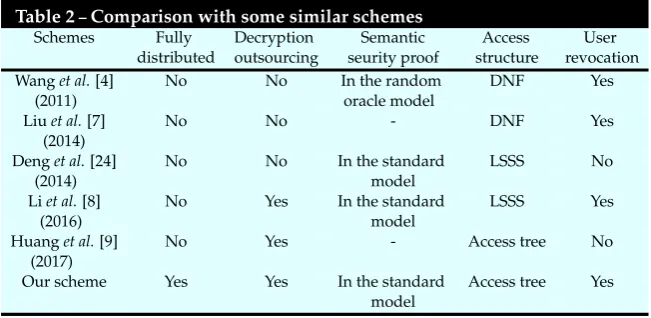
Although, in [6], it is shown that the scheme proposed by Wanget al. is fully insecure, their proposed idea had a considerable impact on the several works. In fact, the hierarchal model is used in several CP-ABE schemes [7, 8, 9, 10] to improve the efficiency of their key delegation mechanism. However, in [7, 8] just like the scheme of Wanget al. [4], each administers a number of disjoint attributes and therefore they may have the similar problems mentioned in the last paragraph. In [9, 10], the scenario is a bit different. Unlike [4, 7, 8] that any attribute in the universal set is assigned to a unique key generator authority, in [9, 10] any data user is assigned to a unique key generator authority. Indeed, in such the schemes, data users are not allowed to get his/her attribute secret-keys from different domains. Actually, the secret-keys gotten from different domains can not be used together in decryption process.
Although, two schemes [9, 10] seem more flexible than the others in the key management aspect, im-proving the flexibility and scalability of key delegation and revocation mechanisms can be an interesting problem.
In this paper, we propose a novel fully distributed lightweight access control system. The main contri-butions of the paper can be summarized as follows:
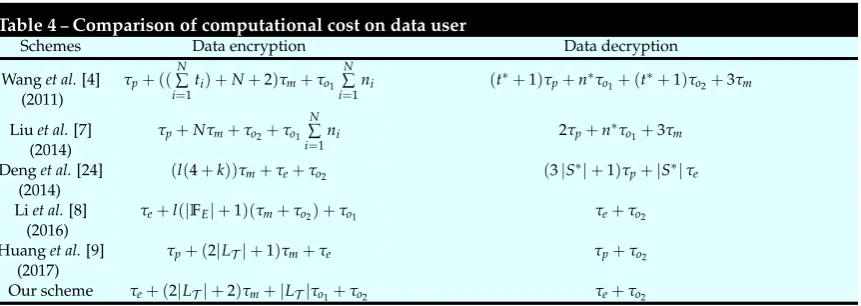
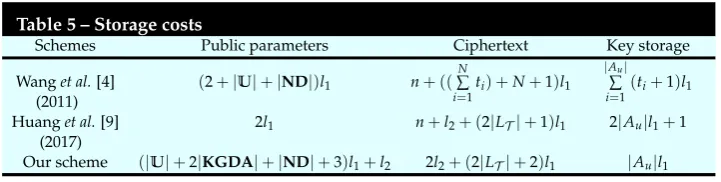
2. We provide a lightweight pairing-free CP-HABE scheme, using the outsourcing technique. Also, we significantly reduce the key storage cost on the user side.
3. We prove our proposed scheme is adaptively semantically secure in the standard model, using the hardness assumption of DBDH problem.
The rest of this paper is organized as follows: Section 2 reviews some related works. In Section 3 we introduce some required preliminaries. The system model, security model, and design goals of our proposed scheme are provided in Section 4. Section 5 presents our proposed CP-HABE in detail. Also the security and performance analyses are given in Section 6 and 7, respectively. In Section 8, we conclude this paper.
2. Related work
The notion of attribute-based encryption (ABE) was introduced for the first time by Sahi and Waters in [1]. The origin of ABE schemes can be derived from the identity-based encryption (IBE) schemes [11, 12, 13]. In such schemes, data owner could share his/her data with several expected data users without knowing their identifier and their public-keys. Actually, the data owner just specifies a set of descriptive attributes and a threshold valued. Each user who has at leastdattributes of the specified set can recover the data. After the advent of ABE, two different works [2, 3] divided the primitive class of encryption schemes into two categories of key-policy ABE (KP-ABE) and ciphertext-policy ABE (CP-ABE), respectively. Until then, all the exist ABE schemes were proven in the selective-model. Lewkoet al. [14] proposed the first adaptive-secure ciphertext-policy and key-policy schemes.
In an ABE scheme, there is just one key authority for generating attribute secret-keys. So, this kind of schemes are not desirable for a large network. For addressing the problem, Wanget al. proposed hier-archical ABE (HABE) schemes [4]. After introducing the system, someone uses the hierarchal model for improving the flexibility and scalability of their schemes.
Liuet al.[7] by considering the concept of time into the combination of HABE and PRE, proposed a
time-based proxy re-encryption (TimePRE) scheme. The main benefit of the scheme is that it is not necessary for the data owner to be online during the user revocation process. In this scheme each user can be identified by a set of attributes and a set of effective time periods that specifies how long the data user is authorized for the attributes.
Liet al. [8] proposed a multi-authority attribute-based data access control scheme. In this scheme by
outsourcing technique, the decryption overhead for data users has been reduced significantly. Also, an efficient user revocation scheme has been proposed in this work.
In the schemes [4, 7, 8] there are several key generator authorities that each of them administers a num-ber of disjoint attributes. Each data user who has a specific attribute can request to the unique key generator authority and get the corresponding secret-key. Also, for revoking some users, the key generator authority have to update the secret-keys of the unrevoked users and generate an update-key for re-encrypting some encrypted data.
By using an ABE scheme a data owner can control data users’ access rights under some attributes which can be organized logically as a single set. It can cause some problems when the data owner does not want to allow the data users who have some specific attributes together to access some data. Bobbaet al.addressed the problem by introducing attribute set-based encryption (ASBE) schemes [15]. After that Wanet al. [10], proposed a CP-HASBE by combining the notions of CP-ASBE and HABE.
Huanget al. [9] proposed a data collaboration scheme, by using HABE model in its key delegation mechanism. In this scheme, decryption outsourcing technique is used to reduce the decryption and signing computation overhead. However, the revocation problem has not been considered in the scheme.
In the first category like [4, 8, 9, 10, 16] and ours, in order to lighten the burden of key generator authority, several domain authorities with a hierarchy structure are considered. The main goal in such the systems is to improve the scalability and flexibility of key delegation and user revocation mechanisms. However, In the second one [17, 18, 19, 20] the attributes and files are assumed in a hierarchical relationship with each other and there is just one key generator authority. In CP-HABE schemes [18, 19], the shared data have hierarchical structure. A group of files in these schemes are divided into some hierarchy subgroups and the file in the same hierarchy structure can be encrypted under an integrated access policy structure. The main benefit of designing such schemes is saving encryption time and storage cost. It seems that combining the benefits of the two class of HABE schemes can afford a system with high capabilities. But we will not consider the problem in this work and we will assume that all the attributes are in a same level.
3. Preliminaries
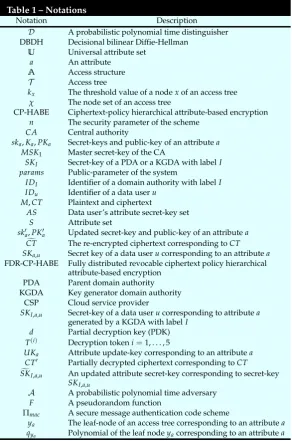
In this section, we introduce some required definitions and assumptions. The notations used in this section can be found in Table 1.
3.1. Bilinear map
Suppose that(G1,+)and(G2, .)are two cyclic groups of a prime orderqandP0is a generator ofG1. A
function ˆe:G1×G1→G2is called a bilinear map if it satisfies the following properties:
1. Non-degeneracy: ˆe(P0,P0),1.
2. Bilinearity: ˆe(aP1,bP2) =eˆ(bP1,aP2) =eˆ(P1,P2)ab, for anya,b∈Zq, andP1,P2∈G1.
3. Computability: There is a polynomial time algorithm which compute ˆe(P1,P2), for anyP1,P2∈G1.
Given two cyclic groupsG1, G2of a prime orderq, a bilinear map ˆe, and a random generatorP0 ∈ G1.
Consider three elements aP0, bP0, cP0 of G1, where a, b and c are three uniform elements of Zq. The
decisional bilinear Diffie-Hellman (DBDH) problem is to distinguish between ˆe(P0,P0)abc and ˆe(P0,P0)z,
wherez∈Zqis a uniform element. The hardness assumption of DBDH problem relative to cyclic groups
G1andG2of a prime orderqand a bilinear map ˆe:G1×G1→G2is that for any probabilistic
polynomial-time (PPT) distinguisherD, there is a negligible functionneglsuch that:
Pr(D(G1,G2,q, ˆe,aP0,bP0,cP0, ˆe(P0,P0)abc) =1)−Pr(D(G1,G2,q, ˆe,aP0,bP0,cP0, ˆe(P0,P0)z) =1)≤negl(n),
(1)
whereP0 ∈ G1is a random generator,a,b,c,z ∈ Zq are four uniform elements ofZq, andnis a security
parameter.
3.2. Access tree
LetU={a1, . . . ,am}be a universal set of attributes. An access structure onUis a nonempty subsetA
of 2U. Access structureAis called monotone if for each A ∈ Aand B ∈ 2U,A∪B ∈ A. For an access structureA, the sets inAare called authorized sets and the other sets of attributes are unauthorized. Since then, we focus on monotone access structures.
Any monotone access structureAcan be presented by a treeT, whereT is the logical representation ofA. We refer toT asaccess tree.
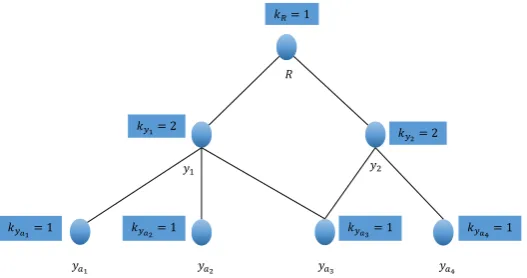
In this case, any leaf node of the access tree corresponds to an attribute of the access structure. For each nodexof the tree,kxdenotes its threshold value. Also, the threshold value of any leaf-node of the tree is
equal to 1. For example, the access tree corresponding to access structure
Table 1 – Notations
Notation Description
D A probabilistic polynomial time distinguisher DBDH Decisional bilinear Diffie-Hellman
U Universal attribute set a An attribute
A Access structure T Access tree
kx The threshold value of a nodexof an access tree
χ The node set of an access tree
CP-HABE Ciphertext-policy hierarchical attribute-based encryption n The security parameter of the scheme
CA Central authority
ska,Ka,PKa Secret-keys and public-key of an attributea MSK1 Master secret-key of the CA
SKI Secret-key of a PDA or a KGDA with labelI params Public-parameter of the system
IDI Identifier of a domain authority with labelI IDu Identifier of a data useru
M,CT Plaintext and ciphertext
AS Data user’s attribute secret-key set S Attribute set
sk′a,PKa′ Updated secret-key and public-key of an attributea
f
CT The re-encrypted ciphertext corresponding toCT SKa,u Secret key of a data userucorresponding to an attributea FDR-CP-HABE Fully distributed revocable ciphertext policy hierarchical
attribute-based encryption PDA Parent domain authority KGDA Key generator domain authority
CSP Cloud service provider
SKI,a,u Secret-key of a data userucorresponding to attributea generated by a KGDA with labelI
d Partial decryption key (PDK) T(i) Decryption tokeni=1, . . . , 5
UKa Attribute update-key corresponding to an attributea CT′ Partially decrypted ciphertext corresponding toCT
f
SKI,a,u An updated attribute secret-key corresponding to secret-key SKI,a,u
A A probabilistic polynomial time adversary F A pseudorandom function
Πmac A secure message authentication code scheme
�� �� �� �� �
� �
�� = �
� = ��=
��� = ��� =
��� = ��� =
Figure 1: The access tree corresponding to the monotone access structureA={{a1,a2},{a1,a3},{a2,a3},{a3,a4},{a1,a2,a3},{a1,a2,
a4},{a1,a3,a4},{a2,a3,a4},{a1,a2,a3,a4}}
is shown in Figure 1.
Letχbe the node set of an access treeT andSbe a subset of the universal attribute setU. Consider a functionTeS:χ→ {0, 1}, where for each leaf nodex,TeS(x) =1 if and only if the corresponding attribute to
xbelongs toSand for each non-leaf nodex,TeS(x) =1 if and only ifxhas at leastkxchildren likex1, . . . ,xkx withTeS(xi) =1, for any 1≤i≤kx.
We say that a set of attributesSsatisfies the access treeT ifTeS(R) =1, whereRis the root ofT.
3.3. Revocable CP-HABE
Any revocable CP-HABE scheme consists of a cloud service provider (CSP) which provides the storage service, a central authority (CA) which responsible for generating public-parameters of the system, sev-eral domain authorities that generate the users’ secret-keys, some data owners that encrypt and outsource their data to the CSP, and some data users which are labeled by a set of attributes and can access to the outsourced data according to their attributes. When a data user possesses an attribute, he/she can get the corresponding secret-key from a domain authority. Also, in these systems, it is possible that an attribute is revoked from a data user. In this case, in order to prevent the access of the data user, the corresponding parameters of the system to the attribute should be updated and the ciphertexts that are relevant to the attribute should be re-encrypted. Also, the attribute secret-keys of the other data users should be updated according to the new parameters. These schemes consist of the following nine algorithms [4]:
1. Setup(1n): The CA runs this algorithm. The input of this algorithm is a security parameter 1n. The algorithm outputs public-parameters of the system,params, secret key,ska, and public-key, PKa, of
each attribute in the universal attribute set, and master secret-key of the CA,MSK1.
2. CreateDomain(params,SKi,{IDi+1}ti=1): The algorithm is run by the CA or a domain authority to
createt∈ Nnew subdomains. The inputs of the algorithm are the public-parameters of the system,
params, secret-key of the domain authority running the algorithm, SKi, (master secret-key of CA,
MSK1, if CA is the runner of this algorithm) and an identifier set of the new sub-domains,{IDi+1}ti=1.
The outputs of the algorithm are secret-keys of the new sub-domains.
3. CreateUser(params,SKi,IDu,ska): This algorithm can be run by any domain authority. Its inputs
are the system public-parameters,params, secret-key of the domain authority running the algorithm,
SKi, a data user’s identifier, IDu, and secret-key of an attribute,ska. The output of the algorithm is a
secret-key of the data user corresponding to the attribute.
5. Decrypt(params,CT,AS): This algorithm is run by a data user. The inputs of the algorithm are the system public-parametersparams, a ciphertextCT, and a secret-key set ASof a specific data useru
corresponding to an attribute setS. The decryption can be done if and only ifSsatisfies the access tree ofCT.
6. UpdateAttribute(params,a):A domain authority runs this algorithm. It takes the public-parameters of the system,params, and an attributearevoked from a data user. The outputs of the algorithm is the updated secret-keysk′aand public-keyPK′aof the attribute.
7. UpdatekeyGen(params,ska,sk′a):This algorithm is run by a domain authority. It takes public-parameters
of the system,params, the secret-key of a revoked attribute,ska, and the updated secret-keysk′a
ob-tained fromUpdateAttribute(params,a). It returns an update-keyUKa.
8. ReEncrypt(params,a,UKa,CT): The cloud service provider runs this algorithm. It takes the system
public-parametersparams, an attributea, an update-keyUKacorresponding to the attributea, and a
ciphertextCTwhich its access tree has a leaf-nod corresponding to the attribute. The output of the algorithm is a re-encrypted ciphertextCTf.
9. UpdateSecretKey(params,a,UKa,SKa,u,IDu): Any domain authority can run this algorithm. The
inputs of the algorithm are the system public-parametersparams, an attributea, an update-keyUKa
corresponding to the attribute, a data user’s attribute secret-keySKa,u, and a data user’s identifier
IDu. It outputs an updated attribute secret-key of the data user.
4. Definitions, system model and security requirements of the proposed scheme
In this section, we propose the definition of a fully distributed revocable CP-HABE (FDR-CP-HABE) scheme for the first time. Then, we present the system model and system definition of our proposed scheme. After that, we give the security model, design goals, and security definitions of an FDR-CP-HABE scheme. Table 1 presents the notations used in this section and our proposed construction in Section 5.
4.1. Definition of a fully distributed revocable CP-HABE (FDR-CP-HABE) scheme
Consider a revocable CP-HABE scheme as Section 3.3. We say that this scheme isfully distributeif the following conditions hold:
• For any attributeain the universal attribute set, a data useru eligible for the attribute can get the corresponding attribute secret-key from any key-generator domain authority in the system.
• The attribute secret-keys generated by different domain authorities can be used together in the de-cryption process.
• For any attributearevoked from a data user, generating the correponding update-key, and updat-ing the parameters of the attribute and secret-keys of the other data users can be done by any key-generator domain authority in the system, even if the domain authority updating a secret-key is not the generator of it.
4.2. System model
The architecture of our proposed FDR-CP-HABE scheme is described in Fig.2. Similar to Section 3.3, the following entities participate in our proposed FDR-CP-HABE scheme:
1. Central authority (CA): A trusted third party which is responsible for generating the global public parameters of the system and also providing secret-keys of domain authorities in the top level. 2. Domain authority: It is a trusted third party which, as Fig.2 illustrates, according to its position can
be considered as one of the following domain authorities:
• Parent domain authority (PDA): These Domains at least have one subdomain. Their responsi-bility is to generate secret-keys of their subdomains.
• Key generator domian authority (KGDA): These Domains does not have any subdomains. They are responsible for generating data users’ attribute secret-keys.
3. Cloud service provider (CSP): A semi-trusted entity which has a high computational power and storage capacity. This party provides storage and computational services for the other entities. 4. Data owner: This client outsources his/her data to the cloud after defining access structure over a set
of attributes and encrypting the data under the access structure using the public-parameters of the system.
5. Data user: Each data user is specified by a set of attributes and a unique identifier (ID). Any data user who has an attribute can make a query to an arbitrary KGDA. The KGDA checks whether the data user is eligible for the attribute or not. If so, the corresponding secret-key is generated and is returned to him/her. The data user can access to some outsourced data using the obtained secret-keys.
System setup
User registration and attribute secret-key
generation Data encryption Partial and full decryption User revocation Parent domain authority (PDA)
Key generator domian
authority (KGDA)
Cloud service
provider (CSP) Data user Data owner
Central
authority (CA)
CreatePDA
CreateKGDA
CreateUser
Encryp
Store Store Store Store
Store Store CreatePDA Setup Store Store CreateKGDA Store CreateUser UpdateAttribute Store PartialDecrypt Store Store Store Encryp Store Store FullDecrypt ReEncrypt Store Store Store UpdateSecretKey Store FullDecrypt Store CreateDecryptionToken Store �� � �� ��, ��� ��,�,� � �� � ′ � �� ෪ � ���′ ���′ ෪��,�,� Domain setup Store
Figure 3: Workflow of our proposed scheme
4.3. Definition of our proposed FDR-CP-HABE system
Our proposed FDR-CP-HABE scheme consists of the following eleven algorithms shown in Figure 3 which are classified in six phases: system setup, domain setup, user registration and attribute secret-key generation, data encryption, partial and full decryption, and user revocation.
4.3.1. System setup
This phase is managed by the CA by running the following algorithm.
• Setup(1n): The CA takes security parameter 1nas input and generates the global public-parameters,
params, secret keysska andKafor each attributeain the universal attribute set, and its own master
secret-keyMSK1.
4.3.2. Domain setup
Domain authorities of the system administer this phase using the following algorithms:
• CreatePDA
(
Params,SK(i1=1,i2,...,ik),{ID(i1=1,i2,...,ik,j)}t j=1
)
: The algorithm is run by the CA or a PDA with identifier ID(i1=1,i2,...,ik). The inputs of the algorithm are global public-parameters, params, the secret-key of the domain authority running the algorithm,SK(i1=1,i2,...,ik), and a set consists oft∈ N
unique identifiers of the new PDAs, {ID(i1=1,i2...,ik,j)}tj=1. The algorithm outputs a set consists oft
secret-keys of the new PDAs,{SK(i1=1,i2,...,ik,j)}
• CreateKGDA
(
params,SK(i1=1,...,ik),{ID(i1=1,...,ik,j)}
t j=1
)
: The algorithm is run by a PDA. The inputs of this algorithm are system public-parameters params, the secret-key of the PDA,SK(i1=1,...,ik), and
t ∈ N identifiers of the new KGDAs, {ID(i1,...,ik,j)}
t
j=1. The algorithm outputs the secret-key set
{SK(i1=1,...,ik,j)}t
j=1of the new KGDAs.
4.3.3. User registration and attribute secret-key generation
The attribute secret-keys of data users are delegated in this phase by the following algorithm:
• CreateUser
(
params,SK(i1=1,i2,...,ik),IDu,ska
)
: This algorithm is conducted by a KGDA takes public-parameters of the system, params, secret-key of the KGDA, SK(i1=1,i2,...,ik), a data user’s identifier,
IDu, and secret-key of an attributea,ska, as inputs. It outputs the attribute secret-key of data useru,
SK(i1=1,i2,...,ik),a,u, corresponding to the KGDA and attributea.
4.3.4. Data encryption
In this phase, using the following algorithm a data file is encrypted before outsourcing to the cloud. • Encrypt(params,M,T): Data owner runs this algorithm. The inputs of the algorithm are system
public-parametersparams, a messageM, an access treeT. The algorithm outputs the corresponding ciphertextCT.
4.3.5. Partial and full decryption
This phase is managed by data users and the CSP using the following three algorithms:
• CreateDecryptionToken(CDT)(params,CT,AS): The algorithm is run by a data user. The inputs of the algorithm are system public-parameters params, a ciphertextCT, and a set of the data user’s attribute secret-keys AS. The algorithm returns a partial decryption key (PDK)d, two decryption token setsTS(1),TS(2), and three tokensT(3),T(4)andT(5)as outputs.
• PartialDecrypt
(
params,CT,TS(1),TS(2),T(3),T(4),T(5) )
: The algorithm is run by the CSP . The in-puts of the algorithm are system public-parametersparams, a ciphertextCT, and decryption tokens
TS(1),TS(2),T(3),T(4)andT(5)obtained from a data user. The output of the algorithm is a partially
decrypted ciphertextCT′.
• FullDecrypt(params,CT,d,CT′): This algorithm is run by a data user. The inputs of the algorithm are system public-parameters params, a ciphertext CT, a PDKd obtained from CDT(params,CT,AS), and the partially decrypted ciphertextCT′. The algorithm outputs the message corresponding toCT
if and only if the attribute set corresponding toASsatisfies the access tree of ciphertextCT.
4.3.6. User revocation
This phase can be defined by the following three algorithms:
• UpdateAttribute(params,IDu,a,ska): This algorithm is run by KGDAs of the system. The inputs
of the algorithm are system public-parameters params, a data user identifier IDu, an attribute a
re-voked from the data user, and the secret-key of the attribute,ska. The algorithm outputs the updated
secret-key and public-key of the attribute,sk′aandPK′a, and an update-keyUKafor re-encrypting the
ciphertexts that are relevant to the revoked attribute and updating secret-keys of the other data users. • ReEncrypt(params,a,UKa,CT): The algorithm is run by the CSP. The inputs of the algorithm are
system public-parametersparams, an attributearevoked from a data user, an update keyUKa, and a
• UpdateSecretKey (USK)(params,a,UKa,SK(i1=1,i2,...,ik),a,u,IDu): The algorithm can be run by any KGDA. The algorithm takes system public-parameters, params, an attributea, an update keyUKa,
a data user’s attribute secret-key SK(i1=1,i2,...,ik),a,u, and the data user identifier IDu. It returns an
updated secret-keySKf(i1=1,i2,...,ik),a,uof the data user.
4.4. Security model
The CA and the other domain authorities are assumed trusted. They never collude with the CSP and users. Similar to [4], [21] and [22] the CSP is assumed semi-trusted. It always execute the given protocols correctly. However, it sometimes try to find further information about the stored data. Also, to get illegal access privileges, it may collude with some data users. All the data users are assumed malicious. They may collude with each other and the CSP to get some unauthorized information about the outsourced data. Also, it is assume that there are some secure communication channels between each domain authority and the other existing parties (domain authorities, users and the CSP). Moreover, the communication channels between users (data users and data owners) and the CSP are assumed insecure.
4.5. Design goals
4.5.1. Fine-grained data access control
In practice, there are several data owners that outsource their sensitive data to the CSP and several data users that are interested to access to the outsourced data. It this case, data owners should be able to determine who has access to their data and who does not have. So, they should be enabled to define a flexible access structure on their data such that the access structure identifies the data users who have the privilege to access the outsourced data.
4.5.2. Data confidentiality
Our proposed scheme must be semantically secure. In other words, unauthorized data users must be unable to learn any partial information about the plaintext from the corresponding ciphertexts.
4.5.3. Collusion resistance
Some unauthorized data users may collude to decrypt some outsourced encrypted data such that non of them can do it alone. Our scheme must be resistant against such collision attacks.
4.5.4. Scalable and flexible key delegation and user revocation mechanisms
Our scheme should provide a high level of flexibility and scalability in key delegation and user revo-cation mechanisms. In order to achieve this goal, our proposed scheme should be fully distributed as we have presented in Section 4.1.
4.5.5. High performance
The computational and storage cost on the data user side should be low enough such that data users can easily store and access their data anytime and anywhere without having a powerful device.
4.6. Security definition of an FDR-CP-HABE scheme
We define the semantic security for an FDR-CP-HABE scheme in terms of the following chosen-plaintext attack (CPA) indistinguishability experiment.
Consider the following experiment, denoted by PubcapA,Π(n), whereΠis an FDR-CP-HABE scheme,Ais a probabilistic polynomial time (PPT) adversary, andnis an integer-valued as the security parameter. The experiment consists of the following five steps:
1. Setup: ChallengerC, at first, runs theSetup,CreatePDAandCreateKGDAalgorithms, and gives the adversaryA the generated system public-parameters params and the identifiers of the created domain authorities.
2. Phase 1:AdversaryAcan adaptively make a polynomial number of queries for secret-keys of some arbitrary data users corresponding to his/her attributes generated by some KGDAs. Once challenger Creceives a query, it runsCreateUseralgorithm and gives the requested secret-key to the adversary. 3. Challenge: Adversary A declares an access tree T and two equal length messages M0 and M1
such that there is no any data user that the adversary have queried a set of attribute secret-keys of him/her that the corresponding attribute set satisfies the access tree. ChallengerCflips a random coinb ∈ {0, 1}and then encryptsMb under the access tree. The generated ciphertext is returned to
the adversary.
4. Phase 2: The adversary can adaptively make new secret-key queries, with the same mentioned con-straint in Phase 1, and the challenger responds them same as before.
5. Guess:The adversary outputs a guessb′∈ {0, 1}of b.
The output of the experiment is 1, PubcapA,Π(n) =1, ifb=b′; otherwise the output is 0, PubcapA,Π(n) =0. we say the adversary succeeds, if PubcapA,Π(n) =1.
Definition 1. An FDR-CP-HABE schemeΠis called CPA-secure if for all probabilistic polynomial-time adversaries
A, there is a negligible function negl such that:
Pr(PubcpaA,Π(n) =1)≤ 1
2+negl(n), (2)
where n is the security parameter of the scheme, and the probability is taken over the randomness of the experiment,
as well as the randomness used by the adversaryA.
5. Our construction
In this section, we present our proposed FDR-CP-HABE scheme in detail.
5.1. System setup
The CA produces the system public-parameters and some required keys using the following algorithm. It is assumed that any data user and domain authority has a unique identifier (ID).
Setup:According to the security parametern, this algorithm at first selects a prime numberqand then choosesx,sk0∈Zquniformly at random, two groupsG1andG2of orderq, a bilinear map ˆe:G1×G1→G2
and three random generators P0,P1,P2 ∈ G1. Then, for each attribute a in the universal attribute set U, two uniform elements ska ∈ Zq, Ka ∈ {0, 1}n, and PKa = skaP0 are considered as secret-keys and
public-key of the attribute. After that, it chooses a pseudorandom function F : {0, 1}∗× {0, 1}∗ → Zq
and a secure message authentication code scheme Πmac = (Gen,Mac,Vr f y) [23]. Finally, params =
(
q,G1,G2, ˆe,n,P0,P1,P2,Q0,Q1,g0,g1,{PKa}a∈U,F,Πmac
)
is published as the system public-parameters, where Q0 = sk0P0, Q1 = xP0, g0 = eˆ(Q0,P1), and g1 = eˆ(Q1,−Q0). Also MSK1 = (sk0,x,SK11 =
5.2. Domain setup
The CA or any PDA may run theCreatePDAalgorithm to create some new PDAs. Let us label CA with 1 and itsN1subdomains with(1, 1),(1, 2),. . . ,(1,N1), from left to right. Also, thej-th subdomain of a PDA
with labelI= (i1=1,i2, . . . ,ik)is labeled withI||j= (i1=1,i2, . . . ,ik,j).
CreatePDA:The CA or a PDA with label I = (i1 = 1,i2, . . . ,ik)and secret-keys SK1I, SK2I,{ska}a∈U
and{Ka}a∈Ucan run this algorithm and create some new PDAs. This algorithm selects a uniform element
skI∈Zqand outputs:
SKI||j= (SK1I||j=SK1I+skIIDI||j,SK2I||j =SK2I+skIIDI||j,{ska}a∈U,{Ka}a∈U), (3)
as the secret-key of thej-th created PDA, whereIDI||j∈G1is the identifier of thej-th created PDA.
Any PDA which have not created any subdomains can run theCreateKGDAalgorithm and create an arbitrary number of KGDA.
CreateKGDA:A PDA with labelIand secret-keySKI = (SK1I,SK2I,{ska}a∈U,{Ka}a∈U)which wants to
create some KGDAs, at first chooses a uniform elementskI ∈Zq, and generates the secret-key
SKI||j = (SK′I||j =SK1I+skIIDI||j,{ska}a∈U,{Ka}a∈U) (4)
and the public-key
PKI||j=SK2I+skIIDI||j (5)
for thej-th created KGDA, whereI||jandIDI||j∈G1are the label and identifier of thej-th created KGDA.
5.3. User registration and generation of attribute secret-keys
When a data userujoins to the system, he/she should choose a unique identifier IDu. When the data
user asks a KGDA the corresponding secret-key of an attributea. The KGDA at first checks whether the data user is eligible for the attribute or not. If so, then the KGDA runsCreateUseralgorithm and generates the requested secret-key.
CreateUser:Let a data useruwith identifierIDuhas made a query to a KGDA with labelIand
secret-key (SK′I = SK1I +skIIDI,{ska}a∈U,{Ka}a∈U) for the secret-key corresponding to an attribute a. The
KGDA runs this algorithm and computes the requested secret-key as follows:
SKI,a,u=SK′I+skaIDu. (6)
In order to ease notation, for a labelI= (i1=1,i2, . . . ,ik)of a KGDA and anyl∈ {1, . . . ,k}, we assume
thatIl = (i1, . . . ,il). Therefore,I1=i1=1 andIk =I. It is not hard to verify that, by combining Equations
(3), (4), (5) and (6), and using the new notation, we have:
SKI,a,u=SK11+ k−1
∑
l=1
skIlIDIl+1+skaIDu (7)
and
PKI=SK21+
k−1
∑
l=1
skIlIDIl+1, (8)
5.4. Data encryption
Before outsourcing a data file to the CSP, for controlling the access rights, the data owner should define an access structure on his/her data, in terms of an access tree, and encrypt the data under the access tree. This process can be described in detail as follows:
Encryption:For encrypting a data fileM∈G1, the data owner at first defines an access treeT with root
Rand a threshold valuekxfor each nodexin the tree. Then, he/she setsqR(x) =r+b1x, . . . ,bkR−1x
kR−1, whererandbiare uniform elements ofZq,i= 1, . . . ,kR−1. In a similar way, a polynomialqxi of degree
kxi−1 thatqxi(0) =qR(i)is selected for thei-th child ofR. This process is continued until each node of the tree gets one polynomial. As we noted in Section 3.2, for each leaf nodeyof the tree, the threshold value is equal to one. Therefore,qyis a constant polynomial. Letyabe the leaf node of the tree corresponding to
the attributeaandLT be the leaf node set of treeT. The output of the algorithm is:
CT= (T,V=M.g0r,V′=gr1,C=rP0,C′ =rP2,
{
Ca=qyaP0,Ca′ =qya(PKa−P2)
}
ya∈LT) (9)
5.5. Partial and full decryption
As we mentioned in Section 4.5.5, one of our main goals in designing our FDR-CP-HABE scheme is to decrease the computational costs on the data user side. In other words, we want to provide a situation in which even data users with low computing resources can easily use the scheme. For this purpose, in our scheme, the CSP does the most amount of the required computations in decryption algorithm and very few computations are done by the data user.
When a data user wants to decrypt a ciphertext, he first runsCreateDecryptionToken(CDT)algorithm and generates some decryption tokens for the CSP such that they do not leak any partial information about the corresponding plaintext and the data user’s secret-keys. Then, using the tokens, the CSP runs
PartialDecryptalgorithm and produces a partially decrypted ciphertext for the data user. Finally, using the partially decrypted ciphertext and running theFullDecryptalgorithm, the data user obtains the cor-responding plaintext. Also, as we will note in Remark 2, a data user with the required computational resources can decrypt the ciphertext without the contribution of the CSP.
CreateDecryptionToken(CDT):Given a ciphertextCT = (T,V,V′,C,C′,{Ca,C′a}ya∈LT), a data user
with identifierIDu and an attribute setS = {ai}it=1that for any attributeai,i ∈ {1, . . . ,t}, there is a leaf
nodyai ∈ LT. This algorithm outputs a uniform elementdas partial decryption key (PDK), two token sets
TS(1)={T(1)
ai =d.SKIi,ai,u
}t
i=1,TS
(2)={T(2)
ai =d.Cai
}t
i=1, and three tokensT
(3)=dID
u,T(4)=dQ0and
T(5)= V′d, whereSKIi,ai,uis the secret-key of data userucorresponding to the attributeai and generated by the KGDA with labelIi= (1, . . . ,ki).
For a ciphertextCT= (T,V,V′,C,C′,{Ca,C′a}ya∈LT), a nodeyofT, and a data useru, let
By,u =gq0y(0).g1qy(0). ˆe(P2,IDu)qy(0),
whereqyis the assigned polynomial to the nodeyin the encryption phase.
PartialDecrypt: Given a ciphertextCT with access structureT satisfied by a data user’s attribute set
S={ai}it=1and the decryption tokensTS(1)=
{ Ta(i1)
}t
i=1,TS
(2)={T(2)
ai
}t
i=1,T
(3),T(4)andT(5)obtained
Byd
ai,u=
ˆ
e(Cai,T
(1)
ai )
ˆ
e(Ta(i2),PKIi)eˆ(Ca′i,T
(3)))
=gdq0yai.gdq1 yai. ˆe(P2,T(3))qyai, (10)
for anyi∈ {1, . . . ,t}. Then, it calculatesBR,uin the following way, whereRis the root node of the access
treeT:
Since the access tree T is satisfied byS, there are some internal nodes y as the parent of leaf-nodes
yai1, . . . ,yaiky in the access tree, whereky is the threshold value of node y . Now, if qy is the assigned polynomial to a nodeyof the tree in the encryption phase, then by using the interpolation method we have
qy(x) = ky
∑
s=1
lis(x)qy(is) =
ky
∑
s=1
lis(x)qyais(0), where
lis(x) =
(x−i1). . .(x−is−1)(x−is+1). . .(x−ikyi)
(is−i1). . .(is−is−1)(is−is+1). . .(is−ikyi)
is the Lagrange polynomial,s=1, . . . ,kyi. So, the valueBd
y,ucan be computed as follows:
By,ud =
kyi
∏
s=1
(Byd
ais,u)
lis(0)
=gdq0 y(0).gdq1 y(0). ˆe(P2,T(3))qy(0). (11)
After that, in a similar way, the CSP computesBdy′,ufor some nodesy′in the next level of the access tree, by using some valuesBdy1,u, . . . ,B
d yk
y′,uobtained before, where the nodesy1, . . . ,yky′ are children of the nodey
′.
Continuing this process, the CSP calculates:
BdR,u =g
dqR(0)
0 .g dqR(0)
1 . ˆe(P2,T(3))qR(0)
=g0dr.gdr1. ˆe(P2,T(3))r
=g0dr.T(5). ˆe(C′,T(3)) (12)
and the partially decrypted ciphertext
CT′ = B
d R,u
T(5). ˆe(C′,T(3)) (13)
=g0dr, is returned as the output.
FullDecrypt: Once the data user receives partially decrypted ciphertext CT′, he/she can recover the message as follows:
M= V
CT′1d
Remark 2. A data user u who has an attribute set S satisfying the access tree of a given ciphertext CT= (T,V,V′,
C,C′,{Ca,C′a}ya∈LT)can decrypt CT without getting help from the CSP. In this case, the data user can recover the
file as follows:
• First, the data users calculates
Byai,u =
ˆ
e(Cai,SKI(i),a
i,u) ˆ
e(Cai,PKI(i)). ˆe(Ca′i,IDu)
=gq0yai.g1qyai. ˆe(P2,IDu))qyai,
for each attribute ai∈S.
• Then, as before, by using the interpolation method, the following expression can be calculated
BR,u =gr0.g1r. ˆe(P2,IDu))r
=gr0.g1r. ˆe(rP2,IDu)
=gr0.V′. ˆe(C′,IDu).
Then, the corresponding message is recovered as follows:
M= BV
R,u
V′. ˆe(C′,IDu) .
Remark 3. The most impressive benefit of a FDR-CP-HABE can be observed in the decryption process. As we have seen in this section, despite to the other existing works, the secret-keys of a data user gotten from different domain authorities can be used together in the decryption process. This option offers a high level of scalability and flexibility in the key delegation mechanism.
5.6. User revocation
In real applications, some attributes might be revoked from a data user. To achieve forward secrecy, whenever an attribute is revoked from a data user, it should be made sure that the data user no longer has access to the associated shared data.
For these purposes, KGDAs update secret-key and public-key of the revoked attribute. Also, they update attribute secret-keys of the authorized data users. Furthermore, the related ciphertexts should be re-encrypted by the CSP. The revocation process is described through the following three algorithms.
UpdateAttribute:For an attributea0with secret-keysska0 andKa0, and public-keyPKa0, once a KGDA
judges that a data useru0no longer is eligible for the attribute, it selects a random integer numbersand
broadcasts the messageR(a0,u0) = (a0,IDu0,s,time,MacKa0(IDu0,s,time)), where timeis a time stamp.
Also, it sends an update-keyUKa0 = FKa0(s)−ska0 to the CSP through an authenticated secure channel,
where FKa0(s) = F(Ka0,s). Any KGDA, once receives the message R(a0,u0), using theVrfy algorithm
checks the validity of the message. If so, they substituteska0 andPKa0 withsk′a = FKa0(s) = F(Ka0,s)and PK′a=sk′aP0, respectively, and computeUKa0 =sk′a0−ska0.
ReEncrypt: For a revoked attributea0, once the CSP receives the update-keyUKa0 from a KGDA, any
ciphertextCT = (T,V,V′,C,C′,{Ca,Ca′}ya∈LT)that its access treeT has a leaf nodeya0 corresponding to
attributea0is re-encrypted asCTf = (T,V,C,Ca0,Ce′a0 = C
′
a0+UKa0Ca0,{Ca,C′a}ya∈LT−{ya0}). Then CSP storesCTf and removes the old version of the ciphertext.
UpdateSecretKey(USK):When an authorized data userumakes a query for updating his/her attribute secret-keySKI,a0,uto a KGDA, the KGDA updates his/her secret-key asSKfI,a0,u=SKI,a0,u+UKa0IDuand
Remark 4. In the revoking process one can see another benefit of a FDR-CP-HABE scheme. Same as the key del-egation phase, in this case, the parameters of the revoked attributes and also the corresponding secret-keys of the authorized data users can be updated by any KGDA. Indeed, each KGDA can update secret-keys of any data user, even if the KGDA has not generated them.
5.7. Correctness analysis of our proposed scheme
In this section, we show the correctness of our proposed scheme.
Theorem 5. The decryption process is correct.
Proof. Consider a ciphertextCT = (T,V,V′,C,C′,{Ca,C′a}ya∈LT). LetTS
(1),TS(2),T(3),T(4),T(5),d,S =
{ai}ti=1,Ii andSKIi,ai,ube as in Section 5.5,i = 1, . . .t. In the following, we first prove the correctness of
PartialDecryptalgorithm. For this purpose, we show the correctness of Equations (10), (11), (12) and (13). We have:
Byd
ai,u=
ˆ
e(Cai,T
(1)
ai ) ˆ
e(Ta(i2),PKIi). ˆe(C′ai,T
(3))
= eˆ(Cai,dSKIi,ai,u) ˆ
e(Ta(i2),PKIi). ˆe(C′ai,T
(3)) (15)
Using Equation (7), we thus have:
Bdyai,u =
ˆ
e(Cai,d(SK11+ ki−1
∑
l=1
skIl
iIDIli+1+skaiIDu)) ˆ
e(Ta(i2),PKIi). ˆe(C′ai,T
(3))
= ˆ
e(Cai,dSK11). ˆe(Cai,d ki−1
∑
l=1
skIl iIDIl
+1
i ). ˆe(Cai,dskaiIDu) ˆ
e(Ta(i2),PKIi). ˆe(C′ai,T(3))
= ˆ
e(Cai,dSK
1
1). ˆe(Cai,d(
ki−1
∑
l=1
skIl
iIDIil+1+xQ0−xQ0)). ˆe(Cai,dskaiIDu) ˆ
e(Ta(i2),PKIi). ˆe(C′ai,T
(3))
= ˆ
e(dCai,SK
1
1). ˆe(dCai,(
ki−1
∑
l=1
skIl iIDIil+1
+xQ0−xQ0)). ˆe(dCai,skaiIDu) ˆ
e(Ta(i2),PKIi). ˆe(C′ai,T
(3))
(16)
= ˆ
e(dCai,SK11). ˆe(T
(2)
ai ,
ki−1
∑
l=1
skIl
iIDIil+1+SK
2
1−xQ0). ˆe(dqyaiP0,skaiIDu) ˆ
e(Ta(i2),PKIi). ˆe(C′ai,T
Now, using Equation (8), we see that:
Bdy
ai,u = ˆ
e(dqyaiP0,sk0P1). ˆe(Ta(i2),PKIi−xQ0). ˆe(dqyaiP0,skaiIDu) ˆ
e(Ta(i2),PKIi). ˆe(C′ai,T
(3))
= eˆ(dqyaiP0,sk0P1). ˆe(T
(2)
ai ,PKIi). ˆe(dqyaiP0,−xQ0). ˆe(dqyaiP0,skaiIDu) ˆ
e(Ta(i2),PKIi). ˆe(C′ai,T
(3))
= eˆ(P0,sk0P1)
dqyai
. ˆe(P0,−xQ0)dqyai. ˆe(qyaiskaiP0,dIDu) ˆ
e(C′ai,T(3))
= eˆ(sk0P0,P1)
dqyai
. ˆe(xP0,−Q0)dqyai. ˆe(qyaiskaiP0,T(3))
ˆ
e(qyai(PKai−P2),T(3))
= eˆ(Q0,P1)
dqyai
. ˆe(Q1,−Q0)dqyai. ˆe(qyaiPKai,T
(3))
ˆ
e(qyai(PKai−P2),T(3))
= eˆ(Q0,P1)
dqyai
. ˆe(Q1,−Q0)dqyai. ˆe(qyaiPKai,T
(3))
ˆ
e(−qyaiP2,T(3)). ˆe(qyaiPKai,T(3))
= eˆ(Q0,P1)
dqyai
. ˆe(Q1,−Q0)dqyai
ˆ
e(P2,T(3))−qyai
=eˆ(Q0,P1)dqyai. ˆe(Q1,−Q0)dqyai. ˆe(P2,T(3))qyai
=gdq0 yai.g1dqyai. ˆe(P2,T(3))qyai. (18)
So, Equation (10) is correct. On the other hand,
Bydi,u= kyi
∏
s=1
(Byais,u)dlis(0)
=
kyi
∏
s=1
g0dlis(0)qyai.g1dlis(0)qyai. ˆe(P2,T(3)) lis(0)qyai
=g
dkyi∑
s=1
lis(0)qyai
0 .g
dkyi∑
s=1
lis(0)qyai
1 . ˆe(P2,T(3))
kyi ∑ s=1
lis(0)qyai
=gdq0yi(0).g1dqyi(0). ˆe(P2,T(3))qyi(0) (19)
which proves the correctness of Equation (11). Also,
BdR,u =gdqR(0)
0 .g dqR(0)
1 . ˆe(P2,T
(3))qR(0) =g0dr.gdr1. ˆe(P2,T(3))r
=g0dr.V′d. ˆe(rP2,T(3))
Moreover,
CT′= B
d R,u
T(5). ˆe(C′,T(3))
= g
dr
0.T(5). ˆe(C′,T(3))
T(5). ˆe(C′,T(3))
=grd0. (21)
Therefore, Equations (12) and (13) are correct.
Now, in order to show the correctness of theFullDecryptalgorithm, we should prove Equation (14). Consider the partially decrypted ciphertextCT′andFullDecryptalgorithm. We see that:
V
CT′1d
= M.g
r 0
(gdr0 )1d = M.g
r 0
gr0
= M. (22)
This proves the theorem.
Theorem 6. The re-encryption process is correct. Proof. Leta0,Ca0,C′a0,Ce
′
a0,UKa0,ska0,sk′a0,PKa0 andPK′a0 be the same as Section 5.6. To show the
correct-ness of the re-encryption process, we should prove thatCe′a0 =qya0(PK′a0−P2). We have: e
Ca′0 =C′a0+UKa0Ca0
=qya0(PKa0−P2) + (sk′a0 −ska0)(qya0P0) =qya0(ska0P0−P2) + (sk
′
a0−ska0)(qya0P0) =qya0(sk′a0P0−P2)
=qya0(PK′a0−P2).
So, the re-encryption algorithm is correct.
6. Security analysis
In this section we show that our proposed scheme fulfills the mentioned security requirements in Sec-tion 4. We first prove that the scheme is adaptively semantically secure in the standard model. Then we conclude that the scheme is collusion resistance. After that, we show that it achieves fine-grained access control over the outsourced encrypted data.
6.1. Data confidentiality
Theorem 7. If the DBDH problem is hard relative to two cyclic groups G1, G2of a prim order q and a bilinear map
Proof. Let Π denotes our proposed FDR-CP-HABE scheme. For a security parametern, letA be a PPT adversary in the experiment PubcapA,Π(n)introduced in Section 4.6. We prove that:
Pr(PubcpaA,Π(n) =1)≤ 1
2+negl(n),
for a negligible functionnegl. Consider a PPT distinguisherDwhich attempts to solve the DBDH problem. The distinguisherDhas gotten(q,G1,G2,e,P,αP,βP,γP,h=eˆ(P,P)z), wherePis a randome generator of
G1,α,βandγare three uniform elements ofZq,zis eitherαβγor is a uniform element ofZq. Dwants to
determine the case ofz.
The distinguisherDruns adversaryAas a subroutine as follows: 1. Dsets
P0=P (23)
P1=γP (24)
Q0=αP (25)
Q1=γP−t1P= (γ−t1)P (26)
P2=t2P0 (27)
g0=eˆ(Q0,P1) (28)
g1=eˆ(Q1,−Q0), (29)
where t1 and t2 are two uniform elements ofZq chosen by D. Then, for each attribute ain the
universal attribute set U, it chooses ska ∈ Zq uniformly at random, and gives the system
public-parameters params = (q,G1,G2,e,n,P0,P1,Q0,Q1,P2,g0,g1,{PKa}a∈U,F,Πmac
)
to the adversaryA, whereFis a a pseudorandom function andΠmacis a secure MAC scheme.
2. Before starting Phase 1, the distinguisherD selects a label set L consists of some elements as I = (i1=1,i2, . . . ,ik), whereij ∈Z,j=1, . . . ,k, as the labels of the KGDAs of the system. For anyI ∈L,
it choosesIDI ∈G1as the identifier of the KGDA with labelIand gives it to the adversaryA. Then,
for eachI∈L, it selects a uniform elementAI∈G1and gives
PKI0 =AI0−t1αP0 (30)
to adversaryAas the public-key of the KGDA with labelI. The valueAIis kept secret for eachI ∈L.
In phase 1, when adversaryAmakes a query for a secret-key of a data useru0corresponding to an
attributea0generated by the KGDA with labelI0, distinguisherDresponds to the query with
SK1I0,a0,u0 =AI0+skaIDu. (31)
Remark 8. In the construction introduced in Section 5, we had Q1 = xP0, Q0 = sk0P0, SK11 = sk0P1and
SK21=xQ0=xsk0P0, where x and sk0are two uniform elements ofZq. So, by considering Q1= (γ−t1)P0,
Q0=αP0and P1=γP0, we get:
x=γ−t1,sk0=α. (32)
Therefore, we have:
SK11=sk0P1=αγP0 (33)
and
Now, by combining Equations (7), (8), (33) and (34), we conclude that SKI0,a0,u0 and PKI0 must be in the following forms:
SKI0,a0,u0 =αγP0+
k
∑
l=1
skIl
0IDI0l+1+skaIDu (35)
and
PKI0 =αγP0−t1βP0+
k
∑
l=1
skIl
0IDI0l+1. (36)
On the other hand, the parameters skIl
0, l=1, . . . ,k are some arbitrary elements ofZqand distinguisherDcan
freely select them. So, we can assume that they has been selected in such a way thatαγP0+
k
∑
l=1
skIl
0IDI0l+1
=
AI0. Therefore, PKI0 = AI0−t1αP0is a valid public-key of the KGDA with label I0and SK
1
I0,a0,u0 = AI0+
skaIDuis a valid responses to the query.
3. InChallengestep, adversaryAoutputs two equal length plaintextsM0andM1, and an access treeT
which the adversaryAhas not queried the attribute secret-keys of a specific data user corresponding to an attribute setSsatisfyingT, inPhase 1. Once the distinguisherDreceives the plaintexts, chooses
b∈ {0, 1}and encryptsmbas follows:
Firstly,kRelementsb1. . .bkR ∈ Zqare chosen uniformly at random, wherekRis the threshold value of the access tree’s root. Then, it calculatesska(βP0)−t2(βP0) = β(skaP0−t2P0) =β(PKa−P2)and
considers two following polynomial functions:
{
QR:Zq→G1
QR(x) =βP0+ (b1P0)x+· · ·+ (bkR−1P0)x
kR−1 (37)
and
{
Q′R:Zq→G1
Q′R(x) =β(PKa−P2) +b1(PKa−P2)x+· · ·+bkR−1(PKa−P2)x
kR−1, (38)
for the root of the tree. Then, in a similar way, two following polynomial
{
Qci :Zq →G1
Qci(x) =QR(i) + (b1(i)P0)x+· · ·+ (b(ki)
ci−1P0)x
kci−1 (39)
and
{
Q′ci :Zq→G1
Q′ci(x) =Q′R(i) + (b
(i)
1 (PKa−P2))x+· · ·+ (b
(i)
kci−1(PKa−P2))x
kci−1, (40)
are generated for eachi-th childciof the root.
By continuing this process two polynomialsQyi and Q′yi with degreekyi −1 are generated for any nodeyi of the tree. As we noted, the threshold value of each leaf-node of an access tree is equal to
one. Therefore, the corresponding polynomials to each leaf-nodeya are two constant polynomials
Qya,Q′ya ∈G1. Finally, the distinguisherDoutputs
CTb= (T,V=Mb.h,V′ =h−1. ˆe(αP0,βP0)t1,C=βP0,C′=t2(βP0) =β(t2P0) =βP2,
{
Ca=Qya,Ca′ =Q′ya
}