
International Journal of Research (IJR)
e-ISSN: 2348-6848, p- ISSN: 2348-795X Volume 2, Issue 06, June 2015Available at http://internationaljournalofresearch.org
Efficient Pollution Control Vehicle Routing Protocol Design
Using Genetic Algorithm
Aakanksha & Anuradha Panjeta
CSE & Kurukshetra University
[email protected]
; [email protected]
Abstract-
This paper presents the Pollution-Routing Problem (PRP), which is an extension of the classical Vehicle Routing Problem (VRP) with a broader and comprehensive objective function that accounts not just for the travel distance, but also for the amount of greenhouse emissions(CO2), fuel, travelling time
and their costs. Mathematical models are described for the PRP with or without time windows and computational experiments are performed on realistic instances. The paper sheds light on the tradeoffs between various parameters such as vehicle load, speed and total cost. The results suggest that, compared to the VRP, the PRP is significantly more difficult to solve to optimality but it yields savings in total cost.
Keywords –Vehicle Routing; Fuel Consumption;
CO2 Emission; Genetic Algorithm I Introduction
1.1 Vehicle Routing Problem:
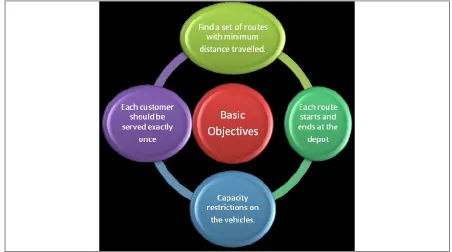
The vehicle routing problem (VRP) can be described as the problem of designing optimal delivery or collection routes from one or several depot(s) to a number of geographically scattered customers subject to side constraints[7]. The vehicle routing problem is very essential in logistics and operational research. The below are basic objectives of vehicle routing problem:
(1) Find a set of routes with minimum distance travelled.
(2) Each customer should be served exactly once.
(3) Vehicle starts from a depot and return back to same depot at end.
(4) Capacity restrictions on the vehicles.
International Journal of Research (IJR)
e-ISSN: 2348-6848, p- ISSN: 2348-795X Volume 2, Issue 06, June 2015Available at http://internationaljournalofresearch.org
Vehicle routing problem tries to find the path which has minimum distance. As the numbers of vehicles are increasing day by day this is causing congestion in traffic. The major concern is of pollution which is emitted by the vehicles. Our main motive behind this project is to find an efficient way to reduce pollution by vehicle routing protocol (VRP). Any vehicle that moves will create CO2 emission and that will eventually contribute
in air pollution. We can't derail development, that's why we can't stop vehicle. Only we can reduce the distance required to cover by vehicle in an efficient manner. Therefore, in order to reduce distance covered by vehicle, we are using genetic algorithm.The main purpose of this study is to find out the best solution of the vehicle routing problem simultaneously considering heterogeneous vehicles, double trips, and multiple depots by using a hybrid algorithm [7].
1.2 Genetic Algorithm for Vehicle Routing Problem:
It contains following steps as shown in Fig.2: 4.1.1 Chromosome Representation
4.1.2 Initial Population Generation 4.1.3 Fitness Testing
4.1.4 Selection 4.1.5 Crossover
4.1.6 Proposed Mutation and Termination
Figure 2:Flow Chart of Genetic Algorithm for Vehicle Routing Problem [9] II Need of PRP
2.1 The Pollution Aware Vehicle Routing Problem[5]:
Classical vehicle routing problem deals with the minimization of distance and now we will move towards deeper objectives that deals with not only with distance travelled but also with quantity of greenhouse gases(GHG) emissions, fuel, travel cost and its costs [5].
International Journal of Research (IJR)
e-ISSN: 2348-6848, p- ISSN: 2348-795X Volume 2, Issue 06, June 2015Available at http://internationaljournalofresearch.org
discuss a new factor that is pollution in the vehicle routing Problem (VRP). In our Problem we are considering two main objectives that are total minimum distance and cost and cost for CO2 emissions. A genetic algorithm based approach is used for vehicle routing problem in order to fulfil our objectives.
III Mathematical Programming Model
3.1 Parameter for Computational test:
TABLE I : Parameters used in Computational Tests [3].
Notation Description Typical Values
W Curb-weight (kilogram) 6350
Fuel-to-air mass ratio 1
K Engine friction factor (kilojoules/revolution/litre) 0.2
N Engine speed (revolution/second) 33
V Engine displacement (litre) 5
g Gravitational constant (m/sec2) 9.81
Cd Coefficient of aerodynamic drag 0.7
Air density (kilogram/square meter) 1.2041
A Frontal surface area (square meter) 3.912
Cr Coefficient of rolling resistance 0.01
ntf Vehicle drive train efficiency 0.4
Efficiency parameter for diesel engines 0.9
fc Fuel and CO2e emissions cost per litre (£) 1.4
fd Driver wage per (£/second) 0.0022
K Heating value of a typical diesel fuel (kilojoules/gram) 44
Conversion factor (gram/second to litre/second) 737
V Speed 40km/h
a Acceleration 0
Ɵ Road angle 30
M Total Mass 12700
Pa Power 0
3.2 Problem Formulation for Pollution Aware VRP [4]:
Suppose there is a vehicle and there are N numbers of customers which are going to be served. Distance between i to j can be denoted by dij and xij is a factor
indicating path followed by the customer. Z is the total distance travelled by the vehicle. Our objective is to minimize the total distance travelled under the consideration of load carried by the vehicle (gixij)
and capacity of the vehicle.
Minimize ……… ………. (1)
Where
Subject to
ij N
i N
j
ij
x
d
Z
0 0
N
j ij
x
0
1
,
0
,
1
ij
International Journal of Research (IJR)
e-ISSN: 2348-6848, p- ISSN: 2348-795X Volume 2, Issue 06, June 2015Available at http://internationaljournalofresearch.org
…….… ……….……….... (2) ………… …..………..………. (3) ……… ……….……. (4) Equation (1) states that total distance/cost is minimized. Equations (2) and (3) denote that there would be one arc into each node and one arc out of each node. Equation (4) clears that the load in the vehicle must be less that capacity of vehicle. Our next objective is to reduce the pollution on that minimum path which was obtained using genetic algorithm. Amount of pollution emitted depends on the amount of fuel consumed. Fuel consumption for the vehicle can be calculated from [4] by following equation.
……….. (5)
And total driving time can be calculated from [4] by following equations.
/
d
t
c
s
j
j
j
……………… (6)
Where
s
j is the time for waiting at node j andt
jdenotes the time for service at node j.
And driver cost can be calculated as:
j d
s
f
……… (7)Where
f
d is the driver wages per second which is constant and have value 0.0022 ands
jis the total time spent on the path.
From reference [1], Numerically experiments are used to compare the models under different scenarios. In all the experiments, we assume a single vehicle driven on a 100 km road, and vary vehicle speed, load, acceleration and road gradient.
Vehicle speed: Countries impose different restrictions on driving speed and here the lower and upper speed limits are set to 20 km/h and 110 km/h.
Vehicle load: The gross vehicle weight rating (GVWR) is the maximum allowable mass of a road vehicle or trailer when loaded, including the weight of the vehicle itself plus fuel, passengers, cargo, and trailer weight. Commercial trucks are usually classified; Classes 1 and 2 or referred light duty, 3–5 as medium duty, and 6–8 as heavy duty. Here we consider a vehicle from each group. The load factors used for light duty vehicles are 0% (unloaded), 10% and 20%. The load factors used for medium duty vehicles are 0%, 15% and 30%. Finally, the load factors used for heavy duty vehicles are 0%, 30%, 60% and 90%.
Acceleration:While there are two types of acceleration: average acceleration which denotes the change in velocity divided by the change in time and instantaneous acceleration which corresponds to the acceleration at a specific point in time, i.e. only consider the latter.
Road slope: The gradient of a road affects the resistance of a vehicle to traction, as the power employed during the driving operation determines the amount of fuel consumption. Road gradient factors are set to ±0.57 and ±1.15 degrees for the road.[1]
V Objective
Minimize total distance travelled
Minimize Fuel Consumption
Minimize Driving Cost
Minimize Driver Cost
Where,
N i ijx
01
Q x g N i Nj i ij
0 0
v d f w kNV M
F(
, )
(
3) /
a
g
sin
gC
rcos
A Cd
0.5
1/1000ntf
International Journal of Research (IJR)
e-ISSN: 2348-6848, p- ISSN: 2348-795X Volume 2, Issue 06, June 2015Available at http://internationaljournalofresearch.org
VI Methodology
Following are the main steps used in a genetic algorithm [10]:
Figure 3: Working Steps Of Genetic Algorithm
Initial Population Generation
Each individual in the population is known as chromosome. In this study in a chromosome we are taking set customers.Each customer in a chromosome represents a gene. The length of customer denoted the number of customer nodes.
6.1 Fitness Checking:
The fitness of each individual is tested. The individual with better fitness value survives and others will be dying. Fitness is checked by the function:
k
z z b
f * , where b is the constant, z is the
cost of best chromosome and zk is the cost of current
chromosome.
6.2 Selection:
In this genetic algorithm for VRP, the roulette wheel selection (RWS) is used. This method scales the fitness value of the members within population so that the sum of the rescaled fitness values equals to 1. In Roulette wheel method, the probability of choosing an individual is directly proportional to its fitness value.
6.3 Crossover:
Crossover is taken from , it states in the following steps:
TABLE II. Father Chromosome Representation [8]
PARENT_A 7 1 2 8 6 3 5 4
PARENT_B 3 1 5 6 2 7 4 8
(a) In the starting one city is chosen as random (Suppose c in our case).
(b) For two chromosomes A and B, four pointers are assigned at location c. (two pointers for chromosome A and two pointers for chromosome B, one will move towards clockwise direction while other will move towards anticlockwise direction)
(c) Starting node c is put into child chromosome A assumes to be first gene and then both pointers with move in its own direction, will go to next city from location c. Then zero is placed on the place of location c in the both parent chromosome A and B.
(d) Now for determining the evaluation value for every pointer, a heuristic function is taken (inverse distance is taken between cities) and that will help us in finding kth gene of child chromosome. (e) The pointer which will have greater evaluation value will move one city ahead in its direction. One
International Journal of Research (IJR)
e-ISSN: 2348-6848, p- ISSN: 2348-795X Volume 2, Issue 06, June 2015Available at http://internationaljournalofresearch.org
Step d to e will be done again and again till all genes in parent chromosomes A and B become zero. There is no scope of repetition of same cities because when a city is traversed, zero is placed on that location.
TABLE III. Distance between Cities
Figure 4: Crossover [8] 6.4 Proposed Mutation and Termination[6]:
In the proposed mutation, each pair in the chromosome is taken and swapped with each other and then termination is done after a number of iterations.
TABLE IV. Mutation [6]
Parent 3 5 4 6 7 8 2 1
After
Mutation 5 3 6 4 8 7 1 2
VII Literature Review
In the planning process, suitable emissions models are needed in reducing greenhouse gas (GHG) emissions in freight transportation. Better approximation is required in planning activities to measure and condense emissions. Many available freight transportation vehicle emission models are compared and their result is analysed in relation with different field studies in [1]. The Time-Dependent Pollution-Routing Problem (TDPRP) introduced in [2] and explained different objectives. With the help of comprehensive emissions function, they break-away related work on congestion-aware VRP. After completion of services, vehicles can wait at the depot or customer node and this leads to the minimization of total cost. They proposed an
bi-International Journal of Research (IJR)
e-ISSN: 2348-6848, p- ISSN: 2348-795X Volume 2, Issue 06, June 2015Available at http://internationaljournalofresearch.org
objective PRP. It includes: An extend version of Pollution-Routing Problem that is bi-objective PRP is introduced, Multi-objectives methods are used for solving the bi-objective PRP, and With the help of four posterior approach, an extensive computational experiment is performed. A Modified genetic algorithm based approach for vehicle routing problem (VRP) with time window constrained is given in [4]. By optimizing the search process for population of solutions and operators like crossover and mutation, an extended genetic algorithm is developed for problems such as travelling salesman Problems. In [6] a parallel sort of a new hybrid genetic algorithm is proposed for vehicle routing problem with time windows. It is explained by a master–slave message-passing model. With coordinating genetic operations and deals with selection of parent whereas slave elements simultaneously perform reproduction and mutation operators. For quality optimization the parallel algorithm extends its sequential portion. A hybrid genetic algorithm is developed in [7] for vehicle routing problem in order to get the best solution and along with that it assumes that there are multiple depots, double trips and heterogeneous vehicles. The study also tells about model for mathematical programming along with a formula that justifies the quantity of delivery and sub-tour elimination. A hybrid genetic algorithm is given that assumes following things: Optimization of generation for an initial solution, Three different heuristic processes, For calculating best solution, a float mutation rate for escaping from the local solution. Multi-depot vehicle routing problem based on hybrid genetic algorithm is discussed in [8]. According to them the practical and challenging problem in logistics is to distribute the finished goods from depots to customer and some good routing and scheduling techniques are needed to satisfy the customers at higher degree because in a short period of time more customers can be served. There is a supposition that there is only one depot for vehicle routing problem but in a situation where there is numbers of depot, the VRP is not appropriate. To overcome this problem they have proposed two hybrid genetic algorithms is developed for multi-depot vehicle routing problem. In [9] the vehicle routing problems with time window (VRPTW) is decomposed into two problems, one is clustering problem and other is a set of travelling salesman problem with time window constraints. The main advantage of decomposition is that it not only condenses the size of the problem but it also helps us to use simple methods to solve them. For solving clustering problem, a genetic algorithm is proposed and for
solving set of travelling salesman problem, a simple heuristic algorithm is developed. A goal programming and genetic algorithm based multi-objective vehicle routing problem with time windows (VRPTW) is presented in [10]. This paper addresses both the total needed fleet size and overall distance travelled is reduced while keeping secured time window and capacity constraints. Capacitated vehicle routing problem includes a central depot and having number of vehicles with same capacity.
VIII CONCLUSION
We have introduced, modeled and analyzed the PRP, a variant of the well-known VRP, which considers, among other factors, an important side effect of vehicle transportation, namely CO2 emissions. The contributions of this paper were:
1. To describe a modeling approach for incorporating fuel consumption and CO2 emissions into existing planning methods for vehicle routing.
2. To offer new integer programming formulations for the VRP which, in contrast to most of the existing studies, minimizes a total cost function composed of labor, fuel and emission costs expressed as a function of load, speed and other parameters. 3. To present extensive computational
analyses that captures the tradeoff between various performance measures. Efficient Pollution Control Vehicle Routing Protocol Design Using Genetic Algorithm was designed.Future work will be conducted to further improve the proposed algorithm.
R
EFERENCES[1]. Emrah Demir, Tolga Bektaş, Gilbert Laporte, A comparative analysis of several vehicle emission models for road freight transportation, Transportation Research Part D: Transport and Environment, Volume 16, Issue 5, July 2011, Pages 347-357, ISSN 1361-9209.
International Journal of Research (IJR)
e-ISSN: 2348-6848, p- ISSN: 2348-795X Volume 2, Issue 06, June 2015Available at http://internationaljournalofresearch.org
October 2013, Pages 265-293, ISSN 0191-2615.
[3]. Emrah Demir, Tolga Bektaş, Gilbert Laporte, An adaptive large neighborhood search heuristic for the Pollution-Routing Problem, European Journal of Operational Research, Volume 223, Issue 2, 1 December 2012, Pages 346-359, ISSN 0377-2217.
[4]. Emrah Demir, Tolga Bektaş, Gilbert Laporte, The bi-objective Pollution-Routing Problem, European Journal of Operational Research, Volume 232, Issue 3, 1 February 2014, Pages 464-478, ISSN 0377-2217.
[5]. Tolga Bektaş, Gilbert Laporte, The Pollution-Routing Problem, Transportation Research Part B: Methodological, Volume 45, Issue 8, September 2011, Pages 1232-1250, ISSN 0191-2615.
[6]. Jean Berger, Mohamed Barkaoui, A parallel hybrid genetic algorithm for the vehicle routing problem with time windows, Computers & Operations Research, Volume 31, Issue 12, October 2004, Pages 2037-2053, ISSN 0305-0548.
[7]. Geonwook Jeon, Herman R. Leep, Jae Young Shim, A vehicle routing problem solved by using a hybrid genetic algorithm, Computers & Industrial Engineering, Volume 53, Issue 4, November 2007, Pages 680-692, ISSN 0360-8352.
[8]. William Ho, George T.S. Ho, Ping Ji, Henry C.W. Lau, A hybrid genetic algorithm for the multi-depot vehicle routing problem, Engineering Applications of Artificial Intelligence, Volume 21, Issue 4, June 2008, Pages 548-557, ISSN 0952-1976.
[9]. Chi-Bin Cheng, Keng-Pin Wang, Solving a vehicle routing problem with time windows by a decomposition technique and a genetic algorithm, Expert Systems with Applications, Volume 36, Issue 4, May 2009, Pages 7758-7763, ISSN 0957-4174.
![TABLE I : Parameters used in Computational Tests [3].](https://thumb-us.123doks.com/thumbv2/123dok_us/7797094.1293649/3.595.55.549.199.789/table-i-parameters-used-computational-tests.webp)
![TABLE II. Father Chromosome Representation [8]](https://thumb-us.123doks.com/thumbv2/123dok_us/7797094.1293649/5.595.153.444.107.317/table-ii-father-chromosome-representation.webp)
![TABLE IV. Mutation [6]](https://thumb-us.123doks.com/thumbv2/123dok_us/7797094.1293649/6.595.148.491.155.430/table-iv-mutation.webp)
