International Journal of Research (IJR)
e-ISSN: 2348-6848, p- ISSN: 2348-795X Volume 2, Issue 08, August 2015Available at http://internationaljournalofresearch.org
An Effective Frame Work for Traffic Offloading in Cellular
Networks
Dr.
K.V. Reddy
1;
K.Abdul Basith
2& A. Arun Sridher
31Professor,Dept of CSE, Marri Laxman Reddy Institute Of Technology & Management, Hyderabad,
Telangana
2 Professor & HOD,Dept of CSE, Marri Laxman Reddy Institute Of Technology & Management,
Hyderabad, Telangana
3M.Tech CSE (PG Scholar),Dept of CSE, Marri Laxman Reddy Institute Of Technology & Management,
Hyderabad, Telangana
ABSTRACT
The explosive traffic demands and limited capacity provided by the current cellular networks, Delay Tolerant Networking (DTN) is used to migrate traffic from the cellular networks to the free and high capacity device-to-device networks. Since these networks can only provide intermittent connectivity to mobile users, utilizing them for cellular traffic offloading may result in a non-negligible delay. As the delay increases, the users’ satisfaction decreases. To avoid this we propose a frame work such a Win Coupon framework to motivate users to leverage their delay tolerance for cellular traffic offloading. To minimize the incentive cost given an offloading target, users with high delay tolerance and large offloading potential should be prioritized for traffic offloading. To effectively capture the dynamic characteristics of users’ delay tolerance, our incentive framework is based on reverse auction to let users proactively express their delay tolerance by submitting bids
To minimize the incentive cost given an offloading target, users with high delay tolerance and large offloading potential should be prioritized for traffic offloading. To effectively capture the dynamic characteristics of users delay tolerance, our incentive framework is based on reverse auction to let users proactively express their delay tolerance by submitting bids. We further illustrate how to predict the offloading potential of the users
by using stochastic analysis for both DTN and WiFi cases. Extensive trace-driven simulations verify the efficiency of our incentive framework for cellular traffic offloading.
Keywords: Cellular traffic offloading; auction; delay tolerant networks; WiFi hotspots
I Introduction
International Journal of Research (IJR)
e-ISSN: 2348-6848, p- ISSN: 2348-795X Volume 2, Issue 08, August 2015Available at http://internationaljournalofresearch.org
Numerous research efforts have focused on improving performance of data access in delay tolerant networks. Public WiFi can moreover be exploited for cellular traffic offloading. Altered from existing works, in our work we suggest an accurate representation to predict offloading of traffic by means of WiFi hotspots when a mobile user is keen to wait for convinced delay time. Existing offloading studies have not considered the satisfaction loss of the users when a longer delay is caused by traffic offloading. Not considered the satisfaction loss of the users when a longer delay is caused by traffic offloading [2]. Only provide intermittent and opportunistic network connectivity to the users. Non-negligible data downloading delay.
In this paper, we focus on investigating the trade-off between the amount of traffic being trade-offloaded and the users’ satisfaction, and propose a novel incentive framework to motivate users to leverage their delay tolerance for traffic offloading. Users are provided with incentives; i.e., receiving discount for their service charge if they are willing to wait longer for data downloading [15]. During the delay, part of the cellular data traffic may be opportunistically offloaded to other networks mentioned above, and the user is assured to receive the remaining part of the data via cellular network when the delay period ends.
To motivate the mobile users with high delay tolerance and large offloading potential to offload their traffic to other intermittently connected networks such as DTN or WiFi hotspots. To capture the dynamic characteristics of users’ delay tolerance.
To predict users’ offloading potential based on their mobility patterns and the geographical distribution of WiFi hotspots in the WiFi case [3, 4].
The major challenge of designing such an incentive framework is to minimize the incentive cost of cellular network operator, which includes the total discount provided to the mobile users, subject to an expected amount of traffic being offloaded. To achieve this goal, two important
factors should be taken into account, i.e., the delay tolerance and offloading potential of the users. The users with high delay tolerance and large offloading potential should be prioritized in cellular traffic offloading.
First, with the same period of delay, the users with higher delay tolerance require fewer discounts to compensate their satisfaction loss. To effectively capture the dynamic incentive mechanism based on reverse auction, which is proved to conduct a justified pricing. In our mechanism [7], the users act as sellers to send bids, which include the delay that they are willing to experience and the discount that they want to obtain for this delay. Such discount requested by users is called “coupon” in the rest of the paper. The network operator then acts as the buyer to buy the delay tolerance from the users [5].
Second, with the same period of delay, users with larger offloading potential are able to offload more data traffic. For example, the offloading potential of a user who requests popular data is large because it can easily retrieve the data pieces from other contacted peer users during the delay period. Also, if a user has high probability to pass by some WiFi hotspots, its offloading potential is large. To effectively capture the offloading potential of the users, we propose two accurate prediction models for DTN and WiFi case, respectively [11]. The optimal auction outcome is determined by considering both the delay tolerance and offloading potential of the users to achieve the minimum incentive cost, given an offloading target. The auction winners set up contracts with the network operator for the delay they wait and the coupon they earn, and other users directly download data via cellular network at the original price.
II. RELATED WORK
International Journal of Research (IJR)
e-ISSN: 2348-6848, p- ISSN: 2348-795X Volume 2, Issue 08, August 2015Available at http://internationaljournalofresearch.org
they started uploading large amounts of content that increases. This increase in demand will overwhelm capacity and limits the providers' ability to provide the quality of service demanded by their users. In the absence of technical
solutions, cellular network providers are
considering changing billing plans to address this. Our contributions are twofold [11].
First, by analyzing user content upload behavior, we find that the user-generated content problem is a user behavioral problem. Particularly, by analyzing user mobility and data logs of 2 million users of one of the largest US cellular providers, we find that:
1) Users upload content from a small number of locations;
2) Because such locations are different for users, we find that the problem appears ubiquitous. However, we find that:
3) There exists a significant lag between content generation and uploading times, and
4) With respect to users, it is always the same users to delay.
Second cellular network architecture, our approach proposes capacity upgrades at a select number of locations called Drop Zones [15]. Although not particularly popular for uploads originally, Drop Zones seamlessly fall within the natural movement patterns of a large number of users. They are therefore suited for uploading larger quantities of content in a postponed manner [8].
To deal with the problem of cellular traffic overload, some studies propose to utilize DTNs to conduct offloading. Ristanovic et al propose a simple algorithm, Mix Zones, to let the operator notify users to switch their interfaces for data fetching from other peers when the opportunistic DTN connections occur. Whitbeck design a framework, called Push-and-Track, which includes multiple strategies to determine how many copies should be injected by cellular network and to whom, and then leverages DTNs to offload the traffic. Han provide three simple algorithms to exploit DTNs to facilitate data dissemination
among mobile users, to reduce the overall cellular traffic [9]. Many research efforts have focused on how to improve the performance of data access in DTNs. The authors provide theoretical analysis to the stationary and transient regimes of data dissemination. Some later works, disseminate data among mobile users by exploiting their social relations. Being orthogonal with how to improve the performance of data access in DTNs, in this paper, we propose an accurate model to capture the expected traffic that can be offloaded to DTNs to facilitate our framework design [6].
Public WiFi can also be utilized for cellular traffic offloading. The authors of design Hot Zones to enable users turning on WiFi interfaces when a WiFi connection is expected to occur based on the user mobility profile and location information of hot zones covered by WiFi. The authors of measure the availability and the offloading performance of public WiFi based on vehicular traces. Lee et al. consider a more general mobile scenario, and present a quantitative study on delayed and on-the-spot offloading by using WiFi. The prediction of future WiFi availability is important to the offloading scheme design, and has been studied in. The authors of propose to enable mobile users to schedule their data transfers when higher WiFi transmission rate can be achieved based on the prediction. In a Lyapunov framework-based algorithm, called SALSA, is proposed to optimize the energy-delay tradeoff of the mobile devices with both cellular network and WiFi interfaces. Different from the existing work, [15] we propose an accurate model to predict how much traffic that can be offloaded via WiFi hotspots if a mobile user is willing to wait for certain delay time [10].
International Journal of Research (IJR)
e-ISSN: 2348-6848, p- ISSN: 2348-795X Volume 2, Issue 08, August 2015Available at http://internationaljournalofresearch.org
in the spectrum leasing is one of the most practical applications [13, 14]. Federal Communications Commission (FCC) has already auctioned the unused spectrum in the past decade, and there are a large amount of works on wireless spectrum auctions. Moreover, auction has also been applied for designing incentive mechanism to motivate selfish nodes to forward data for others. However, none of them has applied auction techniques to cellular traffic offloading.
III. Proposed Work
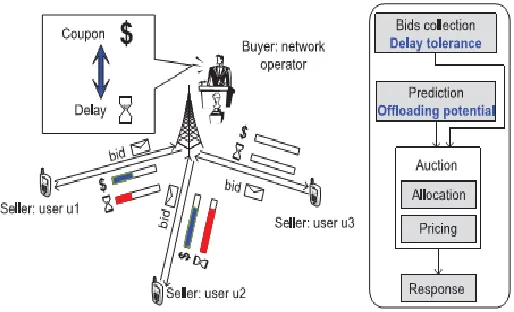
1. Big Picture: By considering the users’ delay tolerance and offloading potential, Win-Coupon uses a reverse auction based incentive mechanism to motivate users to help cellular traffic offloading. The network operator acts as the buyer, who offers coupons to users in exchange for them to wait for some time and opportunistically offload the traffic. When users request data, they are motivated to send bids along with their request messages to the network operator. Each bid includes the information of how long the user is willing to wait and how much coupon he wants to obtain as a return for the extra delay. Then, the network operator infers users’ delay tolerance. In addition, users’ offloading potential should also be considered when deciding the auction outcome. Based on the historical system parameters collected, such as users’ data access and mobility patterns, their future value can be predicted by conducting network modeling, and then based on the information, users’ offloading potential can be predicted.
During the delay period, u1 may retrieve some data pieces from other intermittently available networks, for example, by contacting other peers that cache the data or moves into the wireless range of APs. Once delay t passes, the cellular network pushes the remaining data pieces to u1 to assure the promised delay. The losing bidders immediately download data via cellular network at the original price.
Figure 1: Flow of Win-Coupon
2. User Delay Tolerance: With the users delay tolerance. To flexibly model users’ delay tolerance,
we introduce a satisfaction function S(f), which is a
monotonically decreasing function of delay t, and
represents the price that the user is willing to pay for the data service with the delay. The satisfaction function is deter- mined by the user himself, his requested data, and various environmental factors. We assume that each user has an upper bound of delay tolerance for each data. Once the delay reaches the bound, the user’s satisfaction becomes zero, indicating that the user is not willing to pay
for the data service. The satisfaction function S(t)
of a specific user for a specific data, where tbound
is the upper bound of the user’s delay tolerance, p
is the original charge for the data service, and the satisfaction curve represents the user’s expected price for the data as the delay increases. For
example, with delay t1 the user is only willing to
pay p1 instead of p. p p1 is the satisfaction loss
caused by delay t1.
International Journal of Research (IJR)
e-ISSN: 2348-6848, p- ISSN: 2348-795X Volume 2, Issue 08, August 2015Available at http://internationaljournalofresearch.org
involves a single buyer and multiple sellers, and the buyer decides its purchase based on the bids sent by the sellers. To begin with, we introduce some notations: Bid(bi): It is submitted by bidder i to express i’s valuation on the resource for sale, which is not necessarily true. Private value(xi): It is the true valuation made by bidder i for the resources, i.e., the true price that i wants to obtain for selling the resource. This value is only known by i. Market-clearing price (pi): It is the price actually paid by the buyer to bidder i. This price cannot be less than the bids submitted by i. Utility(ui): It is the residual worth of the sold resource for bidder i, namely the difference between i’s market-clearing price pi and private value xi. The bidders in the auction are assumed to be rational and risk neutral. A common requirement for auction design is the so-called individual rationality.
4. Bidding: To obtain coupon, the users attach bids with their data requests to reveal their delay tolerance. For each user, the upper bound tbound of its delay tolerance can be viewed as the resources that it wants to sell. The user can divide tbound into multiple time units, and submit multiple bids b = {b1, b2, ··· , bl } to indicate the value of coupon it wants to obtain for each additional time unit of delay, where l equals tbound e, and e is the length of one time unit. By receiving these bids, the network operator knows that the user wants to obtain coupon with value no less than ki k=1 bk by waiting for ki time units. The length of time unit e can be flexibly determined by the network operator. Shorter time unit results in larger bids with more information, which increases the performance of the auction, but it also induces more communication overhead and higher computational complexity. To simplify the presentation, in the rest of the paper delay t is normalized by time unit e.
5. Auction Algorithms: Win-Coupon is run periodically in each auction round. Usually, the auction would result in an extra delay for the
bidders to wait for the auction outcome. However, different from other long-term auctions, such as the FCC-style spectrum leasing, the auction round in our scenario is very short, since hundreds of users may request cellular data service at the same time. Also, because the bidders who are willing to submit bids are supposed to have a certain degree of delay tolerance, the extra delay caused by auction can be neglected. Next, we describe two main steps of the auction allocation and pricing.
a. Allocation: In traditional reverse auction, the allocation solution is purely decided by the bids; i.e., the bidders who bid the lowest price win the game in our scenario, besides the bids that express the bidders’ delay tolerance, the offloading potential of the bidders should also be considered. Let ft1; t2; ... ; tjN jg represent the allocation solution, where ti denotes the length of delay that network operator wants to buy from bidder i. Note that because each bidder is asked to wait for integer multiples of time unit, ti is an integer. If ti equals zero, bidder loses the game the allocation problem in Win-Coupon can be formulated.
International Journal of Research (IJR)
e-ISSN: 2348-6848, p- ISSN: 2348-795X Volume 2, Issue 08, August 2015Available at http://internationaljournalofresearch.org
“opportunity cost” that its presence introduces to others It is proved that this pricing algorithm provides bidders with the incentives to set their bids truthfully. Based on the basic idea, in our pricing algorithm, the network operator also pays bidder i the coupon with value equal to the “opportunity cost” exerted to all the other bidders due to presence
IV. Conclusion
We propose a new incentive structure known as Win-Coupon, on the basis of reverse auction, to motivate users to control their delay tolerance in support of traffic offloading that possess advantageous properties such as reliability, individual rationality, and low computational difficulty. By means of considering user delay tolerance as well as offloading potential, the projected structure of Win-Coupon employs a reverse auction based incentive method to motivate users to assist cellular traffic offloading.
REFERENCES
[1] P. Chou, Y. Wu, and K. Jain, “Practical Network Coding,” Proc. Ann. Allerton Conf. Comm., Control, and Computing, 2003.
[2] M.R. Ra, J. Paek, A.B. Sharma, R. Govindan, M.H. Krieger, and M.J. Neely, “Energy-Delay Tradeoffs in Smartphone Applications,” Proc. ACM
MobiSys, 2010.
[3] P. Cramton, “Spectrum Auctions,” Handbook of Telecommunications Economics, pp. 605-639, Elsevier Science, 2002.
[4] P. Xu, S. Wang, and X. Li, “SALSA: Strategyproof Online Spectrum Admissions for Wireless Networks,” IEEE Trans. Computers, vol. 59, no. 12, pp. 1691-1702, Dec. 2010.
[5] C. Boldrini, M. Conti, and A. Passarella, “Modelling Data Dissemination in Opportunistic Networks,” Proc. ACM Third Workshop Challenged Networks (CHANTS), 2008.
[6] P. Costa, C. Mascolo, M. Musolesi, and G. Picco, “Socially Aware Routing for Publish Subscribe in Delay-Tolerant Mobile Ad Hoc Networks,” IEEE J. Selected Areas in Comm., vol. 26, no. 5, pp. 748- 760, June 2008.
[7] W. Gao, Q. Li, B. Zhao, and G. Cao, “Multicasting in Delay Tolerant Networks: A Social Network Perspective,” Proc. ACM MobiHoc, 2009.
[8] A.J. Nicholson and B.D. Noble, “Breadcrumbs: Forecasting Mobile Connectivity,” Proc. ACM MobiCom, 2008.
[9] M.R. Ra, J. Paek, A.B. Sharma, R. Govindan, M.H. Krieger, and M.J. Neely, “Energy-Delay Tradeoffs in Smartphone Applications,” Proc. ACM MobiSys, 2010.
[10] P. Cramton, “Spectrum Auctions,” Handbook of Telecommunications Economics, pp. 605-639, Elsevier Science, 2002.
[11] X. Zhuo, W. Gao, G. Cao, Y. Dai,"Win-coupon: An incentive framework for 3g traffic offloading", In Proc. of IEEE ICNP, 2011.
[12] Cisco Systems Inc.,"Cisco visual networking index: Global mobile data traffic forecast update", pp. 2011-2016, 2012.
[13] S. Gaonkar, J. Li, R.R. Choudhury, L. Cox, A. Schmidt, "Micro-Blog: Sharing and Querying Content through Mobile Phones and Social Participation", Proc. ACM MobiSys, pp. 174-186, June 2008.
[14] N. Ristanovic, J.-Y.L. Boudec, A. Chaintreau, and V. Erramilli, “Energy Efficient Offloading of 3G Networks,” Proc. IEEE Eighth Int’l Conf. Mobile Ad-Hoc and Sensor Systems (MASS), 2011.