Group key exchange protocols withstanding ephemeral-key reveals
Mar´ıa Isabel Gonz´alez Vasco
∗, Angel L. P´erez del Pozo
Dpto. de Matem´atica Aplicada, Universidad Rey Juan Carlos
C/ Tulip´an s/n. 28933, M´ostoles, Madrid, Spain{mariaisabel.vasco, angel.perez}@urjc.es
Adriana Suarez Corona
Departamento de Matem´aticas, Universidad de Le´on
Escuela de Ingenier´ıas Industrial e Inform´atica
Campus de Vegazana, s/n, 24071 Le´on, Spain
December 20, 2016
Abstract
When a group key exchange protocol is executed, the session key is typically extracted from two types of secrets; long-term keys (for authentication) and freshly generated (often random) values. The leakage of this latter so-called ephemeral keyshas been extensively analyzed in the 2-party case, yet very few works are concerned with it in the group setting. We provide a generic group key exchange construction that is strongly secure, meaning that the attacker is allowed to learn both long-term and ephemeral keys (but not both from the same participant, as this would trivially disclose the session key). Our design can be seen as a compiler, in the sense that it builds on a 2-party key exchange protocol which is strongly secure and transforms it into a strongly secure group key exchange protocol by adding only one extra round of communication. When applied to an existing 2-party protocol from Bergsma et al., the result is a 2-round group key exchange protocol which is strongly secure in the standard model, thus yielding the first construction with this property.
1
Introduction
Group key establishment (GKE) protocols are a fundamental cryptographic building block allowingn≥2participants to agree upon a common secret key. It is usually assumed that these participants hold bothlong-termsecrets, which are typically used for authentication andephemeralsecrets, which are session-specific randomly generated values that provide enough entropy for the key to be indistinguishable from random in some sense.
The way to define and handle key privacy in GKE is highly dependent on the amount of information the adversary is supposed to obtain from the two types of secrets described above. In the literature, leakage of ephemeral secrets is often modeled through aRevealStateoracle, which when invoked by the adversary outputs eitherephemeral keysas described above or a larger set containing them, typically referred to as thefull stateof the attacked user. Unfortunately, as first pointed out by Cremers in [16], the meaning offull stateis scarcely defined within the security model and often the output of the corresponding oracle calls is only made explicit when proving particular protocols secure. Generally speaking, ephemeral key leakage refers to the exposure of user-generated fresh randomness, while full state compromise involves in addition other values computed/stored by the user —yet never any long-term keys.
Previous work. Strong securityfor GKE protocols was first considered in [9]. As it is also the case with subsequent proposals dealing with this type of leakage [8, 24, 26], in this paper it is assumed that the adversary can not access any ephemeral secretof the attacked session.
In order to subsume a wider class of attacks, other works have removed this restriction excluding only reveals of boththe ephemeral and long-term secrets of the same user (as, in this case, the session key would be trivially disclosed). Some examples of secure proposals along these lines are the NAXOS protocol [35] in the 2-party setting and [36, 20] for the case of3users. In the general multi-user group setting Zhao et al. [42] modified a protocol by Bohli et al. [6] to obtain strong security. This proposal was however found flawed in [14] where an improvement was proposed, which is proven secure in the random oracle model.
Many of these previous works have in common that the access to the ephemeral secrets is modelled granting the adversary aRevealStateoracle, which, when queried, outputs the contents of a variablestatelinked to the execution. As pointed out by Cremers [16], the security in these models is highly dependent on how thestatevariable is defined for each concrete protocol. In addition Cremers shows that the NAXOS protocol, proven secure in the model with a different formalism (namely, defining a so-calledRevealEphemeralKey oracle), is insecure when more powerful state reveals are allowed. Also in this spirit, in a recent work from PKC2015, Bergsma et al. [5] present a generic 1-round 2-party key exchange construction in the standard model. The authors also propose a strong security model which builds on previous ones and captures both perfect forward secrecy and ephemeral secrets leakage. The latter is modeled by aRevealRandoracle which outputs the local randomness selected by the user in a protocol execution.
Our contributions. We propose a security model for GKE capturing the leakage of ephemeral secrets even within the attacked session. To avoid any ambiguity we define, in the line of [5] in the 2-party setting, a variablerandthat stores, for each instance of a participant, all the session values that cannot be computed from long-term secret keys or other values received/computed previously in the session. Typically these values are chosen uniformly at random from a prescribed set, therefore the name of the variable. The adversary is given access to an oracleRevealRandwhich outputs the values stored inrandwhen queried. The strength of our security model is comparable to that of [42], yet in their treatment ephemeral values involved in the authentication procedure are not included inrandas they are in our case.1
In addition, the main contribution of this work is a generic protocol orcompiler that, building on any strongly secure 2-party authenticated key exchange (AKE) protocol, produces a group AKE which is strongly secure in our model, by adding only one round of communication.2 Further, we highlight that:
• Our construction is the first to expressly take into account the randomness used for authentication. We do so by expliciting that the nonces involved in any signature produced are part of therandvariable linked to the signing instance, and therefore allowing the adversary to obtain these values. This improves previous works, such us [14, 42] where the random values for the signature are supposed to be protected or absent (by using a deterministic signature).
• When instantiated with a 1-round 2-party protocol strongly secure in the standard model, for instance [5], our compiler produces a 2-round GKE which is strongly secure in the standard mode. This scheme is the first construction achieving such strong security guarantees in only two communication rounds.
2
Security Model
2.1
Description and strong security
Our security model is a modification of that of Bohli et al [6], which in turn builds in [4, 3, 33]. Furthemore, we treat
1Actually, as evidenced in [41], the scheme proposed in [42] cannot be proven secure otherwise. We remark here however that in [41] no augmented security notion for group key agreement is put forward along this line. In particular, the scheme of Zhao et al. [42] attacked in this paper is not proven to be secure if (as suggested by the authors) the underlying signature scheme resists randomness leakage.
2A preliminary version of this generic protocol can be found in the short abstract [23], where no security proof is provided and mutual authentication is not considered.
ephemeral reveals in a similar way as [42, 14].3
Protocol instances. Users are modeled as probabilistic polynomial time (ppt) Turing machines. Each user from a set
U of possible participants may execute a polynomial number of protocolinstancesin parallel. To refer to instancesi
of a userUi∈ Uwe use the notationΠsii(i, si∈N). To each instance we assign seven variables, informally described
next:
• usedsi
i indicates whether this instance is or has been used for a protocol run;
• statesi
i keeps the internal state of the Turing machine that executes the protocol;
• randsi
i keeps the session-specific atomic secret values —typically values generated uniformly at random—
which will be referred to asephemeral keys. More precisely, these are any values that cannot be computed from long-term secret keys or other values received/computed previously in the session;
• termsi
i shows if the execution has terminated;
• sidsi
i denotes a session identifier;
• pidsi
i stores the set of identities of those users thatΠ si
i aims at establishing a key with —includingUihimself;
• accsi
i indicates if the user accepted the session key;
• sksi
i stores the session key once it is accepted byΠ si i .
Communication network. Arbitrary point-to-point connections among the users are assumed to be available. The network is non-private, however, and fully asynchronous. More specifically, it is controlled by the adversary, who may delay, insert and delete messages at will.
Adversarial capabilities.We restrict to ppt adversaries. The capabilities of an adversaryAare made explicit through a number oforaclesallowingAto communicate with protocol instances run by the users:
• Send(Ui, si, M)This sends messageM to the instanceΠsii and returns the reply generated by this instance. If
Aqueries this oracle with an unused instanceΠsi
i andM ⊆ U, a set of identities of principals, theused si i -flag
is set,pidsi
i initialized withpid si
i :={Ui} ∪M, and the initial protocol message ofΠsii is returned.
• Execute({Πsu1 u1 , . . . ,Π
suµ
uµ })This executes a complete protocol run among the specified unused instances of
the respective users. The adversary obtains a transcript of all messages sent over the network. A query to the
Executeoracle is supposed to reflect a passive eavesdropping.
• Reveal(Ui, si)Yields the session keysksiialong with the session identifiersid si i .
• Test(Ui, si)Provided that the session key is defined (i. e.accsii=trueandsk si
i 6=⊥) and instanceΠ si i is fresh
(we define freshness later on),Acan execute this oracle query at any time when being activated. Then, the session keysksi
i is returned ifb= 0and a uniformly chosen random session key is returned ifb= 1, wherebis
a hidden bit chosen at random prior to the first call. Namely, an arbitrary number ofTestqueries is allowed for the adversaryA, but once theTestoracle returned a value for an instanceΠsi
i , it will return the same value for
all instances partnered (see the definition of partnering bellow) withΠsi i .4
• RevealRand(Ui, si)This oracle returns the value stored inrandsii.
• Corrupt(Ui)This oracle returns the long term key hold byUi.
3Interpreting theirRevealEphemeralSecretoracle as equivalent to ourRevealRand, which is not the only possible interpretation.
Remark 2.1 Following [25], we say that theinstanceΠsi
i isuncorruptedifAhas not made a callRevealRand(Ui, si)
previously (this notion is relevant when introducing so-calledmutual authentication, see bellow). On the other hand, we say userUiishonestoruncorruptedifAhas not made a callCorrupt(Ui)previously. Note that despite userUi
being corrupted, it can well be the case that an instanceΠsi
i remains uncorrupted.
We aim at two basic goals for our protocol: correctness and strong security. A protocol is correct if all users involved in an execution in the presence of a passive adversary compute the same session key. Our notion of strong security ensures key privacy in the presence of an active adversary which is given access to all the oracles we have described. Before formally defining correctness and strong security, we introducepartneringandfreshness, to express which instances are associated in a common protocol session and limit when the adversary is allowed to call theTest
oracle.
Partnering.We refer to instancesΠsi i ,Π
sj
j as beingpartneredif
sidsi i =sid
sj j ,pid
si i =pid
sj
j andacc si i =acc
sj
j =true.
Freshness.ATest-query should only be allowed to those instances holding a key that is not for trivial reasons known to the adversary. To this aim, an instanceΠsi
i is calledfreshif
• accsi i =true;
• Anever calledReveal(Uj, sj)withΠsiiandΠ sj
j being partnered;
• ifΠsi i andΠ
sj
j are partnered andAcalledCorrupt(Uj),then any message sent toΠsii on behalf ofΠ sj j must
indeed come fromΠsj
j intended toΠ si i ;
• Anever called bothCorrupt(Uj)andRevealRand(Uj, sj)withΠsiiandΠ sj
j being partnered.
Remark 2.2 Note that each user is, in particular, partnered with itself in our definition. Therefore, if an instanceΠsi i
is fresh, thenReveal(Ui, si)cannot have been queried, neither bothCorrupt(Ui)andRevealRand(Ui, si).
Definition 2.3 (Correctness) We call a group key establishment protocolP correct, if in the presence of a passive adversaryA—i. e.,Amust not use theSendoracle— the following holds: for alli, jwithsidsi
i =sid sj j ,pid
si i =pid
sj j
andaccsi i =acc
sj
j =true, we have
sksi i =sk
sj
j 6=null.
Definition 2.4 (Strong security) LetAbe an adversary making at mostqsandqequeries to theSendandExecute
oracles respectively. Letk ∈ Nbe the security parameter and denote bySuccA(k, qs, qe) the probability thatA
queriesTestonly on fresh instances and guesses correctly the bitbused by theTestoracle in a moment when all these instances are still fresh.
We say a group key establishment protocol is(qs, qe)-strongly secureif the advantageAdvA−SGAKE(k, qs, qe)of
any ppt adversaryAin attacking the protocol is bounded by another functionAdvSGAKE(k, qs, qe)which is negligible
ink, where the aforementioned advantage is defined as
AdvA−SGAKE(k, qs, qe) :=k2·SuccA(k, qs, qe)−1.k
Note that our definition provides a strong notion of key privacy, includingperfect forward secrecy[27, 18] and resistance tokey compromise impersonation (KCI) attacksagainst key privacy [25]:
Perfect forward secrecy. An adversary getting the long-term key of a user should not gain any information on the session keys previously established by that user. Our definition captures perfect forward secrecy, since an adversary
Ais allowed to obtain the long-term keys of all users without violating freshness, provided he does not send any “relevant” messages after having received these long-term keys.
Key compromise impersonation resilience (against key privacy). An adversary is said toimpersonatea userB to another userAifB is honest and the protocol instance atAaccepts the session withBas one of his session peers, but there is no such partnered instance atB. An adversaryAis considered successful in mounting akey compromise impersonation(KCI) attack knowing a userA’s long-term private key if he manages to impersonate an honest party B toA. As pointed out in [25], when the goal of the adversary is to break the confidentiality of the session key, it only makes sense to consider an outsideradversary (see also [25] for precise definitions of outsiderandinsider adversaries). Our security definition takes this kind of attacks into account, since ifΠsi
i is theTestsession thenUi
may be corrupted (although the adversary cannot be active with respect to a partnerΠsj j ofΠ
si
i without violating
freshness).
2.2
Further security properties
In addition to key privacy, several other security requirements such asunknown key-share resilience,key confirmation,
explicit key authenticationandmutual authenticationare desirable for a group key exchange protocol. All of them are covered by the notion ofMA-security[10], which was enhanced in [25] to deal with outsider and insider KCI attacks. Here we adopt the stronger one, MA-security with insider KCIR (key compromise impersonation resilience), yet slightly modifying the definition given in [25] as we considerRevealRandinstead ofRevealStatequeries.
Definition 2.5 (MA-security with insider KCIR) Consider an adversary A against the MA-security of a correct GKE protocol, namely, A is allowed to querySend,Execute, RevealRand,Reveal andCorrupt oracles. ThenA
is said to violate theMA propertyif at some point, there exist an uncorrupted instanceΠsi
i (althoughUi may be
corrupted) that has accepted withsksi
i and another partyUj ∈pidsii that is uncorrupted at the timeΠ si
i accepts such
that
• there is no instanceΠsj
j with(pid sj j ,sid
sj
j ) = (pid si i ,sid
si i ),or
• there is an instance with(pidsj j ,sid
sj
j ) = (pid si i ,sid
si
i )that has accepted withsk sj j 6=sk
si i .
Let us denote bySuccmaA(k)the success probability of any ppt adversaryAviolating the MA property. Then, we say a group key establishment providesMA-security in the presence of insidersifSuccmaA(k)is negligible in the security parameterk.
3
Proposal of a secure protocol
3.1
Signatures withstanding randomness reveals
Our proposal of a secure protocol will make use of a signature scheme for authentication. As our security model allows the adversary to access the random coins involved in a protocol execution by means of the oracleRevealRand, we assume that this oracle also outputs the randomness used for signing (if any). Note that this issue was mentioned in [14] but not considered in the proposed construction, as the authors suggest using a trusted device to protect this value or a deterministic signature scheme. As evidenced in [41], the security of this scheme is jeopardized if such precautions are not taken.
We are thus in need of stronger security guarantees, and therefore introduce a security notion for signature schemes, which we callexistential unforgeability under adaptive chosen message and randomness reveal attacks(EUF-CMRA), capturing the property of remaining secure even if the randomness used when signing is leaked. This notion is iden-tical tounforgeability under adaptive chosen message attacks and ephemeral secret leakage attacks securitydefined independently by Tseng et al in [41]5.
Before providing the definition, let us recap some terminology. A public key signature schemeSis explicited by three algorithms(KeyGen,Sign,Verify), whereKeyGen, on input the security parameter, outputs a pair(vk, sigk),
the public verification key and the secret signing key respectively;Signoutputs a signatureσ=Sign(sigk, m, sigr)
wheremis the signed message andsigris a random value chosen from an appropriate set every timeSignis invoked. Further, Verify is the (publicly available) verification algorithm. Note that we are considering thatSigntakes the random coinssigras explicit input: this covers probabilistic and deterministic signature schemes; for the later we allowsigrto be the empty string.
Now the standard security definition for signature schemes, i.e. existential unforgeability under adaptive chosen message attacks (EUF-CMA), is strengthened by giving the adversary access to a more powerful oracle, that also provides the randomness used when generating the signature. More formally, the adversaryAwill play the following game (EUF-CMRA, fromexistential unforgeability under adaptive chosen message and randomness reveal attacks):
1.(vk, sigk)is generated withKeyGenandvkis provided toA;
2. the adversary is given access to a signing oracleOsigk(.)such that, every time a messagemjis queried, a random
valuesigrjis chosen as specified in the signing algorithm, a signatureσj=Sign(sigk, mj, sigrj)is generated
and(σj, sigrj) =Osigk(mj)is returned toA;
3. after adaptively querying the oracle,Aoutputs a pair(m, σ).
We say thatAwins the EUF-CMRAgame if mhas not been queried toOsigk(.)andσis a valid signature for
m. LetAdvA−EUF-CMRA(k, q)denote the probability that an adversaryA, making at mostqcalls to the signing oracle
Osigk(.),wins theEUF-CMRAgame when the security parameter isk.
Definition 3.1 (EUF-CMRAsecurity) The signature schemeS isq-existentially unforgeable under adaptive chosen message and randomness reveal attacks (q−EUF-CMRA) if for every probabilistic polynomial time adversary A
making at most q calls to the signing oracle, the function AdvA−EUF-CMRA(k, q) is bounded by another function
AdvEUF-CMRA(k, q)which is negligible in the security parameterk.
Remark 3.2 This security notion is trivially achieved ifSis aEUF-CMAsignature scheme which is either determin-istic or such that the randomness is part of the signature.
As pointed out in [40], in many existing signature schemes, the randomness is generated in the signing phase and provided to the verifier as part of the signature. For instance, signature schemes in [7, 12, 13, 15, 19, 22, 28, 29, 30, 37, 39, 43] fulfill this property and, therefore satisfy ourEUF-CMRAsecurity notion.
3.2
Collision resistant pseudorandom function families
In our construction we use a pseudorandom function (PRF) familyF = {F`} `∈N,F
` = {F
α}α∈{0,1}`, which has
the additional property of beingcollision resistant(see, for example, [32]). Next we recall the definition. Consider the game where an elementv`in the domain of all functions inF`,is chosen according to a randomized sampling
algorithm and given to an adversaryA.6 The adversary is also given access to an oracleF(.)(v`)and is said to win
the game if it outputs a pair of indexesα6=α0 ∈ {0,1}`such thatF
α(v`) =Fα0(v`), without having queried both indexes to the oracle. We denote byAdvA-COLL-PRF(`, q)the probability that an adversaryA, making at mostqqueries
to the oracle, wins the game.
Definition 3.3 The PRF familyF = {F`}
`∈N isq-collision resistantif for every probabilistic polynomial time ad-versaryAmaking at mostqcalls to the evaluation oracle, the functionAdvA-COLL-PRF(`, q)is bounded by another
functionAdvCOLL-PRF(`, q)which is negligible in`.
In addition and for subsequent use in our security statements, we will denote byAdvPRF(`, q)the function which
upper bounds the advantage of any adversary trying to distinguish a function inF`from a random one (making at 6For simplicity, we may assume all functions inF`to have the same domain{0,1}r`and range{0,1}κ`,withr
`, κ`polynomial in`.
mostqqueries to the function oracle). Note that, due to the PRF property of the familyF,AdvPRF(`, q)is negligible
in the security parameter`.
In our design, we will use a family of universal hash functionsU H = {U H`}`∈N,such that, for a given` ∈N
every function inU H`maps bitstrings of a fixed sizet`onto{0,1}`. The familyU Hwill be used to select an index
within a collision-resistant pseudorandom function familyF = {F`}
`∈N. In the sequel, both parameters`andt`
are assumed to be sufficiently large and polynomial in the security parameterk.Due to the universal property of the familyU H, the probability of any functionUH∈ U H`producing the same output with two different inputs is at most
1/2t` (see, for instance, [38]).
3.3
From 2-Party to group keeping strong security
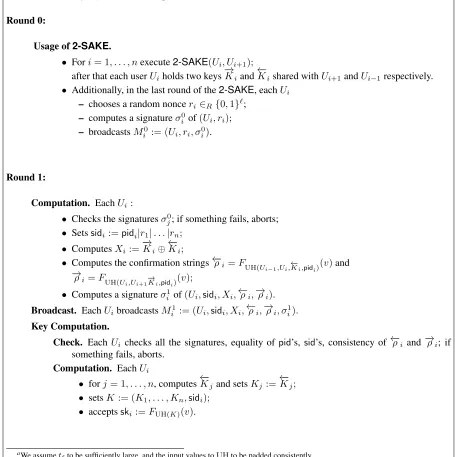
In this section we present a one-round compiler, which applied to a strongly secure 2-party key exchange2-SAKE yields a strongly secure group key exchange, adding only one communication round. Our construction does not involve any idealized assumption, thus if the2-SAKEis in the standard model, so will the resultingn-party protocol be.
Our design is detailed in Figure 1, where theSet upphase can be realized by means of a public key infraestructure (PKI) —and should thus be assumed to involve a trusted entity. At this, users are supposed to be somewhat organized in a cycle (a la Burmester-Desmedt, see [11]); thus, user indicesiare to be taken modulon.Note that we further assume that there might beindependentauthentication keys used for the 2-party and group setting, namely, the compiler will call for (freshly generated) signing keys for a dedicated signature scheme (which we will denote by(vki, sigki)) while
we also explicit each user may have generated a pair of long-term keys(2pki,2ski)for2-SAKE.7
Before moving on to the security statements let us specify how theRevealRandandCorruptoracles work for the compiled scheme. A queryCorrupt(Uj)is answered with the long-term secret key(2ski, sigki)ofUi. A query RevealRand(Ui, si)returns(−→ri,←−ri, ri, sigr0i, sigri1)where→−ri,←−riare the random coins used in the two executions
of the2-SAKE, ri is the random nonce used in Round 1 of the compiler, andsigrij, forj = 0,1 are the nonces
involved in the two signatures enforced by the compiler. Now it is easy to argue thatRevealRandis not useful for the adversary, and thus the strong security of our scheme follows. Indeed,RevealRand(Ui)returns:
a) the randomness used byUiin the2-SAKEprotocol, which is of no use for the adversary due to the strong security
of2-SAKE;
b) the signing noncessigr0i, sigr1i, which will also be useless if the signature scheme is secure in the sense of EUF-CMRA;
c) the nonceri,which is anyway public, as it is broadcast in Round 1.
Theorem 3.4 AssumingSis anEUF-CMRAsignature scheme,2-SAKEis strongly secure,Fis a collision-resistant PRF andU His a universal hash function family, the protocol from Figure 1 is correct and strongly secure.
More precisely, letkand`be as in the protocol specification from Figure 1. Then, for any probabilistic polynomial time adversaryAmaking at mostqscalls to theSendoracle andqecalls to theExecuteoracle,AdvA−SGAKE(k, qs, qe)
is upper bounded by
(nqe+qs)2
2`+1 +nAdvEUF-CMRA(k,2qe+qs)+
+ 1
2t`(nqe+
qs
2) +AdvCOLL-PRF(`,3nqe+qs)+
+2·Adv2-SAKE(k, qs, nqe) +AdvPRF(`,3nqe+qs),
whereAdv2-SAKE(·,·,·)is the advantage in regard to2-SAKE,specified as in Definition 2.4 andt`is polynomial
ink.
Set up:
Fix`∈Npolynomial in the security parameterk. LetU Hbe a family of universal hash functions ranging
in{0,1}`andFbe a collision-resistant pseudorandom function family.
A functionUH :{0,1}t` 7→ {0,1}`fromU H
`and a description ofF`are made public together with a
valuevin the domain of all functions fromF`.a
We assume all users to know a priori their partners and have set the variablepidaccordingly.
Furthermore, a pair of keys(vki, sigki)for the signature schemeSis generated for eachUi,which gets
the secret keysigkiwhilevkiis publicized.
Round 0:
Usage of2-SAKE.
• Fori= 1, . . . , nexecute2-SAKE(Ui, Ui+1); after that each userUiholds two keys
− →
Kiand
←−
Kishared withUi+1andUi−1respectively.
• Additionally, in the last round of the2-SAKE, eachUi
– chooses a random nonceri∈R{0,1}`;
– computes a signatureσi0of(Ui, ri);
– broadcastsMi0:= (Ui, ri, σi0).
Round 1:
Computation. EachUi:
• Checks the signaturesσ0
j; if something fails, aborts;
• Setssidi:=pidi|r1|. . .|rn;
• ComputesXi:=
− →
Ki⊕
←−
Ki;
• Computes the confirmation strings←−ρi =FUH(U i−1,Ui,
←− Ki,pidi)
(v)and
− →ρ
i =FUH(U i,Ui+1
− → Ki,pidi)
(v);
• Computes a signatureσi1of(Ui,sidi, Xi,←−ρi,−→ρi).
Broadcast. EachUibroadcastsMi1:= (Ui,sidi, Xi,←−ρi,−→ρi, σ1i).
Key Computation.
Check. Each Ui checks all the signatures, equality of pid’s,sid’s, consistency of←−ρi and−→ρi; if
something fails, aborts.
Computation. EachUi
• forj= 1, . . . , n, computes←K−jand setsKj :=
←−
Kj;
• setsK:= (K1, . . . , Kn,sidi);
• acceptsski:=FUH(K)(v).
aWe assumet
`to be sufficiently large, and the input values toUHto be padded consistently.
PROOF. Checking the correctness of the protocol is straightforward: if all the participants follow the protocol description and there is no active adversarial intervention, then all checks will succeed and every participant will set the same pidandsid, obtain the same{Kj}jn=1 from the broadcast{Xj}nj=1 and consequently compute the same session key.
The proof for the strong security is conducted through a sequence of games. Following standard notation, we denote byAdv(A, Gi)the advantage of the adversary when confronted with Gamei.The security parameter is denoted
byk.Further, in the sequel we letqeandqsdenote the maximum number of calls made by the adversary to theExecute
andSendoracles (resp.).
Game 0. All the oracles are simulated as in the real protocol; thus,Adv(A, G0)is exactlyAdvA−SGAKE(k, qs, qe)as
in the definition of strong security from Section 2.
Game 1.This game is identical to Game 0, except that the execution is aborted if the eventRepeatoccurs. This is defined to happen if an uncorrupted participant chooses in Round 0 a noncerithat was previously used by an oracle
of some principal.
Asqeandqsdenote the maximum number of calls to theExecuteandSendoracles respectively, the number of
nonces generated by honest users during the game is at mostnqe+qs. Therefore the probability ofRepeatis upper
bounded by the probability of collision when choosingnqe+qsvalues among2`possible ones, which is in turn upper
bounded by(nqe+qs)2/(2·2`)(see, for example, appendix A.4 in [31]). As a result,
|Adv(A, G0)−Adv(A, G1)| ≤ P(Repeat)≤
(nqe+qs)2
2`+1 .
Game 2.This is identical to Game 1, except that now the execution is aborted if the adversary succeeds in forging an authenticated messageMkσfor participantUiwithout having queriedCorrupt(Ui)and whereM was not output
by any ofUi’s instances. Let us call this eventForge.
Indeed, an adversaryAthat can reachForgecan be used for forging a signature in aEUF-CMRAgame: the given public key is assigned randomly to one of thenusers in the group and all other parties are initialized following the protocol specification; then all the queries in thestrong securitygame are answered faithfully and whenever a signature for a message of the selected user is needed, the signing oracle of theEUF-CMRAgame is queried to produce the signature. Note that the number of such queries is upper bounded by2qe+qs.
The probability of the adversary choosing the “right” userUiwhen assigning the public key for the signature equals
1/n, therefore we haveAdvEUF-CMRA(k,2qe+qs)≥ 1n P(Forge)which yields
|Adv(A, G1)−Adv(A, G2)| ≤P(Forge)
P(Forge)≤nAdvEUF-CMRA(k,2qe+qs).
Game 3. In this game, we impose that a fresh instanceΠti
i does not accept in Round 1 whenever it receives a
messageMj1not generated by the respective instanceΠtj
j ,j 6=iin the same session. At this, we take two instances
Πtα0 α0 ,Π
tαr
αr for being in thesame session, if there is a sequence of instances (Π tαµ
αµ )0≤µ≤r such that for eachµ =
0, . . . , r−1the instancesΠtααµµ andΠ tαµ+1
αµ+1 have jointly executed2-SAKE, hold two noncesrαµ andrαµ+1 linked
to this execution8and, furthermore, they all hold the samepid(namely,pidα
0 =· · ·=pidαr). The adversaryAcan
detect the difference to Game 2 ifAreplayed or fabricated a message that should have led to acceptance in Round 1 in that game. Since all messages broadcasted in Round 1 must contain the signed nonceri(as part of the signedsidi)
and we excluded already the eventsForgeandRepeat, games 2 and 3 are identical forA.As a result Adv(A, G3) =Adv(A, G2).
8Implicitly, the pair of nonces(r
Game 4. In this game, we impose that a fresh instanceΠti
i does not accept the session key in Round 1 whenever
two instancesΠtj j andΠ
tj+1
j+1 in the same session (as above) which have jointly executed2-SAKEand hold matching noncesrj andrj+1linked to this execution hold however non-matching two party keys9. Let us denote this event by Coll.
Due to the modifications made in Game 3, in a fresh session every message must have been generated according to the specification of the protocol. Therefore the eventCollhappens only if there are two instancesΠtj
j andΠ tj+1
j+1 such that
− →
Kj 6=
←−
Kj+1but−→ρj=←−ρj+1(as otherwise the involved instances would not accept).
LetUH be the function chosen at the beginning of the protocol and denote by−→αi = UH(Ui, Ui+1,
− →
Ki,pidi)and
←α−
i = UH(Ui−1, Ui,
←−
Ki,pidi). Taking into account how→−ρi,←−ρi,
− →
Ki and
←−
Kiare defined, it is clear that the event Collhappens only if one of the two following events happen:
• Coll1, which is the event that during the security game there exist instancesΠtj j andΠ
tj+1
j+1 such that
− →
Kj6=
←−
Kj+1 but−→αj=←α−j+1.
• Coll2, which is the event that during the security game there exists instancesΠtj j andΠ
tj+1
j+1 such that
− →
Kj 6=
←−
Kj+1,−→αj 6=←α−j+1but−→ρj =←−ρj+1.
Because of the universal property of the family U H, the probability of UH producing the same output with two different inputs is at most1/2t`.
In addition the number of possible pairs of nonces generated during the security game is upper bounded bynqe+q2s.
As a result,
P(Coll1)≤ 1 2t`(nqe+
qs
2).
On the other hand, an adversaryAwhich produces the eventColl2can be used to construct an adversary against the collision resistance of the pseudo-random familyF. The reason is that, in caseColl2happens, then two different indexes−→αj 6=←α−j+1 have been found such thatF−→αj(v) = F←α−j+1(v). As the functionF(.)(v)is invoked at most
3nqe+qstimes during the game, it holds that
P(Coll2)≤AdvCOLL-PRF(`,3nqe+qs).
Putting everything together we have
|Adv(A, G3)−Adv(A, G4)| is bounded by
P(Coll)≤P(Coll1) +P(Coll2)
and thus by
1
2t`(nqe+
qs
2) +AdvCOLL-PRF(`,3nqe+qs).
Game 5. The simulation of theSendandExecuteoracles is modified in the following way. For everyi= 1, . . . , n, whenever an instanceΠti
i is still considered fresh at the end of Round 0, and the two party keys
− →
Kiand
←−
Kiare defined,
they are replaced with random values chosen from the appropriate set. This replacement is done consistently, in the sense that, if−→Kiand
←−
Kicoincide with
←−
Ki+1and
− →
Ki−1respectively, they are replaced with matching random values.
9As2-SAKEis only assumed to have implicit key confirmation, it is not excluded that two users enrolled in an execution end up with different – thus useless – keys
In order to bound the distance betweenG3andG4we will build, from an adversaryAwhich is able to distinguish between these two games, another adversaryBattacking the underlying2-SAKEprotocol such that
|Adv(A, G4)−Adv(A, G5)|= 2·AdvB−2-SAKE(k, qsB, qBe),
whereAdvB−2-SAKE(k, qsB, qBe)denotes the advantage of a probabilistic polynomial time adversaryBattacking2-SAKE
and making at mostqB
s calls to theSendoracle andqeBcalls to theExecuteoracle.
To prove this bound, assume thatB, which runsAas an auxiliary algorithm, is given access to a simulation of 2-SAKE. Further,Bexecutes the key generation algorithm ofSfor each userUi,thus retrieving a pair of
correspond-ing signcorrespond-ing keys(vki, sigki).
Now, whenever an instanceΠsi
i is used byAas the input of a query,Bassociates it with two different independent
instancesΠ2si−1
i andΠ
2si
i of the same user in the2-SAKEprotocol.
Also a listL, storing the returned random noncesri, is needed to answer the queries ofA. More precisely, the
first time a random nonceriis required to answer aRevealRandA,ExecuteAorSendAquery involving instanceΠsi, a
random valueriis chosen u.a.r. from the appropriate set and(Ui, s, ri)is stored inL. Whenever this value is needed
again to answer a query, it is extracted fromL. Similarly,Bmaintains a list for the signing noncesSigL,where he stores appropiately generated randomness involved in any of the signatures that might be involved in the simulation.
Now let us describe how the answers to the queries ofAare constructed:
• Whenever a queryCorruptA(Ui)is made,BqueriesCorruptB(Ui)to retrieve2skiand provides (2ski, sigki)
as answer toA.
• To answer a queryRevealRandA(Ui, si),BexecutesRevealRandB with the two associated instancesΠ2isi−1
andΠ2si
i , obtaining
− →r
iand←−ri. Then choosesriu.a.r. from the appropriate set (or extracts it fromLif needed)
and similarly generates signing nonces forS, r1
i andr2i or retrieves them from theSigLlist.
• To answer anExecuteA query, Bqueries ExecuteB with the corresponding pairs of instances to construct a transcript for Round 0. Then makesTestBqueries to obtain the keys
− →
Kiand
←−
Kifor every user and constructs
the rest of the transcript for Round 1 and 2 as it would be done in a real execution of the protocol, taking random values fromLandSigLas needed.
• To answer aSendAquery for Round 0, a querySendB is executed byBwith the associated instances and the same responses are returned. If theSendA query is for Round 1, firstB sets the values of
− →
Ki and
←−
Ki by
querying one of the oraclesTestBorRevealB(depending on whether the involved instance is fresh according to our definition, and thus allows to queryTestB, or not). The rest of the answer is generated as in the description of theExecuteAanswer.
• ARevealAquery is answered in a similar way as aSendAorExecuteAquery.
• Finally, to answer allowedTestAqueries, a bitb0∈ {0,1}is chosen byBat the beginning of the simulation. If b0= 1a random group key is returned while ifb0= 0an actual key, constructed consistently with the rest of the simulation, is returned.
At some pointAwill output a bitb00 as a guess forb0 which will determine the outputbofB for the2-SAKE challenge. Namely,Boutputsb= 0if and only ifb0 =b00. Taking into account that the view ofAis identical toG4 if the answers ofTestBare real keys and toG5if the answers ofTestBare random ones, and countingqsB ≤qsand
qBe ≤nqe,we have that
|Adv(A, G4)−Adv(A, G5)| is bounded by
Game 6. In this game, for everyi= 1, . . . , n, the valueski :=FUH(K)(v)is replaced with a random value chosen from{0,1}κ`. As by nowK:= (K
1, . . . , Kn,sidi), and all theKi have been chosen u.a.r. in this game, the output
ofFUH(K)is, due to the pseudorandomness property ofF,distinguishable from a random value only with negligible probability in`(which is polynomial ink). More precisely we have,
|Adv(A, G6)−Adv(A, G5)| ≤AdvPRF(`,3nqe+qs).
In addition, the advantage of the adversary in G6 equals 0, as the secret keys are chosen u.a.r. in{0,1}κ`. This concludes the proof.
2
3.4
MA-security
In this section we show our protocol satisfies MA-security with insider KCIR. For the shake of simplicity, we have chosen to formulate the security statement only in terms of the security parameter and not use the number of oracle calls. Further, we provide only a proof sketch, as a detailed one would repeat many of the arguments already specified above in the proof of Theorem 3.4.
Theorem 3.5 AssumingSis anEUF-CMRAsignature scheme, the protocol from Figure 1 satisfies MA-security with insider KCIR.
PROOF’S SKETCH. This result may be obtained by “game hopping”, letting the adversaryAmainteract with a
simu-lator:
Game 0.In this game, the simulator faithfully simulates all protocol participants’ instances for the adversaryAma,
i. e., the adversary’s situation is the same as in the real model:
AdvGame 0Ama (k) =AdvAma(k) =Succ ma
A(k).
Game 1. This game is aborted if the eventsForgeorRepeat, as described in the previous proof, occur. Other-wise, the game is identical to Game 0 and the adversary cannot detect the difference. The distance between the success probabilities ofG0andG1is bounded byP(Forge) +P(Repeat), which is negligible in the security parameterk.
LetΠsi
i be an uncorrupted instance that has accepted. Notice that once these events have been eliminated, all the
honest parties inpidsi
i compute the same key:
LetUj∈pidsiia user that is not corrupted at the timeΠ si
i accepts. If the eventsForgeandRepeatdo not occur,
sinceΠsi
i has checked succesfully the equality of the session and partner identifiers, there is an instanceΠ sj
j such that
(sidsi i ,pid
si
i ) = (sid sj j ,pid
sj
j ). Therefore, for the adversary to win the MA game, the session keys accepted should
be different. However, if the instance accepted, in particularUjsuccessfully checked the confirmation strings←−ρj+1 and−→ρj−1for his left and right two-party keys respectively. This meansKjandKj+1have been computed correctly, except with negligible probability, since F is chosen from F, a collision-resistant pseudorandom function family. Then, from the valuesXlsent by the other users inpidsii, and the rest of the confirmation strings, one can be sure,
with overwhelming probability, that allKlcomputed byUiandUjare equal. Therefore, both users compute the same
session key.
Putting the probabilities together we recognize the adversary’s advantage in the real model as negligible.
2
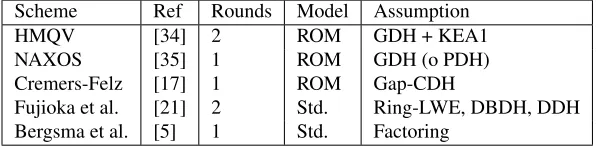
Scheme Ref Rounds Model Assumption
HMQV [34] 2 ROM GDH + KEA1
NAXOS [35] 1 ROM GDH (o PDH) Cremers-Felz [17] 1 ROM Gap-CDH
Fujioka et al. [21] 2 Std. Ring-LWE, DBDH, DDH Bergsma et al. [5] 1 Std. Factoring
Table 1: Examples of recent2-SAKEprotocols
Scheme Ref Assumption
Boneh-Boyen [7] Strong DH for bilinear groups Camenisch-Lysyanskaya [12] Strong RSA
Fischlin [19] Strong RSA
Hofheinz-Kiltz [28] Strong RSA / q-Strong DH for bilinear groups Hohenberger-Waters [30] RSA
Table 2: Examples ofEUF-CMRAsignature schemes
4
Concrete Implementations
In this section we propose several options to instantiate our compiler. Some possible choices for the two-party2-SAKE scheme and theEUF-CMRAsignature scheme are enumerated in Tables 1 and 2.
It is worth pointing out that every signature scheme in Table 2 is secure in the standard model. In addition, [7, 12, 19] provide strong EUF-CMA; however this property is not needed for the security of our proposal, thus [28, 30] are also suitable choices.
When a one-round2-SAKEsecure in the standard model, such as [5], is combined with any signature scheme in Table 2, the result of applying our compiler is a two-round group key exchange protocol which is strongly secure and MA-secure in our model. To the best of our knowledge, this is the first two-round group key establishment protocol with security proofs in a model considering randomness leakage in the attacked session, which does not make use of random oracles. In addition, if the choice for the signature scheme is [30], the security of the compiled two-round protocol depends only on the well-known RSA assumption.
M.I. Gonz´alez Vasco and Angel L. P´erez del Pozo are partially supported by research project MTM2013-41426-R, and A. Su´arez Corona is supported by MTM2013-45588-C3-1-P, both funded by the Spanish MINECO.
References
[1] Michel Abdalla, Jens-Matthias Bohli, Maria Isabel Gonzalez Vasco, and Rainer Steinwandt. (Password) authen-ticated key establishment: From 2-party to group. In Salil P. Vadhan, editor,Theory of Cryptography, 4th Theory of Cryptography Conference, TCC 2007, Amsterdam, The Netherlands, February 21-24, 2007, Proceedings, volume 4392 ofLecture Notes in Computer Science, pages 499–514. Springer, 2007.
[2] Michel Abdalla, Pierre-Alain Fouque, and David Pointcheval. Password-based authenticated key exchange in the three-party setting. In Serge Vaudenay, editor, Public Key Cryptography - PKC 2005, 8th International Workshop on Theory and Practice in Public Key Cryptography, Les Diablerets, Switzerland, January 23-26, 2005, Proceedings, volume 3386 ofLecture Notes in Computer Science, pages 65–84. Springer, 2005.
[4] Mihir Bellare and Phillip Rogaway. Entitiy Authentication and Key Distribution. In Douglas R. Stinson, editor,
Advances in Cryptology – CRYPTO ’93, volume 773 ofLecture Notes in Computer Science, pages 232–249. Springer, 1994.
[5] Florian Bergsma, Tibor Jager, and J¨org Schwenk. One-round key exchange with strong security: An efficient and generic construction in the standard model. In Jonathan Katz, editor,Public-Key Cryptography - PKC 2015 - 18th IACR International Conference on Practice and Theory in Public-Key Cryptography, Gaithersburg, MD, USA, March 30 - April 1, 2015, Proceedings, volume 9020 ofLecture Notes in Computer Science, pages 477–494. Springer, 2015.
[6] Jens-Matthias Bohli, Maria Isabel Gonzalez Vasco, and Rainer Steinwandt. Secure group key establishment revisited.Int. J. Inf. Sec., 6(4):243–254, 2007.
[7] Dan Boneh and Xavier Boyen. Short signatures without random oracles and the SDH assumption in bilinear groups.J. Cryptology, 21(2):149–177, 2008.
[8] Timo Brecher, Emmanuel Bresson, and Mark Manulis. Fully robust tree-diffie-hellman group key exchange. In Juan A. Garay, Atsuko Miyaji, and Akira Otsuka, editors,Cryptology and Network Security, 8th International Conference, CANS 2009, Kanazawa, Japan, December 12-14, 2009. Proceedings, volume 5888 ofLecture Notes in Computer Science, pages 478–497. Springer, 2009.
[9] Emmanuel Bresson and Mark Manulis. Securing group key exchange against strong corruptions. In Masayuki Abe and Virgil D. Gligor, editors,Proceedings of the 2008 ACM Symposium on Information, Computer and Communications Security, ASIACCS 2008, Tokyo, Japan, March 18-20, 2008, pages 249–260. ACM, 2008.
[10] Emmanuel Bresson, Mark Manulis, and J¨org Schwenk. On security models and compilers for group key ex-change protocols. In Atsuko Miyaji, Hiroaki Kikuchi, and Kai Rannenberg, editors,Advances in Information and Computer Security, Second International Workshop on Security, IWSEC 2007, Nara, Japan, October 29-31, 2007, Proceedings, volume 4752 ofLecture Notes in Computer Science, pages 292–307. Springer, 2007.
[11] Mike Burmester and Yvo Desmedt. A Secure and Efficient Conference Key Distribution System. In Alfredo De Santis, editor,Advances in Cryptology – EUROCRYPT’94, volume 950 ofLecture Notes in Computer Science, pages 275–286. Springer, 1995.
[12] Jan Camenisch and Anna Lysyanskaya. A signature scheme with efficient protocols. In Stelvio Cimato, Clemente Galdi, and Giuseppe Persiano, editors,Security in Communication Networks, Third International Conference, SCN 2002, Amalfi, Italy, September 11-13, 2002. Revised Papers, volume 2576 ofLecture Notes in Computer Science, pages 268–289. Springer, 2002.
[13] Jan Camenisch and Anna Lysyanskaya. Signature schemes and anonymous credentials from bilinear maps. In Matthew K. Franklin, editor,Advances in Cryptology - CRYPTO 2004, 24th Annual International Cryptology-Conference, Santa Barbara, California, USA, August 15-19, 2004, Proceedings, volume 3152 ofLecture Notes in Computer Science, pages 56–72. Springer, 2004.
[14] Cheng Chen, Yanfei Guo, and Rui Zhang. Group key exchange resilient to leakage of ephemeral secret keys with strong contributiveness. In Sabrina De Capitani di Vimercati and Chris Mitchell, editors,Public Key Infrastruc-tures, Services and Applications - 9th European Workshop, EuroPKI 2012, Pisa, Italy, September 13-14, 2012, Revised Selected Papers, volume 7868 ofLecture Notes in Computer Science, pages 17–36. Springer, 2012.
[15] Ronald Cramer and Victor Shoup. Signature schemes based on the strong RSA assumption. ACM Trans. Inf. Syst. Secur., 3(3):161–185, 2000.
[16] Cas J. F. Cremers. Session-state reveal is stronger than ephemeral key reveal: Attacking the NAXOS au-thenticated key exchange protocol. In Michel Abdalla, David Pointcheval, Pierre-Alain Fouque, and Damien Vergnaud, editors, Applied Cryptography and Network Security, 7th International Conference, ACNS 2009, Paris-Rocquencourt, France, June 2-5, 2009. Proceedings, volume 5536 ofLecture Notes in Computer Science, pages 20–33, 2009.
[17] Cas J. F. Cremers and Michele Feltz. One-round strongly secure key exchange with perfect forward secrecy and deniability.IACR Cryptology ePrint Archive, 2011:300, 2011.
[18] Whitfield Diffie, Paul C. van Oorschot, and Michael J. Wiener. Authentication and authenticated key exchanges.
Des. Codes Cryptography, 2(2):107–125, 1992.
[19] Marc Fischlin. The cramer-shoup strong-rsa signature scheme revisited. IACR Cryptology ePrint Archive, 2002:17, 2002.
[20] Atsushi Fujioka, Mark Manulis, Koutarou Suzuki, and Berkant Ustaoglu. Sufficient condition for ephemeral key-leakage resilient tripartite key exchange. In Willy Susilo, Yi Mu, and Jennifer Seberry, editors,Information Security and Privacy - 17th Australasian Conference, ACISP 2012, Wollongong, NSW, Australia, July 9-11, 2012. Proceedings, volume 7372 ofLecture Notes in Computer Science, pages 15–28. Springer, 2012.
[21] Atsushi Fujioka, Koutarou Suzuki, Keita Xagawa, and Kazuki Yoneyama. Strongly secure authenticated key exchange from factoring, codes, and lattices.Des. Codes Cryptography, 76(3):469–504, 2015.
[22] Rosario Gennaro, Shai Halevi, and Tal Rabin. Secure hash-and-sign signatures without the random oracle. In Jacques Stern, editor,Advances in Cryptology - EUROCRYPT ’99, International Conference on the Theory and Application of Cryptographic Techniques, Prague, Czech Republic, May 2-6, 1999, Proceeding, volume 1592 of
Lecture Notes in Computer Science, pages 123–139. Springer, 1999.
[23] Maria Isabel Gonz´alez-Vasco, ´Angel L. P´erez del Pozo, and Adriana Su´arez-Corona. Thwarting randomness reveals in group key agreement. In Jes´us Vigo-Aguiar, editor,Proceedings of the 16th International Conference
on Computational and Mathematical Methods in Science and Engineering, CMMSE 2016, volume 2, pages
606–614, 2016.
[24] M. Choudary Gorantla, Colin Boyd, Juan Manuel Gonz´alez Nieto, and Mark Manulis. Generic one round group key exchange in the standard model. In Dong Hoon Lee and Seokhie Hong, editors,Information, Security and Cryptology - ICISC 2009, 12th International Conference, Seoul, Korea, December 2-4, 2009, Revised Selected Papers, volume 5984 ofLecture Notes in Computer Science, pages 1–15. Springer, 2009.
[25] M. Choudary Gorantla, Colin Boyd, Juan Manuel Gonz´alez Nieto, and Mark Manulis. Modeling key compromise impersonation attacks on group key exchange protocols.ACM Trans. Inf. Syst. Secur., 14(4):28, 2011.
[26] M.Choudary Gorantla, Colin Boyd, and JuanManuel Gonzlez Nieto. Modeling key compromise impersonation attacks on group key exchange protocols. In Stanisaw Jarecki and Gene Tsudik, editors,Public Key Cryptography PKC 2009, volume 5443 ofLecture Notes in Computer Science, pages 105–123. Springer Berlin Heidelberg, 2009.
[27] Christoph G. G¨unther. An identity-based key-exchange protocol. In Jean-Jacques Quisquater and Joos Van-dewalle, editors,Advances in Cryptology - EUROCRYPT ’89, Workshop on the Theory and Application of of Cryptographic Techniques, Houthalen, Belgium, April 10-13, 1989, Proceedings, volume 434 ofLecture Notes in Computer Science, pages 29–37. Springer, 1989.
[29] Susan Hohenberger and Brent Waters. Realizing hash-and-sign signatures under standard assumptions. In An-toine Joux, editor,Advances in Cryptology - EUROCRYPT 2009, 28th Annual International Conference on the Theory and Applications of Cryptographic Techniques, Cologne, Germany, April 26-30, 2009. Proceedings, vol-ume 5479 ofLecture Notes in Computer Science, pages 333–350. Springer, 2009.
[30] Susan Hohenberger and Brent Waters. Short and stateless signatures from the RSA assumption. In Shai Halevi, editor,Advances in Cryptology - CRYPTO 2009, 29th Annual International Cryptology Conference, Santa Bar-bara, CA, USA, August 16-20, 2009. Proceedings, volume 5677 ofLecture Notes in Computer Science, pages 654–670. Springer, 2009.
[31] Jonathan Katz and Yehuda Lindell. Introduction to Modern Cryptography (Chapman & Hall/Crc Cryptography and Network Security Series). Chapman & Hall/CRC, 2007.
[32] Jonathan Katz and Ji Sun Shin. Modeling insider attacks on group key-exchange protocols. In Vijay Atluri, Catherine A. Meadows, and Ari Juels, editors, Proceedings of the 12th ACM Conference on Computer and Communications Security, CCS 2005, Alexandria, VA, USA, November 7-11, 2005, pages 180–189. ACM, 2005.
[33] Jonathan Katz and Moti Yung. Scalable Protocols for Authenticated Group Key Exchange. In Dan Boneh, editor,
Advances in Cryptology — CRYPTO’03, volume 2729 ofLecture Notes in Computer Science, pages 110–125. Springer, 2003.
[34] Hugo Krawczyk. HMQV: A high-performance secure diffie-hellman protocol. In Victor Shoup, editor,Advances in Cryptology - CRYPTO 2005: 25th Annual International Cryptology Conference, Santa Barbara, California, USA, August 14-18, 2005, Proceedings, volume 3621 ofLecture Notes in Computer Science, pages 546–566. Springer, 2005.
[35] Brian A. LaMacchia, Kristin E. Lauter, and Anton Mityagin. Stronger security of authenticated key exchange. In Willy Susilo, Joseph K. Liu, and Yi Mu, editors,Provable Security, First International Conference, ProvSec 2007, Wollongong, Australia, November 1-2, 2007, Proceedings, volume 4784 ofLecture Notes in Computer Science, pages 1–16. Springer, 2007.
[36] Mark Manulis, Koutarou Suzuki, and Berkant Ustaoglu. Modeling leakage of ephemeral secrets in tripar-tite/group key exchange.IEICE Transactions, 96-A(1):101–110, 2013.
[37] David Naccache, David Pointcheval, and Jacques Stern. Twin signatures: an alternative to the hash-and-sign paradigm. In Michael K. Reiter and Pierangela Samarati, editors, CCS 2001, Proceedings of the 8th ACM Conference on Computer and Communications Security, Philadelphia, Pennsylvania, USA, November 6-8, 2001., pages 20–27. ACM, 2001.
[38] Moni Naor and Moti Yung. Universal one-way hash functions and their cryptographic applications. In David S. Johnson, editor,Proceedings of the 21st Annual ACM Symposium on Theory of Computing, May 14-17, 1989, Seattle, Washigton, USA, pages 33–43. ACM, 1989.
[39] Sven Sch¨age. Twin signature schemes, revisited. In Josef Pieprzyk and Fangguo Zhang, editors,Provable Se-curity, Third International Conference, ProvSec 2009, Guangzhou, China, November 11-13, 2009. Proceedings, volume 5848 ofLecture Notes in Computer Science, pages 104–117. Springer, 2009.
[40] Sven Sch¨age. Strong security from probabilistic signature schemes. In Marc Fischlin, Johannes A. Buchmann, and Mark Manulis, editors,Public Key Cryptography - PKC 2012 - 15th International Conference on Practice and Theory in Public Key Cryptography, Darmstadt, Germany, May 21-23, 2012. Proceedings, volume 7293 of
Lecture Notes in Computer Science, pages 84–101. Springer, 2012.
[41] Yuh-Min Tseng, Tung-Tso Tsai, and Sen-Shan Huang. Enhancement on strongly secure group key agreement.
Security and Communication Networks, 8(2):126–135, 2015. SCN-13-0353.R1.
[42] Jianjie Zhao, Dawu Gu, and M. Choudary Gorantla. Stronger security model of group key agreement. In Bruce S. N. Cheung, Lucas Chi Kwong Hui, Ravi S. Sandhu, and Duncan S. Wong, editors,Proceedings of the 6th ACM Symposium on Information, Computer and Communications Security, ASIACCS 2011, Hong Kong, China, March 22-24, 2011, pages 435–440. ACM, 2011.