REPRESENTATION OF MULTI-CONNECTED SYSTEM OF FUZZY STATE SPACE MODELING (FSSM) IN POTENTIAL METHOD BASED ON A
NETWORK CONTEXT
JIBRIL AMINU
.
REPRESENTATION OF MULTI-CONNECTED SYSTEM OF FUZZY STATE SPACE MODELING (FSSM) IN POTENTIAL METHOD BASED ON A
NETWORK CONTEXT
JANUARY 2017 Faculty of Science Universiti Teknologi Malaysia
A dissertation submitted in fulfillment of the requirements for the award of the degree of
iii
For Him who always give me strength And
iv
All thanks and praise is due to the almighty Allah (SWT). Our creator, the sustainer and the owner of the universe, Master of the day of reckoning. May His bountiful and endless blessing be onto our noble Prophet Muhammad (S.A.W), members of his household, his Sahabas and all that follow his teaching up to the day of Judgement.
I am greatly indebted to my supervisor Prof. Dr. Tahir Ahmad of the Mathematical Science Department, Universiti Teknologi Malaysia, whose patience, useful criticism and meaningful suggestions were of great inspiration.
May I use this opportunity to recognise some of my lecturers with reference to Prof. Dr. Nor Haniza Sarmin, PM Dr. Shamsuddin Ahmad, Prof. Dr. Zainal Abdul Aziz, Dr. Zaitul Marlizawati Zainuddin, Dr. Shazirawati Mohd Puzi, etc. for their kind and Eveready guidance throughout my graduate studies.
I wish to express my sincere gratitude, thanks and appreciation to Kaduna State Government for awarding me among others, the Kaduna State oversees scholarship scheme award. My thanks also go to the scholarship committee members for their time and the great work.
I am highly obliged to my parent, brothers and sisters, family and friends and colleagues for their endless prayer.
Thank you all.
v
The complexity of a system of Fuzzy State Space Modeling (FSSM) is the reason that leads to the main objective of this research. A multi-connected system of Fuzzy State Space Model is made up of several components, each of which performs a function. These components are interconnected in some manner and determine how the overall system operates. In this study, we study the concept of graph, network system and network projections which are the requisite knowledge to potential method. Finally, the multi-connected system of FSSM of type A Namely Feeder, Common feeder and greatest common feeder are transformed into potential method using various method of transformation.
vi
Pemodelan Ruang Keadaan Kabur (FSSM) adalah sangat kompleks serta membawa kepada objektif utama kajian ini. Suatu sistem Pemodelan Ruang Keadaan Kabur multi-terkait terdiri daripada beberapa komponen. Setiap komponen tersebut mempunyai fungsi yang ditentukan. Komponen ini saling terkait serta menentukan bagaimana keseluruhan sistem itu beroperasi. Dalam penyelidikan ini, konsep graf, sistem rangkaian dan unjuran rangkaian dikaji. Konsep-konsep ini diperlukan bagi memahami kaedah potensi. Yang terakhir, sistem pelbagai sambungan FSSM jernis A yang dinamakan Masukkan, Masukkan Biasa dan Masukkan Terbesar ditukarkan kepada kaedah potensi dengan menggunakan kaedah penukaran yang pelbagai.
vii
TABLE OF CONTENTS
CHAPTER TITLE PAGE
DEDICATION iii
ACKNOWLEDGEMENT iv
ABSTRACT v
ABSTRAK vi
TABLE OF CONTENTS vii
LIST OF TABLES x
LIST OF FIGURES xi
LIST OF ABBREVATIONS xiii
1 INTRODUCTION 1
1.1 Background of the Study 1
1.2 Problem Statement 6
1.3 Objectives of the Study 6
1.4 Scope of this Study 7
1.5 Significances of this Study 7
1.6 Thesis Structure and Organization 7
2 FUZZY STATE SPACE MODELING 9
2.1 Introduction 9
viii
2.3 Fuzzy Set Operation 13
2.4 Fuzzy Systems 15
2.5 Fuzzy Modeling 16
2.6 FSSM in Multi-connected Systems 17
2.7 Algebraic View of Systems of FSSM 19
2.7.1 Relations 20
2.7.2 Divisibility 21
3 POTENTIAL METHOD 24
3.1 Introduction 24
3.2 Some Basic Definitions of Graph 25
3.2.1 Edge Directions 27
3.2.2 Degree of a Vertex 28
3.3 Network System 29
3.3.1 Two-Mode Network 30
3.3.2 Network Projection 32
3.3.3 Types of Network Projections 32
3.4 Potential Method 34
4 POTENTIAL METHOD FOR MULTI-CONNECTED SYSTEM OF
FUZZY STATE SPACE MODELING 39
4.1 Introduction 39
4.2 Systems of Fuzzy State Space Model (FSSM) 39
4.3 Potential Method 43
4.4 Potential Method for Multi-Connected System of Fuzzy State
Space Model 43
ix 4.4.2 Network and Multi-Connected Fuzzy State Space Systems
45
4.5 Summary 54
5 CONCLUSION 55
5.1 Introduction 55
5.2 Conclusion 55
5.3 Recommendations 56
x
LIST OF TABLES
TABLE NO. TITLE PAGE
xi
LIST OF FIGURES
FIGURE NO. TITLE PAGE
1.1 Mathematical Model of a System 3
1.2 State space representation of a system 5
2.1 Diagram of membership function 11
2.2 Union of Fuzzy Sets A and B 13
2.3 Intersection of Fuzzy Sets A and B 14
2.4 Complement of Fuzzy Set A 14
2.5 Block diagram of a Fuzzy System 15
2.6 An example of a simple multi-connected system 18
2.7 Multi-connected systems of type A 18
2.8 Multi-connected systems of type B 19
2.9 𝑆𝑔𝐹1is a feeder of 𝑆𝑔𝐹2 22
2.10 𝑆𝑔𝐹 is a common feeder of 𝑆𝑔𝐹1 and 𝑆𝑔𝐹2 22 2.11 𝑆𝐹𝐹 is the greatest common feeder of 𝑆𝑔𝐹1 and 𝑆𝑔𝐹2 23
3.1 Line Drawings of a Graph A and a Graph B 25
3.2 A simple Directed graph 27
3.3 A Simple Diagraph with Directed Arcs 28
3.4 Example of a Network System 29
3.5 An example of Two-mode network of FSSM 31
3.6 A Simple Directed graph G 37
3.7 Incidence matrix B of the Directed graph G 37 4.1 Multi-connected systems of type A 41
4.2 Multi-connected systems of type B 41
xii
4.4 Common Feeder 42
4.5 Greatest Common Feeders 42
4.6 Two-mode network system of a feeder 46
4.7 Two-mode network of a common feeder 47
4.8 Two-mode network of a greatest common feeder 48
4.9 The projected network of Feeder after projection 51 4.10 The projected network of Common Feeder after
projection 52
4.11 The projected network of Greatest Common Feeder after
xiii
LIST OF ABBREVATIONS
𝑈 - Universe of Discourse or universal set 𝐴, 𝐵, 𝐶, 𝑋, … - Arbitrary set
𝜇𝐴(𝑥) - Membership function for set A {𝑥1, 𝑥2, 𝑥3, … } - Set of elements 𝑥1, 𝑥2, 𝑥3, … 𝑎, 𝑏, 𝑐, … - Elements of arbitrary sets 𝑆𝑢𝑝𝑝(𝐴) - Support of set A
𝐾 - Real number K
𝑟 - Least Upper Bound of K
𝑅 - Relation
𝑆𝑢𝑝 𝐾 - Supremum of K ℎ(𝐴) - Height of set A 𝑆𝑢𝑝 𝐴(𝑥) - Supremum of set A 𝐴 ∪ 𝐵 - Union of set A and B 𝐴 ∩ 𝐵 - Intersection of set A and B
𝐴̅ - Complement of A
∀ - For all
∈ - Element of or belong to
∉ - Not element of
Min - Minimum
Max - Maximum
𝑢̃(𝑡) - Fuzzified input vector 𝑦̃(𝑡) - Fuzzified output vector
𝐴𝑃𝑋𝑃 - State matrix A
xiv
𝐶𝑚𝑋𝑃 - Output matrix C
𝐵𝑒𝑋𝑣 - Incidence matrix
𝑆𝐺𝐹 - Collection of interconnected FSSM systems
𝑆𝑔𝐹 - Common feeder
𝑆𝐹𝐹 - Greatest common feeder
𝑋𝑋𝑋 - Cartesian product
~ - Equivalence
𝑎|𝑏 - a divide b
ℤ - The set of integers
ℝ - The set of real numbers
G - Graph
V - Set of vertices (or nodes)
E - Set of edges
deg(v) - Degree of vertex
𝑤𝑖𝑗 - Weight between node 𝑖 and node 𝑗
∑ - Summation
𝑝 - Number of mutualistic partner between node 𝑖 and node 𝑗
𝑁𝑝 - Number of Authors in paper 𝑝
𝛼 - arc of directed graphs
𝒜 - Set of arcs
CHAPTER 1
INTRODUCTION
1.1 Background of the Study
2 useful for another reason. Hence, it is important that the complex system made just right "resolution" without going into unnecessary details.
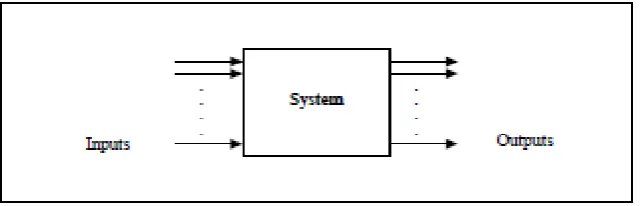
A system is a combination of variable components connected with each other and work together to perform a function (Paraskevopoulos, 2002). Lately, various efforts have been undertaken to synthesize and analyses the control systems in order to create a club approach to the system usually with multiple inputs and multiple outputs. One of the ways used is the state space analysis.
A System model is a model that explains the concept and representation of the system. The system can be described by differential equations including mechanical systems, electronic systems, thermodynamic system, hydraulic system or a chemical system, etc. In response to the input and output of the system, the differential equations can be solved and then, the characteristics of the system can be analysed. Model systems are needed to describe and represent all the various views.
System Modeling plays a vital role in different areas of Engineering (Ismail, 2005). The significant feature of modeling a system is the development of an input and output scheme that will describe behaviour of the system on the working range. Control System modeling is an area of specialization, more general to mathematical modeling. In addition, it provides an approach in modeling and operating the system, and determines the relationship between cause and effect of the input and output manipulation measures. In processing and analysing the system, two functions must perform; Modeling the System and solving for the response of the model. The foundation of establishing a model of the system is the physical laws of the elements of the system and the interconnection between them that must be hold.
3 Modeling is one of the most important tasks in control system design (Ismail, 2005). A model that can express the dynamics of a system correctly will lead to an appropriate controller design. Mathematical models of control systems are mathematical expressions which are describe by the relationships among system inputs, outputs and other inner variables. Establishing a mathematical model in describing a control system is the foundation for analysis and design of control systems. A mathematical model should reflect the dynamics of a control system and be suitable for analysis of the system. Thus, when we construct the model, we should simplify the problem to obtain the approximate model which satisfies the requirements of accuracy.
Figure 1.1: Mathematical Model of a System
Mathematical models of control systems can be established by theoretical analysis or practical experiments. The theoretical analysis method is to analyze the system according to physics or chemistry rules (such as Kirchhoff’s voltage laws for electrical systems, Newton’s laws for mechanical systems and Law of Thermodynamics). The experimental method is to approximate the system by the mathematical model according to the outputs of certain test input signals, which is also called system identification. System identification has been developed into an independent subject.
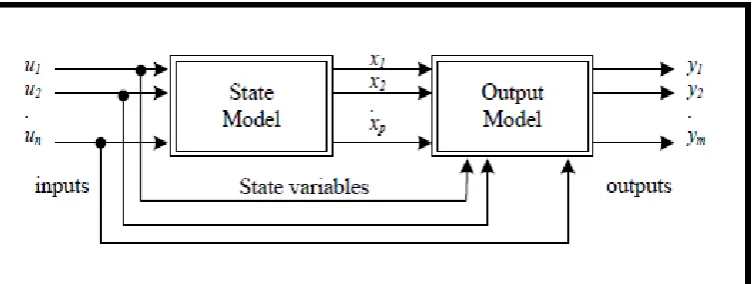
4 systems. The most obvious choice for this mathematical model in a lot of cases is the state space representation since the major part of modern system and control theory such as the design of observers, filters and optimal controllers regards this very efficient and compact representation. The state space models come from the state-space equations. State-state-space equation or simply state equation is a description in the time domain which may be applied to a very wide category of systems. This model has special theoretical, computational and practical importance for the following main reasons (Paraskevopoulos, 2002):
1. State equations can describe a large category of systems, such as linear and nonlinear systems, time-invariant and time-varying systems, systems with time delays, systems with nonzero initial conditions and others.
2. Due to the fact that state equations are a set of first-order differential equations, they can be easily programmed and simulated on both digital and analog computers.
3. State equations by their very nature greatly facilitate both in formulating and subsequently in investigating a great variety of properties in system theory such as stability, controllability and observability. They also facilitate the study of fundamental control problems, such as pole placement, optimal and stochastic control and adaptive and robust control.
5
Figure 1.2: State space representation of a system
A dynamic system consisting of a finite number of lumped elements may be described by ordinary differential equations in which time is the independent variable (Ogata, 2010). By use of vector-matrix notation, an nth-order differential equation may be expressed by a first order vector-matrix differential equation. If n elements of the vector are a set of state variables, then the vector-matrix differential equation is a state equation.
The development of the algorithm for FSSM is based on three phases of a fuzzy system; Fuzzification, fuzzy environment (Ahmad, 1998) and defuzzification. After which Ismail (2005) developed Fuzzy State Space Modeling FSSM
6 Our aim in this research is to study potential method in relation to multi-connected Fuzzy State Space Model using the potential link concept in Taufiq (2007). This will be achieved using network projection as discussed by Pedron et al (2011) and Opsahl (2013).
1.2 Problem Statement
The increasing significance of Fuzzy State Space Modeling (FSSM) in the field of mathematics and engineering have captured the research interest of many researchers across the globe. Although, few authors have applied FSSM in various methods. However, the presentation of FSSM to Potential Method (PM) has not been reported. Therefore, the present study aims at presenting Multi-connect Systems of Fuzzy State Space Model in PM based on a Network context.
1.3 Objectives of the Study
The main objectives of this research are:
1. To explore the concepts and some properties of potential method.
7 1.4 Scope of this Study
This research will focus on the study of the concepts of potential method and its relation base on multi-connected fuzzy state space systems of type 𝐴 presented by Taufiq (2007).
1.5 Significances of this Study
The significant of this research is to highlight the complexity of fuzzy state space modeling which is use to present potential method with regard to multi-connected Fuzzy State Space systems.
1.6 Thesis Structure and Organization
This dissertation is organized base on five chapters. Apart from this Chapter One, that discusses the background in fuzzy sets, systems and system models, mathematical modeling of a system as well as the state space modeling. The chapter also discusses the objective, implication and scope of this study.
8 Chapter Three will discusses the graph theory, network system and potential method which are the requisite knowledge to this research.
However, Chapter Four covers the main objective of this research. It started with the highlight of the system of multi-connected FSSM, the definition of Potential method as well as brief description of network projection methods. Then, the chapter presents the transformation of multi-connected system of FSSM of type 𝐴 base on potential method using the Binary projection method.
REFERENCES
Ahmad, T. (1998). Mathematical and Fuzzy Modeling of Interconnection in Integrated Circuit. Ph.D. Thesis, Sheffield Hallam University, Sheffield, U.K.
Taufiq A., K. (2007). Some Aspects of Number Theory Approach on the Multi-connect Systems of Fuzzy State Space Model. M. Sc Dissertation. Universiti Teknologi Malaysia.
Barabasi and Albert A. (1999). Emergence of Scaling in Random Networks. Science 286.5439: 509-512.
Borgatti, S. P., & Everett, M. G. (1997). Network analysis of 2-mode data. Social networks, 19(3), 243-269.
Caklovic, L. (2002). Decision Making via Potential Method. Preprint.
Caklovic, L. (2003). Graph Distance in Multicriteria Decision Making Context. Metodološki zvezki 19: 25-34.
Čaklović, L. (2009). An IO–Modification of Potential Method. Electronic Notes in Discrete Mathematics 33: 131-138.
Caklovic L, Šego V. (2002). Potential Method Applied on Exact Data. In Proceedings of 9th International Conference on Operational Research KOI:
58
Caklovic, L., and Hunjak, T. (2012). Measuring DMU-efficiency by modified cross-efficiency approach. Mathematical Communications. 17: 559–573
Ebel, Holger, Davidsen J., and Bornholdt S. (2002). Dynamics of Social Networks. Complexity 8.2: 24-27.
Ellison, R.J. et al. (1999). Survivable Network System Analysis: A Case Study. IEEE Softw. 16.4: 70-77.
Fraleigh, J., B., and Victor J., K. (2003). A First Course in Abstract Algebra. Boston: Addison-Wesley.
Hafiz, A., M., M., Abdul W., M., Faiza A., Ahmad W., Mohamed R., W. (2016). Two-Mode Network Modelling and Analysis of Dengue Epidemic Behaviour in Gombak, Malaysia. Applied Mathematical Modelling, doi: 10.1016/j.apm.2016.10.060
Gross, J. L. & Yellen, J. (2004). Handbook of graph theory. CRC press.
Ismail, R. (2005). Fuzzy State Space Modeling for Solving Inverse Problems of Multi-variable Dynamic Systems. PHD Thesis. Universiti Teknologi Malaysia, Skudai, Johor.
Klir, G. & Yuan, B. (1995). Fuzzy sets and fuzzy logic. Prentice hall New Jersey.
59
Newman, M. E. J. (2001). Scientific collaboration networks. II. Shortest paths, weighted networks, and centrality. Physical Review E, 64, 016132.
Newman, M. E. J. (2003). The Structure and Function of Complex Networks. SIAM Rev. 45.2: 167-256.
Ogata, K. (2010). Modern Control Engineering. Boston, MA: Prentice-Hall.
Opsahl, T. (2009). Projecting two-mode networks onto weighted one-mode networks. http://toreopsahl.com/2009/05/01/ projecting-two-mode-networks-onto-weighted-one-modenetworks.
Opsahl, T. (2013). Triadic Closure in Two-Mode Networks: Redefining the global and local clustering coefficients. Social Networks 35, doi: 10.1016/j.socnet.2011.07.001
Paraskevopoulos, P. N. (2002). Modern Control Engineering. New York: Marcel Dekker.
Padrón, B., Nogales, M., Traveset, A. (2011). Alternative approaches of transforming bimodal into unimodal mutualistic networks. The usefulness of preserving weighted information. Basic and Applied Ecology, 12(8), 713-721,
Phlippen, S., and Riccaboni M. (2007). Radical Innovation and Network Evolution. SSRN Electronic Journal n. pag.
60
Sugeno M. and Yasukawa T. (1993). A Fuzzy-Logic-Based Approach to Qualitative Modeling. IEEE Trans. Fuzzy Syst. 1.1: 7.
Takagi T. and Sugeno M. (1985). Fuzzy Identification of Systems and Its Applications to Modeling and Control. IEEE Transactions on Systems, Man, and Cybernetics SMC-15.1: 116-132.
Zadeh, L.A. (1965). Fuzzy Sets. Information and Control 8.3: 338-353.
Zadeh, L.A. (1973). Outline of a New Approach to the Analysis of Complex Systems and Decision Processes. IEEE Transactions on Systems, Man, and Cybernetics SMC-3.1: 28-44.