Towards an Architecture for Teaching
Virtues, Values and Ethics
Berise Thérèse Heasly
BEd (MCAE), BEdSt (Mel), MEd (Mel), GradDipTheol (MCD)
School of Education
Faculty of Arts, Education and Human Development
Victoria University, Melbourne, Australia
Submitted in fulfilment of the requirements of the degree of
Doctor of Philosophy
Abstract
In this thesis, I look towards a new architecture for teaching an eventual
curriculum about virtues, values and ethics. I address three sources of
research: the voices of teachers who are teaching thinking and thinking skills;
the authors who address the various themes and sub-themes emerging from
the thesis questions; and an auto-ethnographical retrospective, which marries
my experiential learning, formal qualifications and classroom experience.
The focus is on what has happened in education, what is best for teachers;
what can be gleaned from the experts’ voices, what consequently is helpful in
the curriculum, and what can be delivered by teachers to enrich students’
learning. Three leading twentieth -century theorists contribute to what counts
as virtues, values and ethics. Research findings, personal experiential
learning, formal qualifications and my own classroom instruments provide a
foundation from which to reach incrementally towards the architecture for
the teaching about virtues, values and ethics.
My theory of edu-tensegrity is derived from the architectural concept of
tensegrity, which uses tension and compression as a building strategy (e.g.,
London’s geodesic millennium dome; Melbourne’s soccer stadium); models
inductive thinking rather than deductive thinking; and employs dialectic,
trilectic and quadrilectic logics. Educationally, this applies to push-pull
factors in decision-making and moral agentry – for both teachers and
students. My conclusions show that such factors, labelled Categories of
Influence, model trilectic logic, necessarily present in the detailed responses,
response-abilities and responsibilities, that inform teachers’ planning,
execution and facilitation of the teaching of applied thinking skills: to
promote excellence and efficiency that builds architecture that will reach
Student Declaration
I, Berise Thérèse Heasly, declare that the PhD thesis entitled Towards an
Architecture for Teaching Virtues, Values and Ethics is no more than
100,000 words in length including quotes and exclusive of tables, figures,
appendices, bibliography, references and footnotes. This thesis contains no
material that has been submitted previously, in whole or in part, for the
award of any other academic degree or diploma. Except where otherwise
indicated, this thesis is my own work.
8 November 2012
Acknowledgements
I wish to acknowledge the following people, who have assisted me in this
journey of discovery:
• Professor Brenda Cherednichenko, Pro-Vice Chancellor (Arts and
Education) Deakin University, for her support, understanding and
early mentoring in my candidature;
• Dr. Anne Davies, Victoria University, for her patient and precise
supervision and technical support;
• Professor Constant Mews, Monash University, for his academic
support at crucial points of my academic journey;
• Roger Sutcliffe, SAPERE, UK, for his timely mentoring and
direction in my progress over a long career of study in
understanding the breadth of thinking skills and the teaching skills
to accomplish this aim;
• The late John Wilson, University of Oxford and Director of the
Farmington Trust, whose mentoring and academic insights
directed my learning in the Oxford University Department of
Educational Studies in 1990-1991 and beyond;
• The late Professor Matthew Lipman, USA, (and his Australian
associates), for personal direction, and whose Philosophy for
Children movement informed so much of my subsequent studies;
• Dr. Peter Vardy late of Heythrop College, London, (and his UK
and Australian associates) for the provision of so much for the
teaching of senior classes via the DialogueAustraliaNetwork
• Dr Rosalie Holian, then at RMIT Victoria, for academic consultation in the 1990s about direction in the compilation of the
Heasly Behaviour Uncertainty Grid;
• Scott Larritt- Evans for technical and ICT support for the geodesic
dome;
• Dr. Adrian Hubbard, for timely academic intervention in the
construction of my theory of Edu-Tensegrity;
• Adjunct Professor Ian Ling, Victoria University, for his erudite
and knowledgeable interventions and generous academic support
towards the close of my academic journey;
• Rev. Fr. Michael Elligate, University of Melbourne, for his
life-long friendship and insightful support in all theological,
psychological, literary and philosophical matters, over the span of
this academic journey and beyond;
• My son, Denis Heasly, for lengthy technical and academic
support during this long journey;
• My husband Bernard and my three daughters, Jane, Clare and
Sara, whose patience and forbearance I can never adequately
Table of Contents
Abstract ... i
Student Declaration ... ii
Acknowledgements ... iii
Table of Contents ... v
List of Figures ... i
List of Tables ... ii
Chapter 1 Finding the Questions ... 1
Introduction ... 1
The genesis of the research ... 1
Learning with Wilson, Lipman and Vardy ... 2
John Wilson 2 Matthew Lipman 3 Peter Vardy 4 The teaching of virtues, values and ethics ... 4
Ontological considerations, epistemological concerns and technical strategies ... 6
Constructing an integrative schema ... 7
Including virtues, values and ethics in the schema ... 8
Including the ontological, epistemological and technical aspects in the schema 8 Conducting research in a multi-faceted context ... 9
Reason for the thesis framework ... 11
Relevance to teachers of this research ... 11
New understandings from brain research ... 14
Students 14
Needs 16 Beginning my research ... 18
Learning the broad spectrum of philosophy ... 20
Planning the research enterprise ... 21
Aims of the research for teacher practice ... 21
Significance of the research and its contribution to new knowledge ... 22
Uncovering critical new knowledge ... 23
Looking forward 28
Chapter 2 Answering the Questions: Listening to Many Voices ... 29
Introduction ... 29
Taking a qualitative and quantitative approach ... 31
The different voices ... 33
Teachers’ voices 33 My practitioner voice 34 Voices from the literature 35 Three different data collection strategies ... 36
Questionnaire 36 Role of the questionnaire in the investigation ...36
The thinking behind the development of a Questionnaire ...38
The development of the Questionnaire ...40
Administering the questionnaire ...41
Auto-ethnography 42 Literature review 44 Analysis of data... 45
Hesitations, confusions, concerns and silences ... 47
My comprehensive analytical framework: two aims ... 48
Evaluation of all relevant criteria for this enterprise ... 49
Looking forward... 50
Chapter 3 52
Voices in the Literature: A Multi-Disciplinary Search ... 52
Introduction ... 52
Ontological considerations... 53
Virtues 53 Values 55 Spirituality and values ...56
Wisdom, concepts and values ...58
Neuroscience and its implications for education in the teaching-learning process ...60
Ethics 63 Epistemological concerns and consequences ... 66
Virtues 66 Values 69 The phenomenon of indoctrination ...71
The links between secular and religious values and beliefs ...72
Moral argument, the good life and values through reflection and resilience ...76
The links to the building of meaning and of attaining wisdom ...78
Shining the light on possible reshaped pedagogies ...83
Links between educational trail-blazers and the application of thinking skills ...84
Religious and secular pathways ...85
The growth of the Community of Inquiry ...87
Linking from values and virtues to ethical considerations ...88
Ethics 88 Links: Zigler, Dewey and education ...91
Ethics and brain-compatible learning ...94
Technical strategies ... 96
Virtues 96 Links between leadership, educational theory, pedagogy and thinking skills ...97
Understanding how the brain learns ...98
Values 100 The role of pedagogy: links between theorists, practitioners and experts ...102
Teachers’ reflective practices ...106
Ethics 107 Inserting the pedagogy of the Community of Inquiry ...108
Ethnographical Connections –broadening depth of My Voice ...110
Looking forward... ... 111
Chapter 4 Practitioner Voices: My Voice, Teachers’ Voices, and Experts’ Voices ... 112
Introduction ... 112
Questions and questioning ... 114
My practitioner voice ... 114
Teachers’ voices ... 117
Teachers’ questions ...117
Timing and frequency of teachers’ questions ...117
Asking students for questions ...119
Types of teachers’ questions to students ...119
Kinds of teachers’ questions ...121
Questions and questioning themes ...121
My researcher’s voice ... 123
Curriculum frameworks ... 123
Teachers’ voices ... 123
Classroom planning ...124
Teachers’ range of strategies for documentation used ...125
Variety in participants’ chosen strategic frameworks ...127
Experts’ voices ... 130
My researcher’s voice ... 130
Hesitation ...130
Confusions ...131
My practitioner voice ... 135
Teachers’ voices ... 135
Stimulating discussion (quantitative) ...135
Initiation of discussion ...137
Stimulation of discussion ...137
My researcher’s voice ... 137
Focussing on students ... 137
My practitioner voice ... 137
Teachers’ voices ... 140
Categories of students (quantitative) ...140
Inclusivity in questioning ...141
The experts’ voices ... 143
My researcher’s voice ... 144
Sequential processes ... 145
Teachers’ voices ... 145
Staged sequences (quantitative) ...145
Staged sequences (qualitative) ...146
Thinking skills ... 149
Teachers’ voices ... 149
Categories, reasons and levels for teaching of thinking skills ...149
Rewards for student use of thinking skills ...151
Activities and rewards (qualitative) ...152
Rewards ...152
My researcher’s voice ... 154
Language and democratic paradigms ...154
Reasons for, and perceptions of, thinking skills ...157
Teaching the process of decision-making ... 159
My practitioner voice ... 159
Six steps of decision-making ...160
Explanation of the ‘ME’ concept ...162
Teachers’ voices ... 164
Teachers’ responses (quantitative) ...164
Teachers’ responses (qualitative) ...165
My researcher’s voice ... 167
My practitioner voice ... 169
Practices that promote consensus and democracy ... 170
My practitioner voice: ...170
An example of ontological, epistemological and technical (techné) schema ...170
Teachers’ voices ... 172
Consensus and democracy (quantitative) ...172
My practitioner voice ... 174
Virtues, Values, Ethics ... 178
My practitioner voice ... 178
Teachers’ voices ... 179
My researcher’s voice ... 183
A profile of current teachers’ responses: Compilation of the hesitations, confusions, concerns and silences... 184
Hesitations ... 185
Confusions ... 186
Concerns ... 188
Silences ... 189
Conclusions and comments on Questionnaire content ... 190
Teachers’ voices ... 191
New ideas emerging: My researcher’s voice ... 192
Metaphors for teaching styles ... 192
Connecting virtues, values and ethics (VVE) to the purpose of making decisions ... 195
Indoctrination and higher-order thinking ... 197
My researcher’s voice ... 197
My practitioner voice ... 198
Concept of indoctrination vs. concept of higher-order thinking ...199
Control of delivered content vs. exploration of content ...199
Other-centred approach vs. self or independent approach ...200
Narrow focus of action vs. sifting of options and action ...200
Assumption of power vs. personal autonomy ...200
Enforcement vs. experimentation /testing/critiquing ...200
Defiance or dismissal of broad evidence vs. response-ability and responsibility ...201
Punishment vs. re-direction ...201
Attribution of guilt vs. acceptance of consequence or recompense...201
Imprisonment vs. empowerment ...202
Obligation vs. transformation ...202
Rote learning vs. applied knowledge ...202
Required obedience vs. gathering of wisdom in action ...203
Ideology vs. world view/faith dimension ...203
Rigidity vs. discovery ...203
Pedagogical processes and outcomes ... 204
My practitioner voice ...204
Need for a new architecture ... 206
My researcher’s voice ... 206
Chapter 5 Auto-Ethnographical Retrospective ... 207
Introduction ... 207
Stages of development: An auto-ethnographic account... 207
Forming ... 208
Qualifications ...208
Formal and informal learning ...210
Ethics and praxis ...211
Norming ... 212
Qualifications ...214
Experiential learning ...214
Pedagogical changes ...215
Change agentry ...215
Storming ... 216
Change agentry ...221
Experiential learning ...221
Leadership initiatives ...222
Politics in education ...223
Research and qualification in Philosophy for Children ...223
Student centred learning ...223
Performing ... 224
Experiential learning ...227
Personal growth...227
Change agentry ...228
The qualifications ...228
Teaching thinking skills ...228
Looking forward ... 229
Chapter 6 From Twelve Categories of Influence to the Concept of Edu-tensegrity ... 230
Introduction ... 230
What is tensegrity? ... 231
The concept of bio-tensegrity ... 232
Tensegrity as a concept for education ... 234
A new concept of education: Edu-tensegrity ... 236
Three dimensions for each Category of Influence ... 238
Explaining the twelve Categories of Influence ... 239
Dimensions of daily life ... 239
Dimensions of thinking ... 240
Dimensions of education ... 240
Curriculum theorists ... 241
Teachers and teaching 242 Instrumental contributions 243
Outcomes and issues of dependence and rich learning ... 243
Construction of a belief system, the good life and a career ... 244
Integration of student, teacher and curriculum ... 244
Looking forward... ... 246
Chapter 7 A new architecture for teaching virtues and values ... 247
Introduction ... 247
Virtues and values and education ... 250
Where do virtues and values fit in education? ... 256
Category of Influence 1: Dimensions of daily life ... 256
The ontological approach ... 257
Virtues as dimensions of daily life ... 258
Values as dimensions of daily life ... 258
Category of Influence 2: Dimensions of thinking... 259
A culture of reflection and a culture of resilience ... 260
Highlighting the culture of reflection ... 262
Linking the culture of reflection and the culture of resilience ... 263
Highlighting the culture of resilience ... 264
Connecting through and significance of the process of maieutic thinking ... 265
The consequences of a reshaped philosophy ... 266
Separating moral matters from religious belief... 268
Levels of moralisation: A reshaped concept of moral sensitivity ... 269
Establishing open-mindedness, close-mindedness, bias, prejudice, personal opinion and point of view ... 270
Teachers and moralisation 271 Category of Influence 3: Dimensions of education ... 272
Uncovering detail in dimensions of education ... 273
Category of Influence 4: Curriculum theorists and shaping the curriculum 274 Wilson ... 274
Lipman ... 275
Vardy ... 276
Category of Influence 5: Constructs about knowledge and the thinking curriculum ... 277
The cycle of inquiry ... 278
Things that get in the way of teaching thinking ... 279
Useful approaches: the role and function of questions ... 280
Role and function of questions: teachers’ perceptions ... 281
Teachers’ responses ... 282
Category of Influence 6: Historical and philosophical theorists ... 283
Category of Influence 7: Meaning, reasoning and choice – blending and synthesising reflection and resilience ... 285
Some historical links between values-based schools and meaning,
reasoning and choice ... 288
Extending the links between thinking skills and decision-making ... 290
Category of Influence 8: Teachers and teaching ... 291
The unique contribution of Fisher ... 294
Evidence of teacher-oriented languages used ... 297
Analysis of the concept of virtue ... 299
Teachers’ perceptions, assumptions and expectations ... 301
Emerging relevance of brain research for teaching thinking ... 302
Category of Influence 9: My contributions ... 305
Category of Influence 10: Outcomes, issues of dependency, rich and deep learning ... 307
Category of Influence 11: The construction of a personal belief system, a good life and a career ... 308
Category of Influence 12: The integration of student, teacher and the curriculum expert to form the nexus of pedagogical delivery ... 310
Looking forward... ... 311
Chapter 8 Reshaping Curriculum: Linking Applied Thinking Skills to Ethics ... 312
Introduction ... 312
Ethics, ethical leadership, edu-tensegrity and education ... 314
Category of Influence 1: Dimensions of daily life ... 318
Categories of Influence 2: Dimensions of thinking ... 319
Categories of Influence 3: Dimensions of education ... 320
Categories of Influence 4: Input from research theorists and the shaping of the curriculum ... 325
Specific linking of brain research, neuro-plasticity and decision-making ... 329
Categories of Influence 5: Constructs and knowledge about the thinking curriculum ... 331
Categories of Influence 6: Medical or biological and philosophical theorists lead us to Edu-Tensegrity ... 332
Categories of Influence 7: Constructs about meaning, reasoning and choice ... 333
Categories of Influence 8: Teachers and teaching ... 338
Categories of Influence 9: My curriculum ... 346
Categories of Influence 10: Students’ new knowledge, understanding and expanded skills for learning ... 349
Categories of Influence 11: Emerging connections of neuroscience to learning ... 350
Teachers’ recognition of inquiry-based learning in classes ... 366
Looking forward... ... 370
Chapter 9 Reshaping the Values, Virtues, and Ethics (V.V.E.) Future: Responses, response-abilities and responsibilities... 372
Introduction ... 372
Responses: Reshaping the future ... 376
Response-abilities: Improving teaching about V.V.E. ... 377
Integration of all Categories of Influence into the dome of education ... 378
Practical implications for the role and function of teacher ... 380
Responsibilities: Creating a future for V.V.E. ... 381
Teachers and planning ... 382
Categories of Influence as responsibilities for education ... 383
Categories of influence in action ... 384
Consequences ... 388
Dependence, independence and interdependence ... 390
Questions raised by this investigation: Results and answers ... 392
Research questions raised in Chapter 1 ... 393
Research questions raised in Chapter 2 ... 393
Emerging elements for twenty-first century learning conditions ... 396
My Final Reflections on the experience of being a researcherError! Bookmark not defined. References ... 400
Appendix A: Questionnaire ... 422
Appendix B: Splitter & Sharp ... 440
Appendix C: John Wilson ... 441
Appendix D: Lipman Obituary by Roger Sutcliffe ... 443
List of Figures
Figure 1.1 An integrative schema ... 8
Figure 2.1 Components of the methodology ... 31
Figure 2.2 Voices and methods ... 36
Figure 3.1 Applying the integrative schema to the literature review ... 53
Figure 4.1 The Construction of students’ questions for enhanced learning .. 115
Figure 4.2 Decision-making: Considered process v.impulse approach ... 138
Figure 4.3 ‘ME’ diagram ... 161
Figure 4.4 The Heasly Uncertainty Grid ... 168
Figure 4.5 Elements of indoctrination and higher-order thinking ... 199
Figure 6.1 Picture of a geodesic dome ... 232
Figure 6.2 Picture of a giraffe’s neck ... 233
Figure 6.3 Model: giraffe’s neck or cable-and-beam sculpture ... 233
Figure 6.4 Edu-tensegrity and the 12 Categories of Influence ... 236
Figure 7.1 Twelve Categories of Influence ... 255
Figure 7.2 Thinking skills and personal goals ... 268
Figure 7.3 Architects and their theories ... 273
Figure 7.4 Heasly cycle of inquiry ... 279
Figure 7.5 Wassermann’s Five Es model ... 280
Figure 7.6 A picture of teacher – scaffolding of questions ... 281
Figure 7.7 Socratic v. Academic approaches ... 295
Figure 7.8 Contrasts ... 295
Figure 7.9 Responses to Socratic questioning ... 296
Figure 8.1 Teachers use of stimuli in classroom ... 340
Figure 8.2 Cyclical thinking- the six steps ... 348
Figure 9.1 Enhancing rich learning ... 389
List of Tables
Table 4.1 Frequency of teachers’ questions ... 117
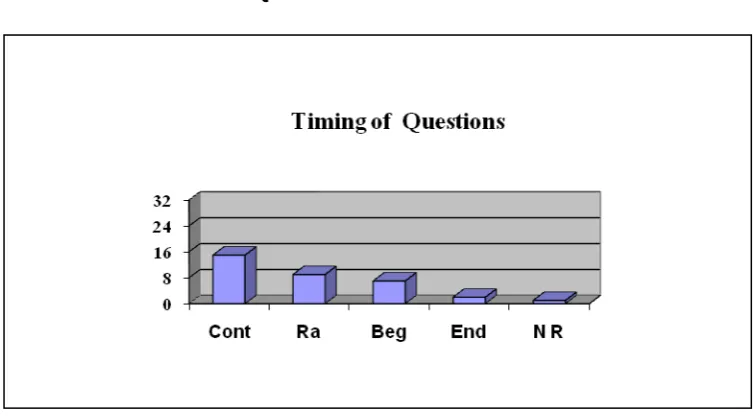
Table 4.2 Timing of questions ... 118
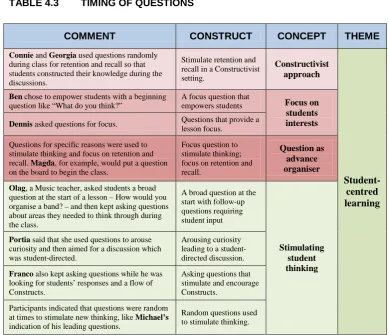
Table 4.3 Timing of questions ... 119
Table 4.4 Frequency of student questions ... 120
Table 4.5 Teachers’ perceptions of their questions ... 120
Table 4.6 Varieties in types of teachers’ questions ... 121
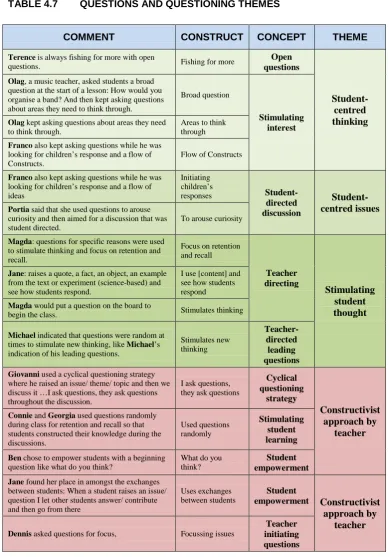
Table 4.7 Questions and questioning themes ... 122
Table 4.8 Teachers’ documentation for classroom planning ... 124
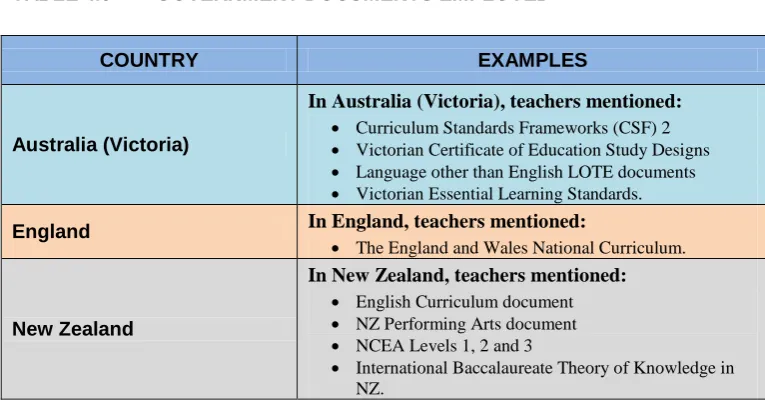
Table 4.9 Government documents employed ... 125
Table 4.10 Classroom planning and suggested schemas ... 125
Table 4.11 Classroom planning and student-centred thinking and learning .. 126
Table 4.12 Strategic frameworks and examples ... 128
Table 4.13 Student-centred thinking ... 130
Table 4.14 Strategies to initiate discussion ... 136
Table 4.15 Strategies to stimulate discussion ... 136
Table 4.16 Finding accurate focus through questions ... 140
Table 4.17 Ensuring full student participation in questioning ... 141
Table 4.18 Staged sequences ... 146
Table 4.19.1 Classroom planning ... 150
Table 4.19.2 How thinking skills are currently addressed ... 150
Table 4.20 Variety of reasoning behind affirmations used ... 151
Table 4.21 Activities based on curriculum areas ... 152
Table 4.22 Reinforcement strategies and approaches ... 153
Table 4.23 Democratic and paradigmatic language ... 155
Table 4.24 Reasons and perceptions of thinking skills ... 157
Table 4.25 Teaching of decision-making skills ... 165
Table 4.26 Teaching the processes of decision-making ... 166
Table 4.27 Teaching the concepts of consensus and democracy ... 171
Table 4.28 Teaching consensus and democracy ... 173
Table 4.29 A listing of formal and informal leadership elements ... 175
Table 4.30 Responses: teaching virtues, values and ethics ... 180
Table 4.31 Teaching values, virtues and ethics ... 181
Table 4.32 Teachers’ conclusions and comments ... 190
CHAPTER 1
Finding the Questions
Introduction
I began my teaching career with minimum qualifications and was determined
to become expert and efficient in knowledge, skills and, if necessary,
leadership. To accomplish this broad aim, I needed to build knowledge
through educational studies, supported by classroom experience; to build
skills through reflective practice; to deepen understanding through attendance
and integration of seminar and conference content; to build a consultative
broad base of current educational issues being promoted by Australian and
other educational leaders.
This thesis is an inductive narrative in which I research widely to
determine the initial and essential questions that might inform and shape my
exploratory efforts to accommodate educational change for twenty-first
century education.
The genesis of the research
Over a long career of thirty-six years as a secondary teacher in twelve
schools (girls’ schools, boys’ schools, co-educational schools), including
leadership for several faculties (Music, English, Religious Studies, Religion
and Values Education), I had become aware that some colleagues focussed
focussed their attention on the student, and upon the development of student
thinking skills so as to enable an understanding of the subject through the
means of the rich learning activities contained in the subject-content. Both
approaches seemed legitimate, but with questions in my mind about them I
decided to find out what was happening in other places. The search began in
the UK and led to the discovery of the work of John Wilson and, almost at
the same time, the work of Matthew Lipman; much later, the work of Peter
Vardy became valuable.
To accomplish such a wide arc of knowledge, I needed to undertake a
comprehensive literature review, so that I was building on what was already
known or as Newton said to Hooke ‘If I have seen further it is by standing on
ye sholdres (sic) of Giants’ (Newton, 1676, p. 39).
Learning with Wilson, Lipman and Vardy
John Wilson, Matthew Lipman and Peter Vardy advocate introducing the concepts of virtues, values and ethics through the medium of teaching thinking skills. The three following sections describe each of their approaches.
John Wilson
During 1990 and 1991, John Wilson personally encouraged me in three
ways. First, he extended an invitation for me to participate in his Master of
Education program, but unfortunately because of school leave requirements
in Victoria, I could not complete the relevant local Oxford University
examinations before it was time to return to teaching in Australia. Second, he
invited me to participate in his D.Phil. classes, which I gladly joined, and,
through this experience of working with Wilson, I developed a new
confidence in my own experience of, and expertise in, teaching. Finally, as
Director of the Farmington Trust, he directed my own subsequent research at
the Library of the Department of Educational Studies in Norham Gardens,
into education in my own milieu. I brought home to Australia extensive notes
and books, formal materials and publications, as a foundation for my
subsequent studies.
As a result of that year’s work I developed an understanding of Wilson’s
concepts of Moral Components (Wilson, 1971) and his indications of the
need to teach students in what he called moral matters.
Matthew Lipman
Concurrent with this development of personal and professional knowledge
and expertise, back in Victoria, Australia, I was introduced to the work of
Matthew Lipman, the originator of Philosophy for Children. By attending
professional development courses before and after my time spent with John
Wilson, I came to realise that for the purposes of my studies, there appeared
to be reasons for incorporating Wilson’s Moral Components into Lipman’s
Philosophy for Children.
The structure of Lipman’s Community of Inquiry formed a basis from
which the concept of teaching children to wonder, to question and to
investigate, could proceed. The significance of incorporating an
understanding about virtues, values and ethics into the promotion of new
knowledge for children was most important if one were to accept Lipman’s
insistence that children, even in early primary school, could reason right from
wrong and use this logic to shape their own behaviour. In my mind this
incorporation became coupled with Wilson’s efforts to insert moral education
into the primary and secondary school curricula by allowing for all
participants to apply their own thinking to their own situations.
My hope, despite resistance from some colleagues, was that students in
secondary schools would benefit academically, for the sake of their studies,
Peter Vardy
The work of Peter Vardy (1998, 1999) was initially applied to the teaching of
concepts and the study of topics for Years 11 and 12 educational purposes. It
included accompanying teaching resources and seminar support for teachers
of such subject areas as Ethics, Philosophy, and Religion and Values
Education (RAVE).
The blending and augmenting of the Wilson Moral Components List, the
Lipman Community of Inquiry and the Vardy RAVE curriculum, provided
the starting point for this research. Importantly, and following Vardy’s lead,
the thinking skills I applied ended in my deeper understanding of how
synthesis worked in thinking through particular challenging situations prior
to personal decision-making.
It is generally agreed that the ability to develop and teach thinking skills
(Lipman, 1993a); (Wilson, 1963; 1987) is essential for effective and efficient
teaching in the changed and changing culture of the twenty-first century
(Cherednichenko, 2000). Lipman’s Community of Inquiry (Lipman, 1993a)
also contributes valuably to the aim of teaching the student through the
medium of the curriculum (Vardy, 1998).
The teaching of virtues, values and ethics
The knowledge and strategies required of the teacher (phronesis;
colloquially, know-how) as first proposed by Aristotle (Beckett, 1994), are
echoed in the teaching-learning strategies constructed by Lipman. The
accuracy of the conceptual frameworks constructed by Wilson also appears
to align with the chief requirement of Aristotle’s phronesis: that the student is
of central significance (Shulman, 1987). The strategies are the teachers’
classroom tools; the content is the opportunity and the process; the outcomes
signify the moral and professional purposes of the teacher’s planning and
practice (Heasly, 1995). Full recognition of the ethical and epistemological
efficient and effective technical (techné) strategies (Aristotle, 1962), results
in the enhancement of effective teaching practice.
The combination of these learnings, led me to an understanding of the
significance of the teaching about virtues, values and ethics. The sense of
virtues and values as shapers of the individual’s understanding about what
constitutes a good life (Aristotle, 1962) began to emerge, and ethics became
comprehendible as the visible behavioural form of personal virtues and
values (Singer, 1979; Lipman & Sharp, 1985).
As I worked with these ideas I realised that I needed to think about the
ontological, epistemological and pedagogical dimensions of, and their
connections to, the teaching about virtues, values and ethics (Kincheloe,
McLaren & Steinberg, 2011p. 163-177; Lincoln, Lynham & Guba, 2011, p.
97-128).
I deemed it important to shape an understanding of the various
philosophical concepts (drawn from Aristotle, John Dewey and Joseph
Schwab) which would emerge for me as applicable to education, connecting
into recognisable theories (those of Hedley Beare and Andy Hargreaves).
This would provide a framework for a new architecture for the teaching of
virtues, values and ethics (as promoted by Wilson, Lipman and Vardy);
would provide a new paradigm for the needs of twenty-first century
education: one which measured and answered at least in part Frank
Crowther’s Fourth of Six Dynamics (micro-curriculum deepening) (2010a;
2010b; 2011). This fourth dynamic proposes capacity-building and
leadership innovations through micro-curriculum deepening in pursuit of
sustainable improvements in education. The new emphasis and new
knowledge gained would provide the content, and would in turn reshape the
educational processes into a unifying theme (Crowther 2010a, 2010b;
Heasly, 1995), based on the parallel architectural principles of ‘tensegrity’
(Ingber, 1997; Levin, 2002), into a structure for the pedagogical development
student, the teacher, the curriculum (what is taught) and the milieu (Schwab,
1983) in which education took place.
Ontological considerations, epistemological concerns
and technical strategies
Cherednichenko and Kruger (2002) provided me with an early understanding
of the ontological considerations, epistemological concerns and
consequences, and the technical dimensions of teaching. And Davies (2005,
p. 25- 26) indicates, Habermas concentrates on the states of rationality and
communicative action, including the relationship between the state and the
public sphere, precisely where, I believe, the visible evidence of ethics in
action are to be seen.
It became apparent that the technical dimension emerging as strategies
and techniques from the Aristotelian idea of techné (Aristotle, 1962),
meaning ‘art’ or ‘applied science’ or ‘skill’
All three dimensions of practice must to be considered, in order to assist
the development of ideas about the teaching of virtues, values and ethics. The
big ideas and philosophical patterns upon which experience, understanding
and commitment rest, translate into ontological considerations. The breadth
of knowledge, the variety of skills and the effectiveness of decision-making
processes, become merged into epistemological concerns and consequences.
The effective strategies and techniques constructed as teachers and
curriculum specialists shape the classroom experience of learning for the , is, of course, pedagogical in
essence. Aristotle’s term refers to skills, and their acquisition from and
application to: inductive and deductive thinking patterns; to knowledge itself;
to decisions based on ontological considerations, epistemological concerns
and their consequences; and to the strategies needed for teaching about
virtues, values and ethics. All cultures and communities rely on such patterns
to achieve harmony and happiness (Seligman, 1990; Rowland, 1993;
estimation, the precise and focussed technical strategies which emerge and
evolve into rich learning, including eschatological speculations about the
meaning of life today.
It is important to me to establish that a number of almost synonymous
terms appearing in this study for what takes place in the classroom can be
identified:
1. Aristotle’s techné, as translated by Ostwald (1962), originally
referred to a similar, but not exactly correlative concept of
working with the learner to harness understanding.
2. Technical strategies (Anih, 1992; Gardner, 1993b; Lipman,
1993a; Anih, 1995; Lipman, 2003) that a teacher uses to help
guide students whose learning styles sometimes differ markedly
as they wrestle with new knowledge.
3. Pedagogical content and subject planning (Schwab, 1983) refer to
much the same area because of the skill required in making the
plans ‘fit’ the complexities of the learning pattern of a particular
class.
Constructing an integrative schema
• These three considerations, together with the content knowledge
associated with the teaching about virtues, values and ethics,
became central to this research endeavour, and the integrative
schema shown below in Figure 1.1 has shaped its conduct and
analysis. The schema functions according to two objectives: one
indicates the importance of analysing and understanding about
virtues, values and ethics, and a second represents the different
Including virtues, values and ethics in the schema
In using this schema, particular attention was given to the chosen three
philosopher-educationalists central to the investigation – Wilson (1963 and
beyond), Lipman (1993a, 2003) and Vardy (1998) – and to their key ideas on
the teaching about virtues, values and ethics. Their seminal work in the
FIGURE 1.1 AN INTEGRATIVE SCHEMA
ONTOLOGICAL CONSIDERATIONS
EPISTEMOLOGICAL CONCERNS AND CONSEQUENCES
TECHNICAL STRATEGIES
Virtues
Virtues and ontological considerations
Virtues and epistemological concerns
and consequences
Virtues and technical strategies
Values Values and ontological
considerations
Values and epistemological concerns
and consequences
Values and technical strategies
Ethics Ethics and ontological
considerations
Ethics and epistemological concerns and consequences
Ethics and technical strategies
development of the teaching of thinking skills includes discussion of what is
to count as virtues, values and ethics in education, and is linked to the efforts
of a variety of other authors who have investigated and developed parts of
the connections mentioned.
Including the ontological, epistemological and technical aspects in the schema
Since a number of conceptual layers interlink the theoretical connections of
the project, I deemed it crucial that the first strands be established
immediately: those relating to ontological, epistemological and technical
(techné) strategies. To facilitate this aim, conceptual links are indicated –
whether consonant with or contrary to virtues, values and ethics – in relation
to various authors’ contributions to content and new knowledge. The schema
diagram shows three sections inspired by Cherednichenko and Kruger
• Ontological considerations: which relate to the big ideas and constructs, philosophies and understandings underpinning the
teaching of thinking and thinking skills.
• Epistemological concerns and consequences: which relate to the
teachers’ knowledge of these big ideas and constructs (Crowther,
2010a, 2010b, 2011); it is on this basis that teachers facilitate the
development of students’ skills.
• Technical strategies: which relate to the further development of how teachers proceed to attain these goals; constructing and
implementing effective strategies and techniques as they proceed
in an increasingly expert use of pedagogical skills (Costa, 2001).
Conducting research in a multi-faceted context
During the blithe stampede of the 1990s in which the Australian Federal
Government, with typical political zeal, pushed Civics and Citizenship
education into the school systems, consequences arose that had never been
considered by the politicians of the time, including demands on, and
requirements of, teachers that they teach and use their understanding of all
underlying concepts (Mackay, 1993) so as to promote such behaviours as
foresight, prudence, commitment, as part of the curriculum (Cam, 2002b).
Initial reaction by government figures has implied an expectation of mere
passivity and quiet acceptance of the recent political landscape’s
economic-rationalist framework on the part of teachers (Splitter & Sharp, 1995;
Gardner, Susan, 1999).
Competition is the central tenet of the harsh world of
economic-rationalism, but Civics and Citizenship education requires much more. It
requires, on a daily basis, the promotion of competition and collaboration,
the insights to facilitate personal choice pertinent to a given situation, and the
only with those tasks that are to be assessed. They do not want to give
credence to any special topic unless, after a combination of teacher input and
consequent investigation, they are to be assessed on their work. There,
according to Hugh Mackay (1999), Civics and Citizenship education ends!
Principles of equity, quality, flexibility and choice (Pascoe, 1996), are
crucial to the broadening of horizons sufficient to allow for the assessment of
educators as more than mere mute implementers of government policy. And
ways must be found to ensure that their voices are heard. In the contemporary
world of pervasive media and advertising influence, there appears to be a
very real narrowing in the perspectives of students; and also (I suspect) of
teachers. This is experienced as a disallowing of any real choice. Naomi
Klein’s (2007) work highlights this in a severe way. There is real reason for
considering the possibility of an insidious form of subliminal indoctrination.
This matter is taken up in Chapter 4.
In their efforts to construct their own future, students come to see that
they are a generation which is societally dependent – financially and
intellectually – until at least the age of 25 years (Mackay, 1993). As I have
observed during my years of teaching, this experience may rob them of their
blossoming initiative in their early teens; an outcome with serious concerns
for the teachers who face them in their secondary schooling. It can and does,
also, lead so often to serious student personal risk-taking that can be
breathtakingly life-threatening.
In today’s highly technological world, the postmodern phenomenon of
blurring the edges of all boundaries is a legacy these students accept from a
previous generation who dignify this situation with ideological labels such as
‘atomism’, ‘human rights’, ‘individual choice’ and ‘independence’. It is no
wonder that we see the emergence of cynicism, nihilism and the
consequentialism/anti-consequentialism linear-thinking bind, as we move
from classroom to classroom (Connell, Ashenden, Kessler & Dowsett, 1982).
If the new social media has become the current place for lasting socialisation,
then the content and format of teaching needs refurbishment at the very least
(Gardner, 1993a). Claims that Lipman’s Philosophy for Children addresses
these phenomena will be examined (Splitter & Sharp, 1995). Other existing
courses for teacher qualification may also need examination in the context of
teachers’ contributions. My Heasly ‘ME’ diagram provided in Chapter 4
addresses and begins the analysis of the socialisation process.
The first and overarching question then, is: how do teachers respond to
the implied needs of the student cohort when including such considerations
as the teaching of thinking skills at secondary school levels and, as I
subsequently postulated, would a proposed virtues, values and ethics
curriculum provide a way forward?
Reason for the thesis framework
Change for change’s sake is not answer enough to any of my questions. The
importance of change in the student experience in the twenty-first century
manifests itself in the broader spectrum of knowledge, facts and information
available through the proper use of information technology sources.
Therefore, the existence and promotion of technology in Australian
culture, and its consequences for the teaching-learning experience of the
whole student cohort, must become part of the studies and skills offered to
students on a regulated curriculum basis for their effective and efficient use
of research sources.
Relevance to teachers of this research
It is most relevant here to inspect and analyse the consequences for student
teachers whose own experience of education and schooling took place in the
climate of the values-neutral classroom pedagogy. Classroom culture is
subject to subtle changes, as Schwab (1983) has indicated. Given the huge
opposite manner This phenomenon sometimes emerges where no
explorations of options are fully researched, so students are choosing to opt
out rather than in. This decision-making is relevant to personal, professional
and academic areas, and can on occasions cover the identification of relevant
virtues, values and ethics. Thus, the use of advisement, as distinct from
advice and from counselling, becomes a skill relevant to the new and
continuing teacher, where available options are offered by the teacher to the
student for their consideration within a problem-solving context. These ideas
are explored further in Chapters 4-9.
Relevant consequences emerge for existing and continuing teachers, who
also had to negotiate: the divide between their own experience of the values-
neutral classroom and the existence of gender-based classes; classes of fifty
or more students; or the opposite, when student classes were for a variety of
reasons only ten to twelve people. My experience of until-now covert agenda
of imparting knowledge about virtues, values and ethics relevant to
classroom culture, needs to be honestly identified and analysed, so that
democracy and consensus can be provided with a balanced foundation from
which understanding and harmonious relationships relevant to the progress of
study can be established. The reasoning and considerations relevant to the
understanding of democracy and consensus in the classroom as espoused
within this thesis are discussed in Chapters 7 and 8.
There is also my emerging discovery of the significance of the
multicultural classroom, which depends on the presence of migrant
populations from across the world, and the possible attendance of refugees
whose experiences and reasons for being present are very different from each
other and from the everyday experiences of Australian students. The content
of class discussion could change depending on the variety and cultural
difference of those in each class group. An example of this profitable
educational aim is reflected on in my auto-ethnographical introspective
Allied to these reflections are new developments in research into how the
brain learns (Beyer, Costa & Presseisen, 2001; Fogarty, 2005; Dispenza,
2007; Doidge, 2007; Greenfield, 2007; Lipton, 2008). The emerging concept
of neuro-plasticity points towards the possibility of new knowledge,
especially regarding the role of memory, and needs to be inserted and
integrated into the practice of education. This content, I judge as being
beyond the scope of this thesis, but it will change the way that classroom
pedagogies are constructed, so as to take account of the various conclusions
about how best to facilitate and teach the rich knowledge and effective skills
necessary for successful twenty-first century living.
The significance of research into how the brain works and learns, and of
the evolution of brain-dendrite accommodation in technological/information
and communications technology (ICT) experiences, especially during early
childhood, is a central part of the considerations of my proposed twenty-first
century reshaped theory of education. Changing what is taught will have
consequences: consequences for student teachers; consequences along
similar lines for continuing teachers; and consequences relevant to the
tendency to delegate political and societal changes to the education
curriculum. All of these considerations will need subtle but careful
development, based on clarity of reasoning and a teaching-learning process
that is understood as the teaching of the student through the medium of the
subjects taught.
There is a need to promote a continuing and growing educational policy
that monitors how much of the existing curriculum is removed in favour of
new curriculum initiatives. Stringent monitoring is needed to avoid the
problem of the removal of content too quickly or for short-term gain. By
connecting this area of concern with Susan Greenfield’s (2004, 2007) brain
research and with Stephen Kagan’s (1994) curriculum research and their
relevant conclusions, new emphases to the emerging reshaped theory of
New understandings from brain research
There is a need to incorporate some of the very significant new knowledge
coming from the study of the mind and its emergent potential. Research by
Greenfield (2004, 2007) is now being supported by an array of
specialisations in neuroscience, one of which relies on the concept of
neuro-plasticity – the ability of the brain to alter its structure and function in
response to input from the environment – in order to explain learning. A
connection with Ingber’s (1997) ‘architecture of life’ becomes significant in
relation to Greenfield’s unfolding brain-function research.
The research process indicates a need to promote the consequences of
these investigated matters into the planning and prosecution of curriculum
change to the administrative arm of the Australian education system. If
reorganised time use and the promotion of thinking skills in classrooms
occurs in a significant and useful manner, then there are consequences for the
manipulation of semester time, for the testing and assessment of content, for
the monitoring of what constitutes a successful teacher, and even for the
successful transformational schools indicated by Caldwell and Spinks’
(1992),and Crowther’s (2010a, 2010b) frameworks.
Students
Students sometimes think that the teaching of applied thinking skills is
secondary to the content of the Key Learning Areas described in the
Victorian Standards Frameworks II (Victorian Board of Studies, 2000), yet
the practise of the science of learning, and indeed of the art of teaching as
discussed by Gagné & Briggs (Gagné & Briggs, 1974) within the contexts of
decision-making and the broad variety of reasoning applicable to thinking, is
to support deeper knowledge and understanding in all learning areas as well
as in social competence (Dewey, 1944, p.80). It has been my experience that
the structure of today’s curriculum can lead to a narrowing focus away from
things, the provision of thinking skills. As Ann Margaret Sharp notes in
Lipman (1993a), there are understandings and practices that explicitly focus
on the teaching of thinking, and particularly of self-correction. The study also
investigates the possible relationships between current learning, personal
decision-making, behaviours, attitudes and preferences, through ‘the
construct of continuous reconstruction of experience’ (Dewey, 1944, p.80);
Wilson talks about the same concept (Wilson, 1963, pp. 126 -141). It follows
that this whole project is couched in a 21st
It has been my experience that Australian students in the twenty-first
century expect to find accessible education married to the strategies they
need to construct a career, develop a philosophy for life and find the means
to investigate eschatological speculations about metaphysical questions on
the meaning of life, as they wish. Without the inclusion of the basic and deep
thinking strategies that can be incorporated into each topic within each
subject area, students are at times subjected to a form of discrimination
which I have found can result in a lifetime of negative consequences. I have
found that their entry into the career path of their choice is affected by their
sometimes tenuous hold on the less obvious, but significant skills that emerge
from the various methods of teaching applied thinking skills. This results in
the need to insert a balanced curriculum, one which attends to twenty-first
century knowledge and education without the unnecessary intrusion of
meaningless and self-perpetuating paperwork that substitutes tests and
assessments for the opportunity to engage with deep and rich learning in the
manner advocated by David Beckett (1994) and noted in Heasly (1995, p.13-
16):
century reality, and can’t be
confused with some utopian dream based in unreality.
central to the classroom practices. … [He implies that] wisdom is part of the aim of education.
Accordingly, this investigation asks the teachers who participated in
completing a Questionnaire for their considered opinions of approaches to
student development.
Needs
Twenty-first century Australian students’ needs, I believe, encompass the
following:
• The integration of, not deletion of, diversity of cultures.
• Balance in the use of ICT.
• Recognition of the management of cultural change.
• The impact of frameworks addressing globalisation.
• The necessity to access educational processes well beyond
subject-based curriculum content.
• The need to link tradition and innovation, religious and secular
matters, and multicultural and intercultural currents in twenty-first
century Australia. This means that students rely on their education
to provide opportunities for personal decision-making for career
choice, for construction of the good life, and eventually for
speculations of an eschatological nature.
Consequently, relevant education experiences need to include:
• Opportunities to learn the construction of relevant questions.
• Learning the preparatory steps to research using appropriate safe
ICT facilities.
• Finding appropriate independent thinking, analysis and
• Facilitation and development of personal decision-making about career, about constructing the good life, and about choosing a
secular or religious journey through life.
This is the multifaceted challenge that educators face in facilitating the
flourishing of their students; yet, it extends beyond positive psychology
(Seligman, 2011). Chapters 7 and 8 begin to address such relevant education
practices.
Teachers’ needs, I believe, include:
• Learning their teaching area effectively and efficiently, for deep
knowledge.
• Recognising the connections and links between the teaching
process and the learning process.
• Having the expertise, for classroom efficiency, to lead and foster
thinking skills strategies.
• Knowing and practising the methodology of teaching applied
thinking in all subject areas.
• Having broad knowledge about virtues, values and ethics to serve
as the foundation of a democratic educational experience for their
students.
The emerging recognition and implementation of such educational aims
are already with us in various frameworks via disciplinary specialisation.
Democratic support rather than prescriptive curricula is warranted for
decisions associated with careers education, in the construction of a personal
philosophy of life, and in their participation in community domains: I have
observed students’ expectations of these outcomes of their education increase
over time. The teachers with whose practices I am familiar are all already
aware of the complexity of these matters, and this investigation is an effort to
address their concerns. My Questionnaire was constructed with these
Beginning my research
Between 2001 and 2009, as Head of Faculty in English and subsequently of
Religion and Values Education at the last college at which I taught, I took up
the opportunities available for professional development, sought out
curriculum and teaching experts, and decided to focus my research on
teachers rather than students.
Before I had begun the physical work on my thesis ten years ago, I
started to think through exactly what the focus of my questions were; what
the aim of the project was; why it was important to pursue these questions;
how it would affect educational practice; and what suggestions for
improvements I could offer for twenty-first century education.
To find a respectful theory for twenty-first century education I needed to
discover how teachers perceived the teaching of thinking skills in secondary
schools. I identified three questions to guide my exploration:
• How could I harness the knowledge, experience and expertise of
my own search of over 20 years, to form a foundation for
academic research in this area?
• How could I hear precisely what other teachers were saying and,
how could I respectfully find accurate evidence from the coalface
– the classroom itself?
• How could I find out what educational theorists and expert
practitioners were thinking and doing?
I asked myself: ‘What are the crucial ontological, epistemological and
technical elements that could be incorporated into the development of an
effective philosophy and format for the teaching of thinking skills to enable
secondary students to learn about, and engage with the concepts of virtues,
values and ethics?’
• Ontological Questions: What significance can be assigned to the development of personal perspectives surrounding a teacher’s
attitude to the teaching-learning process? How do teachers
maintain the emphases needed to teach students for rich learning,
rather than only the subject content?
• Epistemological Questions: How do teachers ensure that students
learn all of the thinking skills relevant to educational knowledge
and skills, so that applied thinking skills are recognised,
identified, modelled, assessed and demonstrated, in all learning
outcomes in all subject areas?
• Technical Questions: How do teachers understand and acquire a
comprehensive list of thinking skills with which to model, teach
and require of students that they use them in every educational
sense: in career choice; in life decisions; and in both secular and
religious dimensions and approaches to life’s eschatological
speculations?
I wanted to develop a respectful theory constructed from a consciously
historical perspective, with the reshaped emphases emerging inductively
from the literature and from my own and other teachers’ experiences. This
investigation relied on inductive reasoning for the construction of a picture of
what twenty-first century education would include.
It was with relief that I found the latest work of Lincoln, Lynham and
Guba, (2011) because chapter 6 sets out the boundaries, the overlaps, the
breadth of important paradigms and the need to identify when writing in a
research paradigm. As I developed my thesis, I found that learning about the
boundaries and concepts underpinned different qualitative research
disciplines. I tested early processes like Case Studies, Grounded Theory, and
found that inductive paradigms often overlapped. This thesis therefore details
emerged. The whole is founded on the teaching of thinking skills, and the
application to as broad an arc of democratic practice as philosophy and logic
would allow.
Learning the broad spectrum of philosophy
While studying with Wilson, I was introduced to the work of a wide range of
philosophers; scholars from the analytical tradition as well as a number of
other philosophical schools. Consequently, the history of education in
Victoria, its changes and developmental steps, became central to my own
questions. Having begun to learn through my studies to identify and
understand philosophical perspectives, I began to make comparisons and to
find parallels in the decades of change I observed and the educational
philosophy behind each shift I discerned. It must be understood, though, that
I was a teacher delving into philosophy, rather than a philosopher reaching
into educational fields and so, many of the nuanced utterances for which
philosophy is renowned may have inevitably escaped my untrained though
eager mind. This earlier experiential learning provides the basis for the
Literature Review associated with this study.
These considerations are central to the development of my theory for a
reshaped twenty-first century Australian classroom, based on clear and
historical educational concepts. General histories of philosophical thought
traced by Richard Tarnas, Jaroslav Pelikan and Bertrand Russell over the last
century appear to inform the values within Australian education. The
historical sweep of these educational values is identified in the large bodies
of work of significant authors (such as Beare, Hargreaves, Dewey and
Bruner) informing the underlying construction of this investigation. The
study’s conclusions feed into other more precise frameworks (such as
Crowther, Hawkes, Ingber, Costa, Greenfield, H. Gardner, and Freakley &
Burgh). Engagement with the broad spectrum of content by Wilson, Lipman
and Vardy, and their large bodies of specialised work, allows depth and
conclusions can then be made. In particular, the work of Laurance Splitter
and of I. A. Snook rounds out the broad perspectives underlying my
conclusions, which are supported by the works of the authors detailed in the
Literature Review in Chapter 3.
Planning the research enterprise
I wanted to find out how teachers, especially teachers in secondary schools,
addressed the concept of the teaching of thinking skills in their classroom
practice. And I specifically wanted to know if the ‘science’ and ‘art’ of
consciously using applied thinking skills from any or all subject areas and
disciplines would advance levels of student understanding, thereby achieving
for them a richer learning and a more enthusiastic engagement. If, by
investigating which authors, educational experts and researchers had
proposed innovations to twenty-first century pedagogical and professional
learning, I could establish a foundation for my questions by administering my
rigorously-designed Questionnaire. It would then be possible to develop
richer and more beneficial learning experiences for twenty-first century
Australian education scenarios. These two sources would be supported and
synthesised through my own experiential and formal learnings and presented
in an auto-ethnographical introspective. Inevitably though, I chose to take
Newton’s approach and stand on the shoulders of giants (Newton, 1676).
Aims of the research for teacher practice
This project seeks knowledge that will enliven teachers’ practice with the
aim of providing improved student outcomes (Heasly, 1995) that has been
central to my work for over two decades. Students have deeply internalised
the tenets and practices of individualism (Singer, 1993) and, simultaneously,
the development of capitalism has resulted in the phenomenon of
consciousness of the connections to considerations of national and
international pedagogical significance. A central question has emerged
concerning how students should be taught the skills necessary for them to
interpret their world, and thus how they can perceive and exercise both their
freedoms and responsibilities as formulated (Lipman, 1993a; Splitter &
Sharp, 1995) in Philosophy for Children terms; by Wilson (1963; 1987), in
early moral education terms; (Singer, 1979) in terms of ethical choice.
Students and their teachers will find ways to think carefully together about
the students’ environment (Seligman, 1990; Anih, 1992; 1995). To inform
such an educational aim, my research seeks to uncover the underlying
thinking and practices which teachers employ during the teaching of thinking
skills, in order to support the development of student skills and outcomes; a
particularly important example of which is the gaining of self-knowledge
(Pritchard, 1985). The analytical framework for this research is drawn from
teaching and learning theory from a number of sources. (Bloom, 1956;
Gagné & Briggs, 1974; Brown, 1980; Knowles, 1984; Cherednichenko,
2000).
Significance of the research and its contribution to new
knowledge
I decided to investigate how some teachers perceive and understand the
teaching of thinking skills in their secondary education practice. This project
considers the conflicts which occur when an essentially literary society,
media and technology, provide students with a particular world view
(Postman, 1986). The research investigates secondary teachers’ declared
reasons for teaching thinking skills as an extension of previous research with
primary teachers conducted by Brenda Cherednichenko (2000), who
investigated the reasons given by teachers for their inclusion of a thinking
curriculum such as Philosophy for Children in their primary curriculum
curricula containing primary skills and socio-cultural background. Only a
few researchers (Gardner, S, 1999; Cam, 2002b; Leckey, 2009) have
investigated secondary curriculum planning on the scale that Cherednichenko
achieved in primary settings.
It seemed to me that it was possible to promote thinking skills in the
middle years of schooling (Years 5 to 9) without looking towards
socio-cultural background to provide the outcome of richer student engagement in
learning; and anecdotal evidence suggests that many schools implement a
thinking-focussed curriculum in the middle years. It may be necessary to
align and link the observations and conclusions gleaned from this research
with other, perhaps as yet undiscovered, or yet-to-be-written research that
emerges in this research field. Eric Jensen (2006) develops a cogent
argument for enrichment for successful learning outcomes.
It is hoped that my research makes possible the further development of
the theoretical foundations proposed, and of teachers’ personal practice of
education. We may then say that, like Freire (1972), who when speaking of
thinking skills in a Brazilian context, we find that our understanding of the
basis of education may become even clearer.
Uncovering critical new knowledge
My research thesis provides teachers and school administrators with critical
new knowledge to enhance educational theory and policy development for
secondary classroom practice by placing slightly adjusted emphases on
knowledge that is already available. Further, I contribute new knowledge
about the pedagogy of the teaching of thinking across the secondary
curriculum. This new curriculum connects existing knowledge from my three
authorities – Lipman, Wilson, Vardy – to enhance the value of recognisable
and parallel processes in the teaching of thinking skills, especially processes
which could relate to moral thinking skills (Wilson, Williams & Sugarman,