Noname manuscript No.
(will be inserted by the editor)
Quantum Attacks on Some Feistel Block Ciphers
Xiaoyang Dong1 · Bingyou Dong1 · Xiaoyun Wang1,2,3
Received: date / Accepted: date
Abstract Post-quantum cryptography has attracted much attention from worldwide cryptologists. How-ever, most research works are related to public-key cryptosystem due to Shor’s attack on RSA and ECC ciphers. At CRYPTO 2016, Kaplan et al. showed that many secret-key (symmetric) systems could be bro-ken using a quantum period finding algorithm, which encouraged researchers to evaluate symmetric systems against quantum attackers.
In this paper, we continue to study symmetric ciphers against quantum attackers. First, we convert the classical advanced slide attacks (introduced by Biryukov and Wagner) to a quantum one, that gains an exponential speed-up in time complexity. Thus, we could break 2/4K-Feistel and 2/4K-DES in polynomial time. Second, we give a new quantum key-recovery attack on full-round GOST, which is a Russian standard, with 2114.8 quantum queries of the encryption process, faster than a quantum brute-force search attack by a factor of 213.2.
Keywords Quantum cryptanalysis, GOST, Feistel, Grover, Simon.
Mathematics Subject Classification (2000) 94A60
1 Introduction
Post-quantum cryptography is about the security of cryptographic systems against quantum attackers. In 1994, Peter Shor [1] invented the first notable and yet the most severe quantum attack, i.e., the Shor’s algorithm, that breaks the most currently used public-key systems, such as RSA cryptosystem [2] and elliptic curve cryptography. But since then quantum threats against secret-key (symmetric) systems are barely known, and it was the common belief that quantum attacks on symmetric primitives are of minor concern, as they mainly consist of employing Grover’s algorithm [3] to generically speed up search (sub-)problems. However, at CRYPTO 2016, Kaplan et al. [4] break a series of symmetric-key systems in polynomial time using quantum period finding algorithm, which stirs great interest of quantum cryptanalysis in symmetric-key cryptographic community.
According to the notions for PRF security in a quantum setting given by Zhandry [5], there are two different models for quantum cryptanalysis against symmetric ciphers:
– Standard security: a block cipher is standard secure against quantum adversaries if no efficient quantum algorithm can distinguish the block cipher from PRP (or a PRF) by making only classical queries (denoted as Q1 by Kaplan et al. [6]).
– Quantum security: a block cipher is quantum secure against quantum adversaries if no efficient quantum algorithm can distinguish the block cipher from PRP (or a PRF) even by making quantum queries (denoted as Q2 by Kaplan et al. [6]).
Xiaoyun Wang is the corresponding author. E-mail: [email protected]. Xiaoyang Dong
E-mail: [email protected].
1. Institute for Advanced Study, Tsinghua University, Beijing 100084, P.R. China. 2. Key Laboratory of Cryptologic Technology and Information Security,
Table 1: Summary of key-recovery attacks on Feistel schemes in classical setting and Q2 model
Ciphers Rounds Key bits Best Previous Classical Attacks Quantum Brute Ours force Search‡
Data Time Memory Source Time
2K-Feistel ∞ n 20.25n 20.25n Negligible [24] 20.5n n+ 2 + 2p
n/2 + 1 4K-Feistel ∞ 2n 20.25n 20.25n Negligible [24] 2n n+ 2 + 2p
n/2 + 1
2K-DES ∞ 96 232 233 Negligible [24] 248 155§
4K-DES† ∞ 192 232 233 Negligible [24] 296 233§
GOST 32 256 232 2224 264or 219 [37, 38] 2128 2114.8
30 256 232 2224 Negligible [36] 2128 2114.6
†: For 4K-DES, both Biryukov et al.’s attack [24] and our attack work for 1/216of all keys. Note that the attacks
on 2K-DES work for all the keys.
‡: The quantum brute force search is just use Grover’s algorithm to find the key, which uses√nquantum queries when the key size isn. It also works in Q1 model.
§: 155 or 233 quantum queries of the encryption process.
In Q1 model, the adversary collects data classically and processes them with quantum operations, while in Q2, the adversary can directly query the cryptographic oracle with a quantum superposition of classical inputs, and receives the superposition of the corresponding outputs. The adversary in Q1 model is more realistic, many cryptanalysis results [7–9] are based on this model. The adversary in Q2 model is much more powerful. Nevertheless, it is still meaningful to study ciphers in Q2 model, since it is possible to devise protocols secure against Q2 adversary, such as quantum-secure signatures from CRYPTO 2013 [10] and quantum-secure message authentication codes from EUROCRYPT 2013 [11], etc. Recently, the security of many specific symmetric ciphers in Q2 model has been evaluated, which includes the key-recovery attacks against Even-Mansour constructions [12], distinguishers against 3-round Feistel constructions [13], forgery attacks against block cipher based MACs [4], key recovery attacks against FX constructions [14], and so on. But more classical cryptographic schemes of greater importance are yet to be studied against quantum attackers. At Asiacrypt 2017, Moody [15] on behalf of NIST reports the ongoing competition for post-quantum cryptographic algorithms, including signatures, encryptions and key-establishment. The ship for post-quantum crypto has sailed, cryptographic communities must get ready to welcome the post-quantum age.
Feistel block ciphers [16] are observed to be important and constitute one of the extensively researched cryptographic schemes. Several standard block ciphers, such as DES, Triple-DES, MISTY1, Camellia, CAST-128 [17] and the Russian GOST [18], are based on the Feistel design. Classically, researchers only consider the security of Feistel block ciphers against attackers who are only equipped with classical comput-ers. In the quantum age to come, the adversaries can be more powerful. There are some attacks on Feistel ciphers in quantum setting. Kuwakado and Morii [13] gave the first quantum distinguisher on 3-round Feistel in Q2 model. Later combining with Leander and May’s algorithm [14], Hosoyamada et al. [19] and Dong et al. [20, 21] introduced some key-recovery attacks in Q2 model by appending several rounds to the quantum distinguisher of Feistel construction. A meet-in-the-middle attack on Feistel cipher in Q1 model was also discussed by Hosoyamada et al. [19]. More recently, Ito et al. [22] introduce the first 4-round quan-tum distinguisher on Feistel cipher in the quanquan-tum chosen-ciphertext setting (Q2 model). In this paper, we only study some Feistel ciphers in Q2 model, that the adversaries could make quantum queries on some superposition quantum states of the relevant cryptosystem.
Our Contributions
In this paper, we focus on the study of the symmetric ciphers against Q2 adversary. Combining with Simon’s algorithm [23], we convert the classical advanced slide attacks (introduced by Biryukov and Wagner [24]) to a quantum one, that gains an exponential speed-up of the time complexity. Thus, we could break 2K-/4K-Feistel block ciphers and 2K-/4K-DES block ciphers in polynomial time. Concretely, we turn the classical attacks on 2K-/4K-Feistel block ciphers with 20.25nencryptions into quantum attacks with about n+2+2pn/2 + 1 quantum queries of the encryption process using aboutn+1 qubits. We turn the classical attacks on 2K-/4K-DES block ciphers with 233encryptions into quantum attacks with 155 or 233 quantum queries of the encryption process with 65 qubits.
On the other hand, concerning the full-round GOST, a Russian block cipher standard, we give a new quantum key-recovery attack, that breaks GOST in 2114.8quantum queries of the encryption process, which is faster than the quantum brute force search attack by a factor of 213.2. The attack needs 224 qubits. The
Quantum Attacks on Some Feistel Block Ciphers 3
Comparison with Bonnetain et al.’s work [25]
Shortly after our work is made public at ePrint in 24 May 2018 [26], there is a concurrent work on similar topic by Bonnetain et al. [25], which appears at ePrint in 2 Nov 2018. Now Bonnetain et al.’s work has been accepted to SAC 2019. Both of the two works include the quantum advanced slide attack. But we want to list the differences in our paper from Bonnetain et al.’s. In our paper, we not only give the attacks on 1K-/2K-/4K-Feistel ciphers (also given by Bonnetain et al.), but also give non-trivial applications on 1K-/2K-/4K-DES. In the attack on 1K-/2K-/4K-DES, we give a new reformulation of the DES-like ciphers e.g. Fig. 7 in Sect. 3.2.1 in order to construct a sound period function. After we derive the period, we have to deal with the irreversible property of DES’s s-box to recover the keys. The quantum circuits of the quantum advanced slide attacks are presented in our work, which is not given by Bonnetain et al. In addition, our paper also includes the new quantum key-recovery attacks on 30-/32-round GOST.
2 Preliminaries
2.1 Attack Model
In this paper, we focus on the powerful Q2 model. In this model, the adversary is not only equipped with local quantum computation resource, but also granted an access with superposition inputs to the remote cryptographic oracle, and obtains the corresponding superposition of outputs. Concretely, suppose the encryption oracle isOk:{0,1}n→ {0,1}n, then the Q2 adversary can make quantum queries|xi|yi 7→
|xi|Ok(x)⊕yi, wherexandyare arbitraryn-bit strings and|xiand|yiare the correspondingn-qubit states
expressed in the computation basis. Moreover, any superposition Px,yλx,y|xi|yi is a valid input to the
quantum oracle, whose corresponding output isPx,yλx,y|xi|y⊕ Ok(x)i. In previous works, the Q2 model
is also called superposition attacks [27], quantum chosen message attacks [10] or quantum security [5]. For symmetric cryptanalysis, Q2 model is important and rational to some extent, as we have already mentioned the protocol of Boneh and Zhandry [11] for MACs that remains secure against superposition attacks. Moreover, as stated by Ito et al. [22]: “the threat of this attack model becomes significant if an adversary has access to its white-box implementation. Because arbitrary classical circuit can be converted into quantum one, the adversary can construct a quantum circuit from the classical source code given by
the white-box implementation.”
2.2 Quantum Algorithms
Our quantum attacks are based on two of the most popular quantum algorithms, namely Simon’s algorithm [23] and Grover’s algorithm [3].
Black-box period finding:given a function, f : {0,1}n → {0,1}n, that is observed to be invariant under somen-bit XOR perioda, finda. In other words, finda6= 0 such thatx⊕y=a⇒f(x) =f(y).
The optimal classical time to solve the problem is O(2n/2). However, Simon [23] presents a quantum algorithm that provides exponential speedup and requires onlyO(n) quantum queries to find a.
Simon’s Algorithm [23]:the algorithm includes five quantum steps that are as follows:
I. Initialization of twon-bit quantum registers to state|0i⊗n|0i⊗n. Then apply the Hadamard transform
to the first register to attain an equal superposition in the following manner:
H⊗n|0i|0i= √1
2n
X
x∈{0,1}n
|xi|0i. (1)
II. A quantum query to the functionf maps this to 1
√
2n
X
x∈{0,1}n
|xi|f(x)i.
III. While measuring the second register, the first register collapses to the following state: 1
√
2(|zi+|z⊕ai). IV. Applying the Hadamard transform to the first register, we obtain:
1
√
2 1
√
2n
X
y∈{0,1}n
V. The vectorsy, thaty·a= 1, depict an amplitude of zero. Hence, measuring the state yields a value ofy, which meets thaty·a= 0.
Intuitively, after repeating the above algorithm ntimes, we may obtain aby solving a system of linear equations if the system is of rankn−1. However, Kaplan et al. [4] and Santoli [28] showed that in the cryptanalysis scenario, the period functionf(x) constructed may have many so-called “unwanted collisions”, which means there might be other collisions in addition to those of the formf(x) =f(x⊕a). For example, there might exist a pair (x0, a0), such that f(x0) = f(x0⊕a0), wherea0 6= a. Hence, one may need more repetitions of the above algorithms to obtain a full rank linear system of equations to geta. At Asiacrypt 2017, Leander and May [14] assume that f(x) behaves as a random periodic function with perioda, and show that any function value f(x) has only two preimages with probability at least 12. Moreover, they show thatl= 2(n+√n) repetitions of the Simon’s algorithm are sufficient to compute a. The probability is greater than 4
5 that it contains at least n−1 linearly independent vectorsy that are orthogonal toa
(Lemma 4, [14]). In this paper, we follow Leander and May’s assumption, that all the periodic functions used in our attacks behave as random periodic functions. Therefore we use Lemma 4 of [14] to evaluate the complexity of our attacks.
Simon’s algorithm has been used to attack many primitives, such as the key-recovery attacks against Even-Mansour constructions [12], distinguishers against 3-round Feistel constructions [13], forgery attacks against block cipher based MACs [4], key recovery attacks against FX constructions [14], and so on.
Quantum search: given an unordered set of N = 2n items, quantum search problem is to find the unique element that satisfies some condition. In other words, givenf(x),f(x) = 0 for all 06x <2nexcept x0, for whichf(x0) = 1, findx0. The best classical algorithm for a search over unordered data requiresO(N)
time, but Grover’s algorithm [3] performs the search on a quantum computer in onlyO(√N) operations, a quadratic speedup.
Grover’s Algorithm [3]: define a black box oracle O as O|xi|qi= |xi|q⊕f(x)i. The steps of the algorithm are as follows:
1. Initialization of an (n+ 1)-bit register|0i⊗n|1i. Apply the Hadamard transform to attain an superpo-sition that can be given as follows:
H⊗(n+1)|0i⊗n|1i= √1
2n
X
x∈{0,1}n
|xi[(|0i − |1i)/√2] =|Φi. (2)
2. Define|ϕi= √1 2n
P
x∈{0,1}n
|xiand define the Grover iteration as (2|ϕihϕ| −I)O, and apply itR≈ π4√2n
times to the state|Φi:
[(2|ϕihϕ| −I)O]R|Φi ≈ |x0i[(|0i − |1i)/
√
2]. 3. Measure the final state and returnx0.
We give some brief explanations on step 2, and for more details, we refer the readers to [29]. As shown in Figure 1, Grover denotes (2|ϕihϕ| −I) as diffusion transform. It includes two Hadamard transforms H⊗nand a conditional phase shift operation, which is represented by the unitary operator 2|0ih0| −I, and satisfies (2|0ih0| −I)|0i = |0i and (2|0ih0| −I)|xi= −|xi, where x 6= 0. Therefore, the entire diffusion transform using the notation|ϕiis:
H⊗n[2|0ih0| −I]H⊗n= 2H⊗n|0ih0|H⊗n−I = 2|ϕihϕ| −I. (3) Hereafter, we get the Grover iteration: (2|ϕihϕ| −I)O.
For the oracleO, when applying it to|xi[(|0i−|1i)/√2], we getO|xi[(|0i−|1i)/√2] = √1
2(|xi|0⊕f(x)i−
|xi|1⊕f(x)i). Sincef(x0) = 1, thenO|x0i[(|0i − |1i)/
√
2] =√1
2(|x0i|0⊕1i − |x0i|1⊕1i) = 1 √
2(|x0i|1i −
|x0i|0i) = (−1)|x0i[(|0i − |1i)/
√
2]. When x 6= x0, O|xi[(|0i − |1i)/
√
2] = √1
2(|xi|0⊕0i − |xi|1⊕0i) = 1
√
2(|xi|0i − |xi|1i) =|xi[(|0i − |1i)/
√
2]. SoO|xi[(|0i − |1i)/√2] = (−1)f(x)|xi[(|0i − |1i)/√2]. Further, Brassardet al. [31] generalized the Grover search as an amplitude amplification method.
Theorem 1 (Brassard, Hoyer, Mosca and Tapp [31]). LetAbe any quantum algorithm onqqubits
that performs no measurement. LetB:Fq2→ {0,1}be a function that classifies the outcomes ofAas either
good or bad state. Let p > 0 be the initial success probability that the measurement of A|0i is good. Set
t=bπ
4θc, whereθis defined usingsin
2(θ) =p. Furthermore, define the unitary operatorQ=−AS
0A−1SB,
where the operatorSB changes the sign of the good state,
|xi 7→
−|xiifB(x) = 1,
|xiifB(x) = 0.
Further, S0 changes the sign of the amplitude only in case of the zero state |0i. Finally, after performing
Quantum Attacks on Some Feistel Block Ciphers 5 An Introduction to Quantum Algorithms 3.2 Grover’s algorithm: How it works
represented by the unitary operator 2|0i h0| −I:
[2|0i h0| −I]|0i= 2|0i h0|0i −I =|0i (4a) [2|0i h0| −I]|xi= 2|0i h0|xi −I =− |xi (4b)
Giving the entire diffusion transform, using the notation|ψifrom equation 2:
H⊗n[2
|0i h0| −I]H⊗n = 2H⊗n
|0i h0|H⊗n
−I = 2|ψi hψ| −I (5)
And the entire Grover iteration:
[2|ψi hψ| −I]O (6)
In considering the runtime of the Grover iteration, the exact runtime of the oracle depends on the specific problem and implementation, so a call to O is viewed as one elementary operation. The total runtime, then, of a single Grover iteration is Θ(2n), from the two Hadamard transforms, plus the cost of applying O(n) gates to perform the conditional phase shift [12], is O(n). It follows that the runtime of Grover’s entire algorithm, performingO(√N) =O(√2n) =O(2n2) iterations each with a runtime ofO(n),
isO(2n2).
diffusion transform
|0i /n H⊗n
O H
⊗n 2|0i h0| −I
n H⊗n · · · NM
|1i H · · ·
repeat O(√N)≈π
4
√
N times
z }| {
| {z }
Figure 5: Circuit diagram for Grover’s algorithm, with a scratch qubit for the oracle [25].
Once the Grover iteration has been performed an adequate number of times, a classical measurement is performed to determine the result, which will be correct with probability
O(1) completing the execution of the algorithm.
Grover’s algorithm is summarized nicely in [12] as follows:
Input:
• A quantum oracle O which performs the operation O |xi = (−1)f(x)|xi, where
f(x) = 0 for all 0≤x <2n exceptx
0, for whichf(x0) = 1.
• nqubits initialized to the state|0i
Page 23 of 35 Fig. 1: Circuit diagram for Grover’s algorithm [30]
Assume that |ϕi=A|0iis the initial vector, whose projections on the good and the bad subspace are denoted by |ϕ1i and |ϕ0i, respectively. The state |ϕi = A|0i exhibits an θ with a bad subspace, where sin2(θ) =p. EachQiteration increases the angle by 2θ. Hence, aftert ≈ 4θπ, the angle is observed to be approximately equal toπ/2. Therefore, the state aftert iterations is almost orthogonal to that of the bad subspace. After measurement, it produces a good vector with high probability.
2.3 Hosoyamada and Sasaki’s Method to Truncate Outputs of Quantum Oracles
At ISIT 2010, Kuwakado and Morii [13] introduced a quantum distinguish attack on 3-round Feistel scheme by using Simon’s algorithm. As shown in Figure 2:
F :{0,1} × {0,1}n/2 → {0,1}n/2
b, x 7→ αb⊕X3, where (X3, Y3) =EK(x, αb), F(b, x) = f1(k1, f0(k0, αb)⊕x).
F is periodic function thatF(b, x) =F(b⊕1, x⊕f0(k0, α0)⊕f0(k0, α1)),α0andα1are arbitrary constants.
Then using Simon’s algorithm, one can get the periods= 1||f0(k0, α0)⊕f0(k0, α1) in polynomial time.
Note that, in the above attack, one has to truncate the output n bits of EK to obtain the left half n/2 bits, namelyX3. However, Kaplan et al. [4] and Hosoyamada et al. [19] pointed out that in quantum
setting it is not trivial to truncated the entanglednqubits ton/2 qubits, since the usual truncation destroys entanglements.
At SCN 2018, Hosoyamada and Sasaki [19] introduced a method to simulate truncation of outputs of quantum oracles without destroying quantum entanglements. LetO:|xi|yi|zi|wi 7→ |xi|yi|z⊕OL(x, y)i|w⊕
OR(x, y)ibe the encryption oracleEK, whereOL,OR denote the left and rightn/2 bits of the complete
encryption, respectively. The goal is to simulate oracleOL:|xi|yi|zi 7→ |xi|yi|z⊕ OL(x, y)iby using some
ancilla qubits.
Let|+i:=Hn/2|0n/2i= √1 2n/2
P
w|wi, whereHn/2is ann/2-qubit Hadamard gate. Then,O|xi|yi|zi|+i=
O(|xi|yi|zi[√1 2n/2
P
w|wi]) = |xi|yi|z⊕ OL(x, y)i[√21n/2
P
w|w⊕ OR(x, y)i] holds. In addition, let w 0
= w⊕ OR(x, y). Then,|xi|yi|z⊕ OL(x, y)i[√21n/2
P
w|w⊕ OR(x, y)i] =|xi|yi|z⊕ OL(x, y)i[√21n/2
P
w|w 0i
] =
|xi|yi|z⊕ OL(x, y)i[√1 2n/2
P
w0|w
0i
] =|xi|yi|z⊕ OL(x, y)i|+iholds. Therefore,O|xi|yi|zi|+i=|xi|yi|z⊕
OL(x, y)i|+iholds.
Based on this observation, Hosoyamada and Sasaki defined OL0 := (I⊗Hn/2)◦ O ◦(I⊗Hn/2). Since
O0L|xi|yi|zi|0n/2i = |xi|yi|z⊕ OL(x, y)i|0n/2i holds, O0L completely simulates OL. Hence, OL can be
simulated given the complete encryption oracleOusing ancilla qubits.
3 New Advanced Quantum Slide Attacks
3.1 Slide Attack and Advanced Slide Attack
Slide attack and advanced slide attack were proposed by Biryukov and Wagner [24, 32]. They are a set of powerful cryptanalysis tools. Classically, slide attack and advanced slide attack are launched against block ciphers with exponential time complexity. At CRYPTO 2016, Kaplan et al. [4] converted the slide attack on iterated Even-Mansour cipher into a quantum one by applying the slide attack and Simon’s algorithm, shown in Figure 3. They defineF :{0,1}n+1→ {0,1}nas
F(bkx) =
P(EPk(x))⊕xif b= 0, EPk(P(x))⊕xif b= 1,
f0
f1
f2
b
xX0 Y0
1
X Y1
2
X Y2
3 Y 3
X
0 k
1 k
2 k
Fig. 2: 3-round quantum distinguisher
10 A. Hosoyamada and K. Aoki
whereb ∈ {0,1}, x∈ {0,1}n. The function f can be implemented on efficient
quantum circuits [5]. For arbitraryx∈ {0,1}n, we have
f(0x) =P(EkP(x))⊕x
=P(EkP(x))⊕k⊕(x⊕k)
=EP
k(P(x⊕k))⊕(x⊕k)
=f(1(x⊕k)) =f((0x)⊕(1k)),
thusf has a period 1k. Hence we can recoverkwith Simon’s algorithm (Fig.7).
Fig. 7.Slide attack against iterated Even-Mansour cipher round keys of which are all
the same.
Remark 4.1. The argument in Sect.4.1is not actually complete. Strictly
speak-ing, we should evaluate (f;k1) and apply Proposition 3.1 for calculating the
period k1 of f. Kaplan et al. strictly argued these problems in their paper [5]
and showed that(f;k1)<1/2 holds forP without any second-order differential
with probability greater than 1/2. Similarly, they strictly argued these problems
also for the quantum slide attack in Sect.4.2.
5
Quantum Related-Key Attack
Let Ek be a symmetric key block cipher. Assume an adversary is allowed to
access (classical or quantum) oraclesEk, Ek, wherekandk are different secret
keys. A related-key attack is an attack in which the adversary does not knowk
andk themselves, but knows a relationship thatkandk satisfy. DenoteP an
n-bit public random permutation. Iterated Even-MansourEP(x;k
1, k2, . . . , ki)
is defined as
EP(x;k1, k2, . . . , ki) = (Pki−1◦ · · · ◦Pk2◦Pk1)(x)⊕ki,
where k1, k2, . . . , ki ∈ {0,1}n are the secret keys and Pk = P(x⊕k). In the
following, we assume that two keys k = (k1, k2, . . . , ki), k = (k1, k2, . . . , ki)
satisfy the relationshipkl=kl+1 (1≤l ≤i−1). For i= 2, an iterated
Even-Mansour cipher corresponds to an original Even-Even-Mansour cipher and we can
perform the polynomial time attack described above, so we assumei≥3 in the
following. We also assume that an adversary can query a superposition of inputs to quantum oracles.
Fig. 3: Slide attack against iterated Even-Mansour cipher of which round keys are all the same
whereb∈ {0,1}, x∈ {0,1}n. For arbitraryx∈ {0,1}n, we have
F(0kx) =P(EkP(x))⊕x=EkP(P(x⊕k))⊕(x⊕k) =F(1k(x⊕k)). (5)
Thus,s= 1kkis the period ofF. Finally, they could retrieve the secret key by applying Simon’s algorithm with polynomial time complexity.
Feistel ciphers form an important special case for applying slide attacks. Kaplanet al.’s quantum slide attack against iterated Even-Mansour cipher could not be applied to Feistel ciphers trivially. Thus, we will give some new quantum attacks on some Feistel ciphers.
In this paper, we focus on the 1K-/2K-/4K-Feistel and 1K-/2K-/4K-DES block ciphers, which were introduced and studied by Biryukov and Wagner [24, 32]. They designed a novel advanced slide attack on these ciphers with exponential time complexities in classical computers. 2K-/4K-DES block ciphers are the modified DES examples which use two or four independent 48-bit keys and the key arrangements are the same as 2K-/4K-Feistel block ciphers. The total number of rounds of 2K-/4K-DES are 64 or more, thus they resist to the conventional differential [33] and linear attacks [34]. In this paper, we give some advanced quantum slide attacks on /2K-/4K-Feistel block ciphers and extend them to attacks on 1K-/2K-/4K-DES block ciphers by looking into the concrete round function of DES. Our attacks work on m-round 1K-Feistel/1K-DES block cipher, or on 2m-round 2K-Feistel/2K-DES block cipher, or 4m-round 4K-Feistel/4K-DES block cipher, wheremis any positive integer. For simplicity, in the following sections, we only list example attacks on 4-round 1K-Feistel/1K-DES block cipher, 4-round 2K-Feistel/2K-DES block cipher and 8-round 4K-Feistel/4K-DES block cipher, respectively.
3.2 Advanced Quantum Slide Attack on 1K-Feistel
As shown in Figure 4, 1K-Feistel block cipher adopts repeating round subkey and identical round function f.
We first define the following function using given random constantα:
F :{0,1} × {0,1}n/2 → {0,1}n/2
b, x 7→
EK(x, α)R ifb= 0, EK(α, f(α)⊕x)L ifb= 1,
(6)
wherenis the block size of 1K-Feistel block cipherEK,EK(·)L andEK(·)Rare the left branch (n2-bit) or
Quantum Attacks on Some Feistel Block Ciphers 7
f k
f
f
f
Encryption
f
f
f
f
Encryption k
k
k
k
k
k
k x
0
X Y0
1
X Y1
1
X Y1
2
X Y2
4
X Y4
3
X Y3
2
X Y2
3
X Y3
4
X Y4
5
X Y5
Fig. 4: Quantum Attacks on 1K-Feistel Block Cipher
b
x
0
f
U
( ) xf
x
f
U
( ) xf
x
Truncate
( , ) F b x b
EK x
f
U
( ) xf
x
f
U
( ) xf
x
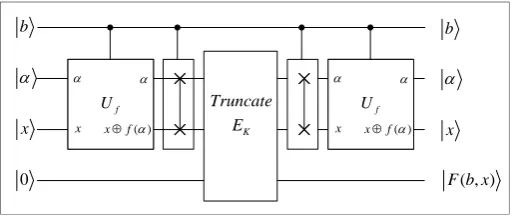
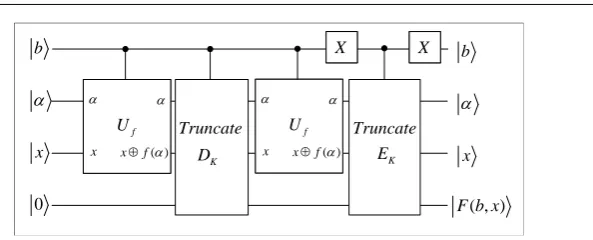
Fig. 5: A quantum circuit that computes the functionF for the attack on 1K-Feistel. Please refer to [35] for the relevant quantum gates and circuit symbols
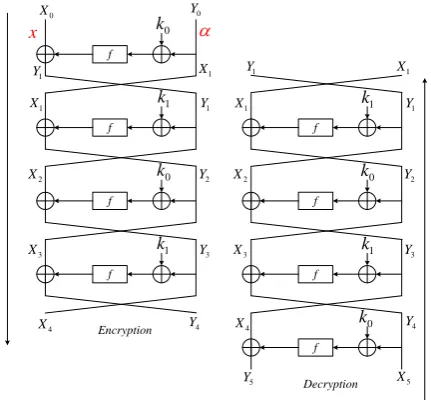
As shown in Figure 4,EK(x, α)R=Y4,EK(X1, Y1)L=X5=Y4,X1=α andY1=f(k⊕α)⊕xhold.
Thus, fromEK(x, α)R=EK(X1, Y1)L=Y4, we deduce
F(0, x) =EK(x, α)R=EK(α, f(k⊕α)⊕x)L=F(1, x⊕f(α)⊕f(k⊕α)). (7)
SoF(b, x) is a function with periods= 1kf(α)⊕f(k⊕α) and the period could be retrieved by applying Simon’s algorithm. According to Sect. 2.2, the time complexity is aboutl= 2(n/2+1+pn/2 + 1) repetitions of Simon’s algorithm to recover s, which is equivalent to l= 2(n/2 + 1 +pn/2 + 1) quantum queries of the encryption process, using aboutn+ 1 qubits.
In order to simulate F(b, x), we have to truncate the output of EK to get the right half or left half n/2 bits. Thanks to Hosoyamada and Sasaki’s work [19] shown in Sect. 2.3, we can truncate outputs of quantum oracles with ease. The quantum circuit ofF(b, x) is shown in Figure 5. Iff is reversible, such as GOST [18], Camellia [17] etc., it is easy to getkwith the knowledges. Iff is irreversible, such as for DES and its variants, it is possible to recover the key by studying the detailed structure of their round function as shown in Sect. 3.2.1. Note that, the attack works for any number of rounds of 1K-Feistel, we only give a 4-round example attack in this section.
3.2.1 The application to 1K-DES
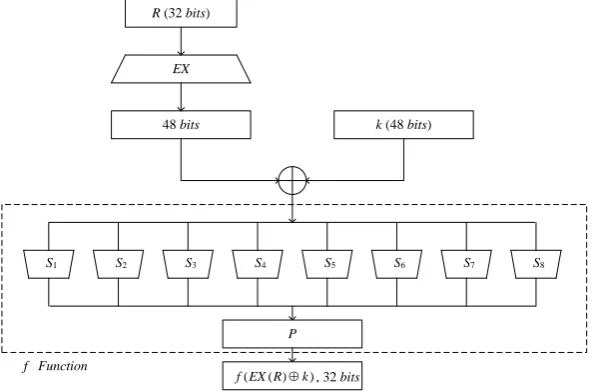
The round function of DES is shown in Figure 6. We define that 1K-DES uses only one 48-bit key in every round. The 32-bit right branch, i.e.,Rbranch word is expanded byEXfunction to 48-bit, then it is XORed by 48-bitk. Thef function is applied to the 48-bit state, and outputs 32-bit word. The s-boxes map 6-bit input into 4-bit output. We only give S1 s-box in Table 2 as an example. The quantum advanced slide
attack on 1K-DES is shown in Figure 7. The period function is therefore defined as follows:
F :{0,1} × {0,1}n/2 → {0,1}n/2
b, x 7→
EK(x, α)R ifb= 0, EK(α, f(EX(α))⊕x)L ifb= 1,
R (32 bits)
48 bits k (48 bits)
EX
S1 S2 S3 S4 S5 S6 S7 S8
P
( ( ) )
f EX Rk, 32 bits f Function
Fig. 6: DES Round Function
S1 0 1 2 3 4 5 6 7 8 9 10 11 12 13 14 15
0 14 4 13 1 2 15 11 8 3 10 6 12 5 9 0 7
1 0 15 7 4 14 2 13 1 10 6 12 11 9 5 3 8
2 4 1 14 8 13 6 2 11 15 12 9 7 3 10 5 0
3 15 12 8 2 4 9 1 7 5 11 3 14 10 0 6 13
Table 2: DES s-box:S1
f
k
f
f
f
Encryption
f
f
f
f
Encryption
k
k
k
k
k
k
k
xX0 Y0
1
X Y1
1
X Y1
2
X 2
Y
4
X Y4
3
X
3
Y
2
X 2
Y
3
X
3
Y
4
X
4
Y
5
X Y5
EX
EX-1
EX
EX-1
EX
EX-1
EX
EX-1
EX
EX-1
EX
EX-1
EX
EX-1
EX
EX-1
Fig. 7: Quantum Attack on 1K-DES Block Cipher
Then,
F(0, x) =EK(x, α)R=EK(α, f(k⊕EX(α))⊕x)L=F(1, x⊕f(EX(α))⊕f(k⊕EX(α))). (9)
Thus, s= 1kf(EX(α))⊕f(k⊕EX(α)) is the period of F function. Suppose we have recovereds by Simon’s algorithm, and thenf(k⊕EX(α)) is known. Note that,Si(i= 1,2, ...,8) is mapping 6-bit input
Quantum Attacks on Some Feistel Block Ciphers 9
f
0 k
f
f
f
0
X Y0
Encryption
f
f
f
f
Decryption
1 k
0 k
1 k
1 k
0 k
1 k
0 k
1
X Y1
2
X Y2
3
X Y3
4
X Y4
1
Y X1
4
X Y4
1 X 1
Y
1
X Y1
2
X Y2
3
X Y3
5
Y X5
x
Fig. 8: Quantum Attack on 2K-Feistel Block Cipher to Recoverk0
6-bit keys for each s-box. For example, suppose that the output ofS1 is 14, we could get 4 different 6-bit
inputs as shown in Table 2.
Note that, we could use a differentα, to construct a different period functionF. We selectαso that in each s-box, the 6-bit inputs are different for eachα. For example, the 6-bit inputs of S1 for all selectedα
should be different. Hence, we could get differentf(k⊕EX(α)) with differentα. It is expected that with 2 different α, we could uniquely determine one correct 48-bitk by uniquely determining each 6-bit key separately for each s-box. According to Sect. 2.2, the time complexity is 2l = 2×2×(33 +√33)≈ 155 repetitions of Simon’s algorithm, which is equivalent to 155 quantum queries of the encryption process, using 65 qubits.
3.3 Quantum Slide Attack on 2K-Feistel
As shown in Figure 8, 2K-Feistel block cipher adopts round subkeys (k0, k1) iteratively and identical round
functionf.
We first define the following function using given random constantα:
F :{0,1} × {0,1}n/2 → {0,1}n/2
b, x 7→
EK(x, α)R ifb= 0, DK(f(α)⊕x, α)R ifb= 1.
(10)
As shown in Figure 8, EK(x, α)R =Y4, DK(Y1, X1)R = X5= Y4,Y1 =f(k0⊕α)⊕x,X1= αhold.
Thus, fromEK(x, α)R=DK(Y1, X1)R=Y4, we deduce
F(0, x) =EK(x, α)R=DK(f(k0⊕α)⊕x, α)R=F(1, x⊕f(α)⊕f(k0⊕α)). (11)
SoF(b, x) is a function with periods= 1kf(α)⊕f(k0⊕α). According to Sect. 2.2, the time complexity
is about l= 2(n/2 + 1 +pn/2 + 1) repetitions of Simon’s algorithm to recovers, which is equivalent to l = 2(n/2 + 1 +pn/2 + 1) quantum queries of the encryption process, using about n+ 1 qubits. The quantum circuit of F(b, x) is shown in Figure 9, and please refer to [35] for the relevant quantum gates and circuit symbols. Iff is reversible, such as GOST [18], Camellia [17], etc., it is easy to getk0 with s.
Iff is irreversible, such as 2K-DES, it is easy to recoverk0 with the same strategy as Sect. 3.2.1 and the
same complexity. Note that, the attack works for any even number of rounds of 2K-Feistel, we only give a 4-round example attack in this section.
To getk1, we design a similar quantum period function in Equation (12).
F :{0,1} × {0,1}n/2 → {0,1}n/2
b, x 7→
DK(α, x)L ifb= 0, EK(α, f(α)⊕x)L ifb= 1.
b
x
0
f
U
( ) xf
x f
U
( ) xf
x
K
E
( , )
F b x Truncate
X X
K
D
Truncate
f
U
( ) xf
x f
U
( ) xf
x
b
x
X X
Fig. 9: A quantum circuit that computes the functionF for 2K-Feistel. TheX gate is the quantum equivalent of the NOT gate that flips the qubit|0iand|1i.
f
0 k
f
f
f 1
X Y1
Encryption f
f
f
f
Decryption
1 k
0 k
1 k 1
k
0 k
1 k
0 k
2
X Y2
3
X Y3
4
X Y4
5
X Y5
3
X Y3
0
X
0
Y
0
X Y0
1
X Y1
2
X Y2
4
Y X4
x
Fig. 10: Quantum Attacks on 2K-Feistel Block Cipher to Recoverk1
As shown in Figure 10,DK(α, x)L=Y4,EK(X1, Y1)L =X5=Y4,Y1 =f(k1⊕α)⊕x,X1 =αhold.
Thus, fromDK(α, x)L=EK(X1, Y1)L=Y4, we deduce
F(0, x) =DK(α, x)L=EK(α, f(k1⊕α)⊕x)L=F(1, x⊕f(α)⊕f(k1⊕α)). (13)
SoF(b, x) is a function with periods= 1kf(α)⊕f(k1⊕α), andk1 is got consequently.
3.4 Quantum Slide Attack on 4K-Feistel
As shown in Figure 11, 4K-Feistel block cipher adopts round subkeys (k0, k1, k2, k3) iteratively and identical
round functionf. Given arbitrary constantα∈Fn/22 , define:
F :{0,1} × {0,1}n/2 → {0,1}n/2
b, x 7→
EK(x, α)R ifb= 0, DK(f(α)⊕x, α)R ifb= 1.
(14)
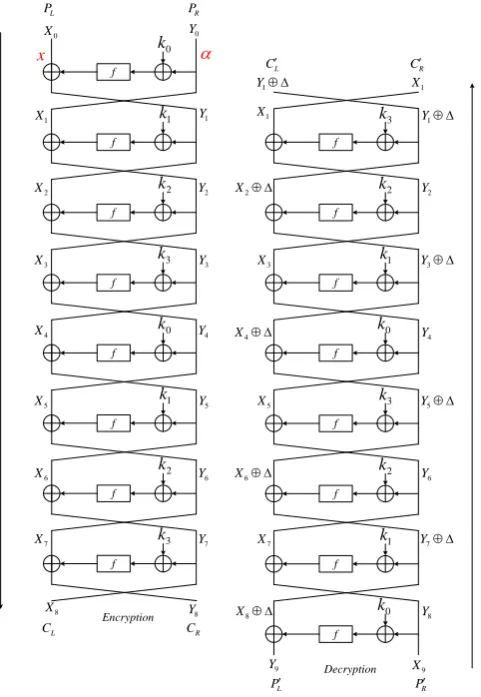
As shown in Figure 11, EK(x, α)R =Y8, DK(Y1⊕∆, X1)R =X9 =Y8, Y1 =f(k0⊕α)⊕x, X1= α
hold, where∆=k1⊕k3. Thus, fromEK(x, α)R=DK(Y1⊕∆, X1)R=Y8, we deduce
F(0, x) =EK(x, α)R=DK(f(k0⊕α)⊕x⊕∆, α)R=F(1, x⊕f(α)⊕f(k0⊕α)⊕∆). (15)
So, F(b, x) is a function with period s = 1kf(α)⊕f(k0⊕α)⊕∆. According to Sect. 2.2, the time
complexity is about l = 2(n/2 + 1 +pn/2 + 1) repetitions of Simon’s algorithm to recover s, which is equivalent to l = 2(n/2 + 1 +pn/2 + 1) quantum queries of the encryption process, using about n+ 1 qubits.
Similar to the attack on 2K-Feistel, we could also design a similar period function, with period s0 = 1kf(α)⊕f(k3⊕α)⊕∆0, where∆0=k0⊕k2. Note that, the attack works for any 4m-round 4K-Feistel,
Quantum Attacks on Some Feistel Block Ciphers 11
f
0 k
f
f
f
f
f
f
f
1 k
2 k
3 k
3 k
2 k
1 k
0 k
f
0 k
f
f
f
Encryption
1 k
2 k
3 k
f
f
f
f
Decryption
3 k
2 k
1 k
0 k
0
X Y0
1
X
1
Y
2
X Y2
3
X Y3
4
X Y4
5
X Y5
6
X Y6
7
X Y7
8
X Y8
1
X
1
Y X1 Y1
2
X Y2
3
X Y3
4
X Y4
5
X Y5
6
X Y6
7
X Y7
8
X Y8
9
Y X9
x
L
P PR
L
P PR
L
C CR
L
C CR
Fig. 11: Quantum Attacks on 4K-Feistel Block Cipher
We follow the the assumption made by the 2K-/4K-Feistel’s designers, i.e., Biryukov and Wagner, that the round function f is simple, just like the round function of GOST [18], Camellia [17], DES [17], etc. Hence, it is easy to get the secret keys by the knowledge of sands0, when looking into the details of the round function. We give an example attack on 4K-DES in Sect. 3.4.1.
3.4.1 Application to 4K-DES
As shown in Figure 12, 4K-DES block cipher adopts four 48-bit round subkeys (k0, k1, k2, k3) iteratively.
Given arbitrary constantα∈Fn/22 , the period function is defined as follows:
F :{0,1} × {0,1}n/2→ {0,1}n/2
b, x 7→
EK(x, α)R ifb= 0, DK(f(EX(α))⊕x, α)R ifb= 1.
(16)
As defined in Sect. 3.2.1,EX is the expand function. Let∆=EX−1(k1⊕k3), our attack works only
whenEX(∆) =k1⊕k3. SinceEX−1 maps 48-bit wordk1⊕k3 to a 32-bit word,EX(∆) =k1⊕k3 holds
with probability 2−16. Thus, our attack on 4K-DES only works for 1/216 of all keys, which is the same as
Biryukov and Wagner’s attack [24].
SinceEK(x, α)R=Y4,DK(Y1⊕∆, X1)R=X5=Y4,Y1=f(k0⊕EX(α))⊕x,X1=αhold, we could
deduce the following equation fromEK(x, α)R=DK(Y1⊕∆, X1)R=Y4.
F(0, x) =EK(x, α)R=DK(f(k0⊕EX(α))⊕x⊕∆, α)R
=F(1, x⊕f(EX(α))⊕f(k0⊕EX(α))⊕∆). (17)
So, F(b, x) is a function with periods = 1kf(EX(α))⊕f(k0⊕EX(α))⊕∆. When given the value
f
0
k
f
f
f
f
f
f
f 1
k
2
k
3
k
3
k
2
k
1
k
0
k
0X Y0
1 X
2
X Y2
3
X Y3
1 X
1 Y
1
X Y1
2
X Y2
3
X Y3
4 X
4 Y
x
L
P PR
L
C CR
EX
EX-1
EX
EX-1
EX
EX-1
EX
EX-1
EX
EX-1
EX
EX-1
EX
EX-1
EX
EX-1
4 X
4 Y
5 X 5
Y Encryption
Decryption
L
P PR
L
C CR
1 Y
Fig. 12: Quantum Attack on 4K-DES Block Cipher
S
16-bit kin 4-bit kout
6-bit in 4-bit out
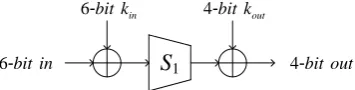
Fig. 13: Input and output of s-boxS1
For example, as shown in Figure 13, if we use three different α to run Simon’s algorithm1, we could get three valid input-output pairs of s-boxS1, i.e., (in1, out1), (in2, out2) and (in3, out3). We guess the 6-bit kin, we could get 3 candidate kout by the three pairs, which are equal with probability 2−8. Thus, at
last only one (kout, kin) pair is expected to remain. After calculate (kout, kin) for each of the 8 s-boxes
respectively, we find the right key (k0, EX−1(k1⊕k3)). According to Lemma 4 of [14], the time complexity
is 3l = 3×2×(33 +√33) ≈ 233 repetitions of Simon’s algorithm, which is equivalent to 233 quantum queries of the encryption process, using 65 qubits.
4 Quantum Key-recovery Attack on GOST Block Cipher
4.1 GOST Block Cipher
GOST [18] is a block cipher designed during the 1970’s by the Soviet Union as an alternative to the American DES. Similar to DES, it has a 64-bit Feistel structure, employing 8 s-boxes and is intended for civilian use. Unlike DES, it has a significantly larger key (256 bits instead of just 56), more rounds (32 compared with DES’s 16), and uses different sets of s-boxes. After the USSR had been dissolved, GOST was accepted as a Russian standard.
Suppose the input state of i-th round function is (Xi−1, Yi−1), where Xi−1 andYi−1 are the left and
right branches of thei-th round function fori= 1,2, ...,32. The first round of GOST is given in Figure 14, the only difference for each round is the subkeys. The symbols used are
Quantum Attacks on Some Feistel Block Ciphers 13
0
X Y0
11
1
X Y1
0
k 0
s
1
s
2
s
3
s
4
s
5
s
6
s
7
s
Fig. 14: The first round of GOST block cipher.
0
X Y0
11
S
1
X Y1
11
S
2
X Y2
0
k
1
k
Fig. 15: 2-round of GOST block cipher
+ modular addition,
− modular subtraction,
⊕ bitwise addition,
≪j cyclic left rotation byjbits , ≫j cyclic right rotation byjbits. X[i1, .., ij] thei1, .., ijth least significant bits of
the 32-bit wordX.
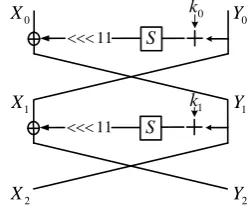
In the round function, the round key is (modular) added with 32-bit right branch; then the 32-bit state is substituted byS, which is composed of 8 4×4 s-boxes in parallel; then rotating left the 32-bit state by 11 bits. It has a simple key schedule: 256-bit key is divided into eight 32-bit words k0, k1· · ·, k7 and the
sequence of round keys is given ask0,· · ·, k7, k0,· · ·, k7, k0,· · ·, k7, k7, k6,· · ·, k1, k0.
4.2 Quantum Attack on 30-round GOST Block Cipher
We first give some properties of GOST.
Property 1 As shown in Figure 15, for a two round GOST, if we know (X0, Y0) and (X2, Y2), thenk0 =
S−1((X0⊕X2)≫11)−Y0,k1=S−1((Y0⊕Y2)≫11)−X2.
Property 2 (Reflection Property [36]) If the input state of the 25th round meets condition X24 =Y24,
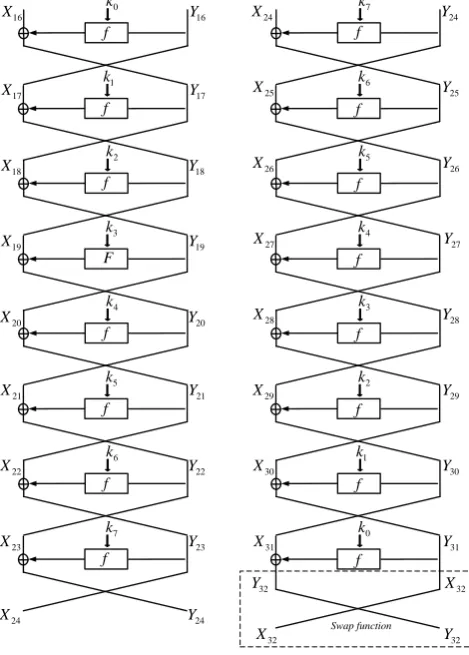
then the last 16-round of 32-round GOST acts as an identity by ignoring the last swap function, i.e., the input of 17th round is (X16, Y16), and the output of 32th round is (X32, Y32) = (Y16, X16).
Proof As shown in Figure 16, it is easy to see that,X23=fk7(Y23)⊕Y24,Y25=fk7(Y24)⊕X24. SinceX24=
Y24 andY23=X24, we getX23=Y25. WhileY23=X24=X25holds. Thus, we get (X23, Y23)=(Y25, X25). X22 = fk6(Y22)⊕Y23, Y26 = fk6(Y25)⊕X25. Since (X23, Y23)=(Y25, X25) and Y22 = X23, we get X22=Y26. WhileY22=X23=Y25=X26 holds. Thus, we get (X22, Y22)=(Y26, X26). Iterating the above
procedures, finally, we get the conclusion of Property 2, i.e., (X32, Y32) = (Y16, X16).
f 0 k
f 1 k
f 2 k
F 3 k
f 4 k
f 5 k
f 6 k
f 7 k
f 7 k
f 6 k
f 5 k
f 4 k
f 3 k
f 2 k
f 1 k
f 0 k 16
X Y16
17
X Y17
18
X Y18
19
X Y19
20
X Y20
21
X Y21
22
X Y22
23
X Y23
24
X Y24
24
X Y24
25
X Y25
26
X Y26
27
X Y27
28
X Y28
29
X Y29
30
X Y30
31
X Y31
32
X Y32
Swap function 32
Y X32
Fig. 16: Reflection Property of the last 16-rounds GOST block cipher.
Rounds 3-8
2
,
3,
,
7k k
k
Rounds 9-10
0
,
1k k
Rounds 11-16
2
,
3,
,
7k k
k
16-round RP
C
C
P
Fig. 17: Attack on 30-round reduced GOST
iterations. In the following, we combine the reflection property and Grover’s algorithm to attack 30-round GOST block cipher in 2112 Grover iterations.
Note that the input and output are (X2, Y2) and (X32, Y32). We first construct the following quantum
algorithm A: Preparing the initial 32×7-bit register |0i⊗224. Apply Hadamard transform H⊗224 to the register to attain an equal superposition (omitting the amplitudes):
X
X2,k2,k3,...,k7∈{0,1}32
|X2i|k2, k3, ..., k7i=|ϕi, (18)
whereX2 is the left half of the input of the 30-round GOST; the right halfY2 is a constant.
According to the Reflection Property 2, whenX24=Y24, the last 16-round is an identical transformation
by ignoring the last swap function. Thus, given 232inputs (X2, Y2), it is expected that there is one (X2, Y2)
pair that satisfies the conditionX24=Y24, then (X16kY16) = (Y32kX32).
Once we get the right (X2, Y2) somehow, we guessk2, k3, ..., k7, then encrypt for round 3-8 to get the
internal state (X8, Y8), decrypt (X16kY16) for round 11-16 to get (X10, Y10). According to Property 1, we
could deducek0 andk1from (X8, Y8) and (X10, Y10).
Considering the superposition |ϕi, assume that we had a classifier B : {0,1}32×7 → {0,1}, which partitions |ϕi into a good subspace and a bad subspace: |ϕi= |ϕ1i+|ϕ0i, where |ϕ1iand |ϕ0i denote
the projection onto the good subspace and bad subspace, respectively. In the good subspace|ϕ1i, (X2, Y2)
meets the Reflection Property andk2, k3, ..., k7are the right subkeys. For the good state|xi,B(x) = 1.
We construct the quantum classifier B. DefineB: {0,1}32×7→ {0,1}that maps (X
2, k2, k3, ..., k7) to
Quantum Attacks on Some Feistel Block Ciphers 15
1. For (X2, Y2), derive (X32, Y32) from the 30-round encryption oracle, note that Y2 is a random given
constant.
2. Use (k2, k3, ..., k7), (X2, Y2) and (X32, Y32) to derivek0, k1 from Property 1.
3. Check the derived (k0, k1, k2, ..., k7) by 5 plaintext-ciphertext pairs using the 30-round encryption oracle.
If the check is right, output 1. Else output 0.
We classify a state|X2i|k2, k3, ..., k7iis a good state if and only ifB(X2, k2, k3, ..., k7) = 1. The classifier
Boutputs good under two conditions:
a) Condition 1. (X2, Y2) meets the Reflection Property. According to the above cryptanalysis, it is right
with a probability of 2−32.
b) Condition 2.k2, k3, ..., k7are the right subkeys. It is right with a probability 2−192.
If we measure|φi, it produces the good state with probabilityp:
p= Pr[|X2i|k2, k3, ..., k7iis good]
= Pr[B(X2, k2, k3, ..., k7) = 1]
= Pr[Condition 1]·Pr[Condition 2]
≈2−32×2−32×6= 2−224.
(19)
Our classifier B defines a unitary operator SB that conditionally change the sign of the quantum state
|X2i|k2, k3, ..., k7i:
− |
X2i|k2, .., k7iifB(X2, k2, .., k7) = 1
|X2i|k2, .., k7iifB(X2, k2, .., k7) = 0 (20)
The complete amplification process is realized by repeatedly for ttimes applying the unitary operator Q=−AS0A−1SB to the state|ϕi=A|0i, i.e.QtA|0i.
Initially, the angle between |ϕi=A|0iand the bad subspace|ϕ0iisθ, where sin2(θ) =p= hϕ1|ϕ1i.
Whenpis smaller enough,θ≈arcsin(√p)≈2−2242 . According to Theorem 1, aftert=bπ 4θc=b
π 4×2−2242 c ≈ 2112 Grover iterations Q, the angle between resulting state and the bad subspace is roughly π/2. The
probabilityPgoodthat the measurement yields a good state is aboutsin2(π/2) = 1.
The whole attack needs 224 qubits and 2112Grover iterations, where each Grover iteration needs about 6 quantum queries of 30-round GOST. Hence, it costs about 2114.6 quantum queries of the encryption process, which is more efficient than the trivial quantum search (256 qubits and 2128Grover iterations).
4.3 Quantum Attack on Full-round GOST Block Cipher
Property 3 (Fixed Point Property [37]) As shown in Figure 18, assume that when we encrypt a 64-bit
plaintext P =(X0, Y0), we obtain (X8, Y8)=(X0, Y0) after 8 encryption rounds. Since rounds 9-16 and
17-24 are identical to rounds 1-8, we obtain P after 16 and 24 encryption rounds as well. In rounds 25-32, the round keys k0, ..., k7 are applied in the reverse order, and we obtain some arbitrary ciphertext C = (X32, Y32). The knowledge of P andC immediately gives us the two input-output pairs of the first
8-round, i.e., (P, P) = (X0kY0, X0kY0) and ( ¯C,P¯) = (Y32kX32, Y0kX0). The probability to get a fix point
of the first 8 rounds is 2−64.
Proof As shown in Figure 18, once we get an input-output pair (P, P) = (X0kY0, X0kY0) for the rounds
1-8, we get the input-output pair (P, C) for rounds 25-32. We focus on rounds 25-32 shown in Figure 16, different from rounds 1-8, the subkeys are in inverse order. If we consider rounds 25-32 in inverse direction, i.e., from 32th round to 25th round, the only difference from rounds 1-8 is that there is an additional swap function in the first round but not in the last round. So, ( ¯C,P¯) = (Y32kX32, Y0kX0) is also an input-output
pair for rounds 1-8.
Property 4 As shown in Figure 19, if we know two valid input-output pairs of the 3-round GOST, i.e.,
(X5kY5, X8kY8) and (X50kY50, X80kY80), then we can easily determine the three subkeysk5, k6, k7.
Proof As shown in Figure 19, we get
(S(Y5+k5)≪11)⊕X5= (S(X8+k7)≪11)⊕Y8, (21)
(S(Y50+k5)≪11)⊕X50 = (S(X80+k7)≪11)⊕Y80. (22) We rewrite Equation (21), as S(Y5+k5)⊕S(X8+k7) = (X5⊕Y8)≫11. Note that S is composed of
Rounds 1-8 0
, ,
1,
7k k
k
Rounds 9-16 Rounds 17-24
P
Rounds 25-32C
P
P
0 1 7P
, ,
,
k k
k
k k
0, ,
1,
k
7k k
7,
6,
,
k
0Fig. 18: Attack on the Full-round GOST
5
X Y5
11
S
6
X Y6
11
S
7
X Y7
5 k
6 k
11
S
8
X Y8
7 k
Fig. 19: 3-round GOST.
could determineX8[3, ..,0] +k7[3, ..,0] and getk7[3, ..,0] by (modular 24) subtractingX8[3, ..,0]. Similarly,
by Equation (22), we could also derive another value ofk7[3, ..,0], if they are not equal, then the guessing of k5[3,2,1,0] is wrong. After we determine a right candidatek5[3,2,1,0] andk7[3,2,1,0], we could continue
to guess and determine k5[7,6,5,4] and k7[7,6,5,4] with the known carry bits of the previous nibbles.
Finally, we are expected to get the right candidatek5, k7. Then we computeY6= (S(Y5+k5)≪11)⊕X5.
Thus we get k6 = S−1((Y5⊕X8) ≫ 11)−Y6. Totally, we only use 8×24×2 + 2×8 = 272 s-boxes
operations without any memory cost, which approximate one encryption of GOST (it needs 8×32 = 256 s-boxes operations).
A Classical Attack:
Using Property 3 and 4, we could devise a classical attack without any memory complexity. We list the brief steps of the classical attack here:
1) For each of 264 plaintexts, and for each of 2160 key guessingk0, k1, ..., k4:
(a) Construct two input-output pairs of rounds 1-8 according to Property 3, i.e., (P, P) and ( ¯C,P¯). Use Property 4 to computek5, k6, k7.
(b) Use 5 additional plaintext-ciphertext pairs to checkk0, k1, ..., k6, k7, if it is right, return the key.
The time complexity of the above classical attack is 264+160 = 2224. The data complexity is 264, while the best previous attack only use 232 data complexity with similar time complexity as shown in Table 1. However, our attack do not use any memory cost, which is very important to devise an efficient quantum algorithm. Since quantum memory is equivalent to the number of qubits in the circuit, which is very expensive.
The Quantum Attack:
In our quantum attack on full-round GOST, we first construct the following quantum algorithmA: Prepar-ing the initial 32×7-bit register |0i⊗224. Apply Hadamard transform H⊗224 to the register to attain an equal superposition (omitting the amplitudes):
X
X0,Y0,k0,k1,...,k4∈{0,1}32
|X0, Y0i|k0, k1, ..., k4i=|ϕi. (23)
According to Property 3, once we get the right P =(X0, Y0) that meets the fix point property, we get
two input-output pairs of the first 8 rounds.
Considering the superposition |ϕi, assume that we had a classifier B : {0,1}32×7 → {0,1}, which
Quantum Attacks on Some Feistel Block Ciphers 17
projection onto the good subspace and bad subspace, respectively. In the good subspace|ϕ1i,P = (X0, Y0)
meets the fixed point property andk0, k1, ..., k4are the right subkeys. For the state|xiin the good subspace,
B(x) = 1.
We construct the quantum classifierB. DefineB: {0,1}32×7→ {0,1}that maps (X0, Y0, k0, k1, ..., k4)
to 0 and 1:
1. For (X0, Y0), derive (X32, Y32) from the encryption oracle of GOST.
2. Suppose (X0, Y0) meets the fix point property, use (k0, k1, ..., k4) to derivek5, k6, k7 from Property 4.
3. Check the derived (k0, k1, k2, ..., k7) by 5 plaintext-ciphertext pairs using the GOST encryption oracle.
If the check is right, output 1. Else output 0.
We classify a state|X0, Y0i|k0, k1, ..., k4iis a good if and only ifB(X0, Y0, k0, k1, ..., k4) = 1. The classifier
Boutputs good under two conditions:
a) Condition 1. (X0, Y0) meets the Property 3. It is right with a probability of 2−64.
b) Condition 2.k0, k1, ..., k4are the right subkeys. It is right with a probability 2−160.
If we measure|φi, it produces the good state with probabilityp:
p= Pr[|X0, Y0i|k0, k1, ..., k4iis good]
= Pr[B(X0, Y0, k0, k1, ..., k4) = 1]
= Pr[Condition 1]·Pr[Condition 2]
≈2−64×2−32×5= 2−224.
(24)
Our classifier B defines a unitary operator SB that conditionally change the sign of the quantum state
|X0, Y0i|k0, k1, ..., k4i:
−|
X0, Y0i|k0, k1, ..., k4iifB(X0, Y0, k0, k1, ..., k4) = 1
|X0, Y0i|k0, k1, ..., k4iifB(X0, Y0, k0, k1, ..., k4) = 0 (25)
The complete amplification process is realized by repeatedly for ttimes applying the unitary operator Q=−AS0A−1SB to the state|ϕi=A|0i, i.e.QtA|0i.
Initially, the angle between |ϕi=A|0iand the bad subspace|ϕ0iisθ, where sin2(θ) =p= hϕ1|ϕ1i.
Whenpis smaller enough,θ≈arcsin(√p)≈2−2242 . According to Theorem 1, aftert=bπ 4θc=b
π 4×2−2242 c ≈ 2112 Grover iterations Q, the angle between resulting state and the bad subspace is roughly π/2. The
probability Pgood that the measurement yields a good state is about sin2(π/2) = 1. The whole attack
needs 224 qubits and 2112 Grover iterations where each Grover iteration needs about 7 quantum queries of GOST encryption. Hence, it costs about 2114.8 quantum queries of the encryption process.
5 Conclusion
In this paper, we have studied several Feistel block ciphers against quantum attackers, including the attacks on 1K-/2K-/4K-Feistel and 1K-/2K-/4K-DES in polynomial time and the attacks on GOST which are faster than the quantum brute force search attack by a factor of 213.2. Through this study, we believe that the communities should continue to deepen the understanding of quantum security of symmetric cryptographic schemes, as more plausible attacks might be found following quantum strategies.
6 Acknowledgements
We would like to thank the anonymous reviewers for their important comments on this paper. This work is supported by National Key Research and Development Program of China (No. 2017YFA0303903), the National Natural Science Foundation of China (No. 61902207), the National Cryptography Development Fund (No. MMJJ20180101, MMJJ20170121).
References
[1] Shor P W. Polynomial-time algorithms for prime factorization and discrete logarithms on a quantum computer. SIAM Journal on Computing, 1997, 26(5): 1484–1509.
[2] Rivest R L, Shamir A, Adleman L. A Method for obtaining digital signatures and public-key cryptosystems. Commun. ACM, 1978, 21(2): 120–126.
[4] Kaplan M, Leurent G, Leverrier A, Naya-Plasencia M. Breaking symmetric cryptosystems using quantum period finding. In: Robshaw M, Katz J, eds. Advances in Cryptology - CRYPTO 2016. Lecture Notes in Computer Science, Vol 9815. Berlin: Springer-Verlag, 2016. 207–237.
[5] Zhandry M. How to construct quantum random functions. In: 53rd Annual IEEE Symposium on Foundations of Computer Science, FOCS 2012, New Brunswick, NJ, USA, October 20-23, 2012, pages 679–687. IEEE Computer Society, 2012.
[6] Kaplan M, Leurent G, Leverrier A, Naya-Plasencia M. Quantum Differential and Linear Cryptanalysis. IACR Trans. Symmetric Cryptol., 2016(1):71–94.
[7] Hosoyamada A, Sasaki Y, Xagawa K. Quantum multicollision-finding algorithm. IACR Cryptology ePrint Archive 2017, 864 (2017)
[8] Hosoyamada A, Sasaki Y: Cryptanalysis against symmetric-key schemes with online classical queries and offline quantum computations. In: Smart, N.P. (ed.) CT-RSA 2018. LNCS, vol. 10808, pp. 198–218. Springer, Cham (2018).
[9] Chailloux A, Naya-Plasencia M, Schrottenloher A. An efficient quantum collision search algorithm and implications on symmetric cryptography. Cryptology ePrint Archive, Report 2017/847 (2017)
[10] Boneh D, Zhandry M. Secure signatures and chosen ciphertext security in a quantum computing world. In: Canetti R, Garay J A, eds. Advances in Cryptology - CRYPTO 2013. Lecture Notes in Computer Science, Vol 8043. Berlin: Springer-Verlag, 2013. 361–379.
[11] Boneh D, Zhandry M. Quantum-secure message authentication codes. In: Thomas Johansson and Phong Q. Nguyen, editors, Advances in Cryptology - EUROCRYPT 2013, 32nd Annual International Conference on the Theory and Applications of Cryptographic Techniques, Athens, Greece, May 26-30, 2013. Proceedings, volume 7881 of Lecture Notes in Computer Science, pages 592–608. Springer, 2013.
[12] Kuwakado H, Morii M. Security on the quantum-type even-mansour cipher. In: International symposium on informa-tion theory and its applicainforma-tions, ISITA 2012. IEEE, 2012. 312–316.
[13] Kuwakado H, Morii M. Quantum distinguisher between the 3-round feistel cipher and the random permutation. In: International symposium on information theory, ISIT 2010. IEEE, 2010. 2682–2685.
[14] Leander G, May A. Grover meets simon - quantumly attacking the FX-construction. In: Takagi T, Peyrin T, eds. Advances in Cryptology - ASIACRYPT 2017, Part II. Lecture Notes in Computer Science, Vol 10625. Cham: Springer, 2017. 161–178.
[15] Moody D. The Ship Has Sailed: the NIST Post-quantum Cryptography ”Competition”(Invited talk). In: Advances in Cryptology - ASIACRYPT 2017. Berlin: Springer, 2017.
[16] Feistel H, Notz W A, Smith J L. Some cryptographic techniques for machine-to-machine data communications. In: Proceedings of the IEEE, 1975, 63(11): 1545–1554.
[17] International Organization for Standardization(ISO). International Standard- ISO/IEC 18033-3, Information technology-Security techniques-Encryption algorithms -Part 3: Block ciphers. 2010.
[18] National Soviet Bureau of Standards. Information Processing System - Cryptographic Protection - Cryptographic Algorithm GOST 28147-89 (1989)
[19] Hosoyamada A, Sasaki Y. Quantum Demiric-Sel¸cuk Meet-in-the-Middle Attacks. Applications to 6-Round Generic Feistel Constructions. In: Catalano D, De Prisco R, eds. Security and Cryptography for Networks - 11th International Conference, SCN 2018. Lecture Notes in Computer Science, Vol 11035. Springer, Cham, 2018. 386–403.
[20] Dong X, Wang X. Quantum key-recovery attack on Feistel structures. Science China Information Sciences, 2018, 61(10): 102501. https://doi.org/10.1007/s11432-017-9468-y
[21] Dong X, Li Z, Wang X. Quantum cryptanalysis on some generalized Feistel schemes. Science China Information Sciences, 2018, 62(2): 22501.
[22] Ito G, Hosoyamada A, Matsumoto R, Sasaki Y, Iwata T. Quantum Chosen-Ciphertext Attacks Against Feistel Ciphers. In: Matsui M, eds. Topics in Cryptology - CT-RSA 2019 - The Cryptographers’ Track at the RSA Conference 2019, San Francisco, CA, USA, March 4-8, 2019, Proceedings. Lecture Notes in Computer Science, Vol 11405. Springer, 2019. 391–411.
[23] Simon D R. On the power of quantum computation. SIAM Journal on Computing, 1997, 26(5):1474–1483.
[24] Biryukov A, Wagner D. Advanced Slide Attacks. In: Preneel B, eds. Advances in Cryptology - EUROCRYPT 2000. Lecture Notes in Computer Science, Vol 1807. Springer, Berlin, Heidelberg, 2000. 589–606.
[25] Bonnetain X, Naya-Plasencia M, Schrottenloher A. On Quantum Slide Attacks. Cryptology ePrint Archive, Report 2018/1067. To appear at SAC 2019.
[26] Dong X, Dong B, Wang X. Quantum Attacks on Some Feistel Block Ciphers. Cryptology ePrint Archive, Report 2018/504.
[27] Damg˚ard I, Funder J, Nielsen J.B, Salvail L: Superposition attacks on cryptographic protocols. In: Padr´o, C. (ed.) ICITS 2013. LNCS, vol. 8317, pp. 142–161. Springer, Heidelberg (2014).
[28] Santoli T, Schaffner C. Using simon’s algorithm to attack symmetric-key cryptographic primitives. Quantum Inf. Comput. 17(1&2), 65–78 (2017)
[29] Strubell E. An Introduction to Quantum Algorithms. https://people.cs.umass.edu/∼strubell/doc/quantum tutorial.pdf [30] Benoist J C. Quantum circuit representation of Grover’s algorithm. Wikimedia, Inc. (Accessed 5 January, 2011).
[Online]. Available: http://en.wikipedia.org/wiki/File: Grovers algorithm.svg
[31] Brassard G, Hoyer P, Mosca M, et al. Quantum amplitude amplification and estimation. arXiv: Quantum Physics, 2000.
[32] Biryukov A, Wagner D. Slide Attacks. In: Knudsen L, eds. Fast Software Encryption, FSE 1999. Lecture Notes in Computer Science, Vol 1636. Springer, Berlin, Heidelberg, 1999. 245-259.
[33] Biham E, Shamir A. Differential cryptanalysis of DES-like cryptosystems. J. Cryptology (1991) Vol 4, Issue 1. 3-72. [34] Matsui M. Linear Cryptanalysis Method of DES Cipher. In: Helleseth T, eds. EUROCRYPT 1993. LNCS, Vol. 765.
Springer, Heidelberg, 1994. 386-397.
[35] Nielsen M.A, Chuang I. Quantum computation and quantum information. aapt.scitation.org, 2002.
[36] Kara O. Reflection cryptanalysis of some ciphers. In: Chowdhury D R, Rijmen V, Das A, eds. Progress in Cryptology - INDOCRYPT 2008. Lecture Notes in Computer Science, Vol 5365. Berlin: Springer-Verlag, 2008. 294–307.
[37] Dinur I, Dunkelman O, Shamir A. Improved Attacks on Full GOST. In: Canteaut A, eds. Fast Software Encryption, FSE 2012. Lecture Notes in Computer Science, Vol 7549. Berlin: Springer-Verlag, 2012. 9–28.