Design and Implementation of Automatic
Hydroponics System using ARM Processor
Rajeev lochan Mishra
1, Preet Jain
2M.E. Student[Embedded System & VLSI Design], Dept. of ECE, SVITS, Indore, MP, India1 Head, Department of ECE, SVITS, Indore, MP, India2
ABSTRACT: In this paper a two electrode sensor for measuring water conductivity for the hydroponics system is presented. The sensor is designed to measure the conductivity of nutrient solution which is in the range of millisiemens (mS). These electrodes are used to regulate the nutrient in hydroponics solution according to the plant’s requirement. The automatic hydroponic system is based on low cost ARM processor that monitors and control the need of hydroponics plants. Automatic hydroponics system will boost the production by controlling the different parameters.
KEYWORDS: Hydroponics, EC, electrodes,Soil-less Cultivation, nutrient solution, PSoC4.
I. INTRODUCTION
Now a day’s due to increasing industrialization, the vegetative land area is decreasing or in other words the effective land for vegetation is becoming infertile and thus demand-supply of food is not meeting the requirement. Also due to this farm lands are being rapidly converted into housing plots that result is reduction in crop grown area especially for the vegetable which in turn cause’s heavy impact on economy.
The growth by convention system has its own limits like conventional method of farming needs manpower to control need of plant where everything should have to be manually monitored. For example to monitor the electrical conductivity (EC) one should use electronic meter to read the value and it’s a time consuming process and in this manner there is a need of periodically monitoring.
Now a day’s every system become smarter and automatic in that way there is a need of revolution in agriculture industry there is a need to find a new way for cultivation and require more accurate system for cultivation so that major thrust is needed to be given to the technology development and proliferation of vegetable production in small areas. Vegetable farming in top of building, inside areas and in poly-houses is an approach to address this concern. In that circumstances hydroponics is one of the best alternatives of conventional cultivation.
Hydroponics is a method of growing crops and vegetables without soil with the help of nutrient solution. It is the way to grow the fruits and vegetables for the year around in such places where the soil is not present or it is contaminated.
The system has following advantages-
It reduces the excess use of fertilizer.
It fosters the plant growth
It reduces manpower
It improves product quality.
And high rate of production
Paper shows the implementation of automatic hydroponics system with the help of two electrode conductivity cell including system description, prototype implementation and graphical results. Measurement is done in different conditions in terms of solution concentration, time and solution conductivity.
II.RELATED WORK
Hydroponics is one of the best alternatives of conventional cultivation but it is used in small level because of its limitations so there is a need of improvement in field. Paper published in some journals in hydroponics system in the last few years they suggested how the hydroponic system works, Plants which are best suited for hydroponic system also the use of microprocessor for nutrient control [3]. According to Kumar and Cho hydroponics waste nutrient solution can be reusable [6]. Processor based hydroponics growth chambers used in ecological life support systems this paper is all about controlling the system through virtual instrument using Lab VIEW [1]. Another paper is Development of an automatic microcontroller system for Deep Water Culture (DWC), starting of this paper gives the basic idea of deep water culture which is one type of hydroponics system later in this paper discussed the methodology used for measuring the pH value from the sensor and maintaining it to certain level also the level of the water in the reservoir is continuously maintained [2]. Research of hydroponics nutrient solution control technology this paper describe constitute of the control system of hydroponic nutrient solution and analysis the affecting factor and controlling difficulties also in this paper discussed a problem coming during the automation [4]. Control process of Electrical conductivity and pH is highly non linear process and coupling with pure time delay.
NASA has also looked to utilize hydroponics in space. Kennedy space life science lab’s plant physiologist believes that hydroponics will create advances with in space travel he terms this as a bio generative life support system [5]. Hydroponics system used in many countries especially in Israel also in some places in India but rate of production is very less and in small level. Defense Research Laboratory Haldwani in Uttaranchal made extensive work on hydroponics and suggested a model [5].
As far as water conductivity is concerned, several solutions have been proposed. The main problems associated with water-conductivity measurements are sensitivity to external disturbances, initial conductivity of water and measurement dynamic range [7].
III.SYSTEM DISCRIPTION AND PROTOTYPE
There are basically 6 types of hydroponics system and each one has their own advantages and use. For this experiment NFT system has used which is nutrient film technique system this system is a simplest system among all. For making the system cost effective plastic bottles are used which are generally used in beverages and cold drinks. There are some advantages of using these bottles irrigation system that is they are the good insulator of electric conductivity also have good water holding capability. These bottles are connected with each other and kept in a fixed angle for maintaining proper flow. Coco peat, perlite and vermiculite are used as a composed material for holding the plant in water.
Hardware unit
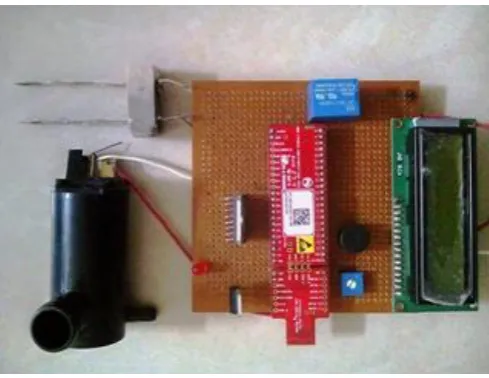
Fig .1 Basic Hardware unit of System
Basic structure of hydroponics system
The physical implementation of bottles irrigation system for tomatoes plants are shown below in fig.2 each unit of bottle is connected to other bottle for proper circulation of nutrient. Substrate of coco peat, vermiculite and perlite are kept in small cups and keep these cups inside the bottles. The substrate has very good water absorbing capability which is very useful in hydroponics. The nutrient solution flows continuously inside the bottles. The major objective of this system is to promote eco-safe vegetable production unit. It produces self sufficient, safe and sustainable vegetable production.
Fig .2 Bottles based structure of hydroponics
IV.PROCESS FLOW AND WORKING OF SYSTEM
In this work, some of the primary objectives are to regulate the nutrient solution according to plant need which enable to reduce a unnecessary use of fertilizer and make the system affordable because as mentioned above high cost of a system is one of the big problem in hydroponics so there is need such kind of system which can control the operation, improve performance and give the desire output at lower cost.
.
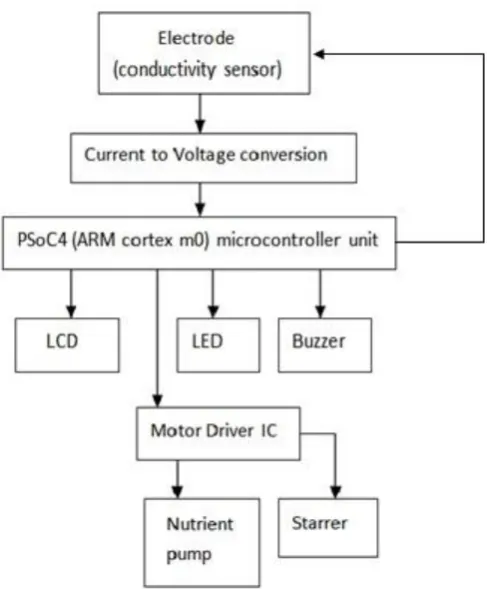
The electrodes are kept inside the solution reservoir and operated periodically with the help of microcontroller. Timer is set by microcontroller that in starting of each hour electrodes will work, when electrodes conduct the current flows inside the nutrient solution which is totally depends on the ions present inside the solution. Because ions are directly related to the water resistance means resistivity and conductivity both depends on no. of ions. Those current after that converted in to voltage and sensed by controller, microcontroller operates periodically and make decision according to need and repeat this whole procedure continuously.
Fig .3 Basic Process flow of Automatic system
V. SIMULATION/EXPERIMENTAL RESULTS
In a table below results are show which indicating that by increasing the concentration of the solution conductivity also increases, there is also variation in conductivity for the same concentration. Table also shows the temperature variation which brings crucial research challenge for temperature compensation.
Table 1 also show an average variation of conductivity for 1liter water. After the 6 reading has been made, deviation in reading is approx 6µS with average temperature of 32.4°C. This value has been used as a reference.
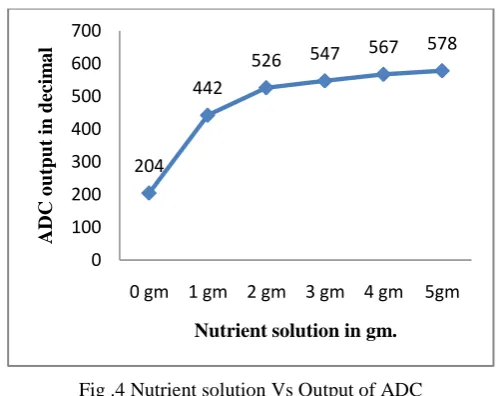
The graph shown below is a variation of result of PSoC4 ADC output with increasing the nutrient concentration, that result is obtained from ADC over LCD and taken with the help of conducting probes.
Fig .4 Nutrient solution Vs Output of ADC
Also in Fig 4, Nutrient Solution Vs ADC output, ADC output is measured in a fixed interval of nutrient solution. Output of ADC is nothing but an output voltage in decimal form which is further used to calculate conductivity.
204 442
526 547 567 578
0 100 200 300 400 500 600 700
0 gm 1 gm 2 gm 3 gm 4 gm 5gm
ADC
o
utput
in decim
a
l
Nutrient solution in gm.
Concentration Conductivity (µS) Difference Temperature (°C)
Min. Max.
0 gm 242 245 3 33.4
1 gm 1006 1011 5 32.5
2 gm 1602 1596 6 32.6
3 gm 1960 1969 9 32.3
4 gm 2437 2429 8 32.1
5 gm 2819 2814 5 32.0
Average 6
VI. CONCLUSION
Design and implementation of automatic hydroponic system are presented in this paper mainly focused on measurement of conductivity of nutrient solution. Results are in the range of mS for the nutrient solution of tomatoes. Designed system is very helpful for reducing the system cost and manpower. The EC firstly measured on drinking water for reference purpose and after that conductivity is measured of nutrient solution with different concentration. In both cases obtained result are acceptable. The system is useful in hydroponics cultivation and suitable for small space, low cost, low power and able to recycle the nutrient solution which is already used by plant. However there is need to make this system more advanced more accurate and cost effective so that formers can use this system in large scale which is challenge that must be addressed in a future, and hence system become fully automatic by controlling the other parameter such as pH, temperature, light intensity, ambient humidity, oxygen level in water. The designed prototype ensures of high rate of production. This system effectively makes the rural and urban household self sustained in vegetable consumption.
REFERENCES
[1] Asumadu, J.A., Smith, B., Dogan, N.S., Loretan, P.A., Aglan, H., “Microprocessor-based instrument for hydroponic growth chambers used in ecological life support systems Instrumentation and Measurement Technology”, IEEE Instrumentation and Measurement Technology Conference, June 4-6, 1996.
[2] Saaid, M.F., Yahya, N.A.M., Noor, M.Z.H., Ali, M.S.A.M. “A development of an automatic microcontroller system for Deep Water Culture (DWC)”, IEEE 9th International Colloquium on Signal Processing and its Applications, 8 - 10 Mac. 2013.
[3] Velazquez, L.A., Hernandez, M.A., Leon, M. Dominguez, R.B., Gutierrez, J.M. “First advances on the development of a hydroponic system for cherry tomato culture”, IEEE 10th International Conference on Electrical Engineering, Computing Science and Automatic Control (CCE), September 30-October 4, 2013.
[4] Yang Chenzhong, Huang Yinchun, Zheng Weihong, “Research of hydroponics nutrient solution control technology”, 5" World Congress on Intelligent Control and Automation, Vol.1, June 15-19, 2004.
[5] https://en.m.wikipedia.org/wiki/Hydroponics
[6] RR Kumar and JY Cho, “Reuse of Hydroponic waste solution”, Environ Sci Pollut Res (2014),
http://link.springer.com/article/10.1007/s11356-014-3024-3,2014
[7] K. Striggow and R. Dankert, “The exact theory of inductive conductivity sensors for oceanographic applications,” IEEE Journal of Oceanic Engineering, Vol. OE-10, no. 2, pp. 175–179, Apr. 1985.