Symbolic Proofs for Lattice-Based Cryptography
Gilles Barthe∗ Xiong Fan† Joshua Gancher† Benjamin Gr´egoire‡ Charlie Jacomme§ Elaine Shi†
June 14, 2019
Abstract
Symbolic methods have been used extensively for proving security of cryptographic protocols in the Dolev-Yao model, and more recently for proving security of cryptographic primitives and constructions in the computational model. However, existing methods for proving security of cryptographic construc-tions in the computational model often require significant expertise and interaction, or are fairly limited in scope and expressivity.
This paper introduces a symbolic approach for proving security of cryptographic constructions based on the Learning With Errors assumption (Regev, STOC 2005). Such constructions are instances of lattice-based cryptography and are extremely important due to their potential role in post-quantum cryp-tography. Following (Barthe, Gr´egoire and Schmidt, CCS 2015), our approach combines a computa-tional logic and deducibility problems—a standard tool for representing the adversary’s knowledge, the Dolev-Yao model. The computational logic is used to capture (indistinguishability-based) security no-tions and drive the security proofs whereas deducibility problems are used as side-condino-tions to control that rules of the logic are applied correctly. We then useAutoLWE, an implementation of the logic, to deliver very short or even automatic proofs of several emblematic constructions, including CPA-PKE (Gentry et al., STOC 2008), (Hierarchical) Identity-Based Encryption (Agrawal et al. Eurocrypt 2010), Inner Product Encryption (Agrawal et al. Asiacrypt 2011), CCA-PKE (Micciancio et al., Eu-rocrypt 2012). The main technical novelty beyond AutoLWEis a set of (semi-)decision procedures for deducibility problems, using extensions of Gr¨obner basis computations for subalgebras in the (non-)commutative setting (instead of ideals in the commutative setting). Our procedures cover the theory of matrices, which is required for lattice-based assumption, as well as the theory of non-commutative rings, fields, and Diffie-Hellman exponentiation, in its standard, bilinear and multilinear forms. Additionally, AutoLWEsupports oracle-relative assumptions, which are used specifically to apply (advanced forms of) the Leftover Hash Lemma, an information-theoretical tool widely used in lattice-based proofs.
1
Introduction
Formal methods, and in particular formal verification, have long been used for building and checking math-ematical claims of correctness or security for small but possibly very complex to moderately large and complex systems. In contrast to pen-and-paper counterparts, formally verified claims deliver higher assur-ance and independently verifiable proofs that can be replayed by third parties. Over the last 20 years, formal methods have been applied successfully to analyze the security of cryptographic protocols in the Dolev-Yao model [DY83], an idealized model in which cryptographic constructions are treated algebraically. By ab-stracting away from the probabilistic nature of cryptographic constructions, the Dolev-Yao model has served as a suitable and practical foundation for highly or fully automated tools [ABB+05, Bla01, SMCB12]. These
∗
IMDEA Software Institute. Email:[email protected]. †
Cornell University. Email:[email protected],[email protected],[email protected]. ‡
Inria Sophia-Antipolis, Email:[email protected]. §
tools have subsequently been used for analyzing numerous cryptographic protocols, including recently TLS 1.3. [CHH+17, KBB17]. Unfortunately, the Dolev-Yao model is focused on cryptographic protocols and cannot be used for reasoning about cryptographic primitives. A related approach is to use so-called refine-ment types (a.k.a. logical assertions) for reasoning about implerefine-mentations written in a functional program-ming language [SCF+13]; this approach has also been used for analyzing TLS 1.3. [BFK+13, DFK+17], but is also primarily limited to cryptographic protocols.
An alternative approach is to develop symbolic methods that reason directly in the computational model. This approach applies both to primitives and protocols, and instances of this approach have been instru-mented in tools such asCertiCrypt[BGB09],CryptHOL[Loc16]CryptoVerif[Bla06],EasyCrypt[BGHZ11, BDG+13], and FCF[PM15] (see also [IK03, BDKL10] for further approaches not supported by tools). However, these tools require significant user interaction and expertise, in particular when used for reasoning about cryptographic primitives.
A promising approach for analyzing cryptographic primitives in the computational model is to com-bine computational logics and symbolic tools from the Dolev-Yao model. Prior work has demonstrated that this approach works well for padding-based (combining one-way trapdoor permutations and random ora-cles) [BCG+13] and pairing-based cryptography [BGS15]. Broadly speaking, computational logics formal-ize game-playing security proofs; each step of the proof corresponds to a hop, and symbolic side-conditions are used to ensure the validity of the hop. More specifically, computational logics, which can be seen as specializations of [BDKL10], are used to capture computational security goals and to drive security proofs whereas side-conditions use symbolic tools such as deducibility and static equivalence to guarantee that the rules of the logic are applied correctly. In particular, a key idea of this approach is to use deducibility for controlling the application of rules for performing reductions to hardness assumptions, and for perform-ing optimistic samplperform-ing, a particularly common and useful transformation which simplifies probabilistic experiments by allowing to replace, under suitable circumstances, sub-computations by uniform samplings. The use of deducibility in side conditions, as opposed to arbitrary mathematical conditions, is a nec-essary step for automating application of proof rules, and more generally for automating complete proofs. However, the interest of this approach is conditioned by the ability to check the validity of deducibility problems. The problem of deciding deducibility has been studied extensively in the context of symbolic ver-ification in the Dolev-Yao model, where deducibility formalizes the adversary knowledge [Low96, MS01, Pau00, KMM94, Sch96, RKTC03, CLS03, RT03]. This line of work has culminated in the design and implementations of decision procedures for classes of theories that either have some kind of normal form or satisfy a finite variant property. However, existing decidability results are primarily targeted towards algebraic theories that arise in the study of cryptographic protocols. In contrast, deducibility problems for cryptographic constructions require to reason about mathematical theories that may not have a natural notion of normal form or satisfy the finite variant property.
Thus, a main challenge for computational logics based on deducibility problems is to provide precise and automated methods for checking the latter. There are two possible approaches to address this challenge:
• heuristics: rather than deciding deducibility, one considers weaker conditions that are easier for verifica-tion. As demonstrated withAutoG&P, such an approach may work reasonably well in practice. However, it is not fully satisfactory. First, the heuristics may be incomplete and fail to validate correct instances. Second, advanced proof rules that perform multiple steps at once, and proof search procedures, which explores the space of valid derivations, become unpredictable, even for expert users.
Predictability is very important when a high level of automation is sought. Indeed, automation is often achieved through advanced tactics. When they involve multiple heuristics, the outcome of advanced tac-tics cannot be anticipated, which is a major hurdle to the adoption of formal verification tools. Third, it formalizes connections between known mathematical problems, which may have been extensively stud-ied, and verification problems that may arise for the first time. Lastly, it encourages reusing existing algorithms and implementations.
The idea using methods from computational mathematics to reason about deducibility is natural. However, we are not aware of prior work that exploits this connection in relation with the use of deducibility in a computational logic.
1.1 Contributions
We propose symbolic methods for proving security of lattice-based cryptographic constructions. These con-structions constitute a prime target for formal verification, due to their potential applications in post-quantum cryptography and their importance in the ongoing NIST effort to standardize post-quantum constructions; see e.g. [Pei16] for a recent survey of the field.
In this paper, we define a logic for proving computational security of lattice-based cryptographic con-structions. The logic follows the idea of combining computational proof rules with symbolic side-conditions, as in [BCG+13, BGS15]. One important feature of our logic is that the proof rule for assumptions supports information-theoretic and computational assumptions that are stated using adversaries with oracle accesses. This extension is critical to capture (advanced cases of) the Leftover Hash Lemma [ILL89]. The Leftover Hash Lemma is a powerful information-theoretical tool which allows to replace, under suitable conditions, a subcomputation by a sampling from a uniform distribution. The Leftover Hash Lemma is widely used in cryptographic proofs, in particular in the setting of lattice-based cryptography. We implement our logic in a tool calledAutoLWE(https://github.com/autolwe/autolwe), and use the tool for prov-ing (indistprov-inguishability-based) security for several cryptographic constructions based on the Learnprov-ing with Errors (LWE) assumption [Reg05a].
More specifically, our examples include: dual Regev PKE [GPV08], MP-PKE [MP12], ABB-(H)IBE [ABB10] and IPE [AFV11]. All of our mechanized proofs are realistically efficient, running in at most three seconds (Fig. 12); efficiency in this setting is usually not an issue, since cryptographic constructions typically induce small instances of the deducibility problem. Recent progress on more advanced cryptographic construc-tions based on lattices, like attribute-based encryption [BGG+14] and predicate encryption [GVW15], are closely related to both the structure of the schemes and strategy in the proofs in [GPV08, ABB10, AFV11]. The MP-PKE [MP12] inspires development in some lattice-based constructions, like homomorphic encryp-tion [AP14] and deniable attribute-based encrypencryp-tion [AFL16].
2
Example: Dual Regev Encryption
In this section, we describe an example public-key encryption scheme and show how it will be encoded in our formal system. We provide some mathematical background in Section 5.2. Recall that a public-key cryptosystem is given by three probabilistic algorithms(Setup,Enc,Dec) for generating keys, encryption, and decryption, such that with overwhelming probability, decryption is the inverse of encryption for valid key pairs.
We consider the Dual Regev Encryption scheme [GPV08], an optimization of Regev’s original encryp-tion [Reg05b]. We focus on a simple version that encrypts single bits; however, standard techniques can be used to encrypt longer messages.
Definition 2.1(Dual Regev Encryption). Below, letλ=nbe the security parameter,m=O(nlogq), q=
O(m)andχ(orχn) be discrete Gaussian distribution overZ(orZn).
• The key generation algorithm,KeyGen(1λ), chooses a uniformly sampled random matrixA∈Zn×m q and
a vectorr∈ {−1,1}msampled uniformly, interpreted as a vector in
Zmq . The public key ispk= (A,u),
whereu=Ar, and the secret key issk=r.
• To encrypt a messageb∈ {0,1}, the encryption algorithmEnc(pk, b)chooses a random vectors∈Zn q,
a vector x0 sampled fromχnand an integer x1 sampled from χ. The ciphertext consists of the vector c0 =sTA+xT0 and the integerc1 =sTu+x1+bdq/2e, whereTdenotes the transpose operation on
matrices.
• The decryption algorithm checks whether the valuec1 − hr,c0iis closer to 0 orbdq/2emodulop, and
returns 0 in the first case, and 1 in the second.
Decryption is correct with overwhelming probability, since we compute thatc1−hr,c0i=x1+bdq/2e− hr,x0i,so the norm of the termx1− hr,x0iwill be much smaller thanbdq/2e.
Gentry, Peikert and Vaikuntanathan [GPV08] show that Dual Regev Encryption achieves chosen-plaintext indistinguishability under thedecisional LWE assumption, defined below. Traditionally, chosen-plaintext in-distinguishability is modeled by a probabilistic experiment, where an adversary proposes two messagesm0
andm1, and is challenged with a ciphertextc? corresponding to an encryption of message mb, wherebis sampled uniformly at random. The adversary is then requested to return a bitb0. The winning condition for the experiment isb=b0, which models that the adversary guesses the bitbcorrectly. Formally, one defines the advantage of an adversaryAagainst chosen-plaintext security as:
AdvcpaA =
PrG[b=b0 ]− 1 2
whereGis the probabilistic experiment that models chosen-plaintext security and 12 represents the proba-bility that a trivial adversary which flips a coinb0 at random guesses the bitbcorrectly. We note that in our case, since the message space is{0,1}, we can wlog set m0 = 0andm1 = 1; thus, the adversary only
needs to be queried once in this experiment.
The formal definition ofG, instantiated to Dual Regev Encryption, is shown in Figure 1. We inline the key generation and encryption subroutines. In line 1, the public key(A,u)and its associated secret keyr
are randomly sampled. In lines 2 and 3, the message bitbis sampled uniformly, and the ciphertext(c0, c1)
of this message is generated. Finally, in line 4, the adversary outputs a bitb0, given as input the public key and the ciphertext.
Learning with Errors
TheLearning With Errors(LWE) assumption [Reg05b] is a computational assumption about the hardness of learning a linear function from noisy samples. We make use of the decisional variant, in which one distinguishes a polynomial number of “noisy” inner products with a secret vector from uniform.
Definition 2.2 (LWE). Letn, m, q, andχ be as in Definition 2.1. Given s ∈ Zn
q, letLWEs,χ (dubbed the LWE distribution) be the probability distribution onZnq×m×Zqm obtained by samplingA ∈Znq×mat
uniform, samplingefromχn, and returning the pair(A,sTA+e). The decision-LWEq,n,m,χproblem is to
distinguishLWEs,χfrom uniform, wheresis uniformly sampled.
We say the decision-LWEq,n,m,χproblem is infeasible if for all polynomial-time algorithmsA, the ad-vantageAdvlweA (1λ)is negligibly close to1/2as a function ofλ:
AdvlweA (1λ) =|Pr[Asolves LWE]−1/2|
The works of [Reg05b, Pei09, BLP+13] show that the LWE assumption is as hard as (quantum or classical) solving GapSVP and SIVP under various settings ofn, q, mandχ.
Leftover Hash Lemma
LetA∈Zn×m
q be a collection ofmsamples of uniform vectors fromZnq. The Leftover Hash Lemma (LHL) states that, given enough samples, the result of multiplyingA with a random{−1,1}-valued matrixRis statistically close to uniform. Additionally, this result holds in the presence of an arbitrary linear leakage of the elements ofR. Specifically, the following leftover hash lemma is proved in [ABB10] (Lemma 13). Lemma 2.1(Leftover Hash Lemma). Letq, n, mbe as in Definition 2.1. Letkbe a polynomial ofn. Then, the distributions{(A,AR,RTw)} {(A,B,RTw)}are negligibly close inn, whereA ←−$ Znq×min both
distributions,R←− {$ 0,1}m×k,B←−$
Znq×k, andw∈Zmq is any arbitrary vector.
Given the above, security of Dual Regev Encryption is stated as follows:
Proposition 2.2([GPV08]). For any adversaryAagainst chosen-plaintext security of Dual Regev Encryp-tion, there exists an adversaryBagainstLWE, such that:
• AdvcpaA ≤AdvlweB +LHL;
• tA≈tB;
whereAdvlweB denotes the advantage ofBagainst decisional LWE problem,LHLis a function of the scheme
parameters determined by the Leftover Hash Lemma, andtA andtB respectively denote the execution time
ofAandB.
Security proof We now outline the proof of Proposition 2.2.
The proof proceeds with a series of game transformations, beginning with the game in Figure 1. The goal is to transform the game into one in which the adversary’s advantage is obviously zero. Each transfor-mation is justified semantically either by semantic identities or by probabilistic assertions, such as the LWE assumption; in the latter case, the transformation incurs some error probability which must be recorded.
GameGpkeorg :
A←$ Zn×m q ,r
$
← {−1,1}m; letu=Ar;
b← {$ 0,1},s←$ Zn q,x0
$
← DZm, x1← D$
Z; letc0 =sTA+x0, c1=sTu+x1+bdq/2e;
b0 ← A(A,u,c0, c1);
Figure 1: IND-CPA security of dual-Regev PKE.
(This invocation does not use the linear leakagew from Lemma 2.1). In order to apply this lemma, we
factorthe security game from Figure 1 into one which makes use ofAandu, but notr. That is, ifG0is the
original security game, then we have factoredGinto
G0 =G0{A←$Znq×m; r←${−1,1}m; letu=Ar}p,
whereG0{·}p is a game context with a hole at positionp, such thatG0 does not make reference torexcept in the definition ofu. By the Leftover Hash Lemma, we may now move to the game:
G1 =G0{A←$ Zqn×m; u←$ Znq}p.
This transformation effectively removesrfrom the security game, thus removing any contribution of the secret keyrto the information gained by the adversaryA. This transformation incurs the error probability
LHL. The resultant game is shown in Figure 2.
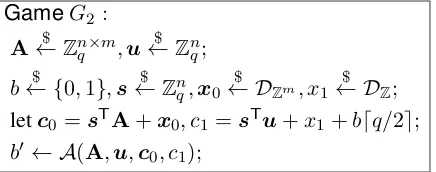
GameG2: A←$ Zn×m
q ,u
$ ←Zn
q;
b← {$ 0,1},s←$ Znq,x0 $
← DZm, x1← D$
Z; letc0 =sTA+x0, c1=sTu+x1+bdq/2e;
b0 ← A(A,u,c0, c1);
Figure 2: Dual-Regev PKE: Game 2
The second transformation performs a reduction step based on the LWE assumption. Indeed, note that after the first transformation, the ciphertexts(c0, c1)contain an LWE distribution of dimensionn×(m+ 1),
with the message bit added to c1. By applying LWE, we then may safely transform c0 to be uniformly
random, andc1to be uniformly random added to to the message bit. The resulting security game is shown
GameG3 : A←$ Zn×m
q ,u
$ ←Zn
q;
b← {$ 0,1},r0 ←$ Zmq , r1 $ ←Zq;
letc0=r0, c1=r1+bdq/2e;
b0 ← A(A,u,c0, c1);
Figure 3: Dual-Regev PKE: Game 3
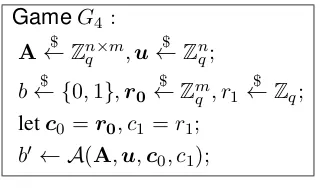
The next transformation applies a semantics-preserving transformation known asoptimistic sampling. To remove the message bit from the adversary input, note that the term c1 is equal to the sum ofr1 and
bdq/2e, wherer1is uniformly sampled and does not appear anywhere else in the game. Because of this, we
know thatc1 itself is uniformly random. Thus, we can safely rewrite the body ofc1 to be equal to a fresh
uniformly sampledr1. The resulting game is shown in Figure 4.
GameG4 : A←$ Zn×m
q ,u
$ ←Zn
q;
b← {$ 0,1},r0 $
←Zmq , r1 $ ←Zq;
letc0=r0, c1=r1;
b0 ← A(A,u,c0, c1);
Figure 4: Dual-Regev PKE: Game 4
In this final game, there is no dependence between the challenge given to the adversary and the challenge
b, so the probability that the adversary guessesbis upper bounded by 12.
The most important point about the above proof is that while the cryptographic theory underlying the Leftover Hash Lemma and Learning with Errors assumption is in nature analytic, the proof of security which uses them is only algebraic. That is, no complicated analytic arguments must be made in order to carry out the above proof; instead, each transformation is a straightforward syntactic transformation of the security game.
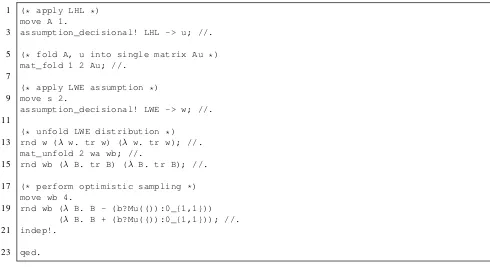
1 (* apply LHL *) move A 1.
3 assumption_decisional! LHL -> u; //.
5 (* fold A, u into single matrix Au *) mat_fold 1 2 Au; //.
7
(* apply LWE assumption *)
9 move s 2.
assumption_decisional! LWE -> w; //.
11
(* unfold LWE distribution *)
13 rnd w (λ w. tr w) (λ w. tr w); //. mat_unfold 2 wa wb; //.
15 rnd wb (λ B. tr B) (λ B. tr B); //.
17 (* perform optimistic sampling *) move wb 4.
19 rnd wb (λ B. B - (b?Mu(()):0_{1,1})) (λ B. B + (b?Mu(()):0_{1,1})); //.
21 indep!.
23 qed.
Figure 5: AutoLWEproof for Dual Regev Encryption.
operation.
Therndtactic is used to reason about transformations of uniform samplings: given two functionsf, f−1
which must be mutual inverses, therndtactic allows one to “pull” a uniform sampling throughf−1. This is used in two ways in the proof: on lines 13 and 15, we userndto show that instead of sampling a matrix, we may instead sample its transpose. Whenever the original matrix is used, we now take the transpose of the new sampled matrix. Similarly, on line 19 we usernd to perform an optimistic sampling operation, in whichBis transformed in order to remove the additive factorb?Mu(()):0_{1,1}. Here,Muis an uninterpreted function from the unit type to1 by 1matrices, modelling the message content dq/2e, and 0_{1,1}is the constant zero matrix of dimension 1 by1. The notation_?_:_ is the standard ternary if-then-else construct; thus, we can model the expressionbdq/2epresent in the Dual Regev scheme as the expressionb?Mu(()):0_{1,1}.
Finally, theindep! tactic is used to reason about games such as the game in Figure 4, in which the adversary trivially has no advantage. Detail about the proof rules present in our logic is given in Section 3.4.
3
Logic
Our logic reasons about probabilistic expressionsP, built from atomic expressions of the formPrG[φ ], whereGis a game, andφis an event. Games are probabilistic programs with oracle and adversary calls, and
φis the winning condition of the game. The proof rules of the logic formalize common patterns of reasoning from the game-playing approach to security proofs. In their simpler form, proof steps will transform a proof goalPrG[ φ ] ≤ pinto a proof goalPrG0[ φ0 ] ≤ p0, withp = p0+c, andG0 a game derived from G; alternatively, they will directly discharge the proof goalPrG[φ]≤p(and give a concrete value forp) when the proof goal is of a simple and specific form, e.g. bounding the probability that an adversary guesses a uniformly distributed and secret value.
Dimensions
d ::= n dimension variable
| d1+d2 addition
| 1 constant dimension1 Types
t ::= B boolean value
| Zq prime field of orderq
| Zd1×d2
q integer matrix
| listdt list
| t×. . .×t tuple Expressions
M ::= 0 null matrix
| I identity matrix
| [M] constant list
| M+M addition
| M×M multiplication
| −M inverse
| M kM concatenation
| slM left projection
| srM right projection
| M> transpose
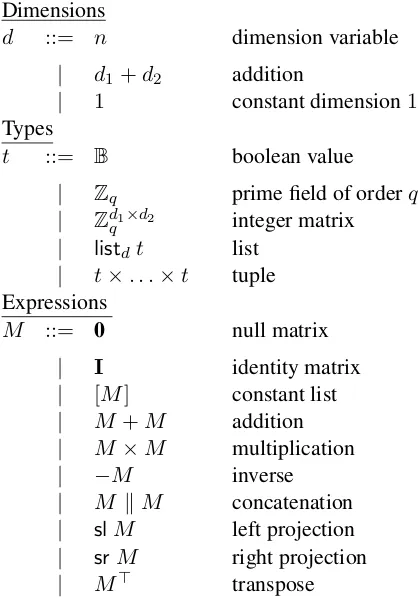
Figure 6: Syntax of expressions (selected)
the expression language includes vectors and matrices; new rules for probabilistic samplings and for oracle-relative assumptions (both in the information-theoretic and computational forms). These extensions do not pose any foundational challenge, but must be handled carefully to obtain the best trade-off between generality and automation.
3.1 Games
Games consist of a security experiment in which an adversary with oracle access interacts with a challenger and of an assertion that determines the winning event.
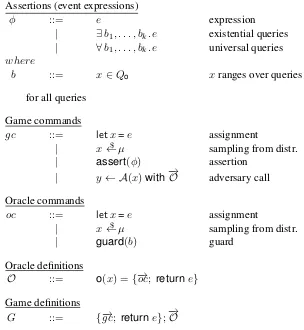
Expressions The expression language operates over booleans, lists, matrices, and integers moduloq, and includes the usual algebraic operations for integer moduloq and standard operators for manipulating lists and matrices. The operations for matrices include addition, multiplication and transposition, together with
structural operationsthat capture the functionalities of block matrices, and can be used for (de)composing matrices from smaller matrices. concatenation, split left, andsplit right. The type of lists,listd, denotes a list of lengthd. Lists are manipulated symbolically, so do not support arbitrary destructuring. Lists may be constructed through theconstant listoperation[·], which takes a typeτ to the typelistdτ, for anyd. All of the matrix operations are lifted pointwise to lists.
Assertions (event expressions)
φ ::= e expression
| ∃b1, . . . , bk. e existential queries
| ∀b1, . . . , bk. e universal queries
where
b ::= x∈Qo xranges over queries
for all queries
Game commands
gc ::= letx=e assignment
| x←$µ sampling from distr.
| assert(φ) assertion
| y ← A(x)with−→O adversary call
Oracle commands
oc ::= letx=e assignment
| x←$µ sampling from distr.
| guard(b) guard
Oracle definitions
O ::= o(x) ={−→oc; returne}
Game definitions
G ::= {−→gc; returne};−→O
whereAandOrange over adversary and oracle names respectively.
Figure 7: Syntax of games
numbers. This fixes the interpretation of types. Expressions are then interpreted in the intended way; for instance, transposition is interpreted as matrix transposition, etc.
Games Games are defined by a sequence of commands (random samplings, assignments, adversary calls) and by an assertion. The command defines the computational behavior of the experiment whereas the assertion defines the winning event. Each adversary call contains a list of oracles that are available to the adversary; oracles are also defined by a sequence of commands (random samplings, assignments, assert statements) and by a return expression. The grammars for oracle definitions and game definitions are given in Figure 7.
The operational behavior of oracles is defined compositionally from the operational behavior of com-mands:
• random samplingx←$µ: we sample a value fromµand store the result in the variablex; • assignments:letx=e: we evaluate the expressioneand store the result in the variablex;
In addition, we assume that every oracleOcomes with a valueδO that fixes the maximal number of times that it can be called by an adversary. To enforce this upper bound, the execution is instrumented with a countercOthat is initially set to 0. Then, whenever the oracle is called, one checkscO ≥δo; if so, then⊥
is returned. Otherwise, the countercO is increased, and the oracle body is executed. In order to interpret events, we further instrument the semantics of the game to record the sequence of interactions between the adversary and the oracle. Specifically, the semantics of oracles is instrumented with a query set variableQO that is initially set to∅. Then, for every call the query parameters are stored inQO. (Following [BDKL10] it would be more precise to hold a single list of queries, rather than a list of queries per oracle, but the latter suffices for our purposes.)
Informally, adversaries are probabilistic computations that must execute within a specific amount of re-sources and are otherwise arbitrary. One simple way to give a semantics to adversaries is through syntax, i.e. by mapping adversary names to commands, and then interpret these commands using the afore de-scribed semantics. However, our language of games is too restrictive; therefore, we map adversary names to commands in a more expressive language, and then resort to the semantics of this richer language. For convenience of meta-theoretic proofs, e.g. soundness, it is preferable to choose a language that admits a set-theoretical semantics. For instance, one can use the probabilistic programming languagepWhileto model the behavior of the adversaries.
The semantics of games is defined compositionally from the operational behavior of commands, oracles, and adversaries:
• assertionassert(φ): we evaluateφand abort if the result is false.
• adversary cally ← A(e)with−→O: we evaluatee, call the adversaryAwith the result as input, and bind the output of the adversary toy. The adversary is provided with access to the oracles−→O.
Finally, the interpretation of PrG[ φ ] is to be the probability of φ in the sub-distribution obtained by executingG.
Throughout the paper, we assume that the games satisfy the following well-formedness conditions and (without loss of generality) hygiene conditions: (WF1) all variables must be used in scope; (WF2) com-mands must be well-typed; (Hyg1) adversary and oracle names are distinct; (Hyg2) bound variables are distinct.
3.2 Reasoning about expressions
Our indistinguishability logic makes use of two main relations between expressions: equality and deducibil-ity. Equality is specified through a set of axiomsE, from which further equalities can be derived using standard rules of equational reasoning: reflexivity, symmetry, transitivity of equality, functionality of oper-ators, and finally instantiation of axioms. We writeΓ `E e = e0 ifeande0 are provably equal from the axioms E and the set of equalitiesΓ. Throughout the paper, we implicitly assume that the set of axioms includes standard identities on matrices.
Deducibility is defined using the notion of contexts. A contextCis an expression that only contains a distinguished variable•. We writee`C
E e0, wheree, e0are expressions andCis a context, if`E C[e] =e0. We write e `E e0 if there exists a context C such that e `CE e0. Similarly, we write Γ |= e `CE e0 if Γ `E C[e] = e0 andΓ |= e `E e0 if there exists a context C such thatΓ |= e `E e0. More generally, a (general) context C is an expression that only contains distinguished variables •1, . . . ,•n. We write
e1, . . . , en `CE e0, wheree1, . . . , en, e0 are expressions andC is a context, if`E C[e1, . . . , en] = e0. We writee1, . . . , en `E e0 if there exists a context C such that e1, . . . , en `CE e0. Similarly, we write Γ |=
given other expressions. If we consider matrices, we may haveM +N, O, N ` M ×Owith the context
C(•1,•2,•3) := (•1− •3)× •2.
3.3 Strongest postcondition
A desirable property of any logic is that one can replace equals by equals. In particular, it should always be possible to replace an expressioneby an expressione0 that is provably equivalent to e. However, it is often desirable to use a stronger substitution property which allows to replaceeby an expressione0 that is provably equivalent toerelative to the context in which the replacement is to be performed. To achieve this goal, our proof system uses astrongest postconditionto gather all facts known at a positionpin the main command. The computation ofspp(G) is done as usual, starting from the initial position of the program with the assertiontrueand adding at each step the assertion φccorresponding to the current commandc, where:
φletx=e = x=e
φguard(b) = b
φassert(e) = e
φ∀/∃b1,...,bk. e = true
3.4 Judgment and proof rules
Our computational logic manipulates judgments of the form P P0 where P and P0 are probability expressions drawn from the following grammar:
P, P0 ::=|c|P+P0|P −P0 |c×P | |P| |PrG[φ],
whereranges over variables,cranges over constants, |P|denotes absolute value, andPrG[ φ ]denotes the success probability of eventφin gameG. Constants include concrete values, e.g. 0and 12, as well as values whose interpretation will depend on the parameters of the scheme and the computational power of the adversary, e.g. its execution time or maximal number of oracle calls.
Proof rules are of the form
P1 1 . . . Pkk
P
wherePis andP are probability expressions,is are variables and finallyis a probability expression built from variables and constants.
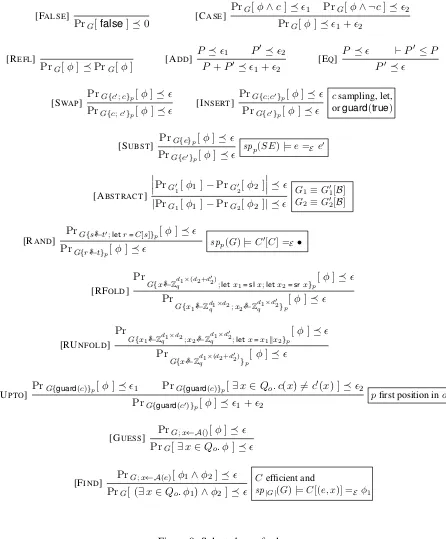
Figure 8 present selected rules of the logic. In many cases, rules consider judgments of the form PrG[φ]; similar rules exist for judgments of the form|PrG[φ]−PrG0[φ0 ]| .
Rules [FALSE] and [CASE] formalize elementary axioms of probability theory. Rules [REFL] and [ADD]
formalize elementary facts about real numbers. Rule [EQ] can be used to replace a probability expression by another probability expression that is provably smaller within the theory of reals. For instance, derivations commonly use the identity1≤ |1−2|+2.
Rules [SWAP], [INSERT], [SUBST] are used for rewriting games in a semantics-preserving way. Con-cretely, rule [SWAP] swaps successive commands (at positionp) that can be reordered (are dataflow inde-pendent in the programming language terminology). By chaining applications of the rule, one can achieve more general forms of code motion. Rule [INSERT] inserts at positionpcommand that does not carry any operational behaviour. Rule [SUBST] substitutes at positionpan expressioneby another expressione0that is contextually equivalent atp, i.e. spp(G)|=e=E e0 holds.
[FALSE]
PrG[false]0
[CASE] PrG[φ∧c]1 PrG[φ∧ ¬c]2 PrG[φ]1+2
[REFL]
PrG[φ]PrG[φ]
[ADD] P 1 P 0
2
P +P01+2
[EQ] P `P 0≤
P P0
[SWAP] PrG{c 0;c}
p[φ]
PrG{c;c0}
p[φ]
[INSERT] PrG{c;c 0}
p[φ]
PrG{c0}
p[φ]
csampling, let, orguard(true)
[SUBST] PrG{e}p[φ] PrG{e0}
p[φ]
spp(SE)|=e=E e0
[ABSTRACT]
PrG01[φ1 ]−PrG02[φ2 ]
|PrG1[φ1 ]−PrG2[φ2 ]|
G1≡G01[B]
G2≡G02[B]
[RAND] PrG{s←
$t0;letr=C[s]}
p[φ]
PrG{r←$ t}p[φ]
spp(G)|=C0[C] =E •
[RFOLD] Pr
G{x←$ Z
d1×(d2+d02)
q ;letx1=slx;letx2=srx}p
[φ]
Pr G{x1←$
Zdq1×d2;x2←$Z
d1×d02
q }p
[φ]
[RUNFOLD] Pr
G{x1←$ Zqd1×d2;x2←$ Z
d1×d0
2
q ;letx=x1kx2}p
[φ]
Pr G{x←$
Z
d1×(d2+d02)
q }p
[φ]
[UPTO] PrG{guard(c)}p[φ]1 PrG{guard(c)}p[∃x∈Qo. c(x)6=c 0
(x) ]2
PrG{guard(c0)}
p[φ]1+2
pfirst position ino
[GUESS]
PrG;x←A()[φ]
PrG[∃x∈Qo. φ]
[FIND] PrG;x←A(e)[φ1∧φ2] PrG[ (∃x∈Qo. φ1)∧φ2]
Cefficient and
sp|G|(G)|=C[(e, x)] =E φ1
thatCis provably bijective at the program point where the transformation arises, using a candidate inverse contextC0 provided by the user. Rules[RFOLD]and[RUNFOLD]are dual and are used to manipulate ran-dom samplings of matrices. The rule[RFOLD]is used to turn two uniform samplings of matrices into one uniform sampling of the concatenation; conversely, the rule[RUNFOLD]may be used to turn one uniform
sampling of a concatenation into uniform samplings of its component parts. (We also have similar rules [LFOLD]and[LUNFOLD]in order to manipulate the vertical component of the dimension.) These rules are primarily used to apply axioms which are stated about matrices of compound dimension.
The rule [ABSTRACT] is used for applying computational assumptions. The rule can be used to in-stantiate a valid judgment with a concrete adversary. The side-conditions ensure that the experimentsG1
andG2 are syntactically equivalent to the experiment G01[B := B]andG02[B := B], where the notation
G0[B := B]represents the game obtained by inlining the code ofBinG0. Because of the requirement on syntactic equivalence, it is sometimes necessary to apply multiple program transformations before applying an assumption.
The rule [UPTO] rule is used for replacingguard(c0)at positionpin an oracle withguard(c). According to the usual principle for reasoning up to failure events, the rule yields two proof obligations: bound the probability of the original event and the probability that the adversary performs a query where the results of
candc0differ.
The rules [GUESS] and [FIND] rules are used to deal with winning events involving existential quantifi-cation.
The logic also contains a rule for hybrid arguments. The rule is similar to [BGS15] and ommitted For lack of space.
3.5 Soundness
All proof rules of the logic are sound. To state soundness, we lift the interpretation of games to an interpre-tation of judgments and derivations. This is done by first defining a fixed interpreinterpre-tation of dimensions that is used for all the games of the derivation. Then, we define the interpretation ofP inductively. We say that judgmentP P0 isvalidiff the inequality holds for every valid interpretation ofP andP0. Finally, one can prove thatP P0is valid wheneverP P0is derivable in the logic.
3.6 Axioms Used
Here, we describe the axioms used to prove the schemes in Sections 2 and 5 secure. Each axiom is deci-sional, in that it is a claim about the closeness of two games. This is modeled by having both games end with a bit outputb, so that each axiom is a claim of the form|PrG0[b]−PrG1[b]| . This allows us to apply the [ABSTRACT] rule from Figure 8.
3.6.1 Learning with Errors
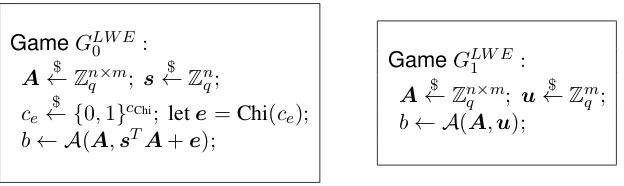
Recall from Section 2 that the LWE assumption states that the distribution(A,sTA+e)is indistinguishable from uniform, where A and s are uniformly sampled elements of Zqn×m and Znq respectively, and e is sampled from some given error distribution.
In various applications of the LWE assumption, the parameter settings of Figure 9 will alter slightly – for instance, in the Dual Regev scheme from Section 2, we do not usemon the nose, but ratherm+ 1. This difference is immaterial to the validity of the assumption.
GameGLW E0 :
A←$ Zn×m q ; s
$ ←Zn
q;
ce
$
← {0,1}cChi; lete=Chi(c
e);
b← A(A,sTA+e);
GameGLW E1 :
A←$ Zn×m q ; u
$ ←Zm
q ;
b← A(A,u);
Figure 9: The LWE assumption, encoded inAutoLWE.
3.6.2 Leftover Hash Lemma
The most subtle part of our proofs is often not applying the LWE assumption, but rather applying the Leftover Hash Lemma. This is because the LHL is aninformation-theoretic judgment rather than a com-putational one; information-theoretic judgments enjoy stronger composition properties than comcom-putational judgments.
Recall that the (basic) LHL states that the distribution(A,AR,wR)is statistically close to the distri-bution(A,B,wR), whereAis a uniformly random element ofZnq×m,Ris a uniformly random element of
{−1,1}m×k(interpreted as a matrix), andwis a fixed arbitrary vector in
Zmq . For the LHL to hold, however, we can actually relax the requirements onA: instead ofAbeing sampled uniformly, we only require that
Ais sampled from a distribution which isstatistically closeto uniform.
In the literature, it is often the case that the lemma being applied is not the LHL on the nose, but rather this weakened (but still valid) form in whichAonly need to be close to uniform. In many of our proofs, this occurs becauseA is not uniformly sampled, but rather sampled using an algorithm, TrapGen, which produces a vectorAstatistically close to uniform along with atrapdoorTA, which is kepts secret from the adversary.
By combining the LHL with the TrapGen construction, we obtain the security games in Figure 10. Both games are displayed at once: the expressions which vary between the two games are annotated with which game they belong in. In order to model how R is sampled, we sample the component bits of R from
{0,1}dLHL,and apply a symbolic function, bitinj, which converts these component bits into a matrix. Note
in this security game thatwcomes from a symbolic adversary,A1. This models the universal quantification
ofw in the LHL. Additionally, note thatA2 actually receives the trapdoor TA. This is counterintuitive,
because adversaries in the cryptosystems do not have access to the trapdoor. However, remember that here we are constructing the adversaryfor the LHL; givingA2 the trapdoor reflects the assertion that the distribution(A,AR,wR, TA)is statistically close to the distribution(A,B,wR, TA), which follows from
the information theoretic nature of the LHL.
While we use the assumption from Figure 10 in our proofs, we also use several small variations which are also valid. One such variation is in the proof of Dual Regev, where we do not use the TrapGen algorithm, but rather sampleAuniformly (and do not give the adversaryTA); additionally, we do not include this linear
GameGLHLβ :
c← {$ 0,1}dT G; let(A, T
A) =TrapGen(c);
r← {$ 0,1}dLHL; letR=bitinj(r);
ifβ=1
B←$ Znq×m;w← A1();
b← A2(A, ifβ=0
AR ifβ=1
B ,wR, TA,w);
Figure 10: The LHL assumption combined with TrapGen, encoded inAutoLWE.
3.6.3 Distribution Equivalences
In addition to the two main axioms above, we also rely on several opaque probabilistic judgments about distributions from which the adversary may sample, but are written in terms of private variables which the adversary may not access. For instance, in an Identity-Based Encryption scheme, the adversary could have access to aKeyGen oracle, which must use the master secret key in order to operate. This is the case in Section 5.2. In the concrete proof, there is a step in which we change the implementation of theKeyGen
oracle from one uninterpreted function to another. Transformations of this sort are encoded using oracle-relative assumptions, which are generalizations of axioms in AutoG&Pwhich allow adversaries to query oracles.
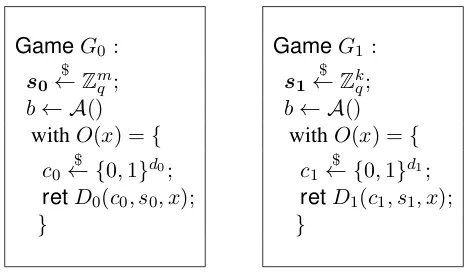
For example, in Figure 11, we state closeness of the distributionsD0(s0,·)andD1(s1,·), where both s0 ands1 are unknown to the adversary. (As before, each distribution is separated into a coin sampling
stage and a deterministic stage.) Note that s0 and s1 need not be of the same type, since the adversary
does not see them. Jumping ahead in (H)IBE part in the case study,D0, D1correspond to the real/simulated
key generation algorithms, wheres0 is the master secret key, ands1 is the secret trapdoor information the
simulator knows in order to answer secret key queries.
GameG0 : s0←$ Zm
q ;
b← A() withO(x) ={
c0 ← {$ 0,1}d0; retD0(c0, s0, x); }
GameG1: s1 ←$ Zk
q;
b← A() withO(x) ={
c1 ← {$ 0,1}d1; retD1(c1, s1, x); }
Figure 11: Example axiom capturing computational closeness of distributions.
4
Deciding deducibility
a common subgameBwhich can be used to factor the former pair into the latter. Finding this subgameB
will induce deducibility subproblems. In order to automate the application of the rules, it is thus necessary to provide algorithms for checking whether deducibility problems are valid. As previously argued, it is desirable whenever possible that these algorithms are based on decision procedures rather than heuristics.
In this section, we provide decision procedures for the theory of Diffie-Hellman exponentiation, both in its basic form and in its extension to bilinear groups, and for the theory of fields. The decision procedures for Diffie-Hellman exponentiation are based on techniques from Gr¨obner bases. In addition to being an important independent contribution on its own, the algorithms for Diffie-Hellman exponentiation also serve as a natural intermediate objective towards addressing the theory of matrices (although the problems are formally independent). For the latter, we require significantly more advanced algebraic tools. For the clarity of exposition, we proceed incrementally. Concretely, we start by considering the case of fields and non-commutative rings. We respectively provide a decision procedure and a semi-decision procedure. Subsequently, we give a reduction from deducibility for matrices to deducibility for non-commutative rings. The reduction yields a semi-decision procedure for matrices. The algorithms for non-commutative rings and matrices are based on so-called SAGBI [RS90] (Subalgebra Analog to Gr¨obner Basis for Ideals) techniques, which as justified below provide a counterpart of Gr¨obner basis computations for subalgebras.
4.1 Diffie-Hellman exponentiation
Diffie-Hellman exponentiation is a standard theory that is used for analyzing key-exchange protocols based on group assumptions. It is also used, in its bilinear and multilinear version, inAutoG&Pfor proving secu-rity of pairing-based cryptography. In this setting, the adversary (also often called attacker in the symbolic setting) can multiply groups elements between them, i.e perform addition in the field, and can elevate a group element to some power he can deduce in the field. Previous work only provides partial solutions: for instance, Chevalier et al [CKRT03] only consider products in the exponents, whereas Dougherty and Guttman [DG14] only consider polynomials with maximum degree of 1 (linear expressions).
The standard form of deducibility problems that arises in this context is defined as follows: let Y be a set of names sampled inZq,gsome group generator,E the equational theory capturing field and groups operations, some setX⊂Y,f1, ...fk, h∈K[Y]be a set of polynomials over the names, andΓbe a coherent
set of axioms. The deducibility problem is then:
Γ|=X, gf1, ..., gfk `
E gh
Proposition 4.1. Deducibility for Diffie-Hellman exponentiation is decidable.
The algorithm that supports the proof of the proposition proceeds by reducing an input deducibility prob-lem to an equivalent membership probprob-lem of the saturation of someZq[X]-module inZq[Y], and by using an extension for modules [Eis13] of Buchberger’s algorithm [Buc76] to solve the membership problem.
The reduction to the membership problem proceeds as follows: first, we reduce deducibility to solving a system of polynomial equations. We then use the notion of saturation for submodules and prove that solving the system of polynomial equations corresponding to the deducibility problem is equivalent to checking whether the polynomialhis a member of the saturation of some submoduleM. The latter problem can be checked using Gr¨obner basis computations.
4.2 Fields and non-commutative rings
theory capturing field operations, f1, ...fk, h ∈ K[Y]be a set of polynomials over the names, and Γbe a
coherent set of axioms. The deducibility problem is then:
f1, ..., fk `E h
We emphasize that this problem is in fact not an instance of the problem for Diffie-Hellman exponentiation. In the previous problem, if we look at field elements, the adversary could compute any polynomial in
K[X]but he may now compute any polynomial in K[f1, ..., fk], the subalgebra generated by the known polynomials.
Decidability is obtained thanks to [SS88], where they solve the subalgebra membership problem using methods based on classical Gr¨obner basis.
Proposition 4.2. Deducibility for fields is decidable.
If we wish to characterize the full adversary knowledge as done for Diffie-Hellman exponentiation using Gr¨obner basis, we would have to resort to so-called SAGBI [RS90] (Subalgebra Analog to Gr¨obner Basis for Ideals) techniques, which form the counterpart of Gr¨obner basis computations. However, some finitely generated subalgebras are known to have infinite SAGBI bases [RS90], thus it can only provide semi-decision for the membership problem.
For the case of non-commutative rings, we are not aware of any counterpart to [SS88], we resort to the non-commutative SAGBI [Nor98] theory.
Proposition 4.3. Deducibility for non-commutative rings is semi-decidable.
It is an open problem whether one can give a decision procedure for non-commutative rings. We note that the problem of module membership over a non-commutative algebra is undecidable [Mor94], as there is a reduction from the word problem over a finitely presented group. On the other hand, the problem is known to be decidable for some classes of subalgebras, notably in the the homogeneous case where all monomials are of the same degree.
4.3 Matrices
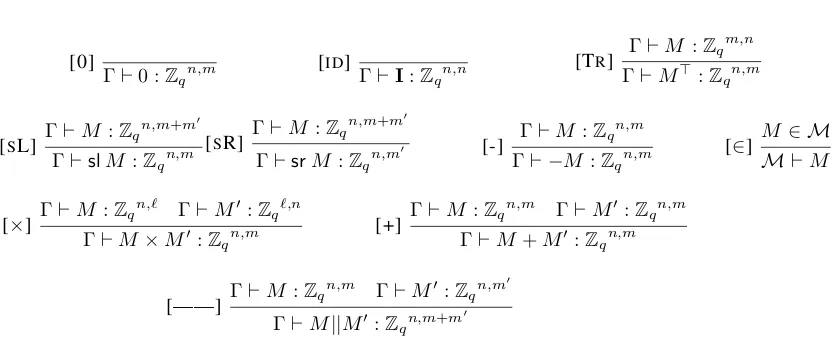
The case of matrices introduces a final difficulty: expressions may involve structural operations. To ad-dress the issue, we show that every deducibility problem in the theory of matrices is provably equivalent to a deducibility problem that does not involve structural operations, nor transposition—said otherwise, a deducibility problem in the theory of non-commutative rings.
Proposition 4.4. Deducibility for matrices is semi-decidable.
The algorithm that supports the proof of semi-decidability for matrices operates in two steps:
1. it reduces the deducibility problem for matrices to an equivalent deducibility problem for non-commutative rings;
2. it applies the semi-decision procedure for non-commutative rings.
The reduction to non-commutative rings is based on a generalization of the techniques introduced in [BDK+10] for the theory of bitstrings—note that the techniques were used for a slightly different purpose, i.e. deciding equivalence between probabilistic expressions, rather than for proving deducibility constraints.
• M `M kN ⇔ M `M∧ M `N
• M ∪ {M kN} `T ⇔ M ∪ {M, N} `T
For transposition, we observe that it commutes with the other operations, so in a proof of deducibility, we can push the transposition applications to the leaves. Everything that can be deduced from a set of matrices
Mand the transpose operation can also be deduced if instead of the transpose operation we simply provide the transposition of the matrices inM.
5
Implementations and Case Studies
The implementation of our logic, calledAutoLWE, is available at:
https://github.com/autolwe/autolwe
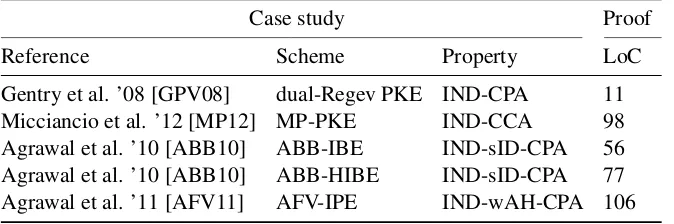
AutoLWEis implemented as a branch ofAutoG&Pand thus makes considerable use of its infrastructure. Moreover, we have usedAutoLWEto carry several case studies (see Figure 12): an Identity-Based En-cryption scheme and an Hierarchical Identity-Based EnEn-cryption scheme by Agrawal, Boneh and Boyen [ABB10], a Chosen-Ciphertext Encryption scheme from Micciancio and Peikert [MP12], and an Inner Product Encryp-tion scheme and proof from Agrawal, Freeman, and Vaikuntanathan [AFV11]. These examples are treated in Sections 5.2, 5.4, 5.3 and 5.5 respectively.
Globally, our tool performs well, on the following accounts: formal proofs remains close to the pen and paper proofs; verification time is fast (less than 3 seconds), and in particular the complexity of the (semi-)decision procedures is not an issue; formalization time is moderate (requiring at most several hours of programmer effort per proof). One of the main hurdles is the Leftover Hash Lemma, which must be applied in varying levels of sophistication. The Leftover Hash Lemma (and more generally all oracle-relative assumptions) increase the difficulty of guessing (chained) applications of assumptions, and consequently limits automation.
Case study Proof
Reference Scheme Property LoC
Gentry et al. ’08 [GPV08] dual-Regev PKE IND-CPA 11 Micciancio et al. ’12 [MP12] MP-PKE IND-CCA 98 Agrawal et al. ’10 [ABB10] ABB-IBE IND-sID-CPA 56 Agrawal et al. ’10 [ABB10] ABB-HIBE IND-sID-CPA 77 Agrawal et al. ’11 [AFV11] AFV-IPE IND-wAH-CPA 106
Figure 12: Overview of case studies. All proofs took less than three seconds to complete.
5.1 Implementation
5.1.1 Oracle-relative Assumptions
AutoG&Pallows one to add user defined axioms, both to express decisional assertions (two distributions are computationally close) and computational assertions (a certain event has small chance of happening). In
AutoG&P, these user-defined axioms are stated in terms of symbolic adversaries, which are related to the main security game by rules such as [ABSTRACT] in Section 3.4. However, the symbolic adversaries present in axioms may not have oracles attached to them. While these restricted adversaries can be used to define the LWE assumption, they are not expressive enough to state the oracle-relative axioms we use throughout our proofs. InAutoLWE, we remove this restriction. An example axiom we now support which we did not before is that in Figure 11.
Recall that in order to apply a user defined axiom using [ABSTRACT], we must factor the security game
into one which is in terms of the axiom’s game. This is done essentially by separating the security game into sections, where each section either reflects the setup code for the axiom, or an instantiation of one of the adversaries in the axiom. We still do this factoring in the case of oracle-relative axioms, but we must also factor oracles in the security game in terms of oracles in the axiom. Once this second step of factoring is done, oracles in the axiom can be compared syntactically to factored oracles in the security game.
5.1.2 Theory of Lists and Matrices
Note that in our case studies, we manipulate both matrices and lists of matrices (often simultaneously). Thus, both our normal form algorithm and our deducibility reduction from Section 4.3 must be lifted to apply to lists of matrices as well. This is what allows our system to reason about the more complicated HIBE scheme in a manner similar to the IBE scheme, which does not use lists.
In order to do this, we do not implement our main algorithms on expressions of matrices directly, but instead over a generalsignatureof matrices, encoded as a certain type of an ML module. We then instantiate this signature both with matrices and lists of matrices. By doing so, we receive an implementation for our new algorithms which operate uniformly across these two types of expressions.
5.1.3 Deduction algorithms
Many implementations of Gr¨obner basis computations can be found online, but all of them are only usable for polynomial ideals. In order to handle module and non-commutative subalgebra, we thus implemented generic versions of the Buchberger algorithm forK[X]-module and the SAGBI algorithm and plugged them into AutoLWE. The algorithms performed well: we could prove all the LWE examples, and the pairing-based examples very quickly, using the SAGBI methods. The efficiency of the computations contrasts with the complexity of the algorithms, which is high because the saturation squares up the number of inputs terms and the Gr¨obner Basis can be at worst a double exponential. However, we are dealing with relatively small instances of our problem that are extracted from concrete primitives.
5.2 Identity-Based Encryption
Mathematical background. LetΛbe a discrete subset ofZm. For any vectorc ∈Rm, and any positive
parameter σ ∈ R, let ρσ,c(x) = exp(−π||x−c||2/σ2) be the Gaussian function onRm with center c
and parameterσ. Next, we letρσ,c(Λ) = Px∈Λρσ,c(x) be the discrete integral ofρσ,x overΛ, and let
χΛ,σ,c(y) := ρρσ,cσ,c(Λ)(y). Let Sm denote the set of vectors in Rm whose length is 1. The norm of a matrix R∈Rm×mis defined to besupx∈Sm||Rx||. We say a square matrix is full rank if all rows and columns are
linearly independent.
strings are equivalent. The security model,IND-sID-CPA, requires adversary to declare challenge identity upfront before seeing the public parameters, and allows adversary to ask for secret key for any identity ex-cept for the challenge identity, and CPA security holds for ciphertext associated with the challenge identity. The IBE scheme our system supports is constructed by Agrawal et al. [ABB10]. The scheme operates as follows:
• MatrixA is generated by algorithm TrapGen, which outputs a random A ∈ Zn×m
q and a small norm matrixT ∈Zm×m
q such thatA·TA = 0. MatricesA1,Bare sampled randomly fromZnq×m, anduis sampled randomly fromZnq. Setpp= (A,A1,B,u)andmsk=TA.
• To encrypt a messageµ ∈ {0,1}with identityid ∈ Znq, one generates a uniforms ∈ Znq, error vector
e0 ← χm and error integer e1 ← χfrom discrete Gaussian, a randomR ∈ {0,1}m×m, and computes
ciphertext
ct=sT[A||A1+M(id)B||u] + (eT||eTR||e0) + (0||0||dq/2eµ)
• The secret key for identityid∈Zn
q is generated by procedurer←SampleLeft(A,A1+M(id)B,TA,u),
where we haveris statistically close toχ2m, and[A||A1+M(id)B]r=u.
The idea of the proof is first to rewriteA1asAR−M(id∗)B, whereid∗ is the adversary’s committed
identity. If we do so, we then obtain that the challenge ciphertext is of the form
sT[A||AR||u] + (eT||eTR||e0) + (0||0||dq/2eµ),
whereAcomes from TrapGen. We then apply a computational lemma about SampleLeft, in order to rewrite the KeyGen oracle to be in terms of another probabilistic algorithm, SampleRight. This is a statement about equivalence of distributions from which the adversary may sample, so must be handled using an oracle-relative assumption. This is done as described in Section 3.6.3. The computational lemma states that, for appropriately sampled matrices,
SampleLeft(A,AR+B, TA,u)≈SampleRight(A,B,R, TB,u),
whereAis sampled from TrapGen in the first and uniform in the second, andBis sampled uniformly in the first and from TrapGen in the second. By applying this transformation to our KeyGen oracle, we transform our matrixAfrom one sampled from TrapGen to uniform.
Now thatAis uniform, we finish the proof by noticing that our challenge ciphertext is equal tob||bR||b+
dq/2eµ, where(b, b) forms an LWE distribution of dimensionn×m+ 1. Thus we may randomizebto uniform, and apply therndtactic to eraseµfrom the ciphertext.
The main point of interest in this proof is the initial rewriteA1 → AR−M(id∗)B. Given thatA1 is
uniform, we may first apply optimistic sampling to rewriteA1toA2−M(id∗)B, whereA2 is uniformly
sampled. Thus, we now only need to perform the rewrite A2 → AR. This rewrite is not at all trivial,
becauseAat this point in the proof comes from TrapGen. However, as noted in Section 3.6.2, it is sound to apply the LHL in this case, because TrapGen generates matrices which are close to uniform in distribution. Thus, we can use the LHL as encoded in Figure 10.
5.3 CCA1-PKE
• MatrixA∈Zn×m
q is sampled randomly andR← {−1,1}m×m. Setpk= (A,AR)andsk=R.
• LetM :Znq →Znq×mbe an embedding fromZnq to matrices, such that for distinctuandv,M(u)−M(v) is full rank. To encrypt a messageµ ∈ {0,1}, one generates a uniform s ∈ Zn
q, a uniformu ∈ Znq, a uniform matrix R0 ∈ {−1,1}m×m and an error vectore ∈
Zmq sampled from a discrete Gaussian, and computes the ciphertext
c0 =u,c1 =sTAu+ (eT||eT∗R0) + (0||Encode(µ))
whereAu := [A|| −AR+M(u)G],Gis a publicly known gadget matrix, andEncode:{0,1} →Zmq sendsµtoµdq/2e(1, . . . ,1).
• To decrypt a ciphertext(u := c0,c1)withsk= Randu 6= 0, one computesAu and calls a procedure
Invert(Au,R,c1), which will outputs andesuch thatc1 = sTAu+e, whereehas small norm. By
doing a particular rounding procedure usingc1,s,e,andR, the message bitµcan be derived.
The main subtlety of the proof is that the secret keyRis used in the decryption oracle. Because of this, we must apply the Leftover Hash Lemma relative to this oracle, by using oracle-relative axioms. As we will see, not all uses of the LHL are valid in this new setting; care must be taken to ensure that the axioms derived from the LHL are still cryptographically sound.
The high-level outline of the proof is as follows: first, we note that instead of using a fresh R0 to encrypt, we can actually use the secret keyR. This is justified by the following corollary of the Leftover Hash Lemma: the distribution (A,AR,e,eR0) is statistically close to the distribution (A,AR,e,eR) whereA,R,R0,andeare sampled as in the scheme. This corollary additionally holds true relative to the decryption oracle, which makes use ofR.
Once we useRto encrypt instead ofR0, we again use the Leftover Hash Lemma to transformARinto
−AR+M(u)G, whereuis generated from the challenge encryption. Again, this invocation of the Leftover Hash Lemma is stated relative to the decryption oracle. Crucially, note here that we donottransformAR
directly into uniform, as we did before: the reason being is that this transformation would actually be
unsound, because it would decouple the public key fromRas it appears in the decryption oracle. Thus, we must do the transformationAR→ −AR+M(u)Gin one step, which is cryptographically sound relative to the decryption oracle. (Currently, we must write this specialized transformation as a unique variant of the Leftover Hash Lemma, as discussed in Section 3.6.2; future work will involve unifying these separate variants.)
At this point, we may apply the LWE assumption along with a more routine invocation of the LHL in order to erase the message content from the challenge ciphertext, which finishes the proof.
5.4 Hierarchical Identity-Based Encryption
Hierarchical IBE is an extension of IBE. In HIBE, the secret key for ID stringidcan delegate secret keys for ID stringsid0, whereidis a prefix forid. Moreover, decryption succeeds if the ID string for the secret key is a prefix of (or equal to) the ID string for the ciphertext. The security model can be adapted according to the delegation functionality.
The HIBE construction our system supports is described in [ABB10]. The ID space for HIBE is idi ∈ (Znq)d. The secret key for ID stringid = (id1, . . . ,id`), whereidi ∈ Znq, is a small-norm matrixT, such thatFidT= 0, and
Fid= [A0||A1+M(id1)B|| · · · ||A`+M(id`)B]
The security proof of HIBE is similar to the counterpart of IBE. The challenge ID stringid∗ = (id∗1, . . . ,id∗`) is embedded inppas
∀i∈[`],Ai =ARi−M(id∗i)B, ∀` < j ≤d,Aj =ARj
For admissible queryid= (id1, . . . ,idk), whereidis not a prefix ofid∗, we have
Bk= [(M(id1)−M(id∗1))B|| · · · ||(M(idk)−M(id∗k))B]6= 0
Then we can generate secret key for id using information Bk andRk = (R1|| · · · ||Rk). In previous cases, we manipulate and apply rewriting rules to matrices. However, in order to reason about the security in a similar manner to pen-and-paper proof, we introduce thelistnotation, and adapt our implementation to operate uniformly across these two types of expressions.
5.5 Inner Product Encryption
The IPE scheme our scheme supports is described in [AFV11]. We briefly recall their construction as
• MatrixAis generated by algorithmTrapGen. Matrices{matBi}i∈[d]are sampled randomly fromZnq×m, and random vectoruis fromZnq. The public parameterspp= (A,{Bi}i∈[d],u), andmsk=TA. • Secret keyskv =rfor vectorv ∈Zdqis computed by algorithmr←SampleLeft(A,
P
i∈[d]BiG−1(viG),TA,u),
where for operationG−1(·) :Zqn×m →Zmq×m, for anyA∈Znq×m, it holds thatG·G−1(A) =Aand
G−1(A)has small norm.
• To encrypt a messageµ∈ {0,1}for attributew, one generates a uniforms∈Zn
q, error vectore0 ←χm
and error integere1 ←χfrom discrete Gaussian, random matrices{Ri}i∈[d]∈ {0,1}m×m, and computes
ciphertext(c0,{ci}i∈[d], c)as
c0=sTA+eT0, ci =sT(Bi+wiG) +eT0R, c=sTu+e+dq/2eµ
The main challenge in the proof is to answer secret key queries for any vectorvas long ashv,w0i,hv,w1i
are both not 0, where(w0,w1)is declared by adversary upfront. The attributewb(bis a random bit) is first embedded inpp, i.e.Bi=ARi−wbiG,∀i∈[d], whereRi is a small matrix. By unfolding the matrix for queryv, we have
A|| X
i∈[d]
BiG−1(viG)
=
A||A X
i∈[d]
RiG−1(viG) +hwb,viG
Ifhwb,vi 6= 0, the algorithmSampleRightcan be used to generate secret key forv.
The sequence of hybrids generated in symbolic proof is a bit different from the pen-and-paper proof. In particular, instead of transforming from embedding of challenge attributew0 directly to embedding of w1, we use the original scheme as a middle game, i.e. from embedding of w0 to original scheme, then
to embedding ofw1. The reason for using the original scheme again in the proof is that when using LHL
6
Related work
For space reasons, we primarily focus on related works whose main purpose is to automate security proofs in the computational model.
Corin and den Hartog [CdH06] show chosen plaintext security of ElGamal using a variant of a gen-eral purpose probabilistic Hoare logic. In a related spirit, Courant, Daubignard, Ene, Lafourcade and Lakhnech [CDE+08] propose a variant of Hoare logic that is specialized for proving chosen plaintext secu-rity of padding-based encryption, i.e. public-key encryption schemes based on one-way trapdoor permuta-tions (such as RSA) and random oracles. Later, Gagn´e, Lafourcade, Lakhnech and Safavi-Naini [GLLS09, GLL13] adapt these methods to symmetric encryption modes and message authentication codes.
Malozemoff, Katz and Green [MKG14] and Hoang, Katz and Malozemoff [HKM15] pursue an alter-native approach for proving security of modes of operations and authenticated encryption schemes. Their approach relies on a simple but effective type system that tracks whether values are uniform and fresh, or ad-versarially controlled. By harnessing their type system into a synthesis framework, they are able to generate thousands of constructions with their security proofs, including constructions whose efficiency compete with state-of-the-art algorithms that were discovered using conventional methods. Using SMT-based methods, Tiwari, Gasc´on and Dutertre [TGD15] introduce an alternative approach to synthesize bitvector programs, padding-based encryption schemes and modes of operation.
Our work is most closely related to CIL [BDKL10], ZooCrypt[BCG+13] and AutoG&P [BGS15]. Computational Indistinguishability Logic (CIL) [BDKL10] is a formal logic for reasoning about secu-rity experiments with oracle and adversary calls. CIL is general, in that it does not prescribe a syn-tax for games, and side-conditions are mathematical statements. CIL does not make any provision for mechanization, although, as any mathematical development, CIL can be formalized in a proof assistant, see [CDL11]. ZooCrypt[BCG+13] is a platform for synthesizing padding-based encryption schemes; it has been used successfully to analyze more than a million schemes, leading to the discovery of new and in-teresting schemes. ZooCryptharnesses two specialized computational logics for proving chosen-plaintext and chosen-ciphertext security, and effective procedures for finding attacks. The computational logics use deducibility to trigger proof steps that apply reduction to one-wayness assumptions, and to compute the probability of bad events using a notion of symbolic entropy. However,ZooCryptis highly specialized.
AutoG&P[BGS15] introduce a computational logic and provide an implementation of their logic, called
AutoG&P, for proving security of pairing-based cryptographic constructions. Their logic uses deducibility for ensuring that proof rules are correctly enforced. Their implementation achieves a high level of automa-tion, thanks to a heuristics for checking deducibility, and a proof search procedure, which decides which proof rule to apply and automatically selects applications of computational assumptions. We build heavily on this work; in particular, AutoLWE is implemented as an independent branch ofAutoG&P. The main differences are:
• AutoLWE supports oracle-relative assumptions and general forms of the Leftover Hash Lemma, and (semi-)decision procedures for deducibility problems, for the theories of Diffie-Hellman exponentiation, fields, non-commutative rings and matrices. In contrast, AutoG&Ponly support more limited assump-tions and implements heuristics for the theory of Diffie-Hellman exponentiation;
• AutoG&P supports automated generation ofEasyCryptproofs, which is not supported byAutoLWE. Rather than supporting generation of proofs a posteriori, a more flexible alternative would be to integrate the features ofAutoG&PandAutoLWEinEasyCrypt.
between cryptographic proofs. However, they are not supported by an implementation. In contrast, we implement our computational logic. Furthermore, proofs inAutoLWEhave a first-class status, in the form of proof scripts. An interesting direction for future work is to implement automated compilers that transform proofs from the group- and pairing-based settings to the lattice-based settings. Such proof compilers would offer a practical realization of [TM18] and could also implement patches when they fail on a specific step.
7
Conclusion
We have introduced a symbolic framework for proving the security of cryptographic constructions based on the (decisional) Learning with Errors assumption. A natural step for future work is to broaden the scope of our methods to deal with other hardness assumptions used in lattice-based cryptography, including the Ring Learning with Errors assumption, the Short Integer Solution assumption. A further natural step would then be to analyze lattice-based key exchange protocols [Pei14, BCD+16]. To this end, it would be interesting to embed the techniques developed in this paper (and in [BGS15]) into theEasyCryptproof assistant [BGHZ11, BDG+13], and to further improve automation ofEasyCryptfor typical transformations used for proving security of protocols.
Acknowledgements.
This work is partially supported by ONR Grant N000141512750 (Barthe), by IBM under Agreement 4915013672 (Fan), and by NSF Grant 1704788 and NSF CNS-1617676 (Shi, Gancher).
References
[ABB+05] Alessandro Armando, David A. Basin, Yohan Boichut, Yannick Chevalier, Luca Compagna, Jorge Cu´ellar, Paul Hankes Drielsma, Pierre-Cyrille H´eam, Olga Kouchnarenko, Jacopo Man-tovani, Sebastian M¨odersheim, David von Oheimb, Micha¨el Rusinowitch, Judson Santiago, Mathieu Turuani, Luca Vigan`o, and Laurent Vigneron. The AVISPA tool for the automated validation of internet security protocols and applications. In Kousha Etessami and Sriram K. Rajamani, editors,Computer Aided Verification, 17th International Conference, CAV 2005, Ed-inburgh, Scotland, UK, July 6-10, 2005, Proceedings, volume 3576 ofLecture Notes in Com-puter Science, pages 281–285. Springer, 2005.
[ABB10] Shweta Agrawal, Dan Boneh, and Xavier Boyen. Efficient lattice (H)IBE in the standard model. In Henri Gilbert, editor,EUROCRYPT 2010, volume 6110 ofLNCS, pages 553–572. Springer, Heidelberg, May 2010.
[AFL16] Daniel Apon, Xiong Fan, and Feng-Hao Liu. Deniable attribute based encryption for branching programs from LWE. In Martin Hirt and Adam D. Smith, editors,TCC 2016-B, Part II, volume 9986 ofLNCS, pages 299–329. Springer, Heidelberg, October / November 2016.
[AFV11] Shweta Agrawal, David Mandell Freeman, and Vinod Vaikuntanathan. Functional encryption for inner product predicates from learning with errors. In Dong Hoon Lee and Xiaoyun Wang, editors,ASIACRYPT 2011, volume 7073 ofLNCS, pages 21–40. Springer, Heidelberg, Decem-ber 2011.