Copyright to IJIRSET www.ijirset.com 1337
Role of Endogenous Nucleic Acids and
Proteins in Adventitious Root Formation in
Mung Bean Cuttings
S. Nag
1, A. Paul
2and M. A. Choudhuri
3Assistant Professor, Department of Botany, Rampurhat College, Rampurhat, Birbhum, West Bengal, India1
Part-time Lecturer, Department of Botany, Rampurhat College, Rampurhat, Birbhum, West Bengal, India2
Retired Professor, Department of Botany, University of Burdwan, Burdwan, West Bengal, India3
Abstract: Nucleic acid, proteins and their degradative enzymes (DNase omitted) associated with adventitious root formation (ARF) were determined in different phases at the base of hypocotyl cuttings of mung bean (Vigna radiata L. cv. 105). DNA and RNA contents in mung bean hypocotyls showed that there was a marked change in nucleic acid contents (DNA and RNA) during the early inductive phase (0-24h). However, there was a gradual accumulation of DNA and RNA after 24h up to the early expression phase (24-96h). Although the rise in the content of RNA was markedly greater than that of DNA. The synthesis of new DNA and RNA might have a role during new root initial formation in mung bean hypocotyls. The pattern of RNase activity was inversely correlated with endogenous RNA content during the induction and early initiation phase (0-48h). The total protein contents tally with RNA content suggesting that high protein synthesis is preceded by RNA synthesis. Soluble protein increased during early phase (0-72h) but insoluble protein was remarked low during this early phase. However, the greater activities of proteases (acidic and neutral) at the expression phase (72-120h) rather than at the induction phase (0-24h) may indicate that they are involved in protein turnover during root development at the later phase in mung bean hypocotyls explants.
Keywords: adventitious root, mung bean, nucleic acids (DNA and RNA), protease, protein.
I. INTRODUCTION
The information of adventitious roots at the base of stem cuttings is an important developmental phenomenon for the growth and survival of stem cuttings and has attracted the attention of a large number of physiologists, biochemists and horticulturists. Although it is clear from our present knowledge that, this process appears to be governed by an array of physiological and biochemical factors and as well as various environmental factors and growth conditions of the parent plant (Heuser and Hess, 1972; Torey, 1986; Burtin et al., 1990) that can act on genetically controlled developmental programmes. It is not yet clear how the rooting process is induced, initiated stepwise and governed internally and the role of various endogenous factors in the process working in tandem. Among the endogenous factors of ARF in cuttings require synthesis of nucleic acids and proteins for the development of root primordial (Webster and Van’t Hof, 1970; Molnar and La Croix, 1972). Regarding the role of RNase in rooting, several workers (Bhattacharya et al., 1976) have suggested that RNase activity may be related to rooting, but the mechanism of involvement is not clear. However, as in the case for proteins and their degradative products, very few studies reveal the concomitant results on these compounds and rhizogeneses. Keeping the above view in mind the present study was carried out to study the changes in the metabolism of DNA, RNA, Proteins, RNase and protease activity with time under in vivo
conditions using mung bean hypocotyls explants as experimental materials.
II. MATERIALS AND METHODS
Surface sterilization with 4% sodium hypochloride (w/v) of seeds of mung bean (Vigna radiata L. cv. 105) were done before germination and seedlings raised in a temperature (24 10 C) and light (16 hours photo period at 222 µ moles m -2
s-1 at 400-700 nm) in a controlled growth room for 7 days. The hypocotyls of 7 day old seedlings were excised 3cm below the cotyledonary node, the cotyledons were removed, and the resulting cutting consisting of the hypocotyl and the intact epicotyl, with a pair of primary leaves was used for experiments.
Copyright to IJIRSET www.ijirset.com 1338
12d. The endogenous levels of free DNA, RNA and total soluble and insoluble proteins and the activities of RNase, acidic and neutral protease were analyzed form 0 to 5 day after excision at intervals of 24 h.
Total nucleic acids of mung bean hypocotyls explants were extracted with cold methanol following the method II as described by Cherry (1962). Then the total DNA content was analysed using Diphenylamins method of Burton (1956) as modified by Choudhuri and Chatterjee (1970). Further total RNA content was estimated using orcinol reagent as described by Markham (1955) and modified by Choudhuri and Chatterjee (1970).
The activity of RNase was assayed following the method of Cherry (1973). The amount of total protein was determined by the method of Bradford (1976) with bovine serum albumin as the standard. Soluble protein was also estimated by Bradford reagent as mentioned earlier whereas the insoluble protein was assayed using the pellete as described by Kar and Mishra (1976).
The activity of protease was assayed according to Drivdahl and Thimann (1977).
Diadram-1: Schematic representation combining all the results obtained showing probable interrelationships of nucleic acids, proteins and their degradative enzymes (DNase omitted) associated with ARF at different phases in mung bean which are self-explanatory
III. RESULTS AND DISCUSSION
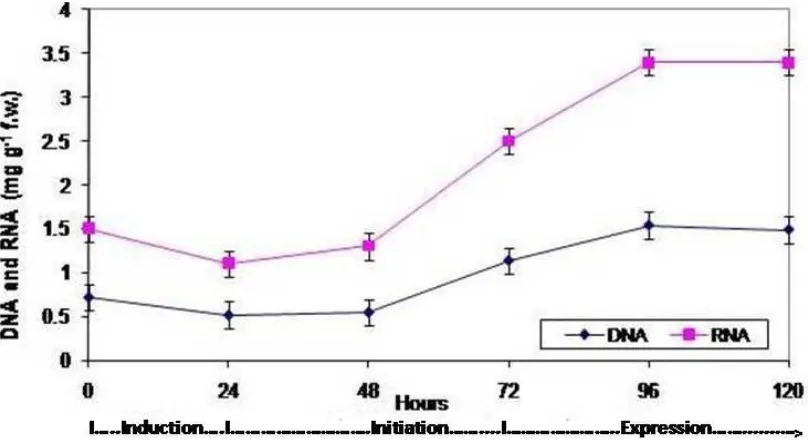
A schematic representation combining all the results is shown in Diagram-1. This should help to explain the interdependent results of changes in total DNA and RNA contents (Fig. 1) in mung bean hypocotyls; showed that there was no marked changes in nucleic acid contents (DNA and RNA) during the early inductive phase (0-24h) suggesting that the synthesis of these two cellular macromolecules did not commence in full showing at the preparatory stage of rooting process and such observations could be supported by the data of some other workers (Molnar and La Croix, 1972; Jarvis et al., 1985).
Copyright to IJIRSET www.ijirset.com 1339
of new DNA and RNA molecules start during the initiation and early expression phase, which could evidently be correlated well with the intense cell division and new root initial in mung bean hypocotyls explants. The low level of RNA during 0-24h may be explained as due to the inhibition of synthesis of some RNAs, presumably mRNAs, which are thought to be the suppressor of root formation at the early phase (Shibaoka et al., 1967). It will be further evident from the data that the turnover of both RNA and DNA reached almost equilibrium at the late expression phase of root emergence (96-120h) after a large scale replication at the earlier phases.
A critical analysis (Fig. 2) of the data changes in RNase activities at different phases reveals that its activity showed a rise during the early phase (from 0-48h) when the RNA content was minimal. This corresponds to the low content of RNA during the induction and early initiation phase (0-48h) as discussed earlier. It is further evident that RNase enzyme maintained a low activity throughout the later phases when the RNA level remained quite high. Such an explanation for DNA content could not, however, be offered in the absence of data on DNase activity in mung bean explants.
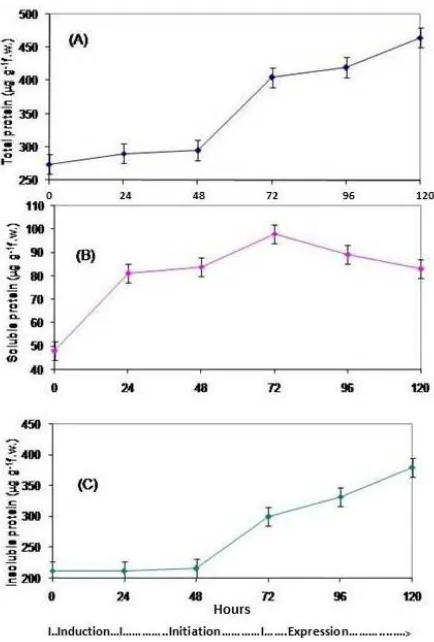
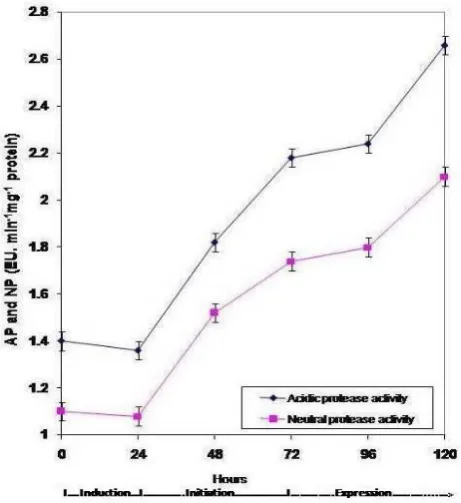
A perusal of the data of changes in total protein content (Fig. 3A) in mung bean hypocotyls with progress of root development shows that there was a slow rise of total protein contents during the early phase (0-48h) of rooting followed by a sharp increase at the later phase (after 48h). This trend did tally with RNA content suggesting that high protein synthesis is preceded by RNA synthesis during root development and emergence. Most of the enzyme proteins are soluble proteins, whereas insoluble proteins mainly constitute the structural proteins. A sharp rise in soluble proteins (Fig. 3B) during 0-72h seems to indicate that the enzymes, which are likely to participate in the rooting process, are mostly synthesis during this period. It is interesting to note that the level of insoluble proteins (Fig. 3C) remained low during the early phase and high during the late phase suggesting that structural proteins are required in greater amount during the expression phase (root emergence) of ARF in mung bean hypocotyl explants. The study of the change in acidic and neutral proteases (Fig. 4) during the progress of root development shows that their activities gradually increased after 24h, reaching the maximal state at the more advanced phase. This suggests that intense proteolytic activities and protein turnover take place during these phases. However, it is difficult to comment whether such changes in enzyme activities at the base of mung bean explants are easily related to rooting or are simply a result of rooting process.
Nevertheless, the greater activities of proteases at the expression phase rather than at the induction phase may indicate that they are involved in protein turnover during root development at the later phases, which are similar to the observations of Upadhyaya et al. (1986).
Copyright to IJIRSET www.ijirset.com 1340
Fig. 2: Changes in RNase activities with time in mung bean hypocotyl explants at intervals of 24h
Copyright to IJIRSET www.ijirset.com 1341
Fig. 4: Changes in acidic protease (AP) and neutral protease (NP) activities with time in mung bean hypocotyl explants at intervals of 24h
REFERENCES
[1] Bhattacharya, N. C., Bhattacharya, S., and Malik, C. P., “Transients in the activities of some hydrolases and their relationship with adventitious root formation in hypocotyl cuttings of Phaseolus mungo”, Plant Sci., Vol. 8, pp. 38-44, 1976.
[2] Bradford, M. M., “A rapid and sensitive method for the quantitation of microgram quantities of protein utilizing the principle of protein-dye binding”, Anal Biochem., Vol. 72, pp. 248-254, 1976.
[3] Burtin, D. J., Martin-Tanguy, J., Paynot, M., Carre, M., and Rossin, N., “Polyamines, hydroxy cinnamoyl- puterscine and root formation in leaf explants of tobacco cultivated in vitro”, Plant Physiol., Vol. 93, pp. 1398-1404, 1990.
[4] Burton, K. A, “study of the conditions and mechanism of the diphenylamine reaction for the colorimetric estimation of deoxyribonucleic acid”, Biochem J., Vol. 62, pp. 315-323, 1956.
[5] Cherry, J. H., “Nucleic acid determination in storage tissue of higher plants”, Plant Physiol., Vol. 37, pp. 670-678, 1962. [6] Cherry, J. H.,“Molecular Biology of Plants”, A Text Manual, Columlcia University Press, New York, pp. 17-19, 1973.
[7] Choudhuri, M. A., and Chatterjee, S. K., “Seasonal changes in the levels of some cellular components in the abscission zone of coleus leaves of different ages”, Ann. Bot., Vol. 34, pp. 275-287, 1970.
[8] Drivdahl, R. H., and Thimann, K. V., “Proteases of senecing oat leaves, I, Purification and general properties”, Plant Physiol., Vol. 59, pp. 1059-1063, 1977.
[9] Heuser, C. W., and Hess, C. E., “Isolation of three lipoid root inhibiting substances from juvenile Hedera helix shoot tissue”, J. Am. Soc. Hort. Sci., Vol. 97, pp. 571-574, 1972.
[10] Jarvis, B. C., Yasmin, S., and Coleman, M. T., “RNA and Protein metabolism during adventitious root formation in stem cuttings of Phaseolus
aureus”, Physiol Plant, Vol. 64, pp. 53-59, 1985.
[11] Kar, R., and Mishra, D., “Catalase, Peroxidase and polyphenol oxidase activities during rice leaf senescence”, Plant Physiol., Vol. 57, pp. 315-319, 1976.
[12] Markham, R., “Nucleic acids, their components and related compounds”, In: Modern Methods of Plant Analysis (K. Peach M.V. Tracey, eds.), Springer – Verlag, Berlin, pp. 246-304, 1955.
[13] Molnar, J. M., and La Croix, L. J., “Studies on the rooting of cuttings of Hydrangea macrophylla : DNA and protein changes”, Can J. Bot, Vol, 50, pp. 387-392, 1972.
[14] Shibaoka, A., Anzai, T., Mitsuhashi, M., and Shimokoriyama, M., “Interaction between heliangine and pyrimidines in adventitious root formation of Phaseolus cuttings”, Plant Cell Physiol., Vol. 8, pp. 647-656, 1967.
[15] Torey, J. G., “Endogenous and exogenous influences on the regulation of lateral root formation”, In: New Root Formation in Plant and cuttings (MB Jackson, ed.), Martinus Nijhoff Pub, Dordrecht, pp. 32-66,1986.
[16] Upadhyaya, A., Davis, T. D., and Sankhla, N., “Some biochemical changes associated with paclobutrazol induced root formation on bean hypocotyl cuttings”, Ann. Bot., Vol. 57, pp. 309-315, 1986.
Copyright to IJIRSET www.ijirset.com 1342
BIOGRAPHY
Dr. S. Nag, Ph.D. in Botany, Assistant Professor, Department of Botany, Rampurhat College, Rampurhat, Birbhum, West Bengal, India; and the corresponding author.
A. Paul, M.Sc. in Botany, Part-Time Lecturer, Department of Botany, Rampurhat College, Rampurhat, Birbhum, West Bengal; and Ph. D. scholar, Department of Botany, Visva-Bharati, Santiniketan, Birbhum, West Bengal, India.