Copyright to IJIRSET www.ijirset.com 2688
PRODUCTION OF SELF-CLEANING
CEMENT USING MODIFIED TITANIUM
DIOXIDE
Jatinder Kumar
1, Anurag Srivastava
2, Ajay Bansal
3Assistant Professor, Department of Chemical Engineering, Dr. B.R. Ambedkar N.I.T, Jalandhar, India1 P.G. Student, Department of Chemical Engineering, Dr. B.R. Ambedkar N.I.T, Jalandhar, India2
Associate Professor, Department of Chemical Engineering, Dr. B.R. Ambedkar N.I.T, Jalandhar, India3
Abstract: The present work explores the applications of titanium dioxide and photocatalysis to produce self-cleaning cement. In the present study, self-cleaning cement was prepared using titanium dioxide and white cement. To enhance the performance, titanium dioxide was also doped with Ag, and further used for preparation of self-cleaning cement. The doped titanium dioxide was characterized using XRD and TEM. The surface of prepared cement samples were analyzed using SEM. The self-cleaning ability of the prepared cement samples were evaluated in a photocatalytic activity test under sun-light as well as artificial UV-light. It has been observed that prepared cement samples are able to clean their surfaces.
Keywords: TiO2; Photocatalysis; Cement; Doping; Sun-light
I. INTRODUCTION
The work of Honda and Fujishima in 1970s has led to diverse applications of TiO2, particularly in the field of
photocatalysis. Fujishima and Honda reported the photochemical dissociation of water using TiO2 photoanode followed
by Wrigton et al. [1,2]. TiO2 is widely accepted photocatalyst because of its chemical and biological inertness, and
economically feasible production. Among the three forms of TiO2, anatase is most photoactive [3]. The photocatalytic
activity of anatase TiO2 can be further improved by incorporation and impregnation methods using metal and
non-metals [4]. In the range of higher temperature 600-700 °C, anatase is irreversibly converted to rutile due to its lower thermal stability [3, 5]. Development of the stable anatase TiO2 at higher temperature is especially one of the biggest
challenges, especially with respect to application of self-cleaning coating on ceramic materials such as sanitary wares, glass and tiles, which are produced at higher temperature.
The main applications of photocatalytic anatase TiO2 include anti-bacterial, self-cleaning and anti-soiling coatings. In
practice, surface cleaning of building materials like tiles, fascades and glass panes cause considerable trouble, high consumption of energy and chemical detergents, which results in high expenditure. Ceramic materials coated with cement containing TiO2 are considered to be very effective against organic contaminants and bacteria [6, 7].
Applications of TiO2 photocatalysts to construction materials began towards the end of the 1980s. Development of
TiO2 - cementitious binders providing self-cleaning has been carried out in order to enhance aesthetic durability of
cementitious materials, particularly those based upon white cement. Most of the external building walls get soiled from automobile exhaust gases, and other pollutants. By coating building walls with TiO2, the dirt of the wall can be easily
washed away by rain due to super-hydrophilic nature of TiO2, keeping the external building walls clean for a very long
time. TiO2 can also photocatalytically degrade the other pollutants that come in contact with it. In order to verify
self-cleaning performances of photocatalytic cements and concretes, tests involving organic substances have been set up mainly based upon the degradation of colour in dyes. Folli et al. (2012) worked on Rhodamine B to check self-cleaning effect in concrete. In the present study, self-cleaning cement was prepared by using titanium dioxide and white cement. To enhance the performance, titanium dioxide was also doped with Ag, and further used for preparation of self-cleaning cement. The self-self-cleaning ability of prepared cement samples were evaluated in a photoactivity test.
II. EXPERIMENTAL
A. Chemicals
Copyright to IJIRSET www.ijirset.com 2689 Limited, Mumbai. Birla White was taken as white cement from local market. Azo dye amaranth (C20H11N2O10S3Na3)
was purchased from S. D fine-Chem. Limited, Mumbai.
B. Preparation of modified TiO2 nanoparticle
Impregnation method was used for the modification of titanium dioxide nanoparticles [8]. Modified titania catalyst were prepared with two different concentrations of Ag, 0.2% and 2%. For the preparation of titania doped catalyst with 0.2% Ag, 0.002 moles of silver was dissolved in 50 ml of distilled water in porcelain bowel and 0.998 moles of titanium dioxide was added to the solution. For the preparation of titania doped catalyst with 2% Ag, 0.02 moles of moles silver was dissolved in 50 ml of distilled water in porcelain bowel and 0.98 moles of titanium dioxide was added to the solution. The solutions were stirred well and allowed to settle for 24 hr, the contents were heated well to evaporate all the water. The dried solids were first ground and then calcined at 400 OC for 6 hrs in muffle furnace.
C. Preparation of cement samples
Total six different types of cement samples were prepared with varying ratio of TiO2 to cement. TiO2 was used in
doped as well as non doped form. Cement slabs of dimensions 75 × 25 × 5 mm were prepared using white cement, titanium dioxide, and water. The composition of prepared cement samples along with nomenclature is presented in Table 1.
TABLE I
COMPOSITION OF CEMENT SAMPLES
TiO2 to cement
ratio (w/w)
Titanium dioxide Name of sample
Nature Percent Ag
(w/w)
0.1
0.2
0.1
0.1
0.2
0.2
Non-doped
Non-doped
Doped
Doped
Doped
Doped
__
__
0.2
2.0
0.2
2.0
C1
C2
C3
C4
C5
C6
D. Characterization
The crystallinity of the titanium dioxide was analyzed with a X-Ray diffractometer (XPERTPro) using Cu-Kα radiation operated at 40 mA and 45 kV at an angle of 2θ from 20-80o. High resolution images of doped and non-doped
TiO2 were obtained using transmission electron microscope (Hitachi 7500). Surface images of cement samples were
obtained by scanning electron microscope (JSM 6610 LV).
E. Photocatalytic activity test
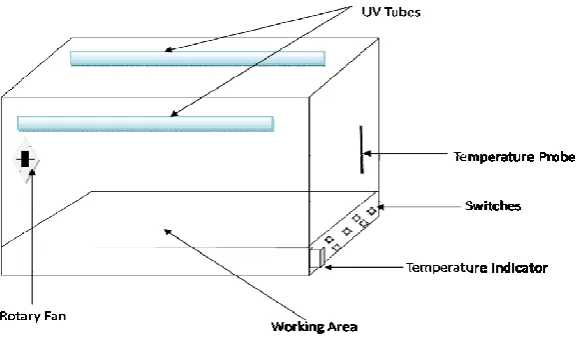
Copyright to IJIRSET www.ijirset.com 2690 Fig. 1 Photocatalytic reactor
III. RESULT AND DISCUSSION
A. Characterization
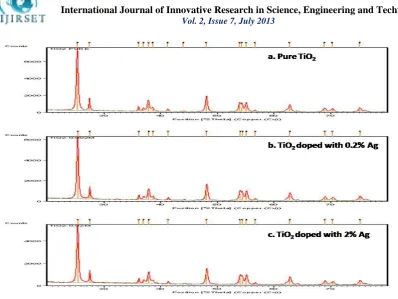
XRD analysis was performed to understand the crystal structure of the doped and non-doped TiO2. Major peaks
occurred at 2θ = 25.32, 27.45, 37.92, 48.14, 54.34, 55.18, 62.94, and 69.12 in all the XRD patterns as shown in Fig. 2. These major peaks correspond to diffraction maxima of anatase. It can be inferred that after modification in P-25 the modified particles are able to retain their anatase form.
TEM was used to further examine the crystallinity and morphology of modified TiO2 samples. It can give a real space
image on the distribution of particles, their surface and shape. Fig. 3 shows the TEM images of pure TiO2, TiO2 doped
with 0.2% of Ag, and TiO2 doped with 2% of Ag. The distribution of silver is shown in the TEM images with the
arrows. It has been revealed that the TiO2 powders in rutile phase consist of both spherical and rod shapes but the
particles of TiO2 powders in anatase phase are mostly of spherical morphology [9]. It can be seen from Fig. 3 that the
particles are mostly of spherical shape, which is an indication of anatase form.
SEM analysis was also performed. Fig. 4 shows the SEM images of surface of cement slabs of pure white cement, TiO2
and white cement in ratio of 0.1 and 0.2. The distributions of TiO2 were shown by the circles in the SEM images.
Surface image of pure cement implies that the particles were very closely packed, and some dust and small cracks were observed on the surface. Sample of cement slab with TiO2 to cement ratio of 0.1 and 0.2 show even distribution of
Copyright to IJIRSET www.ijirset.com 2691 Fig. 2 X-Ray diffraction spectra of (a) Pure TiO2 (b) TiO2 doped with 0.2% Ag and (c) TiO2 doped with 2% Ag
(a) (b) (c)
Fig. 3 TEM images at 150000x of (a) pure TiO2 (b) TiO2 doped with 0.2% silver (c) TiO2 doped with 2% silver.
(a) (b) (c)
Fig. 4 SEM images at 1500x of (a) Cement slab made up of white cement only (b) Cement slab made-up of TiO2 to
Copyright to IJIRSET www.ijirset.com 2692 B. Photocatalytic activity test
Total six different types of cement samples were prepared with varying TiO2 to cement ratio using doped and non
doped TiO2. These prepared cement samples were used to form cement slabs of dimensions 75×50×5 mm. The
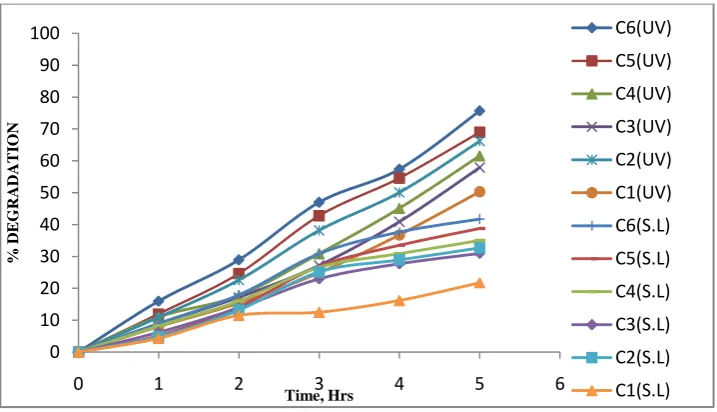
prepared cement slabs were used to degrade amaranth dye for evaluating degradation efficiency and self-cleaning capability. Degradation of the dye was observed under UV light as well as sun light. Fig. 5 shows the time effect on degradation of dye using different cement samples under UV light (UV) and sun light (SL).
Fig. 5 Percent degradation in doped and non doped samples under sun light (SL) and UV light (UV) with time
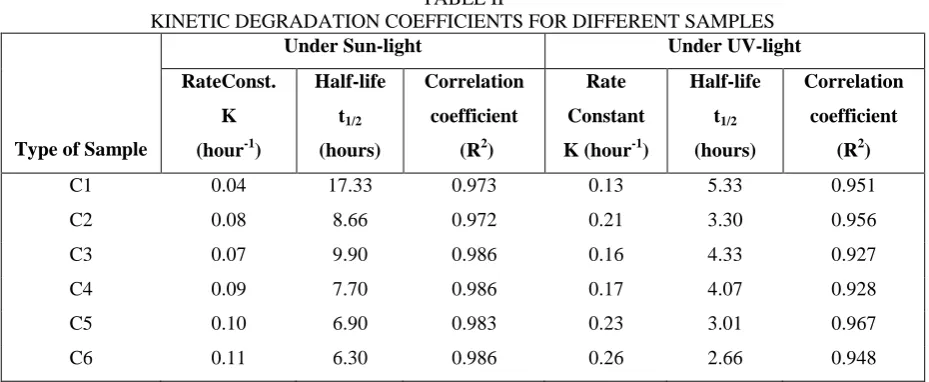
Table 2 shows the half-life time and rate constant obtained in all the cement samples. It can be observed from Figure 5 that the undoped samples C1 and C2 show degradation of 50 and 66%, respectively under UV light. Under sun-light C1 and C2 samples show degradation of 22 and 32% respectively. The degradation is more in case of C2 sample having more amount of titanium dioxide. The degradation efficiencies particularly depend on the amount of TiO2 distributed
on the surface. The distribution of TiO2 in cement slabs having TiO2 to cement ratio 0.2 (C2) was more prominent than
in cement slabs having ratio 0.1 (C1), resulting in the increase in degradation efficiency in case of C2 sample. Degradation of 58, 62, 69, and 76% has been observed in case of doped samples C3, C4, C5, and C6, respectively. It can be observed that cement samples containing doped titanium dioxide (C3, C4, C5, C6) show better degradation than sample containing undoped titanium dioxide (C1, C2) under UV light as well as sun-light. The doping of titanium dioxide with silver prevents the recombination of holes and electrons, which results in better photocatalytic activity. As a results cement samples containing doped titanium dioxide present better degradation. TiO2 gets active only in UV
light due to its larger band gap (3.2 eV). So, the degradation efficiencies were found to be greater in UV light as compared to sun-light (as shown in Figure 5) because sun-light contain very less amount of UV light.
0 10 20 30 40 50 60 70 80 90 100
0 1 2 3 4 5 6
%
D
E
GR
A
D
A
T
ION
Time, Hrs
C6(UV) C5(UV)
C4(UV)
C3(UV) C2(UV)
C1(UV)
C6(S.L)
C5(S.L) C4(S.L)
C3(S.L)
C2(S.L)
Copyright to IJIRSET www.ijirset.com 2693 TABLE II
KINETIC DEGRADATION COEFFICIENTS FOR DIFFERENT SAMPLES
Type of Sample
Under Sun-light Under UV-light
RateConst.
K
(hour-1)
Half-life
t1/2
(hours)
Correlation
coefficient
(R2)
Rate
Constant
K (hour-1)
Half-life
t1/2
(hours)
Correlation
coefficient
(R2)
C1 0.04 17.33 0.973 0.13 5.33 0.951
C2 0.08 8.66 0.972 0.21 3.30 0.956
C3 0.07 9.90 0.986 0.16 4.33 0.927
C4 0.09 7.70 0.986 0.17 4.07 0.928
C5 0.10 6.90 0.983 0.23 3.01 0.967
C6 0.11 6.30 0.986 0.26 2.66 0.948
Degradation on TiO2 surface take place by photocatalytic mechanism (TiO2 sensitized photoreaction) as well as dye
sensitized pathway [10]. In the first mechanism light activates TiO2 through promotion of electrons from valence band
to conduction band. Adsorbed water and oxygen react with valence band positive holes and conductance band electrons, respectively to generate hydroxyl radicals, HO·, which ultimately degrade the adsorbed dye. In the dye sensitized mechanism, electrons in the HOMO (Highest occupied molecular orbital) level of the dye undergo transitions to the LUMO (Lowest unoccupied molecular orbital) level, and these electrons subsequently injected into the conductance band of TiO2. These electrons are then used by oxygen to generate oxidative species, which degrade
the already partially reacted dye. Dye – sensitised pathways are predominant when the system TiO2/amaranth is
irradiated with visible light. The lower energies available from visible light are insufficient to induce photo-activation of TiO2, but they can lead to dye sensitisation and degradation of colour by this mechanism.
IV. CONCLUSION
The current work explores the feasibility of development of a self-cleaning cement surface. It has been observed that nanoparticles of TiO2 retain their anatase form after doping with silver. Cement sample containing doped TiO2 shows
better degradation efficiency than cement samples having non-doped TiO2 in case of sun-light as well as UV light.
Cement slab having TiO2 (doped with 0.2% Ag) to cement ratio of 0.2 show the maximum degradation of 76%. TiO2
also enhances the degree of whiteness of the white cement. TiO2-Cement slabs having TiO2 (doped with 2% Ag) to
cement ratio 0.2 shows maximum efficiency of degradation of colour on the surface as compared to other samples. Application of TiO2 photocatalysis to white cement provides an efficient strategy to obtain self- cleaning cement
surface, which works simply with the support of sun-light, atmospheric oxygen and water present as humidity or rain water as well.
ACKNOWLEDGEMENT
The authors thank Evonik Industries, Germany for kindly providing P-25 TiO2 for the present research work.
REFERENCES
[1] Fujishima, A., and Honda, K., “Electrochemical photolysis of water at a semiconductor electrode”, Nature., Vol. 238, pp. 37-38, 1972. [2] Wrigton, M. S., Ellis, A. B., Wolczanski, P. T., Morse, D. L., Abrahamson, H. B., and Ginley, D. S., “Efficient photoassisted electrolysis of
water at zero applied potential”, American Chemical Society, Vol. 98, pp. 2774-2779, 1976.
[3] Periyat, P., Divya, A. S., and Warrier, K. G. K., “Photocatalytic cement by TiO2 addition”, Material Science Forum., Vol. 712, pp. 65-72, 2012.
[4] Behnajady, M. A., Modirshahla, N., Shokri, M., and Rad, B., “Enhancement of photocatalytic activity of TiO2 nanoparticles by silver doping:
Photodeposition versus liquid impregnation methods”, Global Nest Journal, Vol. 10, pp. 1-7, 2008.
[5] Pillai, S. C., Periyat, P., George, R., McCormack, D. E., Serry, M. K., Hayden, H., Colreavy, J., Corr, D., and Hinder, S. J., “Synthesis of high temperature stable anatase TiO2 photocatalyst”, Journal of Physical Chemistry C., Vol. 111, pp. 1605-1611, 2007.
[6] Zaleska, A., “Doped-TiO2: A Review”, Recent Patents on Engineering, Vol. 2, pp. 157-164, 2008.
[7] Folli, A., Pade, C., Hansen, T. B., Marco, T. D., and Macphee, D. E., “TiO2 photocatalysis in cementitious cement: Insights into self cleaning
and depollution chemistry”,Cement Concrete Research, Vol. 42, pp. 539-548, 2012.
[8] Sahoo, C., Gupta, A. K., and Pal, A., “Photocatalytic degradation of Crystal Violet (C.I. Basic Voilet 3) on silver ion doped TiO2 ”
, Dyes and Pigments, Vol. 66, pp. 189-96, 2005.
[9] Thamaphat, K., Limsuwan, P., and Ngotawornchai, B., “Phase characterization of TiO2 Powder by XRD and TEM”, Natural Science, Vol. 42,
pp. 357-361, 2008.
[10] Rehman, S., Ullah, R., Butt, A. M., and Gohar, N. D., “Strategies of making TiO2 and ZnO visible light active”, Journal of Hazardous