International Journal of Research (IJR)
e-ISSN: 2348-6848, p- ISSN: 2348-795X Volume 2, Issue 09, September 2015 Available at http://internationaljournalofresearch.org
Live Activity List Based Shortest Path Calculation
1
M.Arjun &
2K.Sirisha
1
M.Tech Student, Department of CSE, CREC, Tirupati,
Email id:
hiarjun.m
@gmail.com
).
2
Assistant Professor, Department of CSE, , CREC, Tirupati, INDIA,
Email.id:
[email protected]
Abstract—
When you drive to somewhere ‘far away’, you will
leave your current location via one of only a few
‘important’ traffic junctions. Starting from this
informal observation, we develop an algorithmic
approach—transit node routing— that allows us to
reduce quickest-path queries in road networks to a
small number of table lookups. We present two
implementations of this idea, one based on a
simple grid data structure and one based on
highway hierarchies. For the road map of the
United States, our best query times improve over
the best previously published figures by two orders
of magnitude. Our results exhibit various
trade-offs between average query time (5 μs to 63 μs),
preprocessing time (59min to 1200min), and
storage
overhead
(21
bytes/node
to
244
bytes/node).
Index terms
:
Shortest path, air index, broadcasting
I INTRODUCTION
The classical way to compute the shortest path between two given nodes in a graph with given edge lengths is Dijkstra’s algorithm Shortest path computation is an important function in modern car navigation systems and has been extensively studied in This function helps a driver to figure out the best route from his current position to destination. Typically, the shortest path is computed by offline data pre-stored in the navigation systems and the weight (travel time) of the road edges is estimated by the road distance or historical data. These systems can calculate the snapshot shortest path queries based on current live traffic data; however, they do not report routes to drivers continuously due to high operating costs. Answering the shortest paths on the live traffic data can be viewed as a continuous monitoring problem in spatial databases, which is termed online shortest paths computation (OSP) in this work. To the best of our knowledge, this problem has not received
much attention and the costs of answering such continuous queries vary hugely in different system architectures. The main challenge on answering live shortest paths is scalability, in terms of the number of clients and the amount of live traffic updates. A new and promising solution to the shortest path computation is to broadcast an air index over the wireless network. The main advantages of this model are that the network overhead is independent of the number of clients and every client only downloads a portion of the entire road map according to the index information. For instance, the proposed index constitutes a set of pair wise minimum and maximum traveling costs between every two sub partitions of the road map. However, these methods only solve the scalability issue for the number of clients but not for the amount of live traffic updates. As reported in the re-computation time of the index takes 2 hours for the San Francisco (CA) road map. It is prohibitively expensive to update the index for OSP, in order to keep up with live traffic circumstances. Motivated by the lack of off-the-shelf solution for OSP, in this paper we present a new solution based on the index transmission model by introducing live traffic index (LTI) as the core technique.
1.The index structure of LTI is optimized by two novel techniques, graph partitioning and stochastic-based construction, after conducting a thorough analysis on the hierarchical index techniques To the best of our knowledge, this is the first work to give a thorough cost analysis on the hierarchical index techniques and apply stochastic process to optimize the index hierarchical structure
2.LTI efficiently maintains the index for live traffic circumstances by incorporating Dynamic Shortest Path Tree (DSPT) [into hierarchical index techniques. In addition, a bounded version of DSPT is proposed to further reduce the broadcast overhead.
International Journal of Research (IJR)
e-ISSN: 2348-6848, p- ISSN: 2348-795X Volume 2, Issue 09, September 2015 Available at http://internationaljournalofresearch.org
II PRELIMINARY
A Performance Factors
The main performance factors involved in OSP are: (i) tune-in cost (at client side), (ii) broadcast size (at server side), and (iii) maintenance time (at server side), and (iv) query response time (at client side). In this work, we prioritize the tune-in cost as the main optimized factor since it affects the duration of client receivers into active mode and power consumption is essentially determined by the tuning cost If we minimize the tune-in cost of one service, then we reserve more resources for other services.
a shortest route using pre-stored weights b .shortest route using traffic live (by LTI)
Fig. 1. Two alternative shortest paths
The index maintenance time and broadcast size relate to the freshness of the live traffic information. The maintenance time is the time required to update the index according to live traffic information. The broadcast size is relevant to the latency of receiving the latest index information. As the freshness is one of our main design criteria, we must provide reasonable costs for these two factors The last factor is the response time at client side. Given a proper index structure, the response time of shortest path computation can be very fast The computation also consumes power but their effect is outweighed by communication. It remains, however, an evaluated factor for OSP. BA Adaptation of Existing Approaches The communication cost is proportional to the number of clients. Thus, we omit this model from the remaining discussion 1. Raw Transmission Model
Under the raw transmission model, the traffic data (i.e., edge weights) are broadcasted by a set of packets for each broadcast cycle. Uninformed search (e.g., Dijkstra’s algorithm) traverses graph nodes in ascending order of their distances from the source s, and eventually discovers the shortest path to the destination t. Bi-directional search reduces the search space by executing Dijkstra’s algorithm simultaneously forwards from s and backwards from Goal directed approaches search towards the target by filtering out the edges that cannot possibly belong to the shortest path.
The filtering procedure requires some pre-computed information. ALT and arc flags (AF) are two representative algorithms in this category
Dynamic shortest path tree (DSPT) maintains a tree structure Finding a shortest path from s to any node is computed at time on the shortest path tree. In their work, a simple dynamic version of Dijkstra is proposed which can outperform all competitors. locally for efficient shortest path retrieval
2 Index Transmission Model
The index transmission model enables servers to broadcast an index instead of raw traffic data. We review the state-of the- art indices for shortest path computation and discuss their applicability on the index transmission model.
Road map hierarchical approaches try to exploit the hierarchical structure to the road map network in a pre-processing step, which can be used to accelerate all subsequent queries.
Hierarchical index structures provide another way to abstracting and structuring a topographical index in a hierarchical fashion. Hierarchical MulTi-graph model (HiTi) is a representative approach in this category. Hierarchical encoded path view (HEPV) and Hub indexing share the same intuition of HiTi which divides large graph into smaller sub graphs and organize them in a hierarchical fashion by pushing up border nodes Furthermore, there is no discussion on how to maintain the TEDI structure in presence of edge weight updates.
Oracle focus on pre computing certain shortest path distances called oracles in order to answer approximate shortest path queries efficiently. Full pre-computation pre-computes the shortest paths between any two nodes in the road network, such as SILC and distance index . Even though these approaches offer fast query response time, the maintenance cost and size overhead become prohibitive on large road networks. Combination approaches integrate promising features from different index structure to support efficient shortest path computation. SHARC and CALT are two well studied combination approaches which integrate road map hierarchical approaches with AF and ALT, respectively
III LTI OVERVIEW AND OBJECTIVES
A LTI Overview
International Journal of Research (IJR)
e-ISSN: 2348-6848, p- ISSN: 2348-795X Volume 2, Issue 09, September 2015 Available at http://internationaljournalofresearch.org
When a mobile client wishes to compute and monitor a shortest path, it listens to the live traffic index and reads the relevant portion of the index for computing the shortest path.
Fig. 3. LTI system overview
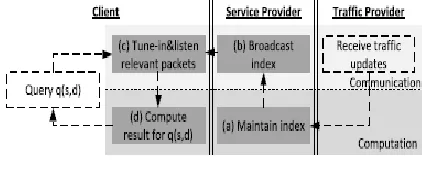
In Fig. 4, we illustrate the components and system flow in our LTI framework. The components shaded by gray color are the core of LTI. In order to provide live traffic information, the server maintains (component a) and broadcasts (component b) the index according to the up-to-date traffic circumstances. In order to compute the online shortest path, a client listens to the live traffic index, reads the relevant portions of the index (component c), and computes the shortest path (component d).
Fig 4. Components in LTI B LTI Objectives
(1) Efficient maintenance strategy. Without efficient maintenance strategy, long maintenance time is needed at server side so that the traffic information is no longer live. This can reduce the maintenance time spent at component a. (2) Light index overhead. The index size must be controlled in a reasonable ratio to the entire road map data. This reduces not only the length of a broadcast cycle, but also makes clients listen fewer packets in the broadcast channel. This can save the communication cost at components b and c.
(3) Efficient computation on a portion of entire index. This property enables clients to compute shortest path on a portion of the entire index. The computation at component d gets improved since it is executed on a smaller graph. This property also reduces the amount
Fig. 5. Hierarchical index structure
Of data. hierarchical index structures enable clients to compute the shortest path on a portion of entire index. However, without pairing up with the first and second features, the communication and computation costs are still infeasible for OSP. the hierarchical index structures enable clients to compute the shortest path on a portion of entire index. However, without pairing up with the first and second features, the communication and computation costs are still infeasible for OSP.
IV LTI CONSTRUCTION
To the best of our knowledge, this is the first work to analyze the hierarchical index structures and exploit the stochastic process to optimize the index.
A Analysis of Hierarchical Index Structures
International Journal of Research (IJR)
e-ISSN: 2348-6848, p- ISSN: 2348-795X Volume 2, Issue 09, September 2015 Available at http://internationaljournalofresearch.org
Fig.6.Effect of hierarchical structure. To estimate the average size of the search graphs, we
apply a stochastic process, Monte Carlo, that relies on random sampling to obtain numerical results.
The construction terminates when we have enough leave entries (i.e., g). Algorithm 1 shows the pseudo codes of the partitioning algorithm based on the stochastic process.
The effect of g. In this work, LTI requires only one parameter g to construct the index which is used to control the number of subgraphs being constructed. Our proposed techniques attempt to optimize the index (O2 and O3) subject to g.
V LTI TRANSMISSION
The broadcasting model uses radio or wireless network (e.g., 3G, LTE, Mobile WiMAX) as the transmission medium. When the server broadcasts a data set (i.e., a “programme”), all clients can listen to the data set concurrently. Thus, this transmission model scales well independent of the number of clients. A broadcasting scheme is a protocol to be followed by the server and the clients. First, the server partitions the data set into m equi-sized data segments. Each packet contains a header and a data segment, where a header describes the broadcasting schedule of all packets. In this example, the variables i and n in each header represent the last broadcasted item and the total number of items. The server periodically broadcasts a sequence of packets. The query performance can be measured by the tuning time and the waiting time at the client side. The tuning time is the time for reading the packets. The waiting time is the time from the start time to the termination time of the query. In this broadcasting scheme, the parameter m decides the tradeoff between tune-in size and the overhead. A large m favors small tune-in size whereas a small m incurs small waiting time. Imielinski et al. suggests to set m to the square root of the ratio of the data size to the index size.
5.3 Client Tune-in Procedures of Air LTI
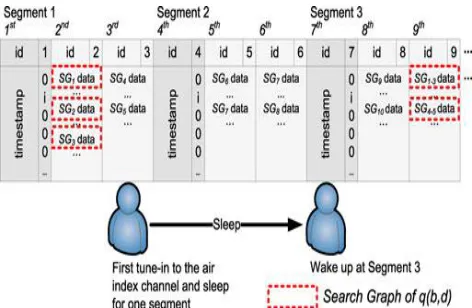
Fig. 9 shows the content of a broadcast cycle for a LTI structure in Fig. 7. In this example, the air index uses a ð1; 2Þ interleaving scheme and each data packet stores the edge
weight of different sub graphs. For instance, the edge weight of sub graph SG1 are stored in the 2nd packet of a broadcast cycle.
Fig. 7: Receiving LTI data from the air index
VI .LTI MAINTENANCE
International Journal of Research (IJR)
e-ISSN: 2348-6848, p- ISSN: 2348-795X Volume 2, Issue 09, September 2015 Available at http://internationaljournalofresearch.org
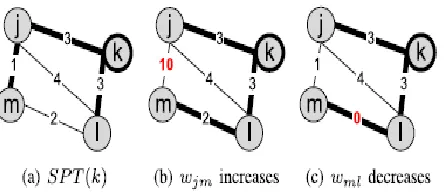
Fig. 8:. Shortest path tree maintenance Definition 1 (Bounded shortest path tree (BSPT)).
Inspired by the discussion, we propose a variant shortest path tree, named as bounded shortest path tree BSPTðvÞ, in Definition 1. A shortest path starting from v is necessarily kept in a bounded shortest path tree BSPTðvÞ if and only if the distance of the shortest path is shorter than the distance from v to every border node. In Fig. 11b, BSPTðlÞ keeps only one shortest path l ! k. The shortest path l ! m and l ! j are dropped since the shortest distance of l ! m and l ! j is not shorter than the distance from l to border node k. Typically, BSPTðvÞ is much smaller than SPTðvÞ and it also boosts up computation efficiency due to smaller search space. Pruning ability of BSPT. The pruning ability of BSPT is highly relevant to the border node selection in each subgraph. In the worst case, BSPT performs as the same as a na€ıve SPT if the borders are very far from each others. However, such cases rarely happen in LTI since the graph partitioning technique prefers a partitioning having small number of borders, which minimizes the change of the worst-case scenario. In our study, BSPT prunes 30 to 50 percent edges from the complete SPT for our evaluated data sets.
PUTTING ALL TOGETHER
A client can invoke Algorithm 2 in order to find the shortest path from a source s to a destination t. First, the client generates a search graph Gq based on s (i.e., current location) and d. When the client tunes-in the broadcast channel it keeps listening until it discovers a header segment (cf. Fig. 9). After reading the header segment, it decides the necessary segments (to be read) for computing the shortest path. These issues are addressed. The client then waits for those segments, reads them, and updates the weight of Gq. Subsequently, Gq is used to compute the shortest path in the client machine locally Note that Algorithm 2 is kept running in order to provide online shortest path until the client reaches to the destination. service provider, as shown in Algorithm 3. The first step is devoted to construct the live traffic index; they are offline tasks to be executed once only. The service provider builds the live traffic index by partitioning the graph G into a set of sub graphs fSGig such that they are ready for broadcasting. We develop an effective graph partitioning algorithm for minimizing the total size of sub graphs and study a combinatorial optimization for reducing the search space of shortest path queries in. In each broadcasting cycle, the server first collects live traffic updates from the traffic provider, updates the sub graphs fSGig eventually broadcasts them.
VII CONCLUSION
International Journal of Research (IJR)
e-ISSN: 2348-6848, p- ISSN: 2348-795X Volume 2, Issue 09, September 2015 Available at http://internationaljournalofresearch.org
a small portion of index. This important feature is thoroughly used in our solution, LTI. Our experiments confirm that LTI is a Pareto optimal solution in terms of four performance factors for online shortest path computation. In the future, we will extend our solution on time dependent networks. This is a very interesting topic since the decision of a shortest path depends not only on current traffic data but also based on the predicted traffic circumstances.
REFERENCE
[1] H. Bast, S. Funke, D. Matijevic, P. Sanders, and D. Schultes, “In Transit to Constant Time Shortest-Path Queries in Road Networks,” Proc. Workshop Algorithm Eng. and Experiments (ALENEX), 2007.
[2] P. Sanders and D. Schultes, “Engineering Highway Hierarchies,” Proc. 14th Conf. Ann. European Symp. (ESA), pp. 804-816, 2006.
[3] G. Dantzig, Linear Programming and Extensions, series Rand Corporation Research Study Princeton Univ. Press, 1963.
[4] R.J. Gutman, “Reach-Based Routing: A New Approach to Shortest Path Algorithms Optimized for Road Networks,” Proc. Sixth Workshop Algorithm Eng. and Experiments and the First Workshop Analytic Algorithmics and Combinatorics (ALENEX/ANALC), pp. 100-111, 2004.
[5] B. Jiang, “I/O-Efficiency of Shortest Path Algorithms: An Analysis,” Proc. Eight Int’l Conf. Data Eng. (ICDE), pp. 12-19, 1992.
[6] P. Sanders and D. Schultes, “Highway Hierarchies Hasten Exact Shortest Path Queries,” Proc. 13th Ann. European Conf. Algorithms (ESA), pp. 568-579, 2005.
[7] D. Schultes and P. Sanders, “Dynamic Highway-Node Routing,” Proc. Sixth Int’l Conf. Experimental Algorithms (WEA), pp. 66-79, 2007.
[8] F. Zhan and C. Noon, “Shortest Path Algorithms: An Evaluation Using Real Road Networks,” Transportation Science, vol. 32, no. 1, pp. 65-73, 1998.
[9] “Google Maps,” http://maps.google.com, 2014.
[10] “NAVTEQ Maps and Traffic,” http://www.navteq.com, 2014.
[11] “INRIX Inc. Traffic Information Provider,” http://www.inrix. com, 2014.
[12] “TomTom NV,” http://www.tomtom.com, 2014.
[13] “Cisco Visual Networking Index: Global Mobile Data Traffic Forecast Update, 2010-2015,” 2011.
[14] D. Stewart, “Economics of Wireless Means Data Prices Bound to Rise,” The Global and Mail, 2011.