ISSN(Online): 2319-8753 ISSN (Print): 2347-6710
International Journal of Innovative Research in Science,
Engineering and Technology
(An ISO 3297: 2007 Certified Organization)
Website: www.ijirset.com
Vol. 6, Issue 9, September 2017
An E-Learning System Architecture using
Information System Design Theory (ISDT)
Javed Wasim1, Dr.Raghav Mehra2
Research Scholar, Bhagwant University, Ajmer, Rajasthan, India1
Associate Professor, Department of CSE, Bhagwant University, Ajmer, Rajasthan, India 2.
ABSTRACT: An Information Systems Design Theory is aprescriptive theory that offers theory-basedprinciples, which can guide practitioners and scholarsin the design of effective information systems and setan agenda for on-going research. This paper displays an e-learning architecture based on Information Systems Design Theory (ISDT) . TheISDT draws on various piece speculations to determine a data framework that backingsthe level of assortment and change innate in the act of e-learning inside a Universitysetting. It also offer an answer to the problem of how to design, implementand support information systems that effectively and efficiently support e-learningwithin universities. This problem is increasingly prevalent and important to theoperation of universities. It is also a problem where existing solutions are limitedin terms of variety, quality and explicit theoretical guidance. Due to a lack of prior empirical research on the interdisciplinary research of E-learningand in response to a need for theoretical and practical framework in this area, theobjective of this paper is to propose a conceptual framework of implementation,which has been largely neglected by discipline of E-learning research in informationtechnology/information system in general, in E-learning particular.
KEYWORDS:E-Learning, Ontology,ISDT,KPI,Kernel
I. INTRODUCTION
The importance of information and communication technologies and e-learning inpromoting open, distance and flexible education in contemporary universities cannot bedenied (deFreitas & Oliver, 2005). In the turbulent business world of today, technological advancements, elevatedcompetition and the shifting demands of business require companies to continually update their skills and capacities. This is primarily achieved through Education thatdevelops skills, knowledge and value within human resources. The growth of e-learning reflects the recognition by the business world of thebenefit to be gained through developing employees to be “knowledge workers”, capableof utilizing new technological tools to gain a competitive advantage. The advent of ICT and the Internet has greatly influenced the way knowledge istransmitted. This has resulted in the development of e-learning.
“E-Learning is the use of network technology to design, deliver,select, administer, andextend LEARNING” – Elliot Masie, The Masie Center
As the technological andpedagogical prerequisites of which E-Learning istraditionally organized and distributed, hence it creates a challenge to how practitioners perceive and useguidelines for implementing E-Learning that is for anon-traditional E-Learning context. In an attempt toaddress this problem, this paper develops and presents an architecture through the use of theory-based design principles in the form of anInformation Systems Design Theory (ISDT).
II. RESEARCH PROBLEM
ISSN(Online): 2319-8753 ISSN (Print): 2347-6710
International Journal of Innovative Research in Science,
Engineering and Technology
(An ISO 3297: 2007 Certified Organization)
Website: www.ijirset.com
Vol. 6, Issue 9, September 2017
demarcate the range of system features anddevelopment activities to a more manageable set [1].For scholars, ISDTs provide principles that are open toempirical testing and thus can form a basis for furtherresearch [3] [4] .
The development of ISDTs for E-Learning ingeneral has been explicated into formulations and fullydeveloped theories, providing practitioners guidelinesin how to design and develop E-Learning systems [5][6] [7]. Alternatives to E-Learning systems have been suggested to offer a better fit for therequirements of tertiary E-Learning and the broadercontext within which it operates [8]. But thoseapproaches have explicitly emphasized the context ofhigher education and not other levels of education.Therefore, prior E-Learning literature [9] [5] [6][7] [8] shows that there has been limited theorybased guidance for the design and support ofunderlying information systems for E-Learning,which overrides the traditional discourse of E-Learning.
III.INFORMATION SYSTEMS DESIGN THEORY
Theories in general are identified into five interrelated categories of theory based on the principle question at the groundwork of a research project [8].These five categories are summarized in Table 1.
Table 1. Categories of Theory [8]
Type Question
Analyzing & Describing What is?
Understanding How & Why?
Predicting What will be?
Explaining & Predicting What is, how, why and what will be?
Design & Action How to do something
An ISDT belongs to the fifth and last category of theories, focusing on generating principles that inform practice and are open for empirical evaluation [8] [3]. An ISDT provides design principles for guidance about how to achieve specific goals in reality without explicitly constraining hypothetical tests to closed experimental environments [10]. It also provides theory-based guidelines about how to design and support a particular type of information system [1],but also assist with more cumulative knowledge building [3].
ISDTs are integrated with components of prescription (see Figure 1) consisting of a particular class of requirements, a type of system solutions with particular features, and a set of efficient development practices [1]. Walls et al’s [1] anatomy for an ISDT defines both design as a noun (product) and a verb (process). However, both the aspect of nouns and verbs are generally informed through kernel theories [1], or as Gregor & Jones [3] address it ‘Justificatory Knowledge’, which enables the formulation of empirically testable predictions relating the design theory to actual outcomes.
Figure 1. Components of an ISDT [1]
ISSN(Online): 2319-8753 ISSN (Print): 2347-6710
International Journal of Innovative Research in Science,
Engineering and Technology
(An ISO 3297: 2007 Certified Organization)
Website: www.ijirset.com
Vol. 6, Issue 9, September 2017
In any case, there has been constrained hypothesis based direction for the outline and support of the fundamental data frameworks foundation. Hypothesis is required in light of the fact that the plan and usage of such frameworks is troublesome: they are mind boggling frameworks that join an assortment of authoritative, regulatory, instructional and innovative segments (Avgeriou et al., 2003)[12].
IV.RESEARCH APPROACH
The principle point of research in data frameworks (IS) is the investigation of the successful outline, conveyance, utilize and effect of IT in associations and society (Keen, 1987)[13]. This work is a case of configuration explore inside the data frameworks field. Configuration look into means to make utilization of existing learning and hypothesis to build antiques that enhance some circumstance (Simon, 1996)[14]. In configuration inquire about it is as yet critical for a hypothesis to clarify a wonder, yet it is less imperative than the instrumental utilization of a hypothesis to fabricate a framework that is proficient and successful according to the potential clients of the data framework (Lee, 2000)[15]. Configuration investigate inside the data frameworks field has a long history yet is regularly not profoundly unmistakable (Burstein and Gregor, 1999)[16]. Lately there has been an expansion in enthusiasm with two articles (Markus et al., 2002, Hevner et al., 2004)[17][18] in MISQ, the arrival of ISWorld's outline look into site (Vaishnavi and Kuechleer, 2004)[19] and the formation of a plan science office inside the Communications of the Association for Information Systems (Hevner and March, 2004)[18]. It has been recommended that plan and the more customary "normal" science are two integral periods of research inside the data frameworks field .
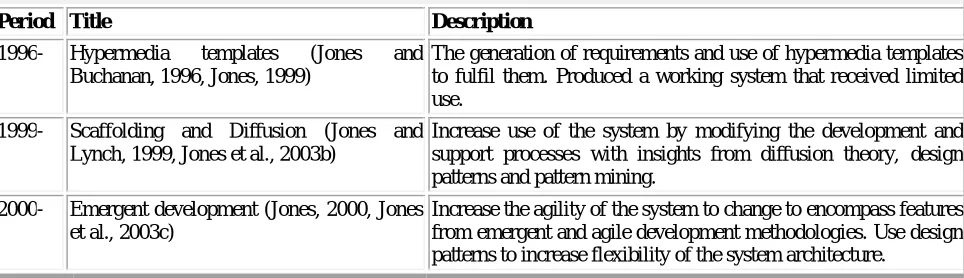
The process for this ISDT has been underway since mid-1996 with the initial design and development of the Webfuse system (Jones and Buchanan, 1996, Jones, 1999)[20][21].Since 1996 there have been three identifiable research and development cycles each drawing on a different set of kernel theories to address specific shortcomings. Table 2 provides a summary of the three cycles.
Table 2: Process cycle summary of ISDT
Period Title Description
1996- Hypermedia templates (Jones and
Buchanan, 1996, Jones, 1999)
The generation of requirements and use of hypermedia templates to fulfil them. Produced a working system that received limited use.
1999- Scaffolding and Diffusion (Jones and Lynch, 1999, Jones et al., 2003b)
Increase use of the system by modifying the development and support processes with insights from diffusion theory, design patterns and pattern mining.
2000- Emergent development (Jones, 2000, Jones et al., 2003c)
Increase the agility of the system to change to encompass features from emergent and agile development methodologies. Use design patterns to increase flexibility of the system architecture.
V. REFINEMENTOFTHEINFORMATIONSYSTEMSDESIGNTHEORY
Drawing on the components of an ISDT shown in Figure 1 each of the following sections provides a high level description of the formulated ISDT.
A.Kernel Theories
ISSN(Online): 2319-8753 ISSN (Print): 2347-6710
International Journal of Innovative Research in Science,
Engineering and Technology
(An ISO 3297: 2007 Certified Organization)
Website: www.ijirset.com
Vol. 6, Issue 9, September 2017
Table 3: Provides a summary of the kernel theories ISDT Component Kernel Theories
Meta-requirements Work system framework (Alter, 2002)[22]; e-learning literature
Meta-design
Hypermedia templates (Catlin et al., 1991, Nanard et al., 1998)[23][24], Software wrappers, (Bass et al., 1998)[25], Enterprise Integration (Hohpe and Woolf, 2003)[26], Design patterns (Fowler, 2003)[27]
Design method Emergent development (Truex et al., 1999)[28], Lightweight methodologies (Highsmith and
Cockburn, 2001[29]), Diffusion theory (Rogers, 1995)[30]
B.Meta-requirements
For the motivations behind this work e-learning is characterized as the utilization of Information and Communication Technologies (ICTs) to empower and upgrade the instructing and learning process inside establishments of advanced education. This definition perceives that instructing and learning requires managerial support and, moreover, that contemporary learning conditions ought to coordinate scholarly and regulatory bolster benefits specifically into the understudies' condition (Segrave and Holt, 2003)[31]. Thus the meaning of e-learning prerequisites is extended to incorporate support for all assignments required to energize proficient and powerful educating and learning.
The plan of the underlying state into a compelling portrayal is urgent to finding a powerful outline arrangement (Weber, 2003)[32]. Portrayal profoundly affects configuration work (Hevner et al., 2004)[18] especially in transit in which assignments and issues are considered. The work framework structure (Alter, 2002)[33] was utilized to build up a conceptualisation of the underlying state confronting a current University embracing e-learning (Jones, 2004)[34]. The significant finding of this conceptualization is that awesome differing qualities – through the tremendous assortment of controls, academic convictions, prerequisites and different elements – and nonstop change – caused generally by the perception that e-learning is as yet unfurling and nobody truly knows its future shape (Zemsky and Massy, 2004)[47] – are inborn necessities that any data supporting e-learning should address.
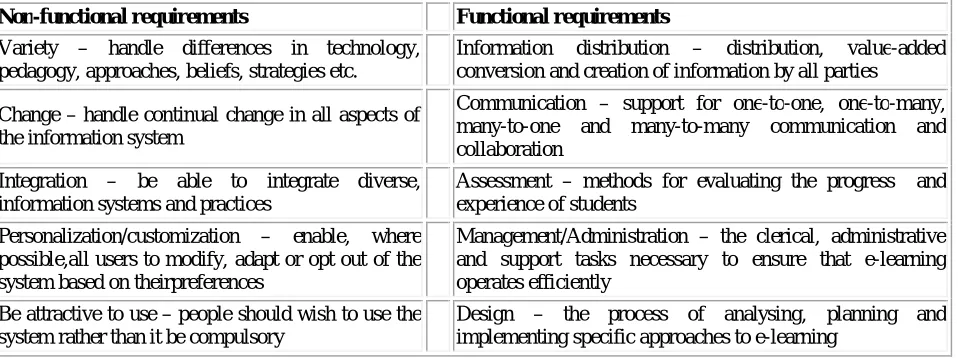
The meta-necessities for this ISDT have been isolated into two classifications regular in the product building writing (Sommerville, 2001)[36] : non-functional and functional. Non-useful necessities are requirements on and characteristics of the administrations offered by the framework. Practical necessities are proclamations of the administrations the framework ought to give. Table 3 outlines the practical and non-useful meta-prerequisites created as a feature of this ISDT.
Table 3: functional and non-functional meta-requirements developed as part of this ISDT. Non-functional requirements Functional requirements
Variety – handle differences in technology, pedagogy, approaches, beliefs, strategies etc.
Information distribution – distribution, value-added
conversion and creation of information by all parties
Change – handle continual change in all aspects of the information system
Communication – support for one-to-one, one-to-many, many-to-one and many-to-many communication and collaboration
Integration – be able to integrate diverse, information systems and practices
Assessment – methods for evaluating the progress and experience of students
Personalization/customization – enable, where possible,all users to modify, adapt or opt out of the system based on theirpreferences
Management/Administration – the clerical, administrative and support tasks necessary to ensure that e-learning operates efficiently
Be attractive to use – people should wish to use the system rather than it be compulsory
ISSN(Online): 2319-8753 ISSN (Print): 2347-6710
International Journal of Innovative Research in Science,
Engineering and Technology
(An ISO 3297: 2007 Certified Organization)
Website: www.ijirset.com
Vol. 6, Issue 9, September 2017
Some of the non-useful criteria (change, assortment and mix) were perceived in the first plans (Jones and Buchanan, 1996)[20] . The requirement for configuration bolster is a noteworthy issue inside e-learning because of the developing issue of poor outline of instructional materials inside e-learning (Frizell and Hubscher, 2002)[39].
So as to utilize data innovation to enhance learning forms, the instructive suspicions basic the outline of data innovation for instructive purposes must be comprehended (Leidner and Jarvenpaa, 1995)[40]. It is normal for e-learning data frameworks to be intended to exemplify presumptions taken from a particular learning hypothesis. But then, as expressed over, the necessities for this ISDT make no unequivocal say of particular learning speculations.
1) Meta-design
The meta-design component of this ISDT encapsulates a range of features or design principles intended to fulfil both the functional and non-functional requirements identified above. Tables 4 (non-functional requirements) and 3 (functional requirements) list the requirements (left-hand column) and the accompanying design principles (right-hand column).
Table 4: ISDT design principles to non-functional requirements
Design principles Non-functional Requirements
Hypermedia templates (Nanard et al., 1998, Catlin et al., 1991) as software
wrappers for COTS software (Braun, 1999) Variety, change, integration
Platform independence variety, change, integration
OO Design patterns (Gamma et al.,1995, Fowler, 2003, Hohpe &Woolf, 2003) variety, change, integration,
customisation
Open source software Change, integration
Scripting language (Ousterhoust, 1998) Change, variety, integration
A key feature from the initial formulation of this ISDT was the recognition that reliance on any single organization, be it a software vendor or a local development team, to produce all the required services and tools for an e-learning information system would result in a number of limitations (Jones and Buchanan, 1996, Jones, 1999)[20][21]. To avoid these problems a major emphasis has been on developing an infrastructure that can integrate the widest range of existing and future e-learning tools and yet still provide a consistent user interface.
This flexible infrastructure was achieved through the use of hypermedia templates (Catlin et al., 1991, Nanard et al., 1998)[23][24] as the primary system abstraction. The system’s templates were designed to act as software wrappers (Bass et al., 1998)[25] and provide a consistent abstraction around external software. This enables development to integrate the widest possible range of commercial off-the-shelf (COTS) products while providing a consistent user and system interface. This approach combines the original benefits of hypermedia templates – simplified authoring process, increased reuse, and reduced costs (Catlin et al., 1991, Nanard et al., 1998)[23][24] – with the benefits of the COTS approach – shorter development schedules and reduced development, maintenance, training and infrastructure costs (Braun, 1999).
Table 5: ISDT design principles to functional requirements
Design principles/features Functional requirements
Authentication, Access control, File transfer, Versioning, Backups/restores, Usage tracking,
Integration with organisational systems, Wiki Information distribution
Discussion forums/lists, Chat rooms, Blogs, RSS, Wiki Communication
Online quizzes, Online assignment submission/management, Assessment database, Peer
ISSN(Online): 2319-8753 ISSN (Print): 2347-6710
International Journal of Innovative Research in Science,
Engineering and Technology
(An ISO 3297: 2007 Certified Organization)
Website: www.ijirset.com
Vol. 6, Issue 9, September 2017
External integration, Temporary enrolment, Results processing, Review of grade processing,
Teaching responsibilities database, "Flexible" mirrors, Student impersonation, Timetable Administration
Minimum course sites, Site skeletons, Customizable appearance Design
To additionally improve the adaptability of this approach formats were executed using a scripting dialect (Perl), with overwhelming utilization of protest situated outline designs (Gamma et al., 1995)[41] and wrapped around dominatingly open source programming. The utilization of open source programming gives access to source code and expels the impact of a business seller (Gerlich, 1998)[43] at the cost of requiring expanded specialized abilities. Scripting dialects permit extremely quick advancement of utilizations by means of the sticking together of existing applications, 5 to 10 times speedier than using conventional frameworks programming dialects (Ousterhoust, 1998)[42].
2) Design method
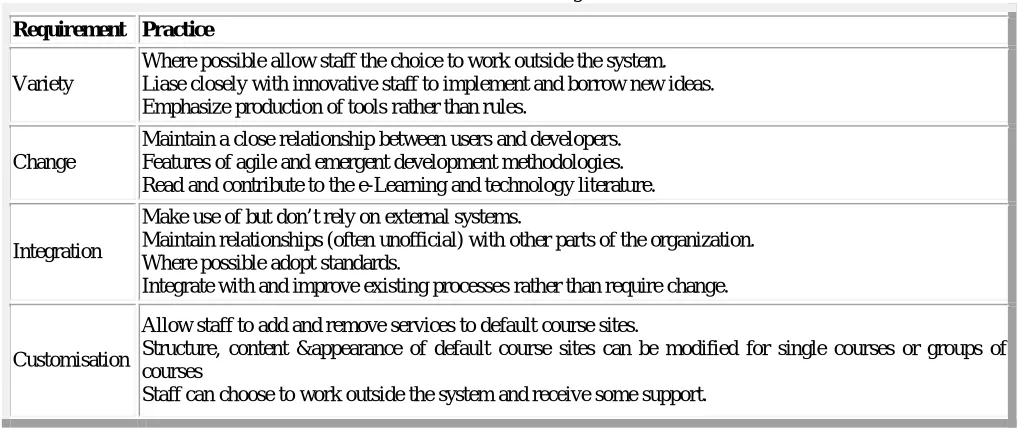
Table gives a review of the advancement hones (right-hand section) for this ISDT and the linkage with non-useful prerequisites (left-hand segment) plot above. These advancement rehearses reject or place less accentuation on the greater part of the suspicions of conventional programming improvement hones and rather receive those of rising (Truex et al., 1999)[28] and light-footed (Highsmith and Cockburn, 2001) [29] advancement techniques. These practices depend on the supposition that there are a gathering of framework designers who constantly endeavor to accomplish arrangement between the association and its data frameworks (duPlooy, 2003). Inside this ISDT this trademark implies that the designers are installed inside the Faculty and are effectively drawing on their perception of life inside the Faculty to recognize what new advancements are required. More prominent detail of these advancement practices and how they were connected is given somewhere else (Jones, 2000, Jones et al., 2003c).
The ISDT perceives that the dedication and inspiration of staff individuals are a basic achievement figure the execution of e-learning and that many staff (e.g. scholastics, instructional creators and administrators) have significant self-governance about how they perform undertakings and regularly can and do oppose the inconvenience of new innovation and changes to routine (Jones et al., 2003a). To address this issue the ISDT draws upon dissemination hypothesis (Rogers, 1995)[153-30] to give ways to deal with assess and outline potential new components (Jones and Lynch, 1999, Jones et al., 2003b)[22][34]. The accentuation given by dissemination hypothesis is to focus on new or enhanced components that are the most alluring, on a reasonable level, to potential clients of the data framework.
Table 6: Overview of Design Method
Requirement Practice
Variety
Where possible allow staff the choice to work outside the system. Liase closely with innovative staff to implement and borrow new ideas. Emphasize production of tools rather than rules.
Change
Maintain a close relationship between users and developers. Features of agile and emergent development methodologies. Read and contribute to the e-Learning and technology literature.
Integration
Make use of but don’t rely on external systems.
Maintain relationships (often unofficial) with other parts of the organization. Where possible adopt standards.
Integrate with and improve existing processes rather than require change.
Customisation
Allow staff to add and remove services to default course sites.
Structure, content &appearance of default course sites can be modified for single courses or groups of courses
ISSN(Online): 2319-8753 ISSN (Print): 2347-6710
International Journal of Innovative Research in Science,
Engineering and Technology
(An ISO 3297: 2007 Certified Organization)
Website: www.ijirset.com
Vol. 6, Issue 9, September 2017
Attractive to
use
Automatically produce default course sites for all courses. Automate as many tasks as necessary.
Continuous evaluation of use and literature in search for new services. New features choice driven by diffusion theory.
3) Hypotheses
Drawing on principles from the kernel theories of this ISDT it is possible to pose a range of hypotheses that are open to empirical testing. Table 6-7 provides an overview of the testable design product and process hypotheses for this ISDT and an indication of which kernel theories the hypotheses are drawn from.
Table 7 :An overview of the testable design product and process hypotheses for ISDT
Kernel Theory Hypotheses
Hypermedia templates It is possible to construct an IS for e-learning using hypermedia templates as the
main system abstraction.
Software wrappers, COTS, emergent
development, design patterns, open source software
Use of this ISDT will produce an IS which is flexible, open and customisable.
Emergent/Agile development
Overtime the IS produced from this ISDT will become customized to the needs and requirements of the particular organization and consequently provide a possible source of strategic advantage.
Diffusion theory A system built using this ISDT will be acceptable to users as demonstrated by
regular and increasing use.
It is proposed that these theories are essential for a scope of reasons. A noteworthy reason is that numerous present e-learning frameworks have critical issues including not being especially creative, exhibiting constrained quality, having restricted coordination, tending to confine future potential outcomes and having a high probability of disappointment (Alexander, 2001, Paulsen, 2002)[11].
VI.E-LEARNING DESIGN AND DEVELOPMENT
ISSN(Online): 2319-8753 ISSN (Print): 2347-6710
International Journal of Innovative Research in Science,
Engineering and Technology
(An ISO 3297: 2007 Certified Organization)
Website: www.ijirset.com
Vol. 6, Issue 9, September 2017
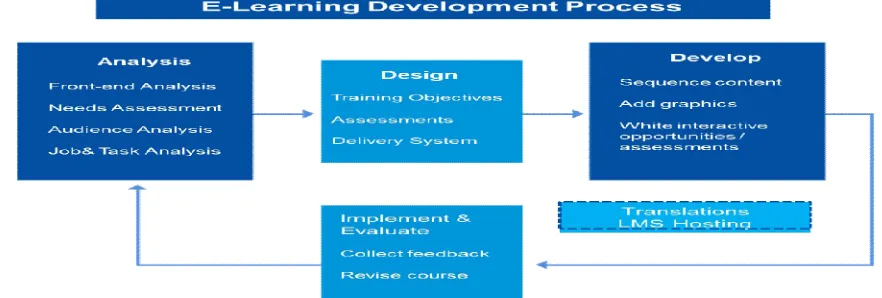
1) Analysis:
This is the first step of the eLearning development process. At this stage, you need to analyze the learning content, learning objectives and the profile of the target audience. You also need to take a look at the type of job or tasks that the participants are expected to accomplish after taking the course. Based on this, a broad instructional strategy is formulated to decide on the best way to present the content.
2) Design:
Next, learning experts need to create a design document that incorporates the recommendations of the learning management team. Requirements of the stakeholders, training objectives, assessments required and design challenges are taken into account at this stage. This document also specifies the instructional, visual and audio elements to be included in the course curriculum.
3) Develop:
The specifications in the design document are executed by incorporating the content, visuals and assessments into a storyboard. The page layout, graphic user interface and multimedia elements are all finalized at this stage and incorporated into the course. There are a range of rapid authoring tools today such as Articulate Storyline, Lectora, Captivate, etc., which can be used for giving a definite shape to your eLearning course. Using rapid authoring tools expedites the course development process considerably thanks to their in-built interactivities and templates. Check out this online video that explains how to zero in on the right authoring tool for your eLearning course development.
4) Evaluate & Implement:
Next, is the evaluation stage where the quality of the developed course is tested to ensure accuracy of functionality as well as content. Editors, instructional designers, subject matter experts and quality control managers check various components of the course to ensure perfection. Feedback is incorporated into the course and uploaded.
5) Translation& LMS Hosting:
If a course needs to be translated into one or more languages, it is done at this stage by following a separate sequence of actions to ensureaccuracy and quality.At long last, the course is facilitated on the LMS or some other learning entry. The intended interest group is given the connection, client data and passwords to get to the course. Utilizing a LMS enables supervisors to screen and assess the preparation program at each stage – what number of clients have enlisted, what number of have finished, what number of have deserted mid-way, and so on. This aides in making remedial move and guaranteeing most extreme achievement of the preparation activity. Correspondence is the key and one needs to guarantee that the courses are not recently simply transferred on to the LMS, but rather data about them is accurately and influentially come to the intended interest group.
To abridge, a great eLearning course can be produced once you break down your necessities and devise a viable learning methodology to share the information required. You have to comprehend the segments, for example, grown-up learning standards, learning styles and instructional plan standards to make a course that meets your goals. At long last, to build up the course you have to embrace a streamlined procedure and utilize the correct instruments to execute course advancement. The duty does not end here. Once the course is conveyed, it needs to achieve the intended interest group. For this reason, you need a decent correspondence system that guarantees your goals are comprehended, acknowledged and acknowledged by everybody
VII. PROPOSED E-LEARNING SYSTEM ARCHITECTURE
ISSN(Online): 2319-8753 ISSN (Print): 2347-6710
International Journal of Innovative Research in Science,
Engineering and Technology
(An ISO 3297: 2007 Certified Organization)
Website: www.ijirset.com
Vol. 6, Issue 9, September 2017
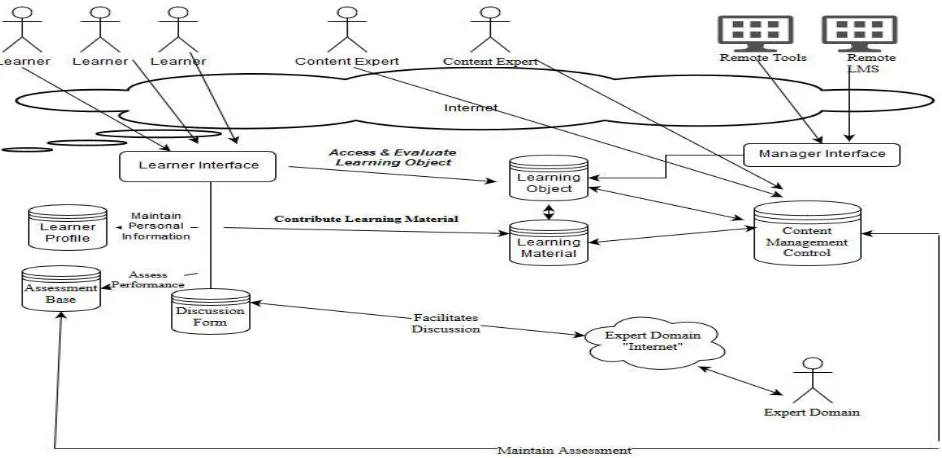
assessment base, as well as maintain the KPI framework with the domain experts. The system can be viewed in two layers. The “ Learning Layer ” provides basic learning management functions in relation to learner profiles, learning objects and materials, and discussion forum. The “ Reasoning Layer ” extends the basic functions by implementing the KPI-based learning ontology and executing semantic reasoning to provide customized learning instructions to the learners. The system can be built using Java programming tools together with Java Struts Hibernate, Protégé, JGraph, and OWL SWRL.
Figure 3: Architecture of the Proposed E-learning System
VIII.SUMMARY
This paper has displayed an Information Systems Design Theory (ISDT) for a data framework to bolster e-learning inside a University setting. This outline hypothesis has been created and experimentally tried through the utilization and on-going assessment of a solitary instantiation of the ISDT. It has been demonstrated that this instantiation is adaptable, customisable and supports a noteworthy level of selection.
There are extra elements that could be explored that are likewise past the extent of the present paper. It is contended that the ISDT exhibited here prompts frameworks that bolster assortment, adapt to change, take into account personalization and customization and are alluring to clients. No cases have been made about different qualities of a framework that are thought alluring, for example, low beginning and on-going cost, absence of reliance on specific specialized staff, coordination with different frameworks et cetera. Additionally work could likewise look at these elements.
IX.SUGGESTION AND RECOMMENDATIONS
ISSN(Online): 2319-8753 ISSN (Print): 2347-6710
International Journal of Innovative Research in Science,
Engineering and Technology
(An ISO 3297: 2007 Certified Organization)
Website: www.ijirset.com
Vol. 6, Issue 9, September 2017
2) The proposed e-learning system architecture will be implemented with other courses, modules and lectures for the academic team in general, and a larger sample of students to increase India`s electronic readiness in terms of the five categories of factors proposed in the framework in the coming academic years.
3) With suitable strategy for the implementation of proposed e-learning system architecture, all the future development stages come easier, because they areconsidered the cornerstone the e-learning. Attitudinal aspects have been cited as determining the success or failure of adopting e-learning in institutions.
4) Institutional leaders should continuously adapt themselves to changing technological environments and inculcate a positive attitude towards the adoption and implementation of e-learning within their institutions.
5)For lecturers to be able to use IT confidently, they must receive continuous training to develop their pedagogical skills according to the dynamic nature of technology.
The students, being the primary resource for HEIs, ought to have access to the internet and e-learning facilities if they are to prove themselves and achieve their goals.
6) The questionnaires that contain closed and open questions could provide suggestions for further improvements of the strategy of e-learning implementation.
7) The research results presented in this thesis could be used to develop an innovative strategy to make modern planning & developing up-to-date learning resources content using innovative technology, implementing the new learning content, and assessing it.
As concluding remarks, e-learning is increasingly considered an essential success issue into building the new India, yet research pertinent to ICT-supported learning in India is still limited. Educational institutions in India face unique challenges in comparison to developed countries. Therefore, it is necessary to understand why and what actuates students and lecturers to do with e-learning. A strong understanding of these obstacles; challenges or barriers allows for taking suitable actions to guarantee e-learning success. Consequently, it is expected that the findings and the strategic architecture of this research will offer a beneficial evidence-based source of information for academics, researchers, administrators, and other decision-makers to contribute in planning, design and implementation of e-learning in India.
REFERENCES
[1] J. Walls, G. R. Widmeyer, and O. A. El Sawy,“Building an Information System Design Theory forVigilant EIS”, Information Systems Research, 3(1), (1992),pp. 36-59
[2] M. L. Markus, A. Majchrzak, and L. Gasser, “A Design Theory for Systems that Support Emergent Knowledge Processes”, MIS Quarterly, 26(3), (2002), pp. 179-212.
[3] S. Gregor, and D. Jones, “The Anatomy of a Design Theory”, Journal of the Association for Information Systems 8, no. 5, (2007), pp. 312-335.
[4] J. Holmström, M. Ketokivi, and A. P. Hameri,“Bridging Practice and Theory: A Design Science Approach”, Design Decisions, 40(1), (2009), pp. 65-87.
[5] D. Jones, “An Information Systems Design Theory for E-Learning”, The Australian National University, (2011) [6] D. Jones, and S. Gregor, “The Formulation of an Information Systems Design Theory for E-Learning”, First
International Conference on Design Science Research in Information Systems and Technology, (2006), pp. 356-373 [7] D. Jones, S. Gregor, and T. Lynch, “An Information Systems Design Theory for Web-based Education”,
IASTED International Symposium on Web-based Education, (2003).
[8] S. Gregor, “The Nature of Theory in Information Systems”, MIS Quarterly, 30(3), (2006).
[9] Garrison, D. R., E-Learning in the 21st Century: A Framework for Research and Practice, Taylor and Francis,(2011).
[10] Hitt, J., and J. Hartman. Distributed Learning: New challenges and opportunities for educational leadership. No. 3. Report, 2002. [11] Alexander, S. (2001) E-learning developments and experiences. Education and Training, 43, 240-248.
[12] M. L. Markus, A. Majchrzak, and L. Gasser, “A Design Theory for Systems that Support Emergent Knowledge Processes”, MIS Quarterly, 26(3), (2002), pp. 179-212.
[13] Keen, P. G. W. (1987) MIS Research: Current Status, Trends and Needs. IN BUCKINGHAM, R. A., HIRSCHHEIM, R. A., LAND, F. F. & TULLY, C. J. (Eds.) Information Systems Education: Recomendations and Implementation. Cambridge, Cambridge University Press. [14] Simon, H. (1996) The sciences of the artificial , MIT Press.
[15] Lee, A. S. (2000) Irreducibly Sociological Dimensions in Research and Publishing. MIS Quarterly, 24, v-vii.
[16] Burstein, F. & Gregor, S. (1999) The Systems Development or Engineering Approach to Research in Information Systems: An Action Research Perspective. ACIS.
ISSN(Online): 2319-8753 ISSN (Print): 2347-6710
International Journal of Innovative Research in Science,
Engineering and Technology
(An ISO 3297: 2007 Certified Organization)
Website: www.ijirset.com
Vol. 6, Issue 9, September 2017
[18] Hevner, A. & March, S. (2004) Editorial Statement: Information Technology and Systems (ITS) Department. Communications of the AIS, 13.
[19] Vaishnavi, V. & Kuechleer, B. (2004) Design Research in Information Systems.
[20] Jones, D. & Buchanan, R. (1996) The design of an integrated online learning environment. IN ALLAN CHRISTIE, P. J., BEVERLEY VAUGHAN (Ed.) Proceedings of ASCILITE’96. Adelaide.
[21] Jones, D. (1999) Webfuse: An integrated, eclectic web authoring tool. IN BETTY COLLIS, R. O. (Ed.) Proceedings of EdMedia’99, World Conference on Educational Multimedia, Hypermedia & Telecommunications. Seattle, Association for the Advancement of Computing in Education.
[22] Alter, S. (2002) The work system method for understanding information systems and information system research. Communications of the AIS, 9, 90-104.
[23] Catlin ,duPlooy, N. F. (2003) Information systems as social systems. IN CANO, J. (Ed.) Critical Reflections on Information Systems: A Systematic Approach. Hershey, IDEA Group Inc.
[24] Nanard, M., Nanard, J. & Kahn, P. (1998) Pushing Reuse in Hypermedia Design: Golden Rules, Design Patterns and Constructive Templates. Proceedings of the 9th ACM Conference on Hypertext and Hypermedia. ACM.
[25] Bass, L., Clements, P. & Kazman, R. (1998) Software Architecture in Practice, Boston, Addison-Wesley.
[26] Hohpe, G. & Woolf, B. (2003) Enterprise Integration Patterns: Designing, Building and Deploying Messaging Solutions, Boston, Addison-Wesley.
[27] Fowler, M. (2003) Patterns of Enterprise Architecture, Boston, Addison-Wesley.
[28] Truex, D., Baskerville, R. & Klein, H. (1999) Growing systems in emergent organizations. Communications of the ACM, 42, 117-123. [29] Highsmith, J. & Cockburn, A. (2001) Agile software development: Business of innovation. IEEE Computer, 34, 120-122.
[30] Rogers, E. (1995) Diffusion of Innovations, New York, The Free Press.
[31] Segrave, S. & Holt, D. (2003) Contemporary learning environments: Designing e-Learning for education in the professions. Distance Education, 24, 7-24.
[32] Weber, R. (2003) Still desperately seeking the IT artifact. MIS Quarterly, 27, iii-xi.
[33] Alter, S. (2002) The work system method for understanding information systems and information system research. Communications of the AIS, 9, 90-104.
[34] Jones, D., Gregor, S. & Lynch, T. (2003a) An information systems design theory for web-based education. IASTED International Symposium on Web-based Education. normal’>Rhodes, Greece, IASTED.
[35] Zemsky, R. & Massy, W. F. (2004) Thwarted innovation: What happened to e-learning and why. The Learning Alliance at the University of Pennsyvlania.
[36] Sommerville, I. (2001) Software Engineering , Addison-Wesley.
[37] McCormack, C. & Jones, D. (1997) Building a Web-Based Education System, New York, John Wiley & Sons.
[38] Avgeriou, P., Papasalouros, A., Retalis, S. & Skordalakis, M. (2003) Towards a Pattern Language for Learning Management Systems. Educational Technology & Society, normal’> 6, 11-24.
[39] Frizell, S. & Hubscher, R. (2002) Supporting the Application of Design Patterns in Web-Course Design. EdMedia’2003. Denver, AACE. [40] Leidner, D. & Jarvenpaa, S. (1995) The use of information technology to enhance management school education: A theoretical view. MIS
Quarterly, 19, 265-291.
[41] Gamma, E., Helm, R., Johnson, R. & Vlissides, J. (1995) Design Patterns: Elements of Reusable Object-Oriented Software, Reading, Massachusetts, Addison-Wesley.
![Table 1. Categories of Theory [8]](https://thumb-us.123doks.com/thumbv2/123dok_us/1588329.1195757/2.595.118.477.606.706/table-categories-of-theory.webp)