ISSN 2286-4822 www.euacademic.org
Impact Factor: 3.1 (UIF) DRJI Value: 5.9 (B+)
The Misalignment - Is it a Determinant of the FDI in
the Developing Countries?
ABDESSALEM GOUIDER URECA, University of Sfax, Sfax
Tunisia
RIDHA NOUIRA1 UREP, University of Sfax, Sfax Tunisia
Abstract:
This paper contributes to a current and intense debate among economists concerning the impact that real exchange rate misalignment can have on FDI. To identify the degree of misalignment, a model of Edwards in Panel will be estimated for a sample of 52 developing countries over the period 1980-2010. Once the misalignment values are determined, they will be included in the FDI model. The results prove that the misalignment is a main determinant of the FDI in the developing countries. Indeed, the overvaluation has a negative and significant effect on the FDI while undervaluation does not have a significant effect on it. Finally, a persistent overvaluation in developing countries can slow down the flow of FDI to these countries, whereas the persistent undervaluation stimulates these flows.
Key words: Foreign direct investment, Overvaluation, Undervaluation
JEL Classification: C21; C23; F31; F33
Introduction
During these last years, the attitude to the Foreign Direct Investment (FDI) has changed. The latter became a key factor of economic growth, in the way that several countries have liberalized their economic policy to attract more flows of FDI to increase employment, exports, tax revenue and to benefit from the technological transfer (Blomström and Kokko, 2003). Since the crisis of the debts which started in Mexico in 1982, developing countries seem to need more and more flows of FDI to fill the insufficiency of their clean financial resources. Since then, they have multiplied their economic policies to improve the attractiveness of their territories.
Beyond the traditional factors of the FDI attraction, there is another crucial incentive that has been ignored in literature, namely the misalignement of the real exchange rate. According to Edwards (1989), misalignment refers to the set of "sustained deviations of the real exchange rate observed in relation to the level of the long-term equilibrium." The degree of misalignment leads to imbalances represented by the phenomena of over-or under-evaluation of the real exchange rate which is expressed by losses or gains in competitiveness. The misalignment of the exchange rate appears to be a key determinant of the FDI flows. In fact, an overvalued exchange rate negatively affects the economic competitiveness and can reduce the FDI for domestic goods (raw materials, natural resources....) which become more expensive and discourages foreign investors. Conversely, by improving the competitiveness of domestic products, the undervaluation may attract the FDI. The prices of raw materials and domestic wages may encourage the location of multinationals.
undervaluation is expected to cause an increase of the entry of the FDI since an undervaluation of the home currency produces domestic assets clearly cheap for foreign investors.
The results of the empirical studies which attempted to empirically estimate the relationship between the misalignment of the real exchange rate and the FDI flows haven't been unanimously agreed. Indeed, if Grossmann and al. (2008) were able to show that the undervaluation of the dollar encourages the attraction of the FDI to the United States, then its overvaluation hampers its entry, Hasnat (1998) found no relationship between the two variables. Bénassy-Quéré and al. (2001) found that exchange-rate volatility is detrimental to the foreign direct investment (FDI) and that its impact compares with that of misalignments. One policy implication is that the building of currency blocks could be a way of increasing FDI to emerging countries as a whole. Lee and Min (2011) found that, for Korea, the effect of exchange rate volatility on the FDI is persistent, whereas the misalignment level is only temporary. However, they suggested that multinational firms consider volatility to be more a generic determinant of the foreign investment than misalignment of exchange rate level.
1. Determinants of the FDI in the Developing Countries
The objective of this section is to identify the main factors that explain the volume of FDI received by an economy of the developing countries. In fact, the majority of the developing countries try to meet the necessary criteria to attract more foreign capital. However, there is no unified theoretical framework which brings together all the determinants of the FDI. In literature, the attractiveness of the FDI is conditioned not only by economic factors but also by socio-political and institutional factors.
Economic factors are mainly related to the market size, to the degree of openness of the host economy and to the macroeconomic stability.
The domestic market size is considered a key factor in attracting foreign capital (Faustino and Leitao, 2010; Hailu, 2010). Some empirical studies have approximated this variable by the GDP (Billigton, 1999; Moosa 2008), while other studies used the GNP as an approximation of this factor (Metwally, 2004; Schneider and Frey, 1985). In some studies, this variable is approximated by the GDP per capita (Alkinkube, 2003). In all cases, strong economic growth may encourage the entry of the FDI because it is synonymous with an increase in the national income and domestic demand. This favors the horizontal FDI. Indeed, multinationals seek again new market shares. So, the more economic growth in the host country is important, the greater domestic demand is and the more massive inflows of the FDI will be.
decision whether to invest in a developing country also depends on the economic liberalization and the export promotion policies. Several empirical studies have shown a positive relationship between trade openness and the FDI (Chakrabarti, 2001; Asiedu, 2002). Generally, the economic openness is measured by the sum of imports and exports relative to the GDP.
The quality of infrastructure is an indicator of attractiveness of the FDI. Indeed, the establishment of a basic infrastructure (roads, airports, telecommunications ...) may attract foreign investment flows (Asiedu, 2002; Deichmann et al., 2003). The infrastructure is at the origin of productivity gains because it allows the minimization of production costs (costs of communication, transport, etc.). The foreign companies try to exploit cost differences between different locations. This is compatible with the vertical FDI. The quality of infrastructure in the host country is usually determined by the number of telephone lines per thousand people. In some studies, this variable is approximated by the total expenditure of the government on transportation and communication (James, 2008).
Macroeconomic stability: This variable is usually approximated by the inflation rate. A high inflation rate is synonymous with the national currency depreciation and thus a loss in terms of consumer purchasing power means a decline in the domestic demand. Inflation is then negatively related to the FDI (Woodward and Rolfe, 1993; Addison and Heshmati, 2003).
Financial development has a positive effect on the entry of the FDI (Deichmann, Karidis and Sayek, 2003). A solid financial system can facilitate the transfer of technology. It can also contribute to the realization of sustainable economic growth. This variable is approximated by the share of private credit in the GDP (James, 2008).
Several empirical studies have shown that inefficient institutions discourage the entry of the FDI (Gastanaga et al., 1998; Asiedu and Villamil, 2000). In addition, the bad governance can produce corruption and bureaucracy. Wei (2000) studied the impact of corruption on the flows of the FDI in 45 host countries. He found a negative relationship between the level of corruption and the entry of the FDI in the host country. Thus, political instability, corruption and bureaucracy create an unfavorable environment to foreign investment because the violation of the law affects the attractiveness of territory, reduces confidence and increases the uncertainty about the potential benefits of this investment.
The continuous search of natural resources remains a fundamental incentive for the FDI entry and explains the important part of foreign capital in the developing countries. It is recognized that the country»s endowments of production factors (natural resources, labor and capital) can affect the attractiveness of the FDI. In this context, Aseidu (2002), and Dupasquier Osajwe (2006) showed that natural resources in the African countries attract more foreign investments.
2. Misalignment and FDI
less competitive on the international markets and, as a consequence, hinders the export of these goods. Moreover, the overvaluation increases the cost of the investment through the enrichment of the production factors (construction, machines, transportation equipment…). Thus, the currency overvaluation of the developing countries should discourage foreign investors to invest in these countries. Therefore, the impact of the misalignment of the real exchange rate on the foreign direct investments depends on its nature. In reality, an undervaluation of the currency should increase the FDI, while an overvaluation should decrease it.
Very few studies took into account the role played by the misalignment in the attraction of the FDI. Among these studies we cite the work of Soydemir and Grossmann (2006). These two authors found a negative relation between the deviation of the real exchange rate observed by its level of PPA and the FDI incomers in the United States. In 1998, Hasnat found no relation between the misalignment (calculated as the difference between the observed rate and the rate of balance of Purchasing Power Parity (PPA)) and the flows of the FDI. By contrast, Grossmann and al. (2008) could show the sensibility of the FDI flows in the values of overvaluation and the undervaluation of the US dollar. In fact, they showed that the undervaluation of the dollar encourages the entry of the FDI in the United States, while its overvaluation hinders it. All these studies focused on the impact of the misalignment on the FDI in the developed countries. For the developing countries, Bénassy-Quéré and al. (2001) found that exchange-rate misalignment is detrimental to foreign direct investment (FDI) to emerging countries as a whole. Lee and Min (2011) found that, for the Korea, the effect of exchange rate misalignment on FDI is temporary.
role in analyzing the relationship between exchange rates and FDI flows and that the omission of timing and the overvaluation persistence in previous papers may cause the inconclusive results.
In this section, we shall try to calculate the degree of misalignment of the currencies of a sample of 52 developing countries over the period 1980-2010. Then, we will determine the impact of misalignment on the flows of the FDI in the developing countries. So, we will introduce the variable "misalignment" into the models of the FDI and we determine the signification of the latter.
2.1 The misalignment of the real exchange rate
The economic model:
countries typically face different sets of structure issues, and a more limited availability of data. Edwards (1986, 1989a, 1994) made a seminal attempt to build an equilibrium exchange rate model specifically tailored to developing countries”2. This model
was adopted by several authors such as Mongardini (1998), Domaç and Shabsigh (1999), Nouira and al. (2011), Nouira and Sekkat (2012) … In literature, the fundamental variables which can act on the internal and external balance are multiple. In this paper, six are retained namely:
- The bias of productivity (or the Balassa-Samuelson effect)
(Balassa)
- The terms of international trade (TOT) - The degree of openness (Open)
- The government consumption (Gov) - The debt services (Debtser)
- The net capital inflow (Capinf)
So Edward»s model can be represented under the following shape:
(1)
The econometric analyses :
In this work, we will estimate the Edwards» model in panel for a sample of 52 developing countries (Appendix A) over the period 1980-2010. The sample is determined according to the availability of data with the major source of information we used (e.g., the World Development indicators of the World Bank). The endogenous variable of this model is the index of the real effective exchange rate (REER) calculated by considering 10 main importing countries. An increase of this
2Spatotafor N., and Stavrev E., (2003). “The equilibrium Real Exchange Rate
rate implies an appreciation of the REER. It is necessary to note that, with the exception of capital inflows of which the sign is uncertain, these variables are expressed in logarithm. Therefore, the empirical model to be estimated is the following:
(2)
Before the estimation of model (2), a stationarity test on the variables of the model is requested. To examine the stationarity, we use a Pesaran (2007) test. This test presents a new and simple procedure for testing unit roots in dynamic panels subject to (possibly) cross sectionally dependent as well as serially correlated errors. This test is built on the well-known augmented Dickey-Fuller regressions. Practically, we consider yit pertaining to the individual i at time t. Run the regression:
(3)
and take the calculated Student statistics of ρi; ti. Where is the average of yit over all the individuals at time t. The statistic
(4)
The best-known cointegration tests are due to Pedroni (2004). The results of the cointegration tests applied to Equation (2) are presented in Appendix C. Two tests suggest that the variables are cointegrated but two others suggest the reverse. We concluded that the variables are cointegrated. We follow Pedroni (2004) who being faced with the same type of results concluded that the variables are cointegrated (See also Barisone et al., 2006).
Although the variables are cointegrated, the Within estimates of the parameter are convergent but not efficient (Kao, Chiang and Chen, 1999). Two methods are available to get efficient estimates of the parameters. One, labeled dynamic OLS (DOLS), was developed by Kao and Chiang (1998) and consists of adding to the cointegration equation lags of the explanatory variables in order to clean the error term from any autocorrelation and heteroskedasticity. The other, called Fully Modified OLS (FMOLS), was proposed by Pedroni (2000) and is a bit complicated to explain in a non-technical way. Roughly explained, it consists of running an OLS estimate of the cointegration equation and using the residuals to compute their variance-covariance matrix. This is then used to perform a sort of GLS on the cointegration equation. The objective of this estimator is to eliminate the bias of the Within estimator. The FMOLS expression is:
(5)
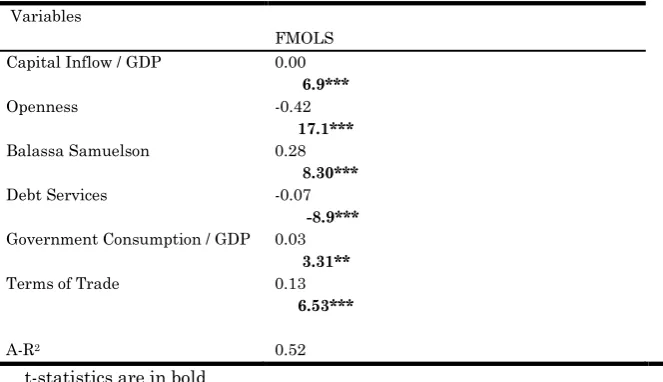
Table I: Estimation Results of Equation (2)
Variables
FMOLS Capital Inflow / GDP 0.00
6.9***
Openness -0.42
17.1***
Balassa Samuelson 0.28
8.30***
Debt Services -0.07
-8.9***
Government Consumption / GDP 0.03
3.31**
Terms of Trade 0.13
6.53***
A-R2 0.52
t-statistics are in bold
* Significant at 10%, ** Significant at 5%, *** Significant at 1%
Using the coefficients in Table I, we can compute the extent of the REER misalignment for the developing countries. We have to recall, however, that misalignment refers to the difference between the REER and its equilibrium level, the EREER. The latter is given by the fitted values using the estimates together in Table I and the long-run values of the explanatory variables. To get such long-run values, we use the Hodrik-Precsott filter to separate the permanent and temporary components of each variable.
We define misalignment as:
Mis = (REER / EREER) - 1 (6)
Figs I: Mean of the misalignment in the developing countries
Figs. I present, the exchange rate misalignment during the periods 1980-2010. This period was characterized by light exchange rate overvaluation (0% ; 20%) and light undervaluation (-20% ; 0%). The figure shows that, in general, the percentage of years during which exchange rate were undervalued is higher during the 1991–2010 than during 1980– 1990.
By making the average of misalignments, every year, for all the developing countries of our sample (Figs 2), we can notice that, on average, the currencies of the developing countries are overvalued between 1980-1992.
Overvaluation Undervaluation -. 1 0 .1 .2 .3 (me a n ) mi s %
1980 1990 2000 2010
year
Average misalignment over time
1983 1994
Figs II: Average misalignment over Time
The determination of the average of misalignment for every country, over a whole period, (Figs III) shows that, with the exception of the Cote d’Ivoire, Sri Lanka, Thailand and Morocco, all the currencies of the developing countries of our sample were overvalued, on average, over the period 1980-2010. Islamic Iran had the maximal value with a percentage of overvaluation of more than 40%, followed by Ghana with a 21% then Congo with a percentage of 16 %.
Iran, Islamic
Ghana
Cote d'Ivoire Sri Lanka
Congo, Rep 0 .1 .2 .3 .4 me a n o f mi s %
Average misalignment over country
2.2 Empirical Relation between the misalignment and the FDI
Ignored in the majority of the empirical studies, misalignment can be an incentive determinant of the FDI. By representing the FDI according to the misalignment for all the countries of the sample (Figs IV), we can notice the existence of an inverse relation between the FDI and misalignment. The countries which have an important value of the FDI are those which have a weak average value of misalignment such as Brazil, China, Mauritius. Iran, Islamic China Comoros Mauritius Ghana Guinea-Bissau Brazil Tunisia 14 16 18 20 22 24 (me a n ) lo g (F D I)
0 10 20 30 40
(mean) mis
Relation between the FDI and the misalignment
Figs IV: The relationship between the FDI and the misalignment
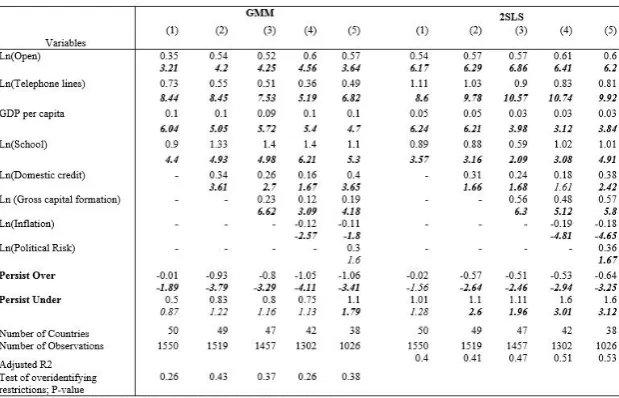
To estimate theses specifications, we must take account of possible endogeneity of the explanatory variable. Indeed, the endogeneity problem comes from several ways. For example, the FDI may affect the misalignment simultaneously. In fact, misalignment is defined as a function, among the determinants of REER, the terms of international trade (TOT) and the net capital inflow(Capinf). These two variables could be affected by FDI flow or stock. Thus the misalignment could be a function of existing FDI or FDI flow. We use two estimators: the two-stage least-squares (2SLS) and the GMM with the lagged dependent and explanatory variables as instruments. The test of overidentifying restrictions is used to check the validity of the estimates.
For all specifications, the period of the study covers the period of 1980-2010, with the exception of the fifth specification where the period of the study is 1984-2010. The sample of countries varies from one specification to another depending on the availability of the data.
Regarding to the first specification, we estimate the FDI model for a sample of 50 developing countries (Appendix B). In this specification, we will retain the following determinants:
• Degree of opening: this variable measures the degree of
economic opening of the host country. It is defined as the sum of exports and imports relative to the GDP.
• Telephone Line: This variable approximates the degree of
development of the country’s infrastructure. It measures the number of telephone lines per a thousand inhabitants.
• GDP Per capita: This is an indicator of the wealth of the
resident of the host country and then demand effectiveness. The expected sign of the corresponding coefficient is positive.
• Primary School: We follow the literature in using as a human
capital indicator the primary school enrolment ratio.
In the second specification, we will add the variable "Domestic credit" which approximates the degree of financial development of the country. It is measured as the ratio of the private credit to the GDP. This specification is estimated for a sample of 49 developing countries (Appendix B).
In the third specification, the variable "Investment" is considered as a determinant of the FDI. This variable informs about the degree of the country industrialization. It is approximated by the gross formation of fixed capital. This specification is estimated for a sample of 47 countries (Appendix B).
In the fourth specification, we will take into account the variable "Inflation" as an approximation of the economic and political stability of the country.
In the fifth specification, we will introduce the variable "Political Risk" as a determinant of the FDI. The quality of political institutions is measured by the political risk index (ICRG). This index is a score of 100 points. It is the sum of 12 indicators relating to the transparency and quality of the administrative system3. A high score (between 80 and 100)
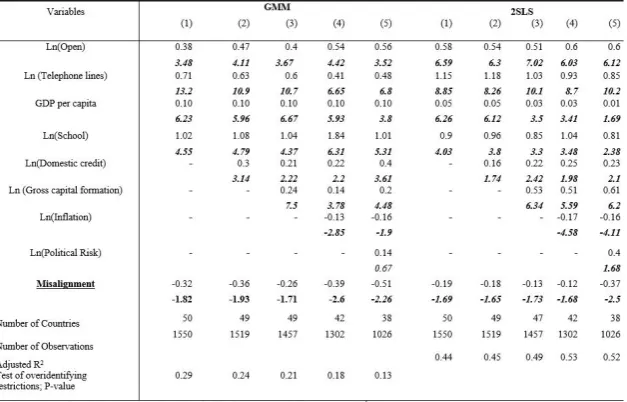
indicates a low risk, whereas a low score (between 0 and 49.5) indicates a high level of political risk. This index is positively correlated with the FDI. This specification is estimated for a sample of 38 countries (Appendix B) for the period 1984-2010. We will introduce the variable misalignment that we calculated in the 5 specifications. We do this by checking how much real exchange rate misalignment affects the FDI in this period. Table II recapitulates the results of the estimation of the 5 specifications with the variable misalignment.
3 The Indicator used to construct this index are given as follows: Stability and
The results indicate that all the explanatory variables have consistent pattern of significance and sign across specifications. Indeed, the coefficient of the GDP per capita is significant and positive. The coefficient of infrastructure and Primary School are positive. Here, investors are mainly concerned with the provision of infrastructure and the quality of the human capital. Inflation pressures are associated with less FDI, higher openness and better quality of development of the country’s infrastructure (Telephone lines) are associated with more FDI, the quality of political institutions has no impact and the amelioration of the investment is associated with more FDI.
Table II: The Effect of REER Misalignment on the FDI in the Developing Countries
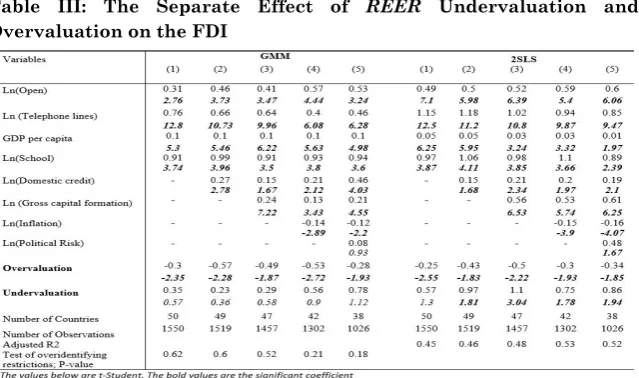
Table III summarizes the results of the estimation of the five specifications by introducing the variables "Overvaulation " and "Undervaluation" into the models.
In Table III, the coefficient of overvaluation is negative and significant in all the variants. The coefficient of undervaluation is positive and significant in only for the specifications 2,3,4 and 5 for the 2SLS estimator and non-significant in the other cases.
So, we can conclude that, the negative effect of the misalignment (Table II) is due to the effect of the overvaluation on the FDI. Since the currencies of the developing countries are generally overvalued, this overvaluation leads to an increase in the cost of the investment through the enrichment of the production factors (construction, machines, transportation equipment…). So, the overvaluation has a negative effect on foreign direct investment in the developing countries. This can be at the origin of the modest value of the flows of the FDI into these countries. Since the overvaluation may negatively affect the FDI, specific economic policies are desired to restore the macroeconomic stability. These policies should target the limitation of the overvaluation.
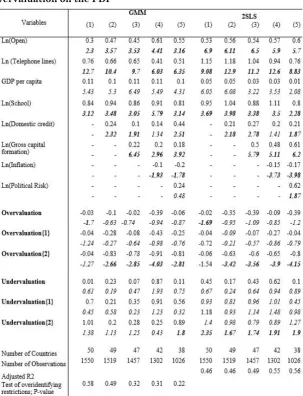
An overvaluation (undervaluation) in the previous years can discourage (encourage) foreign investors from investing in the developing countries. To determine the effect of the undervaluation and overvaluation lagged on the flows of the FDI in the developing countries, we estimated the models of the FDI by adding the variables " Overvauation " and "Undervaluation" lagged two and of one year. Table IV summarizes the results of the estimation of the models with the lagged variables "Overvaluation" and "Undervaluation".
Table IV: The Separate Effect of REER Lagged Undervaluation and Overvaluation on the FDI
countries is related positively to a strengthening of an undervalued home currency in the (t-2) period.
The results show that investors are mainly toward countries with undervalued lagged two years. This supports the positive impact of undervaluation and the negative effect of overvaluation on FDI.
Table V: The Separate Effect of REER Persistent Undervaluation and Overvaluation on the FDI
4. Conclusion
The deep interest a warded today to foreign direct investment is due to its extremely important role as a factor of economic growth and its positive impact on the economies of the developing countries. The FDI acts as a catalyzer of growth and thus development of the economies of the developing countries. To benefit from it, the developing countries need to improve their political, economic and legal environment. Beyond the traditional factors of the FDI attraction, there is another crucial incentive that has been ignored in the literature, namely the misalignment of the real exchange rate. Indeed, it has positive or negative implications on FDI flows: the undervaluation of the currency can attract foreign direct investment while overvaluation may discourage them.
Edwards in panel have been introduced in the models of the FDI. The results show, firstly, that misalignment is a major determinant of the FDI in the developing countries. In reality, overvaluation has a negative and significant effect on FDI. Secondly, we demonstrated that the overvaluation and undervaluation delayed by two periods can have a significant effect on the FDI. Delayed overvaluation has a negative effect while delayed undervaluation has a positive effect. Finally, the introduction of the variables "PersistOver" and "PersistUnder" makes as conclude that the persistence of over-or undervaluation has a significant effect on the FDI. In fact, a persistent overvaluation can discourage the FDI inflows to the developing countries whereas a persistent undervaluation encourages it. So, the results support the view that foreign investors are interested in how a currency is overvalued or undervalued.
REFERENCES
Aitken, B.J., A.E. Harrison, and R.E. Lipsey. 1996. “Wages and Foreign Ownership: A Comparative Study of Mexico, Venezuela and the United States.” Journal of
International Economics, 40 (3-4): 345-71.
Alkinkube, O. 2003. “Flow of Foreign Direct investment to Hitherto Neglected Developing Countries.” Paper presented at the WIDER Conference on ‘The New Economy in Development’, 2, 23-24 January 2003, Helsinki.
Asiedu, E. 2002. “On the determinants of foreign direct investment to developing countries: Is Africa different?”
World Development 30: 107–19.
Barisone, G., R. Driver and S. Wren-Lewis. 2006. "Are our FEERs Justified?" Journal of International Money and
Bénassy-Quéré, A., L. Fontagné, and A. Lahrèche-Révil. 2001. “Exchange-Rate Strategies in the Competition for Attracting Foreign Direct Investment.” Journal of the
Japanese and International Economies 15 : 178-198.
Blomström, M. and A. Kokko. 2003. “The economics of foreign direct investment incentives.” Working Paper 9489, http://www.nber.org/papers/w9489
Blomström, M. and A. Kokko. 1998. “Multinational Corporations and Spillovers.” Journal of Economic
Surveys 12 (2).
Billington, N. 1999. “The Location of Foreign Direct Investment: an Empirical Analysis.” Applied Economics, 31(1): 65-76.
Chakrabarti, A. 2001. “Determinants of FDI: A Comment on Globalization-Induced Changes and the Role of FDI Policies.” Dept. Of Economies, University of Wisconsin, Milwaukee, WI 53201, U.S.A.
Choi, C. 2003. “Does the internet stimulate inward foreign direct investment?” Journal of Policy Modeling (25): 319–26.
CNUCED, Rapport sur l’investissement dans le monde, 2012. CNUCED, World Investment Report, 2004.
Deichmann J., S. Karidis and S. Sayek. 2003. “Foreign direct investment in Turkey: Regional determinants.” Applied
Economics 35: 1767–78.
Domaç, I. and G. Shabisigh. 1999. “Real Exchange Rate Behavior and Economic Growth: Evidence from Egypt, Jordan, Morocco, and Tunisia.” IMF Working Paper WP/99/40.
Edwards, S. 1986. “Real Exchange Rate Variability: An Empirical Analysis of the Developing Countries case.” NBER Working paper No.1930
Edwards, S. 1989a. “Exchange Rate Misalignment in Developing Countries.” The World Bank Research
Observer, 4 (1): 3-21, Washington DC.
Edwards, S. 1989b. Real exchange Rates, Devaluation and adjustment: Exchange Rate Policy in Developing
Countries. Cambridge, Massachusetts: MIT Press.
Edwards, S. 1994. ‘‘Real and monetary determinants of real exchange rate behavior: Theory and evidence from developing countries.” In Estimating Equilibrium
Exchange Rates, edited by J. Williamson, Washington,
D.C.: Institute for International Economics.
Edwards, S. 1998. “The Mexican Peso Crisis: How Much Did We Know? When Did We Know It?” NBER WP 6334. Fedderke, J. W. and A. T. Romm. 2006. ‘‘Growth Impact and
Determinants of Foreign Direct Investment into South Africa 1956–2003.’’ Economic Modelling 23: 738–60. Feenestra, R. and J. Markusen. 1994. ‘‘Accounting for Growth
with New Inputs.’’ International Economic Review 35: 429-47.
Gastanaga, V., J. Nugent and B. Pashamiova. 1998. ‘‘Host Country Reforms and FDI Inflows: How Much Difference Do They Make?’’ World Development 26(7): 1299-1314.
Grossmann, A., M.W. Simpson and C.J. Brown. 2008. ‘‘The impact of deviation from relative purchasing power parity equilibrium on U.S. foreign direct investment.’’
The Quarterly Review of Economics and Finance.
Hailu, Z.A. 2010. ‘‘Impact of Foreign Direct Investment on Trade of African Countries.’’ International Journal of
Hansen B.E., 1992. ‘‘Tests for parameter instability in regression with I (1) process.’’ Journal of Business and
Economic Statistics 10: 321-35.
James B. Ang. 2008. ‘‘Determinants of foreign direct investment in Malaysia.’’ Journal of Policy Modeling 30: 185–89. Kao, C., M-H. Chiang and B. Chen. 1999. ‘‘International R&D
Spillovers: An Application of Estimation and Inference in Panel Cointegration.’’ Oxford Bulletin of Economics
and Statistics, Special issue: 691-709.
Lee, B. and B. Min. 2011. “Exchange rates and FDI strategies of multinational enterprises.” Pacific-Basin Finance
Journal 19(5): 586-603.
Leitão, N.C., and H.C. Faustino. 2010. ‘‘Determinants of Foreign Direct Investment in Portugal.’’ Journal of
Applied Business and Economics 11(3).
Metwally, M.M. 2004. ‘‘Impact of EU FDI on Economic Growth in Middle Eastern Countries.’’ European Business
Review 16(4): 381-89.
Mongardini, J. 1998. ‘‘Estimating Egypt’s Equilibrium Real Exchange Rate.’’ IMF Working Paper WP/98/5.
Moosa, I.A. 2008. ‘‘The Determinants of Foreign Direct Investment in MENA Countries: an Extreme Bounde Analysis.’’ Applied Economics Letters 16 (15): 1559-63. Morrissey O. and D.W. TeVelde. 2003. ‘‘Do Workers in Africa
get a Wage Premium if employed in Firms owned by Foreigners?’’ Journal of African Economies 12 (1): 41-73. Nouira, R., P. Plane and K. Sekkat. 2011. ‘‘Exchange Rate
Undervaluation and Manufactured Exports: A Deliberate Strategy?’’ Journal of Comparative
Economics 39: 584–601.
Nouira, R. and K. Sekkat. 2012. ‘‘Desperately seeking the positive impact of undervaluation on growth.’’ Journal of
Schneider, F. and B.S. Frey. 1985. ‘‘Economic and Political Determinants of Foreign Direct Investment.’’ World
Development 13 (2): 161-75.
Pedroni, P. 2000. ‘‘PPP Tests in Cointegrated Panels.’’ Indiana
University Working Papers.
Pedroni, P. 2004. ‘‘Panel Cointegration Asymptotic and Finite Sample Properties of Pooled Time Series Tests with an Application to the PPP Hypothesis.’’ Econometric Theory 20: 597-625.
Pesaran, M.H. 2007. ‘‘A Simple Panel Unit Root Test in the Presence of Cross Section Dependence.’’ Journal of
Applied Econometrics 22: 265-312.
Soydemir G. and A. Grossmann. 2006. ‘‘The Impact of Productivity Adjusted Deviations from PPP on the U.S. Inbound FDI: Evidence from Japan, U.K. and Germany.’’
Journal of Economics and Finance 30: 140-54.
Appendix:
Appendix A: Countries in the Sample Used to Compute the EREER
Africa Latin America Asia
Algeria Argentina China
Benin Bolivia Iran
Burkina-Faso Brazil Thailand
Cameroon Columbia Pakistan
Chad Costa-Rica India
Comoros Ecuador Philippines
Congo, Rep Mexico Malaysia
Cote d»Ivoire Paraguay Jordan
Egypt Venezuela Syria
Gabon Haiti
Gambia Honduras
Ghana Panama
Guatemala Uruguay
Guinea-Bissau Chile
Kenya Lesotho Madagascar Malawi Mali Mauritania Mauritius Morocco Niger Panama Rwanda Senegal Sierra-Leone Sri Lanka Swaziland
Appendix B: Countries in the Sample Used to estimate the specification 1,2,3,4 and 5
Specification 1 Specification 2 Specification 3 Specification 4 Specification 5
Algeria Algeria Algeria Algeria Algeria
Argentina Argentina Columbia Argentina Argentina
Benin Benin Benin Bolivia Bolivia
Bolivia Bolivia Costa-Rica Brazil Brazil
Brazil Brazil Ecuador Burkina-Faso Burkina-Faso Burkina-Faso Burkina-Faso Burkina-Faso Cameroon Cameroon
Chad Chad Chad China Columbia
Chile Chile Thailand Columbia Congo, Rep
China China Pakistan Congo, Rep Costa-Rica
Columbia Columbia Mexico Costa-Rica Cote d»Ivoire Comoros Comoros Comoros Cote d»Ivoire Ecuador Congo, Rep Congo, Rep Congo, Rep Ecuador Egypt Costa-Rica Costa-Rica Paraguay Egypt Gabon Cote d»Ivoire Cote d»Ivoire Cote d»Ivoire Gabon Gambia
Ecuador Ecuador Venezuela Gambia Ghana
Egypt Egypt Egypt Ghana Guatemala
Gabon Gabon Gabon Guatemala Honduras
Gambia Gambia Gambia Honduras India
Ghana Ghana Ghana India Iran
Guatemala Guatemala Guatemala Iran Jordan
Honduras Honduras Chile Jordan Kenya
India India Jordan Kenya Madagascar
Iran Iran India Lesotho Malawi
Jordan Jordan Madagascar Malaysia
Kenya Kenya Kenya Malawi Mexico
Lesotho Lesotho Lesotho Malaysia Morocco
Madagascar Madagascar Madagascar Mauritius Niger
Malawi Malawi Malawi Mexico Pakistan
Malaysia Malaysia Morocco Panama
Mali Mali Mali Niger Panama
Mauritania Mauritius Mauritius Pakistan Paraguay
Mauritius Mexico Morocco Panama Philippines
Mexico Morocco Honduras Panama Senegal
Morocco Niger Niger Paraguay Sri Lanka
Niger Pakistan Panama Philippines Syria
Pakistan Panama Malaysia Senegal Thailand
Panama Panama Senegal Sri Lanka Uruguay
Panama Paraguay China Swaziland
Paraguay Philippines Panama Syria
Philippines Rwanda Syria Thailand
Rwanda Senegal Sri Lanka Uruguay Senegal Sierra-Leone Swaziland
Sierra-Leone Sri Lanka Argentina Sri Lanka Swaziland Bolivia
Swaziland Syria Brazil
Thailand Thailand Philippines
Uruguay Uruguay Iran
Appendix C:
Test of the Stationarity of the Variables
Variable Stationarity in
Level First difference
Capital Inflow / GDP -1.79 -5.93***
Openness -2.01 -4.85***
Debt Services -1.98 -5.39***
Government Consumption / GDP -1.92 -4.52***
Terms of Trade -1.53 -5.13***
REER -2.06 -4.51***
Balassa Samuelson -1.98 -4.21***
Critical values: -2.11 (5%) -2.20 (1%)
** = Significant at 5%, *** = Significant at 1%
Test of Cointegration
Statistics Calculated value
Panel v- statistic -3.9***
Panel ρ- statistic 4.35***
Panel t- statistic -0.83
Panel ADF statistic -0.14
Critical values: 1.65 (5%) 2.33 (1%)