c e-ISSN: 2348-6848, p- ISSN: 2348-795X Volume 3, Issue 05, March 2016
International Journal of Research (IJR)
Available at http://internationaljournalofresearch.org
Raspberry Pi Controlled Robotic Arm
Nitisha Srivastava
dept. Of Electronics and Telecommunication Fr.C.R.I.T , Vashi Navi Mumbai, India [email protected]
Dr. Jonathan Joshi
(CEO, Eduvance) dept. Of Electrical Engineering Southern California, USA
Abstract:
This paper represents controlling a Robotic arm via Raspberry pi through remote access. People tend to
believe that robots are suitable for industrial use or just by scientist to test different technologies. But there are various other ways and technologies which are based on robots and can be used in our day. They have been used for various purposes like spying on people in ways people can't move and from views humans can't reach, Going far down into the unknown waters , they can capture moments just too fast for the human eye to get, for example the Atlas detector in the LHC project can capture ~ 600000 frames per second while we can see at about 60. They are mostly automated so they can go around by themselves without any human interference. They can help us with normal household chores. This paper presents the development of Robotic arm controlled by Raspberry pi. The movement of the robot arm is controlled by raspberry pi remotely. This paper will demonstrate how robotic arm can be controlled remotely. And similarly how we can make a robot work remotely for other chores.
Keywords—Raspberry pi; robotic arm; Remote access; Python script; Mob Xterm
1. Introduction
Robots are increasingly being integrated into working tasks to replace humans especially to perform the repetitive task. In general, robotics can be divided into two areas, industrial and service robotics. International Federation of Robotics (IFR) defines a service robot as a robot which operates semi- or fully autonomously to perform services useful to the well-being of humans and equipment, excluding manufacturing operations. [1]
Robotics has been a staple of advanced manufacturing for over half a century. As robots and their peripheral equipment become more sophisticated, reliable and miniaturized, these systems are increasingly being utilized for military and law enforcement purposes. A remote control robot is defined as any robot that is remotely controlled by a means that does not restrict its motion with an origin external to the device. Mobile robot with controlled remotely have important rules in area of rescue and
military. [2]
c e-ISSN: 2348-6848, p- ISSN: 2348-795X Volume 3, Issue 05, March 2016
International Journal of Research (IJR)
Available at http://internationaljournalofresearch.org
2. Raspberry Pi
Fig. 1. Raspberry Pi Model
Raspberry Pi board is a miniature marvel, packing considerable computing power into a footprint no larger than a credit card. Raspberry Pi is based on the Broad com BCM2835 system on a chip (Soc), which includes an ARM1176JZF-S 700 MHz processor, Video Core IV GPU,and was originally shipped with 256 megabytes of RAM, later upgraded (Model B & Model B+) to 512 MB. The system has Secure Digital (SD) or Micro SD (Model B+) sockets for boot media and persistent storage. In 2014, the Raspberry Pi Foundation launched the Compute Module, which packages a BCM2835 with 512 MB RAM and an eMMC flash chip into a module for use as a part of embedded systems. In early February 2015, the next-generation Raspberry Pi, Raspberry Pi 2, was officially announced.
The new computer board will initially be available only in one configuration (model B) and features a Broadcom BCM2836 SoC, with a quad-core ARM Cortex-A7 CPU and a Video Core IV dual-core GPU; 1 GB of RAM with remaining specifications being similar to those of the previous generation model B+. Tools are available for Python as the main programming language, with support for BBC BASIC (via the RISC OS image or the Brandy Basic clone for Linux), C, C++, Java, Perl and Ruby.
Fig. 2. Block diagram of Raspberry pi model
In the above block diagram for model A, B, A+, B+; model A and A+ have the lowest two blocks and the rightmost block missing (note that these three blocks are in a chip that actually contains a three-port USB hub, with a USB Ethernet adapter connected to one of its ports). In model A and A+ the USB port is connected directly to the SoC. On model B+ the chip contains a five-point hub, with four USB ports fed out, instead of the two on model B.
3.
Robotic Arm
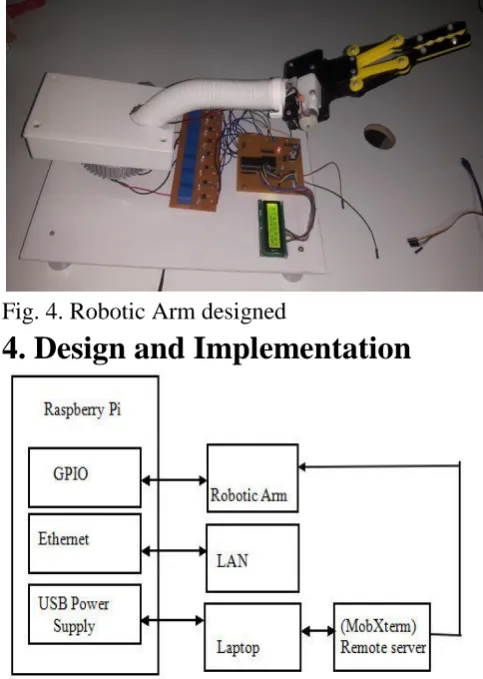
This is block diagram of Robotic arm that is used as an application which is controlled through internet via raspberry pi. Here micro-controller 89s51 is used which is the advance version of 89c51. LCD display is connected controller which displays the status of the relays connected. Power supply unit is used to give supply. Crystal oscillator is used to generate clock
c e-ISSN: 2348-6848, p- ISSN: 2348-795X Volume 3, Issue 05, March 2016
International Journal of Research (IJR)
Available at http://internationaljournalofresearch.org
signal. The clock signal generally changes between two or more states with the transition between the two states being very short. Microcontroller is connected to set of transistors and led’s which are further connected to individual relays. These are connected to the motors. There are three motors used in for the movement of the arm. One motor is used for opening and closing of gripper. Second is used for up and down movement and third is used for rotation of the base. Since in this project raspberry pi is used and interfaced with internet. The controller is connected to raspberry pi from where the input for movement of arm is given and then the output is the movement of arm.
Fig. 4. Robotic Arm designed
4. Design and Implementation
Fig. 5. Proposed work block diagram
This block diagram explains the complete setup of the work done. Raspberry pi is major aspect of the
complete system. It controls the movements of Robotic Arm.
Hardware and software functions are combined making a reliable system. Raspberry Pi is the brain of the system and a protection shield is used with internet. This system has two main parts one is robotic arm and other is computer system used for remote access.
The Raspberry Pi will be interface with internet via protection sheild. The GPIO pins connect with the pins of microcontroller which are individually assigned to different movements of robotic arm using relays. On the other hand Raspberry pi is connected to interne through LAN cable. Power supply is given through computer system it is connected with and using a remote access application raspberry is accessed.
The application used here is MobXterm. With the help of this application we remotely control raspberry pi. Initially the codes are written for movement of Robotic arm using Python script. These codes are saved in the system of raspberry pi. Later to automate the movement of arm in various directions the particular code is called remotely. With this movement of robotic arm is controlled remotely through raspberry pi.
c e-ISSN: 2348-6848, p- ISSN: 2348-795X Volume 3, Issue 05, March 2016
International Journal of Research (IJR)
Available at http://internationaljournalofresearch.org
5. Results
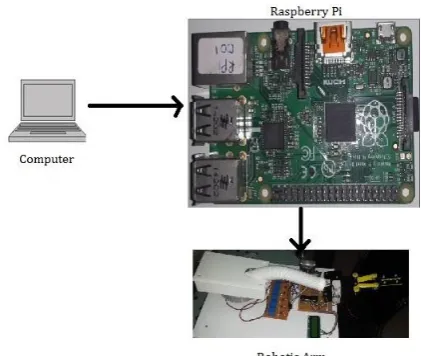
Fig. 7. Setup of proposed model
This figure shows the complete connection setup of robotic arm with raspberry pi and computer system.
Fig. 8. Working of the system
The red led shows that the system has turned on and the LCD displays the status of relay operating or active.
Thus robotic arm can be controlled by using raspberry pi remotely. Advancement of this can be use of internet interface along with raspberry pi for controlling robotic arm.
Fig. 9. Raspberry Pi controlled Robotic arm
6.Conclusion
This project can be mainly divided into two major sections that are hardware development and software development. The hardware operations include the automation process of controlling servo motors and also develop the robotic arm link and joint. Software development consists of developing remote environment and programming Raspberry pi. From the analyses that have been made, it’s clearly shows that controlling a servo motor is quiet easy and the output is accurate. Thus, it is the right choice to choose servo motor for the actuator of the robot arm. The purpose of this project is to show that robots not only restricted to industrial usage only but also suitable for household usage. Taking advantage of the
widespread usage of internet connectivity
nowadays, robots can be controlled via internet instead of a dedicated controller just for the robots. This project was successful and proved that robots are suitable for household usage.
References:
[1] R. C. Luo , K. L. Su,.A multi agent multi sensor based real-time sensory control system for
intelligent security robot. IEEE International
Conference on Robotics and Automation, vol. 2,
c e-ISSN: 2348-6848, p- ISSN: 2348-795X Volume 3, Issue 05, March 2016
International Journal of Research (IJR)
Available at http://internationaljournalofresearch.org
[2] Widodo Budiharto, "Design of Tracked Robot with Remote Control for Surveillance, 2014
International Conference onAdvanced
Mechatronic Systems, Kumamoto, Japan, August
10-12, 2014.
[3] Wan MuhamadHanif Wan Kadira, Reza EzuanSaminb, Babul Salam Kader Ibrahim C. “Internet Controlled Robotic Arm”, Science
Direct, International Symposium on Robotics and
Intelligent Sensors, pg 1065-1071, 2012.
[4] Raspberry Pi Forum and Discussion page http:// www.raspberrypi.org.
[5] Heng-Tze Cheng, Zheng Sun, Pei Zhang, “Real-Time Imitative Robotic Arm Control for Home Robot Applications”, Carnegie Mellon University, IEEE, March 2011
[6] Kuk-Hyun Han, Yong-Jae Kim, Jong-Hwan Kim and Steve Hsia, “Internet Control of Personal Robot between KAIST and UC Davis”, 2000.