Effective Performance Comparative Analysis of
Pro-AODV Routing Protocol in MANET using
NS-2
K.Hanumanthu Naik1, Dr.N.Geethanjali2
1
Research Scholar, 2Associate Professor Department of Computer Science & Technology,
Sri Krishnadevaraya University, Anantapuramu, Andhra Pradesh.
Abstract— Mobile ad-hoc network (MANET) is a wireless communication between mobile nodes, self-configured and multi hop network. This communication takes place by routing protocols in effective and efficient manner, when mobile nodes moving in dynamic topology. Ad-hoc On-Demand Distance Vector (AODV) routing protocol is one among the best reactive routing protocol. The efficient Protocol (AODV) is to explore the characteristics; it is used to forward data packets without much packet loss. In this paper to overcome the problem frequent link failure due to mobility of the nodes in the network. The main causes for link break due to mobility between nodes such as node failure and node power off. The effective performance comparison on AODV routing protocol of sensitive problem on link break route in MANET. The Existing AODV (EX-AODV), Proposed AODV (PRO-AODV) routing protocol to examine and results the mobility of intermediate node under link break due to mobility. The Pro-AODV routing protocol results is better than the existing AODV protocol. The test simulation and results are carried out to quality network using NS-2, based on the performance metrics packet loss, average end-to-end delay and throughput. The outstanding NS-2 simulating tool is better result gives among all other simulators in wireless ad-hoc network.
Keywords—MANET, AODV, Link break, Pro-AODV, Performance matrices, NS-2.35 Simulator.
I. INTRODUCTION
This Wireless network technology is steadily and rapidly increasing in the world. MANET is a collection of mobile devices and is self -configuring, dynamically changing, and multi-hop wireless network. It is self organizing network, no fixed infrastructure network. Every node in a MANET is dynamically to move in any direction, and it will be change links to other nodes frequently it lies within transmission range. In MANET there are many problems related to routing like dynamic topology change and interference. Communication [2] is done through wireless links among mobile hosts through their antennas. Routing is the process of moving information from source to destination in an internetwork. To transfer data from one node to other node we need routing protocols. There are three types routing protocols: proactive routing, reactive routing and hybrid routing.
Proactive routing keeps the routing information even after its use. Reactive routing keeps the information about present link only and hybrid routing keeps combines both the proactive and reactive approaches. In this paper we present Ad-hoc On-Demand Distance Vector Routing (AODV) [1] a novel algorithm for the operation of such ad-hoc networks. The Reactive AODV routing protocol is improved by adding the Local Repair when a link break an active route occur mechanism. In this AODV protocol, intermediate nodes in an existing path try to find new paths to the destination in the event of a link breakage.
The remainder of this paper is proposed work organized as follows: In Section II, the different routing protocols of MANET and Section III presents the AODV Routing Protocol, Section IV discusses about link breaks due to mobility, and Section V describes NS-2 simulation setup and section VI explains about results and xgraph. And finally section VII discusses about conclusion and future work on basis of implemented results.
II. ROUTING PROTOCOLS OF MANET
Fig.2. MANETs Routing Protocol .
i.Proactive/ Table-driven Routing Protocols
Proactive protocol, each node in the network has maintains one or more routing tables which are up to date routing information. The routes to all host pairs are maintained by sending periodical control message updated. Proactive routing protocols are not suitable for large networks, high routing overhead and unnecessary bandwidth wastage for sending control packets.
Ex: DSDV (destination sequenced distance vector).
ii. Reactive/ On-demand Routing Protocols
Reactive protocols proceed for establishing route(s) based on routes can establish ‘on-demand’ process, when require to the destination. This protocol does not need periodic up to date transmission of topological information of the network.
Ex: AODV (Ad-Hoc On-demand Distance Vector).
iii. Hybrid Routing Protocols
Hybrid Routing Protocol combination features of both reactive and proactive routing protocols information. The recently invented several hybrid protocols are also proposed.
Ex: ZRP (Zone Routing Protocol).
III. AODV ROUTING PROTOCOL
AODV (Ad Hoc On-Demand Distance Vector) Routing Protocol changes the Proactive protocol on the way of creating routing. AODV routing protocol allows nodes to create new routes to destinations. The routing information or exchange to the routing tables doesn’t need to maintain by intermediate nodes. Source node to destination node of a communication connection have valid routes to each other, AODV routing permits mobiles nodes to response link break and changes in dynamic network topologies in time manner. This routing protocol works the number of broadcasts by creating routes based on-demand route obtained system. The route discovery and route maintain links are used in AODV routing protocol following control messages [6, 7]:
Route Request Message (RREQ), Route Reply Message (RREP), Route Error Message (RERR),
Route Reply Acknowledgment (RREP-ACK) Message, HELLO Messages.
A. Route Discovery
The source node [6] initiates to send a message to destination node through its neighbor node destination
sequence number, not its broadcasts a RREQ message. The RREQ message process taken two types, which is one if there is know a route to the destination and the source node can send RREQ message uniquely identified by source address, broadcast ID. Source node initiates a RREQ message with the current sequence number of Source node and the last known destination sequence number of Destination node and broadcast ID.This broadcast ID is incremented each time source node sends a RREQ message.The destination node can send a Route Reply (RREP) message back to source node, otherwise they will rebroadcast the RREQ to their set of neighbor nodes. The message keeps getting rebroadcast until its lifetime is up. If source node does not receive a reply in a set amount of time, it will rebroadcast the request except this time the RREQ message will have a longer lifespan time and a new ID number. This entry contains the IP address and current sequence number of source node, number of hops to source and the address of the neighbour from whom destination got the RREQ messages. The destination node sets up a reverse route entry in its route table for the source node. The every node maintains its own sequence number and IP address. The AODV Route Discovery [7] effective use in each intermediate nodes information destination address and sequence numbers to ensure that all routes. Route Discovery process whenever a link is broken, or route has expired, the source node broadcasts a Route Request message in order to find a route to the destination node.
B. Route Maintenance
IV. LINK BREAK MOBILITY
The MANET nature of wireless ad hoc networks, links may fail due to mobility of dynamic topology changes by mobile nodes. When mobile nodes are increases, the wireless ad hoc network has taken challenge in link errors. The ad hoc routing protocols use broadcast message to discover routes may occur due to frequent failures of intermediate node in an end-to-end communication network. In some times, when an intermediate node link breaks, it is automatically to discover a new route locally without resorting to an end-to-end path discovery. Link break [11] may fail or occur due to mobility between nodes, failure of nodes, and node power off.
When link break appears while forwarding route request message information, result is packet loss of data. The link break may occur due to the mobility of source node, destination node and intermediate node. The intermediate node upstream of the break may choose to repair link locally by itself (automatic) to supporting if it satisfies the specific conditions. Source node mobility of link break appears automatically finds route or path by sending RREQ message towards the neighbor or intermediate nodes in the dynamic topology. Intermediate node link break appears due to the mobility of intermediate node verifies the route in forward and backward nodes to find route. In this condition if there is a link break is the possibility of packet loss of data (Fig.7). In this paper we calculate packet loss of data at all conditions. Repairing the link break locally to increase the number of data packets, which are able to be delivered to the RERR message travels to the source node. Local repair of link breaks sometimes results in increased route lengths at active routes to that destination.
V. NS-2SIMULATION.
NS simulator [8] is consists of two languages: one an object oriented simulator in c++(internally) and Otcl (an Object oriented extension of tcl) interpreter and execute user's command scripts. NS is an OTCL interpreter with network simulation and object libraries. There are two libraries: the compiled c++ library and the interpreted Otcl, with each other correspondence between them. The interpreted Otcl allows faster interpret and slow to run. The compiled c++ library allows us to achieve efficiency in the simulation, compiled hierarchy and the faster execution times.
Network Simulator (NS-2) version 2.35 is a open source software, provides simulation results of ad-hoc networks. It is installed on Red Hat Linux (version 5) Operating System
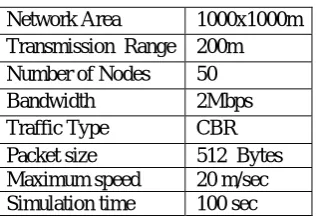
(64bit). In our simulation, we consider a dynamic network of 50 nodes (one source node and one destination node) that are placed random within a 1000m X 1000m network area and simulation time 100seconds.Table I show the content of simulation parameters following below:
TABLE I
PARAMETER METRICS OF SIMULATION
A.Tcl and OTcl programming: Tcl (Tool Command Language) [8, 9] is used by research people in the real world. It is a very simple language with small sintaxis and it allows easy content with other languages. Tcl language[10] created by Jhon Ousterhout. An OTcl interpreter connection with network simulation object libraries in Network Simulator. Tcl provide a graphic interface, compatible with many platforms, flexible for integration, easy to use and also free.
B.NAM: Network Animator (NAM) is an important animator tool for visual aid viewing in real world how packet traces along the network.NAM supports the basic visualization controls, packet level animation, fine tune layout, TCP visualization and generate ns simulation scripts. The NS-NAM interface between node manipulation, link manipulation, topology layout, color and protocol state.
C.AWK Script:The AWK Script is very good, a more capable programming language, which is look like often Perl and Python languages. The AWK script in processing the data from column wise the log.tr or trace files which we get from NS2. The AWK script is to print a specific parameter or fields in output to begin a One Line code, to calculate trace file in all fields and execute output in specific ordered.
To run the awk script in Linux as follows:
awk –f filename.awk filename.tr
VI.RESULTS AND DISCUSSIONS
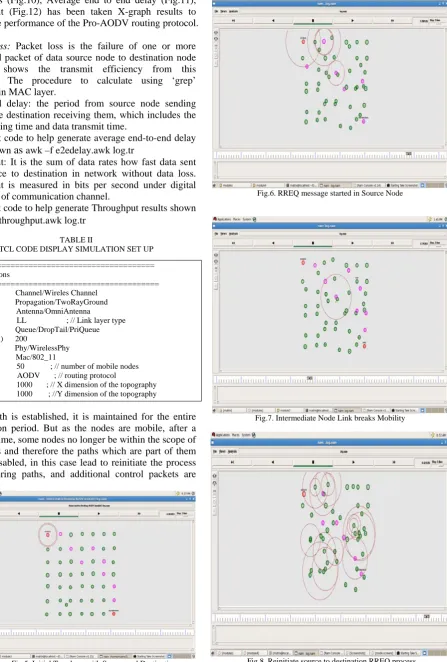
The results and animated screenshots represent following figures (fig.5, fig.6, fig.7, fig.8) shows using NS-2 simulator. The figure.5 represent initial topology with source to destination stated, figure.6 represent starting source node to destination node RREQ message process, figure.7 shows the intermediate node due to mobility to link break condition and figure.8 shows reinitiates source node to destination node RREQ, RREP message process. To demonstrate comparative functionality of proposed AODV (Pro-AODV) routing protocol efficient performance better than existing AODV (Ex-AODV) routing protocol in different parameter metrics. The parameter metrics are
Network Area 1000x1000m Transmission Range 200m Number of Nodes 50
Bandwidth 2Mbps
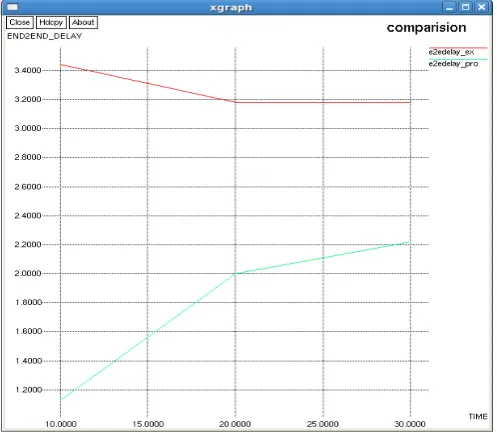
packet loss (Fig.10), Average end to end delay (Fig.11), Throughput (Fig.12) has been taken X-graph results to analyse the performance of the Pro-AODV routing protocol.
Packet Loss: Packet loss is the failure of one or more transmitted packet of data source node to destination node delivered shows the transmit efficiency from this parameter. The procedure to calculate using ‘grep’ command in MAC layer.
End-to-end delay: the period from source node sending data till the destination receiving them, which includes the route building time and data transmit time.
Awk script code to help generate average end-to-end delay results shown as awk –f e2edelay.awk log.tr
Throughput: It is the sum of data rates how fast data sent from source to destination in network without data loss. Throughput is measured in bits per second under digital bandwidth of communication channel.
Awk script code to help generate Throughput results shown as awk –f throughput.awk log.tr
TABLE II
TCL CODE DISPLAY SIMULATION SET UP
Once a path is established, it is maintained for the entire transmission period. But as the nodes are mobile, after a period of time, some nodes no longer be within the scope of neighbours and therefore the paths which are part of them become disabled, in this case lead to reinitiate the process of discovering paths, and additional control packets are generated.
Fig.5. Initial Topology with Source and Destination
Fig.6. RREQ message started in Source Node
Fig.7. Intermediate Node Link breaks Mobility
Fig.8. Reinitiate source to destination RREQ process ============================================
# Define options
============================================= set val(chan) Channel/Wireles Channel
set val(prop) Propagation/TwoRayGround set val(ant) Antenna/OmniAntenna set val(ll) LL ; // Link layer type set val(ifq) Queue/DropTail/PriQueue set val(ifqlen) 200
set val(netif) Phy/WirelessPhy set val(mac) Mac/802_11
set val(nn) 50 ; // number of mobile nodes set val(rp) AODV ; // routing protocol
Fig.9.End-to-End Delay and Throughput values in Proposed AODV routing Protocol
The simulation analysed that the packet loss rate is increased when there is high mobility in the network. The dropping of packets may occur frequently, which leads variations on the throughput of the network. The results generating that the protocol of Existing AODV and Proposed AODV of the parameters that packet loss, average end to end delay and throughput has been taken in different instants in the comparisons following given table.
Table III
Comparison of parameters in the protocols
X-Graphs:
Fig.10. Packet loss values comparison
Fig.11. To change Average End to End Delay
Fig.12. Throughput values increased
VII. CONCLUSION AND FUTURE WORK
In this paper, we have an explanation of the comparison of the reactive routing protocol AODV in mobile ad hoc networks under mobility. The performance of the network shows how local repair scheme has been performed to resolve from Link break using Proposed AODV (Pro-AODV) protocol. To generate results in existing AODV and Proposed AODV routing protocols in different simulations using NS-2.The tested network performance results packet loss, end-to-end delay and throughput decreased when there is mobility in a distributed network. This parameters metrics to efficient performance comparison of ‘on-demand’ routing protocols in x-graph. In future scope of the work the AODV routing protocol to improve quality of service, security, Energy Efficiency and different type of issues is tested in wireless ad-hoc network. Protocols/
Parameters Ex-AODV Pro-AODV
Packet loss
1 106 2 109 3 116
1 54 2 43 3 40
E2Edelay
10 3.44 20 3.18 30 3.18
10 1.33 20 2.00 30 2.22
Throughput
10 18.70 20 8.82 30 5.76
REFERENCES
[1]. C. E. Perkins, E. M. Belding-Royer, and S. R. Das, “Ad Hoc On Demand Distance Vector (AODV) Routing”, IETF, July 2003, RFC 3561.
[2].Yu-Chee Tseng, Wen-Hua Liao, Shih-Lin Wu, “Mobile Ad Hoc Networks and Routing Protocols”, Handbook of Wireless Networks and Mobile Computing, Edited by Ivan Stojmenovic´ ISBNs: 0-471- 41902-8 (Paper); 0-471- 22456-1 (Electronic), 2002.
[3].AODV routing protocol know about this web page is available online at moment.cs.ucsb.edu/AODV/aodv.html
[4].S. R. Das, C. E. Perkins, and E. M. Royer, “Performance Comparison of Two On-Demand Routing Protocols for Ad Hoc Networks “, IEEE Personal Communications Magazine, Special Issue on Mobile Ad Hoc Networks, Vol. 8, No. 1, February 2001.
[5].Nilesh P. Bobade, Nitiket N. Mhala, “Performance Evaluation of Ad Hoc On Demand Distance Vector in MANETs with varying Network Size using NS-2 Simulation”, International Journal on Computer Science and Engineering(IJCSE), Vol. 02, No. 08, 2010, 2731-2735, ISSN : 0975-3397.
[6].K.Vanaja, R. Umarani, “A Simulated Behavioural Study of Prominent Reactive Routing Protocol AODV of MANET Using NS-2”,
International Journal of Advanced Research in Computer and Communication Engineering (IJARCCE), Vol. 1, Issue 3, May 2012. [7].Patil V.P., “Efficient AODV Routing Protocol for MANET with
enhanced packet delivery ratio and minimized end to end delay”, International Journal of Scientific and Research Publications(IJSRP), Vol 2, Issue 8, August 2012.
[8].NS -2, The ns Manual (formally known as NS Documentation) available online at http://www.isi.edu/nsnam/ns/ , http://nile.wpi.edu/NS/
[9].Soni Dalal , Mr Sukhvir Singh, “Comparative Study of Reactive/On Demand Routing Protocols for Mobile Ad hoc Network”, International Journal of Computer Science & Engineering Technology (IJCSET), Vol. 3 No. 7 July 2012, ISSN : 2229-3345. [10]. John K. Ousterhout. Tcl and the Tk Toolkit, Addison-Wesley, ISBN
0-201-63337-X, 1994.
[11].Hua Qu, Peng Zhang, Ji-Hong Zhao, “A New Local Repair Scheme Based on Link Breaks for Mobile Ad Hoc Networks”, 2009 Seventh Annual Communications Networks and Services Research Conference.