Sluicing in Dakkhini: A syntactic analysis
Syeda Humera Amtul Qadeer
Research Scholar, Department of Linguistics, Osmania University.
Abstract:
Sluicing has received much attention in literature since Ross (1969). Merchant (2001) reinvented it. According to Ross sluicing is commonly analysed as involving movement of the interrogative phrase to Spec–CP followed by deletion of TP. Van Craenenbroeck and Liptak (2013) propose that whether a language exhibits genuine sluicing should be predictable from the syntax of a language wh-questions in non–elliptical contexts. This article explores the phenomenon of sluicing in Dakkhini. The approach used for the syntactic analysis of sluicing in Japanese given by Kizu (1997, 2005) is applied to Dakkhini and the limitations are looked into. The other section of the article deals with Manetta (2006) proposal that the wh-questions takes the verb initial position and in case of sluicing the wh-phrase takes this position and then vP is deleted. Some test developed by Manetta (2013) for diagnosing the sluicing structure in Hindi-Urdu are used to check whether the elements involved in sluicing are part of vP or a bigger constituent TP. Finally the copy theory of movement used to explain sluicing in Dakkhini.
Keywords
Wh-movement, Sluicing, Wh-remnant, Preposition stranding, Copy theory of Movement, Case marking, Wh-in-situ, Cleft/Pseudosluicing , Stripping.
1.
Introduction
Dakkhini is a dialect of Urdu language which is an Indo-Aryan language. It has received much attention because it has converged with the Dravidians languages. Section 2 gives an account of Dakkhini dialect. Sluicing the topic of discussion is a phenomenon in which all the constituents of the question are deleted except for the interrogative phrase. Section 2 discusses sluicing in English and the movement plus deletion approach to sluicing. Section 3 talks about the various syntactic analysis of sluicing. Section 4 highlights sluicing in Dakkhini. Properties of sluice given by Merchant [2001] are discussed in section 5. Section 6 deals with the various sub types of sluicing in Dakkhini. Section 7 argues that sluicing in Dakkhini is not
pseudosluicing like Japanese. Section 8 uses some test given by Manetta [2013] to argue in favour of Dakkhini possessing the elided constituent in a sluice is TP and not vP. Section 9 proves that sluicing Dakkhini cannot be an instance of stripping. The last section uses copy theory of Movement to explain sluicing in Dakkhini.
2.
Dakkhini
Dakkhini is a dialect of Urdu language which is an Indo-Aryan language, it is spoken in south of India. It is spoken in Telangana, Maharashtra, Karnataka and Tamil Nadu. It is the native language of Muslims living in these regions. In 14 century Muslims invaded the south and brought Urdu. A long contact of the Urdu speakers and Telugu speakers resulted in the present variety if Dakkhini. Dakkhini has got much attention because it has converged with the Dravidians languages spoken in south of India like Telugu. It now varies a lot from the Lucknawi-Urdu because of convergence. It has lot of literary work. Prominent writers being KhajaBandeNawaz, Sanati, Abdul KhuraishiBidri, Wajhi etc.
2.1.What is Sluicing?
pronounced. In languages like English wh-questions are formed by movement of wh-word to Spec-CP. An instance of sluicing in English is given in 1(a).
1(a) Jack bought something, but I don’t know what.
The sluice in 1(a) can be compared with a construction where ellipses did not occur as in 1(b).
1(b) Jack bought something, but I don’t know [CPwhat1 C0<[TP he boughtt1]>].
3.
Syntactic analysis of Sluice
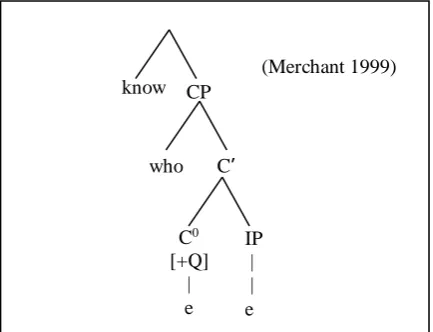
According to Ross (1969), Lasnik (2010) and Merchant (2001, 2008) sluicing is commonly analyzed as involving movement of the interrogative phrase to Spec-CP followed by deletion of TP/IP. It is illustrated below.
Another view of sluice is given by Van Riemsdijk 1978, Culicover and Jackendoff (2005). The wh- remnant is a bare ‘wh-fragment”. Here it functions as a complement to the main verb. It is represented as below
Pollman (1975) believes that the deleted element is copular clause.
2. Jack bought something but I don’t know what (it was)
Here the subject and copula is deleted Merchant calls this pseudosluicing.
4.
Sluicing in Dakkhini
Dakkhini has the basic word order SOV just like the other South Asian languages. Dakkhini is wh-in- situ dialect of Urdu. Following are some questions and their interpretations.
3. siima kitaab paRii Seema book read ‘Seema read a book.’
4. siima kya paRii Seema what read ‘what did Seema read?’
5. kya paRii siima What read Seema ‘What did Seema read?’
6. *kya siima paRii What Seema read
‘What did Seema read?’ (intended)
But other question words can take the sentence initial position.
7. ali ahməd ku mara Ali Ahmed ACC beat ‘Ali beat Ahmed.’
8. ahməd ku kon mara (most natural) Ahmed ACC who beat
‘Who beat Ahmed?’
9. kon ahməd ku mara Who Ahmed ACC beat ‘Who beat Ahmed?’
Question words take the different positions as shown above.
4.1.Sluicing exists in Dakkhini.
10(a). ali kya ki qarida magar Ali something bought but
meku /mereku nai maloom kya (Merchant 1999)
Figure 1. Sluicing as interrogative CPs.
CP know
who C’
IP | | e C0 [+Q]
| e
(Merchant 1999)
Figure 2. Sluicing as ‘wh-fragments’.
DP know
I – DAT Neg know what
‘Ali bought something but I don’t know what’
Comparing it with its non-elided counterpart
10(b) ali kaya ki qarida magar meku Ali something bought but I –DAT
nai maloom (kya qarida ali) NEG know (what bought Ali)
‘Ali bought something but I don’t know (what did Ali buy?)’
The question word is the wh-remnant and the remaining constituents are elided.
5.
Properties of sluice
Merchant (2001) has given some morpho-syntactic features of sluice referred to as form identity effects.
FORM-IDENTITY GENERALISATION I: CASE MARKING
The sluiced wh –phrase must bear the same case that its correlate bears.
Merchant (2001)
According to this generalisation the wh-phrase ‘remnant’ shows the same case marking as case that its counterpart in a non-elided structure would bear. This is illustrated for German below
11. Er will jemandem schmeicheln, he wants someone.DAT flatter
aber sie wissen nicht, but they know not
{*wer / *wen / wem}. who.NOM/ who.ACC/ who.DAT
‘He wants to flatter someone, but they don’t know who.’
12. Er will jemanden loben, he wants someone.ACC praise
aber sie wissen nicht, but they know not
{*wer / wen / *wem}. who.NOM/ who.ACC/ who.DAT
‘He wants to praise someone, but they don’t know who.’
Compare these with their nonelided counterpart.
13. Sie wissen nicht, they know not
{*wer / *wen / wem}. who.NOM/ who.ACC/ who.DAT
er schmeicheln will. he flatter wants
‘They don’t know who he wants to flatter.’
14. Sie wissen nicht, they know not
{*wer / wen / *wem}. who.NOM/ who.ACC/ who.DAT
er loben will. he praise wants
‘They don’t know who he wants to praise.’
Connectivity effects are seen in between a wh-phrase ‘remnant’ and its counterpart in non-elliptical structure.
Dakkhini obeys this form generalisation 1: case marking as there is case marking in Dakkhini.
15. ali kisi ku kitaab diya Ali someone book gave
magar mereku nai but I-DAT NEG
maloom kisku/kaun know whom/*who
‘Ali gave a book to someone but don’t know Whom’
A Language L will allow preposition stranding under sluicing if L allows preposition stranding under regular wh-movement.
(Merchant 2001) Language like English allows preposition stranding in regular wh-question as in 16.
16. Who did peter talk to?
Here the preposition is not moved with the wh-word. English allows preposition stranding in sluiced structure also as in 17.
17. Peter talked to someone, but I don’t know who.
Languages which do not permit preposition stranding will not allow preposition stranding in sluice construction. Example
German
18(a) Anna hat mit jemandem gesprochen, Anna has with someone spoken
aber ich weiß nicht, *(mit) wem. but I know not with who
18(b) * Wem hat sie mit gesprochen? who has she with spoken
Dakkhini does not permit preposition stranding in regular wh-questions as in 19(c).
19(a) ali aam churi se kaaTa Ali mango knife with cut ‘Ali cut the mango with a knife’
19(b) ali aam kisse kaaTa Ali mango with what cut ‘With what did Ali cut the mango?’
19(c) *kis ali aam se kaaTa Q word Ali mango with cut
‘What did Ali cut the mango with?’ (intended reading)
As Dakkhini does not allow the wh-phrase to move out of preposition in regular questions it does not allow it in sluiced structure.
20. ali kisse ki aam Ali with something mango kaaTa magar
cut but
nai maloom kisse/*kis/*kya NEG know with what
‘Ali cut the mango with something but don’t know what’
Thus Dakkhini obeys the form and generalization II preposition stranding.
Dakkhini allows post positions to be pied-piped in general questions as in 21(b).
21(a) ali kis ki kitaab paRa Ali who+GEN book read (whose)
‘Whose book did Ali read?’
21(b) kis ki kitaab ali paRa who+GEN book Ali read (whose)
‘Whose book did Ali read?’
21(c) *kis ali ki kitaab paRa Q word Ali GEN book read ‘Whose book did Ali read?’ (intended)
As Dakkhini permits pied-piped in general questions it also permits pied-piped in sluiced structures.
22. ali kiski ki kitaab paRa magar Ali somebody’s book read but
nai maloom kiski NEG know whose
6.
Subtypes of sluicing
Various sub-types of sluicing are
i) sluicing with adjunct wh –phrase ii) sluicing with overt correlates iii) sluicing with implicit arguments iv) contrast sluice (Chung, Ladusaw
and McClosey (1995), Merchant (2001)
Sluicing with adjunct wh-phrase: here the wh- phrase is an adjunct. It does not correspond to anything in the antecedent clause as in 23.
Ali went but NEG know
kab/kaiku/kaan when/why/where
‘Ali left, but don’t know when/why/where’
Sluicing with overt correlate: Here the wh-phrase corresponds to a correlate in the antecedent as in 24.
24. ali kisse ki baat kara magar Ali someone talk did but
nai maloom kisse NEG know with whom
‘Ali talk to someone but don’t know who’
Sluicing with implicit argument: here the wh-phrase corresponds to an implicit argument which can be a direct object or indirect object as in 25 and 26 respectively.
25. ali pheka magar nai Ali threw but NEG maloom kya
know what
‘Ali threw but don’t know what’
26 ali kitaab diya magar nai Ali book gave but NEG
maloom kisku know to whom
‘Ali gave a book but don’t know to who’
Cross-linguistically sluicing occurs in many languages and some of the languages where it occurs are English, Icelandic, Swedish, Danish, Irish, Greek, German, Dutch, Russian, Persian, Hindi, Catalan, Spanish, French, Arabic, Basque, Chinese, Korean, Hungarian and Japanese, Korean, and Turkish.
Sluicing is extensively discussed in literature especially when it comes to wh-in-situ languages. In
wh-in-situ languages there is no overt movement of wh-element then how is this phenomenon of sluicing explained for these languages.
7.
Is sluicing in Dakkhini pseudosluicing
Kizu (1997, 2005) claims that what appears to be sluicing in Japanese and other wh-in situ languages is in fact a kind of reduced cleft (also see Kuwahara 1996). This structure has also been called pseudosluicing (Merchant 2008). The derivation of 27(a) is explained in 27(b).
27(a) Taroo-ga nanik.a-o yon-da Taro-NOM something-Ace read-PAST
rashii ga, watasi-wa nani-(da)-ka I-heard but. I-TOP what-coP-Q
wakaranai don't know
'I heard that Taro read something, but I don't know what'
27(b) ... watasi-wa [cp2 [cp1 opi [IP Taroo-ga I-TOP Taro-NOM
ti yon-da]-noi]-wa read-PAST-NM-TOP
[nanii-da]-ka] wakaranai what- COP-Q don't know
'I don't know what it is that Taro read.'
CP1 which is topicalized has an antecedent so it is deleted wh- phrase is in focus position and the copula is present optionally. Japanese permit dropping of copula and it is prodrop language so the sentence 27(a) is generated.
Dakkhini has very limited cleft construction as in
28 kiya hai jo app-ke What be.PRS.3SG REL you.GEN
picche hai
back be.PRS.3SG
‘What is it that is behind you?’
Dakkhini because in Japanese the wh-phrase remnant resists case marking whereas in Dakkhini the wh-phrase remnant is inflected for same case as its non-elided counterpart.
29(a) Mai yan kisi –ku dekha I here someome DAT see
magar nai maloom kis ku /*kaun but NEG know whom who
‘I saw someone here but don’t know whom’
29(b) Koi yan tha magar nai Someone here PAST but NEG
maloom kaun/ *kisku know who whom
‘Someone was here but I don’t know who’
Sluicing with adjuncts and implicit arguments is grammatical in Dakkhini as in 23, 25 and 26.
But not with clefting. English too permit sluicing with adjuncts and implicit argument but not with clefting as 30 and 31.
30 .He fixed the car, but I don’t know how (*it was).
31. They served the guests, but I don’t know what(*it was).
(merchant 2001)
32. Ali gari fix kara magar nai Ali car fix do but NEG
maloom kab/kaisa (*thaa)
know when/how (be.PST.M.SG).
This data in 32 shows that in Dakkhini sluicing is a different construction when compared to clefts/pseudosluicing.
8.
Is the sluiced constituent a Vp
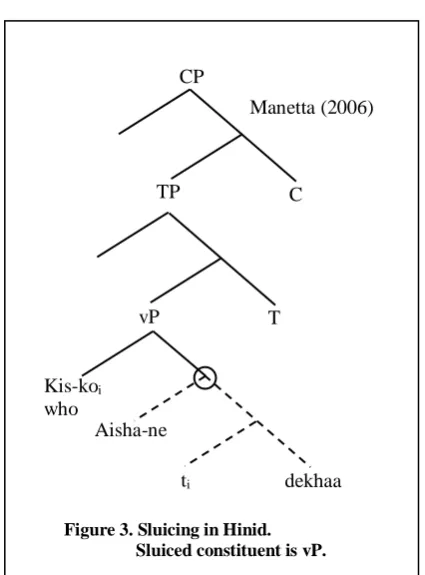
Manetta (2006) explained that in Hindi the elided element in sluicing is the deletion of the sister of the Spec of vP. This indicates that the wh-phrase moves to the Spec of vP and remaining vP is deleted.
33. aisha-ne kisi-ko dekhaa, Aisha-ERG someone-ACC see-PRF.M
lekin mujhe nahiiN pa-taa but 1SG.DAT NEG know-HAB.M
kis-ko who
'Aisha saw someone, but I don't know who.' This is represented in the figure below
Kis-ko moves to Spec-vP and the remaining constituent indicated by the circle is deleted.
Some of the tests developed by Manetta (2013) for diagnosing sluicing structures in Hindi-Urdu are used to check the Dakkhini data
34(a) ali kuch paRna chata tha Ali something read wants
C TP
CP
T vP
Kis-koi who
Aisha-ne
dekhaa ti
Figure 3. Sluicing in Hinid. Sluiced constituent is vP.
magar meku nai maloom kya but I NEG know what
‘Ali wants to read something but I don’t know what?’
34(b) Ali kuch paRna cahta tha magae mereku nai maloom (ali ______paRna cahata tha)
The tense auxiliary ‘tha’ is not present in the sluice structure. The tense auxiliary is a part of TP, but this tense auxiliary is deleted in sluicing. This indicates that the elided constituent is bigger than vP, it could be TP.
Another evidence comes from negation in Dakkhini as in 35(a).
35(a) zahəd kisse ki nai mila dawat Zahid someone NEG meet party me meku nai maloom kisse? in I NEG know whom
‘Zahid did not meet someone in the party but i dont know whom’
35(b) zahəd kisse ki nai Zahid with somebody NEG
mila dawat me meku nai maloom meet party in I NEG know
*kisse nai with whom NEG
‘Zahid did not meet someone in the party, but I don’t know who’ (intended).
Negation is higher than vp but it is elided in sluicing so it indicates that a bigger constituent than vP is deleted. The elided constituent is TP.
Just like negation the speaker oriented adverbs also give a clue that the elided part is bigger than vp and is a TP in Dakkhini.
The speaker oriented adverbs in Dakkhini adjoined above Vp are part of elided constituent
36(a). huʃʃaari se un kis ku ki Clever with 3SG somebody.ACC
manaya magar meku nai maloom convinced but I NEG know
kisku whom
‘He cleverly convinced somebody, but I don’t know who ’
36(b) * huʃʃaari se un kis ku ki Clever with 3GS somebody.ACC
manaya magar meku nai maloom convinced but I NEG know
kisku huʃʃaari se whom clever with
9.
Is sluicing in Dakkhini, stripping
It should be confirmed that Dakkhini sluicing constructions are not stripping Hankamer (2010)has claimed that the sluice structures in Turkish are cases of stripping where all the constituents except one of the second conjunct is deleted. This is also known as bare argument ellipses. It is represented in 37.
37. *Ravi drinks tea and I think ramu too.
Dakkhini does not show stripping as in 38.
38. *ali raat me kaam karta Ali night in work do
aur zahəd bhi and Zahid too
‘Ali works at night and zahid too’
Moreover sluice can precede the antecedent but stripping cannot precede antecedent as in 40 and 39 respectively.
39 .Mere ku nai maloom kan I DAT NEG know where
magar meku maloom ali but i-DAT know Ali
kain gaya somewhere went
40. *zahəd bhi aur ali raat Zahid too and Ali night
me kaam karta in work do
‘*Zahid too and Ali works at night’
so in Dakkhini sluicing structures are not cases of stripping.
10.
Sluicing in wh-in-situ languages
Merchant (2001) divides these languages into a set that is truly wh-in-situ (Japanese, Chinese, and Korean) and those like Hindi-Urdu and Turkish that exhibit what seems to be a kind of focus movement.
In Persian (Toosarvandni 2009) the movement in sluicing is because of movement to a high focus projection. So the wh-phrase moves to Spec-CP and TP is deleted. In Turkish, in sluicing structures the wh-remnant raises overtly to Spec-CP to check focus features. It bears focus intonation. Later TP is deleted (Ince 2006).
In Dakkhini the pre verbal position is the focus position as in the sentence 41.
41. vo mai ich laya tha. That I (emph) bring be.PAST ‘I(emph) brought that.’
But it was seen in the above discussion that sluice constituent are part of TP and not VP, so the movement before deletion cannot be a movement for focus. It could be considered that movement before deletion could be because of scrambling but ‘kiya’ in Dakkhini resist scrambling as seen is 6 above. Using copy theory of movement a regular question in Dakkhini is represented as
[CP kis-ko [ali kis-ku dekha ]] Who.ACC Ali who.ACC see
‘Who did Ali see?’
Here kis-ku moves to Spec-CP from the base generated position. The Spec-CP copy is called the upper copy. It is not pronounced at PF. But the lower copy is pronounced. The question arises as to which copy is pronounced. Applying this copy theory of movement to sluicing in Dakkhini, the following figure explains it.
Following Franks (1998) the top copy in sluicing is pronounced in a wh-chain at PF is just because of preference.
11.
Conclusion
This study concludes that sluicing exists in Dakkhini. Dakkhini obeys form generalization I and II. Dakkhini pied-piped in regular question and also in sluiced structure. Dakkhini does not have preposition stranding in regular question. It does not have preposition stranding in sluicing. The sluiced wh-phrase has the same case marking as its nonelided counterpart. Copy theory of movement is helpful in capturing the wh-movement in sluicing in Dakkhini.
12.
Bibliography
[i] Bhatt, Rajesh., Lecture Handouts: Topics in the Syntax of Modern Indo-Aryan Languages, MIT, Spring, 2003.
[ii] Bhatt, Rajesh, and Veneet, Dayal, "Rightward Scrambling as Rightward Remnant Movement", Linguistic Inquiry 38, 2002, pp. 287-301.
[iii] Chomsky, Noam, Lectures on Government and Binding., Dordrecht: Foris, 1981
[iv] Chomsky, Noam, Barriers, Cambridge: MIT, Press, 1986
[v] Chomsky, Noam., The Minimalist Program., Cambridge, Mass: MIT Press.1995.
[vi] Dayal, Veneeta., “Binding facts in Hindi and the Scrambling phenomenon”, in Theoretical
Perspectives on Word Order Issues in South Asian Languages, (CSLI), Stanford, California, 1994, pp. 237-261
CP
kis – ku who.ACC
C TP
[E] ali kis-ku dekha Ali who.ACC see
Figure 4. Structure of Sluice in accordance to copy theory of movement
[vii] Dayal, Veneeta., “Scope Marking: Cross-linguistic Variation in Indirect Dependency.” in Wh-Scope Marking, Amsterdam, John Benjamins., 2000, pp. 157-194.
[viii] Franks, Stephen., “Clitics in Salvic”, Position paper
for comparative Slavic morphosyntax workshop, held at McCormick’s Creek State Park, June 5-7, 1998.
[ix] Grierson, G.M., The Linguistic Survey of India, 7:2, Calcutta, 1919.
[x] Ince, Atakan., “Pseudosluicing in Turkish”, Working papers in Linguistics Volume 14 University of Maryland, 2006, pp. 111-126.
[xi] Kidwai, Ayesha., XP-Adjunction in Universal Grammar: Scrambling and Binding in I-nndiUrdu, Oxford University Press, 2000
[xii] Kizu, Mika., “Sluicing in wh-in-situ languages”, in
Proceedings of the Thirty-Third Regional Meeting of the Chicago Linguistic Society, Chicago Linguistic Society, 1997, pp. 231–244.
[xiii] Mahajan, Anoop.,The A/A-bar distinction and
movement theory, MIT, Cambridge, Mass, Ph.D.
dissertation, 1990.
[xiv] Mahajan, Anoop., “Rightward scrambling” in
Rightward movement, Amsterdam, John Benjamins, 1997.
[xv] Manetta, Emily., Peripheries in Kashmiri and Hindi-Urdu, University of Caifornia, Santa Cruz, Ph.D. dissertation, 2006.
[xvi]Manetta, Emily., Copy Theory in wh-in-situ languages: Sluicing in Hindi-Urdu, JSAL Vol 6, 2013.
[xvii] Merchant, Jason., The syntax of silence: Sluicing, islands, and identity in ellipsis, University of California, Santa Cruz, Ph.D. dissertation, 1999.
[xviii] Merchant, Jason., The syntax of silence: Sluicing, islands, and the theory of ellipsis, Oxford, Oxford University Press, 2001
[xix] Ross, John Robert, “Guess who?” in Papers from the Fifth Regional meeting of the Chicago Linguistics Society,
University of Chicago, Chicago, 1969.
[xx] Subbarao, K. V., South Asian languages: A syntactic typology, Cambridge University Press, 2012.
[xxi] Toosarvandani, Maziar., “Ellipsis in farsi complex predicates”, Syntax 12(1), 2009, pp. 60–92.
[xxii] Van Craenenbroeck, Jeroen, and Anikó Lipták., “What sluicing can do, what it can’t, and in which language”, Diagnosing syntax, Oxford University Press, 2013, pp. 502–536.
[xxiii] Vicente, Luis., Sluicing and its subtypes Ms. University, Potsdam, 2014.