ISSN (Print) : 2320 – 3765 ISSN (Online): 2278 – 8875
I
nternational
J
ournal of
A
dvanced
R
esearch in
E
lectrical,
E
lectronics and
I
nstrumentation
E
ngineering
(A High Impact Factor, Monthly, Peer Reviewed Journal)
Website: www.ijareeie.com
Vol. 7, Issue 3, March 2018
Identification of Agricultural Diseases in Crop
Management System Using Image Processing
B.Vignesh1, T. Vijayan2, G.Prem Kumar3, R. Abi Nethri4
U.G Students, Department of EIE, BIST, Bharath Institute of Higher Education and Research, Chennai,
Tamil Nadu, India 1,3,
Assistant Professors, Department of EIE, BIST, Bharath Institute of Higher Education and Research, Chennai,
Tamil Nadu, India 2,4 ,
ABSTRACT: Detection of pests in the paddy fields is a major challenge in the field of agriculture. The effective measures have to be developed to fight the infestation while minimizing the use of pesticides. Monitoring of pests infestation relies on manpower, however automatic monitoring has been advancing in order to minimize human efforts and errors. This study extends the implementation of different image processing techniques to detect and extract insect pests by establishing an automated detection and extraction system for estimating pest densities in paddy fields. And then, the result obtained from the Matlab is given to the controller. Depending upon the affected percentage, pesticide will be provided to the crop. Experiment results shows that the proposed system provides a simple, efficient and fast solution in detecting pests in the rice fields.
KEYWORDS: Agriculture, pest infestation, image processing and pesticide
I.INTRODUCTION
ISSN (Print) : 2320 – 3765 ISSN (Online): 2278 – 8875
I
nternational
J
ournal of
A
dvanced
R
esearch in
E
lectrical,
E
lectronics and
I
nstrumentation
E
ngineering
(A High Impact Factor, Monthly, Peer Reviewed Journal)
Website: www.ijareeie.com
Vol. 7, Issue 3, March 2018
II.LITERATUREREVIEW
[1] Explains about sampling techniques and devices for pest management decision making; the light trap, that involves varying size sample which is good for comparing seasonal and yearly catches of insects, but catches are subject to changes in insect behavior and do not catch none flying insects, the sweep net (catching insect using fishnet), is a fast method, very economical, and good for sampling arthropods staying in canopy of rice, but it has human error due to variability and poor catch of arthropods at the base of the plant; tapping the rice, this is a sampling method that utilize a collecting pan with soap solution or oil with water to collect arthropods at the base and stem of the rice. After tapping, arthropods are identified and counted immediately in the field, the visual counting and data recording can be done on field but also subject to human error and very costly in labor, sticky trap is also economical, it measures insect movement and colonization but does not catch non flying insect; yellow pan trap is also economical; it measures insect migration, easy sorting and counting of samples, but the attraction is due to color stimulus and does not catch none flying insects.[2] Describes Image processing is the analysis and manipulation of graphical images from sources such as photographs and videos. There are three main steps in image processing; first is the conversion of captured images into binary values that a computer can process; second, is the image enhancement and data compression; and the third is the output step that consists of the display or printing of the processed image. Image processing is used in such applications as satellite weather mapping, machine vision, and computer-based pattern recognition.. for Electromyography signal used white gaussian noise to represent interference. Two novel mean and median frequencies were presented for robust feature extraction [3] Several attempts have been made to build automatic insect identification systems based on image analysis. The study conducted by Samantha and Ghosh is concentrated to eight major insect pests based on the records of tea gardens of North Bengal Districts of India. The authors apply correlation based feature selection for the feature extraction and reduction, and incremental back propagation neural network as the neural network algorithm used for classifications. Do, Harp and Norris designed a computerized pattern recognition system for non-specialist in recognizing arachids and other arthropods to make the specimen identification easier and accurate. The researchers promote early insect pest detection in greenhouse crops in order to reduce pesticide use. The target application of this system is the detection of pests on plant organs such as leaves. The goal of their work is to define an innovative decision support system for in situ early pest detection based on video analysis and scene interpretation from multi-camera data. In this research, they used apriori
algorithm to detect white flies and aphids, and follow a eneric approach to design a system that can easily adapt different categories of bioagressors. Al-Saqer developed a neural network-based identification system for pecan weevils. used image descriptors as input in the neural network to recognize the pecan weevil. The authors collected different images of pecan weevil and other insects found in the paddy fields. After collecting the images they converted them into binary and re-sized to 114×134 pixels. To process the data, they used different image processing techniques such as Regional Properties and Zernike Moments.
III. SYSTEM ARCHITECTURE
ISSN (Print) : 2320 – 3765 ISSN (Online): 2278 – 8875
I
nternational
J
ournal of
A
dvanced
R
esearch in
E
lectrical,
E
lectronics and
I
nstrumentation
E
ngineering
(A High Impact Factor, Monthly, Peer Reviewed Journal)
Website: www.ijareeie.com
Vol. 7, Issue 3, March 2018
Figure.4.1 Block diagram of the system
4.2. Flow diagram for Crop disease identification
A. ARDUINO CONTROLLER:
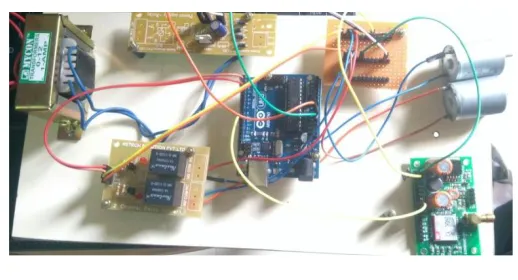
In our system Arduino Uno Board is used. The microcontroller is connected with all other hardware units in the module. This is connected with the all components in the circuit. The main operation of the controller is receive the input and send signal to the fingerprint sensor to verify authentication. When the authentication is successful it sends signal to the lcd display to the gsm module and the power supply to the motor.
B. MATLAB
ISSN (Print) : 2320 – 3765 ISSN (Online): 2278 – 8875
I
nternational
J
ournal of
A
dvanced
R
esearch in
E
lectrical,
E
lectronics and
I
nstrumentation
E
ngineering
(A High Impact Factor, Monthly, Peer Reviewed Journal)
Website: www.ijareeie.com
Vol. 7, Issue 3, March 2018
C. MOTOR:
When magnetic field and electric field interact they produce a mechanical A DC motor is designed to run on DC electric power. Two examples of pure DC designs are Michael Faraday's homo polar motor (which is uncommon), and the ball bearing motor, which is (so far) a novelty.
By far the most common DC motor types are the brushed and brushless types, which use internal and external commutation respectively to create an oscillating AC current from the DC source—so they are not purely DC machines in a strict sense.
D. GSM MODULE:
A GSM modem is a wireless modem that works with a GSM wireless network. A wireless modem behaves like a dial-up modem. The main difference between them is that a dial-up modem sends and receives data through a fixed telephone line while a wireless modem sends and receives data through radio waves. The working of GSM modem is based on commands, the commands always start with AT (which means attention) and finish with a <CR> character.
IV.HARDWARE SETUP
FIGURE 4.3
The software implementation used is the Arduino IDE programming and the embedded c language. With the help of ARDUINO software and the main operation is programmed and the serial input is given to the circuit. This circuit includes authentication, motor ,gsm messaging, DC voltage source,
ISSN (Print) : 2320 – 3765 ISSN (Online): 2278 – 8875
I
nternational
J
ournal of
A
dvanced
R
esearch in
E
lectrical,
E
lectronics and
I
nstrumentation
E
ngineering
(A High Impact Factor, Monthly, Peer Reviewed Journal)
Website: www.ijareeie.com
Vol. 7, Issue 3, March 2018
V.EXPERIMENTAL RESULT AND DISCUSSION
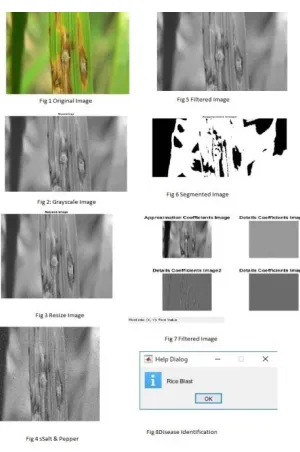
FIGURE 4.4 AFFECTED SAMPLE OUTPUT
ISSN (Print) : 2320 – 3765 ISSN (Online): 2278 – 8875
I
nternational
J
ournal of
A
dvanced
R
esearch in
E
lectrical,
E
lectronics and
I
nstrumentation
E
ngineering
(A High Impact Factor, Monthly, Peer Reviewed Journal)
Website: www.ijareeie.com
Vol. 7, Issue 3, March 2018
From Fig 4.4 and 4.5, the input image that is fetched is obtained as grey scale image. Then the image is resized and by Applying median filter the filtered image is acquired then image is segmented and by implementing HAAR WAVELET transform feature selection is done. Finally the identification of disease has been done.
VI.CONCLUSION
The proposed method explains how embedded system can be applied agriculture and help farmers to improve their crop yield. A reference model is described to implement the proposed solution. Our future work includes implementing the scheme using appropriate IoT devices, hardware and cloud. It is also planned to develop a mobile app to convey the information about the disease to the farmers, in their local languages. This system will benefit the farmers to increase their profit and improve their living condition.
REFERENCES
1.BALAJIBHANU,RAGHAVA RAO,J.V.N.RAMESH AND MOHAMMED ALI HUSSAIN,“AGRICULTURE FIELD MONITORING AND ANALYSIS USING
WIRELESS SENSOR NETWORKS FOR IMPROVING CROP PRODUCTION”,2014ELEVENTH INTERNATIONAL CONFERENCE ON WIRELESS AND OPTICAL
COMMUNICATIONS NETWORKS (WOCN).
2. LIU Dan, Cao Xin, Huang Chongwei, JI Liang Liang, “Intelligent agent greenhouse environment monitoring system based on IOT technology”, 2015 International Conference on Intelligent Transportation, Big Data & Smart City.
3. Joseph Haule, Kisangiri Michael, “Deployment of wireless sensor networks (WSN) in automated irrigation management and scheduling systems: a review”, Science, Computing and Telecommunications (PACT), 2014, Pan African Conference.
4. S. Vijayakumar, J. Nelson Rosario, “Preliminary Design for Crop Monitoring Involving Water and Fertilizer Conservation Using Wireless Sensor Networks”, Communication Software and Networks (ICCSN), 2011IEEE 3rd International Conference.
5. G. Nisha, J.Megala, “Wireless Sensor Network Based Automated Irrigation and Crop Field Monitoring System”, 2014 Sixth International Conference on Advanced Computing (IcoAC).
6. Meng Ji-hua, Wu Bing-fang, Li Qiang-zi, “A Global Crop Growth Monitoring System Based on Remote Sensing”,2006 IEEE International Symposium on Geo-science and Remote Sensing.
7. Alan Mainwaring, Joseph Polastre, Robert Szewczyk, David Culler, John Anderson, “Wireless Sensor Networks for Habitat Monitoring”, International Conference.
8. Lei Xiao, Lejiang Guo, “The Realization of Precision Agriculture Monitoring System Based on Wireless Sensor Network”, 2010 International Conference on Computer and Communication Technologies in Agriculture Engineering.
9. Ling-ling LI, Shi-feng YANG, Li-yan WANG, Xiang-ming GAO, “The Greenhouse Environment Monitoring System Based on Wireless Sensor Network Technology”, Proceedings of the 2011 IEEE International Conference on Cyber Technology in Automation, Control, and IntelligentSystems,March20-23,2011,Kunming,China.
10. Chun-ling Fan, Yuan Guo, “The Application of a ZigBee Based Wireless Sensor Network in the LED Street Lamp Control System”, 2013, College of Automation & Electronic Engineering, Qingdao University of Scientific & Technology, Qingdao, China embedded technology, Consumer Electronics - China, 2014 IEEE International Conference.
11. FuBing, “Research on the Agriculture Intelligent System Based on IOT”, 2012 International Conference on Image Analysis and Signal Processing.
12. Wen-Yao Zhuang, Miguel Costa Junior, Pedro Cheong, Kam-Weng Tam, “Flood Monitoring of Distribution Substation in Low-Lying Areas Using Wireless Sensor Network”, Proceedings of 2011 International Conference on System Science and Engineering, Macau, China - June 2011(NESEA),2012IEEE3rd International Conference.
13. Lin Zhang, Min yuan, Deyi Tai, Xia Oweixu, Xiang Zhan, Yuanyuan Zhang, “Design and implementation of granary monitoring system based on wireless sensor network node”, 2010 International Conference on Measuring Technology and Mechatronics Automation.
14. Yunseop Kim, Member, IEEE, Robert G. Evans, and William M. Iversen, “Remote Sensing and Control of an Irrigation System Using a Distributed Wireless Sensor Network”, Ieee transactions on instrumentationandmeasurement,vol.57,no.7,July2008.