A Study on Dyeing of Silk Fabric with Almond Shells
(
P. Amygdalus L.
) Waste
Deepali Singhee
Principal & Associate Professor, Department of Textile Science, Clothing & Fashion Studies, J.D. Birla Institute, Kolkata (India), [email protected]
and
Shradha Newatia
Former M.Sc Student, Department of Textile Science, Clothing & Fashion Studies, J.D. Birla Institute, Kolkata (India), [email protected]
Abstract: The present study is an endeavour towards making the process of dyeing with natural dyes cost effective through the use of easily available waste products like outer shells of the almond fruit. Degummed crepe silk fabric has been pre-mordanted with 25% (owf) aluminium sulphate and subsequently dyed under different conditions of time, temperature, pH, material to liquor ratio and dye concentration using aqueous extract of almond shells. The effect of variation in the extraction conditions and dyeing
process variables on surface colour
strength, other colour related parameters as well as fastness properties (light, washing and rubbing) have been optimized. Dyeing under acidic pH gives darker shades and the fatness properties of the dyed samples range from moderate to good. Temperature and pH have been found to be the most predominating dyeing process variables for dyeing silk with aqueous extract of almond shells as indicated by the widely dispersed CDI values of the dyed samples indicating that special care should be taken to control these parameters while dyeing
silk and other protein fibers using aqueous extract of almond shell.
Keywords: Almond Shells, Aluminium Sulphate, Colour Dispersion Index (CDI),
Dyeing Process Variables, Fastness
Properties, Natural Dyes, Mordant, Crepe Silk Fabric.
1. Introduction
also have a significantly lower affinity for fibres that causes their lower dye-exhaustion from bath on to the fibre surface (Knizova, 2015). Moreover, the content of the colour component in most natural dyes is limited and large quantities of the dye source are needed to colour small quantities of the textile material (Knizova, 2015). For this, enormous amounts of the dye source has to be
procured which may lead to
overexploitation of natural resources,
specifically from vegetable origin, to obtain dyes. It would also threaten some endangered species (Saxena et al., 2014).
Various efforts have been undertaken all over the world to address these shortcomings of natural dyes and find suitable alternative sources in view of the tremendous environmental advantages that they offer. One such solution lies in the use of waste products.
The food and beverage industry releases considerable amounts of wastes which contain natural dyes. Such wastes could serve as sources for the extraction of natural dyes for textile-dyeing operations without causing any adverse impact on the environment and also avoid substitution food crops for cash crops. Some studies have already been undertaken to use such wastes effectively for dyeing wool with wastes, e.g. pressed berries, pressed grapes, distillation residues from strong liquor production, and wastes and peels from vegetable processing using iron mordants (Bechtold et al., 2006). Use of
walnut shells in dyeing textiles has also been report by (Mirjalili et al., 2013). Such studies are however limited and scanty.
Although literature has reported the use of organic wastes such as almond shells for production of bio-energy and other valuable compounds (Chen et al., 2010), as a biosorbent for dye removal (Deniz, 2013a; Deniz, 2013b; Majib et al., 2012; Sundaram et al., 2012; Atmani et al., 2009), to absorb metals and organic substances in waste water treatment (Bechtold et al., 2006; Laufenberg et al., 2003; Pehlivan et al., 2008) and to dye wool in the presence of bio-mordants (Işmal et.al, 2012) or metal mordants (Işmal et al., 2014), there are very few and scanty reports in literature for its use for dyeing textiles.
Almond is consumed as a valuable food and its production generates millions of tons of residues (shells, hulls, pruning,
leaves, skin and inedible kernel
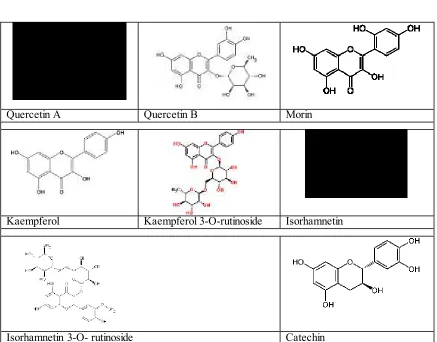
disposition), the bulk of which are the almond shells. The almond shell is the woody endocarp of the almond fruit (P. Amygdalus L.). High performance liquid chromatographic analysis has revealed the
presence of quercetin, isorhamnetin,
kaempferol-3-O-rutinoside,
isorhamnetion-3-O-glucoside and morin as the major flavonoids in all extracts (Esfahlan et al., 2010).
Quercetin A Quercetin B Morin
Kaempferol Kaempferol 3-O-rutinoside Isorhamnetin
Isorhamnetin 3-O- rutinoside Catechin
Figure 1: Structure of the colouring components found in almond shell extract.
Thus, in the present study, almond shells which are abundantly available as a waste product and free of cost have been used to dye crepe silk fabric with an objective to identify a new potential natural dye source which is not costly and can be used to dye silk at lower cost.
2. Materials and Methods
2.1 Materials
2.1.1 Fabric
Crepe silk fabric having 9 tex silk yarns as warp and 6 tex silk yarn as weft with 32 ends/dm and 52 picks/dm and
fabric area density of 66g/m2 obtained
from M/s Handloom Cottage Pvt. Ltd., Kolkata (India) was used for the study.
2.1.2 Dyes and Chemicals
Almond shells obtained from
Barabazar area in Kolkata (India) was ground to a powdered form after drying and was used for dyeing. Aluminium Sulphate 16-hydrate [(Al2(SO4)3.16H2O]
was used as the mordant. Sodium
carbonate, non-ionic detergent (Lux
flakes), acetic acid were also used.
Bleached crepe silk fabric was degummed using 6 gpl non-ionic detergent and 2 gpl Na2CO3 at 90°C for 90 min
using material-to-liquor ratio (MLR) 1:20.
2.3 Pre-mordanting of degummed crepe silk
The degummed crepe silk fabric was was pre-mordanted, before dyeing, using optimized 25% (owf) aluminium sulphate (Al2SO4) at 600C for 30 min using MLR
1:20. The mordant concentration was optimized on the basis of highest colour yield, minimum loss in strength and good colour fastness of the silk fabric pre-mordanted with various concentrations of the mordant and subsequently dyed with aqueous extract of the dye.
2.4 Aqueous extraction of dye from almond shells
The colouring matter from powdered almond shells was extracted under aqueous conditions at variable temperature (RT-1000C), time (15-90 min),
material-to-liquor ratio (1:10-1:50) and pH (2-11) and each extraction condition was optimized on the basis of the highest optical density observed for 1% of the solution at the maximum wavelength. While studying a particular variable, the other variables were kept constant (temperature-80°C, time-30 min, MLR-1:20 and pH-7). All further experiments were carried out at the optimized conditions.
2.5 Exhaust dyeing of pre-mordanted crepe silk
Pre-mordanted fabric samples were dyed using aqueous extract of the dye under variable parameters of dyeing dyeing temperature (RT-100°C), time
(15-90 min), material-to-liquor ratio
(1:10-1:50), pH (2-11) and dye concentration (25-800%) and the optimum values for each condition established. While studying a particular variable, the
other variables were kept constant
(temperature-1000C, time-60 min,
MLR-1:50, pH-11, dye concentratio-100%). After dyeing, the samples were rinsed thoroughly under running water and air dried in shade.
2.6 Determination of maximum
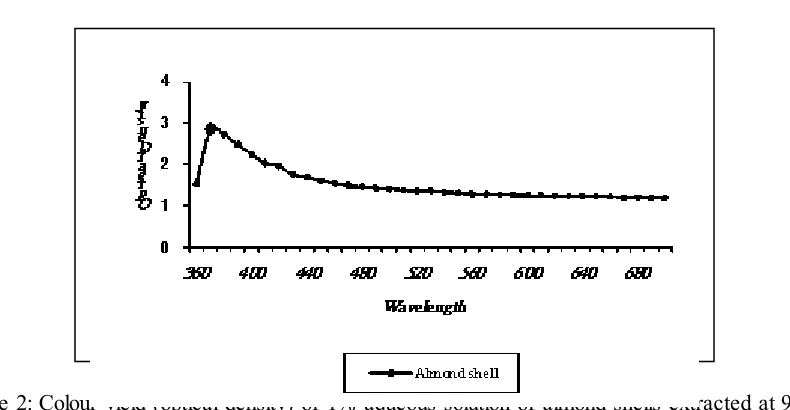
absorbance wavelength of the dye solution The maximum absorbance wavelength of 1% aqueous extract of almond extract (natural dye) was identified by evaluating the relative optical densities of the solution (extracted at 900C for 30 min using 1 gm
of dry source material of the dye in 100 ml of water) at different wavelengths (360-700 nm visible range) using
Hitachi-U-2000 UV-VIS absorbance
spectrophotometer.
Figure 2: Colour yield (optical density) of 1% aqueous solution of almond shells extracted at 900C for
60 min using 1 gm of dye source in 100 ml of water at different wavelengths in the visible zone (360 nm to 700 nm)
2.7 Estimation of surface colour strength, dyeing uniformity and other related colour interaction parameters
Surface colour strength of dyed crepe silk samples was estimated in terms of K/S
values (Kubelka Munk function)
(Bhattacharya et al., 2000; Tomer et al., 2004) by measuring surface reflectance of each of the dyed samples at the λmax (460
nm) using a Premier Colour Scan (model SC 5100A) reflectance spectrophotometer along with associated colourlab plus colour matching software.
Total colour difference (ΔE),
lightness/darkness (ΔL*),
redness/greenness (Δa*),
blueness/yellowness (Δb*), change in
chroma (ΔC*), and change in hue ((ΔHab),
values were measured before and after dyeing to compare the shade depth and colour differences of each dyed sample
against particular undyed (bleached / mordanted) standard sample using the following CIE-lab equations (Samanta et al., 2008).
General metamerism index (MI) was calculated employing the Nimeroff and Yurow’s equation (Samanta et al., 2009).
2.8 Measurement of colour difference index
A newer colour interaction parameter called Colour Difference Index (CDI) postulated earlier (Samanta et al., 2011) that indicates the combined effect of
different known individual colour
different dyeing variables on a single dyeing parameter.
Colour Difference Index (CDI) =
ΔE X ΔH
ΔC X MI
Where ΔE I the total colour difference, ΔC is the change in chroma, ΔH is the change in hue and MI is the metamerism index.
For the application of same
concentration of dye between two sets of dyeing under varying conditions, only the magnitudes of the respective ΔE, ΔC, ΔH and MI values (irrespective of their sign and direction) may be considered to calculate CDI values using the following empirical relationship:
2.9 Evaluation of colour fastness
Colour fastness to washing (ISO-II and ISO-III) of the dyed samples was
determined as per the IS: 764-1984 methods (Ahmed et al., 1997).
Colour fastness to rubbing (dry and wet) was assessed as per the IS: 766-1984 method (Ahmed et al., 1997).
3. Results and Discussion
3.1 Optimization of the conditions of aqueous extraction of colour
Before dyeing silk with extracted solution of almond shells, the conditions of extraction were optimized.
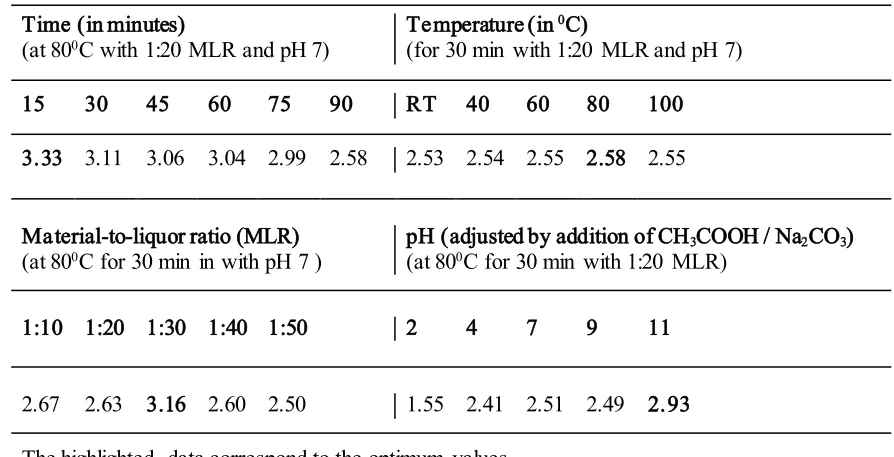
It can be seen from Table-1 that optical density of the solution of almond shells when extracted under aqueous conditions decreases with increase in the time, while it initially increases when temperature is raised to 800C after which
it decreases.
Table 1: Optical densities (colour yield) at λmax (370 nm) of aqueous extracted solution of ground
almond shells extracted at different time and temperature
Time (in minutes)
(at 800C with 1:20 MLR and pH 7) Temperature (in 0C)
(for 30 min with 1:20 MLR and pH 7)
15 30 45 60 75 90 RT 40 60 80 100
3.33 3.11 3.06 3.04 2.99 2.58 2.53 2.54 2.55 2.58 2.55
Material-to-liquor ratio (MLR)
(at 800C for 30 min in with pH 7 ) pH (adjusted by addition of CH(at 800C for 30 min with 1:20 MLR) 3COOH / Na2CO3)
1:10 1:20 1:30 1:40 1:50 2 4 7 9 11
2.67 2.63 3.16 2.60 2.50 1.55 2.41 2.51 2.49 2.93
There is an initial increase in the optical density of the extracted solution of almond shells with increase in material-to-liquor ratio, which reaches the maximum at an MLR of 1.30 ratio and thereafter it decreases as is evident form the data in Table-1. Colour extracted from almond shells increases with increase in the pH indicating that this natural dye is sensitive to acidic pH and can be easily extracted under alkaline conditions.
The conditions of extraction of colours from almond shells with respect to the highest optical density obtained at λmax
(370 nm) has thus been optimized at temperature- 80°C, time-15 min, MLR-1:30 and pH-11.
3.2 Optimization of the mordant concentration
In the initial part of the present work, degummed silk fabric samples have been
mordanted using aluminium sulphate and the resultant changes in tenacity and
surface colour strength have been
assessed. The corresponding data are shown in Table-2 and Table-3.
3.2.1 Effect of mordant concentration on mechanical properties
Treatment with higher concentrations of the mordant results in some loss of strength in both the warp and weft directions as can be seen from Table-3; in most cases this strength loss is always higher in the warp direction as compared to the weft direction. The higher loss of strength in the warp direction compared to that in the weft direction may be due to more shrinkage that arises in the warp direction as a result of exposure of the warp yarns to more tension during weaving rendering it more vulnerable to strength loss than the relatively more relaxed weft yarns.
Table 2: Effect of mordant (alum) on the mechanical properties of degummed crepe silk fabric pre-mordanted with alum at 600C for 30 min using MLR 1:20.
Mordant Concentration Tenacity (cN/tex)
Warp Weft
NIL (degummed crepe silk sample) 13.22 10.09
10% 11.71 8.29
15% 11.73 8.14
20% 11.75 8.16
25% 11.89 8.47
35% 10.36 8.38
50% 10.20 6.64
3.2.2 Effect of mordant concentration on colour yield and colour fastness properties
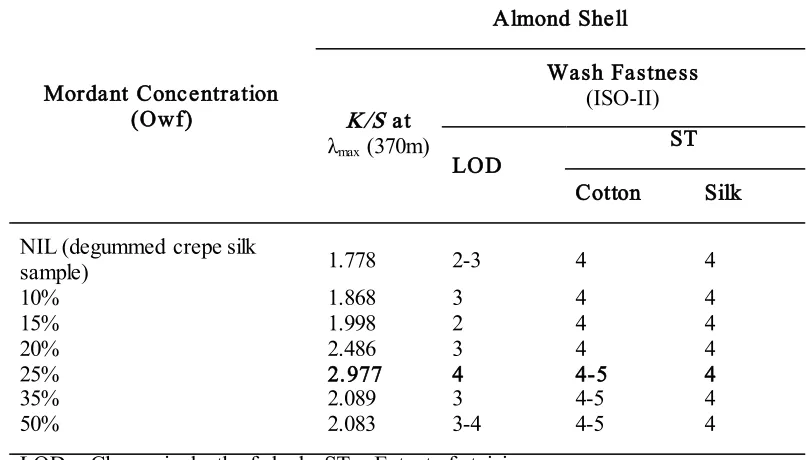
The surface colour strength (K/S value) of mordanted crepe silk when subsequently dyed with aqueous extract of almond shells initially increases with increase in
the mordant concentration upto 25% (owf), after which it starts decreasing as is evident from Table-3. Mordanting with 25% (owf) aluminium sulphate gives maximum surface colour strength (K/S value).
Table 3: Effect of mordant (alum) on the dyeing efficiency of degummed crepe silk fabric pre-mordanted with alum and dyed with standardized aqueous extracted solution of almond shells at 1000C for 1 hr using MLR 1:50
Mordant Concentration (Owf)
Almond Shell
K/S at λmax (370m)
Wash Fastness (ISO-II)
LOD
ST
Cotton Silk
NIL (degummed crepe silk
sample) 1.778 2-3 4 4
10% 1.868 3 4 4
15% 1.998 2 4 4
20% 2.486 3 4 4
25% 2.977 4 4-5 4
35% 2.089 3 4-5 4
50% 2.083 3-4 4-5 4
LOD – Change in depth of shade, ST – Extent of staining The highlighted data correspond to the optimum values
Table-3 also shows the effect of different concentrations of the mordant on the colour fastness of silk fabric dyed with the said dye. Generally the use of aluminium sulphate as a mordant gives good wash fastness with respect to staining of the adjacent fabrics (both silk and cotton). Although the colour fastness to change in the depth of colour ranges from poor to moderate, data in Table-3 indicates that the fastness improves with the increase in the concentration of the mordant and reaches maximum when 25%
mordant although complexes with more dye molecules, it remains unfixed to the fibre and comes out easily during washing thereby causing wash fastness to be reduced.
Thus, keeping all the above parameters (tensile strength, K/S and wash fastness) in mind, 25% (owf) mordant concentration has been selected as the most efficient for mordanting and subsequently dyeing silk fabric with aqueous extract of almond shells.
3.3 Optimization of different dyeing process variables
Effect of different dyeing process variables was optimized on the basis of
uniform colour yield and maximum
fastness properties obtained on crepe silk fabric samples pre-mordanted with 25%
(owf) aluminium sulphate and
subsequently dyed with aqueous extract (extracted at the optimized conditions) of almond shells.
3.3.1 Analysis of colour difference and related colour interaction parameters for application of onion peel extract under different dyeing conditions
It was observed that keeping all other dyeing process variables fixed, with an increase in the dyeing time (15-90 min.) the K/S values shows a corresponding up and down trend (crests and troughs) till 30
min, thereafter which the K/S values
increases up to 60 min. Beyond 60 min it
again starts decreasing with further
increase in the dyeing time. This may possibly be due to the achievement of dyeing equilibrium at 60 min for this dye, depending on the rate of dye diffusion. There may also be some desorption / breaking of dye-fibre-mordant complex beyond 60 min dyeing time, which leads to the dropping trend above 60 min of dyeing (Figure-3, Plot a).
With increase in the dyeing
temperature (from room temperature to 600C), there is a linear increase in the
surface colour strength (K/S) (Table-4 or Figure-3, Plot b) that reaches maximum at 1000C. Increase in the temperature of
dyeing inevitably supplies more energy for the transportation of the dye molecule, thereby facilitating higher rate of dye sorption and diffusion into the fibre. Hence, it has been found that at 1000C
there is maximum absorption of colour from almond shells and hence it gives highest K/S values.
Plot a: Time (minutes) Plot b : Temperature (0C)
Plot c: pH Plot d : MLR
Plot e: Dye concentration
Figure 3: Effects of time temperature, pH, MLR, dye concentration in the dye-bath on colour yield of alum pre-mordanted crepe silk fabric using aqueous extract of almond shell.
Keeping other variables constant, the K/S value of the dyed samples increases with increase in the material-to-liquor ratio (MLR) from 1:10 to 1:50, after which it decreases. MLR (Figure-3, Plot d). MLR-1:40 gave maximum colour yield in terms of the K/S values and has been selected as the optimum.
There is a sharp linear increase in K/S
value with the increase in dye
concentration from 25-800% (on the basis of weight % of dried solid almond shell). This increase is noticeably higher at 800%
concentration. Hence, 800% dye
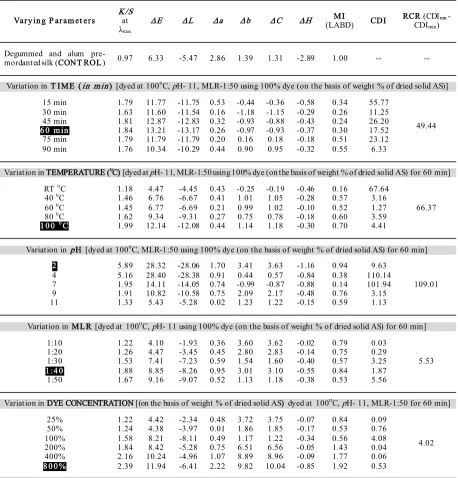
Table 4: Colour strength and related parameters of alum (25%) pre-mordanted crepe silk fabric dyed with standardized aqueous extracted solution of almond shell(AS) using variable conditions of dyeing
Var y in g P ar am et er s K/Sat λmax
ΔE ΔL Δa Δb ΔC ΔH (LABD) M I CDI RCR (CDImax - CDImin)
Degummed and alum
pre-mordanted silk (CONT ROL ) 0.97 6.33 -5.47 2.86 1.39 1.31 -2.89 1.00 -- --
Variation in T I ME (in m in) [dyed at 1000C, pH- 11, MLR-1:50 using 100% dye (on the basis of weight % of dried solid AS)] 15 min 1.79 11.77 -11.75 0.53 -0.44 -0.36 -0.58 0.34 55.77
49.44 30 min 1.63 11.60 -11.54 0.16 -1.18 -1.15 -0.29 0.26 11.25
45 min 1.81 12.87 -12.83 0.32 -0.93 -0.88 -0.43 0.24 26.20
6 0 m in 1.84 13.21 -13.17 0.26 -0.97 -0.93 -0.37 0.30 17.52
75 min 1.79 11.79 -11.79 0.20 0.16 0.18 -0.18 0.51 23.12 90 min 1.76 10.34 -10.29 0.44 0.90 0.95 -0.32 0.55 6.33
Variation in TEMPERATURE (0C) [dyed at pH- 11, MLR-1:50 using 100% dye (on the basis of weight % of dried solid AS) for 60 min] RT 0C 1.18 4.47 -4.45 0.43 -0.25 -0.19 -0.46 0.16 67.64
66.37 40 0C 1.46 6.76 -6.67 0.41 1.01 1.05 -0.28 0.57 3.16
60 0C 1.45 6.77 -6.69 0.21 0.99 1.02 -0.10 0.52 1.27 80 0C 1.62 9.34 -9.31 0.27 0.75 0.78 -0.18 0.60 3.59
1 0 0 0C 1.99 12.14 -12.08 0.44 1.14 1.18 -0.30 0.70 4.41
Variation in pH [dyed at 1000C, MLR-1:50 using 100% dye (on the basis of weight % of dried solid AS) for 60 min] 2 5.89 28.32 -28.06 1.70 3.41 3.63 -1.16 0.94 9.63
109.01 4 5.16 28.40 -28.38 0.91 0.44 0.57 -0.84 0.38 110.14
7 1.95 14.11 -14.05 0.74 -0.99 -0.87 -0.88 0.14 101.94 9 1.91 10.82 -10.58 0.75 2.09 2.17 -0.48 0.76 3.15 11 1.33 5.43 -5.28 0.02 1.23 1.22 -0.15 0.59 1.13
Variation in ML R [dyed at 1000C, pH- 11 using 100% dye (on the basis of weight % of dried solid AS) for 60 min] 1:10 1.22 4.10 -1.93 0.36 3.60 3.62 -0.02 0.79 0.03
5.53 1:20 1.26 4.47 -3.45 0.45 2.80 2.83 -0.14 0.75 0.29
1:30 1.53 7.41 -7.23 0.59 1.54 1.60 -0.40 0.57 3.25
1 :4 0 1.88 8.85 -8.26 0.95 3.01 3.10 -0.55 0.84 1.87
1:50 1.67 9.16 -9.07 0.52 1.13 1.18 -0.38 0.53 5.56
Variation in DYE CONCENTRATION [(on the basis of weight % of dried solid AS) dyed at 1000C, pH- 11, MLR-1:50 for 60 min] 25% 1.22 4.42 -2.34 0.48 3.72 3.75 -0.07 0.84 0.09
4.02 50% 1.24 4.38 -3.97 0.01 1.86 1.85 -0.17 0.53 0.76
100% 1.58 8.21 -8.11 0.49 1.17 1.22 -0.34 0.56 4.08 200% 1.84 8.42 -5.28 0.75 6.51 6.56 -0.05 1.43 0.04 400% 2.16 10.24 -4.96 1.07 8.89 8.96 -0.09 1.77 0.06
8 0 0 % 2.39 11.94 -6.41 2.22 9.82 10.04 -0.85 1.92 0.53
ΔE – total colour difference, ΔL – lightness/darkness, Δa – greenness/redness difference, Δb – blueness/yellowness, ΔH – change in hue,
ΔC – change in chroma, MI – metamerism index, CDI – colour difference index T he highlighted data correspond to the optimum values
Table-4 also shows the effect of the different process variables on other colour
interaction parameter, including total
colour difference (ΔE), changes in chroma (ΔC), general metamerism index (MI) and
has been identified as dyeing time, temperature and pH of the dye-bath as indicated by the wide dispersion of CDI values. The order of increasing CDI values therefore appears to be as follows:
Dye concentration < MLR < Time < Temperature < pH
The corresponding data on ΔE, ΔL, Δa, and Δb for crepe silk fabric dyed with aqueous extract of almond shells indicate are also listed in Table-4. Higher range of ΔE value is observed for the variation in pH, indicating that it is the major controlling-parameter that is responsible for uniform dyeing. The data on ΔL, Δa, and Δb indicate further implication of the
colour difference in terms of
lightness/darkness, redness/greenness and
blueness/yellowness respectively and
analysis of these through individual colour difference parameters for dye from almond shells show that variations are more for the
lightness/darkness scale rather than
redness/greenness scale followed by
blueness/yellowness. This indicates that the major colour component (of the predominating hue) of the natural dye from almond shell has been subjected to more varied absorption / anchoring and thus gives higher ΔL values.
Changes in hue (ΔH) for all the cases are found to be negative (Table-4), indicating that there is no major change in the predominating hue, except for some hypsochromic shift in the colour/tone. However, the maximum negative ΔH value (> -0.50) is again observed in case of
the variation in time (15 min), MLR (1:40), pH (4 & 7) and dye concentration (800%), which further indicates the colour yield for the natural dye obtained from almond shells is sensitive to these four dyeing process variables.
Therefore, for uniform dyeing of silk and other protein fibres with aqueous extract of almond shells extract, special
care should be taken to control
temperature, pH of the dye-bath and dye concentration.
3.3.2 Analysis of colour fastness (washing,
rubbing, light and perspiration) for
application of almond shell extract under different dyeing conditions
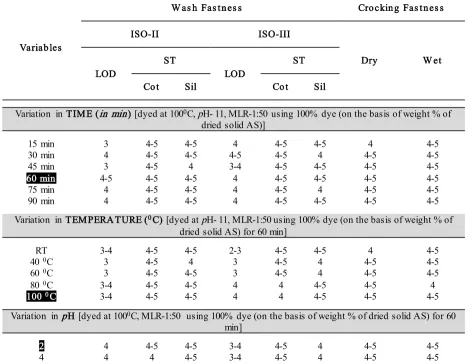
The wet and dry rub fastness of dyed silk samples with almond shell extract has been found to be good (4 to 4-5). Also there is not much variation in the wet and dry rub fastness of dyed silk samples with respect to the variation in the conditions of the dyeing parameters with the exception in case of pH variation. It is also interesting to note that the wet rubbing fastness is either same or marginally lower in few cases (when temperature and MLR
is varied) compared to the corresponding dry rubbing fastness; in few exceptional cases the former is higher.
It is interesting to note from Table-5 that the best results with respect to colour fastness (wash and rubbing) matches with that of the optimized dyeing process parameters i.e dyeing dyeing temperature-1000C, time-60 min, MLR-1:40, pH-2 and
dye concentration-800% (owf).
Table 5: Colour fastness properties of alum (25%) pre-mordanted crepe silk fabric dyed with standardized aqueous extracted solution of almond shell using variable conditions of dyeing
Variab les
W as h Fas tn es s Cro ckin g Fas tn es s
ISO-II ISO-III
Dry W et LOD
ST
LOD
ST
Co t Sil Co t Sil
Variation in TIM E (in min) [dyed at 1000C, pH- 11, MLR-1:50 using 100% dye (on the basis of weight % of
dried solid AS)]
15 min 3 4-5 4-5 4 4-5 4-5 4 4-5
30 min 4 4-5 4-5 4-5 4-5 4 4-5 4-5
45 min 3 4-5 4 3-4 4-5 4-5 4-5 4-5
60 min 4-5 4-5 4-5 4 4-5 4-5 4-5 4-5
75 min 4 4-5 4-5 4 4-5 4 4-5 4-5
90 min 4 4-5 4-5 4 4-5 4-5 4-5 4-5
Variation in TEM PERA TURE (0C) [dyed at pH- 11, MLR-1:50 using 100% dye (on the basis of weight % of
dried solid AS) for 60 min]
RT 3-4 4-5 4-5 2-3 4-5 4-5 4 4-5
40 0C 3 4-5 4 3 4-5 4 4-5 4-5
60 0C 3 4-5 4-5 3 4-5 4 4-5 4-5
80 0C 3-4 4-5 4-5 4 4 4-5 4-5 4
100 0C 3-4 4-5 4-5 4 4 4-5 4-5 4-5
Variation in pH [dyed at 1000C, MLR-1:50 using 100% dye (on the basis of weight % of dried solid AS) for 60
min]
2 4 4-5 4-5 3-4 4-5 4 4-5 4-5
4 4 4 4-5 3-4 4-5 4 4-5 4-5
7 4 4-5 4-5 3-4 4 4 4-5 4-5
11 2-3 4 4-5 3 4-5 4 4-5 4-5
Variation in M LR [dyed at 1000C, pH- 11 using 100% dye (on the basis of weight % of dried solid AS) for 60
min]
1:10 4-5 4 4-5 4 4-5 4-5 4-5 4-5
1:20 4-5 4-5 4-5 3-4 4-5 4-5 4-5 4-5
1:30 4-5 4 4-5 3-4 4 4-5 4-5 4-5
1:40 4-5 4-5 4-5 3-4 4-5 4-5 4-5 4-5
1:50 3-4 4 4-5 3-4 4-5 4-5 4 4-5
Variation in DYE CONCENTRA TION [(on the basis of weight % of dried solid AS) dyed at 1000C, pH- 11,
MLR-1:50 for 60 min]
25% 3 4 4-5 3 4-5 4-5 4-5 4-5
50% 3-4 4 4-5 4-5 4-5 4-5 4-5 4-5
100% 3-4 4 4-5 4 4-5 4-5 4-5 4-5
200% 2-3 4 4-5 2-3 4-5 4 4-5 4-5
400% 4-5 4 4 3 4-5 4 4-5 4-5
800% 4-5 4-5 4 4 4-5 4 4-5 4
LT – Light fastness, LOD – Loss in dept of shade, ST – Extent of staining, Cot – Cotton, Sil – Silk
4. Conclusions
From the present study the following may thus be concluded:
(1) The shades developed on crepe silk fabric samples dyed with almond shell extract ranges from various shades of light beige to dark beige. Darker shades are produced when dyeing is carried out under acidic pH.
(2) The optimized extraction condition
with respect to the highest optical density at maximum wavelength for onion peel has been established at 800C (extraction temperature),
15 minutes (extraction time), 1:30 (MLR) and 11 (pH).
(3) 25% (owf) mordant concentration
has been optimized in terms of the
minimum strength loss and
maximum surface colour strength
of the treated and subsequently dyed fabric.
(4) The optimized dyeing condition
with respect to with respect to
surface colour strength and
fastness properties for dyeing silk crepe fabric using almond shell extract was established at 1000C
(dyeing temperature), 60 min
(dyeing time), 1:40 (MLR) and 2
(pH) and 800% (dye
concentration).
(5) For uniform dyeing with onion peel extract of silk and other protein fibres, special care should be taken
for controlling of pH and
temperature of the dye-bath apart from the dye concentration as indicated by a wide dispersion of CDI values.
5. References
R. and Gogoi, N. (1997). Effect of natural dyes on the physical properties of silk. Indian Silk, 36(11), pp. 17-19
2. Alam, M.M., Rahman, M.L. and
Haque, M.Z. (2007). Extrication of henna leaf dye and its dyeing effect on textile fibre. Bangaldesh Journal of Scientific and Industrial Res, 42(2), pp. 217-222.
3. Atmani, F., Bensmaili A. and
Mezenner N.Y. (2009). Synthetic textile effluent removal by skin
almonds waste. Journal of
Environmental Science and
Technology, 2(4), pp. 153-169.
4. Bechtold, T., Mussak, R.,
Mahmud, Ali., A. Gabglberger, E. and Geissler, S. (2006). Extraction of natural dyes for textile dyeing
from coloured plant wastes
released from the food and
beverage industry. Journal of
Science of Food and Agriculture, 86(2), pp. 233-242.
5. Bensmaili, A. and Mezenner, N.Y.
(2009). Synthetic textile effluent removal by skin almonds waste. Journal of Environmental Science and Technology, 2(4), pp. 153-169.
6. Bhargava, Deepti., and Jalan,
Shahnaz. (2013). Microbial Dyes: A new dimension to natural dyes. Colourage, 60(7), pp. 42-43.
7. Bhattacharya, S.D. and Shah, A.K.
(2000). Metal ion effect on dyeing of wool fabric with catechu. Journal of Society of Dyers
Colorists, 116 (1), pp. 10-12.
8. Chen, Paul., Cheng, Yanling.,
Deng, Shaobo., Lin, Xiangyang.,
Huang, Guangwei and Ruan,
Roger. (2010). Utilization of
almond residues, International
Journal of Agricultural and
Biological Engineering, 3(4), pp. 1-18
9. Deniz, F. (2013). Dye removal by
almond shell residues: studies on
biosorption performance and
process design. Material Science
and Engineering C, 33(5),
pp.2821-2826.
10. Deniz, F. (2013). Adsorption
properties of low cost biomaterial derived from Prunus amygdalus L. for dye removal from water. The Scientific World Journal, 2013, pp. 1-8.
11. Esfahlan, A.J., Jamei, R. and
Esfahlan, R.J. (2010). The
importance of almond (Prunus amygdalus L.) and is by-products. Food Chemistry, 120(2), pp. 349-360.
12. Knizova, Hana. (2015). Natural
dyes: their past, present, future and
sustainability. Recent
Developments in Fibrous Material Science, Křemenáková D. (ed.), Militký J. (ed.), Mishra R. (ed.), Ops Kanina, pp. 59-71
13. Laufenberg, G., Kunz, B. and
Nystroemm, M. (2008).
Implementations. Bioresource Technology, 87(2), pp.167-198.
14. Majid, Aliabadi., Imane, Khazaei.,
Mohsen, Hajiabadi and Fazel,
Shahrzad. (2012). Journal of
Biodivesity and Environmental
Sciences, 2(9), pp. 29-44.
15. Mirjalili, Mohammad. and
Loghman, Karimi. (2013).
Extraction and characterization of natural dye from green walnut shells and its use in dyeing polyamide: Focus on antibacterial properties. Journal of Chemistry, 2013, pp. 1-9.
16. Mohmmad, Gias Uddin. (2014).
Effects of different mordants on silk fabric dyed with onion outer skin extracts, Journal of Textiles, 2014, pp. 1-8.
17. Naz, Saima., Bhatit, Ijaz A. and
Adeel, Shahid. (2011). Dyeing properties of cotton fabric using un-irradiated and gamma irradiate
extracts of Eucalyptus
camaldulensis bark powder. Indian
Journal of Fibre & Textile
Research, 36(June), pp. 132-136.
18. Özlenen, İşmal Erdem and
Yıldırım, Leyla. (2012). Almond shell as a natural colorant. Indian
Journal of Fibre & Textile
Research, 37(4), pp. 358-363
19. Özlenen, İşmal Erdem, Yıldırım,
Leyla. and Ozdogan, Esen. (2014). Use of almond shell extracts plus biomordants as effective textile dye. Journal of Cleaner Production, 70, pp. 61-67.
20. Pehlivan, Erol, and Altun, Turkan.
(2008). Biosorption of chromium
(VI) ion from aqueous solutions using walnut, hazelnut and almond
shell. Journal of Hazardous Matter,
155(1-2), pp. 378-384.
21. Samanta, Asis Kumar and
Agarwal, Priti. (2007). Dyeing of jute and cotton fabrics using Jackfruit wood extract: Part I – Effect of mordanting and dyeing process variables on colour yield and colour fastness properties. Indian Journal of Fibre & Textile Research, 32(4), pp. 466-476.
22. Samanta, A.K., Agarwal, P. and
Dutta, S. (2008). Physio-chemical studies on the dyeing of jute and cotton fabrics using jackfruit wood extract: Part II- Dyeing kinetics and thermodynamic studies. Indian Journal of Fibre and Textile Research, 33(1), pp. 66-72.
23. Samanta, A.K., Agarwal, P.,
Singhee, D. and Dutta S. (2009). Application of single and mixtures of red sandalwood and other natural dyes for dyeing of jute
fabric: studies on colour
parameters / colour fastness and compatibility. Journal of Textile Institute, 100(7), pp. 565-587
24. Samanta, A.K., Konar, A.,
Fibre and Textile Research, 36(1), pp. 63-73.
25. Saxena, S. & Raja, A.S.M. (2014). Natural dyes: sources, chemistry,
application and sustainability
issues. Roadmap to sustainable
textiles and clothing, Springer
Singapore, pp. 37-80
26. Sundaram, Meenakshi, M. and
Sivakumar, S. (2012). Use of Indian almond shell waste and groundnut shell waste for the removal of azure a dye from
aqueous solution. Journal of
Chemical Pharmaceutical
Research, 4 (4), pp. 2047-2054.
27. Tomer, P., Singh, J. and Saroj.
(2004). Utilisation of banyan