
The multidimensional nucleon structure
BarbaraPasquini1,2,and Cédric Lorcé3,
1Dipartimento di Fisica, Università degli Studi di Pavia, Pavia, Italy
2Istituto Nazionale di Fisica Nucleare, Sezione di Pavia, Pavia, Italy
3Centre de Physique Théorique, École polytechnique, CNRS, Université Paris-Saclay, Palaiseau, France
Abstract.We discuss different kinds of parton distributions, which allow one to obtain a multidimensional picture of the internal structure of the nucleon. We use the concept of generalized transverse momentum dependent parton distributions and Wigner distri-butions, which combine the features of transverse-momentum dependent parton distribu-tions and generalized parton distribudistribu-tions. We show examples of these funcdistribu-tions within a phenomenological quark model, with focus on the role of the spin-spin and spin-orbit correlations of quarks.
1 Introduction
During the past two decades, a lot of attention has been paid to generalized parton distributions (GPDs) [1–7] and to transverse-momentum dependent parton distributions (TMDs) [8–12]. Those objects are of particular interest because they describe the three-dimensional parton structure of hadrons — the distribution of the parton’s longitudinal momentum and transverse position in the case of GPDs, and the distribution of the parton’s longitudinal momentum and transverse momentum in the case of TMDs. Even though GPDs and TMDs already are quite general entities, the maximum possi-ble information about the (two-) parton structure of strongly interacting systems is encoded in GT-MDs [13–15]. GTGT-MDs can reduce to GPDs and to TGT-MDs in certain kinematical limits, and therefore they are often denoted asmother distributions. Further limits/integrations reduce them to collinear parton distribution functions and form factors. The Fourier transform of GTMDs can be interpreted as Wigner distributions [16–18], the quantum-mechanical analogue of classical phase-space distri-butions. A classification of GTMDs for quarks (through twist-4) for a spin-0 target was given in Ref. [13], followed by a corresponding work for a spin-12 target [14]. In Ref. [15], the counting of quark GTMDs was independently confirmed, and a complete classification of gluon GTMDs was pro-vided as well. Gluon GTMDs appear when describing high-energy diffractive processes like vector meson production or Higgs production [19–21] in the so-calledkT-factorization in Quantum
Chromo-dynamics. Recently, it was also suggested that the Wigner distributions of small-xgluons are closely related to the color dipole scattering amplitude [22].
For a comprehensive review of both the actual status and future developments in the theoretical and experimental investigation of GPDs, TMDs and Wigner functions we refer to a series of papers col-lected in a "Topical issue on the 3-D structure of the nucleon" [23]. Here, we review some aspects
related to modelling and imaging of the nucleon structure [24]. In Sect. 2, we revisit the definition of the Wigner distributions obtained by Fourier transform of the GTMDs to the impact-parameter space. We identify all the possible correlations between target polarization, quark polarization and quark or-bital angular momentum (OAM) encoded in these phase-space distributions, and we show results for a few selected examples. In Sect. 3 and 4, we discuss some of the complementary information encoded in GPDs and TMDs, in particular with regards to the information on the quark OAM. Concluding remarks are given in the final section.
2 Wigner distributions
The quark GTMD correlator is defined as [14, 15]
WΛabΛ≡
dk−
d4z
(2π)4 e
ik·zP+Δ
2,Λ|ψb(−2z)Wψa(2z)|P−Δ2,Λ, (1)
whereWis an appropriate Wilson line ensuring color gauge invariance,kis the quark average four-momentum conjugate to the quark field separationz, and|p,Λis the spin-1/2 target state with four-momentum p and light-front helicityΛ. A proper definition of the GTMDs should include also a soft-factor contribution [25]. However, it is not relevant for the following multipole analysis. At leading twist, one can interpret
WSSq =18
Λ,Λ
(1+S·σ)ΛΛTr[WΛΛΓSq] (2)
withΓSq =γ++SqLγ+γ5+Sq jT iσTj+γ5, as the GTMD correlator describing the distribution of quarks
with polarizationSqinside a target with polarizationS [26].
The corresponding phase-space distribution is obtained by an appropriate Fourier transform [18]
ρSSq(x,kT,bT; ˆP, η)=
d2Δ T
(2π)2e
−iΔT·bTW
SSq(P,k,Δ)ξ=0, (3)
wherex = k+/P+ and kT are, respectively, the longitudinal fraction and transverse component of
the quark average momentum,bT is the quark average impact parameter conjugate to the
transverse-momentum transferΔT,ξ=−Δ+/2P+is the fraction of longitudinal momentum transfer, andη= +1
(η = −1) indicates a future- (past-) pointing Wilson line. This phase-space distribution can be in-terpreted semi-classically as giving the quasi-probability of finding a quark with polarization Sq,
transverse positionbT and light-front momentum (xP+,kT) inside a spin-1/2 target with polarization
S [18]. Thanks to the hermiticity properties of the GTMD correlator (2), these phase-space distri-butions are always real-valued [27], consistently with their quasi-probabilistic interpretation. Con-sidering the various polarization configurations, one finds that there are 16 Wigner distributions just like there are 16 possible GTMDs [14, 15]. By construction, the real and imaginary parts of these GTMDs have opposite behavior under naive time-reversal transformation. Similarly, each Wigner distribution can be separated into naiveT-even andT-odd contributions,ρSSq = ρe
SSq+ρ
o
SSq,with ρe,o
SSq(x,kT,bT; ˆP, η) = ±ρ
e,o
SSq(x,kT,bT; ˆP,−η) = ±ρ
e,o
SSq(x,−kT,bT;−Pˆ, η). We can interpret theT
-even contributions as describing the intrinsic distribution of quarks inside the target, whereas the naiveT-odd contributions describe how initial- and final-state interactions modify these distributions. The relativistic phase-space distribution is linear inS andSq
ρX U L Tx Ty
U 1 SqLqL Sxqqx Sqyqy L SLqL SLSqL SLqLSqxqx SLqLSqyyq Tx Sxqx SxqxSqL
q
L SxSqx SxqxSqyqy Ty Syqy SyqySqLqL SyqySqxqx SySqy
and can further be decomposed into two-dimensional multipoles in bothkTandbTspaces [28]. While there is no limit in the multipole order, parity and time-reversal give constraints on the allowed multi-poles. It is therefore more appropriate to decompose the Wigner distributionsρX as follows
ρX(x,kT,bT; ˆP, η)=
mk,mb ρ(mk,mb)
X (x,kT,bT; ˆP, η), (X=UU,LU, . . .), (5)
ρ(mk,mb)
X (x,kT,bT; ˆP, η)=B (mk,mb)
X (ˆkT,bˆT; ˆP, η)C (mk,mb)
X [x,k 2
T,(kT·bT)2,b2T], (6)
whereB(mk,mb)
X are the basic (or simplest) multipoles allowed by parity and time-reversal symmetries,
multiplied by the coefficient functionsC(mk,mb)
X which depend onP andT-invariant variables only.
The couple of integers (mk,mb) gives the basic multipole order in both kT and bT spaces. All the
contributionsρX can be understood as encoding all the possible correlations between target and quark
angular momenta, see Table 1.
In order to obtain a two-dimensional representation of the Wigner functions, we integrate these phase-space distributions overxand discretize the polar coordinates ofbT. We also setη= +1 and choose
ˆ
P=ez=(0,0,1) so that ˆbT =(cosφb,sinφb,0) and ˆkT =(cosφk,sinφk,0). The resulting transverse
phase-space distributions are then represented as sets of distributions inkT-space
ρX(kT|bT)=
dxρX(x,kT,bT; ˆP=ez, η= +1)bTfixed (7)
with the origin of axes lying on circles of radius|bT|at polar angleφbin impact-parameter space. In
particular, we choose to represent only eight points in impact-parameter space lying on a circle with radius|bT|=0.4 fm andφb =kπ/4 withk∈Z. Also, for a better legibility, thekT-distributions are
normalized to the absolute maximal value over the whole circle in impact-parameter space.
In the following, we will show results from the light-front constituent quark model (LFCQM) [29], which has been extensively applied to calculate form factors [30], TMDs [31–34] and GPDs [35–38], showing a typical accuracy of 30%. Since our purpose is simply to illustrate the multipole structure, we computed only the naiveT-even contributions in this model. The naiveT-odd contributions are obtained by extracting the coefficient functions from the naiveT-even part and multiplying them by the appropriate basic multipoles. Therefore, the global sign of these naiveT-odd contributions has been chosen arbitrarily. Only a proper calculation including initial- and/or final-state interactions can determine these global signs.
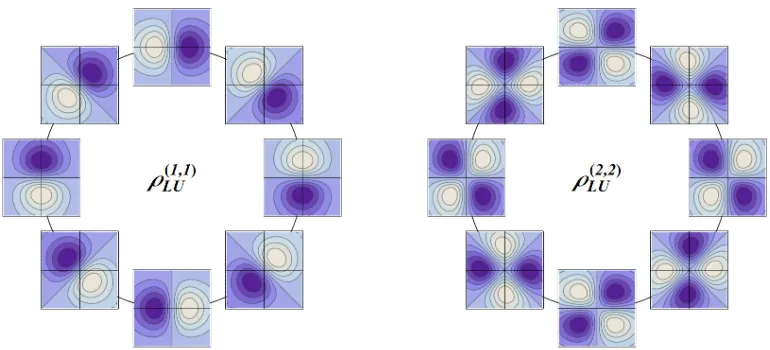
As an example, we discuss here the Wigner distribution for unpolarized quark in a longitudinal polarized target. We find only two phase-space distributions
ρe LU =ρ
(1,1)
LU , ρoLU =ρ (2,2)
LU , (8)
Table 1.Correlations between target polarization (SL,ST), quark polarization (SqL,S q
Figure 1. NaiveT-even (left) and T-odd (right) contributions to the transverse phase-space distributionρLU. Light and dark regions represent, respectively, positive and negative domains of the phase-space distributions.
which are represented in Fig. 1. The corresponding basic multipoles are
SqLB(1UL,1)(ˆkT,bˆT; ˆP, η)=−SqLTi jDikDbj=SLq(ˆbT×kˆT)L, (9)
SqLB(2UL,2)(ˆkT,bˆT; ˆP, η)=−ηSqLTi jQilkQbjl=ηS q
L(ˆbT×kˆT)L(ˆkT·bˆT). (10)
None of these survive integration overkTorbT. Both therefore represent completely new information
which is not accessibleviaGPDs or TMDs at leading twist. ThekT-dipole inρ(1LU,1)signals the presence
of a net longitudinal component of quark OAM correlated with the target longitudinal polarizationSL.
By reversing the target longitudinal polarizationSL, one reverses also the orbital flow. The coefficient
functionC(1LU,1)then gives the amount of longitudinal quark OAM in a longitudinally polarized target SLqL[18]. Similarly, the contributionρ
(2,2)
LU gives the difference of radial flows between quarks with
opposite OAMSLqL, with the coefficient functionC(2LU,2)representing in some sense the strength of
theSLqL-dependent part of the force felt by the quark due to initial- and final-state interactions. As
a matter of fact, the quark OAM can be obtained from theρLUdistribution as [18, 27, 39]
lqz =
dxd2kTd2bT(bT ×kT)zρUL(x,kT,bT; ˆP=ez, η). (11)
Since we are working here with a staple-like gauge link,lqzis the canonical version of quark OAM [40].
On the other side, using a straight gauge link, Eq. (11) gives the kinetic OAM appearing in the Ji decomposition, as discussed in Sect. 4. From Fig. 1, we also note theρoLU cannot contribute to the quark OAM, and hence the quark OAM isη−independent [41–43].
3 Transverse Momentum Dependent Parton distributions
quark pol.
U Tx Ty L
nucleon
pol. U f1
ky
Mh⊥1 −kMx h⊥1 0
Tx kMy f1T⊥ h1+ k2
x−k2y
2M2 h⊥1T
kxky
M2 h⊥1T kMx g1T Ty −kx
M f1T⊥
kxky
M2 h⊥1T h1− k2
x−k2y
2M2 h⊥1T ky
Mg1T
L 0 kx
Mh⊥1L
ky
Mh⊥1L g1L
distributions from one to three dimensions in momentum space, being functions of both the longitu-dinal quark momentum fraction xand the square of the transverse momentumkT. The knowledge
of TMDs allows us to build tomographic images of the inner structure of the nucleon in momentum space. The multipole pattern inkT is clearly visible in Table 2. The TMDs f1,g1Landh1give the
strength of monopole contributions and correspond to matrix elements without a net change of helicity between the initial and final states. The TMDs f1T⊥,g1T,h⊥1, andh⊥1Lgive the strength of dipole
con-tributions and correspond to matrix elements involving one unit of helicity flip, either on the nucleon side (f1T⊥ andg1T) or on the quark side (h1⊥ andh⊥1L). Finally, the TMDh⊥1T corresponds to matrix
elements where both the nucleon and quark helicities flip, but in opposite directions. Conservation of total angular momentum tells us that helicity flip is compensated by a change of OAM [31], which manifests itself by powers ofkT/M. The corresponding quadrupole structure in kT is shown in Fig.
2, as obtained from a LFCQM [31]. The functionh⊥1T has attracted a particular interest, since it has been suggested, on the basis of some quark-model calculations [44, 45], that it may be related to the quark OAM:
Lq z =−
dxd2k
T
k2 T
2M2h
⊥q
1T(x,k 2
T). (12)
0.4 0.2 0.0 0.2 0.4
0.4
0.2 0.0 0.2 0.4
kxGeV ky
GeV
h1TuGeV2
0.15
0.05
0.05 0.15
0.4 0.2 0.0 0.2 0.4
0.4
0.2 0.0 0.2 0.4
kxGeV ky
GeV
h1TdGeV2
0.04
0.02
0 0.02 0.04
Figure 2.Quark density in the transverse-momentum plane for transverse polarization of quarks and nucleon in perpendicular directions. Left (right) panel is for up (down) quarks.
However, Eq. (12) is not a rigorous expression, and holds only in a restricted class of quark models [26, 46]. In general, no direct quantitative relations between OAM and TMDs should actually be expected as the former represents a correlation between parton position and momentum, whereas the latter only provide information about the momentum distribution. Nevertheless, TMDs do provide some indirect information about the OAM content of the nucleon, for example, by constraining the nucleon light-front wave functions that are eigenstates of the OAM [27].
4 Generalized Parton Distributions
When integrating the correlator (1) over kT, one obtains an off-diagonal quark-quark correlator that
can be parametrized in terms of combinations of 8 GPDs (see Table 3). Comparing the entries in Tables 3 and 2, one notices that the same multipole pattern appears, where the role ofkT in Table (2)
is played byΔT in Table (3). Although direct links between GPDs and TMDs cannot exist [14, 47],
this correspondence leads us to expect correlations between signs or similar orders of magnitude [48, 49]. The GPDs are functions ofx, ξ,andt =−Δ2. Just like GTMDs and Wigner distributions
are connected by Fourier transform atξ = 0, one also finds a direct connection between GPDs at
ξ=0 and parton distributions in impact-parameter space. The multipole structure inbT is the same as in Table 3, with the only difference that there are no polarization effects in the impact-parameter distributions for longitudinally polarized quarks in a transversely polarized proton and vice versa, since they are forbidden by time reversal. For example, the distribution of unpolarized quarks in a transversely polarized target reads as
qX(x,bT) =
d2Δ T
(2π)2e
−iΔT·bTH(x,0,−Δ2
T)−
1 2M
∂ ∂by
d2Δ
T
(2π)2e
−iΔT·bTE(x,0,−Δ2
T).
This quark density is given by the sum of a nucleon spin-independent contribution related to the GPDH and a nucleon spin-dependent contribution from the GPDE, corresponding to monopole and dipole distributions in impact-parameter space, respectively. The dipole contribution introduces a large distortion perpendicular to both the nucleon spin and the momentum of the proton, with opposite sign for u andd quarks, as shown in Fig. 3. While details of the GPD E are not known, its x -integral is equal to the Pauli form factorF2, which allows one to constrain the average deformation
model-independently to the contribution from each quark flavorqto the nucleon anomalous magnetic moment.
Even before 3D imaging was introduced, there was great interest in GPDs due to their connection with the form factors of the energy-momentum tensor and thus to the angular momentum (spin plus
quark pol.
U Tx Ty L
nucleon
pol. U H i
Δy
2MET −i2MΔxET 0
Tx i2MΔyE HT+Δ 2
x−Δ2y
2M2 H˜T
ΔxΔy
M2 H˜T 2MΔxE˜ Ty −iΔx
2ME
ΔxΔy
M2 H˜T HT−
Δ2
x−Δ2y
2M2 H˜T
Δy
2ME˜
L 0 Δx
2ME˜T
Δy
2ME˜T H˜
1.0 0.5 0.0 0.5 1.0 1.0
0.5 0.0 0.5 1.0
bxfm by
fm
uXfm2
0.2 0.6 1 1.4 1.8
1.0 0.5 0.0 0.5 1.0
1.0 0.5 0.0 0.5 1.0
bxfm by
fm
dXfm2
0.1 0.2 0.3 0.4 0.5 0.6
Figure 3. Quark density in the impact parameter spacebT for unpolarized quarks in a transversely polarized nucleon along the ˆxdirection, as obtained within a LFCQM [37]. The left (right) panel is for up (down) quark.
orbital) carried by quarks of flavorqas described by the Ji relation [2]
Jq=
1 2
1
0 dx x
Hq(x, ξ,0)+Eq(x, ξ,0)
, (13)
where theξ-dependence on the r.h.s. disappears uponx-integration. The quark kinetic OAM is then obtained by subtracting the quark spin contribution, which is given by the first Mellin moment of the quark helicity distribution.
5 Conclusions
We discussed the leading-twist quark Wigner distributions in the nucleon, introducing a multipole analysis in the four-dimensional transverse phase space. In this approach, the multipole structures are constrained by parity and time-reversal symmetries and are multiplied by coefficient functions which depend onPandT-invariant variables only. This representation provides a clear interpretation of all the amplitudes in terms of the possible correlations between target and quark angular momenta in the transverse phase space, and it gives a convenient basis to make a direct connection with TMDs in transverse-momentum space and GPDs in impact-parameter space. In particular, we discussed results for the Wigner distributions of unpolarized quarks in a longitudinally polarized nucleon that allow us to calculate the phase-space average of the quark OAM. Other ways to access information about the quark OAM from TMDs and GPDs have been also discussed, showing results within a light-front constituent quark model.
References
[1] D. Müller, D. Robaschik, B. Geyer, F. -M. Dittes and J. Hoˇrejši, Fortsch. Phys.42, 101 (1994). [2] X.-D. Ji, Phys. Rev. Lett.78, 610 (1997).
[3] A. V. Radyushkin, Phys. Lett. B380, 417 (1996).
[4] K. Goeke, M. V. Polyakov and M. Vanderhaeghen, Prog. Part. Nucl. Phys.47, 401 (2001). [5] M. Diehl, Phys. Rept.388, 41 (2003).
[8] A. Bacchetta, M. Diehl, K. Goeke, A. Metz, P. J. Mulders and M. Schlegel, JHEP0702, 093 (2007).
[9] U. D’Alesio and F. Murgia, Prog. Part. Nucl. Phys.61, 394 (2008).
[10] M. Burkardt, C. A. Miller and W. D. Nowak, Rept. Prog. Phys.73, 016201 (2010). [11] V. Barone, F. Bradamante and A. Martin, Prog. Part. Nucl. Phys.65, 267 (2010). [12] C. A. Aidala, S. D. Bass, D. Hasch and G. K. Mallot, Rev. Mod. Phys.85, 655 (2013). [13] S. Meissner, A. Metz, M. Schlegel and K. Goeke, JHEP0808, 038 (2008).
[14] S. Meissner, A. Metz and M. Schlegel, JHEP0908, 056 (2009). [15] C. Lorcé and B. Pasquini, JHEP1309, 138 (2013).
[16] X. d. Ji, Phys. Rev. Lett.91, 062001 (2003).
[17] A. V. Belitsky, X. d. Ji and F. Yuan, Phys. Rev. D69, 074014 (2004). [18] C. Lorcé and B. Pasquini, Phys. Rev. D84, 014015 (2011).
[19] A. D. Martin, M. G. Ryskin and T. Teubner, Phys. Rev. D62, 014022 (2000). [20] V. A. Khoze, A. D. Martin and M. G. Ryskin, Eur. Phys. J. C14, 525 (2000). [21] A. D. Martin and M. G. Ryskin, Phys. Rev. D64, 094017 (2001).
[22] Y. Hatta, B. W. Xiao and F. Yuan, Phys. Rev. Lett.116, no. 20, 202301 (2016). [23] M. Anselmino, M. Guidal, and P. Rossi, Eur. Phys. J. A52, 164 (2016). [24] M. Burkardt and B. Pasquini, Eur. Phys. J. A52, no. 6, 161 (2016).
[25] M. G. Echevarria, A. Idilbi, K. Kanazawa, C. Lorcé, A. Metz, B. Pasquini, and M. Schlegel, Phys. Lett. B759, 336 (2016).
[26] C. Lorcé and B. Pasquini, Phys. Rev. D84, 034039 (2011).
[27] C. Lorcé, B. Pasquini, X. Xiong and F. Yuan, Phys. Rev. D85, 114006 (2012). [28] C. Lorcé and B. Pasquini, Phys. Rev. D93, no. 3, 034040 (2016).
[29] C. Lorcé, B. Pasquini and M. Vanderhaeghen, JHEP1105, 041 (2011). [30] B. Pasquini and S. Boffi, Phys. Rev. D76, 074011 (2007).
[31] B. Pasquini, S. Cazzaniga and S. Boffi, Phys. Rev. D78, 034025 (2008). [32] B. Pasquini and F. Yuan, Phys. Rev. D81, 114013 (2010).
[33] S. Boffi, A. V. Efremov, B. Pasquini and P. Schweitzer, Phys. Rev. D79, 094012 (2009). [34] B. Pasquini and P. Schweitzer, Phys. Rev. D83, 114044 (2011).
[35] S. Boffi, B. Pasquini and M. Traini, Nucl. Phys. B649, 243 (2003). [36] S. Boffi, B. Pasquini and M. Traini, Nucl. Phys. B680, 147 (2004). [37] B. Pasquini and S. Boffi, Phys. Lett. B653, 23 (2007).
[38] B. Pasquini, M. Pincetti and S. Boffi, Phys. Rev. D72, 094029 (2005).
[39] K. Kanazawa, C. Lorcé, A. Metz, B. Pasquini and M. Schlegel, Phys. Rev. D90, 014028 (2014). [40] K. F. Liu and C. Lorcé, Eur. Phys. J. A52, no. 6, 160 (2016).
[41] C. Lorcé, Phys. Lett. B719, 185 (2013). [42] Y. Hatta, Phys. Lett. B708, 186 (2012).
[43] X. Ji, X. Xiong and F. Yuan, Phys. Rev. D88, no. 1, 014041 (2013). [44] J. She, J. Zhu and B. Q. Ma, Phys. Rev. D79, 054008 (2009).
[45] H. Avakian, A. V. Efremov, P. Schweitzer and F. Yuan, Phys. Rev. D81, 074035 (2010). [46] C. Lorcé and B. Pasquini, Phys. Lett. B710, 486 (2012).
[47] S. Meissner, A. Metz and K. Goeke, Phys. Rev. D76, 034002 (2007). [48] M. Burkardt, Nucl. Phys. A735, 185 (2004).

![Table 3. Combinations of twist-2 GPDs, as defined in Ref. [26], for different quark (columns) and nucleon(rows) polarizations.](https://thumb-us.123doks.com/thumbv2/123dok_us/8153164.1359777/6.482.112.373.555.652/table-combinations-twist-dened-dierent-columns-nucleon-polarizations.webp)
![Figure 3. Quark density in the impact parameter spacenucleon along the ˆ bT for unpolarized quarks in a transversely polarizedx direction, as obtained within a LFCQM [37]](https://thumb-us.123doks.com/thumbv2/123dok_us/8153164.1359777/7.482.68.417.76.214/figure-parameter-spacenucleon-unpolarized-transversely-polarizedx-direction-obtained.webp)
