Inflation with light Weyl ghost
AnnaTokareva1,
1INR RAS, 60-letiya Oktyabrya prospekt 7a, Moscow 117312, Russia
Abstract.Inflationary perturbations are considered in a renormalizable but non-unitary theory of gravity with the additional Weyl term. We obtained that ghost degrees of free-dom do not spoil the inflation and the scalar perturbation amplitude at the linear level even in a case of the ghost with mass smaller than Hubble parameter at inflation. The ghost impact to the observables is also estimated to be negligible for the range of masses allowed by the experiment. The non-linear level of the theory and its possible application are also discussed.
1 Introduction
General relativity, providing a good explanation for all known experimental results, fails all attempts to quantize it consistently. The Einstein-Hilbert action leads to the non-renormalizable theory which means the loss of its predictive force at Planck energies. Despite the low energy physics is described by the effective field theory, there are examples showing that some processes below the Planck scale (such as inflation and reheating) may be sensitive to the UV completion of the theory [1, 2].
It is well known that there is a way to construct the renormalizable theory of gravity by the price of unitarity. The quadratic in curvature action for gravity was studied by Stelle in Refs. [3, 4]. This action,
S = M 2
P
2
d4x√−g ⎛ ⎜⎜⎜⎜⎝R− 1
2m2CμνρσC
μνρσ + 1
6m2 0
R2 ⎞
⎟⎟⎟⎟⎠ (1)
when linearised on the flat space background, provides usual massless graviton, scalar with massm0
and spin-2 ghost degree of freedom with massm. HereCμνρσstands for the Weyl tensor andMPis the
reduced Planck mass. The adimentional variant of this action was recently discussed in [5].
Despite the interpretation of non-unitary theories is a complicated problem such theories might be useful in the sense of an effective description. In particular, the non-interacting ghost is not dangerous because it may be consistently quantized with the negative norm and positive energy (see for example Ref. [6] for the discussion). In this paper, we discuss the limit in which the Weyl ghost becomes interacting very weakly and hereafter we impose the negative norm prescription for the ghost states. Since it has only derivative coupling to matter we expect that this limit corresponds to the light ghost. In the next section we estimate the typical time of ghost amplification and find out the allowed range for the ghost mass to bem 10 MeV providing the lifetime of ghost instability to be much larger than the Universe age.
In order to check the validity of the effective description in terms of non-unitary theory we calcu-late the evolution of the scalar perturbations in a theory with light Weyl ghost starting from vacuum initial conditions (this case is not yet studied in literature). We obtained the deviations from the stan-dard cosmology to be negligible for the discussing range of masses. The ghost impact to the tensor perturbations has been found in a paper [7]. It looks interesting that the amplitude of tensor pertur-bations (which is observable in cosmology) in a case of light ghost is damped by a factorm/√2H0, whereH0stands for the Hubble parameter at the inflationary stage.
The paper is organised in the following way. In the Section 2 we show that the limit of light ghost really corresponds to low rates of ghost creation and decay. In the Section 3 we calculate the scalar perturbations on the inflationary stage in a gravity with the Weyl term for the case of the light ghost. In the Section 4 we follow the evolution of scalar perturbations up to the late Universe and obtain the ghost impact on CMB. In the last section, we come to conclusions.
2 The discussion about the light ghost
In a paper [5] the naturalness problem for the Higgs mass in a case of the heavy ghost was pointed out. This problem may be avoided when the ghost is lighter than 1010 GeV which is less than the
usual Hubble parameter at inflation. Preserving the Higgs mass naturalness motivates the study of the inflationary perturbations in a case of the ghost being lighter than the Hubble parameter. We must require for the first that the instability connected with the ghost decay (which is actually the ghost number amplification because of the negative width) evolves very slowly, corresponding to the ghost decay width much larger than the Universe lifetime. With negative norm prescription the ghost decay width may be estimated as [8, 9]
Γ∼ −m3
M2
P
(2)
In order to have a ghost lifetime to be much larger than the age of Universe we must havem10 MeV.
Another process with the negative probability which must be negligible in the considering limit of the light ghost is the ghost production in a hot plasma. Although there is a problem of interpretation with the negative cross sections we take as the estimation of the ghost effects values calculated in a usual way. We approximate the cross section as
σ∼ − e2
M2
P
. (3)
Hereestands for the electron charge. We obtain the number of produced ghosts which corresponds to their impact on the energy density of Universe being equal to
Ωgh=0.02 m
10 MeV
Tmax
1013GeV. (4)
HereTmaxis the maximal temperature that has ever been in the Universe. One can see again that for
the ghost lighter than 10 MeV and natural values of the reheating temperature a number of ghosts turn out to be negligible.
Ghosts with too low masses cannot be considered because of experimental constraints for the gravity at short distances. The limit coming from recent measurements [10] ism> 10−2 eV which
3 Scalar perturbations at the inflationary stage
3.1 Common equations
We consider the action
S = M 2
P
2
d4x√−gR−1
2
d4x√−g ∂μφ ∂μφ+2V(φ)
− MP2
4m2
d4x√−gCμνρσCμνρσ, (5)
wheregis the determinant of the metricgμν,Ris the scalar curvature andCμνρσis the Weyl tensor.1
This action describes the usual Einstein gravity corrected by the Weyl curvature term. The scalar
φwith the proper potential may be appropriate for inflation. If we consider the most general quadratic in curvature corrections to the Einstein gravity action than theR2term may be rewritten in the Einstein
frame through the additional scalaron fieldφ[11]. So the action (5) with a special form ofV(φ) may describe the general second order corrected gravity which with the specially tuned scalaron mass may provide the phenomenologically viable Starobinsky inflation [12].
We start to work in the newtonian gauge [13] where the metric and inflaton perturbations take the form:
ds2=a(η)2{−(1+2Ψ)dη2+2 ¯Ψ
idηdxi+[(1+2Φ)δi j+h¯i j]dxidxj}, δφ=χ. (6)
Here ¯hi j correspond to the tensor modes, ¯Ψi– to the vector modes and the scalar sector is described
byΦ, Ψandχ.
The expansion of the action (5) at quadratic order in the perturbations is presented in Ref. [14]:
S(S)=S(S)E − M 2
P
3m2
d4x[(Ψ−Φ)]2, (7)
where
SE(S)= M 2
P
2
d4x a2 −6Φ2+12HΨ Φ+2∂iΦ(2∂iΨ +∂iΦ)−2(H+2H2)Ψ2
+ 1
M2
P
χ2−∂
iχ ∂iχ−a2V,φφχ2−6φΦχ−2φχΨ−2a2V,φΨχ⎤⎥⎥⎥⎥⎦ .
(8)
Here the primes mean the derivatives with respect to conformal timeη, andH=a/ais the conformal Hubble parameter. The action describes two coupled dynamical fields: a ghost and an inflaton while
Ψis to be integrated out.
3.2 Initial conditions and solutions for the de Sitter space
In a limit of de Sitter space the action may be diagonalized. Here we usea(η)=−1/(H0η) whereH0
is the Hubble parameter at inflation. The action for the inflaton perturbation takes the usual form:
Sχ=1
2
d4x 1 H2 0η2
(χ2−(∂iχ)2), (9)
1Units: M P =1/
√
8πG,c =1. Conventions: (−+ ++);Rμνρσ = ∂ρΓμνσ−∂σΓμνρ+· · ·;Rνσ =Rμνμσ;R =gμνRμν;
Gμν=Rμν−12gμνR.Cμνρσ=Rμνρσ−12(gμρGνσ−gμσGνρ−gνρGμσ+gνσGμρ)−R
After integrating outΨone obtain the action for the ghost perturbation:
SΦ=
dηd3q3M 2
P
H2 0
⎡ ⎢⎢⎢⎢⎢
⎢⎣− βq4η2
9+βq4η4Φ
(q)Φ(−q)+3q
4 β2q6η6+βq4η4(1−4β)−3βq2η2+9
9+βq4η42 Φ(q)Φ(−q) ⎤ ⎥⎥⎥⎥⎥ ⎥⎦
(10) Hereβ=H2
0/m
2. The vacuum initial conditions for the inflaton and ghost perturbations are to be set
atη → −∞in the subhorizon limit. The action for the inflaton behaves as in the usual gravity while the action for the ghost becomes
SΦ=
d4x3M 2
P
H2 0η2
−Φ2+(∂
iΦ)2
. (11)
After canonical normalization one can obtain that the vacuum initial conditions lead to the field per-turbations atη→ −∞:
Φ = H0qη
2π√6MP
e−iqη, χ= H0qη
2π e
−iqη.
(12)
In the opposite limitη→0 one obtain an equation
Φ+2
ηΦ+
1
βη2Φ =0, (13)
while the equation forχis standard [13]. The solution for ghost consists of the modes:Φ∝η−1and
Φ∝η−1/β≈const. We see that there is a growing as a scale factor mode in the set of solutions for the
ghost field. The initial conditions lead for this mode to be normalised as (up to a factor of order unity)
Φ = H0
2π√6MP
aH0
q . (14)
Later we will see that this instability is not physical, it is connected with the choice of gauge.
3.3 Slow roll inflation
The real inflationary stage lead to small deviations from the exact de Sitter space so the equations on
Φandχfollowing from the action (7) becomes coupled. In the superhorizon limit and within the slow roll approximation the equation forχis2
Ψ = 3M2PH
V Φ˙, χ¨+3Hχ˙=−φ˙(3 ˙Φ−Ψ˙)−2V,φΨ. (15)
SinceΦhas a growing mode (14) it induce the growing solution forχthrough the upper equation. In the slow roll approximationV=3H2M2
P,V,φ=−3Hφ˙so forχone obtain
¨
χ+3Hχ˙=4Hφ˙ H02
2π√6MP
a
q, (16)
which provides the solution (up to the falling sub-dominate modes):
χ= H0
2π + ˙
φ H
H2 0
2π√6MP
a
q. (17)
In order to show that the growing modes are artefacts of the choice of gauge in the next section we calculate the metric perturbations in the comoving gauge.
0 .0 0 0 1 0 0 .0 0 0 0 5 0 .0 0 0 0 5 0 .0 0 0 1 0
0 .0 0 0 1 5 H
_ .
|R|
t
0 .0 0 0 0 1 0 .0 0 0 0 1 0 .0 0 0 0 2 0 .0 0 0 0 3 0 .0 0 0 0 4 0 .0 0 0 0 5
t
Amplitude
qB
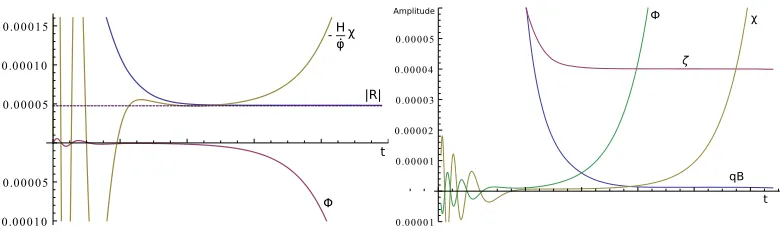
Figure 1.Left plot shows the cancellation between the growing modes ofΦandχwhen the metric perturbation in a comoving gaugeζis calculated. Right plot illustrates the time evolution for the discussed perturbation amplitudes in Newtonian and comoving gauges.
3.4 The perturbations in the comoving gauge
The comoving gauge is defined by the conditionδφ=0. The metric takes the form
g00 =a2(1+2A), g0i=2a2∂iB, gi j=a2(δi j(1+2ζ)+∂i∂jE) (18)
Here only scalar part of perturbations is considered. The perturbationE may be set to be zero by the special choice for one of the two gauge transformation parameters. The other parameter fixes the conditionδφ=0 [13]. The parameterAis falling approximately as 1/ain the superhorizon limit so we concentrate on the perturbationsζandBconnected with variables from Newtonian gauge as
ζ= Φ−Hφ˙ χ, B= χ
aφ˙ (19)
Substituting our solutions (14) and (17) we obtain
ζ =−H
2 0
2πφ˙ =
H0
2π√2MP
, B= H0
2π√6qMP
=−
3
ζ
q. (20)
Here = M2
P(V,φ/V)2/2 is the first slow roll parameter. We see that growing modes inΦandχ
cancel each other providing the value ofζto be the same as in the usual Einstein gravity defining the amplitude of curvature perturbation that is known to beζ=10−5. The difference is in the component B: in usual gravity it is falling as 1/awhile in the considered model it is constant. The quantity which actually stands in metric,∂iB=ni
√
/3ζ 1 (whereniia a unit vector) is much smaller than unity
proving that the linear regime is consistent in the comoving gauge being broken in the Newtonian gauge.
All the discussed solutions are plotted in a Figure 1. In order to obtain the possible phenomeno-logical consequences of non-vanishing perturbationBwe need to follow its evolution after inflation up to the late Universe. We will do it in the next section.
4 Evolution of cosmological perturbations after inflation
4.1 Equations
defined in the Newtonian gauge. The combinationW = Ψ−Φhas a very important property: it is possible to write all Einstein equations as one fourth order equation onW. After solving it one can easily obtain all the perturbations in the comoving gauge using formulas given in [14]. For the inflationary stage (or stage dominated by the scalar field) the master equation has been derived in [14]:
1
m2
W(4)−H¨
˙
HW (3)
+C2W¨ +C1W˙ +C0W =0, (21)
where ⎧⎪⎪ ⎪⎪⎪⎪⎪ ⎪⎪⎪⎪⎪ ⎪⎨ ⎪⎪⎪⎪⎪ ⎪⎪⎪⎪⎪ ⎪⎪⎪⎩
C2=1+ 1
m2
2q2 a2 −H
2
,
C1=H−H¨˙ H+
1
m2
H2H¨
˙
H −3H
˙
H−q 2
a2 ¨
H
˙
H +4H
,
C0=2 ˙H−H˙H¨ H +
q2 a2 +
q2 m2a2
HH¨
˙
H −
4 3H˙+2H
2+q2 a2
.
(22)
This equation was derived for the stage dominated by the scalar field. To proceed with the hot stage we need to obtain a similar equation from the set of Einstein equations. At the stages dominated by the fluid (matter or radiation) they take the form:
q2
a2Φ +3H( ˙Φ−HΨ)−
1 3m2
q4 a4W=
δρ
2M2
p
, (23)
−Φ¨ −3HΦ +˙ HΨ + Ψ˙ (2 ˙H+3H2)− q2
3a2(Ψ + Φ)−
1 9m2
q4 a4W =
δp
2M2
p
, (24)
−(Φ + Ψ)= 1
m2( ¨W+HW˙ + q2
3a2W). (25)
The first equation is (00) component of Einstein equations and the other two are the trace and traceless part of (i j) component. The (0i) component may be considered as the definition of velocity perturbation. For adiabatic perturbations the equation of state connectsδpandδρas
δp=c2sδρ, c2s=−1−
¨
H
3HH˙ (26)
which allows us to obtain the closed equation onW like in the case of inflation driven by scalar field.
1
m2
W(4)−H¨˙ HW
(3)
+A2W¨ +A1W˙ +A0W =0, (27)
where ⎧⎪⎪⎪ ⎪⎪⎪⎪⎪ ⎪⎪⎪⎪⎪ ⎨ ⎪⎪⎪⎪⎪ ⎪⎪⎪⎪⎪ ⎪⎪⎪⎩
A2=1+ 1
m2
q2
3a2
¨
H HH˙ −H
2
,
A1=H−H¨˙ H+
1
m2
H2H¨
˙
H −3HH˙− q2 a2
2 ¨H
3 ˙H+2H
,
A0=2 ˙H−H˙H¨ H −
q2 a2
¨
H
3HH˙
+ q2
m2a2
HH¨
˙
H −4 ˙H+2H 2
− q4
m2a4
1+ H¨ 3HH˙
.
(28)
One can see that equation (27) differs from (21) only by terms proportional toq2so in the superhorizon
4.2 Solutions in the superhorizon regime
Now we consider the common solution of equation (21) (or (27) since they coincide in the super-horizon regime). UntilH mholds this equation may be analytically solved. The four solutions are:
Wc,
adt,
dt
a,
adt1 t1 H
a2dt2
t2 aH˙
H2dt3 (29)
The first modeWccorrespond toζ =constand this solution provide the main impact toζin the
limitsq/a HandH m. In the Section 3.4 it was shown that at inflationζ behaves exactly as in the usual gravity. The exact conservation ofζin the considering model was proved in [14]. Wcis
connected toζas:
Wc=−2ζ – inflation, Wc=−
2ζ
p+1 – stagea∝t
p. (30)
The second mode growing as adtprovides the main constant impact to the comoving perturbationB
which is absent in Einstein gravity. One can see thatBis conserved untilHmholds independently of the stage of the Universe expansion.
The last solution at inflationary stage grows astwhile at matter stage it behaves ast2. This solution
may be combined withWcin such a way that it would give the only subdominant (and decreasing)
impact toζandB.
When the Hubble parameter becomes smaller then the ghost mass,Hm, the ghost modes start oscillate even in the superhorizon regime. The solutions forW in that case were obtained in [14] for the stagea∝tp:
Wc, t−p−1, tp/2e±imt. (31)
The first two modes correspond to the Einstein modes and the growing oscillations are special solu-tions for Weyl gravity. As it was noted in [14] the growing modes do not give an impact toζ. Again only modeWccontribute toζlike in the usual gravity. But the ghost modes provide the main impact
to the comoving perturbationB. Since constant modes can be sewed exactly as in the Einstein gravity [mukhanov] we can sew remaining ghost modes through their contribution toB. The oscillating mode contribute toBast−p/2e±imt. Connecting the solution forBat the transition momentt=1/mone can
estimate fort>1/m
B= ζ q
3(mt)
−p/2 α
+eimt+α−e−imt
, (32)
whereα±are expected to be constants of order unity.
4.3 Coming back to the horizon
In order to connect the superhorizon evolution of modes with the late subhorizon regime one can observe that the oscillating ghost modes resolve the equation on W in both cases: q/a < H and
q/a<H. The only needed condition ism>Hwhich holds at late stages for all potentially observable modes. So the ghost modes come into the horizon remaining unchanged from which follows that the subhorizon evolution for constant mode is the same as in the usual gravity.
Since the presence of ghost breaks the Newtonian gauge we must find all observables using the comoving gauge. The difference from the usual gravity is only in the non-vanishing perturbation
1 0 1 0 0 1 0 0 0 1 04 1 01 1
1 08 1 05 0 .01 1
q a0Ht0 m=10-12GeV
m=1 MeV
qB
1 0 1 0 0 1 0 0 0 1 04
1 01 0 1 07
1 04 0 .1 1
q a0Ht0 m=10-12GeV
m=1 MeV
qB
Figure 2.The left plot shows the valueqB/ζcharacterising the ghost contribution to the CMB anisotropy related to the present Universe. The right plot is for the moment of recombination. Hereq/a0is the present physical
momentum andHt0is the present Hubble parameter. Directly observable modes correspond toq/a0Ht0<1000.
distinguish this case only if they are of the same order: qB ∼ ζ. The plots on Figure 2 shows the results related to the moment of recombination (right plot) and to the present moment (left plot). One can see that the deviations from the usual gravity may be expected only for short waves that we can not directly observe because they are in a strongly non-linear regime.
5 Conclusions
Summarising, we exploited the idea that extremely weak interacting ghost may be not so dangerous if we are considering the only effective description of the Universe. The instability arising from the small interaction between matter and ghost may be moved to the time much larger than the Universe age. This means that we can describe early Universe in terms of renormalizable and weakly interacting theory. We obtained the corrections to the observables, connected with scalar perturbations, due to extra ghost degrees of freedom to be negligible for the allowed ghost mass range.
In the considering theory, there are some processes with small but negative probabilities. The interpretation of such processes is an outstanding problem which we try to hide but actually it is impossible. Another problem for the non-unitary theory is that it remains unclear how to connect the quantum theory with bounded and positive energy, reached due to the negative norm prescription, to the classical field theory in which there is no way to avoid unbounded energy. This is an independent problem which is left beyond the scope of our consideration in this paper.
The author thank M. Ivanov, D. Gorbunov, A.A. Starobinsky, V.A. Rubakov, S.Sibiryakov for valuable discussions and critics. The work has been supported by Russian Science Foundation grant 14-12-01430.
References
[1] R. Kallosh, A. D. Linde, D. A. Linde and L. Susskind, Phys. Rev. D52, 912 (1995) [hep-th/9502069].
[2] F. Bezrukov, A. Magnin, M. Shaposhnikov and S. Sibiryakov, JHEP 1101, 016 (2011) [arXiv:1008.5157 [hep-ph]].
[5] A. Salvio and A. Strumia, JHEP1406, 080 (2014) [arXiv:1403.4226 [hep-ph]].
[6] S. W. Hawking and T. Hertog, Phys. Rev. D65, 103515 (2002) doi:10.1103/PhysRevD.65.103515 [hep-th/0107088].
[7] T. Clunan and M. Sasaki, Class. Quant. Grav.27, 165014 (2010) [arXiv:0907.3868 [hep-th]]. [8] A.A. Starobinsky, Ya.B. Zeldovich, JETP Lett.26, 252 (1977)
[9] A. Vilenkin, Phys. Rev. D32, 2511 (1985).
[10] A. A. Geraci, S. J. Smullin, D. M. Weld, J. Chiaverini and A. Kapitulnik, Phys. Rev. D78, 022002 (2008) [arXiv:0802.2350 [hep-ex]].
[11] G. Magnano, M. Ferraris and M. Francaviglia, Gen. Rel. Grav. 19, 465 (1987). doi:10.1007/BF00760651
[12] A. A. Starobinsky, Phys. Lett. B91, 99 (1980).
[13] V. F. Mukhanov, H. A. Feldman and R. H. Brandenberger, Phys. Rept.215, 203 (1992). [14] N. Deruelle, M. Sasaki, Y. Sendouda and A. Youssef, JCAP1103, 040 (2011) [arXiv:1012.5202