596 |
P a g e
GSA-BBO HYBRIDIZATION ALGORITHM
Sajad Ahmad Rather
1, Naresh Sharma
2 1,2Department of Computer Science and Engineering, SRM University,
Delhi NCR Campus Ghaziabad, UP 201 204, (India)
ABSTRACT
In recent years, many heuristic optimization methods have been developed. Many of these methods are inspired
by swarm behaviours in nature. In this paper, a new optimization algorithm based on newtons law of gravity
and biogeography is introduced. In the proposed algorithm, the searching space of GSA is increased from local
population range to global by using the concepts of biogeography. Also, the fitness of agents is optimized in
GSA by using mathematical analysis.
Index Terms: GSA, BBO, GSA-BBO HYBRIDIZATION ALGORITHM,HSI,SIV
I INTRODUCTION
GSA(Gravitational Search Algorithm)
The hybridization of an algorithm pretends the algorithm more powerful and enhances the capabilities of an
algorithm. Due to hybridization, coverage area of algorithms exacerbates and it can wrap more problems. The
GSA is also hybridizes with conventional and swarm based algorithms to enhance its capabilities.
In solving optimization problems with a high-dimensional search space, the classical optimization algorithms do
not provide a suitable solution because the search space increases exponentially with the problem size,
therefore solving these problems using exact techniques (such as exhaustive search) is not practical. Over the
last decades, there has been a growing interest in algorithms inspired by the behaviors of natural phenomena. It
is shown by many researchers that these algorithms are well suited to solve complex computational problems
such as optimization of objective function, pattern recognition, control objectives, image processing, filter
modelling etc. Various heuristic approaches have been adopted by researches so far, for example Genetic
Algorithm,Simulated Annealing, Ant Colony Search Algorithm ,Particle Swarm Optimization, etc.These
algorithms optimization algorithms is an open problem.This algorithm is based on the Newtonian gravity:”Every particle in the universe attracts every other particle with a force that is directly proportional to the product of their masses and inversely proportional to the square of the distance between them”.
BBO(Biogeography Based Optimization)
The science of biogeography can be traced to the work of nineteenth century naturalists such as Alfred Wallace
and Charles Darwin . Until the 1960s, biogeography was mainly descriptive and historical. In the early 1960s,
Robert MacArthur and Edward Wilson began working together on mathematical models of biogeography, their work culminating with the classic 1967 publication, “The Theory of Island Biogeography”.Mathematical
597 |
P a g e
how species become extinct. The term “island” here is used descriptively rather than literally. That is, an island is any habitat that is geographically isolated from other habitats. We therefore use the more generic term “habitat” in this paper (rather than “island”) . Geographical areas that are well suited as residences for biologicalspecies are said to have a high habitat suitability index (HSI) . Features that correlate with HSI include such
factors as rainfall, diversity of vegetation, diversity of topographic features, land area, and temperature. The
variables that characterize habitability are called suitability index variables (SIVs). SIVs can be considered the
independent variables of the habitat, and HSI can be considered the dependent variable.
Biogeography is nature‟s way of distributing species, and is analogous to general problem solutions. Suppose that we are presented with a problem and some candidate solutions. The problem can be in any area of life
(engineering, economics, medicine, business, urban planning, sports, etc.), as long as we have a quantifiable
measure of the suitability of a given solution. A good solution is analogous to an island with a high HSI, and a
poor solution represents an island with a low HSI. High HSI solutions resist change more than low HSI
solutions. By the same token, high HSI solutions tend to share their features with low HSI solutions. (This does
not mean that the features disappear from the high HSI solution; the shared features remain in the high HSI
solutions, while at the same time appearing as new features in the low HSI solutions. This is similar to
representatives of a species migrating to a habitat, while other representatives remain in their original habitat.)
Poor solutions accept a lot of new features from good solutions. This addition of new features to low HSI
solutions may raise the quality of those solutions.We call this new approach to problem solving
biogeography-based optimization (BBO).
II STEPWISE GSA-BBO HYBRIDIZATION ALGORITHM
STEP-1
:-
Generate Initial Population
The gravitation is the tendency of masses to accelerate toward each other. It is one of the four fundamental
interactions in nature (the others are: the electromagnetic force, the weak nuclear force, and the strong nuclear
force). Every particle in the universe attracts every other particle. Gravity is everywhere. The inescapability of
gravity makes it different from all other natural forces. The way Newton‟s gravitational force behaves is called „„action at a distance”. This means gravity acts between separated particles without any intermediary and without any delay. In the Newton law of gravity, each particle attracts every other particle with a „gravitational force‟. The gravitational force between two particles is directly proportional to the product of their masses and
inversely proportional to the square of the distance between them:
F
G
M M
12 2R
, (1)where F is the magnitude of the gravitational force, G is gravitational constant,
M
1 andM
2 are the mass ofthe first and second particles respectively, and R is the distance between the two particles. Newton‟s second law
says that when a force, F, is applied to a particle, its acceleration, a, depends only on the force and its mass, M :
a
F
M
598 |
P a g e
Based on (1) and (2), there is an attracting gravity force among all particles of the universe where the effect ofbigger and the closer particle is higher.
In addition, due to the effect of decreasing gravity, the actual value of the „„gravitational constant depends on
the actual age of the universe. Eq. (3) gives the decrease of the gravitational constant, G, with the age:
G t
( )
G
(t )
0t
0,
1,
t
(3)Also,
G t
( )
G e
0 t, (3.1) constant at the first cosmic quantum-interval of timet
0.G
0is initial value of gravitational constant. Three kindsof masses are defined in theoretical physics:
Active Gravitational Mass
,
M
a, is a measure of the strength of the gravitational field due to a particularobject. Gravitational field of an object with small active gravitational mass is weaker than the object with more
active gravitational mass.
Passive Gravitational
where G(t) is the value of the gravitational constant at time t. G(t
0) is the value of thegravitational Mass,
M
p, is a measure of the strength of an object‟s interaction with the gravitational field. Within the same gravitational field, an object with a smaller passive gravitational mass experiences a smallerforce than an object with a larger passive gravitational mass.
Inertial Mass
,M
i, is a measure of an object resistance to changing its state of motion whena force
is applied. An object with large inertial mass changes its motion more slowly, and an object with small inertialmass changes it rapidly.
Now, considering the above-mentioned aspects, we rewrite Newton‟s laws.
The gravitational force,
f
ij, that acts on mass i by mass j, is proportional to the product of the active gravitational of mass j and passive gravitational of mass i, and inversely proportional to the square distancebetween them.
a
i is proportional tof
ij and inversely proportional to inertia mass of i. More precisely, one can rewrite Eqs. (1) and (2) as follows:f
ijG
M
aj 2M
pi,
R
(4)
i ij
,
ii
F
a
M
(5)
where
M
aj andM
pi represent the active gravitational mass of particle i and passive gravitational mass of particle j, respectively, andM
ii represents the inertia mass of particle i.599 |
P a g e
Consider the probabilityP
s,that the habitat contains exactly S species.P
schanges from time t to time(
t
t
)
as follows:(
)
( )(1
)
s s s s
P t
t
P t
t
t
p
s1
s1
t
P
s1
s1
t
, (6)where
sand
s are the immigration and emigration rates when there are S species in the habitat.We assume that
t
is small enough so that the probability of more than one immigration or emigration can beignored. Taking the limit of (6) as
t
0
gives equation (7) shown at the bottom of the page. We definemax
n
S
andP
[P ,
0
, P ]
n T , for notational simplicity. Now, we can arrange theP
s equations (for S=0,
... ,n) into the single matrix equation
P
=AP, (7)
Initialize Emigration rate „E‟,Immigration rate „I‟,
S
max,m
max,Wherek k
E
,[when E=I], (8)Also,
E
n
kk
, (9)1
k
I
k
n
,
(10
I
n
kn
k
, (11)max
n
S
, (12)max max
( )
1
sm s
P
m
P
, (13)Where
m
maxis user-defined parameter , m(s) is mutation rate andP
max is the solution probability.t
M
I
E
,[Adaptive learning step]1 2
[m , m ,..., m ]
i i i is
m
where, s is the dimension of problem
f(m )
i =f(m
i1)+f(m
i2)+...+f(m
is)Also,
ti
m
=[(I
i1
E
i1)+(I
i2
E
i2)+...+(I
is
E
is)]600 |
P a g e
iji
f
I
E
a
, (14)ij k k
i
f
n
n
a
n k
k
[
(
)]
(
)
i
ij k k
a n
f
k
n
k
k n
k
, (15)ij
GSS
f
Where GSS is the global search space factor.
Note:
This step is going to increase the search space of GSA .
As, GSA uses the local population range to collect sample mass items, but by using BBO, its searchingspace is going to increase by folds i.e; Global population range
Number of samples used in collectinginformation for processing increases
More optimal solutions
More optimization.Step-2
:-
Randomized Initialization
To give a stochastic characteristic to our algorithm, we suppose that the total force that acts on agent i in a
dimension d be a randomly weighted sum of dth components of the forces exerted from other agents:
1,
( )
d d
i i ij
j j i
f
t
rand f
(t), (16)where
rand
iis a random number in the interval [0, 1].We remind that in order to avoid trapping in a local optimum the algorithm must use the exploration at
beginning. By lapse of iterations, exploration must fade out and exploitation must fade in. To improve the
performance of GSA by controlling exploration and exploitation only the Kbest agents will attract the others.
Kbest is a function of time, with the initial value
K
0 at the beginning and decreasing with time. In such a way,at the beginning, all agents apply the force, and as time
passes, Kbest is decreased linearly and at the end there will be just one agent applying force to the others.
Therefore, Eq.(19) could be modified as:
,
( )
( )
d d
i i ij
j Kbest j i
f
t
rand f
t
, (17)where Kbest is the set of first K agents with the best fitness value and biggest mass.
Also, initialize a random set of habitats, each habitat corresponding to a potential solution to the given problem.
STEP-3
:-
Fitness Evaluation Of Agents
Gravitational and inertia masses are simply calculated by the fitness evaluation. A heavier mass means a more
601 |
P a g e
equality of the gravitational and inertia mass, the values of masses are calculated using the map of fitness. Weupdate the gravitational and inertial masses by the following equations:
,
ai pi ii i
M
M
M
M
i=1,2,3,...,N,
ai pi ii i
M
M
M
M
(18)( )
( )
( )
,
( )
( )
i i
fit t
worst t
m t
best t
worst t
(19)1
( )
( )
i i N j jm t
M
m t
,
(20)where
fit t
i( )
represent the fitness value of the agent i at time t. Calculate HSI,i.e; HSI=
SIV
i
P
os
k
k, (21) Where, HSI is Habitat Suitability Index, SIV is Suitability Index Variable andP
os is the original population size.Using equations (9) and (10), We get
i.e;
HSI
SIV
iP
osI
1
k
Ek
n
n
(
)
i osk I
E
HSI
SIV
P
I
n
,
(22)
If I+E=
M
t,Then
t i os
kM
HSI
SIV
P
I
n
,
(23)
HSI
max t i os
kM
SIV
P
I
S
,
(24)
[
n
S
max]
Where,
SIV
i
[
SIV SIV
i1,
i2,....,
SIV
is]
,
(25)
1 2
(
i) [ (
i)
(
i) ....
s(
is)]
f SIV
f SIV
f SIV
f SIV
As, HSI=
fit t
i( )
,
(26)
Compare (22) and (28),We get
i.e;
fit t
i( )
=
max t i os
kM
SIV
P
I
S
602 |
P a g e
Substitute value of (30) in (22),We get
max max
( )
( )
[
( )
( )]
os t iS
SIV
P
I
worst t
km
m t
S
best t
worst t
,
(28)
STEP-4
:-
Update G(t), best(t), worst(t) and
M t
i( )
, for, i=1,2,3,...,N
( )
i
M t
=
1
( )
( )
i N j jm t
m t
,
(29)
For a Minimization Problem ,We have,
{1,..., }
( )
max
j( )
j N
best t
fit t
,
(30)
{1,..., }
( )
max
j( )
j N
worst t
fit t
,
(31)
STEP-5
:-
Calculation Of The Total Force In Different Directions
At a specific time „t‟, we define the force acting on mass „i‟ from mass „j‟ as following:
( )
( )
( )
( )
( )
pi aj d ij ijM
t
M
t
f
t
G t
R t
,
(32)
where
M
ajis the active gravitational mass related to agent j,M
piis the passive gravitational mass related to agent i, G(t) is gravitational constant at time t, e is a small constant, andR
ij is the Euclidian distance between two agents i and j:2
( )
(t),X ( )
ij
R t
i
j
X
t
, (33)STEP-6
:-
Calculation Of Accelaration And Velocity
By the law of motion, the acceleration of the agent i at time t, and in direction dth,
a
id(t), is given as follows:( )
( )
( )
i i iif t
a t
M t
, (34)where
M
ii is the inertial mass of ith agent.Furthermore, the next velocity of an agent is considered as a fraction of its current velocity added to its
acceleration.Therefore, its velocity could be calculated as follows:
(
1)
( )
( )
d d d
i i i i
603 |
P a g e
where
rand
iis a uniform random variable in the interval [0, 1]. We use this random number to give a
randomized characteristic to the search.
For a Maximization Problem ,We have,
{1,..., }
( )
max
j( )
j N
best t
fit t
,
(36)
{1,..., }
( )
min
j( )
j N
worst t
fit t
,
(37)
The gravitational constant, G, is initialized at the beginning and will be reduced with time to control
the search accuracy. In other words, G is a function of the initial value (
G
0) and time (t):
0
( )
(G , )
G t
G
t
,
(38)
STEP-7
:-
Updating Agents Position
We have,
(
1)
( )
(
1)
d d d
i i i
x t
v t
v t
,
(39)
STEP-8
:- Repeat steps (3) and (4), Until the stop criterion is reached.
STEP-9
:- Stop.
III PRINCIPLE OF GSA-BBO HYBRIDISATION ALGORITHM
To see how the proposed algorithm is efficient some remarks are noted:
– Since each agent could observe the performance of the others, the gravitational force is an
information-transferring tool.
– Due to the force that acts on an agent from its neighborhood agents, it can see space around itself.
– A heavy mass has a large effective attraction radius and hence a great intensity of attraction. Therefore, agents
with a higher performance have a greater gravitational mass. As a result, the agents tend to move toward the best
agent.
– The inertia mass is against the motion and make the mass movement slow. Hence, agents with heavy inertia
mass move slowly and hence search the space more locally. From BBO, Immigration and Emigration concepts
are used to modify existing islands of habitats. So, these can be considered as adaptive learning steps.
– Gravitational constant adjusts the accuracy of the search, so it decreases with time (similar to the temperature
in a Simulated Annealing algorithm).
From BBO, HSI and SIV are used to create accurate habitats of species, creating species diversity.
– GSA-BBO is a memory-less algorithm. However, it works efficiently like the algorithms with memory. Our
604 |
P a g e
– Here, we assume that the gravitational and the inertia masses are the same. However, for some applications different values for them can be used. A bigger inertia mass provides a slower motion of agents in the searchspace and hence a more precise search. Conversely, a bigger gravitational mass causes a higher attraction of
agents. This permits a faster convergence.
YES
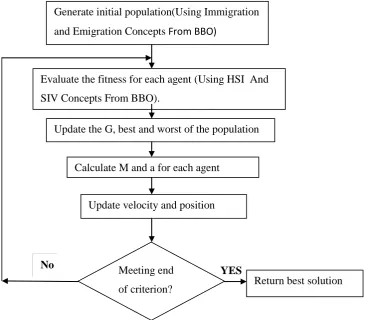
Fig. 1. General Principle Of GSA-BBO Hybridisation Algorithm
IV COMPARATIVE STUDY
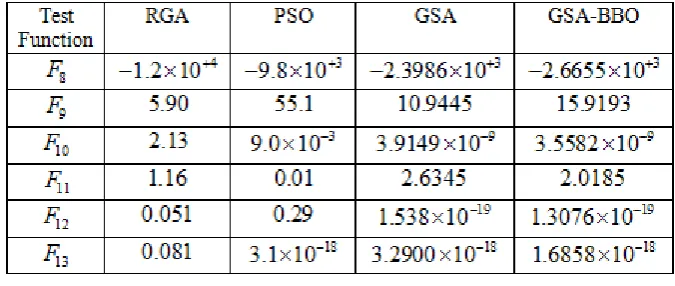
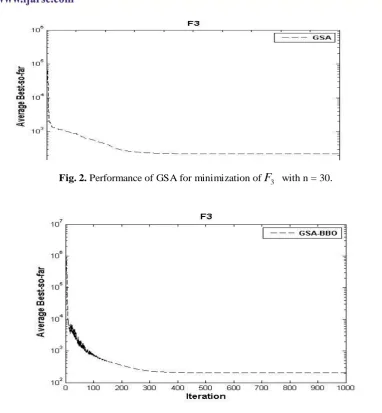
In this section, to see how GSA-BBO is situated comparing other heuristic search algorithms, we
compare GSA-BBO with PSO, RGA and GSA. First, the tables of comparision are given and then
some implementation outputs are given.
Table 1
Minimization result of benchmark functions(
F
1to
F
7)
with n = 30. Maximum number of iterations =
1000.
Test Function
RGA
PSO
GSA
GSA-BBO
1
F
23.13
31.8 10
1.4408 10
171.005 10
172
F
21.87
31.2 10
2.8707 10
82.3515 10
83
F
35.6 10
34.1 10
446.8342
224.5238
Generate initial population(Using Immigration
and Emigration Concepts
From BBO)
Evaluate the fitness for each agent (Using HSI And
SIV Concepts From BBO).
Update the G, best and worst of the population
thepopulation.
Calculate M and a for each agent
Update velocity and position
Meeting end
of criterion?
Yes
Return best solution
605 |
P a g e
4F
11.78
8.1
92.3137 10
2.8518 10
95
F
31.1 10
3.6 10
426.1268
25.8640
6
F
24.01
31.0 10
0
0
7
F
0.06
0.04
0.0163
0.0100
Table 2
Minimization result of benchmark functions(
F
8to
F
13)
with n = 30. Maximum number of iterations
= 1000.
Table 3
Minimization result of benchmark functions in (
F
14to
F
23)
. Maximum number of iterations = 500
Test Function
RGA
PSO
GSA
GSA-BBO
14
F
n=2
0.998
0.998
6.8563
2.0769
15
F
n=4
34.0 10
2.8 10
30.0025
0.0034
16
F
n=2
1.0313
1.0316
1.0316
1.0316
17
F
n=2
0.3996
0.3979
0.3979
0.3979
18
F
n=2
5.70
3.0
3.0000
3.0000
19
F
n=3
3.8627
3.8628
3.8628
3.8628
20
F
n=6
3.3099
3.2369
3.3220
3.3220
21
F
n=4
5.6605
6.6290
3.9228
10.1532
22
F
n=4
7.3421
9.1118
10.4029
10.4029
23
606 |
P a g e
V CONCLUSION
This paper presents the hybridization of Gravitational Search Algorithm and Biogeography Based
Optimization.I have used the mathematical analysis, in order to find the optimization equations which
can be used to increase the functionality of GSA.In GSA, we have an isolated system of masses.
Using the gravitational force, every mass in the system can see the situation of other masses. The
gravitational force is therefore a way of transferring information between different masses.I have used
the Biogeography, the study of the geographical distribution of biological species, it can be used to
derive algorithms for optimization. The concepts which I have used are Immigration, Emmigration,
HSI,SIV,etc.
This paper is preliminary in nature and, therefore, opens up a wide range of possibilities for further research.Fig. 2. Performance of GSA for minimization of