498 | P a g e
DWT and PCA Techniques with SURF for Copy-Move
Forgery Detection
Nisha Gupta
1, Rajiv Jain
2, Monica Goyal
31 Assistant Professor, SBSSTC Ferozepur, Punjab, (India)
2 Assistant Professor, MIMIT Malout, Punjab, (India)
ABSTRACT
Throughout the most recent couple of years, there has been a developing assemblage of work on apparatuses
for computerized picture crime scene investigation. These apparatuses are fit for recognizing altering in
pictures from any camera, without depending on watermarks or specific equipment. Rather than watermarks,
these apparatuses accept that pictures have certain regularities that are aggravated by altering. So to evaluate
the algorithms for image manipulation and to group they based upon their degree of manipulation. It is also
important to consider image compression of image files in the area of work. An evaluation and comparison of
the existing forgery detection techniques, and carry out the evaluation along with defining a new grouping
structure for forgery detection techniques. There are situations when it is hard to recognize the altered district
from the first picture. Discovery of fraud part of a picture drives a need of a genuineness and to keep up
trustworthiness of a picture. Here in this paper, two techniques such DWT and PCA with SURF as detector, is
implemented to detect the forged part of an image from tampered image. Both algorithms have their own
validation but PCA with Surf improves to be better in all respective. As in PCA-SURF we can detect as well
remove the forged object and it also takes less time to solve the detection problem than DWT-SURF.
Keywords
-
SURF, PCA, DWT, tampering, forged.
I.INTRODUCTION
A computerized picture is a numeric portrayal of a two-dimensional picture. Contingent upon whether the
picture determination is settled, it might be of vector or raster compose. Without capabilities, the expression
"computerized picture" as a rule alludes to raster pictures, likewise called bitmap pictures. When we see a photo
on our screen or utilize our computerized camera (or scanner), the picture we are survey or managing isn't
consistent like a pencil drawing – it is comprised of numerous little components by each other. When we have
enough components, we get the fantasy of a photo or picture. Early computerized pictures (previously shading)
showed up in highly contrasting. The minor components that contained computerized pictures were either dark
or white. These two 'hues' compared to 1 and 0 called bits or binary digits. Digits 1 and 0 are utilized as a part of
the twofold (base 2) framework. In this way, a guide (design) made up of these 1's and 0's was alluded to as a
499 | P a g e
Crime scene investigation implies the utilization of science and innovation in the examination and foundation ofactualities. So the photos or different pictures can be transmitted to and reconverted into pictures by another PC.
Computerized criminology (once in a while known as advanced legal science) is a branch of measurable science
incorporating the recuperation and examination of material found in advanced gadgets. As advanced picture
legal sciences goes for approving the validness of pictures by recouping data about their history. Two principle
issues are tended to: the recognizable proof of the imaging gadget that caught the picture, and the identification
of hints of falsifications. Now a days, because of the promising outcomes achieved by early examinations and to
the continually developing number of uses, advanced picture legal sciences speaks to an engaging examination
space for some specialists. With the across the board accessibility of picture altering programming, advanced
pictures have been winding up simple to control and alter notwithstanding for non-proficient clients. Picture
control has turned out to be typical with developing simple access to effective registering capacities. Some
normal picture control with the intension of misdirecting a watcher incorporates:-
Reorder
Synthesis or Splicing
Correcting, recuperating, cloning
Content implanting or Steganography
Nowadays, due to rapid advances and availabilities of powerful image processing software, modifying the
content of digital images becomes much easier with the help of sophisticated software such as Adobe
Photoshop. Digital watermarking is the process of embedding information into a digital signal which may be
used to verify its authenticity or the identity of its owners. There are several characteristic of watermarked
image:
Robustness
Perceptibility
Capacity
Embedding method
There are many ways to categorize the image tampering, and generally, we can tell that some usually performed
tasks in picture altering are:
Erasing or concealing an area in the picture.
Including another protest into the picture
Distorting the picture data
To insert and splicing image part of the original image is the one of the most typical method. Watermarking is
the popular way to counterfeit the forgery image. The digital watermark, unlike the printed visible stamp
watermark, is designed to be invisible to viewers. The bits embedded into an image are scattered all around to
avoid identification or modification. Therefore, a digital watermark must be robust enough to survive the
500 | P a g e
II.LITERATURE SURVEY
A proficient and consistent detection method such as DCT proposed by Jessica Fridrich [1] successfully
detected the copied area which it merged with the background, even after enhancing or retouching and also even
when the forged image is saved in a lossy format, such as JPEG.A novel technique based on transform-invariant
features is proposed by P. Kakar and N. Sudha [2].Using the features from the MPEG-7 image signature tools, the
transform-invariant features are obtained. The proposed technique detects copy-paste forgeries, with translation,
scaling, Also it is efficient for lossy compression, rotation and flipping. This technique gives very high accuracy
across post processing operations, and also the cloned regions are found with a high true positive rate and lower
false positive rate. Tushant A. Kohale, and P. R. Lakhe [3] studied the combination of block-based and feature
based methods, the effect of different types of tampering on the digital image, detect image forgery by
copy-move under many types of attacks and accurately locating the duplicated region. Salma Amtullah, and Ajay Koul
[4] presented the passive image forensic method based on SURF to detect copy-move forgery in digital
images.In this method the features are extracted and their descriptors are obtained by SURF algorithm and the
Nearest Neighbor approach is used for feature matching to identify the copy-move forgery in digital images.
SIFT techniques are quite effective in producing an attacked image with very few (or no) keypoints, but at the
expense of an image distortion. I. Amerini et al [6] evaluated the effectiveness of the attacking methods with
respect to perceptual image quality. Based on a perceptual metric, they proposed a modified SIFT keypoint
removal method and well supported it with series of perceptive experiments. Mohammad Farukh Hashmi et al
[7] proposed a series of algorithms in which the combination of speeded-up robust feature transforms and
Wavelet Transforms are used. The authors also showed that their algorithm showed better results in terms of
computational complexity and invariance to scale and also for the combination of attacks and rotation. Ramesh
Chand Pandey et al [8], used both SURF and SIFT method, to make it very fast and robust in detecting
copy-moved regions which are copy-copy-moved with the help of geometrical and illumination transform. Takwa Chihaoui
et al [9], proposed a method using the Scale Invariant Feature Transform (SIFT) and Singular Value
Decomposition (SVD) method which detects duplicated regions in the same image automatically. The results of
hybrid method are robust to geometrical transformations and are able to detect with high performance duplicated
regions. Rutuja Tendulkar and Manoj Sabnis [10] here alluded to confirmation of a picture got from communication
network a testing as well as necessary task.In this paper, using transform domain, an algorithm to find
copy-move forgery is proposed. Fast Fourier Transform (FFT) and Discrete Wavelet Transform (DWT) are applied
on a forged picture to discover matching blocks. Sushama Kishor Bhandare [11] reviewed the forensic methods
for detecting globally and locally applied contrast enhancement, cut-and-paste forgery, histogram equalization,
and noise in the digital image.
III.METHODOLOGY
The Proposed method of copy-move forgery detection has following main parts.
501 | P a g e
2. Lexicographic Sorting3. Shift Vector Calculation
4. Neighbor block matching
This method will work as follows:-
Read Image
Get Image Apply Correlational Measures
Measure Difference
Check the difference to identify Original & Coded Image
Figure 1: Flow chart to define the methodology
IV.RESULTS
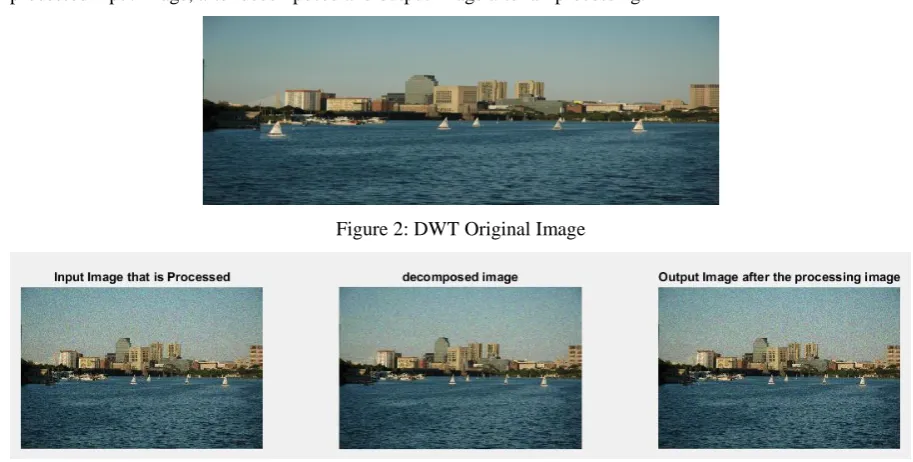
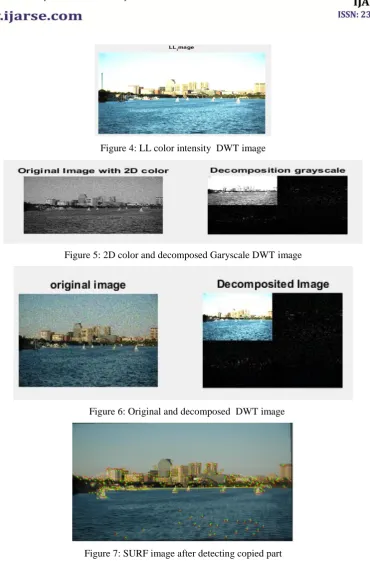
In Matlab, outcome of detecting of the copy pasted part after implementing is shown in below figures. Figure 2
to 6demonstrates the DWT results. Figure 2, shows the original image. Figure 3 below demonstrates the
processed input image, after decomposed and output image after all processing.
Figure 2: DWT Original Image
Figure 3: Processed and decomposed DWT Image
Figure 4 demonstrates the image with different color intensity of RGB which is decomposed further in LL of
level. Figure 5 demonstrates the original image with 2d color and that image after decomposition in gray scale
image. Figure 6, shows the original image with the Decompositon level which have been given as for
502 | P a g e
Figure 4: LL color intensity DWT imageFigure 5: 2D color and decomposed Garyscale DWT image
Figure 6: Original and decomposed DWT image
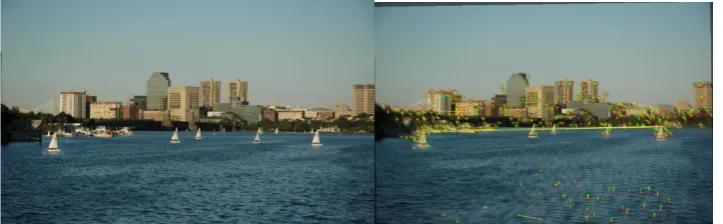
Figure 7: SURF image after detecting copied part
Figure 7, demonstratesthe SURF techniques in which copied part of images is detected from forged image.In
MATLAB, outcome of detecting of the copy pasted part after implementing is shown in figures. Figure 8a and
8b demonstrates the DWT-SURF results. Figure 8a demonstrates original image. Figure 8b, demonstrates the
503 | P a g e
Figure 8a: DWT-SURF Original Forged Image &Figure 8b: DWT-SURF after Detecting PCAFigure 9: PCA Forged Image with parameter detection
Figure 10a: PCA-SURF Detected Image&Figure 10b:PCA-SURF detecting copied part of Forged Image
Figure 9 demonstrates the performance parameters by utilizing PCA method. Figure10a demonstrates the
performance parameters by utilizing PCA-SURF method. Figure 10b demonstrates the detection part of copied
in forged image using PCA-SURF method. In above window four sections are demonstrated, initial picture is
the original image, second demonstrates the Forged image. Lower initial image demonstrates the actually
detected part from black and white image with 2D color. At last, copied part is demonstrated from the forged
image.
Table 1: Outcome compared by Elapsed Time (PCA-SURF and DWT-SURF)
504 | P a g e
2.2387 16.83904.6027 14.3953
3.4736 15.1943
3.2826 17.0797
V.CONCLUSIONS
Digital image forensics goes for approving the validness of pictures by recouping data about their history.
Duplicate glue imitation, where in a district from a picture is supplanted with another locality from a similar
picture (with conceivable changes). Since the replicated part originate from a similar picture, its essential
properties, for example, clamor, shading palette and surface, will be perfect with whatever remains of the
picture and in this manner will be more hard to recognize and identify these parts. Computerized picture crime
scene investigation is a fresh out of the box new research field which goes for approving the genuineness of
pictures by recuperating data about their history. In this all the above images having red part using PCA-SURF
technique is the detecting copied and pasted part from the original images. Same way DWT-SURF technique is
used from above images shows through lines what, from, where, which part has been copied. Both techniques
use their own way for detection but as comparing we can say that PCA-SURF is best detection technique as it
detect the object and also remove that part where as DWT-SURF does not remove the detected part but only
tells that from where the part has been copied. From Table1, it is clarified that PCA-SURF is best as it take half
or less time compared to DWT-SURF and results in more clarity of detecting of copied object.The key issues
which inquire about found in the writing can be classified into the characteristic, phony recognition, stream
mapping, and source distinguishing proof. In this manner, the inventiveness and realness of pictures or
information uses much of the time as ending up in testing issue. Analysts have related the common issues to the
progress in PC designs, movement, interactive media in the relationship of high processing machines,
calculations, expands the many-sided quality of the issue.In response to this, researchers have begun developing
505 | P a g e
detecting imperceptible traces left by editing operations in digital multimedia content. In this dissertation, wepropose several new digital forensic techniques to detect evidence of editing in digital multimedia content. We
use DWT and PCA with SURF for forensic tasks such as identifying cut-and-paste forgeries from compressed
images. Additionally, we consider the problem of multimedia security from the forger’s point of view.
PCA-SURF is best compared to DWT-PCA-SURF in tme and Clarity of detecting objects.
REFERENCES
[1] Fridrich. J, “Detection of copy-move forgery in digital images”, Digital Forensic Research Workshop,
Cleveland, OH, 2003
[2] P. Kakar and N. Sudha “Exposing Post processed Copy-Paste Forgeries through Transform-Invariant
Features”, vol. 206, no. 1-3, pp. 178–184, 2011.
[3] Tushant A. Kohale, and P. R. Lakhe “ Detection of Post operated Copy Move Image Forgery by
Integrating Block Based and Feature Based Method”, International Journal of Advanced Research in
Computer Science and Software Engineering, Volume 4, Issue 1, January 2014
[4] Salma Amtullah, Ajay Koul “Passive Image Forensic Method to detect Copy Move Forgery in Digital
Images” IOSR Journal of Computer Engineering Volume 16, Issue 2, Ver. XII pp 96-104 March 2014
[5] Andrea Costanzo, Irene Amerini, Roberto Caldelli, “Forensic Analysis of SIFT Key point Removal and
Injection,” in IEEE Transactions On Information Forensics And Security, VOL. 9, NO. 9, September 2014.
[6] Amerini, F. Battisti, R. Caldelli, M. Carli and A. Costanzo, "Exploiting perceptual quality issues in
countering SIFT-based Forensic methods," 2014 IEEE International Conference on Acoustics, Speech and
Signal Processing (ICASSP), Florence, 2014, pp. 2664-2668.
[7] Mohammad Farukh Hashmi, Vijay Anand, Avinash G. Keskar “A Copy-move Image Forgery Detection
Based on Speeded Up Robust Feature Transform and Wavelet Transforms” 5th International Conference
on Computer and Communication Technology, 2014.
[8] R. C. Pandey, S. K. Singh, K. K. Shukla, R. Agrawal, "Fast and robust passive copy-move forgery
detection using SURF and SIFT image features," 9thInternational Conference on Industrial and Information
Systems (ICIIS), Gwalior, pp. 1-6. 2014.
[9] Takwa Chihaoui, Sami Bourouis, and Kamel Hamrouni, “Copy-Move Image Forgery Detection Based On
Sift Descriptors And Svd-Matching,” in 1st International Conference on Advanced Technologies for
Signal and Image Processing - ATSIP'2014, March 17-19, 2014, Sousse, Tunisia
[10]Rutuja Tendulkar and Manoj Sabnis “Copy-Move Image Forgery Detection Using Transform Domain”,
International Journal of Advanced Research in Computer Science and Software Engineering, Volume 5,
Issue 5, May 2015.
[11] Sushama Kishor Bhandare, Nitin Krishnarao Bhil, “Digital Image Forensic”, International Journal of