12 |
P a g e
SELECTION OF THE PARAMETERS OF POLYMER
MATRIX COMPOSITES FOR ENGINEERING
APPLICATIONS
Prof. G. S. Jagushte
1, Dr. S. N. Waghmare
2, Prof. A. R. Suware
31, 2, 3,
Assistant Professor, Mechanical Engineering Department,
Rajendra Mane College of Engineering & Technology, Ambav (Devrukh),
Ratnagiri, Maharashtra (India)
ABSTRACT
In composites, materials are combined in such a way as to enable us to make better use of their virtues while
minimising to some extent the effects of their deficiencies. The process of optimization can release a designer
from the constraints associated with the selection and manufacture of conventional materials. He can make use
of tougher and lighter materials, with properties that can be tailored to suit particular design requirements. And
because of the ease with which complex shapes can be manufactured. The evolution of composite materials has
given an opportunity to various designers to use new and better materials resulting in cost reduction, increase
in efficiency and better utilization of available resources. Composite materials are finding their applications in
aerospace industry, automobile sector, manufacturing industries etc. This paper deals with the strategy for the
PMC’s application and the specific reasons for selecting the particular material systems according to functions and applications. A brief review of FRP’s and selection of the material system is possible to create innovative
design.
Keywords
-
Fiber-reinforced polymer (FRP), Types of Fiber, Resins, Moulding Processes, Natural
Fibers
I.
INTRODUCTION
Fiber-reinforced polymer (FRP), also Fiber-reinforced plastic, is a composite material made of a polymer matrix
reinforced with fibers. The fibers are usually glass, carbon, or aramid, although other fibers such as paper or
wood or asbestos have been sometimes used. The polymer is usually an epoxy, vinyl ester or polyester
thermosetting plastic, and phenol formaldehyde resins are still in use. FRPs are commonly used in the aerospace,
automotive, marine, and construction industries.
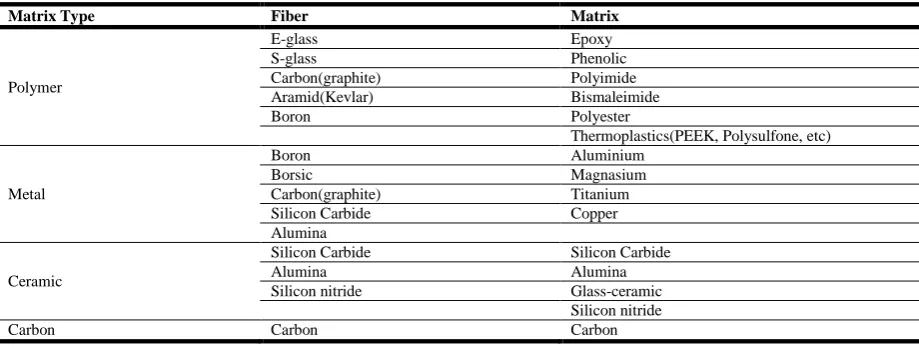
Fiber reinforced composites can be classified into broad categories according to matrix used:
A) Polymer matrix composite- It include thermosets (epoxy, polyamide, polyester) or thermoplastic
(Poly-Ether-Ether-Ketone, Poly sulfone) resins reinforced with glass, carbon (graphite), aramids (Kevlar), or Boron fibers.
13 |
P a g e
B) Metal matrix composites-It consists of metals or alloys (Aluminium, Magnesium, Titanium, Copper)
reinforced with boron, carbon(graphite), or ceramic fibers. Their maximum use of temperature is limited by the
softening or melting temperature of the metal matrix
C) Ceramic matrix composites- It consists of ceramics matrices (Silicon Carbide, Alumina, Glass-ceramic,
Silicon nitride) reinforced with ceramic fibers. They are best suited for very high temperature applications.
D) Carbon matrix composites-It consists of carbon or graphite matrix reinforced with graphite yarn or fabric.
They have unique properties of relatively high stiffness and moderate or low strength at high temperature
coupled with low thermal expansion and low density (Daniel and Ishai, 2013).
Table 1 Type of Fiber Composite Materials (Daniel And Ishai, 2013).
Matrix Type Fiber Matrix
Polymer
E-glass Epoxy
S-glass Phenolic
Carbon(graphite) Polyimide
Aramid(Kevlar) Bismaleimide
Boron Polyester
Thermoplastics(PEEK, Polysulfone, etc)
Metal
Boron Aluminium
Borsic Magnasium
Carbon(graphite) Titanium
Silicon Carbide Copper
Alumina
Ceramic
Silicon Carbide Silicon Carbide
Alumina Alumina
Silicon nitride Glass-ceramic
Silicon nitride
Carbon Carbon Carbon
The importance of materials in modern world can be realized from the fact that much of the research is being
done to apply new materials to different components. However it is natural for a design engineer to rely on
trusted and tested materials, but now the world is changing . The evolution of composite materials has given an
opportunity to various designers to use new and better materials resulting in cost reduction, increase in
efficiency and better utilization of available resources. (Mahajan and Aher, 2012)
The most commonly used composite class for load bearing structural applications is the continuous fiber
reinforced polymer matrix composite. The most popular material system has been the epoxy based resins
reinforced with carbon, glass, or aramid (Kevlar) fibers. FRP‘s are commonly used in the aerospace,
automotive, marine and construction industries. As the polymer matrix material is the most affected (rather than
the reinforcing fibers) by high temperature, it is the matrix material that has been the focus of attention in the
development of high temperature PMCs. The research and development efforts to produce polymer matrices
with higher service temperatures (up to 500⁰ C) have shown encouraging trends. (Fazlur et al., 2012)
The interest in natural fiber-reinforced polymer composite materials is rapidly growing both in terms of their
industrial applications and fundamental research. These new FR materials are called as bio-composites. They
are renewable, cheap, completely or partially recyclable, and biodegradable. Plants, such as flax, cotton, hemp,
jute, sisal, kenaf, pineapple, ramie, bamboo, banana, etc., as well as wood, used from time immemorial as a
source of lignocellulosic fibers, are more and more often applied as the reinforcement of composites. Their
14 |
P a g e
attractive ecological alternative to glass, carbon and man-made fibers used for the manufacturing of composites.(Chandramohan and Marimuthu, 2011).
II.
SELECTION
OF
THE
PARAMETERS
Following is the strategy for the selection of the different parameters for particular material system for
innovative designs of polymer matrix composites.
A) Criteria for selecting Polymer matrix composites-
The properties of the material such as tensile strength, density, corrosion resistance, stiffness, flexural strength
plays an important role in selecting the material for polymer matrix composite apart from cost and weight saving.
Because of low production volume, cost is not a main factor in aerospace sector as compared to automotive
industries having high volume production, cost plays a significant role. The matrix material used for FRP is
epoxy, polyester, and vinyl ester resins. Material systems comprising of epoxy based resins reinforced with
carbon fiber, glass fiber, Kevlar fibers are most popular. As per the properties required for the particular
application, proper material system should be selected. Marerial system comprising of phenolic resin and
asbestos fiber can be used for making acid resistant tanks. Aluminium can be replaced with graphite epoxy
material system in aircraft engineering due to reduced weight and cost with increased corrosion resistance.
(Fazlur et al., 2012)
B) Selection of right polymer matrix
The main purpose of a resin system is to transfer load from fiber to fiber, alongside this, the resin will also;
1) Protects sensitive fibers from abrasion.
2) Forms a protective barrier between fibers and the environment.
3) Can provide shear, tensile and compression properties to the Composite.
4) Can affect the thermo-mechanical performance of the composite.
Polymers are generally classified into two classes, thermoplastics and thermosetting. Thermoplastics currently
dominate as matrices for bio-fibers (forming bio-composites). The most commonly used thermoplastics for this
purpose are Polypropylene (PP), Polyethylene , High density Polyethylene (HDPE), Low density Polyethylene
(LDPE), and Poly –vinyl- Chloride (PVC). Thermoplastic resins are softened on heating from solid state before
processing without chemical reaction. Thermoplastics return to solid state (matrix) after processing. The primary
advantage of thermoplastic resin over thermoset resins is their high impact strength and fracture toughness.
Some of the other advantages of thermoplastic resins are:
1. Unlimited storage (shelf) life at room temperature.
2. Less time to fabricate.
3. High formability
4. Ease of repair by (plastic) welding, solvent bonding, etc.
5. Ease of handling.
6. Can be recycled.
7. Higher fracture toughness than thermosets such as epoxies.
15 |
P a g e
Main matrix resin thermosets are1) Polyester Resins
Polyester resins are very versatile. The curing mechanism involves the addition of chemicals (free radical
catalysts) that cause the resin molecules to lengthen and solidify. It has yellowish tint. It is UV sensitive and can
tend to degrade over time, and due to that it is coated to help preserve it. It is often used in the production of
surfboards and for marine applications. Required hardener is a MEKP, and is mixed at 14 drops per oz. MEKP
is composed of methyl ethyl ketone peroxide, a catalyst. When it is mixed with the resin, the resulting chemical
reaction causes heat to build up and cure or harden the resin. (Fazlur et al., 2012)
2) Urethane Methacrylate
Urethane methacrylate resins are new materials which have similar characteristics to polyester resins. They are
capable of taking a lot more fillers and therefore characteristics such as fire performance can be improved.
3) Vinyl Ester
Vinyl ester resins are typically more expensive than polyester systems; however they share the same curing
mechanisms. They bond well to Kevlar and carbon fiber reinforcements and have high strength as a cured neat
resin. Vinyl esters also have excellent chemical resistance. It tends to have a purplish to bluish to greenish tint. It
has lower viscosity than polyester resin, and is more transparent. It uses the same hardener as polyester resin and
the cost is approximately the same. (Fazlur et al., 2012)
4) Epoxy Resin:
Epoxy resins have played a vital role in polymer matrix materials because of their superior mechanical and
adhesive properties. They have been used widely as a matrix to hold the high-performance fiber reinforcement
together in composite materials, as well as structural adhesives. It is almost totally transparent when cured.
Epoxy Resins are thermosetting resins, which cure by internally generated heat. Epoxy systems consist of two
parts, resin and hardener. When mixed together, the resin and hardener activate, causing a chemical reaction,
which cures (hardens) the material.
Table 2 Charactristics of Resins (Fazlur Et Al., 2012).
5) Phenolic
Phenolic resins are the oldest synthetic polymers. The newer formulations were designed to cure at low
temperature and pressure through the use of acid-based catalysts. Phenolic resins have excellent fire resistance
and when they are induced to burn they will release only minimal quantities of smoke or toxic fumes. (Fazlur et
al., 2012)
Table 3 Properties of Thermoplastic Polymer (Fazlur Et Al., 2012; Begum and Islam, 2013; Ku Et Al)
Characteristics Polyester Resin Epoxy Resin
Flexural Strength Good Best
Tensile Strength Good Best
Elongation % Good Lowest
Water Absorption Good Lowest/Excellent
Hardness Good Best
Pot Life 4 – 7 Min. 14 – 20 Minutes
Working Time 20 – 30 Min. ½ - 6 Hours
Above Waterline Yes Yes
Below Waterline Yes Yes
Major Construction Yes Yes
General Repairs Yes Yes
16 |
P a g e
Property PP* LDPE* HDPE* PS*
Density(g/cm2) 0.90-0.92 0.91-0.925 0.94-0.96 1.04-1.06
Tensile strength (MPa) 26-41.4 40-78 14.5-38 25-69
Elastic modulus (GPa) 0.95-1.77 0.055-0.38 0.4-1.5 4-5
Elongation (%) 15-700 90-800 2.0-130 1-2.5
Water absorption 24hrs (%) 0.01-0.02 <0.015 0,01-0,2 0.03-0.10
Izod impact strength(J/M) 21.4-267 >854 26.7-1068 1.1
*PP=Polypropylene, LEDP=Low density polyethylene, HDPE=High density polyethylene, PS=Polystyrene.
Table 4 Properties of Thermosetting Polymer (Fazlur Et Al., 2012; Begum And Islam, 2013; Ku Et Al)
Property Nylon6 Polyester resin Vinyl ester resin Epoxy
Density(g/cm2) 1.12-1.14 1.2-1.5 1.2-1.4 1.1-1.4
Tensile strength (MPa) 43-79 40-90 69-83 35-100
Elastic modulus (GPa) 2.9 2-4.5 3.1-3.8 3-6
Elongation (%) 20-150 2 4-7 1-6
Water absorption 24hrs (%) 1.3-1.8 0.1-0.3 0.1 0.1-0.4
Izod impact strength(J/M) 42.7-160 0.15-3.2 2.5 0.3
c) Selection of right fibers
Technologically, the most important composites are those in which the dispersed phase is in the form of a fiber.
The Design of fiber-reinforced composites is based on the high strength is the ratio between strength and
density. Fiber length has a great effect on the mechanical characteristics of a material. The fibers are either long
or short. Long continuous fibers are easy to orient and process, while short fibers cannot be controlled fully for
proper orientation. Long fibers provide many advantages over short fibers. These include impact resistant, low
shrinkage, improved surface finish and dimensional stability. However short fiber provide low cost are easy to
work and have fast cycle time in fabrication process. The principal fibers in commercial use are various types of
glass, carbon, graphite, Kevlar. All these fibers can be reinforced into a matrix either in continuous lengths or in
discontinuous lengths. The matrix material may be a plastic or rubber polymer, metal or ceramic. Laminate is
obtained by stacking a number of thin layers of fibers and matrix consolidating them to the desired thickness.
Fiber orientation in each layer can be used to control and generate a wide range of physical and mechanical
properties for the composite laminate. (Vinod et al., 2016)
Carbon Fiber: By oxidizing and paralysing a highly drawn polyacrylonitrile (PAN), and subsequently
hot-stretching it, it is possible to convert it to a carbon filament. Clean-room methods of production can result in
substantial increases in the tensile strength of commercial materials. Prior to sale, fibers are usually
surface-treated by chemical or electrolytic oxidation methods in order to improve the quality of adhesion between the
fiber and the matrix in a composite. Depending on processing conditions, a wide range of mechanical properties
(controlled by structural variation) can be obtained, and fibers can therefore be chosen from this range so as to
give the desired composite properties. (Harris, 1999)
Glass fiber: Glass Fibers are essential reinforcement materials and recent developments uses as increased
17 |
P a g e
be imparted in the composites. These composites are suitable for orthopaedic uses and glass fiber compositescan be used as smart materials for self-healing properties.
Glass fiber composites have found applications in the automobile, industrial, marine engineering sectors as well
as others mainly due to the inexpensive and light weight properties of glass fiber. Glass fiber composites are
also developing as ideal fillers for orthopedic posts. (Pirzada, 2015)
Aramids / Kevlar fibers: Aromatic Ether Amide or Aramid fibers are organic, manmade fibers. They are
generally characterised as having relatively high strength, medium modulus and low density. Aramid fibers are
fire resistant and perform well at high temperatures. They are also resistant to organic solvents, fuels and
lubricants. Aramid are the toughest fibers with highest strength to weight ratio of all fibers. Kevlar belongs to a
group of highly crystalline aramide (aromatic amide) fibers that have the lowest specific gravity and the highest
tensile strength to weight ratio among the current reinforcing fibers. (Chandramohan and Marimuthu, 2011)
They are being used as reinforcement in many marine and aerospace applications.
The Use of natural fibers for the reinforcement in the composites has increasing attention both by the academic
sector and the industry. Natural fibers have many significant advantages over synthetic fibers. Currently, many
types of natural fibers have been investigated for use in plastics including flax, cotton, hemp, jute straw, wood,
kenaf, ramie, sisal, coir, etc. (Chandramohan and Marimuthu, 2011)
Table 5 Properties of Natural Fiber (Chandramohan And Marimuthu, 2011)
Fiber Type Density Kg/m3 Water absorption % Modulus of Elasticity E(GPa) Tensile Strength (MPa)
Sisal 800-700 56 15 268
Roselle 800-750 40-50 17 170-350
Banana 950-750 60 23 180-430
Palm 463 60-65 70 125-200
coconut 145-380 130-180 19-26 120-200
Reed 490 100 37 70-140
Sisal 800-700 56 15 268
D) Selection of fabrication process for frp
Several factors should be considered before selecting the manufacturing process for a particular part;
1) Materials - reinforcing, and matrix systems
2) Reinforcing architecture required
3) Complexity of part geometry
4) Number to be manufactured
5) How quickly they are to be manufactured
Different Fabrication processes are:
1) Hand lay up:
Process: Simplest of moulding processes. The reinforcement mat is simply laid into an open mould on which
resin is then applied with a brush and after which laminate is rolled on and allowed to cure.
Fibers: CSM (Chopped strand mat) is predominantly used. WR (Woven roving) is used is a higher volume of
fraction is required.
18 |
P a g e
2) Spray lay up:Process: Resin and chopped glass fiber are simultaneously sprayed on to an open mould. The laminate is rolled
and the allowed to cure
Fibers: Grades of glass fiber roving. They have good chop ability together with low static and fast wet through.
Resins: Usually only orthophthalic and isophthalic polyester resins are used.
3) Cold press moulding:
Process: A press moulding technique in which light duty tooling is used; hence low temperatures and pressures
are required. Reinforcement mat is placed on the lower mould and a mixed resin system is then poured over.
Two halves of the moulds are then closed.
Fibers: Glass fiber CFM (Continuous filament mat) and needle mat are common. WR and multi-axial
reinforcements can also be used. Resins: Polyester is most common.
4) Resin transfer moulding (RTM):
Process: Reinforcement material is placed in the mould which are then closed and clamped together. Resin is
then injected into the cavity under pressure. Cure takes place rapidly.
Fibers: Glass fiber CFM is commonly used. Resins: Polyester and epoxy are both ideal.
5) Autoclave / vacuum bag:
Process: Pre-impregnated fiber layers are applied in a mould and rolled. Rubber or plastic bag placed over the
layup and is removed by a vacuum pump. Mould is placed into and oven (or autoclave) which applied pressure
and heat to cure the resin. Fibers: Carbon, glass and aramid fibers and prepress of these. Resins: Epoxy resins
are used almost exclusively.
6) Hot press moulding:
Process: Mass production method. A hydraulic press is used to compress the tool which is heated to about 130 –
170oC before the thermoset mix and reinforcement is placed in the tool which is closed and cure is completed in
2-3 minutes. Fibers: Continuous strand mat of chopped strand mat with insoluble binder
Resins: Polyester or epoxy resins.
7) Pultrusion:
Process: Continuous reinforcement is pulled through a device,
which applies the resin. The wetted fiber is then pulled on to a heated steel die which is the shape of the part to
be produced. Typically the die is heated to around 150oC which cures the resin. The cured section is then pulled
of the die and cut to the correct length as required.
Fibers: Most common is glass although carbon and aramid can be used.
Resins: Most common is polyester, vinylester can be used for corrosion resistance, urethane methacrylate has
good fire, smoke and toxicity resistance. Epoxy gives higher performance and used primarily with carbon fiber.
Phenolics are also being developed for use due to their good fire resistance.
8) Filament winding:
Process: Consists of a rotating cylindrical mandrel on to which fibers impregnated with resin are wound. The
19 |
P a g e
Fibers: Glass fiber roving, carbon fiber and aramid as roving and yarns. Woven tapes of these fibers can also beused. Resins: Epoxy is the most commonly used.
Table 6 Suitability Of Frp Applications (Fazlur Et Al., 2012)
Parameters FRP Suitability Applications
Strength and Stiffness Very High Aerospace
High Marine, Construction, Bridges, Automotive
Weight Very High Aerospace, Marine, Construction, Bridges, Automotive
Corrosion Resistance Very High Marine, Boat and Construction industry
High Automotive Industry
Environmental Durability Very High Marine, Boat and Construction industry
High Automotive Industry
Ease of field construction High Building, Bridges, Pavements, Wind mill Blades
Ease of Repairs High Bridges, Underwater piles
Fire Very High Aerospace, Marine, , Automotive
Medium Bridge desks, Marine boats
Transportation Handling Very High Bridge desks, components and assembled FRP systems
Toughness and Impact High Bullet proof vests and walls
E) Applications of various Matrices
The most extensively used matrices are polymeric, which can be thermosets or thermoplastics. The other
matrices are considered for high temperature applications, with increasing use temperature from metallic to
ceramic and carbon matrices. Thermoset polymers are the most predominant types of matrix systems.
Thermoset resins undergo polymerization and cross-linking during curing with the aid of the hardening agent
and heating. They do not melt upon reheating, but they decompose thermally at high temperatures. The most
commonly used thermosets are unsaturated polyesters, epoxies, polyamides, and vinyl esters. Polyesters are
used in large quantities with glass fiber reinforcement for quick curing and room temperature curing systems in
a variety of commercial products like automotive, boats, ships, structural components, storage tanks etc.
Polyester-matrix composites have good mechanical properties and low cost, but they are sensitive to elevated
temperatures. Epoxies have better mechanical and thermal properties than polyesters. Depending on type of
hardening agent, epoxies can be cured at different temperatures, typically 1200C or 1750C. The lower
temperature-curing epoxies are used in components exposed to low or moderate temperature variations (e.g.
sporting goods). Those cured at higher temperature are used in high performance components exposed to high
temperature and moisture variations (e.g. aircraft structures). Vinyl esters, being closely related to both
polyesters and epoxies, combine both of the desirable properties of both, fast and simple curing with good
mechanical and thermal properties. Vinylester-matrix composites are preferred in corrosive industrial and
marine applications.
Most thermosets are limited by their relatively low temperature resistance. Thermoset Polyimides (PI) and
bismaleimides (BMI) can be used in higher temperature applications in excess of 3000C. However these
polymers have relatively lower strength and are more brittle at room temperature than epoxies. Thermoplastics
are fully polymerized polymers and can be altered physically by softening or melting them with heat.
20 |
P a g e
polysulfide, poly-ether-ether-ketone (PEEK), and thermoplastic polyamides. They are more compatible with hotforming and injection moulding process. Compared to epoxies and thermoset Polyimides, thermoplastics can be
processed more quickly and maximum use temperature up to 4000C. They exhibit higher fracture toughness and
are much less sensitive to moisture absorbtionbut processing is not easily controlled. Polypropylene is usually
reinforced with glass fibers in mass produced automotive and structural applications. Polyphenylene sulfide
(PPS) is resistant to chemicals and fires and has reasonable mechanical properties. It is reinforced with glass or
carbon fibers and used in some high performance applications. Poly-ether-ether-ketone (PEEK) has high
mechanical properties and is reinforced with glass or carbon fibers and used in some high performance
applications. Carbon fiber reinforced polymers are used for manufacturing automotive, marine and aerospace
parts.
III.
DISCUSSION AND CONCLUSION
The natural fiber-reinforced polymer composite is rapidly growing both in terms of their industrial applications
and fundamental research. They are renewable, cheap, completely or partially recyclable and biodegradable.
These composites are having low density and cost as well as satisfactory mechanical properties make them an
attractive due to easy availability and renewability of raw materials. Natural fibers have been proven alternative
to synthetic fiber in transportation such as automobiles, railway coaches and aerospace. Other applications
include military, building, packaging, consumer products and construction industries for ceiling paneling,
partition boards. (Bongarde and Shinde, 2014)
The FRPCs are developed primarily using synthetic fibers such as glass, carbon, aramid, Kevlar etc. Synthetic
FRPCs have unique advantages over monolithic polymer materials. Besides high strength and high stiffness,
these composites have long fatigue life and adaptability to the intended function of the structure. Additional
improvements can also be realized in the synthetic FRPCs with regarding corrosion resistance, wear resistance,
appearance, temperature-dependent behavior, environmental stability, thermal insulation and conductivity.
Specific properties of these materials (such as high-stiffness, high-strength, and low-density as compared to
metals) make the material highly desirable in primary and secondary structures of both military and civilian
aircraft. Kevlar or equivalent aramids have many applications in aerospace such as landing gear doors, aircraft
cabin and jet engines.
Although the Synthetic fiber reinforced polymer composites possess exclusive mechanical strength, they have
got some serious drawbacks such as high cost, high density (as compared to polymers), and poor recycling and
no biodegradable properties. For these reasons, over the last few years’ natural plant fibers reinforced polymer
composites are increasingly gaining attention as viable alternative to Synthetic fiber reinforced polymer
composites (Begum and Islam, 2013).
The Matrix of a composite works as a binder transferring the loads through the fiber network. It maintains the
fiber orientation and protects the fibers from environmental effects, redistributing the load to surrounding fibers
when and individual fiber breaks. Important considerations when selecting a resin candidate are the stiffness
(elastic modulus) and the yield and ultimate strength and toughness properties. The resin must be compatible
21 |
P a g e
Thermoset polymers dominate as matrices in structural composite applications for reasons of good mechanicaland thermal properties, good bonding to reinforcement, low cost, low viscosity and ease of processing.
Thermoplastics are raising interest for their advantages in areas such as: toughness, potential processing
advantages, recyclability and low volatile emissions; their high viscosity and poor bonding to reinforcement are
disadvantages. Elastomers generally have too low of an elastic modulus to serve as a matrix for rigid structural
composites. The most common thermoset resins used as composite matrices are unsaturated polyesters, epoxies,
and vinyl esters. These resins offer good process ability for liquid processing techniques. (Ku et al)
REFERENCES
[1] Isaac M. Daniel and Ori Ishai, Engineering Mechanics of Composite Materials, 2nd ed., Oxford University
Press, Reprinted 2013, ISBN-13:978-0-19-809838-6
[2] G.V. Mahajan, Prof. V. S. Aher, Composite Material: A Review over Current Development and
Automotive Application, International Journal of Scientific and Research Publications, Volume 2, Issue 11,
November 2012 1 ISSN 2250-3153
[3] D. Chandramohan, K. Marimuthu, A Review On Natural Fibers, Vol.8, Issue2, IJRRAS, pdf 194, August
2011
[4] Dr. J. Fazlur Rahman, Mohammed Yunus, T.M. Tajuddin Yezdani, Dr.A.Ramakrishna, Road Map for the
Selection of Characteristic Parameters of Polymer Matrix Composites for Engineering Applications,
International Journal of Emerging Technology and Advanced Engineering, Volume 2, Issue 7, July 2012,
63, ISSN 2250-2459
[5] Mr.Vinod G. Pujari, Prof. Abhijit L. Dandavate, A Review Paper On Design, Manufacturing And
Analysis Of composite Axle For Four Wheeler, International Journal of Advance Research in Science and
Engineering, Vol.5, Sp. Issue 2, March2016, ISSN 2319-8354
[6] Muqsit Minhaj Pirzada, Recent Trends and Modifications in Glass Fibre Composites – A Review,
International Journal of Materials and Chemistry 2015, 5(5): 117-122 DOI: 10.5923/j.ijmc.20150505.03
[7] Bryan Harris, Engineering Composite Materials, The Institute of Materials, London, 1999
[8] V. Nikil Murthy, Dr. B. Anjaneya Prasad, Dr. M. Ashok Kumar, Characterization of Carbon Fiber / Epoxy
Composites with Different Fiber Parametric Quantity, IJSRST, Volume 1, Issue 4, © 2015 | Print ISSN:
2395-6011 | Online ISSN: 2395-602X Themed Section : Engineering and Technology
[9] Sonalinkumar K. Patel, Review on Manufacturing Techniques of Fibreglass Reinforced Composites,
IJSRD - International Journal for Scientific Research & Development| Vol. 3, Issue 03, 2015 | ISSN
(online): 2321-0613
[10] ITW IIIinois Tool Works Inc, Plexus Guide To Bonding Plastics, Composites And Metals, IIIinois 60026
USA
[11] D. Verma, P.C. Gope, M.K. Maheshwari, R.K. Sharma, Bagasse Fiber Composites-A Review, J. Mater.
Environ. Sci. 3 (6) (2012) 1079-1092 Verma et al. ISSN : 2028-2508 CODEN: JMESCN 1079
[12] U.S.Bongarde, V.D.Shinde, Review on natural fiber reinforcement polymer composites, ISSN: 2319-5967
ISO 9001:2008 Certified International Journal of Engineering Science and Innovative Technology (IJESIT)
22 |
P a g e
[13] Begum K. and Islam M.A., Natural Fiber as a substitute to Synthetic Fiber in Polymer Composites: AReview, Research Journal of Engineering Sciences, ISSN 2278 – 9472,Vol. 2(3), 46-53, April (2013) Res.
J. Engineering Sci., International Science Congress Association.
[14] H Ku, H Wang, N.N. Pattarachaiyakoop and M. Trada, A review of the tensile properties of natural fibre
reinforced polymer composites Centre of excellence in Engineered fibre composites and faculty of
Engineering, University of Suthern Queensland.
[15] Taj, S., Munawar, M. A., & Khan, S. (2007). Natural fiber-reinforced polymer composites.
Proceedings-Pakistan Academy of Sciences, 44(2), 129.
BIOGRAPHICAL NOTES
Prof. Ganesh S Jagushte is working as Assistant Professor in Mechanical Engineering Department for last 04 years and he also worked as a workshop Superintendent for 15 years at Rajendra Mane College of Engg &
Technology. He received his M. E. in Mechanical Engineering with
specialisation in Production Engineering from Shivaji University. His research interest is in the field of Production engineering, Material Technology, Metrology and Quality Engineering.
Prof. Sachin N. Waghmare is working as Assistant Professor in Mechanical Engineering Department at Rajendra Mane College of Engg & Technology for last 12 years. He completed his Ph.D. in Production Engineering at
Veermata Jijabai Technological Institute (VJTI), from Mumbai
University. He received his M. Tech. in Mechanical Engineering with
specialisation in Machine Design at Veermata Jijabai Technological
Institute (VJTI), from Mumbai University. His research interest is in the field of Machine Design, Reliability, Quality, Industrial Engineering and Manufacturing Processes.